
Freedom & action
Axial Consciousness
An authorial exploration of acknowledgment and restoration through Maat and the Axial Age, retaining responsibility and the other person’s freedom not to forgive.
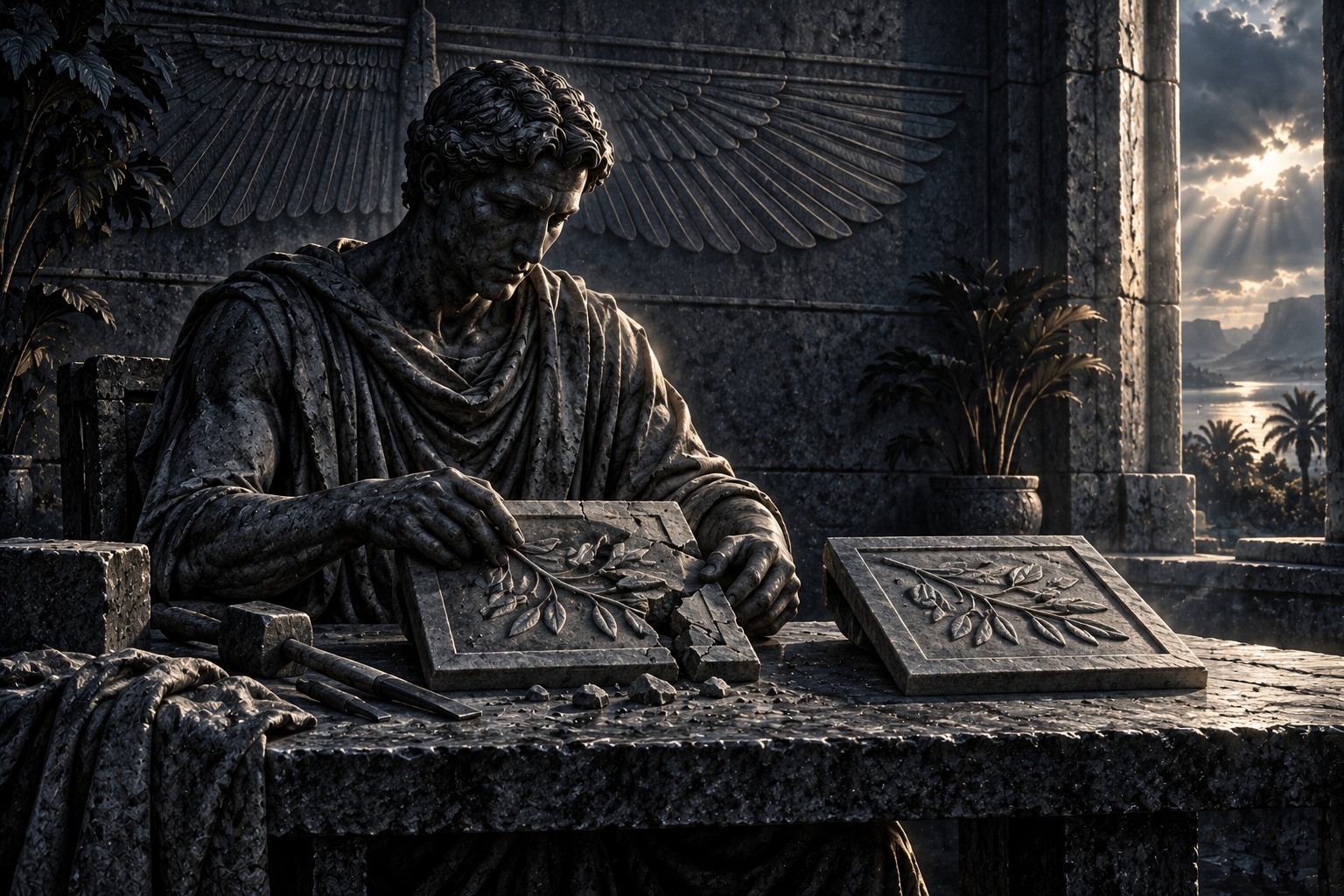
Why a person always retains the right to acknowledge a mistake
Andrey Zarinsh & Maria Evilkut · United Wisdom · Inner Transformation · Author series
Archival translator’s note. This full translation preserves the essay’s account of moral recovery and its historical argument. The asserted single Egyptian origin, uninterrupted transmission to later religions and psychology, priority claims, and specific quotations have not been independently verified here. They are the authors’ historical interpretation, not established findings of this package. A person’s capacity to acknowledge harm does not guarantee reconciliation, remove legal or ethical responsibility, or require a harmed person to forgive or resume contact. The stark either-or claim in section XVII is the archive’s rhetoric, not an exhaustive account of a person’s options or a clinical conclusion. Quotations are rendered from the Russian archive.
Why a person always retains the right to acknowledge a mistake. The concept arose in ancient Egypt approximately 4,500 years ago, took shape in Jaspers’s Axial Age, and became the foundation of all the great world religions. Direct intersections between six traditions—from Maat to teshuvah, metanoia, tawba, paravritti, gai guo, and catharsis—show that every person, regardless of the depth of their shadow and the weight of their past, retains the structural possibility of acknowledgment, understanding, a changed role, and restoration.
I. Where Hope Remains After the Shadow
When people first look honestly into their own shadow, they learn things about themselves they would rather not know. That greed exists in them. That they can lie with a persuasiveness they themselves find unpleasant. That they can cause pain and then find reasons why it was justified. That in certain circumstances they behaved in ways they would never have believed themselves capable of.
This knowledge does not go away. Such an encounter with oneself leaves an uncomfortable residue and raises a legitimate question: what do I do with this now? With what has already happened. With what I did and know about.
Psychology offers tools: analysis, integration, awareness of patterns. These work. But this work contains a layer that modern psychological language rarely approaches: the layer of possibility, the right to restoration. Not to forget, but to continue living while knowing.
This possibility was not invented in the twentieth century. It is built much more deeply into human consciousness and appears long before a culture has words to describe it. This article concerns how and when that possibility was first articulated, and why it remains in force for everyone who discovers it in their own life.
II. A Word Everyone Has Heard
There is a word that, over two thousand years of institutional history, has become so thickly overgrown with religious associations that it is scarcely used in ordinary speech.
Redemption. It is spoken either in the context of sacraments, as a mockery, or as a metaphor in the margins of a book.
This is a loss. Beneath its religious covering, the word has a human substance independent of denomination. Redemption is the process in which someone who acknowledges an action has the possibility of not remaining that action forever. Of not being equated with the worst thing they have done.
In this sense, redemption is not a punishment served in a prescribed amount. Nor is it a superficial forgiveness that fails to reach the heart of the matter. Nor self-deception in which someone convinces themselves that nothing serious happened. It has another structure: I acknowledge what I did, understand how it happened, change my way of acting, and restoration follows—inward, sometimes outward, sometimes both.
The idea that a person has this right is older than Christianity, Judaism, or Buddhism. It is older than all the great religions. We will try to trace the birth of that idea.
III. Where It Began—Not in Greece
Textbooks on the history of philosophy usually begin the story of human ethical consciousness with Socrates. Before Socrates: myth, ritual, tribal thinking. With Socrates come conscience, reason, and personal responsibility.
It is a convenient scheme. It is wrong by approximately two thousand years.
Socrates spoke in Athens in the fifth century BCE. Two thousand years before him, a culture already existed on the Nile in which a person appeared before a tribunal after death, answered personally for their actions, and faced a fate of the soul determined by what they had done in life. This culture wrote texts about it, painted scenes of the judgment on tomb walls, and set those scenes down on papyrus scrolls. These were not philosophical treatises. They were what millions of people believed and lived by for three millennia.
What Karl Jaspers in the twentieth century called the Axial Age—the astonishing simultaneous leap in thought in Israel, Iran, India, China, and Greece between the eighth and third centuries BCE (Axial Age, Wikipedia)—did not grow from nothing. Its roots extend another millennium and a half into Egyptian soil.
IV. The Pyramid Texts: The First Answer
Humanity’s oldest body of religious texts is carved on the walls of underground chambers in the pyramids at Saqqara. The Pyramid Texts date to approximately 2400–2300 BCE, the late Fifth and Sixth Dynasties of the Old Kingdom (Pyramid Texts, Wikipedia).
Most are magical spells: formulas intended to help a pharaoh pass from earthly to heavenly existence. They are instrumental, like a ladder, food in the afterlife, or protection from dangers along the way. At first glance, they are a mythological engineering manual.
Yet among these spells a theme already sounds that cannot be reduced to magic. The pharaoh will have to “give an answer.” The journey after death is not automatic. Between death and bliss lies a test, and the test has something to do with what a person did while alive.
This seed is still incomplete. In the Pyramid Texts, the judgment of the soul is described briefly and episodically, without the clarity that will come later. But the seed is already there. There is already an idea that a person’s fate after death depends on more than ritual and position. It depends on something within the person.
A few centuries later, this seed will grow into a complete picture.
V. Maat: Cosmic Order as an Ethical Structure
Before describing the judgment of the heart, we must describe the field in which that judgment is possible. In Egyptian culture, this field is called Maat.
Maat is among the world’s most difficult words to translate. She is called a goddess, depicted as a woman with a feather on her head, and honored with sanctuaries. But Maat is not a goddess in the usual polytheistic sense. Maat is the ethical order of the universe itself. Truth. Order. Justice. Harmony. The law by which rivers flow, the sun rises, and one human being should treat another (Maat, Wikipedia).
Maat is what stands against chaos. Crucially, she is one for everyone. The pharaoh rules according to Maat. The priest serves according to Maat. The farmer sows according to Maat. The poor person asks according to Maat. Every inhabitant of the Two Lands must live “according to Maat,” and this is neither a privilege nor a burden, but the very fabric of existence.
It is difficult to overstate this concept’s significance for the subsequent course of human history. Before Maat, ethical law in most archaic cultures was bound to status, tribe, or a particular god. Maat is the earliest known formulation of a single ethical structure applying equally to all people. From this soil would later grow the idea of one God, one law, and one humanity.
There is something else. Maat lives in the heart. This is her most important quality. The Egyptian heart, ib, was considered the seat of intellect, memory, and moral feeling, rather than emotion as we tend to think today (Book of Death, NCBI PMC). To live according to Maat means keeping the heart in balance with the law.
It is precisely the heart that will be placed on the scales after death.
VI. Psychostasia: Forty-Two Questions to Oneself
In the New Kingdom, approximately from the reigns of Hatshepsut and Thutmose III, around 1475 BCE, a scene takes its final form in Egyptian culture whose power has no equal in any earlier culture (Book of the Dead, Wikipedia).
This scene is chapter 125 of the Book of the Dead, known as the “weighing of the heart,” or psychostasia. It appears thousands of times on tomb walls and papyri, with astonishing precision of detail.
The deceased—not a pharaoh, but any Egyptian who could afford a scroll—stands before Osiris, lord of the afterlife. Beside him stand forty-two assessor gods, each responsible for one aspect of human life (Assessors of Maat, Wikipedia). Anubis leads the soul into the judgment hall.
Here something happens that changes the history of human ethical consciousness.
The deceased recites forty-two negative confessions, one before each judge. They sound like this:
“I have not done what displeases the gods. I have not killed. I have not ordered killing. I have not stolen. I have not taken property from people. I have not lied. I have not slandered. I have not oppressed the poor. I have not made anyone weep. I have not caused hunger. I have not taken milk from a child. I have not diverted water from its course. I have not extinguished a fire when it should have burned. I have not insulted the king. I have not despised the god of my city.”
And so on, through forty-two points. This is the first extensive ethical code known to humanity in which every statement concerns a particular person’s personal responsibility for a particular action. Not membership of a clan. Not performance of a ritual. An action.
After the confessions comes the psychostasia itself. The deceased’s heart is placed on one pan of the scales. On the other lies the feather of Maat, symbol of truth and cosmic order. If the heart is lighter than or equal to the feather, the way opens to the Fields of Iaru, the blessed land of the afterlife. If it is heavier, the monster Ammit, the Devourer, stands nearby, with a crocodile’s head, a lion’s body, and a hippopotamus’s hindquarters. Ammit eats the heart, and the soul disappears forever.
Pause over this scene and it is overwhelming. Everything the great religions and philosophies will later say is already there: a person answers for their actions with their own fate; ethical law is one and universal; death is a threshold rather than an end; a person’s inner essence, their heart, outweighs all outward merits.
There is something else. The very possibility of confessing forty-two points is already an act. The deceased has a voice. They are considered. They are heard. This is not a verdict pronounced from above without participation. It is a dialogue between the soul and cosmic law.
In this possibility lies the root of what we today call the right to acknowledgment.
VII. Six Cultures, One Breakthrough
More than a thousand years after the scene of psychostasia took shape, between the eighth and third centuries BCE, thinkers arise in six geographically separated human cultures. Independently, they formulate what Egypt had depicted but had not yet fully grasped in words.
In Israel, the prophets: Amos, Hosea, Isaiah, Jeremiah. They move religion’s center from ritual to personal responsibility. Amos utters a phrase that strikes at the entire temple economy of the age: “I hate, I reject your festivals… but let judgment flow like water, and righteousness like a mighty stream.” God does not need ceremonies. God needs an honest heart (The Axial Age Prophets, Human Journey). Conscience emerges as something speaking directly to a person, bypassing the priesthood.
In Iran, Zarathustra. He teaches people to see the world as a field of choice between Asha, truth, and Druj, falsehood. Every person makes this choice daily. Each is an ally or an enemy. No intermediaries (Axial Age, Britannica).
In India, the authors of the Upanishads, and a few centuries later, the Buddha. The Upanishads rediscover that the deepest Self, Atman, and the highest principle, Brahman, are one. The Buddha goes further: an action’s inner intention matters more than the action itself. The Eightfold Path—right intention, right speech, right action—for the first time places motive above form (Noble Eightfold Path, Wikipedia).
In China, Confucius. He speaks of ren, humanity as a daily practice requiring self-examination. He has a brief formula quoted for two and a half millennia: “Every day I examine myself in three respects.” The very fact that a person should examine themselves is a discovery on an axial scale (Tu Weiming, IEP). Alongside him, Laozi speaks of the Dao, naturalness, and transparency of the heart.
In Greece, Socrates. At the trial leading to his death, he speaks a phrase that becomes the formula of an entire age: “The unexamined life is not worth living” (The unexamined life, Wikipedia). According to Socrates, someone who does not reflect on themselves is not yet truly living. Plato and Aristotle will develop this into a system: inward logos, ethics as a practice of reason, and the soul as an object of care.
What is striking is that these cultures had no regular contact. Between Athens and Luoyang lie about ten thousand kilometers and impassable distances. Yet almost simultaneously the same structural shift occurs: a person discovers themselves as an individual moral unit.
VIII. What Happened on the Axis
Describing this period in 1949, Karl Jaspers called it “a respite of freedom, a deep breath bringing the clearest consciousness” (Axial Age, Wikipedia). This is a poetic image, but it rests on a concrete observation.
What happened in the Axial Age can be described collectively in several points. The individual becomes a moral unit: the person answers, rather than the clan. Conscience emerges as an inner voice. An idea appears of posthumous or metaphysical judgment of an individual’s actions. Conscious choice between good and evil becomes possible, and the categories themselves become objects of thought. A teacher-reformer appears who articulates this shift. Most importantly, thinking about thinking emerges: reflection as a new way of existing.
Jaspers described the shift directly: “Ideas, customs, and conditions previously accepted unconsciously were subjected to examination, questioned, and eliminated” (PMC, Cognitive styles). A person stopped living inside their worldview and began looking at it from outside.
The twentieth-century philosopher Eric Voegelin gave this shift another name: a “leap in being.” According to Voegelin, during the Axial Age a person first realizes that the source of cosmic order lies beyond the cosmos rather than within it. A vertical dimension of transcendence appears, along with an understanding that one’s own consciousness is part of reality’s structure, rather than a chance episode within it (VoegelinView, Voegelin’s Leap).
In Religion in Human Evolution (2011), the sociologist Robert Bellah formulated it more precisely: before the Axial Age, humanity lived in a mythic culture; in the Axial Age, theoretical culture is born—the ability to model the whole human universe and think of it as a whole (Bellah review, NDPR).
To sum it up in a phrase, the axis marked a transition from living in the world to living before the world. From embeddedness to dialogue. From rhythm to response.
IX. Three Consequences That Concern Me Personally
Axial consciousness has three simple consequences for everyone reading this article. They concerned my grandfather and my child. They concern me.
The first consequence: the action belongs to me personally. Not to a clan that might answer for me. Not to stars unfavorably aligned. Not to a fate leading me against my will. I did it; I am its author. This is a heavy statement, but everything else grows from it.
The second consequence: since the action is mine, I can acknowledge it. No external authority can prohibit or cancel that acknowledgment. Acknowledgment is an inward act, and in it I am entirely free. I can deny something all my life, but the possibility of acknowledgment remains open until my last breath.
The third consequence: since acknowledgment is possible, restoration is possible. Acknowledgment opens a path on which a person need not remain forever equated with the worst thing they have done. This path is neither easy nor instantaneous. But it exists.
This is the essence of the right to redemption growing from the axial structure of consciousness. Not an institution’s gift. Not mercy from above. A structural possibility built into the organization of human self-awareness.
X. One Principle, Six Languages
Each great tradition growing from the Axial Age has its own word for the process we call the right to restoration. These words are not identical, but they describe the same structure.
In Judaism, teshuvah, from the root shuv, “to return.” Not self-flagellation or punishment, but a return to one’s authentic essence. Hasidic thought takes the idea to a paradox: where the person who has returned stands, the Talmud says, a perfectly righteous person cannot stand. The word has a subtler layer too: in biblical Hebrew, the same root shuv also means “to give an answer”—return and response in a single root (Reuven Chaim Klein, Times of Israel).
In Christianity, metanoia, literally “a change of mind.” Not an apology or self-torment, but a fundamental shift in thinking. In early Christianity, Tertullian already objected to translating metanoia as “repentance,” considering it a gross distortion.
In Islam, tawba, turning toward God. The Quran says, “God loves those who turn back,” and turning here is the ability to face the source again and again, rather than a one-time ritual. The Semitic root of Arabic t-w-b is related to Hebrew shuv: in two neighboring languages, the two traditions expressed the same idea—to turn and return. This is no accidental coincidence, but a trace of a shared Semitic layer deeper than their divisions.
In Buddhism, purification through awareness and right intention. Here things differ: there is no God before whom one repents. But karma responds to a change of motive. And there is the Eightfold Path, on which a changed intention changes the whole trajectory. In the Lankavatara Sutra, a specific word appears: paravritti, Sanskrit parāvṛtti, “a turning of consciousness at its very root” (Lankavatara Sutra, Dharma Wheel). It is the same image of turning found in teshuvah and tawba, expressed in another language.
In Confucianism, daily self-examination and correction. Gai guo, Chinese gǎi guò, means “correct a mistake.” A teacher, Confucius says, is not someone who never errs but someone who hears a correction and makes a change. The Daoist tradition complements Confucianism with gai guo qian shan: “correct a mistake, move toward the good.”
In Greek philosophy, catharsis. In tragedy the word meant purification through experience; in Plato and the Stoics it acquires an ethical meaning—purifying the soul through clear self-understanding.
Six words. One outline: acknowledgment, awareness, change. A person’s right to return to themselves after having done what they did.
XI. Where the Traditions Meet
Step back from the words and look at the practices, and an even denser layer of correspondences appears. Not at the level of doctrine, but of what people actually do.
Annual moments of collective acknowledgment. In Judaism, Yom Kippur—the tenth day of Tishrei, when the whole community stops, fasts, and spends a day working with conscience. In Islam, during the Prophet Muhammad’s early Medinan period, there was a direct parallel: fasting on Ashura, the tenth of Muharram, which, according to preserved hadiths, was consciously related to the practice of Medina’s Jews (Day of Ashura & Yom Kippur, Al Jumuah). In Christianity, Lent: a forty-day path of self-examination before Easter. In Jainism, Paryushana: an annual eight-day period ending in the rite of samvatsari pratikramana, collective acknowledgment and a request for forgiveness from all living beings. Four traditions, four calendars, one structure: an annual point when a person must lay down what has accumulated.
Daily forms of speaking aloud. In Judaism, vidui, confession recited not only on Yom Kippur but daily in the nighttime prayer. In the Catholic tradition, the sacrament of confession; in monastic life, the desert fathers’ exagoreusis of thoughts. In Islam, istighfar, the formula “I ask God for forgiveness,” repeated many times throughout the day. In Jainism, pratikramana, performed morning and evening with a review of specific violations during the day (Pratikraman Sutra, Jainstudy). Four traditions arrived entirely independently at one conclusion: acknowledgment should not be rare. It is daily hygiene of consciousness.
A direct historical line. Researchers identify the connection between Egyptian “negative confession” and the Zoroastrian practice of patet, Middle Persian for acknowledgment of sins in prayer, as one of the oldest documented interreligious transmissions. Through Persian rule in late Egypt and later contact between Zoroastrianism and the Jewish tradition during the Babylonian captivity, this structure is reborn in Semitic culture, and through it in Christianity and Islam. When we say “I have sinned” today, a chain three and a half millennia long stands behind us.
A structural rule repeated everywhere. In the eighth-century Bodhicaryavatara, Shantideva formulates four powers necessary for genuine acknowledgment: the power of reliance—whom one relies on; regret—what exactly one regrets; resolve—what one promises oneself; and the antidote—what specifically one does differently (Bodhicaryavatara, Upaya). This scheme almost literally matches the conditions of genuine teshuvah described by Maimonides in the twelfth century: acknowledgment in words, regret, a decision not to return, and correction of the action. A Buddhist monk in Nalanda and a Jewish philosopher in Cairo, unaware of each other, described the same inner structure.
When practices in different cultures independently arrive at the same outline, it is not coincidence. It is a sign that they answer to one real organization of human consciousness.
XII. Six Mystics Speaking of One Thing
A subtler layer of correspondences exists too: in the voices of individual people thinking about acknowledgment at the limit of their understanding, rather than in institutions.
Rabbi Nachman of Breslov, in the late eighteenth century, left a formula that Breslov Hasidim repeat for support in their darkest moments: “There is no despair in the world at all.” Beneath this statement lay Nachman’s meaning: someone who has discovered an abyss within themselves should know that the discovery itself is already the beginning of return (Never Despair, Breslov).
Isaac of Nineveh, in the seventh-century East Syriac tradition: “God’s mercy is like a spring that never runs dry; even if a person pours dirt into it, the spring remains pure.” This does not justify the action. It asserts that the structure of restoration does not depend on the magnitude of the offense.
Abu Hamid al-Ghazali, at the turn of the eleventh and twelfth centuries, in The Revival of the Religious Sciences: tawba is light entering the heart, and once that light has entered even once, a person is no longer who they were. Ghazali insists that what matters is the quality of the last return, rather than the number of returns.
In the Bodhicaryavatara, Shantideva addresses a student overwhelmed by their own offenses with striking directness: “What I did in ignorance, I acknowledge. I stand before the buddhas with a trembling heart, bowing again and again.” This is not self-abasement. It is a calm account after which one can move on.
Zhu Xi, in the twelfth-century Neo-Confucian synthesis: daily self-examination, xue, is not a reproach turned inward. It is an act of respect for one’s own nature, good at its source and needing only to be cleared of accumulated layers.
Augustine, in the fourth- to fifth-century Confessions: “I became a great mystery to myself.” This phrase holds the essence of axial work. Neither “I am bad” nor “I am good,” but “I am an object of inquiry to myself.” Acknowledging a mistake begins with the willingness to become a task for oneself.
Six voices, six cultures, six centuries. One tone: acknowledgment is the opening of a path, rather than a sentence.
XIII. Genuine and Ritual Acknowledgment
Caution is needed here, because confusing two kinds of acknowledgment is one of the human mind’s oldest traps.
Ritual acknowledgment looks like acknowledgment but has a different structure. A person says the right words, sometimes sincerely experiencing something while saying them, yet the purpose is to obtain permission to continue living as before. An outward sign of guilt has been placed. The inward structure remains untouched.
The acknowledgment that sets axial consciousness to work is different. It has three subtle signs.
The person does not try to diminish what happened. They call things by their names. Not “a misunderstanding arose,” but “I lied.” Not “circumstances developed that way,” but “I chose what I chose.”
The person does not hurry forgiveness. They do not ask the person they harmed for immediate absolution. They understand that forgiveness, if it is possible at all, will arrive at the other person’s pace rather than their own.
Most importantly, the person looks at the mechanism that produced the action. Not “I am a bad person,” but “this operated in me, and it will operate again if I change nothing.”
Only the third sign distinguishes living acknowledgment from a dead one. Without it, a ritual remains that will repeat a month later with someone else.
XIV. Analysis Matters More Than Self-Punishment
Cultures inheriting the axial structure through religious institutions have a long-standing, heavy distortion: confusing acknowledgment with self-torment. A good person suffers for their sin. The more suffering, the more genuine the acknowledgment. The deeper the self-condemnation, the greater the moral worth.
This is a distortion. Maat’s psychostasia does not require self-flagellation. The forty-two negative confessions are neither lamentation nor humiliation. They are a calm account of what someone did and did not do: a list requiring clarity.
Self-punishment is convenient in exactly one way: it creates the illusion of work. A person suffers, so something must be happening, so they must not be evading responsibility. In fact, suffering often becomes a way to avoid real responsibility. While I strike my own cheek, I need not work out which mechanism operated in me. While I accuse myself, I need not change anything.
Analysis works differently. It asks: what in me produced this? What habit of thought? What unresolved hurt? What fear? What childhood decision still operating in my adult life? These questions are difficult, but concrete. They can be answered, and the answers can become the basis for changing something concrete.
A gulf separates striking oneself from looking into oneself.
XV. A Change of Role
The most common mistake after serious acknowledgment is a vow: “I will never do that again.” However sincerely spoken, such a vow fails in the overwhelming majority of cases—not because the person is bad, but because it is built on negation. It asks the future not to resemble the past without understanding exactly how the past became what it was.
What works is organized differently. It is a change of role: a concrete way of acting in concrete recurring situations.
If someone discovers that they lied out of fear of rejection, changing roles means deciding to act differently in the next situation that activates the same fear, rather than vowing “never to lie.” Perhaps pause. Say, “I need time to think.” Tell the truth even when it is disadvantageous. Once. Then again. Each such episode rebuilds the mechanism.
If someone discovers that they hurt a loved one because of an unrecognized grievance, changing roles means developing the ability to notice that hurt as it arises and speak about it before it turns into action, rather than vowing “not to take offense.”
A change of role is always concrete, always concerns one situation at a time, and is always measurable. That is what distinguishes it from a vow.
XVI. The Price of Restoration
The right to redemption does not mean restoration comes free. It has a price, and the price is real.
The first price is an encounter with oneself. A person must spend a considerable amount of time with themselves, examining what they did without turning away or anesthetizing it. This hurts, especially at first.
The second price is sometimes the need to encounter those who were harmed. This is not always possible: sometimes a person has died, sometimes contact has been permanently severed, and sometimes the meeting itself would cause more pain than benefit. But if a meeting is possible and appropriate, it must be lived through. Not to obtain the harmed person’s permission to go on living, but so that acknowledgment does not remain only in one’s head.
The third price is abandoning habitual self-defense. A person has grown used to explaining to themselves why they are not at fault. This mechanism has worked for years. Giving it up feels like losing part of one’s identity, and at first like vulnerability.
The fourth price is irreversibility. The right to restoration does not cancel what happened. What was done remains done. Restoration does not erase the past; it changes a person’s relationship with it.
These prices are real and should be known in advance. Without understanding them, people approach acknowledgment expecting immediate relief and often retreat when relief fails to arrive.
XVII. When the Shadow Has Gone Deep
This is the most important section and the conversation’s most delicate point.
There is one kind of reader for whom this article was largely written: someone whose past contains something they consider unforgivable. Not a small mistake or awkwardness, but a serious failure in which they caused physical, psychological, or material harm and still live with that burden, not knowing what to do with it.
Such people usually receive one of two responses. The first is accusatory: you got what you deserved; live with it. The second is reassuring: you are not guilty; circumstances led you; do not judge yourself harshly.
Neither response helps. The first fixes a person in the role of offender forever. The second deprives them of a chance at real restoration, because restoration without acknowledgment of the fact is impossible.
Axial consciousness offers a third path. It does not say “you are not guilty.” It says: “You did what you did, and there is no escaping that. But your right to face it, acknowledge it, and change yourself remains.” The depth of the action does not cancel that right.
This thought may seem too lenient toward serious failures. It is not leniency. It is a structural principle. If a person who has done something grave is deprived of the right to restoration, only two options remain: continue living unchanged, or destroy themselves. Both options only increase the amount of harm in the world.
The right to redemption is neither an indulgence nor an amnesty. It is a structural possibility by which someone willing to face their worst can stop repeating it. When Maat places the heart on the scales, she does not require it to be perfect. She requires it not to be heavier than the feather of truth. That is, the person arriving for judgment must be able to tell the truth about themselves. This is the condition.
One more thing: the right to restoration does not cancel responsibility toward those who were harmed. These are two different kinds of work. Restoration before oneself can begin immediately. Restoration before another person can happen only at their pace and with their readiness. Sometimes it never happens at all, and that too must be lived with.
XVIII. What Remains of Egypt Within Us
Four thousand years lie between the forty-two negative confessions on a Book of the Dead scroll and today’s inward voice that stops the hand of someone about to do something they will later feel ashamed of.
This line has never been broken.
From Maat to the Ten Commandments, in which researchers have long seen echoes of Egyptian ethics (Assessors of Maat, Wikipedia). From the Ten Commandments to Israel’s prophets, who turned outward law into an inward voice. From the prophets to Jesus, who moved the center of religious life into the heart. From Jesus to Augustine’s Confessions, the first detailed autobiography of the inner person in European culture. From Augustine to the Reformation, in which conscience stood alongside authority. From the Reformation to Kant and his categorical imperative, and Dostoevsky with his underground man. From them to the twentieth century, with psychoanalysis, existentialism, and the personal ethics practiced—or at least experienced—today by anyone seriously asking, “What did I do, and who am I after it?”
All these are descendants of one original discovery made in the Nile Valley almost five millennia ago. All of it works within each of us, even when we do not know the names Maat, Amos, Buddha, Confucius, or Socrates.
XIX. A Final Orientation
Axial consciousness is not an exhibit in a museum of intellectual history. It is a structure activated whenever someone, alone with themselves, honestly says, “Yes, I did that.” When this phrase is spoken without qualifications, blurring, or shifting blame, four thousand years of humanity’s work on itself gather into one point, and that point is inside the speaker.
No institution, community, or external authority grants or removes this right. It is built into the very organization of human self-awareness. The shadow, whatever it may be, does not annul it. The gravity of the offense does not annul it. Age, language, culture, denomination, philosophy, era—none of these annuls it. The right to acknowledge a mistake and the right to restoration remain open as long as a person is alive.
This is the central inheritance left by those who, five millennia ago, first wrote on the walls of the Saqqara pyramids that a person would have to answer.
They gave us more than the duty to answer. They gave us the right to be heard.
United Wisdom — a series of in-depth author essays on inner transformation.
One source—many languages.
References Inherited from the Archive
These links accompanied the archived original and have not been newly verified.
- PDF-L001 — source PDF page 4.
- PDF-L002 — source PDF page 4.
- PDF-L003 — source PDF page 5.
- PDF-L004 — source PDF page 5.
- PDF-L005 — source PDF page 5.
- PDF-L006 — source PDF page 5.
- PDF-L007 — source PDF page 7.
- PDF-L008 — source PDF page 7.
- PDF-L009 — source PDF page 7.
- PDF-L010 — source PDF page 7.
- PDF-L011 — source PDF page 7.
- PDF-L012 — source PDF page 8.
- PDF-L013 — source PDF page 8.
- PDF-L014 — source PDF page 8.
- PDF-L015 — source PDF page 10.
- PDF-L016 — source PDF page 10.
- PDF-L017 — source PDF page 11.
- PDF-L018 — source PDF page 11.
- PDF-L019 — source PDF page 12.
- PDF-L020 — source PDF page 12.
Keep what resonates with you.