
Freedom & action
The Master Who Turned Out to Be a Servant
An authorial essay on the cost of power, service, ego as navigation, and moving from possession toward participation.
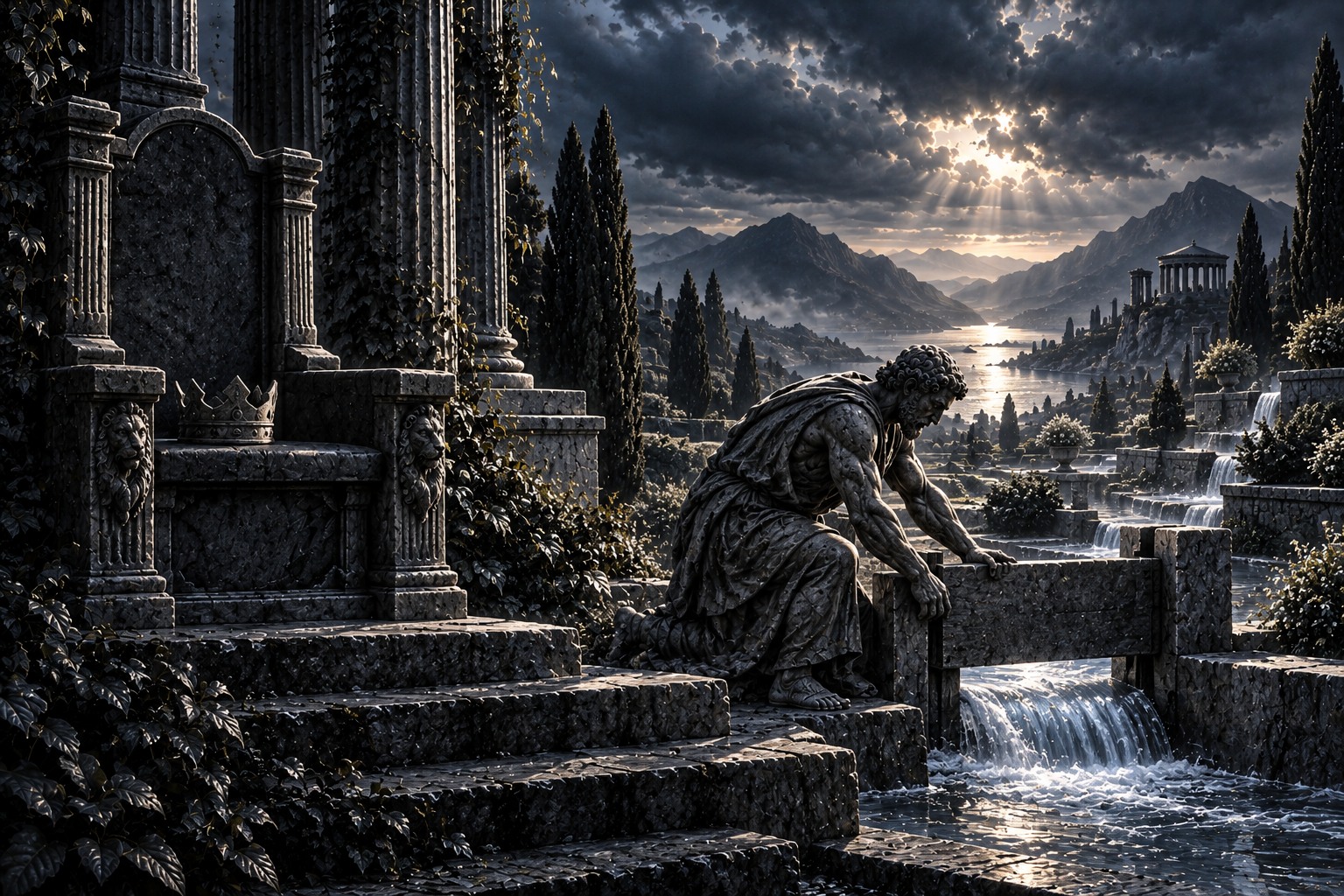
From the Master who holds the world for himself to the Conduit who holds himself for the world
“The more power you allow to pass through you, the greater the volume entrusted to you.”
Andrey Zarinsh & Maria Evilkut
United Wisdom · Inner Transformation · Philosophical Schools · 2026
Archival editor's note. This full translation preserves the supplied essay and its spiritual vocabulary. Its equation of ego, thermodynamic systems, and moral or spiritual outcomes is an authorial analogy, not a demonstrated physical law of people. The source also uses “closed” and “isolated” systems interchangeably; its thermodynamic explanation has not been scientifically reverified here. Claims about energies, entities, multidimensional space, inevitable collapse, and shared truth across traditions remain worldview statements. “Service” must not be interpreted as surrendering consent, boundaries, or safety. The appendix/removal image describes the source's metaphor and does not justify excluding or harming people. Historical, clinical, and source verification were not performed anew.
What this article is about
There is a temptation that looks like strength but turns out to be a cage. A person gains access to energy — money, influence, another's will, subtle and dense practices — and the first thing their ego does is say: “I am special.” With that word begins a long descent that the person walking it takes for an ascent.
This article examines one transition: from the figure of the Master, who holds the world for himself, to the Conduit, who holds himself for the world. I read this transition in Indian, Buddhist, Daoist, Christian, Sufi, and Kabbalistic traditions, and in Stoic philosophy; thermodynamics supplies a metaphor for it. This comparison turns on one observation: the ego, understood as the principle of separation, is the human being's chief limitation. Not a sin, weakness, or enemy, but precisely a limitation. A wall mistaken for the self.
I. The trap of being exceptional
Power arrives, and the ego immediately claims it. “If I can do this, I must be chosen.” Everything that follows develops quickly.
Dark, dense, manipulative energies are especially seductive to the ego because they provide immediate, tangible results. Suppress another's will. Take a resource. Take revenge. Obtain it here and now. This creates a sense of total control — and it is the sensation, rather than control itself, that becomes the drug.
The trap lies in the ego's own mechanics. It works only through separation: “I” against “everything else.” The louder a person proclaims their specialness, the thicker the wall between them and what they draw upon. In the Indian tradition this has a precise name: ahamkara, literally “I-maker.” It is the psychic function producing the feeling “I am a separate being standing against others.” The Encyclopaedia Britannica describes ahamkara as the stage at which consciousness mistakenly takes individuality for its essence.[1] Vedic thought regards it as the root of avidya, the ignorance from which suffering grows.
The magician who inflates himself ultimately becomes hostage to his own battery. He is tied to the source he chose, to the entities with which he made a pact, and to the very image of being chosen, without which he no longer knows who he is. The power that promised freedom has become a leash.
II. The Master's paradox
People of power often laugh at the word “service.” They hear slavery, weakness, religious submission. “We are masters of our fate and of other people's wills” sounds proud. A systemic error hides in that pride, visible as soon as we follow the role of Master through to its conclusion.
Power over a system cannot be maintained without sustaining its order. As soon as you declare yourself its manager, you assume responsibility for the stability of what you manage. From there, the fork is simple.
Rule for your whim, and the system falls into chaos and buries you in its debris. Rule so that the system lives, and you give it all your time and resources. An effective Master discovers that he is the busiest worker in his own enterprise. He no longer belongs to himself. The crown has turned out to be a yoke.
The Stoics saw this two thousand years ago. Seneca wrote that nobody lives happily by making everything a matter of personal advantage: you must live for another if you wish to live for yourself.[2] Marcus Aurelius reminded himself each morning that he was part of a whole and that outside this whole his good did not exist.[3] The Master who maintains a system only for himself violates its nature and therefore continually fights what he owns.
III. The ego as a closed system
Here physics offers philosophy an image of openness and closure.
The second law of thermodynamics states that disorder in an isolated system can only increase. A closed system that exchanges neither matter nor energy with the world is doomed to slide toward equilibrium — and equilibrium in thermodynamics means not peace but heat death, an even gray chaos in which nothing happens anymore.
Living things work differently. In What Is Life? (1944), Erwin Schrödinger observed that an organism maintains its order by feeding on what he called negative entropy from its environment.[4] A cell remains a cell only because a flow passes through it.
Ilya Prigogine developed this thought into a rigorous theory and received the Nobel Prize for it: far from equilibrium, open systems can spontaneously generate order; he called them dissipative structures.[5] Order arises not despite the flow but because of it. Stop the flow and the structure falls apart.
In this analogy, the ego closed in upon itself is a closed system. It accumulates, holds, fences itself off — and thereby signs its own sentence. Accumulation without exchange becomes an image of inner decay. Someone who turns themselves into a reservoir begins to rot from within, and no quantity of power poured in will stop it. The Conduit, by contrast, is an open system. Something flows through, and while it flows, the Conduit remains alive and complex.
IV. The left hand and the right
Occult tradition distinguishes the Left-Hand Path from the Right-Hand Path. Precision matters here, because cheap mythology has accumulated around these words.
This is not “evil magic versus good magic.” In Indian Tantra, vamachara, left hand, and dakshinachara, right hand, are two technically different ways toward the same goal, liberation. The right works through abstaining from objects; the left through their transgressive inclusion, deliberately breaking taboos to burn away duality.[6] Both aim at dissolving the same ahamkara.
Western occultism drew the boundary on another basis. The Right-Hand Path leads to the dissolution of the “I” in the Source — a current containing Christian mysticism, Sufism, and Vedanta. The Left-Hand Path aims at self-deification, the apotheosis of the separate “I”: “You are a god by nature; strengthen yourself to the limit.” And here is the crux.
In this sense, the left hand is a metaphysics of consumption. Its direction is inward, toward compression and appropriation. “The entire world is for me.” Its logic is flawless until it reaches the ego's capacity. That capacity is finite. When incoming power exceeds what a separate “I” can contain and process, it begins to burn the vessel into which it is poured. Separation carried to an absolute isolates the magician so thoroughly that he is left alone with his power, as with a fire in a locked room.
V. Becoming a conduit as the highest skill
The right hand chooses another direction: outward, toward expansion. “I am for the world because the world is me.”
Service here has nothing to do with being a victim. It is the position of a Conduit. The more power a person lets pass through them for the movement and growth of others, the greater the volume entrusted to them. Not as a reward for virtue, but through the same physics of open systems: the channel widens under the flow passing through it.
Zen left us an unforgettable image. Kakuan Shiren's Ten Oxherding Pictures depict the entire path of awakening. The eighth picture is an empty circle, the disappearance of everything, and many traditions would have stopped there. But Kakuan drew a ninth and a tenth. In the tenth, the awakened person returns to the marketplace with giving hands, entering the town with open palms.[7] The arhat withdraws into peace; the bodhisattva returns to the noise. Mahayana built its entire ideal upon this: the bodhisattva's vow is not to enter final liberation until everyone is liberated. The highest point of the path turned out not to be leaving the world, but returning to it.
The Daoist sage does the same, quietly. “The sage does not accumulate,” says Chapter 81 of the Dao De Jing. “The more he gives to others, the more he has.”[8] Power is pictured as water: the softest overcomes the hard because it does not fight and takes the low place everyone despises. This is the direct opposite of the Master's logic.
VI. The same turn in seven traditions
When this reversal appears in one school, we can attribute it to that school's particular mythology. When it repeats almost everywhere, we begin to suspect that it concerns the structure of the human being rather than a doctrine.
Christianity calls it kenosis, self-emptying. Philippians says that Christ, being in the form of God, did not cling to equality with God, but emptied himself and took the form of a servant.[9] In Mark, the logic of power itself is reversed: whoever wishes to be great must become a servant, and whoever wishes to be first the slave of all.[10] Thomas Aquinas defines pride, superbia, not through villainy but through refusing to subordinate oneself to a higher order.[11] In other words, through precisely the same separation as ahamkara.
In Sufism the lower “I” is called nafs, and the path passes through fana, the fading of the ego in God, to baqa, abiding in God after that fading. The Encyclopaedia Iranica makes an important clarification: fana does not destroy the person but carries them through, removing the attributes of the lower self and returning the person to the world as an instrument of God's purpose.[12] Alongside it stands khidma, service, without which the Sufi path is not considered a path.
In Yehuda Ashlag's Kabbalah, the desire to “receive for oneself” produces what is called the bread of shame. The task is to transform it into “receiving in order to give”: the vessel must become a conduit rather than a reservoir.[13] In the act of creation itself, according to Lurianic Kabbalah, God's first movement was not expansion but tzimtzum, self-contraction: the Infinite voluntarily limiting itself to make room for another. Even supreme Power, in this picture, manifests through self-limitation rather than taking over space.
Seven traditions that knew little of one another described the same turn in different words. United Wisdom exists precisely to show that this is one source speaking many languages.
VII. What psychology knows about this
Jung translated the ancient intuition into twentieth-century language, making it testable in the consulting room.
For Jung, the ego is the center of consciousness, not the center of the psyche. He called the center of the entire psyche, including the unconscious, the Self. The condition he described as ego inflation occurs when the ego identifies with the Self and swells to its dimensions.[14] The result, in his own expression, is something like a nebulous superman: an inflated “I” that has mistaken itself for the center of the world. Do you recognize the Master from the second section?
Jung called the remedy individuation. Here is the subtlety that made this whole structure worth building: individuation does not destroy the ego. It places the ego in the service of the Self. The ego stops being a self-appointed king and becomes the representative of something larger within consciousness. The same turn from Master to Conduit, without religious vocabulary: a process of psychological maturation Jung observed in hundreds of people.
A century before Jung, Schopenhauer supplied its metaphysical framework. For him, reality is one, while its fragmentation into separate beings is an illusion produced by the principium individuationis, the principle of individuation through space and time. Suffering grows from this illusion of separateness. Liberation comes through compassion, which he defined literally as the immediate recognition of oneself in another, a breach through the wall between “I” and “not-I.”[15] He himself pointed out that this was the same thought as Buddhist anatta, not-self.
VIII. The ego is an organ, not an enemy
Here the pendulum needs to be stopped, or it will swing to the other extreme and the reader will decide that self-destruction is being demanded.
The ego is not to be destroyed. Trying to destroy it is another form of pride, merely turned inside out. Buddhist anatta does not mean “you do not exist.” In the Anattalakkhana Sutta, the Buddha does not say that the “I” does not exist; he says that none of a person's constituents is a permanent, independent, all-powerful self.[16] This is subtler and more important. The ego is an organ, like the liver or sight: an organ for navigation in the world of forms. Without it, we cannot act, speak, love, protect, or build.
The problem is not the ego's existence but its inflation, when the organ of navigation declares itself captain, navigator, ship, and ocean all at once. Advaita calls this adhyasa, superimposition: the figure of the doer is imposed upon the pure Witness, sakshi, and the person begins to believe they are that doer.
Maturity is therefore not the absence of ego but a proper relationship to it. An ego in its place serves. An ego that has occupied another's throne enslaves. Jung said the same: the goal is not to dissolve the ego but to return it to service.
IX. Action without appropriation
A practical question remains: how does a person act after relinquishing the role of Master without dissolving into inactivity?
The Bhagavad Gita offers the clearest answer. Krishna tells Arjuna: you have a right to action, but never to its fruits; do not regard yourself as the cause of results, and do not become attached to inaction.[17] This is nishkama karma, action without thirst for its fruits. Not renouncing the work, but renouncing its appropriation. The hand works with full strength without closing around the result.
This removes the false dilemma in which people of power often trap themselves: either I grab everything, or I do nothing and quietly become holy in a corner. The Conduit's way of acting refutes both extremes. The Conduit acts powerfully without appropriating, builds systems, leads people, carries responsibility, while not confusing the self with the crown temporarily worn. Daoists called this wu wei: action without violence against the nature of things, without imposition, without the extra effort through which the ego endlessly tries to prove it is in charge.
The Master acts and claims the credit. The Conduit acts and lets things pass through. From outside they may look identical: two people managing the same enterprise. Within, the difference is absolute: one burns out, the other flows.
X. Crisis or growing up
Andrey asked a precise question: is the transition from Master to Conduit always the result of a painful collapse of the ego, or can it be reached through the mind's conscious maturation?
The honest answer is that both paths are real, but they are not equal.
The path through crisis is the most common and the most costly. The ego does not surrender its throne voluntarily; it is usually knocked off by a blow it cannot deflect. Illness, loss, betrayal, failure at the summit, the moment when all accumulated power suddenly proves powerless. Mystics called it the dark night of the soul. It works because it destroys the illusion of control bluntly and visibly. Yet the price is high, and not everyone puts themselves back together.
The path of conscious maturation is slower and quieter. It rests on one capacity: noticing ego inflation before the bill arrives. Seeing the Master within just as he raises his head, rather than waiting for the system to collapse before noticing. This is the work of discrimination the Indian tradition called viveka, and Jung a slow alignment of ego and Self. It is not dramatic. It resembles daily hygiene more than illumination.
There is nevertheless a bridge between the paths. Even conscious maturation needs small deaths, voluntary and measured. Every time someone gives away a result they could have boasted about. Every time they yield in an argument where they could have forced their way. Every time they serve without witnesses. These are rehearsals for the great letting-go that would otherwise arrive as catastrophe. The wise person dies a little at a time and therefore does not die all at once.
XI. An appendix or an organ of a higher order
Let us reduce this to a simple image, because the conclusion deserves one.
Sooner or later, everyone who touches power faces a fork. Become an element of a higher order: serve the Whole, conduct more through yourself than you can contain, grow as a channel. Or remain an appendix: a separate organ that closed in on itself, stopped participating in the shared circulation, and must therefore be removed. The system tolerates autonomy as long as it does no harm. An appendix is removed not for revenge but for hygiene.
There is no escaping service. This is not morality or an appeal to be good. It is the structure of multidimensional space, as indifferent to our preferences as the second law of thermodynamics. An open system lives; a closed one dies. The Conduit grows; the Master burns out. We may call service weakness as often as we like; the law does not change.
XII. The wall you mistook for yourself
It remains to name the thing for which this entire article was written.
The ego is the human being's chief limitation. Not circumstances, other people, or lack of power, but the wall of separation once mistaken for one's essence and defended as life itself. Each tradition we have considered names it in its own way: ahamkara, nafs, superbia, inflation, principium individuationis, closed system. Different names for one wall.
Here is what someone who works with dense energies and prides themselves on autonomy especially needs to hear. The wall looks like armor but functions as a ceiling. It truly protects, and precisely for that reason does not let things through. The power that can be poured into a closed vessel is limited by the vessel's volume. The power that can pass through an open channel is limited only by how much you are prepared to pass onward.
The transition from Master to Conduit is therefore not a moral choice between selfishness and goodness. It removes the ceiling. A person takes down the wall mistaken for the self and discovers that beneath it all along was not a small self, but someone capable of letting incomparably more pass through. The ego does not die. It simply stops pretending it is everything.
That wall can be taken down by a blow from outside or quiet work within. But it will have to come down. Otherwise it will fall by itself, together with the person hiding behind it.
Andrey Zarinsh & Maria Evilkut
United Wisdom · One source — many languages
Sources and parallels
Where the correspondences come from
- Ahamkara, “I-maker,” Encyclopaedia Britannica. Reference.
- Seneca, Of a Happy Life, Chapter 24, Wikisource. Reference.
- Marcus Aurelius, Meditations, MIT Classics. Reference.
- E. Schrödinger, What Is Life? (1944), on negentropy. Reference.
- I. Prigogine, Nobel Lecture, 1977: dissipative structures. Reference.
- Vamachara / Dakshinachara: Tantra's left and right hands. Reference.
- Kuoan, Ten Oxherding Pictures, tenth picture: entering the marketplace. Reference.
- Dao De Jing, Chapter 81, J. Legge, Sacred Texts. Reference.
- Philippians 2:5–8: kenosis. Reference.
- Mark 10:43–45: servant of all. Reference.
- Thomas Aquinas, Summa Theologiae II–II, question 162: superbia. Reference.
- Fana and baqa in Sufism, Encyclopaedia Iranica. Reference.
- Yehuda Ashlag: the “bread of shame” and receiving in order to give. Reference.
- C. G. Jung, ego inflation: Collected Works, overview. Reference.
- A. Schopenhauer, principium individuationis and compassion. Reference.
- Anattalakkhana Sutta, SN 22.59, Access to Insight. Reference.
- Bhagavad Gita 2.47: nishkama karma. Reference.
The translations and interpretations of terms are the authors' own, in the spirit of United Wisdom's comparative approach.
Keep what resonates with you.