
Freedom & action
The Magician Archetype
Will and realizing ideas, self-efficacy and manipulation in an authorial comparison of psychology, traditions, and culture.
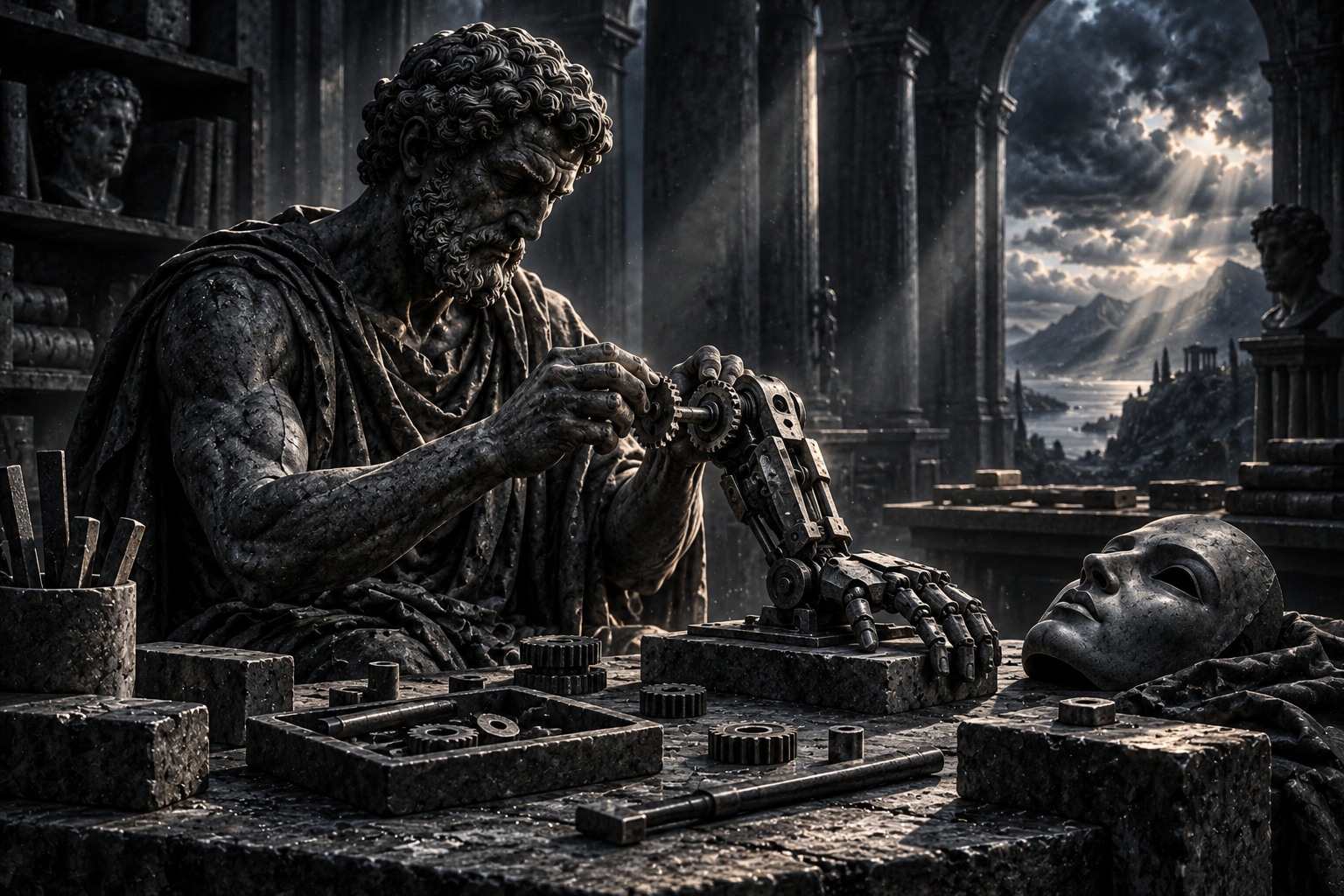
Will, manipulation, and making thoughts material. Why the same gift turns an idea into reality—and a person into an illusionist.
Andrey Zarinsh & Maria Evilkut · United Wisdom · Inner Transformation · Author series
Archival translator’s note. The essay’s archetypes and comparisons between traditions, philosophy, and psychology are preserved as authorial interpretations. Its scientific superlatives, historical quotations, and causal account of overcontrol and burnout have not been independently reverified here. “Materializing thoughts” describes the essay’s image of purposeful action; it does not establish supernatural causation, diagnose a reader, or promise success.
“God placed man at the center of the world and said to him: I have given you neither a fixed place nor a form of your own … so that you yourself, by your own will, might be the sculptor and maker of yourself.”
— Giovanni Pico della Mirandola, Oration on the Dignity of Man (1486), as quoted in the archive
What This Article Is About
Some people give themselves away by their voice. They speak confidently, persuasively, almost hypnotically, without a shadow of doubt, holding the attention of any audience. Their appearance serves a purpose: their clothes suggest calculation and status; first-class gadgets are extensions of their hands. This is the project leader who makes investors fall in love with an undeveloped idea in a five-minute pitch and persuades them to write a check; the person who has “everything under control” and a technological solution to every question.
If the previous article concerned the Fool, the generator of wild ideas and freedom, this one is about the person who brings those ideas into being: the Magician archetype. Carl Gustav Jung called it the “mana-personality,” Mana-Persönlichkeit: a figure credited with a special power to influence reality. Like every archetype, it has two sides. Its light side makes a person a bridge between “I thought of it” and “I did it”: focus, resource management, unwavering intention. Its dark side turns the gift into manipulation, charlatanism, and burnout from excessive control.
This article asks where the Magician creates reality and where he merely distorts it. We will travel from Hermes Trismegistus and the alchemists to Tony Stark and Steve Jobs’s presentations, from Schopenhauer to the “dark triad.” This is a self-contained text, but it continues United Wisdom’s conversation about the Fool archetype, Nietzsche’s will, and Stoic discipline.
I. Who Is the Magician? Will as the First Principle
Jung introduced the concept of the mana-personality in his essay The Relations Between the Ego and the Unconscious (CW 7). Mana is a word from Melanesian languages meaning “magical power around which everything revolves.” The Magician is the person who attracts this power. But Jung immediately warned of the trap: “Only insofar as I unconsciously identify myself with this figure can I imagine that I possess mana myself” (Jung, CW 7). Behind the archetype’s light always stands the risk of inflation: the ego swelling into an illusion of omnipotence. Jung offered two examples of attempts to seize this power: Goethe’s Faust and Nietzsche’s Zarathustra.
Will lies at the archetype’s foundation. In The World as Will and Representation (1818), Arthur Schopenhauer declared will, Wille, the very first principle of being: a “blind, ceaseless striving” at the heart of everything that exists (SEP, Schopenhauer). Nietzsche turned this dark force into a creative one: the will to power, Wille zur Macht, is an “irresistible creative will toward ever greater power,” a striving to overcome the resistance of the world and of oneself (LitCharts). The Magician is the archetype of focused will. His credo: “I want it to be this way—and I will make it happen.” He does not wait for a muse or signs; he believes in his mind and his abilities.
II. The Light Side: Focus and Resource Management
The Magician’s central strength is being a bridge between an idea and a result. While the Fool generates ideas, the Magician sits down and turns them into a working model. This capacity has a precise psychological name: self-efficacy. In 1977, Albert Bandura defined it as “belief in one’s ability to organize and carry out the actions needed to manage the future” and showed that it is one of the strongest predictors of real success: people with high self-efficacy perceive difficulties as tasks rather than threats (Bandura, 1977). Its main source, according to Bandura, is mastery experience: each problem solved strengthens belief in the next.
The second aspect is the synthesis of resources. A true Magician brings different things together with virtuosity: assembles and inspires a team, works out a budget, builds a strategy, appeals to people’s emotions. In alchemical symbolism, this is the joining of the elements—fire, earth, air, and water—in a single work. In Psychology and Alchemy (1944), Jung showed that the Great Work, magnum opus, is a metaphor of transformation: the alchemist makes the inward outwardly real, and to create “gold” must change himself (Jung, 1944).
The third aspect is unwavering intention and focus. Anders Ericsson demonstrated that mastery is produced not by the number of hours but by deliberate practice: structured effort at the limit of one’s abilities (Ericsson). In goal-setting theory, Edwin Locke and Gary Latham established that specific, difficult goals produce significantly better results than a vague “I’ll do my best” (Locke & Latham). The Magician does not scatter his will; he focuses it on a single point.
In business, the highest expression of this bright power became known as the “Reality Distortion Field.” Apple engineer Bud Tribble coined the term about Steve Jobs in 1981. Andy Hertzfeld described it as “the ability to convince himself and others to believe almost anything … to make you believe that the impossible was possible” (Reality Distortion Field). This is the Magician in his pure, bright form: someone who shifts the boundary of possibility through the power of persuasion.
III. The Dark Companion: The Great Illusionist
Yet the shadow waits for the Magician in precisely the place where he creates. The same power that persuades people to believe in the impossible can easily become manipulation.
The Magician sees human weaknesses exceptionally well—and in his shadow begins using people as pieces on a board. Psychology described this as the “dark triad”: narcissism, Machiavellianism, and psychopathy, brought together by Delroy Paulhus and Kevin Williams in 2002 (Dark Triad). Richard Christie and Florence Geis had described Machiavellianism—calculated manipulation and indifference to morality—as early as 1970. Only his triumph matters to the shadow Magician, not whether his methods are considerate of others. Charm becomes an instrument of exploitation.
The second trap is charlatanism: selling an illusion of value where no value exists. History provides models. Count Cagliostro, Giuseppe Balsamo (1743–1795), claimed to possess the philosopher’s stone and the elixir of life; Thomas Carlyle called him a “charlatan of charlatans” (Cagliostro). Franz Mesmer (1734–1815) built an entire theory of “animal magnetism”—until, in 1784, a royal commission including Benjamin Franklin and Antoine Lavoisier exposed it in one of history’s earliest blind experiments: the effect came not from magnetic “force” but from the patients’ imagination (Royal Commission, 1784). The shadow Magician sells thin air in beautiful wrapping, through aggressive marketing, psychological triggers, and a “reality distortion field” put to harmful use.
The third trap is excessive control. His ego inflated, the Magician slips into the belief that “if you want something done well, do it yourself.” Jung would call this inflation: the ego has appropriated mana and attempts to control every detail. The price is burnout. Christina Maslach, who created its principal measurement instrument, the MBI, in 1981, described three faces of it: emotional exhaustion, cynicism, and a diminished sense of personal efficacy (Maslach, burnout). The Magician trying to hold everything together breaks under mental overload—and his power turns against him.
IV. Echoes of Traditions: A Will That Creates Worlds
It is remarkable how different cultures, disagreeing about everything else, converged on the image of a person whose focused will changes reality.
Hermeticism took as its foundation the formula of the Emerald Tablet: “That which is below is like that which is above,” or “as above, so below.” The correspondence of inward and outward made the human being a co-creator (Tabula Smaragdina). The idea flared again in the Renaissance. In 1462, Cosimo de’ Medici instructed Marsilio Ficino to interrupt his translation of Plato and urgently translate the Corpus Hermeticum. In his Oration on the Dignity of Man (1486), Pico della Mirandola proclaimed that the human being is the only creature without a predetermined form, “the sculptor of himself.” In Occult Philosophy (1533), Agrippa called magic “the absolute perfection of philosophy”: knowledge of nature’s hidden connections (De occulta philosophia).
In India, the same idea sounds as tapas, the “heat” of ascetic discipline and concentration that creates worlds themselves in the Rigveda: “supernatural energy and willpower produced by the utmost concentration” (Tapas). Its working instrument is sankalpa, sacred intention, the resolve to focus the mind on a single goal. In Taoism, this is the inner alchemy of neidan: the body becomes a “cauldron” in which the three treasures—jing, qi, and shen—are refined (Neidan). In Shamanism (1951), Mircea Eliade described the oldest Magician: the shaman, a mediator between worlds who directs spiritual powers into the physical world for healing (Eliade).
Almost every tradition also left a warning: the very thing Jung called inflation. In the Yoga Sutras, Patanjali teaches that siddhis, extraordinary abilities arising from concentration, are merely “milestones and distractions,” not the goal. Attachment to them leads away from liberation (Siddhi). Power without humility becomes a trap for the Magician himself.
V. The Magician on Screen and in Brands
The archetype has not disappeared. It has dressed itself as an engineer and entrepreneur.
Tony Stark, Iron Man—the Marvel comic by Stan Lee and collaborators, 1963; Jon Favreau’s film starring Robert Downey Jr., 2008—is the exemplary modern Magician. A genius who creates an engineering marvel literally “in a cave, from scrap metal.” An enormous ego, absolute belief in technology, will, and intelligence—and the dark triad always standing behind him (Iron Man). Sherlock Holmes, from Arthur Conan Doyle’s A Study in Scarlet (1887), is a Magician of the mind: he subjects the chaos of facts to rigorous logic and forces reality to reveal hidden details. Doyle wrote to Holmes’s model, the physician Joseph Bell: “It is most certainly to you that I owe Sherlock Holmes … round the centre of deduction and inference and observation … I have tried to build up a man” (Conan Doyle).
The same archetype has long driven brands. In The Hero and the Outlaw (2001), Margaret Mark and Carol Pearson identified the Magician as one of twelve brand archetypes: its promise is transformation, turning a dream into reality, a “moment of wonder” (Mark & Pearson). The model is Steve Jobs and Apple. Jobs’s presentations were constructed as magic shows, with technology presented as a world-changing wonder: the Macintosh launch in 1984 with Ridley Scott’s legendary commercial; the unveiling of the iPhone on January 9, 2007; the slogan “Think Different” (1997). Behind it all stood that “reality distortion field.” Dyson, whose founder built 5,127 vacuum-cleaner prototypes before succeeding (Dyson), operates by the same logic, as does Tesla, betting on the feeling that its products are ahead of their time.
VI. A Lesson for the Reader: Activating the Inner Magician
If you are stuck in endless preparation, suffering from “eternal student syndrome”—essentially a stalled Fool—and afraid finally to launch a project, put yourself forward, or raise your fee, you need to awaken your inner Magician. The Magician begins not by searching for perfect conditions but with what already lies in front of him.
The “Inventory of the Table” practice: sit down and write on a sheet of paper which tools you have right now—experience, contacts, money, skills, reputation. Stop searching for one more course. The Magician begins to act with what is available, fine-tuning the system in the midst of the struggle. This is the transition from self-efficacy as belief to self-efficacy as action: every resource gathered is a brick in your “work.”
But remember the shadow. The Magician’s power remains alive only while it serves the work rather than feeding the ego. The Stoics drew a precise boundary here: will has power only over “what is up to us,” ta eph’ hēmin, and is powerless over the rest. The Magician who forgets this falls into inflation: the illusion of total control that leads to manipulation and burnout. We discussed the discipline of will that keeps power from disintegrating in detail in the United Wisdom articles on Stoicism and Nietzsche. The true Magician is not the one who subjugates everyone, but the one who focuses himself.
And yet the final word is in the Magician’s defense. Magic is not spells from old books. Real magic is the ability to take the chaos of your own thoughts, focus your will on one point, and make the material world change. A gulf lies between “I thought of it” and “I did it,” and the Magician alone builds a bridge across it. You are the architect of your own reality. The tools are already on the table. Pick them up and get to work.
Key Quotation
“The reality distortion field is the ability to convince himself and others to believe almost anything … to make you believe that the impossible was possible.”
— Andy Hertzfeld on Steve Jobs; term coined by Bud Tribble, 1981 (Reality Distortion Field), as quoted in the archive
Connections Between Traditions
- The Emerald Tablet, Hermeticism, “as above, so below” ↔ Pico della Mirandola, Renaissance, the person as “sculptor of himself”: correspondence between the inward and outward as the basis of co-creation.
- Tapas and sankalpa, India, heat-will and intention ↔ neidan, Taoism, the body-cauldron ↔ Bandura’s mastery experience: focused will as a force transforming reality.
- Bandura’s self-efficacy ↔ Nietzsche’s will to power ↔ “become who you are”: belief in one’s own capacity as the engine of becoming oneself.
- Siddhis as “distractions,” Patanjali ↔ inflation of the mana-personality, Jung ↔ the Stoic ta eph’ hēmin: the shared warning of all traditions against the illusion of omnipotence.
- The Fool, generator of ideas ↔ the Magician, the one who realizes them: two neighboring archetypes, the freedom of conception and the discipline of execution, each needing the other.
Sources Listed in the Archive
- Jung, C. G. Two Essays on Analytical Psychology (CW 7): mana-personality. IAAP / CW7.
- Jung, C. G. (1944). Psychology and Alchemy (CW 12).
- Mark, M. & Pearson, C. (2001). The Hero and the Outlaw. Brand archetypes; WorldCat.
- Tabula Smaragdina, the Emerald Tablet.
- Corpus Hermeticum, Ficino’s translation, 1462–1463.
- Pico della Mirandola, G. (1486). Oratio de hominis dignitate, Oration on the Dignity of Man.
- Agrippa, H. C. (1533). De occulta philosophia libri tres.
- Paracelsus (1493–1541).
- Eliade, M. (1951). Le Chamanisme, Shamanism: Archaic Techniques of Ecstasy.
- Tapas, Rigveda; McMaster thesis PDF.
- Sankalpa. Kripalu.
- Siddhi; Patanjali’s Yoga Sutras III.37, III.55.
- Neidan, inner alchemy.
- Schopenhauer, A. (1818). Die Welt als Wille und Vorstellung, The World as Will and Representation. SEP.
- Nietzsche, F. Will to Power; Ecce Homo (1888). LitCharts; Gutenberg.
- Bandura, A. (1977). Self-Efficacy. Psychological Review, 84, 191–215.
- Ericsson, K. A. Deliberate practice.
- Locke, E. & Latham, G. (1990). A Theory of Goal Setting and Task Performance.
- Reality Distortion Field, Bud Tribble, 1981.
- Paulhus, D. & Williams, K. (2002). The Dark Triad.
- Cagliostro (1743–1795). Alessandro Cagliostro.
- Mesmer / Royal Commission (1784). Animal magnetism; Royal Commission; PubMed.
- Maslach, C. & Jackson, S. (1981). Maslach Burnout Inventory. Occupational burnout.
- Iron Man, Marvel, 1963; film directed by Jon Favreau, 2008.
- Conan Doyle, A. A Study in Scarlet (1887).
- Apple / Steve Jobs: “Think Different” (1997).
- Dyson: 5,127 prototypes.
Tags
Magician archetype, mana-personality, will, intention, self-efficacy, deliberate practice, reality distortion field, dark triad, manipulation, charlatanism, burnout, overcontrol, Jung, alchemy, Hermeticism, Pico della Mirandola, tapas, sankalpa, neidan, Schopenhauer, Nietzsche, Tony Stark, Sherlock Holmes, Steve Jobs, United Wisdom.
About the Authors
Andrey Zarinsh (@andrey.zarinsh) and Maria Evilkut (@ilkutki) are the author duo behind United Wisdom. We bring together the precision of science and the depth of traditions to discuss inner transformation without esoteric simplifications: with names, dates, and verifiable sources.
Andrey Zarinsh & Maria Evilkut · United Wisdom · Laboratory of Integrated Wisdom.
References Inherited from the Archive
These links accompanied the archived original and have not been newly verified.
- PDF-L001 — source PDF page 2.
- PDF-L002 — source PDF page 3.
- PDF-L003 — source PDF page 3.
- PDF-L004 — source PDF page 3.
- PDF-L005 — source PDF page 3.
- PDF-L006 — source PDF page 3.
- PDF-L007 — source PDF page 3.
- PDF-L008 — source PDF page 3.
- PDF-L009 — source PDF page 4.
- PDF-L010 — source PDF page 4.
- PDF-L011 — source PDF page 4.
- PDF-L012 — source PDF page 4.
- PDF-L013 — source PDF page 4.
- PDF-L014 — source PDF page 5.
- PDF-L015 — source PDF page 5.
- PDF-L016 — source PDF page 5.
- PDF-L017 — source PDF page 5.
- PDF-L018 — source PDF page 5.
- PDF-L019 — source PDF page 5.
- PDF-L020 — source PDF page 5.
- PDF-L021 — source PDF page 5.
- PDF-L022 — source PDF page 6.
- PDF-L023 — source PDF page 6.
- PDF-L024 — source PDF page 6.
- PDF-L025 — source PDF page 7.
- PDF-L026 — source PDF page 7.
- PDF-L027 — source PDF page 8.
- PDF-L028 — source PDF page 8.
- PDF-L029 — source PDF page 8.
- PDF-L030 — source PDF page 8.
- PDF-L031 — source PDF page 8.
- PDF-L032 — source PDF page 8.
- PDF-L033 — source PDF page 8.
- PDF-L034 — source PDF page 8.
- PDF-L035 — source PDF page 8.
Keep what resonates with you.