
Freedom & action
Virtue, Duty and Consequences in One Situation
Virtue, duty and consequences in one venue decision: distinct grounds, a shared search for permissible action and responsibility for implementation.
Epigraph
states of character arise out of like activities.
Aristotle, Nicomachean Ethics II.1, W. D. Ross translation; a clause excerpt. The passage concerns the formation of character through action, not the infallibility of a habit.
What this article is about
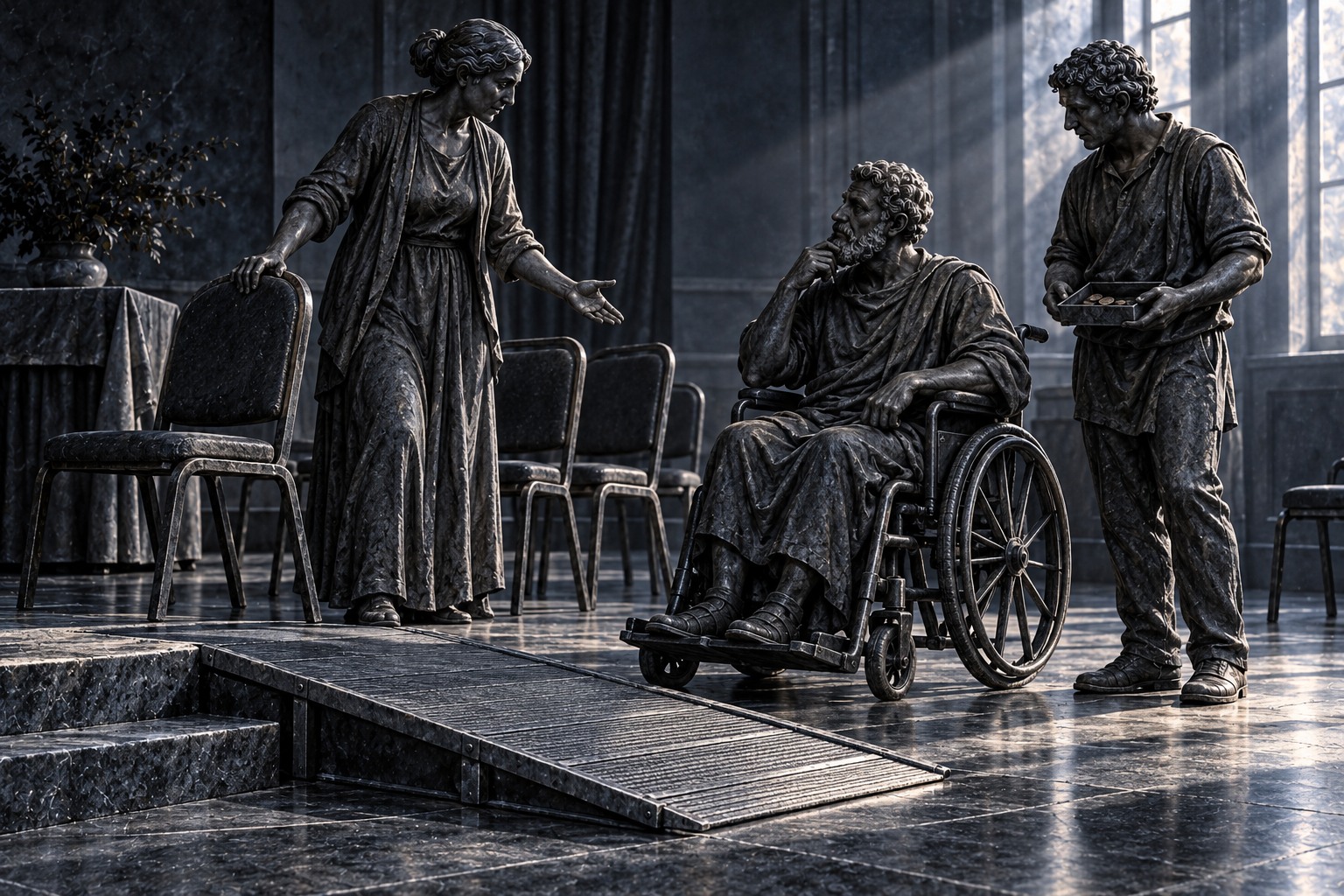
Nina is bringing friends together after several years apart. She has found an inexpensive room, sent the address and collected money for the booking. Then she discovers that the room is reached by stairs one participant cannot manage. Another venue is accessible but costs more. Someone proposes keeping the original plan because most people have already agreed. Someone else wants to change the venue immediately and divide the extra cost equally. Nina feels that any decision can be called right if she chooses a convenient explanation.
This is a hypothetical scene, not the authors' biography. It offers no answer on behalf of ethics as a whole. But it reveals how questions about character, obligation and consequences work differently. One asks what kind of person an action helps us become; another asks what we owe each other regardless of advantage; a third asks whom the outcome affects and how. These questions are useful when their differences do not become a market for excuses. We will follow the same situation along three paths, preserve their disagreements, and return to a specific decision whose adequacy cannot be guaranteed by naming a school.
I. Describe the action before judging it
While Nina tells herself that she must choose between care and keeping her word, the decision seems more tragic than it already is. That description hides unknowns. Is the booking payment final? Can the money be refunded? Who knew about the stairs? What exactly did she promise: a particular room, a certain price or an opportunity for everyone to meet? The participant unable to enter has not yet expressed a view. Others have already made that person the cause of the conflict, although they might suggest an option nobody else has noticed.
Description matters without facts being able to produce a moral conclusion by themselves. The size of an extra charge does not establish who must pay it. Yet a mistaken fact can hold us inside a false dilemma. Nina checks the booking terms and finds that the meeting can be moved without a penalty until tomorrow. She finds a third venue: farther from the centre, with an accessible entrance and the same price. Now the discussion concerns travel time rather than an unavoidable exclusion. Moral grounds still matter, but the available actions have changed.
There is an opposite danger: searching indefinitely to avoid acknowledging an uncomfortable choice. Nina does not need to learn everybody's entire life before choosing a venue. She needs facts capable of changing accessibility, agreement, expenses and timing. Once those facts are available, investigation must give way to action. Clarification becomes avoidance if she keeps requesting details while already knowing the entrance is inaccessible and the booking can be changed. The factual question therefore needs a boundary: what remains significant, where can it be checked, and when will we decide?
An accurate description also identifies the person acting. Nina is organising the meeting, but she does not own her friends' money or time. She can propose, clarify, decline a contribution of her own or acknowledge a mistake. She cannot accept an extra expense for somebody else, announce their willingness to endure an inconvenience or present silence as permission. This distinction does not yet select an ethical school. It returns the action to a scale at which responsibility can be discussed without assigning one person's decisions to another or making the organiser the sole source of everyone's welfare.
II. Virtue: the way of acting we make our own
The question of virtue directs attention to the quality of participation. Nina might choose an accessible venue from fear of criticism, a desire to appear caring or attentiveness to people. The outward result may be the same while the way of acting differs. This does not justify reading other people's minds. We can instead notice our own process: do we listen, acknowledge an inconvenient fact and correct a decision without humiliating the person who made it? Character appears in the discussion's passage through a particular mistake as well as in the room selected.
In Book II, Aristotle connects moral formation with repeated activities. In II.4, he distinguishes an accidentally correct act from action involving knowledge, choice and a stable disposition. We do not turn this ancient description into a psychological test. For our scene it supplies a limited question: if Nina always shelters behind the majority, what habit of participation is she sustaining? If she always takes every cost upon herself to prevent anger, is the group learning attentiveness, or learning that inconvenience disappears at somebody else's expense?
Care does not equal compliance here, and decisiveness does not equal harshness. Nina can say plainly that the original venue does not work for a shared meeting. She can then discuss alternatives without requiring one person to justify a need or dismissing other people's financial constraints. She need not perform the role of a faultless organiser. Practical honesty starts with acknowledging an omission and correcting it without a grand speech about her own goodness. Courage may consist in a short, awkward conversation rather than a willingness to pronounce a moral sentence on everybody.
However, a good quality of character does not replace assessment of an action. Wanting to be generous does not permit spending a shared fund without agreement. Being accustomed to keeping one's word does not establish which word was given or to whom. Describing our own virtue is particularly unreliable when an advantage has already been selected. It is more useful to direct the character question towards an observable way of participating: what did we check, whom did we hear, and what responsibility did we acknowledge? Feeling decent grants no permission and makes no objection evidence of another person's bad character.
III. Duty: what an attractive outcome cannot replace
A different line examines the grounds of obligation. If friends contributed to a shared meeting at an agreed price, an organiser cannot simply declare a new amount compulsory because the new venue is better. If the invitation included the whole group, excluding one participant requires a more serious explanation than that person's being numerically rare. What matters here is not Nina's impression of her goodness. It is what another person can expect from an accepted agreement and what relationship the method of deciding expresses.
In the Groundwork, Kant formulates a requirement to treat humanity in oneself and others as an end, rather than merely a means. Nearby he considers a lying promise: the other person cannot knowingly join a way of acting founded on deception. This is a philosophical basis, not a ready-made meeting procedure. In a limited comparison with our scene, it asks whether friends are being used as convenient material: payers, majority votes or evidence that the organiser is sufficiently caring.
Obligation also requires an honest description of the rule. Always retaining the original plan and always excluding whoever cannot use it are different rules, even if they produce the same result today. Nina cannot conceal the second behind the first. But examining a rule is not a mechanical exercise of imagining everybody doing it and then adding up inconveniences. Kant's account is not reducible to forecasting a rule's popularity. In our editorial argument, the question is more modest: can we openly name the ground of a decision to the people affected by it?
That ground may leave several permissible actions. An accessible venue can be chosen jointly, the meeting postponed or its format changed after discussion. Respect for a person does not require Nina alone to pay any amount, and does not make every proposal that person offers compulsory. It does constrain the method: do not conceal significant conditions, present another's consent as obtained or declare an absent person irrelevant. Within these boundaries, work with circumstances remains. Duty does not remove that work or guarantee a convenient outcome.
IV. Consequences: good for whom, and in what way?
Assessing consequences expands the picture beyond intention and formal agreement. A new room might be accessible but too expensive for two participants. The old one might be cheaper while effectively turning the shared meeting into a meeting without one person. The third preserves the price but adds travel. The question is not which option gives Nina most pleasure. It is which significant results different people will experience and which losses we propose to accept. The organiser's inconvenience belongs in the picture, but does not occupy it entirely.
In Chapter II of Utilitarianism, Mill connects the moral criterion with overall welfare and distinguishes it from the agent's private advantage. He does not reduce every good to identical pleasant sensations; the chapter discusses the quality of pleasures separately. We do not calculate the friends' happiness or present an editorial table as a utilitarian proof. Our limited use of the text helps reveal that an argument about consequences weakens when it considers only the majority, the next hour or financial savings while leaving other significant losses outside the comparison.
Prediction calls for modesty. Nina can learn the price and travel time, but cannot promise that everybody will be pleased. She can ask about significant obstacles without demanding private explanations of every reaction. Some consequences are known and others possible. Speech should distinguish them: one venue has no accessible entrance; another is likely to create difficulty with expenses; the third requires a transport check. When assumptions sound like facts, a table decorates a predetermined choice instead of helping assess its effects.
Comparison must also include consequences of the way the decision is made. Even a suitable room may leave distrust if Nina changes the booking secretly and announces an extra charge afterwards. A less convenient venue might sustain cooperation when selected openly and paid for by agreement. This does not mean trust outweighs every other outcome. It means the result includes more than the physical room. Nor does a promise of future harmony remove the need for present consent: a favourable forecast cannot force somebody to accept conditions substantially beyond their reach.
V. Three approaches do not form a voting panel
It is tempting to assemble an internal jury: virtue favours the new room, duty the old one, and consequences the third, so we decide by a majority. This is convenient but assigns each approach a single answer too early. A caring character may require recognition of a limited budget. Fidelity to an obligation may support changing the address if the promise concerned meeting together. Assessing consequences may reject the third venue after checking the journey. Each approach requires reasoning rather than a label placed beside the option we already prefer.
The three lines may also differ in grounds while supporting the same decision. Nina selects an accessible room without an extra charge. One person values respect for the invited friend, another the overall outcome, and another the organiser's attentiveness. Agreement does not demonstrate that the philosophies say the same thing. Elsewhere they may order requirements and losses differently. Preserving those differences now does not destroy joint action. It clarifies what people agree to and which reason remains significant for each of them.
We cannot use one school for permission, another to escape responsibility and a third for a flattering self-description. For example, accept exclusion for the majority's convenience, call it fidelity to a promise, and then describe oneself as a person of care. That is not synthesis; it is changing grounds according to the question being asked. A simple way to notice the substitution is to record separately why an option was chosen and why alternatives were rejected. Applying a soft assessment to our advantage and an unconditional requirement to another's is not corrected by adding a philosopher's name.
It is more useful to seek compatible requirements where possible and honestly acknowledge remaining disagreement. An accessible venue at the same price removes part of the conflict but does not make everyone's journey equally short. Timing, travel assistance and confirmation can be agreed. If compatibility cannot be found, a decision still requires responsibility and an explanation of losses. Neither a school's name nor the number of arguments makes an organisational choice morally infallible. The work ends with a specific proposal to people, not with a theoretical team winning inside our heads.
VI. Traditions converse while keeping different questions
Analects IV.16 distinguishes an orientation towards righteousness from an orientation towards gain. It is neither a formula for three modern ethical approaches nor a prohibition on considering the meeting's cost. Within its historical context, the saying raises a question about what guides worthy participation. Our comparison is limited: when Nina speaks about principles, she can examine whether the language serves only convenience. Money remains a real circumstance, but personal savings do not automatically become the right thing merely because an organiser explains her actions persuasively.
The Samaritan narrative in Luke 10:25–37 directs attention towards an injured person who is noticed and helped. This is a religious answer to a question about the neighbour, not a room-booking instruction. In our scene, the relevant comparison is a turn of attention: do not discuss the absent participant exclusively as an obstruction to the plan. That person has a perspective and can respond. A shared question about attention does not make Christian mercy identical to Aristotelian virtue, Kantian duty or utilitarian welfare. Such identification would weaken every side of the comparison.
Aristotle's question about forming character belongs to a whole life and education. Kant's ground of moral requirement does not depend on the pleasure an action promises. Mill's overall welfare is a criterion, rather than merely a useful additional observation. Our editorial comparison neither removes these differences nor declares one approach finally correct. It offers different ways to notice what habitual reasoning might overlook. For practical discussion, we can acknowledge the particular requirement each approach makes visible in this meeting.
This also preserves the boundary of the authors' position. We propose considering the quality of participation, obligations and significant consequences together, without attributing that arrangement to the primary sources. The sources did not endorse our question list or test its efficacy. They can be studied further and criticised on their own grounds. The scene is an exercise in precision, not evidence that the doctrines are one. Readers committed to a particular tradition can use the comparison to clarify a decision while retaining differences and disagreeing with our editorial arrangement.
VII. A decision whose grounds remain visible
Nina sends a short message: the original entrance does not work for everybody; the booking can be changed until tomorrow; a venue at the same price has been found farther from the centre. She asks whether the journey creates significant obstacles and proposes agreeing a time. There is no solemn announcement of moral maturity. There is a significant fact, a deadline and an action still open to discussion. The participant unable to use the original entrance need not give a personal explanation to everyone; the known limitation and their willingness to discuss options are sufficient.
Responses may change the proposal. Two people would struggle to travel home late. The group can then choose an earlier time or find a fourth option. If money is still short, Nina can ask for a voluntary contribution while explicitly retaining the possibility of declining. She does not declare that a true friend will certainly pay more. Voluntariness requires that refusal not immediately produce shame or exclusion. An additional contribution can be valued without making it the hidden price of belonging or assigning one generous participant to solve the problem permanently.
Nina acknowledges her failure to check the entrance. This should be distinguished from taking on all future expenses. She can answer for the mistake, its prompt correction and proper handling of money without promising the impossible. If her action caused an actual expense, name and discuss it separately. If no expense occurred, responsibility does not require inventing a punishment. In either case, an apology does not close discussion: friends need the relevant information and an opportunity to influence the decision while the action remains unfinished and their conditions can still be considered.
The proposal will not be ideal for everyone, but its grounds can be examined. We see attention to the person, preservation of agreement and assessment of travel, price and participation. If it fails, we can return to a specific missing element instead of blaming an entire ethical approach. A journey proved harder than expected: the prediction was wrong. Money was spent without consent: the way of managing a shared resource was wrong. Precision allows correction and sustains relationships without making an outcome a total judgement of every participant's human worth.
VIII. Responsibility continues after the choice
Moral reasoning can easily end when a convincing explanation is found. The action continues. The new address must be sent, the booking confirmed, surplus contributions returned if any, and receipt of information checked. These tasks seem small beside a conversation about ethical grounds. Yet they make the decision accessible to other people. Nina might discuss inclusion carefully and then forget to notify one participant. Good reasoning would then fail to do the work for which it began and would require a specific correction.
Not every consequence depends on her. Somebody may cancel for a new reason, transport may be delayed or the room noisier than expected. Responsibility does not require confidently explaining every chance event as an expression of character. Distinguish what could be checked from what the organiser could not know. This does not excuse inattention: missing information that was readily available matters. But an unforeseen outcome does not automatically prove a moral error either. In discussing it, return to the information and decisions available at the relevant time.
It is also useful to ask what the group has learned. Accessibility and budget can be clarified earlier next time, organisation shared, and one person no longer expected to quietly remove every obstacle. This is a practical inference from the scene, not a promise to form virtue in an evening. Habits change through repetition, but repetition alone does not make them good. A procedure needs revision if it continues to exclude somebody or shift expenses without agreement. A good rule is also recognisable by its capacity to withstand a justified clarification.
The three ethical lines remain useful afterwards. The character question reveals the way of participating; the obligation question reveals an unfulfilled promise and the boundaries of another's decision; the consequences question reveals results and overlooked effects. They do not abolish disagreement or create a guarantee. Their joint work begins when we can name a specific action, hear an affected person and change what can still be changed. For Nina, this means preparing the next meeting more attentively while preserving her friends' ability to answer for themselves, rather than becoming a faultless organiser forever.
What this means in practice
Choose an ordinary decision affecting another person which can still be changed. Do not use a situation involving threats, violence or professional risk: this exercise is not assigned to resolve them. Record the action without a moral adjective. Instead of acting caringly, write changing the venue and proposing a new time. Identify who owns the decision, what has already been promised and which fact remains unknown. Limit fact-finding to what could significantly change the action, and set a time to return to the decision.
Then make three separate notes. First: what way of participating does this action sustain, and what observable evidence supports my description? Second: which accepted obligation or another person's boundary must I preserve? Third: which significant results are expected for each affected participant, what is known, and what is merely assumed? Do not give the schools votes or select a winner by counting agreements. If one note excuses an advantage already chosen, rewrite it from the perspective of the person bearing the principal loss.
Look for another option that preserves several requirements together. If none exists, name the remaining loss and why you are prepared to accept it. Prepare a short proposal: the significant fact, the possible action, what needs agreement and a response deadline. Do not present your internal table as another person's consent. They must retain a real opportunity to identify an obstacle or decline additional participation; no response does not automatically become permission.
After acting, check one specific result and one fulfilled obligation: was the address received, money returned or the time confirmed? If a mistake appears, correct what can be corrected and clarify the future procedure separately. This practice was designed by United Wisdom's authors. It is not a psychological test, does not measure virtue and has no claimed research-established efficacy. Its purpose is to make the grounds of an action visible and keep responsibility within the scale of real circumstances, consent and capacity.
Key quotation
The mind of the superior man is conversant with righteousness; the mind of the mean man is conversant with gain.
Confucius, Analects IV.16, James Legge translation. The historical contrast between forms of moral participation is not used to assess the reader's personality.
Connections between traditions
| Source | The text's own question | Limited comparison | Difference preserved |
|---|---|---|---|
| Aristotle II.1–4 | Character formation and conditions of virtuous action | How a repeated way of organising affects participation | Ancient ethics of a whole life does not become a modern character scale |
| Kant, Groundwork II | Humanity as an end; the lying-promise example | Do not treat another's money and consent as available material | Duty's ground is not reduced to forecasting convenience |
| Mill, Utilitarianism II | Overall welfare as a criterion | Consider consequences for different participants | An editorial table is not a happiness measurement |
| Confucius IV.16 | Righteousness and gain in a historical ideal of worthy conduct | Examine whether convenience hides behind principle | Three modern ethical schools are not attributed to the saying |
| Luke 10:25–37 | The neighbour and mercy in a Gospel narrative | Notice the affected person, not just an obstruction | Christian mercy is not equated with three philosophical criteria |
Sources
- Aristotle. Nicomachean Ethics, Book II, W. D. Ross translation, MIT Classics. II.1–4 and the opening of II.6 were read; the argument uses II.1–4 and the epigraph II.1. No reading of the whole book or research validation of the exercise is claimed.
- Immanuel Kant. Fundamental Principles of the Metaphysic of Morals, Thomas Kingsmill Abbott translation, Project Gutenberg 5682. The selected context of the humanity formula and lying-promise example in section II was read. This is a limited comparison with an organisational scene, not a practical procedure attributed to Kant.
- John Stuart Mill. Utilitarianism, Project Gutenberg 11224. Selected Chapter II passages about the criterion and general welfare, and the displayed context concerning qualities of pleasure, were read. Consequence reasoning is not reduced to private advantage.
- Confucius. The Analects, James Legge translation, Project Gutenberg 3330. IV.15–26 context was read; the key quotation is IV.16. Rights in the historical edition are not declared established in every jurisdiction.
- Gospel according to Luke, King James Version, Wikisource. Luke 10:25–37 was read. Its religious context is preserved; this article uses no literal quotation from it.
Tags
ethics, virtue, duty, consequences, character, obligation, welfare, choice, responsibility, consent, promise, means, end, accessibility, meeting, budget, inclusion, prediction, uncertainty, rule, dignity, care, attentiveness, correction, Aristotle, Kant, Mill, Confucius, Gospel according to Luke
About the authors
Andrey Zarinsh is the author and founder of United Wisdom. He explores inner transformation, the unity of traditions, intercultural dialogue, and contemporary spiritual discipline. Instagram: @andrey.zarinsh.
Maria Evilkut is a co-author of United Wisdom. Alongside her research, she seeks to test these ideas in practice and observe how principles of unity and mutual understanding work in real life between people and cultures. Instagram: @ilkutki.
Keep what resonates with you.