
Freedom & action
An Animal as a Resource, a Companion and a Bearer of Interests
Distinguishing human benefit, companionship and an animal's interests to consider a particular decision more carefully.
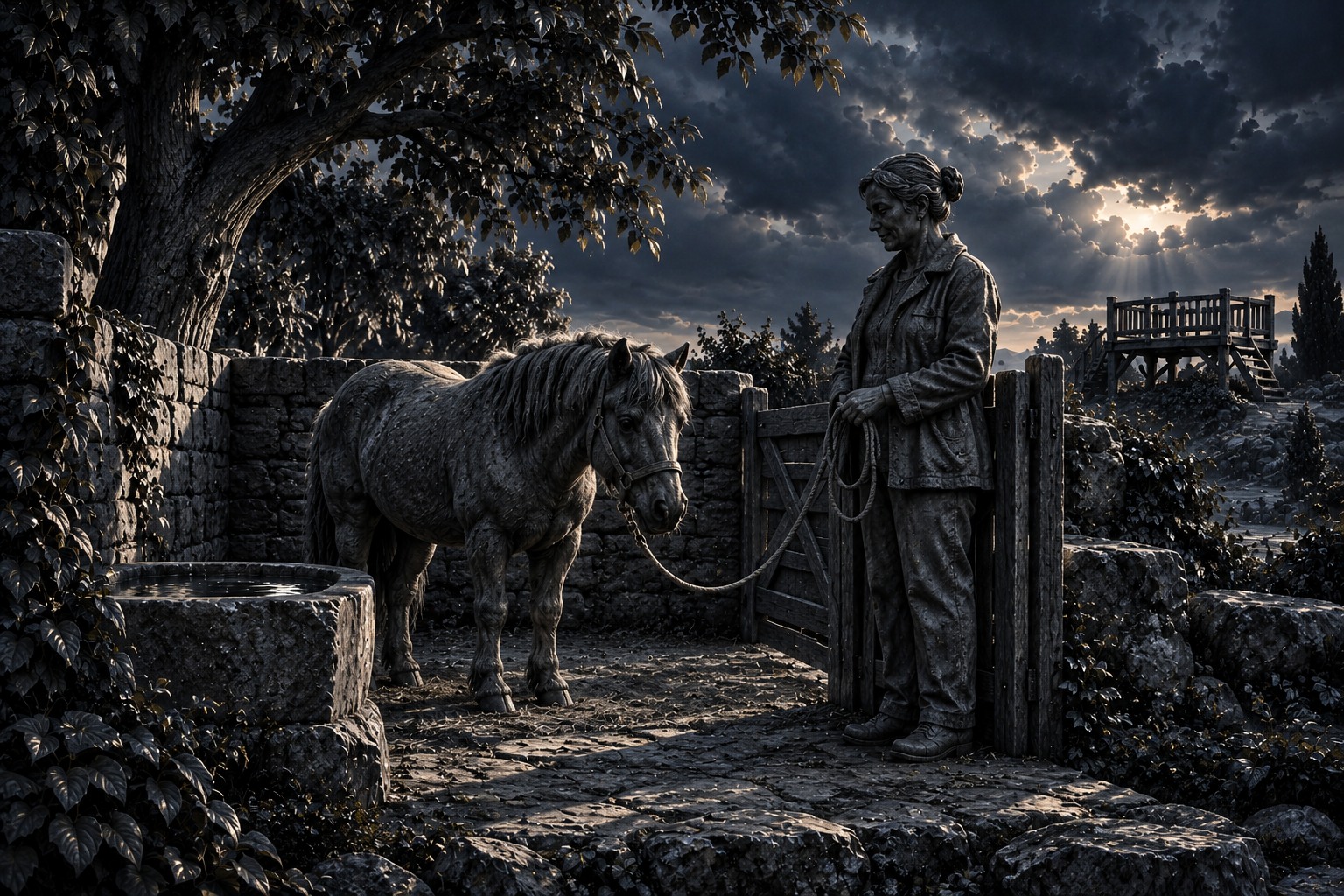
Epigraph
Can they suffer?
Jeremy Bentham, An Introduction to the Principles of Morals and Legislation, chapter XVII, note 122. A brief question from the checked English text. It opens moral consideration; it does not replace knowledge about a particular animal.
What this article is about
Imagine a family celebration. The organisers invite a pony's owner for children's photographs beside the animal. At midday, the pony stops approaching. An employee says paid time requires continuing the programme. The owner calls the pony a member of the family. A visitor, Maya, asks who decides when the animal needs a break. All three are speaking about the same creature, but they see different relationships: a service, a close bond, and responsibility towards someone absent from the human conversation.
These distinctions matter. An animal can benefit people while also having interests of its own. Closeness can sharpen attention, but it does not make every owner's decision right. Recognising interests requires considering what happens to the animal, although it does not settle every question about use, care or resources. These distinctions disappear especially easily when disagreement becomes a choice between unlimited human control and ending all relationships with animals.
This article examines the three perspectives, their limits and a more honest approach to an ordinary decision. Historical sources are interlocutors rather than modern care manuals. Our hypothetical scene cannot establish the pony's condition; it helps identify questions that human convenience can obscure.
I. A Resource Describes Human Benefit, Not the Whole Creature
The word resource answers a question about what people receive. An animal may take part in work, provide income, produce something or assist with an activity. This language identifies real human needs and costs. In the celebration scene, the owner expects to cover transport and time, the organisers want to fulfil their promised programme, and visitors have come for the event. It would be inaccurate to declare these interests imaginary. Yet an account of usefulness describes one side of the relationship: it does not show what happens to the animal while that benefit is obtained.
We can ask about an object's useful life and replacement cost. Those calculations are insufficient for an animal when possible suffering, condition and living circumstances also matter. Including the pony in a programme does not establish that every part of the programme's duration is suitable for the same activity. Payment, schedules and promises to people cannot, by themselves, determine the limits of acceptable treatment. They must be considered alongside another side of the decision. The moral difficulty begins where a human demand to continue encounters a circumstance that cannot be resolved merely by pointing to paid hours.
The resource perspective becomes particularly narrow when attention to an animal exists only to protect future income. Rest is then permitted because tomorrow's service would otherwise be impossible, rather than because what happens to the animal matters today. The practical measures may coincide, but their grounds differ. The difference becomes visible when continuing benefits people while consequences for the animal can be concealed or kept outside a report. One useful question is what would change in our decision if future working capacity no longer had monetary value. The answer reveals the limits of the calculation without requiring us to deny human benefit itself.
Recognising the incompleteness of one perspective does not, however, mean condemning every form of use in advance. That conclusion requires separate grounds: the activity's nature, necessity, available alternatives, conditions and consequences. Our scene poses a much narrower question: is continuing this photography activity now justified, given the uncertainty and a possible alternative? The more precisely we define the issue, the harder it is to hide it inside a general dispute about every relationship between humans and animals. We can assess a particular action without pretending that the entire dispute has already been resolved.
II. Companionship Creates Closeness, Not Infallibility
Companionship highlights shared life and an enduring relationship. A person remembers an animal's familiar reactions, makes plans around its presence, experiences separation and cares about maintaining the bond. Such experience can make another's condition more noticeable than the language of costs and outcomes does. The pony's owner may know circumstances that Maya cannot see. That information deserves attention. But closeness and accurate observation are different things: sincere attachment does not establish that every interpretation of behaviour is correct or that personal interests have no influence on a decision.
Calling an animal a family member can express care; it can also end a conversation that deserves to continue. Saying that I love this animal answers a question about the speaker's relationship, but does not explain why the chosen workload is suitable today. Maya need not dispute the owner's feelings to ask about specific grounds. How was the break determined? Who observes the animal's condition? What caused the refusal to approach? Which parts of the answer are known, and which are assumed? These questions concern a decision, so they do not require a judgement about someone's whole character.
There is an opposite danger too: projecting our own ideas of enjoyment onto an animal. A festive costume, constant attention from guests or involvement in every family event may look like love to a person. The moral question is what we actually know about the suitability of those activities for the animal. Companionship includes the ability to limit our desire for closeness when it obstructs attention to another side. The relationship is not diminished when someone gives up a convenient image of perfection. Sometimes care looks like a less impressive but more attentive decision.
Personal closeness also naturally directs attention towards a familiar creature. This does not mean that unfamiliar animals' interests disappear. We can have special responsibilities within relationships we have created while also noticing inconsistencies in our general reasons. If avoiding suffering matters for a beloved pony, we should explain why the same consideration would cease to matter for an unfamiliar animal. That explanation can take different circumstances and human needs into account. It should not end solely with the fact that we love one animal and do not know the other's name.
III. A Bearer of Interests Need Not Speak Our Language
Calling an animal a bearer of interests means that some events can matter to the animal itself, rather than only to people nearby. Here, the word does not mean an ability to write demands, enter contracts or describe a life plan. It identifies a side of the decision that cannot be fully captured by human benefit. Even when participants disagree about philosophical grounds, they can discuss the basis for continuing a particular activity and what information about the animal is considered. This is a more accessible shared question than requiring agreement on a whole theory of moral standing first.
In Bentham's chapter XVII and note 122, the capacity to suffer challenges animals' exclusion from moral attention. We use that question specifically. Other claims in the note about food and death are not adopted as modern scientific conclusions. For our scene, the useful distinction is that lacking human speech does not make possible suffering irrelevant. Our subsequent practical reasoning belongs to this article, rather than to the historical text.
Recognising interests does not imply that all creatures have identical needs or that every human and animal interest receives the same weight. Different cases require different knowledge. Wanting a celebration photograph, needing to protect a person, and considering long-term care are different tasks. Combining them allows a particular argument to acquire an unjustifiably broad reach. We can recognise an animal's moral significance while continuing to discuss competing responsibilities, acceptable forms of protection and limits to assistance. Difficult cases do not erase the significance of simpler ones in which unnecessary burdens can be removed.
Speaking about interests also requires care in describing them. We cannot honestly put whatever suits us into the pony's mouth. In our scene, an observable action is known: the animal has stopped approaching. Its cause is not established. This is enough to stop treating continuation as unquestionable and to investigate the circumstances. It does not supply a diagnosis, a story about resentment or a confident description of thoughts. Taking another side seriously includes distinguishing facts from interpretations. Interests then become a subject of responsible attention rather than a part in an invented human conversation.
IV. Observation Must Be Separated from Convenient Explanations
When behaviour disrupts a programme, the first explanation often permits the programme to continue. The pony is supposedly being difficult, the employee is too anxious, or the visitor does not understand the work. Such explanations can sound confident before they have been checked. Opposite certainty is no better: an observer may immediately declare the incident proven cruelty. In both cases, conclusions outrun information. A better beginning is to identify the change itself, when it appeared and the known conditions, then establish who can assess the situation competently. Precision protects the moral question from becoming a dispute about personalities.
Separating fact from explanation does not require absolute certainty before every decision. Participants can temporarily stop an activity if continuation raises a significant concern and a pause is available. That does not establish the cause or deliver a final judgement on the programme. It is a separate decision about what to do while information remains inadequate. Comparing alternatives can support it: continuation increases the activity's impact, whereas a pause permits clarification and changes to the queue. A concrete assessment belongs to responsible, competent participants rather than a reader who sees only a short account of the scene.
Uncertainty can be distributed unevenly. The person earning income may control the account of events; a visitor sees only a few minutes; an employee notices a change but fears delaying the celebration. Who is allowed to raise a concern therefore becomes part of responsibility. If an observation can be reported only to someone interested in continuation, the arrangement can easily lose information. It helps to establish beforehand who receives observations and who may pause the activity for assessment. This is an organisational measure, not a promise that the measure eliminates every mistake or establishes one correct answer.
Attention to an animal does not imply rejecting professional knowledge. Recognising the limits of our understanding increases the importance of competent assessment. Specific care, workload and condition require information that a philosophical article cannot provide. Consulting a knowledgeable person should not, however, become a way to remove the moral question permanently. Technical possibility and justification remain distinct. An answer about what can be done deserves further questions about necessity, available alternatives and consequences for all affected sides.
V. An Unnecessary Burden Needs Its Own Justification
In the celebration scene, the human desire is understandable: a child has been waiting for a photograph, a queue has formed, and the organisers have promised a particular service. But an understandable desire does not establish its weight. If the photograph can take a different form, the need to continue the original activity requires explanation. Repeating that it is customary, paid for or likely to disappoint participants is insufficient. Those circumstances describe people's difficulty; they do not explain why it should be resolved at the animal's expense. The relationship between interests must be considered rather than hidden inside the word programme.
A useful question distinguishes the purpose from the means. The purpose may be a family memory of the celebration; having the pony in every photograph is one means. An employee might suggest another setting, reschedule part of the photography or explain a change to the programme. No alternative has to be as convenient or attractive as the original. The distinction nevertheless reveals that some human benefit may be retained without preserving every detail. An alternative becomes serious when its conditions and the person responsible for carrying it out are specified, rather than merely saying that something will be arranged.
It is easy here to call everything we personally dislike unnecessary. That move also needs limits. What looks like entertainment to one person may be an important source of income for another. The difference deserves honest consideration. It can affect the time needed for change, the allocation of costs and available options. Yet dependence on an existing practice does not establish that every part of it is permissible. We must separate the justification of an occupation overall from the justification of a particular burden now. That allows improvement without dismissing human work or turning earnings into unlimited permission.
The most substantive discussion asks who bears the cost of change. The owner may lose payment, the organiser part of the programme, and a family the expected photograph. If every cost falls on one participant, others can demand care from a convenient position. A more honest conversation addresses rescheduling, sharing costs or another form of performance alongside the grounds for stopping. This is neither a mandatory compensation formula nor a conclusion about contractual rights. It avoids demanding a moral decision while keeping all the benefits of the previous arrangement and complete freedom from its consequences.
VI. Care Should Not Depend Only on an Appealing Image
A small familiar animal more readily attracts attention than an unfamiliar creature without a name. In our scene, everyone can see the pony: it has an owner, children approach it, and the celebration creates a personal impression. Visibility helps bring the question into view. But we should formulate the moral reason so that it does not disappear with a less appealing image. If possible suffering concerns us, the absence of an attractive photograph does not make it irrelevant. This can be recognised without claiming that every animal has an identical capacity for identical experiences.
In The Basis of Morality, part III, chapter VIII, point 7, Schopenhauer includes animals within compassion's scope. We reject his anti-Jewish polemic and sweeping judgements about religions, and do not present historical assertions as scientific data. One limited question is useful: why should attention to suffering stop at personal sympathy's boundary? We develop the answer independently rather than adopting the whole text as one norm.
We can test a reason by changing the description. Imagine the same activity involving an unfamiliar animal that nobody calls a family member. Which arguments remain? If only our tenderness disappears, that does not explain why responsibility disappears too. If the work, risks to people or available means of intervention change, those differences should be identified separately. This test reveals selective care without demanding equal emotional closeness to every living being. Moral attention can extend beyond attachment; it does not require pretending to feel an emotion that we do not currently experience.
Broadening attention should not become a competition in personal purity. Someone may discover inconsistency in their habits and begin with one available change. This neither resolves every other question nor devalues what was done. The accusation that unless you fix everything, you should fix nothing merely leaves the existing arrangement unexamined. It is more useful to name the step's boundaries, its grounds and the next unresolved question. Partial improvement then remains partial, while the demand for consistency directs further work instead of prohibiting all work before a perfect result is possible.
VII. Responsibility Is Stronger Where We Have Created Dependence
A relationship with an animal does not begin afresh every morning. People choose conditions of care, transport, work and participation in events, creating dependence on their decisions. The pony's owner is responsible for those conditions differently from a visitor responsible for an observation. Responsibilities differ because of more than feelings: who controls resources, who has undertaken care, and who can change the arrangement all matter. Recognising moral attention in general does not erase this specificity. It requires identifying whose action an available change now depends on.
In Proverbs 12:10, care for one's animal's life appears within a religious distinction between righteousness and cruelty. This is the text's own context rather than a modern checklist for keeping animals. Our scene raises the question of responsibility already undertaken. It cannot be dismissed because an animal has become inconvenient for a schedule. The following discussion of roles is this article's reasoning, rather than an interpretation of every requirement of the biblical book.
The organiser also enters the relationship by inviting an animal and setting programme conditions. Paying for a service does not remove every question about its performance. The owner may have specialist knowledge and the principal care role; the organiser has authority over queues, schedules and employees' demands. Dividing competence works when each party identifies its own part of the decision. It fails when everyone points to someone else as solely responsible. It helps to agree beforehand which circumstances change the programme and who will explain that change to guests.
A visitor has fewer options, but not none. Maya can report an observation to a responsible person, decline a particular form of participation or support a change instead of demanding that a promise be fulfilled at any cost. The scene gives her no authority to take control of someone else's animal or make specialist decisions without knowledge. Limited responsibility can be acknowledged without indifference. A person should choose an action proportionate to what they actually see and can do. Moral attention then finds a specific direction rather than becoming an unlimited duty to save every animal in the world.
VIII. Human Interests Must Be Named, Not Used as a Curtain
Serious attention to an animal does not require people to disappear from the decision. The owner earns a living, the employee is responsible for work, children may be disappointed, and the organiser has obligations. Dismissing these circumstances as trivial invites participants to hear contempt rather than an invitation to consider complexity. Yet a human interest must be named precisely. Saying that people need something can mean protecting life, retaining basic resources or preserving one event's convenience. Combining these grounds prevents us from understanding what cost another side is being asked to bear and why it is considered justified.
Our scene permits a limited comparison. Continuing photography preserves a familiar arrangement but increases an activity whose suitability has been questioned. A break creates organisational difficulty and an opportunity to clarify. Ending the animal's participation changes the programme more substantially while removing this particular burden. The decision should consider actual information and possibilities; a brief account does not determine the winner in every circumstance. It nevertheless shows that human benefit takes different forms, and naming each alternative makes that benefit visible without giving it automatic priority.
Another question concerns the distribution of authority. When those receiving a benefit also decide which losses to the animal count, there is particular reason to examine the grounds carefully. This does not prove bad intentions in a specific owner. It identifies a decision arrangement in which personal interest may remain unnoticed. An independent observation, clear stopping conditions and a possibility of reconsideration make the picture fuller. They do not promise objectivity by themselves, but they prevent benefit from silently becoming the only source of information about what is acceptable.
Moral honesty also means acknowledging unresolved conflicts. Sometimes the available options affect important human needs and animal interests, with no easy replacement. We cannot promise that kindness automatically removes the difficulty. We can describe necessity more precisely, eliminate some unnecessary impact, allocate responsibility and examine whether conditions can change. The decision remains bounded by circumstances rather than becoming proof that one side's interests never matter. Difficulty calls for better consideration, rather than making an inconvenient participant disappear from that consideration.
IX. A Particular Action Connects to the Relationship's Arrangement
A break at the celebration addresses the immediate question but may not change how later events are organised. If the programme is again designed without stopping conditions, the same conflict may confront another employee. We should therefore distinguish the nearest action from the relationship's subsequent arrangement. The first responds to an observed circumstance today. The second determines what organisers, owners and guests know beforehand. Care becomes more sustainable when there is time and a place to discuss conditions, rather than merely a sudden demand for personal courage before an irritated queue.
That discussion might cover participation limits, responsible observation, authority to revise schedules and how people are informed. The details depend on the animal, activity and competent assessment. This article offers no universal workload standard. The principle is that conditions account for a possible need to change a human plan, instead of treating that need as a breakdown to conceal at any cost. When a promise to guests includes that possibility from the beginning, expectations become more honest. People receive more truthful information about what an organiser can actually promise.
Not every improvement requires a large new institution. Sometimes changing one agreement and removing one insufficiently justified requirement is enough. Sometimes a person cannot change an arrangement alone but can clearly pass the question to someone with decision-making authority. The scale of action should reflect actual power rather than the strength of moral feeling. Otherwise, care becomes a proposal to do the impossible, followed only by disappointment. A small step is useful when its result is checked and its limits identified, rather than when it is declared the solution to the whole problem.
After a change, it matters to see what happened. Was the agreed message communicated? Did the chosen activity stop? Is it clear who takes the next decision? Which questions remain open? Checking does not prove the animal's welfare in every respect or establish a general practice's effectiveness. It confirms a particular completed step. Speaking about results this way allows care to continue without grand guarantees and without substituting our feeling of moral achievement for actual action. Responsibility depends on connecting intention, decision and observable performance.
X. A Fuller View Leaves Room for Reconsideration
The three descriptions do not form a ladder on which the last destroys the first two. The resource perspective shows human benefit and costs. Companionship shows a history of closeness and care undertaken. Animal interests show a side that exists independently of our benefits and feelings. These perspectives can coexist in real relationships. Distinguishing them reveals which reason is operating and what it cannot explain. A fuller question emerges: how can important human purposes be maintained without declaring what happens to an animal merely an internal cost of achieving them?
Maya need not begin by demanding that the owner adopt a particular philosophical system. She can report an observation and ask about break conditions. The owner need not defend the whole history of humans and animals. They can describe what is known, acknowledge uncertainty and participate in a particular decision. The organiser can take responsibility for explaining changes to guests. This process does not ensure agreement, but it clarifies disagreement's subject. Participants discuss an activity and its grounds rather than merely each person's right to regard themselves as good.
Reconsideration does not mean the earlier decision was necessarily deliberately cruel. Information may have become clearer, an inadequate agreement may have emerged, or conditions may have changed. We can acknowledge a mistake without inventing an accusation, and accept a new boundary without a story of personal perfection. At the same time, good intentions do not remove the need to change an activity whose grounds prove insufficient. These thoughts are compatible: a person may not intend harm and still be responsible for correcting what lies within their power. Care requires attention to the next step as well as the moral image of the past.
What matters is therefore more than choosing an animal's most appealing description. We need to keep several sides present in the decision. Usefulness is incomplete; closeness does not guarantee accuracy; recognising interests neither replaces knowledge nor resolves every conflict in advance. Together, the perspectives help us act less blindly. If a conversation leaves participants clearer about what is known, what should stop or change, and who is responsible for what follows, a specific improvement has occurred. It can be named without promising universal agreement. More consistent moral consideration begins with such attention to a particular creature.
What this means in practice
Choose an ordinary situation in which a human decision affects an animal. It might involve an event, a familiar interaction or a condition of care already undertaken. If no real situation is available, use the celebration scene as an exercise in reasoning. This practice does not determine an animal's condition and is not a researched method of behaviour change.
First, describe the event without judging participants' characters. What is happening, who decides, and what result do people seek? Then separate what is observed from what is assumed. For example, the animal does not approach the photography spot is an observation; the reason is a question. Record missing information and who can assess it. Do not fill gaps with stories about the animal's thoughts or certainty grounded only in your affection.
Name three sides separately: human benefit, the history of particular care, and the activity's possible significance for the animal. Check whether one side has swallowed the others. Then compare available options: continue, pause, change the means or give up part of the plan. For each, identify who benefits, who bears the cost and who actually has authority to carry out the next step.
Choose one bounded question or action. You might clarify a stopping condition, report an observation to a responsible person, suggest a programme change or check an agreed decision. Specify a time and an attainable result. Afterwards, record what actually happened and what you still do not know. The exercise helps clarify consideration; an animal's welfare and the suitability of particular care require relevant information and competence that a written outline alone cannot provide.
Key quotation
A righteous man regardeth the life of his beast.
Proverbs 12:10, the short first clause, King James Version. The text's religious ground is retained; the quotation is not a modern rule for every form of animal care.
Connections between traditions
| Source or perspective | Its own ground | Question for this article | Limit of comparison |
|---|---|---|---|
| Bentham, XVII, note 122 | Moral significance of suffering | What is lost by describing only human benefit? | Historical animal claims are not scientific assessment |
| Schopenhauer, III.VIII.7 | Compassion towards animals | Why should sympathy limit care? | Polemic against religions and peoples is rejected |
| Proverbs 12:5–15 | Righteousness, care and counsel | Which responsibility have we already undertaken? | Religious context is not replaced by a technical standard |
| United Wisdom | Three sides of the hypothetical scene | Who decides, what is known and what can change? | Original reasoning is not attributed to the sources |
Sources
- Jeremy Bentham. An Introduction to the Principles of Morals and Legislation, chapter XVII. Continuous selected contexts § 1, I–IV and the entire note 122 were read. The suffering question is used; historical claims about food and death are not treated as scientific data. English web transcription; the page's specific print basis is not established.
- Arthur Schopenhauer. The Basis of Morality, Project Gutenberg 44929. Arthur Brodrick Bullock translation, Swan Sonnenschein, 1903. Continuous selected point III.VIII.7, printed pages 218–228, was read. Polemical generalisations about religions and peoples are rejected; dietary and scientific assertions are not used as established facts.
- Proverbs, King James Version, Wikisource. Continuous selected 12:5–15 context was read; the quotation is the first clause of 12:10. Rights in particular editions are not declared established worldwide. Full source texts are not imported.
Tags
animal, interests, resource, companion, care, responsibility, suffering, usefulness, closeness, observation, uncertainty, decision, workload, break, alternative, necessity, sympathy, dependence, keeping animals, work, programme, authority, information, competence, consequences, participation, compassion, Bentham, Schopenhauer, Proverbs
About the authors
Andrey Zarinsh is the author and founder of United Wisdom. He explores inner transformation, the unity of traditions, intercultural dialogue, and contemporary spiritual discipline. Instagram: @andrey.zarinsh.
Maria Evilkut is a co-author of United Wisdom. Alongside her research, she seeks to test these ideas in practice and observe how principles of unity and mutual understanding work in real life between people and cultures. Instagram: @ilkutki.
Keep what resonates with you.