
Freedom & action
Inspiration and craft in sustained work
Inspiration, meaningful repetition, revision and completion in sustained creative work.
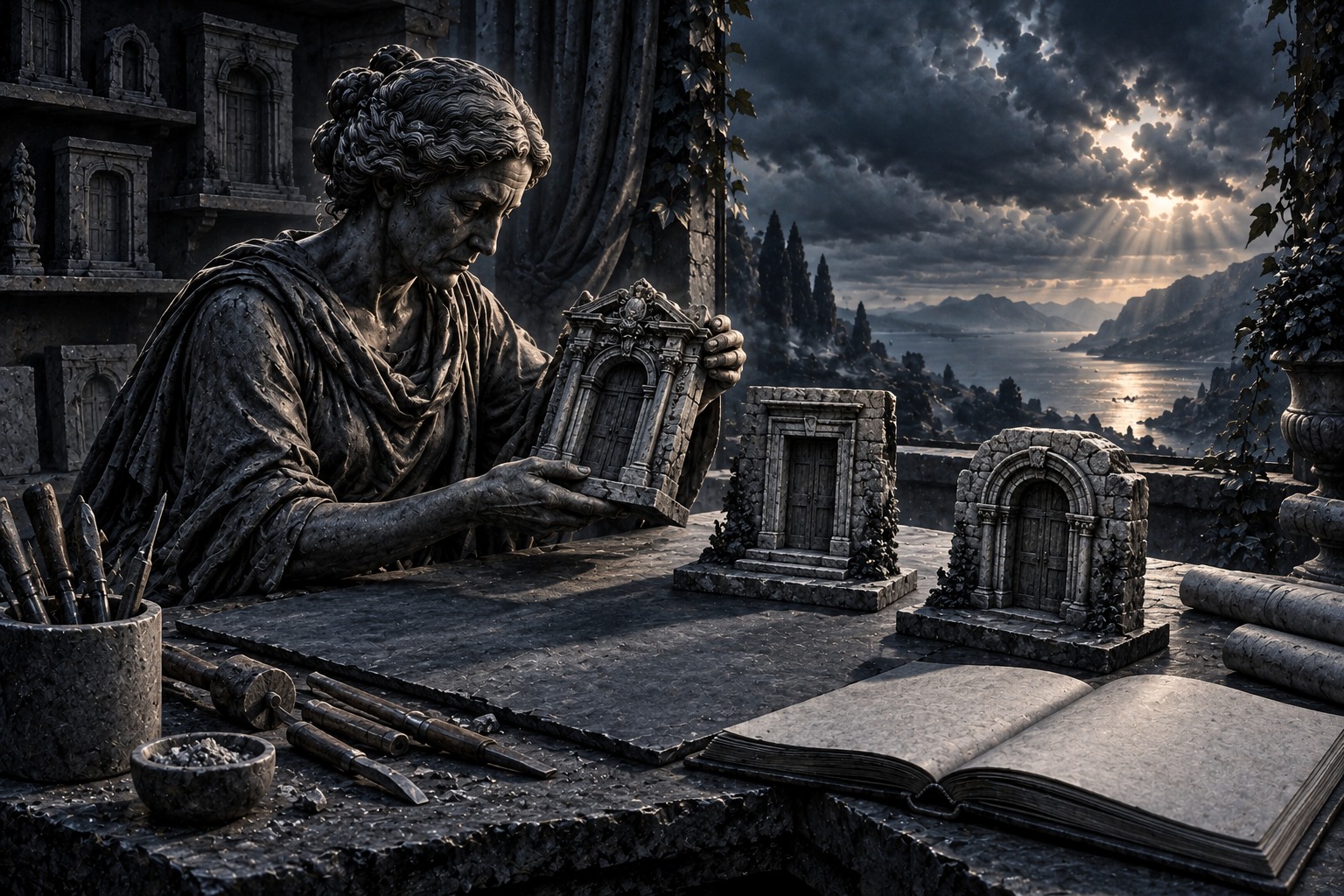
Epigraph
For the things we have to learn before we can do them, we learn by doing them
Aristotle, Nicomachean Ethics, II.1; an excerpt from the sentence before its builder and musician examples. W. D. Ross translation displayed by the Internet Classics Archive; the electronic text's exact print source has not been established. This is an argument about activity and habit, rather than an experimental theory of creativity.
What this article is about
Imagine an illustrator planning an atlas of city doors and passageways. The first drawings come easily: unusual light, an old arch, the feeling of having found a personal way of seeing. Weeks later, measurements, captions, return visits and pages that will not become a book remain. The work has changed, but its maker may mistake this for the disappearance of the idea itself. This article distinguishes inspiration that opens a direction from craft that carries work through different stages. It considers useful repetition and established mistakes, boredom and lost purpose, new ideas and evasion of a chosen one, revision and completion. Aristotle’s connection between activity and skill and a Stoic reminder about human work offer limited philosophical bearings. They promise neither creative success nor virtue through exhaustion. The practical question is which next action serves this particular work, how it can be checked, and when conditions or the attempt itself should change.
I. A spark reveals a possibility, but does not yet define the work
In our hypothetical story, Nina draws entrances in an old neighbourhood and decides to make a small atlas. She is interested in how a door connects the street with someone else’s everyday life, rather than in making a property catalogue. Three expressive drawings emerge in one evening. That experience deserves attention: it has revealed a way of looking that she wants to develop. Yet the strength of those first drawings does not determine their eventual number, sequence or the information a reader will need. Nina has a beginning, rather than evidence that the future book is already complete within her and only needs to be brought out without obstruction.
When initial excitement is treated as a finished structure, ordinary decisions can seem like alien intrusions. A caption beneath an arch appears to spoil the drawing’s purity; arranging access to a courtyard seems to move her away from art; page size is something that ought to decide itself. Yet these choices change what another person can see and understand. Nina needs to decide whether she is making a walking route, an artistic sequence or a story about the city’s memory. The decision may remain provisional, but the distinction already matters. A route needs landmarks, a sequence needs relationships between images, and a story needs verified information supporting its account.
Inspiration need not answer every question immediately. It can remain a significant starting experience without becoming the future editor, researcher and printer as well. Nina can then avoid blaming herself when work stops resembling that first evening. A new stage requires a different contribution. She might express a provisional intention in one sentence and choose several pages to test it. If the sentence fails to fit the material, she can change it. Change would then arise from a concrete experience, rather than from the general conclusion that every difficulty signals lost authentic inspiration and requires waiting for another sudden beginning.
II. Craft preserves distinctions within repetition
A repeated operation is not necessarily an identical one. Nina draws another doorway, but today she needs to show depth more accurately, tomorrow to preserve differences between materials, and later to maintain the scale of a spread. If she notices these tasks, repetition has a subject. If she repeats a movement simply because it is familiar, accumulating drawings may conceal a lack of development. Craft here means recognising what needs attention now, choosing a suitable action and distinguishing its result. It cannot be reduced to the number of hours worked or a willingness to endure monotony without asking questions.
In Nicomachean Ethics, II.1 and II.4, Aristotle connects acquiring skill with activity while distinguishing good practice from bad; a work’s quality is also distinct from its maker’s moral condition. This philosophical argument helps frame the character of repetition. It sets no required hours, measures no creativity and cannot determine Nina’s human worth from a drawing. The further distinction belongs to our editorial inquiry: what the repeated action does for this atlas, and what would show that it changed the work.
Nina could compare two drawings solely for their treatment of depth, temporarily setting colour and overall expression aside. That limited examination does not make the other qualities unimportant. It makes the observation precise enough to use. She can then return the change to the whole page: improved depth may damage a drawing’s lightness or distract from the passageway that prompted it. A craft examination moves between part and whole. It helps her avoid defending a familiar technique merely because it is practised, or declaring every new movement an achievement before it has met the actual task.
III. An established mistake can also look like confidence
Ease of execution does not prove that an action has become more suitable. Suppose Nina can quickly outline every door with a dark line. On an individual drawing, this gives a clear silhouette; across a spread, it makes every entrance equally heavy, although some almost disappear into their walls in reality. She performs the technique confidently, yet it erases the difference the atlas was intended to preserve. What matters is not the freedom of her hand alone, but its relationship to the subject. The work may require abandoning an effective-looking movement, rather than repeating it still faster and more neatly on the next page.
An observation needs a form that can be examined. “You are too taken with your style” can turn discussion of a page into an argument about personality. A more precise observation is that the same line makes different materials look alike in three images, so captions must explain what the drawings no longer distinguish. Nina can agree, object or suggest an alternative. Uniformity may have been an intentional artistic decision. She would then need to check whether it serves the book and whether readers can understand its role. Neither abandoning nor preserving the technique is automatically right because one option sounds disciplined and the other sounds free.
Useful feedback leaves the author to work with the observation’s grounds. It does not make someone else responsible for choosing the book’s entire form for Nina. Nor does it require an endless succession of advisers: incompatible proposals must be assessed against one task, rather than all implemented together. She can preserve two versions of a page and identify what became clearer and what was lost in each. If the difference cannot be discerned, it is more honest to admit that than to credit the new version with improvement because it cost effort. Examination informs the next choice; it guarantees no recognition and gives no outside opinion final authority over quality.
IV. Conditions for returning matter more than a performance of constant excitement
Sustained work needs conditions that allow a return even when the mood of the first evening does not recur. This requires no single correct ritual. Leaving the next page on her desk, keeping verified captions in a separate folder and noting an unresolved question may help Nina. These arrangements do not summon inspiration on demand. They reduce the need to rediscover where work stopped and why that step was chosen. Conditions for returning preserve memory of a particular work. Their usefulness can be assessed through the availability of a next action, rather than through the attractive appearance of a working lifestyle.
A ritual becomes questionable when it acquires more requirements than the work itself. If Nina believes she can draw only in a certain light, with a whole free morning and without a single unrelated thought, real opportunities narrow. Light may indeed matter for a particular operation; she can identify that operation and its conditions. Captions, sequencing and address checking may need a different arrangement of the day. Separating tasks does not devalue the artistic part. It avoids imposing the requirements of the most sensitive stage on every stage, or treating the absence of ideal surroundings as a ban on all meaningful progress.
Order must not become an accusation against someone who lacks quiet space, time or materials. Conditions differ, and sometimes they really do make a chosen scope unavailable. Nina can reduce the atlas, change her method, request specific help or postpone release. Such a decision concerns the project’s possibilities; it certifies no character defect. A working arrangement remains open to choice and revision. It should not become a new system of trials in which a person must first earn permission to pursue a loved activity through a faultless schedule, special clothing or a continually convincing account of their creative discipline.
V. Boredom calls for a question about the stage of work
“Boring” can describe different situations without selecting an action. Nina may be tired of addresses because the artistic task is settled and she is checking supporting details. Or drawing more doors may bore her because every page answers the same question and the book has stopped developing. In the first case, she can bound the checking and finish the necessary operation. In the second, she can examine what the atlas still lacks: a transition, another time of day, a change of viewpoint or an intelligible basis for selection. The same feeling cannot establish in advance that either situation is laziness or evidence of an exhausted idea.
The distinction begins with the subject of the immediate work. When a task is clear, its need understandable and its result visible, lack of pleasure does not remove its purpose. These features still require neither enduring any workload nor accepting every condition. Nina can check whether work has become too large or presently unavailable. If an operation has no intelligible role, disciplined execution may simply enlarge the uncertainty. Why does the atlas need twenty more similar drawings, and what changes if they are absent? Asking whether they are necessary does not betray inspiration. It distinguishes commitment to a work from commitment to an initially imagined page count.
Sometimes the answer reveals a harder choice: Nina cares about the subject, but the intended format does not convey what she has seen. A small exhibition or a sequence of drawings without a route may be more suitable than a book. Revision should be connected to specific losses and possibilities, rather than a promise that a new format will restore earlier excitement. She needs to identify which materials remain, which decisions must be made again and who was promised something different. Change costs something, but so does continuing the old arrangement. Boredom becomes an occasion to examine this choice, rather than proof that either option will necessarily release her from ordinary work.
VI. Human work is not endless busyness
In Meditations, V.1, Marcus Aurelius addresses reluctance to rise through the Stoic human role and common good. He recognises rest but also compares himself sternly with absorbed craftspeople who neglect their bodies. This is moral exhortation within a particular worldview; its tension cannot disappear into a modern recommendation to keep a schedule. Our narrower question is what meaningful participation in a chosen work looks like now. Nina need not establish human dignity through the number of drawings, and an artistic result cannot morally justify every means of producing it.
A limited connection with that text invites a question about what the next action belongs to, instead of waiting for a special sense of personal exceptionality. Today Nina can finish a caption, check an access arrangement or correct an inaccurate drawing. Each action serves the book, although it need not bring the state conveniently called inspiration. Performing an action and permanently endorsing a project’s continuation are different choices, however. Changed conditions call for reconsidering the intention itself. Responsibility for a chosen work includes noticing that it has become unavailable, mistaken or disproportionate, as well as an ability to make oneself begin it once more.
It helps to distinguish dedication to work from the display of dedication. In the former, a decision is explained by what it enables or preserves. In the latter, the main result becomes visible devotion: someone remains at their desk despite no longer being able to name the task they are performing. An observer cannot always distinguish these cases, so this article offers no assessment of others through working hours or signs of fatigue. Nina can compare her own intention, action and result. A discrepancy gives her grounds to change her participation, rather than make diligence more costly to sustain a convincing image of loyalty to her craft.
VII. A new idea can wait without being lost
While making the atlas, Nina imagines a series of night drawings of city rooftops. Novelty supplies clarity missing from the old project: everything again seems possible and limitations have not yet emerged. This does not make the new idea false. Comparing its first attraction with an almost finished book’s difficulties nevertheless compares different stages. The new series has no unsuccessful drawings, contested sequence or obligations to readers yet. Nina is free to choose it, but it helps to recognise that she changes not just her subject but her position in the process, returning to a beginning where many decisions can still remain unmade.
Writing down a new idea separates preserving it from carrying it out immediately. A few lines about what was interesting, one sketch and a question worth exploring can hold it until the next reconsideration. This guarantees neither that the idea will remain equally expressive nor that ideas do not change. It does, however, avoid demanding that Nina abandon the atlas to prove respect for every creative impulse. She can choose after finishing a trial spread or examining the sequence. Her decision would then draw on material from the present work and a more clearly recorded new intention, rather than only the difference in emotional vividness between two evenings.
If the new idea reveals an important error in the old one, discipline need not keep it isolated. A night drawing might reveal that Nina is interested in changing boundaries between private and shared spaces under different light, rather than the structure of entrances. This could refine the atlas or lead to another work. She can identify the thought new material introduces and test it against existing pages. Revision differs from continual escape by having a subject and grounds. It preserves information about an earlier choice and does not require declaring past work meaningless before a new work is allowed to exist.
VIII. Someone else’s finished work is not your own draft
Comparison with another person’s strong work can supply a criterion or confuse different subjects. Nina opens a published atlas and sees a clear sequence, light captions and confident drawings. She sees selected pages after the work of an author, editor and printer; in her own folder, she sees everything still unsorted, including rejected versions. That difference does not establish a lack of talent or insufficient commitment. Yet reassurance that comparison is simply forbidden would be a poor response too. She needs to decide which feature of another work helps her ask a more precise question about her own.
She could examine one technique: why is the transition between two spreads understandable without a long explanation? Nina then tries to identify the relationship between her own pages. An absent relationship is a substantive observation, rather than a verdict on her personality. If a relationship exists but differs in kind, the other author’s method need not become a model to copy. Such reading recognises another’s skill while leaving room for difference. It also requires acknowledging a borrowed technique or source when relevant to presenting the work. Admiration does not remove the need to understand an idea’s provenance, and personal execution cannot make a structure noticed elsewhere an independently conceived intention.
Public recognition adds another scale that should not silently replace quality. Another book may be more visible because of its subject, publisher or circumstances of distribution; this article does not determine what caused its success. Nina may want attention and discuss ways to present her atlas. Presentation nevertheless differs from improving a drawing or deciding what the book should convey. If every page is judged solely through anticipated public reaction, its internal task keeps changing with an imagined audience. It helps to give questions about the intended reader a separate place, rather than make them a continual vote on the acceptability of every personal artistic decision.
IX. A pause needs a connection with returning
A pause may belong to the work, or may be a withdrawal that its maker has not named. Both can look alike from outside: the folder is closed and no new drawings appear. Continuous visible activity therefore cannot establish someone’s loyalty to a work. Nina has a more specific question available: what is suspended, what will remain accessible afterwards, and whether a decision is needed before returning. Waiting for a courtyard owner’s answer has an external subject. If the book feels impossibly large, changing its scope may need to come first. Choosing another undertaking can also be acknowledged without inventing a story about the idea secretly maturing.
A short note before a pause preserves the work’s location. It can identify the chosen spread, an unresolved doubt and information still needing verification. The note forces no return and prescribes no universal rest period. It allows a future decision to draw on preserved grounds. Afterwards, Nina may notice that she defended an unnecessary page or almost abandoned an important drawing too quickly. Reconsideration need not be a pure improvement: distance sometimes offers a different view, and sometimes requires reconstructing the subtlety of an earlier observation. This article promises no correction of a work through pausing alone.
Limits on participation also concern other people. If Nina promised trial pages to an editor on a certain day, a long pause changes the conditions of their work together. Where possible, she should explain what is available and what date she can honestly give. That requires neither personal disclosure nor justification for a right to rest. It preserves the other person’s ability to decide for themselves. Commitment to craft does not mean meeting any deadline while keeping silent about quality or the state of materials. Sometimes responsibility means handing over an incomplete version with clear limits, changing a promise by agreement or withdrawing from release in its earlier form.
X. Completion sets a boundary, rather than establishing perfection
Sustained work may continue because it is unfinished, or because completion has not been defined. Nina corrects another drawing and reopens the size of the entire book. An individual revision may help, yet repeatedly return the whole atlas to the stage of intention. Release needs signs of sufficient coherence: an intelligible selection, verified captions, a readable sequence and image quality suited to the chosen presentation. Such signs cannot be prescribed universally for every work. They are formulated in relation to what this particular book promises and what its readers actually need.
An agreed boundary does not permit hiding a known substantial error. An incorrect address that breaks a route, or a caption assigning an unsupported history to a building, concerns the atlas’s content rather than endless refinement of taste. Nina can correct it, remove the assertion or clearly mark uncertainty. A drawing she would now make slightly differently is another matter if it preserves the chosen distinction and does not mislead. A potentially stronger future version does not make every current version unacceptable. Completion requires separating a known defect needing a decision from an open possibility of development that will remain available after release.
A completed atlas preserves its provenance: drawings, others’ contributions, checked and unchecked information, and the chosen edition. Nina can retain notes for a future version without placing her entire working history on the reader’s pages. Completion opens the work to another person and leaves its maker free to continue learning. It guarantees neither satisfaction, sales nor a final feeling of having expressed everything seen. Inspiration has not disappeared beneath craft: an initial way of looking has acquired a form that can be presented, discussed and, if needed, revised. The next work begins with this experience, rather than a demand to prove the purity of its beginning again.
What this means in practice
For a chosen sustained work, a short note can separate intention from the immediate task. Nina can identify what the atlas offers readers, what does not yet cohere and which action might provide new information. Rather than generally promising to return to the book, she can choose a trial spread: check its sequence, a disputed caption or the distinction between two materials in its drawings. Scope and time depend on actual conditions, with no universal timetable. Afterwards, she can preserve what became clearer, what remains unresolved and which next question now has grounds. An absence of improvement is information too; it need not be decorated with a story about obligatory creative growth.
Repetition calls for checking whether a known defect is being established. A concrete comparison is enough, rather than a general trial of talent: what changed on the page, and does the change help the whole work? A new idea can be recorded separately, with a moment chosen for deciding between continuation and revision. If it changes the initial intention, the grounds and cost of change should be named. If it simply restores the pleasant stage of beginning, that too deserves recognition. Keeping or replacing a plan requires no proof of special moral stature. The decision concerns a work and available conditions, rather than a person’s permission to consider themselves an author.
Before a pause, it helps to preserve a version, an unresolved question and information needed for a return. Before completion, substantial errors can be separated from optional improvements, promises to readers checked and provenance identified. If others participate, changes in scope or date should be made intelligible through the information they need. In our hypothetical story, Nina returns to a chosen spread that can now be examined and finished, rather than to a demand to feel the first evening again. This is a limited way to organise participation. It guarantees neither inspiration, success nor freedom from difficulty; its value is giving the next action a subject and reconsideration some grounds.
Key quotation
it is to go about a man's work that I am stirred up
Marcus Aurelius, Meditations, V.1; the complete final clause of the opening sentence in the electronic edition of Meric Casaubon’s translation, Project Gutenberg 2680. The whole passage concerns the Stoic human role and common good; its stern comparisons are not adopted here as a prescription to neglect the body for creativity.
Connections between traditions
| Question | Philosophical bearing | Editorial connection | Boundary |
|---|---|---|---|
| Beginning an action | Aristotle, II.1: skill and activity | An intention meets material | An analogy without required hours |
| Meaningful repetition | Aristotle, II.1: differing practice | Examine a particular change | Mastery is not guaranteed |
| Distinguishing qualities | Aristotle, II.4: a work and a moral act | A drawing’s error does not determine its maker’s worth | Art is not reduced to ethics |
| Returning to work | Marcus Aurelius, V.1: the human role | Action is possible without special excitement | Stoic nature is not a theory of creativity |
| Keeping a limit | Marcus Aurelius, V.1: rest and stern devotion | Participation conditions need reconsideration | Bodily neglect is not adopted |
The map relates Aristotelian ethics and Roman Stoic exhortation to a contemporary editorial question. Similar questions establish neither a unified doctrine nor historical borrowing of the proposed working approach.
Primary sources
- Aristotle. Nicomachean Ethics, Book II. Internet Classics Archive, W. D. Ross translation; II.1 and II.4 are used, including the activity examples and the distinction between craft and moral action. The electronic text’s exact print source is unverified. This is a philosophical bearing, rather than research on creative productivity.
- Marcus Aurelius. Meditations, Book V.1. Project Gutenberg 2680, electronic text of Meric Casaubon’s translation. Editorial notes describe comparison of the 1634 and 1635 editions and changes in presentation. V.1 and the edition note were read; the eBook catalogue reports public domain status in the USA, release in 2001 and update on 13 July 2026. Non-US rights have not been independently established. Its Stoic context of human work is used with explicit limits on transfer.
Tags
inspiration, craft, sustained work, creative intention, illustration, artistic choice, repetition, practice, feedback, examination, quality, draft, completion, revision, pause, working conditions, attention, boredom, new idea, intended reader, authorship, provenance, discipline, Aristotelian ethics, Aristotle, Marcus Aurelius, Stoicism, common good, sufficiency, creative responsibility
About the authors
Andrey Zarinsh is the author and founder of United Wisdom. He explores inner transformation, the unity of traditions, intercultural dialogue, and contemporary spiritual discipline. Instagram: @andrey.zarinsh.
Maria Evilkut is a co-author of United Wisdom. Alongside her research, she seeks to test these ideas in practice and observe how principles of unity and mutual understanding work in real life between people and cultures. Instagram: @ilkutki.
Keep what resonates with you.