
Meaning & path
Buried Alive: Symbolic Death and the Limits of Comparison
An archival comparative essay on enclosure, initiation, solitude, and flotation; historical reference only, without medical or practice guidance.
Inner transformation · An authorial series
Andrey Zarinsh & Maria Evilkut
Archival editorial note — historical reference, not practice guidance. The following translates an existing essay that describes dangerous practices and makes disputed claims. Historical descriptions are retained for archival fidelity, not offered as instructions or recommendations. Burial alive, starvation, toxic ingestion, dehydration, and extreme isolation can cause serious injury or death; a teacher, tradition, breathing device, or claimed “integration” does not make them safe. Claims of suspended vital functions, predictable neurological mechanisms, or guaranteed transformation remain unverified archival assertions. The source's concluding exhortations are identified as its author's position, not adopted as guidance.
Introduction
Temporary burial, enclosure, wrapping in cloth, retreat into a cave, and withdrawal into darkness recur across many cultures. The archive places Japanese sokushinbutsu, Indian jīva-samādhi, medieval anchorites, Mexican temazcal, and shamanic initiation alongside one another. It proposes a common pattern: an encounter with death understood as a means of beginning again. Their resemblance is the essay's organizing interpretation, not proof of a shared mechanism or independent historical origin.
I. The Bamboo Tube
The source opens with a pit about two meters deep, fitted to the person's height; a wooden or stone enclosure; a bamboo tube extending outside for breathing; sometimes a bell held in the hand, so those above would know the person below was still alive. Then silence. Then earth being packed down. This is the archive's historical scene, not a viable safety design.
The archive frames the scene as a voluntary practice rather than an execution, pointing to traditions separated by vast distances and long periods of history. It names Japanese monks in Dewa Sanzan, yogins in Tamil Nadu, Russian recluses in Sarov, Mexican temazcal healers, Lakota sweat-lodge practitioners, and Tibetan dark-retreat hermits. In the authors' comparison, earth, darkness, enclosed space, and bounded time become instruments of an encounter with mortality and a hoped-for renewal.
The essay follows a recurring cultural gesture: enclosing someone alive in the hope that they will emerge changed. That descriptive framing does not establish the practice as survivable or beneficial.
II. A Recurring Gesture
Why does this image appear in so many traditions? The archive turns first to archaeology, asserting that early Neanderthal and Homo sapiens burials contain red ochre, flowers, and tools. It interprets ochre, the color of blood, as a sign of life. Grave and cradle seem already to overlap, as though a body placed in the earth were being prepared for another life. These archaeological generalizations and meanings are inherited, not newly established here.
Earth holds both senses: grave and womb. Symbolically, a person comes from it at birth, returns to it at death, and is fed by it in between. The article suggests that a culture expressing transition may express it through earth, and enact it within the earth.
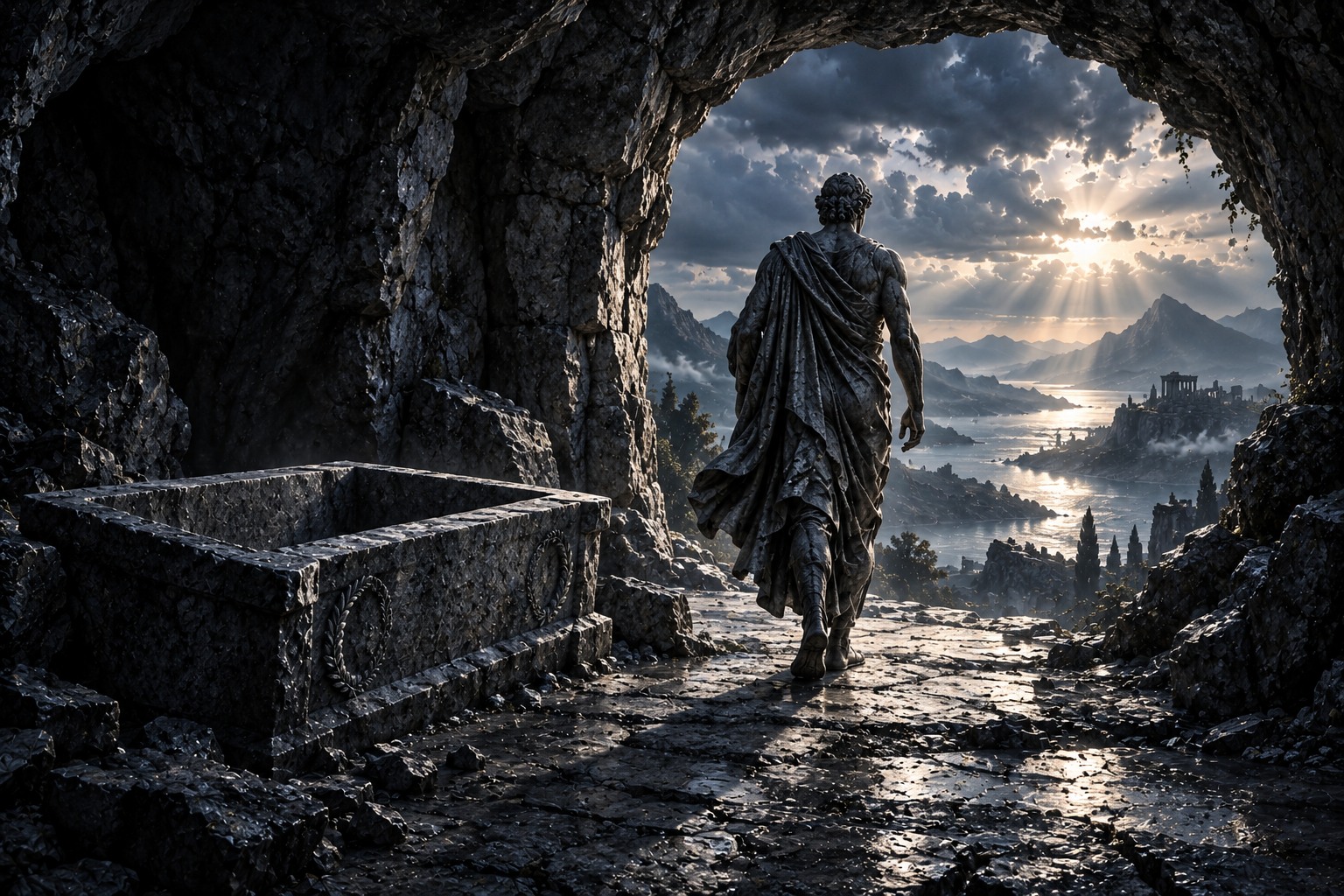
The forms vary: pit, cave, anchorhold, temazcal dome, dark room. Inside is a person separated from the world; outside are those waiting. Between them remains some limited opening or connection. The essay makes that boundary central to its image.
III. Four Elements
Despite differences between traditions, the authors identify four recurring elements: isolation from familiar social surroundings, voices, and roles; darkness and the reduction of visual input; confinement of bodily movement; and a real or symbolic proximity to death.
The source claims that these elements combine to alter perception more strongly than any one alone. It connects sensory restriction, interrupted social feedback, changes in bodily experience, and a sense of being at a threshold. This is the archive's proposed explanatory structure. A universal “rewiring” effect has not been demonstrated by this adaptation, and calling proximity to death “controlled” does not establish control.
IV. Sokushinbutsu
The archive describes seventeen preserved bodies in the mountains of Yamagata and Fukushima, near the three sacred peaks of Dewa Sanzan. They are associated with monks who pursued self-mummification, called sokushinbutsu, glossed as becoming a Buddha in this very body.
The archive says the process lasted roughly three thousand days, almost eight years. It describes an initial three years of mokujikigyō, “tree-eating,” with nuts, seeds, bark, roots, resins, and pine needles, during which the body lost fat and water. It then describes another three years of more severe restriction, even excluding seeds. In the final period, it reports drinking a preparation from the urushi tree, the tree used to produce Japanese lacquer. The source calls the drink poisonous and attributes later resistance to decomposition to its toxicity toward bacteria and insects. These are inherited historical assertions about a fatal practice, not validated preservation science or dietary guidance.
In its concluding account, the monk was placed in a small wooden chamber in a meditation posture, within a stone enclosure connected to the outside by a bamboo tube. A bell signaled that he remained alive. When the signal ceased, the tube was removed and the chamber sealed. The source says it was reopened after a thousand days. A preserved body was interpreted as attainment of sokushinbutsu and revered as a living Buddha; decomposition meant the intended preservation had failed, although prayers continued. The narrative describes death, not safe temporary burial.
According to the article, practitioners did not understand this as suicide. They regarded it as a final ascetic stage and an attempt to remain in meditation at the boundary of life and death. It reports an official prohibition in nineteenth-century Japan and isolated twentieth-century cases. Those historical claims require separate checking.
The authors distinguish this extreme from traditions involving temporary withdrawal and return. That distinction is essential: a fatal self-mummification account cannot serve as evidence that temporary burial is safe.
V. Yangti Dark Retreat
The archive describes a dark-retreat practice associated with Tibetan Dzogchen and Yungdrung Bön, called yangti. A practitioner withdraws into a space without light. The source mentions retreats lasting days, a seven-week interval linked to bardo, and exceptionally much longer seclusions. These are historical and religious descriptions, not a schedule to follow.
Within the tradition as presented, the purpose is not a sensory experiment but recognition of the nature of mind. Without external visual reference points, practitioners may experience colored points, rings, figures, or landscapes. The tradition interprets them through the primordial clear light of awareness. Their religious meaning is not established by their occurrence alone.
The article also cites a 2025 New York Times Magazine report on a New England center where Lama Justin von Bujdoss leads related retreats. It describes a journalist's three-day experience of intense imagery, altered time, and moments in which personal boundaries seemed to disappear. The report and its date have not been newly verified here.
The authors compare darkness with the removal of outside support in other practices, while emphasizing that Tibetan retreat anticipates return. They describe yangti as a rehearsal of bardo: in that religious account, recognizing such states while alive may prepare a practitioner for death. This remains a tradition-specific belief, not a medical finding.
VI. Jīva-Samādhi
Indian yogic traditions include the concept of jīva-samādhi, the “samādhi of the living.” The archive describes a belief that a yogin can stop breathing and the heartbeat without dying, the body supposedly sustained by inner prāṇa, and be recovered alive after days, weeks, or even months of burial. These are extraordinary religious claims, not demonstrated physiology or grounds for attempting burial.
Tamil Nadu's siddhars are spiritual masters, many of whom are said to have departed in this way. Their tombs are revered as sites of a teacher's continuing presence and blessing. The article distinguishes mahāsamādhi, a final departure without return, from accounts of jīva-samādhi in which return is expected. Traditions and usages vary; the distinction is inherited from this source.
The archive invokes Prahlad Jani and reports hospital observations in India in 2003 and 2010 concerning prolonged absence of food and water. It says the observers neither established a mystical interpretation nor offered a final physiological explanation. These reports do not, by themselves, verify survival without vital functions or validate burial. The source also contrasts measurable changes in metabolism during meditation with complete metabolic cessation, which it acknowledges remains outside modern verification.
Its broader point is historical: Indian religious traditions preserve accounts in which burial of a living teacher belongs to a spiritual narrative. That is a claim about belief and practice, not evidence that the physiological claims are true.
VII. Recluses
The article locates voluntary enclosure in early Christianity, particularly Eastern Christianity. It relates the anchorite to the Greek anakhōrētēs, one who withdraws. In medieval England, male and female anchorites vowed to remain in cells often attached to churches. Openings allowed communion, food and water, and spiritual counsel to visitors. Their commitment could last for life.
The source describes an entry rite modeled on a funeral, involving prayers for the dead and the sealing of the cell. Julian of Norwich, author of Revelations of Divine Love, is presented as having lived for decades in such seclusion and produced one of medieval England's great mystical works.
The essay follows the line into Russia. It recounts Seraphim of Sarov's thousand days of stylite-like ascetic practice and many years of complete seclusion. Theophan the Recluse, a nineteenth-century bishop and prolific writer, is described as spending his final twenty-eight years in seclusion at Vysha, never leaving his cell, sending writings through an opening and celebrating the liturgy alone; the archive gives 1988 as the year of his canonization.
The source also describes profession into the great schema as involving a monk lying on the floor in a deathlike posture, covered by a vestment while prayers for the dead are sung. It extends this account to both Orthodoxy and Catholicism. That cross-tradition claim needs correction or source-specific verification. The archive calls it a formal “burial alive”: the worldly person dies and a life already dead to the world begins. The symbolic point is the death of a former identity, not literal permission to endanger a living body.
VIII. Cave and Hermitage
A related strand is cave seclusion. The Kyiv Pechersk Lavra developed from caves associated with Anthony in the eleventh century, in a hillside above the Dnieper. The archive describes recluses living and later being buried in these spaces. A cave could be dwelling, place of worship, and tomb.
It also describes remote hermitages on Mount Athos, some accessible only by rope ladder. In its account, a recluse lives within a few square meters on bread and water, sometimes plant flour and water, while reciting the Jesus Prayer. These inherited ascetic descriptions are not nutritional advice. The article distinguishes this from self-mummification: suicide is not intended, although this is an extreme form of withdrawal rather than ordinary monastic routine, with space reduced to the scale of a grave and time to the next breath.
The Christian symbolism has another layer. Christ's tomb is a cave; resurrection comes from the tomb. The authors read voluntary cave seclusion through that religious pattern of entering a place from which Christ emerged. This is theological symbolism, not proof that dangerous confinement produces renewal.
IX. The Shaman and Dismemberment
Accounts of Siberian, Tungus, and Nganasan shamanic initiation describe an experienced death. For several days, an initiate may appear from outside to be seriously ill or in a trance; from within, the account may involve being dismembered by spirits, having bones boiled, or receiving new organs. Some narratives include temporary burial, which the source describes as lasting an hour, a day, or a night. These are reported accounts, not safe exposure limits.
The archive cites Mircea Eliade's Shamanism and Sergei Shirokogoroff's Psychomental Complex of the Tungus. It presents illness as a summons into a vocation rather than a freely selected exercise, followed by return with authority to perceive and heal. Its claim of a universal structure across the Eurasian north is broader than this adaptation can verify.
It then compares Dogon, Baka, and Gabonese bwete initiations, including iboga-related practices and ancestral-contact narratives. The source goes so far as to describe iboga amounts that supposedly stop the heart for minutes, followed by temporary burial for “contact with ancestors.” This is an unverified and dangerous assertion in the archive, not a reliable physiological description: cardiac arrest is a life-threatening emergency, not an initiation technique endorsed here.
The authors conclude that descent toward death often figures in becoming a shaman. Written documentation varies, and this comparative theme should not be turned into a universal rule for all such communities.
X. Vision Quest
The article groups several Plains and other Indigenous North American traditions under the English term vision quest, naming Lakota, Shoshone, Apache, and Crow. Its narrative describes a young person or seeker going to a high place, remaining within a sacred stone circle in prayer, observation, and expectation of a vision. The source reports one to four days without food or water. This is an inherited cultural account, not a safe fasting or dehydration schedule.
Before departure, the source describes a sweat-lodge ceremony of purification; after return, an elder helps interpret the vision, sometimes giving it significance for years ahead.
The authors see the same structural pattern without literal burial: separation, vulnerability, solitude, and return to a community with new knowledge or standing. The archive gives the Lakota term hanblechia, glossed as a cry for a vision. Community-specific names, purposes, and protocols must not be collapsed into a single generic technique.
XI. Temazcal
Mexico preserves traditions of the temazcalli, a Nahuatl “house of heat,” associated in the archive with Aztec, Maya, and Zapotec inheritances. The essay describes a low domed structure of stone, brick, or adobe, the size of a small tent, with a depression in the floor. In its account, stones heated in an outside fire were brought inside and water with herbal infusions poured over them. The description records a cultural form; it does not establish safe construction, ventilation, temperature, or operation.
The temazcal is interpreted as the womb of Mother Earth. Entry on the knees is likened to an infant's posture: darkness, damp heat, initial difficulty, then, in some participants' accounts, a moment when “the bodily boundary melts.” The temazcalero guides a ceremony framed through four “doors,” associated here with directions, elements, and ages of life. The source describes pauses between stages and changing intensity of heat. These details are inherited and may differ across communities; they are not a protocol to reproduce.
Leaving the structure can symbolize a second birth; the archive describes some participants emerging on all fours, as through a birth canal. The article compares this with Lakota inípi, noticing an enclosed dome, heated stones, and four ceremonial rounds. Its further claim of a common Paleolithic origin is speculative, not demonstrated by the resemblance.
Unlike solitary enclosure, other people are present. The article nevertheless connects darkness, restricted space, heat, and altered bodily experience with its proposed common pattern. Such a comparison does not establish either a shared mechanism or safety.
XII. Asclepian Incubation
Greco-Roman antiquity practiced enkoimēsis, temple sleep. The sick came to sanctuaries of Asclepius, including Epidaurus, Pergamon, and Kos. The archive describes purification involving three days without sex or contact with the dead or women in childbirth, followed by an offering, a hymn, and sleep in an abaton, “the inaccessible,” a sacred space it characterizes as underground or partly underground. These are reported historical ritual rules, not contemporary health recommendations.
It was believed that Asclepius or his sacred yellow snakes could appear in dreams, heal, or offer counsel. A priest helped interpret the dream afterward. The source describes more than eight hundred years of practice, from the sixth century BCE into late Roman times, and hundreds of inscribed accounts of cures at Epidaurus. These inherited historical details have not been newly checked.
The authors distinguish this from burial. Their comparison concerns retreat into darkness and sleep, then return with an instruction or relief. The archive describes an abaton partly below ground, without windows and with stone couches. It reads the overnight separation as a symbolic farewell to one's unwell condition, with the hope of emerging changed. Reports of temple healing are not modern evidence of treatment efficacy.
XIII. Northern Parallels
The archive identifies related practices in Celtic and Scandinavian traditions. It mentions ceremonies within dolmens and megalithic chambers, while acknowledging limited written evidence. Archaeological finds in Brittany and Ireland are invoked as signs of ceremonial use after the original burials; this does not establish every later druidic interpretation.
Old Norse útiseta, “sitting out,” is described as a seiðmaðr or völva spending a night alone on a burial mound or in a sacred place, awaiting a vision or an answer from spirits. The authors compare it structurally with vision quest while recognizing a different landscape and mythology.
For pre-Christian Ireland, the article recounts royal-initiation stories associated with Tara: a prospective ruler faces ancestral judgment and emerges authorized to rule. It acknowledges that these descriptions come through medieval sagas and mingle with legend. The shared image is descent into the earth as initiation.
XIV. An Anthropological Model
Arnold van Gennep's The Rites of Passage (1909) provides the essay's comparative framework: separation from a former status, a liminal or threshold phase, and reincorporation into the community in a new role. Birth, initiation, marriage, and death can be examined through that pattern.
Victor Turner developed the idea in the 1960s and 1970s, paying particular attention to liminality: being between categories, no longer one thing and not yet another. In the archive's account, familiar names and statuses can temporarily fall away.
Death imagery—burial, black clothing, masks, silence—can express this change. Initiation and funerary ritual may use related symbols because both mark transitions.
The authors place live burial at an extreme of liminality and infer from it both transformative intensity and danger. The anthropological model describes social meaning; it does not demonstrate psychological benefit or justify exposure to lethal conditions.
XV. Contemporary Russian Burial Practices
The archive reports that burial-based “transformation” retreats spread in Russian-speaking settings from the early 2010s. It describes a participant lying in a shallow grave, a breathing tube left in place, and earth placed above them. The source reports an hour and a half to two hours, while mentioning accounts ranging from half an hour to five hours, accompanied by meditation, breathing practices, or mantras. These reported durations and devices are not safe limits or safeguards; the physical act can be lethal.
Supporters, according to the source, describe catharsis: fear reaching a peak and giving way to a renewed sense of life. Critics point to panic, psychological injury, and asphyxiation. Those dangers are not removed by a claimed cathartic outcome.
The article contrasts a longstanding ritual context—preparation, a teacher, community, and return—with a commercial retreat that may offer little beyond the event itself. Its formulation is that “the pit itself is not frightening,” but becomes so when separated from its framing meaning; without a before, an after, and a rite of return, it supposedly works only halfway. This reassurance is recorded as the source's position, not accepted as a safety fact: burial can be physically lethal regardless of meaning or tradition.
This is not a judgment of people drawn to the experience. It is a necessary distinction between cultural interpretation and the physical safety of the act.
XVI. Dark Retreat Today
The essay places contemporary dark retreat alongside the earlier discussion of yangti. It names teachings associated with Chögyal Namkhai Norbu and his students, Tenzin Wangyal Rinpoche in Bön, and Mantak Chia's Daoist presentation. The archive reports programs ranging from three days to seven weeks of darkness; none is endorsed here as a suitable duration.
Participants' accounts are organized into an initial period of adjustment, sadness or fear; intense imagery, including points and figures; and, in some reports, later clarity or stabilization. These are reported narratives, not a predictable sequence for every person.
The New York Times Magazine journalist cited earlier described cinematic imagery, altered time, and peace alternating with anxiety. The article calls dark retreat physically less constricting than burial, while comparing the interruption of ordinary perception and social reference points. This relative comparison does not establish psychological safety.
XVII. Flotation and REST
In the mid-twentieth century, John C. Lilly, working at the US National Institutes of Health, developed an isolation tank that reduced ordinary sensory input through flotation in a controlled environment. The source describes concentrated salt water at body temperature, darkness, and sound isolation, with a floating person scarcely sensing water or weight. It uses the modern term REST, expanded there as “Restricted Environmental Stimulation Therapy.” Terminology and claims require source-specific checking.
The source reports a 2025 systematic review of sixty studies and 1,838 participants, claiming favorable findings for anxiety, chronic pain, post-traumatic stress, and athletic contexts. It says six studies documented altered states, including imagery, altered time, out-of-body sensations, and changed bodily boundaries. Those numbers and condition-specific conclusions are inherited; this adaptation has not assessed the review or established clinical efficacy.
Lilly described his experiences in The Center of the Cyclone and Programming and Metaprogramming in the Human Biocomputer. The archive notes both his radical views and criticism of methodological mixing, while asserting that subsequent work supports effects of restricted sensory input on experience.
The authors call flotation their mildest, most reproducible analogue of “burial,” noting darkness, quiet, stillness, and altered bodily feedback. It is an analogy, not an equivalence. Removing underground confinement does not justify claiming that a practice is risk-free or appropriate for everyone.
XVIII. What the Archive Claims About Science
The source offers four proposed explanations. They are preserved here as claims requiring evaluation, not as established mechanisms common to all the practices discussed.
First, it invokes sensory restriction and predictive perception. When incoming signals diminish or become monotonous, internally generated imagery may become more prominent. The archive calls this ordinary predictive processing rather than pathological hallucination. That generalization cannot determine the meaning or clinical significance of any individual's experience.
Second, it invokes the default mode network, linking it with self-related narrative and future-oriented thought. The source claims that prolonged darkness and isolation reduce its activity and weaken a continuous story of self, then equates religious “pure presence” with nondual experience. Neither a uniform neural change nor that equivalence has been established here.
Third, the archive claims that after an initial fear peak, anxiety and heart rate fall, parasympathetic activity predominates, cortisol falls, and neuroplastic change follows. It uses this chain to explain improvements reported after flotation. The chain is not verified in this adaptation and must not become a reason to persist through fear or distress.
Fourth, the source compares descriptions of dark retreat and burial experiences with psychedelic reports: altered boundaries, unity, and temporary changes in self-identification. Similar descriptions do not demonstrate matching neurochemical states. The archive's stronger assertion of shared neurochemistry remains unsupported here.
XIX. Thinkers and Researchers in the Archive's Account
John Lilly is the first figure named: the source describes extensive experience in his own tank and detailed written reports. It then names Charles Tart's research on altered states and Stanislav Grof's development of holotropic breathwork. The archive calls the latter a gentle alternative; that safety characterization is not adopted here.
Timothy Leary appears as a controversial popularizer of “set and setting” and as someone the archive associates with isolation-tank experiences, including contact with Lilly.
In its Russian and Soviet discussion, the source names “Mikhail Nalimov,” calls him a mathematician and philosopher, and links him with Spontaneity of Consciousness. That name and attribution require verification. It also mentions philosopher and Buddhist scholar Alexander Piatigorsky and alleged long solitary retreats in India.
The source names Daniel Ingram, author of Mastering the Core Teachings of the Buddha, and describes dark retreats interpreted through Buddhist awakening maps. Its designation of him as a psychiatrist is not verified and should not be reused as a credential.
Religious figures include Thomas Merton, the Cistercian monk who lived in a Kentucky hermitage and wrote about solitude, and Ramana Maharshi, associated with profound withdrawal at Arunachala in Tiruvannamalai. The archive's detailed portrayal of those experiences remains inherited biography.
The list is explicitly incomplete. The authors use it to argue that serious solitude belongs to a significant strand of twentieth-century spiritual and intellectual history. It does not establish that every named person practiced the same kind of deprivation or proximity to death.
XX. What They Have in Common—and What Remains Different
The essay proposes a structural outline spanning Japanese self-mummification, Mexican temazcal, Tibetan yangti, and flotation.
First is an encounter with a limit. The source portrays its dangers as managed by a teacher, tradition, or equipment. This adaptation retains the cultural claim but does not endorse its assurance of control.
Second is interruption of familiar identity: roles, names, and ordinary sensory reference points may recede. The person may describe temporarily feeling different from their everyday self.
Third is a three-part narrative: preparation, an experience of separation, and return through telling, interpretation, or a new social role. The archive claims that without integration the experience remains trauma rather than transformation. That categorical clinical claim is not established; integration is not a guarantee against injury.
Fourth is the hoped-for return as someone changed. The authors treat the quality of subsequent life as more important than the unusual experience itself. Their stronger criterion—that unchanged return means failure—should not be imposed on participants as an obligation to report transformation.
XXI. Danger
The archive explicitly recognizes that these practices can be dangerous. Self-mummification involves death. It reports severe adverse psychological episodes after dark retreats, deaths associated with exposure during quests, and cases of asphyxiation and intense panic during contemporary burial practices. Individual reports and rates were not newly checked in this adaptation.
The source's response is that danger is “not a reason to forbid, but a reason to respect.” It calls for a guide who has undergone the experience and recognizes trouble, physical and psychological preparation sometimes lasting years, and a tradition, community, and return ritual. Without them, it says, a pit is merely a pit. Those requirements describe the authors' position; they do not make burial alive, toxic ingestion, or extreme deprivation safe, and the permissive conclusion is not endorsed as guidance.
The authors also identify the attraction of a quick effect: hours rather than years of practice. They distinguish an extraordinary story one tells from a change embodied in daily living. A powerful experience, however, is neither proof of benefit nor a reason to repeat a dangerous act.
XXII. Earth as a Mirror
The series is called “One source, many languages.” This essay follows a recurring image: descent, enclosure, darkness, wrapping, or a womb-like space. The authors find it difficult to regard all resemblance as coincidence, yet acknowledge that they do not know.
They propose a shared structure of human experience: reaching a threshold within a cultural form that can hold the passage. This is their interpretive hypothesis, not a requirement that real change approach physical danger.
Earth is their oldest image for that holding form: grave and womb together, the place of ending and of emergence. In the closing metaphor, something in a person dies and something is born. The point is not to establish whether an unseen realm was encountered, but to describe a felt change.
The source concludes categorically: in its account, every tradition that discovered the practice agrees that real transformation requires passage through death—not actual death, but an approach close enough that something within the person dies. It calls this the only way of “rebooting” humanity has known from the Paleolithic to flotation tanks, and ends with the maxim: “To be born, you must die.” These universal and prescriptive assertions are preserved as the essay's conclusion, not endorsed as fact or advice. The metaphor does not establish that dangerous exposure or a dramatic experience is required for personal change.
Andrey Zarinsh & Maria Evilkut
United Wisdom · One source, many languages
References Inherited from the Archive
These links preserve the archive’s reference record; their contents were not newly checked for this translation.
- PDF-L001 — original PDF page 2
- PDF-L002 — original PDF page 3
- PDF-L003 — original PDF page 3
- PDF-L004 — original PDF page 4
- PDF-L005 — original PDF page 4
- PDF-L006 — original PDF page 4
- PDF-L007 — original PDF page 5
- PDF-L008 — original PDF page 5
- PDF-L009 — original PDF page 5
- PDF-L010 — original PDF page 6
- PDF-L011 — original PDF page 6
- PDF-L012 — original PDF page 6
- PDF-L013 — original PDF page 6
- PDF-L014 — original PDF page 8
- PDF-L015 — original PDF page 8
- PDF-L016 — original PDF page 8
- PDF-L017 — original PDF page 8
- PDF-L018 — original PDF page 9
- PDF-L019 — original PDF page 9
- PDF-L020 — original PDF page 12
- PDF-L021 — original PDF page 12
- PDF-L022 — original PDF page 13
Keep what resonates with you.