
World & consciousness
Falsafa, Kalam and Tasawwuf: Different Ways of Inquiry
How to distinguish philosophical reasoning, theological interpretation and spiritual practice while preserving the intersections and limits of Islamic disciplines.
“All people naturally seek knowledge.”
Aristotle, Metaphysics, I.1, 980a21; source English translation by W. D. Ross. Editorial English rendering of the approved Russian version, not a quotation from Ross's published English wording. This is a philosophical entry into the question of knowledge, not an Islamic profession of faith.
About this article
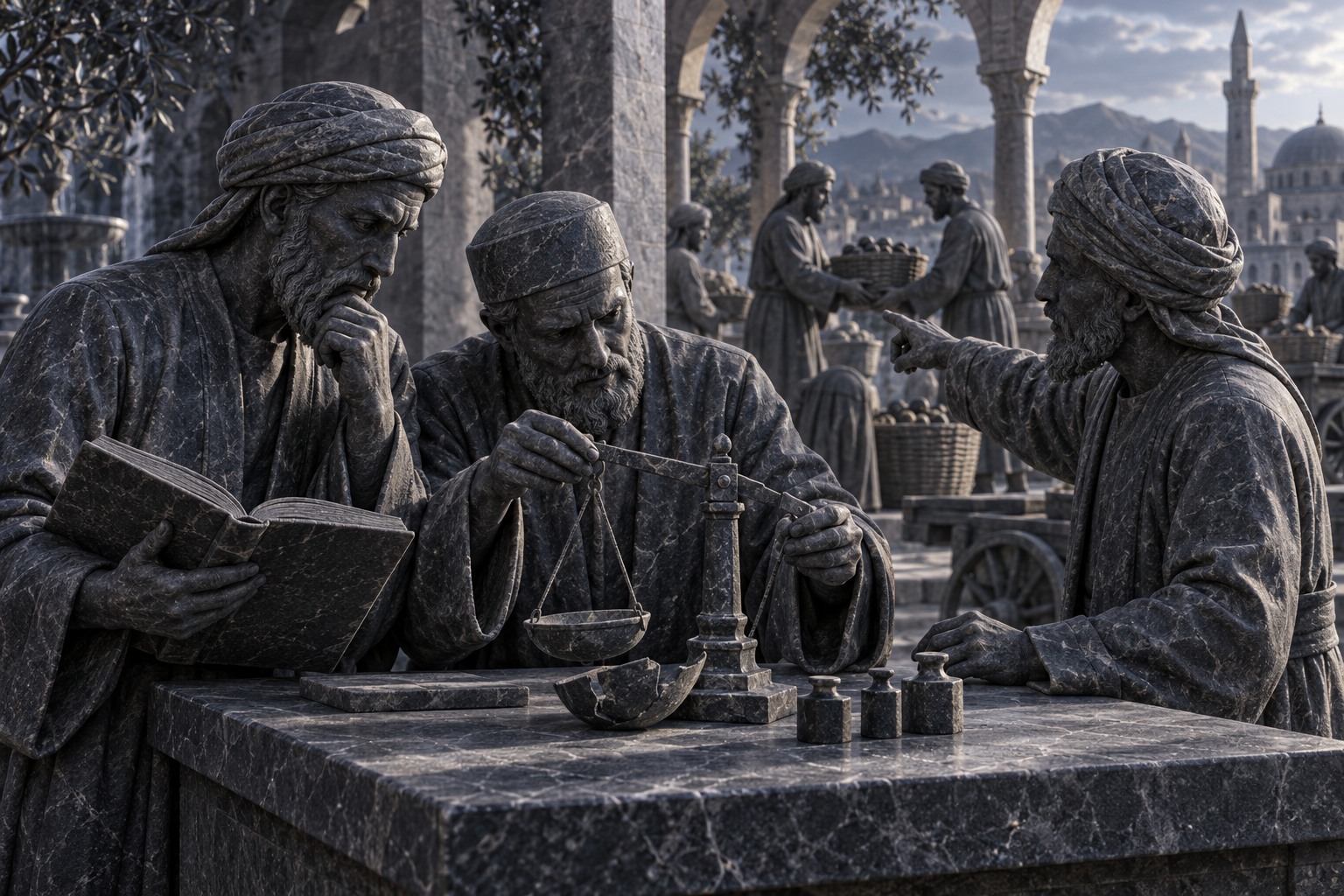
Three people discuss the same problem but ask different questions: does the conclusion withstand scrutiny, does it accord with its religious grounds, and does understanding change how someone lives? This hypothetical scene opens a path into the history of falsafa, kalam and tasawwuf. These names do not designate three stages in which reason gives way first to faith and then to experience. They identify overlapping fields of inquiry, debate and practice within Islamic culture. We will examine their tasks, standards of persuasion and possible errors, then explore their intersections through al-Ghazali. Comparisons with Aristotle, a Platonic dialogue and a Buddhist text will help distinguish proof from authority, and ethical discipline from agreement with the right words. The contemporary applications belong to our analysis; they do not turn historical disciplines into a universal prescription. The central question is how to identify the work a problem requires before judging the answer.
I. Three names do not form a ladder of maturity
Begin by rejecting a convenient hierarchy. Neither history nor meaning justifies arranging these names as “first faith, then reason, then higher experience.” That prematurely assumes one discipline replaces another and differences reflect personal development.
Three similar remarks arise at a hypothetical table. “That is impossible: the argument contradicts itself.” “You cannot read the text that way: its meaning would disappear.” “I know these words, but my life does not live up to them.” All discuss knowledge. Yet the first examines an argument, the second an interpretation, and the third their condition and conduct. The same reply to everyone soon makes conversation fruitless.
Islamic intellectual history is often organised as hastily: philosophers thought, theologians believed, and Sufis felt. The scheme is memorable and almost immediately becomes an obstacle. It takes arguments away from theology, intellectual work away from mysticism, and questions about life away from philosophy. Historical names become psychological types that the sources need not recognise.
In his study of natural philosophy in the Islamic world, Jon McGinnis examines both kalam and falsafa as intellectual traditions concerned with the structure of nature. Their differences included approaches to bodies, motion and causation. Thus “rational philosophy versus irrational theology” does not even describe their subjects accurately.
Ask instead what a particular argument attempts. Is it explaining what exists? Testing the consistency of beliefs? Defending a particular understanding of revelation? Investigating a change in behaviour? One author may move between these tasks and change their method of argument accordingly.
Someone hypothetically asks why they made a promise, whether they must keep it, and why they postpone it despite understanding the obligation. An answer to the third question will not replace an answer to the second. An honest admission of weakness does not cancel an obligation, and a precise rule does not automatically explain how to fulfil it. These distinct inquiries concern one episode.
The historical disciplines are much more complex than this example. But it reveals the ladder's mistake: solving one kind of problem does not establish superiority in others. A mathematical proof does not give a person a fully formed moral character. Serious religious practice does not make every argument they offer logically sound.
Once differences stop ranking people, we can examine them carefully. The question becomes “What does this way of inquiry make visible, and what lies beyond its reach?” rather than “Which person is higher?” That question preserves the participants' dignity and makes substantive disagreement possible.
Use “Islamic” carefully too. It may name an author's faith, working environment, subject or intellectual language. These need not coincide. Marenbon, for example, describes commentators in Baghdad who were Muslims and Christians. An era's name cannot predetermine its participants. A shared language of scholarship does not entail a shared faith, and a shared faith does not entail a single philosophical answer.
The distinction helps with modern catalogues too: categories organise searches without describing each work. Shelving a book under philosophy does not remove its religious commitments. Shelving it under religion does not make its arguments automatically immune to scrutiny. The catalogue helps us find the text; the text helps us examine the catalogue. Without that movement, classification produces conclusions instead of reading.
II. Falsafa: an explanation must withstand scrutiny
Falsafa is not modern secular science: it is historically situated philosophy, translating and transforming Aristotle and other ancient authors. Inheritance is not copying: a thinker may retain a question and reshape its answer.
In his survey of medieval philosophy, John Marenbon shows the diversity of this work and its later intersections with kalam. Avicenna, in particular, did more than comment on earlier texts: he constructed his own philosophical system. This history does not fit a scheme in which reason appeared once and then disappeared after religion intervened.
Explanation matters to the reader. A persuasive conclusion is insufficient: identify its premises and whether they must be accepted. Ordinary arguments often confuse two different moves: someone shows that they dislike the consequence and assumes they have thereby refuted the reasoning. Yet an unwelcome conclusion may follow from grounds they themselves have accepted.
In a hypothetical situation, someone says, “Anyone who makes a mistake is incompetent.” They then become indignant when the rule is applied to them. Several revisions are possible: acknowledge their own incompetence, abandon the original premise, or clarify what counts as a mistake. Irritation alone accomplishes none of these.
Philosophy's useful rigour exposes hidden transitions. Observing that someone sometimes relies on other people's opinions does not establish that all their beliefs are false. Recognising the causes of an action does not establish an absence of responsibility. An argument is needed to connect the propositions.
Explanation nevertheless has limits. An elegantly organised system may contain a disputed premise; logical consistency does not guarantee agreement with the facts. When the subject is the observable world, the information must also be checked. Respect for philosophical reasoning does not require treating every historical cosmology as current physics. Readers can examine an argument without accepting its natural philosophy.
III. Kalam: belief becomes a subject of argument
Kalam involves rational discussion of theological questions. Its commitments differ from those expected of contemporary philosophy without religious affiliation. Commitments do not exclude argument: how are they articulated, defended and connected?
The study of natural philosophy already mentioned shows theological discussions of atoms, change and causation. Theologians did not all hold the same positions. “Kalam” is not the name of one immutable theory that can be attributed to every Muslim author without qualification.
To understand this conversation from within, it helps to distinguish an accepted foundation from a particular interpretation. Someone may acknowledge a text's authority while disputing what follows from it. They may regard a claim as binding yet reject the proposed way of defending it. Disagreement with an argument does not always mean abandoning faith.
A hypothetical community says that justice is necessary. One participant thinks justice means the same rule for everyone; another thinks it requires attention to different circumstances. They need not yet disagree about the value of justice itself. Their dispute concerns its content and application. Calling one a “defender of justice” and the other an “opponent” loses the subject of the conversation.
Let us continue that hypothetical situation. Both participants may appeal to the same recognised foundation of justice, but the first adds the premise that equality always requires identical action, while the second adds that a relevant difference in circumstances changes how the principle should be applied. Examine those additional premises: shared values have not decided between them. Within the conversation, one argument may be stronger even though an outside listener has not accepted the initial authority. That listener faces a different question: why is this foundation binding? Both discussions can coexist if internal success is not presented as persuading every reader. The distinction clarifies theology's argument while leaving its commitments open to inquiry.
This internal work is not closed to external questions. A reader may ask why the original text's authority is accepted, what supports a particular interpretation, and how contradictions are resolved. That external question is not the tradition's only question.
There is also a risk of defensive reasoning. If every possible difficulty is redescribed in advance so that the belief cannot change, the argument becomes immune to testing. This risk is not exclusive to theology. Someone can defend a political idea, a family legend or their own image as a reasonable person in exactly the same way.
Studying kalam therefore requires two movements. First understand what an author is defending and why the question matters in their setting. Then examine how well the proposed answer withstands an objection. Premature contempt obstructs the first movement; premature agreement obstructs the second.
IV. Tasawwuf: knowledge touches the way one lives
Tasawwuf, usually associated with Sufism, includes spiritual practice and reflection on that practice within Islamic life. It cannot be reduced to emotional intensity or any unusual experience. In his study of mysticism in Arabic and Islamic philosophy, Mehdi Aminrazavi shows the practical and philosophical dimensions of this field and its intersections with other intellectual traditions.
A question arises here that the truth of a proposition does not exhaust: how does knowledge exist in the person who knows? Someone may explain gratitude beautifully yet continually behave as if other people's help deserves no attention. They may demonstrate the importance of patience and fail to tolerate a brief disagreement. The gap between speech and action does not automatically make the speech false, but it changes the question about the person speaking.
Someone hypothetically knows and can defend the prohibition on humiliation, yet quickly mocks an opponent. Offering another definition of dignity may do little: the definition has already been learned. What needs investigation is the sequence of events, their attention to themselves, and how they act.
This contemporary example does not fully describe Sufi discipline. Within the religious tradition, broader aims, relations with God, guidance and forms of practice are at issue. Removing that context to produce a universal technique would be historically inaccurate.
Practice does not, however, cancel scrutiny of statements. An experience of clarity may matter deeply to someone, but by itself it does not persuade another person that every conclusion is true. “I have lived this” conveys something about the speaker's experience; it does not yet establish that they have explained its source and meaning correctly.
Intellectual and practical work may therefore need one another. Reasoning helps identify an error that experience overlooks. Practice exposes a gap that sound reasoning does not remove. Their connection does not require declaring them identical. It becomes more precise when each retains its own question and does not appropriate the other's achievement.
V. One author can stand at an intersection
The history of these intersections prevents us from turning three names into three camps. Marenbon's survey follows medieval ways of doing philosophy through their development: later authors combined Avicenna's inheritance, kalam and Sufi themes. Al-Ghazali is particularly inconvenient for a simple scheme because he discussed philosophy, theology, law and spiritual life.
Intersection does not mean indiscriminate mixing. An author may accept a tool while criticising a particular conclusion reached with it. They may recognise the usefulness of logic without accepting the philosophers' entire metaphysics. They may consider a theological argument necessary for one task and insufficient for another.
In a hypothetical contemporary project, an architect uses mathematics, takes legal requirements into account and investigates the experience of space. This does not make mathematics, law and human experience one subject. Nor does it eliminate possible conflict between them: an attractive solution may break a rule, a permitted solution may be inconvenient, and a comfortable one may require complex calculations.
The historical analogy is limited, but it shows how an intersection works. Different forms of knowledge come together because a task reaches into several fields, not because their differences disappear. Competence also includes noticing when a different question needs to be asked.
When reading an author, it is useful to mark these transitions. Here they are demonstrating something; here interpreting a text; here describing religious experience; here engaging in polemic; here proposing action. Genre changes need not be inconsistent, but must be visible to prevent transferring one kind of support to another.
For example, historically established evidence that a practice existed does not prove its metaphysical explanation. A persuasive ethical observation does not establish the truth of the cosmology described alongside it. A coherent belief system is not an experimental report. Each claim needs grounds appropriate to its subject.
The reader need not choose a single cell in a table on an author's behalf. Instead, we can follow the movement of their thought: which problems make them change tools, what survives the transition, and where new commitments arise. Complexity becomes part of the text rather than an obstacle to classification.
VI. Different ways of persuading require different checks
A dispute about knowledge often becomes a dispute about speaking styles. One person sounds confident and quick, another cautious, and a third vivid and personal. Listeners may mistake impression for support. But a confident voice does not confirm a premise, caution does not prove an error, and a moving story does not replace an argument.
Al-Farabi considered society, education and different ways of presenting knowledge. In her study of his philosophy of society and religion, Cleophea Ferrari shows the importance of these questions within his own system. We are not adopting his political model as a ready-made contemporary programme. What matters here is the possibility of distinguishing the content of a thought from the way it is communicated.
A hypothetical teacher explains one proposition with a formula, a drawing and a story. The drawing makes a relation visible but may conceal an exception. The story holds attention but may give a single case the appearance of a general rule. The formula is precise under specified conditions but does not itself tell us where those conditions obtain. Each form remains valid but needs its own check.
The same care is needed when reading philosophical reasoning, theological polemic and an account of a spiritual path. Reconstruct an argument as a sequence of premises. Understand a polemic alongside the opponent's position. Distinguish a description of experience from an explanation of experience and from a prescription for the reader. Calling all three “opinions” loses these differences.
Conversely, allowing only one mode of speech hides everything not expressible as proof. Yet an account of fear may be needed to understand which question someone can discuss at that moment. It will not become proof of metaphysics, but it will change the conditions of the conversation.
Precision means refusing unwarranted transfers. Respect for a storyteller does not entail agreement with every conclusion. Finding a contradiction does not entail contempt for their life. The importance of an experience does not confer a right to cancel factual scrutiny. Distinctions make disagreement harder, which is precisely why it has a chance to become more than an exchange of impressions.
Audience matters too. Understanding an explanation without yet being able to convey it does not refute it: learning takes time. However, invoking the difficulty of communication must not replace communication forever. When a claim affects other people's decisions, they need accessible grounds or an honest admission that they are being asked to trust it.
A hypothetical organiser says, “Trust me, this is the right path; once you have followed it, you will understand.” Perhaps the path involves experience that cannot be fully anticipated. Before starting, participants are still entitled to know the conditions, costs, possibility of stopping, and limits of the promises. Different methods do not remove responsibility for inviting people. They help clarify what can be explained now and what will remain a matter of personal experience.
VII. Where each field can go wrong
It is useful to test this map of inquiry through its vulnerabilities. This contemporary framework is not an exhaustive historical diagnosis. It prevents their names from becoming honorary titles that exempt their holders from scrutiny.
Reasoning can be tempted to replace its subject with a beautiful system. Someone values the coherence of an explanation so much that they disregard whatever does not fit. In a hypothetical dispute, they derive consequences accurately without checking whether the initial situation has been described correctly. The argument works like a functioning tool applied to the wrong task.
Defending a belief can tempt someone to make it invulnerable. Every confirmation counts; every refutation is declared a misunderstanding. Questions are still permitted, but changing the answer is impossible. Readers should notice not just the arguments offered but the conditions under which an author would be willing to revise their position.
Discussion of inner work can tempt someone to make the criterion private. They say they cannot be understood without the same experience and then demand unconditional trust in their conclusions. But the impossibility of fully conveying an experience does not automatically authorise control over other people, especially where money, relationships, consent or safety are involved.
One might object that these mistakes are too general. They are: they do not belong to a single culture. The map must not catalogue others' failings. It helps us ask what form an error takes in a particular text and what means of scrutiny are available within that conversation.
Looking for internal self-criticism is therefore useful too. An author may distinguish real knowledge from displays of learning, religious devotion from self-admiration, and an argument from a verbal victory. Reading that distinction matters more than assigning a tradition the role of a naive opponent of modern reason in advance.
Self-criticism does not establish that every problem has already been solved. It shows participants' own questions; outside readers may add others. Inquiry continues where we can name a significant difficulty without destroying a person's dignity or relaxing the demands on their claim.
VIII. Knowledge, grounds and action in particular texts
A useful comparison puts a question to each position that can be examined; it does not distribute traditions among three ready-made boxes. Ancient Greek philosophy does not become falsafa as a whole, Christian theology does not become kalam, and Buddhist practice does not become tasawwuf. The historical names belong to particular languages, schools and disputes.
In Plato's Euthyphro, 10a–11b, Socrates distinguishes approval by the gods from the grounds of piety. This reveals why appealing to authority and explaining a judgement may require different work. Alongside al-Farabi's account of religion and philosophy, the question helps distinguish effective persuasion from a form of proof. But a dialogue about Greek gods does not formulate an Islamic answer about the one God, nor does merely asking its question refute religious thought.
Aristotle in Book II of the Nicomachean Ethics connects ethical character with repeated actions. Al-Ghazali in Deliverance from Error, §§80–85, distinguishes understanding the Sufi path from putting it into practice while examining his own intention. The intersection is precise: knowing a description is not yet living accordingly. The difference is equally important: acquiring virtue in Aristotle and directing oneself towards God in al-Ghazali do not automatically give happiness, purpose or help the same meaning. We can compare the gap between knowing and acting without declaring their entire ethical systems identical.
In AN 3.65, qualities are evaluated in relation to harm, benefit and the judgement of the wise. The text is useful alongside a discussion of the criteria of belief: accepting an opinion simply because it has been handed down or seems persuasive is insufficient. It does not follow that one may choose any view according to taste; the sutta's criterion is not a method for deriving an Islamic religious or legal judgement.
The three speakers therefore need not express everything in one language. One may find an unsupported transition, another a misread foundation, and a third a discrepancy between intention and conduct. In a successful conversation their observations complement one another only once the task has been named. If someone wants a historical explanation, personal experience alone is insufficient. If an action is being discussed, impeccable classification does not perform it for us. The map of inquiry serves this distribution of responsibility.
IX. A map that leaves pathways open
Falsafa, kalam and tasawwuf are useful names for spaces of inquiry if we do not turn them into fences. They help us see different tasks, forms of argument and relationships between knowledge and life. They stop helping when they explain an entire person in advance.
The historical Islamic world did not speak with one voice. Philosophical inheritances were translated and transformed; theological propositions were debated; spiritual life was reflected upon. Authors argued and borrowed, sometimes combining what later schemes would place in separate columns. This complexity calls for sources and attention to particular works.
It cannot supply a simple formula for modern self-help. Historical disciplines have their own aims, concepts and religious commitments. Yet we can learn to ask more precise questions in our own conversations. What kind of claim is being made? What would count as sufficient support? Who needs to be persuaded, and how?
Return to the three remarks at the table. A contradictory argument requires a better argument. An unclear interpretation requires work on the text and its grounds. A gap between words and life requires investigation of the action itself. None of these tasks has to demean the other two to retain its importance.
Readers may notice their inclinations: debating principles instead of admitting a mistake, describing experience instead of testing conclusions, or invoking authority instead of checking its words. Such an inclination is not a diagnosis; it indicates work we habitually leave to someone else.
A good map does not spare us the journey. It shows passages between fields and warns where one tool no longer answers the question that has arisen. Different modes of inquiry then offer a way to continue a conversation more precisely, rather than three ready-made answers.
That conversation remains open without promising universal agreement. Its success may consist in participants finally understanding what they disagree about and ceasing to demand that someone else's answer solve a question it was not made to address.
What this means in practice
In everyday life, this map may help define a question more precisely. It does not offer to turn someone into a philosopher, theologian or Sufi in a few steps. The work is more modest: stop demanding that one answer provide something it cannot give.
Consider a hypothetical promise to help someone close to you. First comes a factual question: what exactly was said, under what conditions, and what has changed? Clarify it before beginning general discussions of duty. Then comes the question of grounds: why does the promise bind someone, and which exceptions matter? This begins reasoning about a norm. Finally comes the question of fulfilment: what prevents the promised action, and what step is available now?
Confusing the order can produce a persuasive but useless answer. Someone receives a lecture on responsibility when they already acknowledge the obligation and cannot organise the help. Or they are told to calm down when the content of the promise is still unclear. Or scheduling details are discussed when the participants understand the obligation differently.
The practical check consists of three brief formulations. “What I need to establish now is…” concerns a fact. “What I need to understand is why…” concerns grounds. “What I need to examine is how…” concerns action. These sentences need not encompass every situation, but they often show where a conversation has jumped too far ahead.
The next question concerns the source of confidence. Am I certain because I saw something? Because I reconstructed an argument? Because I trust a particular authority? Because an experience was powerful? Several grounds may be present, but it helps not to collapse them into one unclear feeling. The next worthwhile check then becomes easier to identify.
Finally, leave room for a result that does not settle everything. You can clarify a fact without choosing an action yet. You can recognise a contradiction and retain your religious affiliation. You can change your behaviour without fully explaining its previous causes. A partial result is more honest than a grand claim concealing unresolved questions.
This way of conversing preserves effort as well as precision. It helps us stop repeating the same correct answer to three different questions. Sometimes a shift follows not from new information but from recognising which work remains undone.
Key quotation
“We become just by performing just actions.”
Aristotle, Nicomachean Ethics, II.1, 1103b; source English translation by W. D. Ross. Editorial English rendering of the approved Russian version, not the published English wording. The formation of virtue is compared with a discipline of life while retaining their different religious foundations.
Connections across traditions
These are our analytical comparisons. Historical influence is not asserted where no evidence for it is supplied.
| Subject | Positions and supporting texts | What can be compared | Where the boundary lies |
|---|---|---|---|
| Experience and explanation | Falsafa: natural science — Aristotle, Metaphysics I.1 | Inquiry distinguishes accumulated experience from explanation. | Falsafa has its own history of translations and transformations; similarity does not make all its authors Aristotelians. |
| Authority and argument | Al-Farabi: religion and philosophy — Plato, Euthyphro 10a–11b | Approval and an explanation of grounds are not the same question. | The Greek debate about gods does not provide a ready-made Islamic theological answer. |
| Knowledge and life | Al-Ghazali, §§80–85 — Aristotle, Ethics II.1 | Understanding a description is distinguished from acquiring the corresponding quality. | Habituation to virtue and purification of intention towards God belong to different ethical systems. |
| The limits of representation | Islamic mystical philosophy: a survey — Pseudo-Dionysius, I.1–2 | Religious knowledge can question the enclosure of what is highest within a concept. | The survey presents different authors' positions; Dionysius's Trinitarian theology is not identical to tasawwuf. |
| Testing conviction | Al-Farabi: forms of persuasion — AN 3.65 | Persuasiveness and sufficient grounds are distinguished. | Evaluating harm and benefit in the sutta does not replace philosophical demonstration or an Islamic method of inquiry. |
| Discipline and external things | Al-Ghazali: practice, §§80–85 — Epictetus, §§1–2 | Work on oneself requires distinguishing one's own action from external recognition. | Stoic responsibility for judgement is not identical to al-Ghazali's intention and religious purpose. |
Sources
Primary texts, normative documents and research commentary are identified separately in the descriptions. The section's title does not turn a scholarly reference study into a primary text.
- Jon McGinnis. Arabic and Islamic Natural Philosophy and Natural Science. Stanford Encyclopedia of Philosophy. Introduction and sections on kalam and falsafa.
- John Marenbon. Medieval Philosophy. Stanford Encyclopedia of Philosophy. §§2.3–2.4 and discussion of later intersections between disciplines.
- Mehdi Aminrazavi. Mysticism in Arabic and Islamic Philosophy. Stanford Encyclopedia of Philosophy. Introduction and §1; practical and philosophical dimensions.
- Cleophea Ferrari. al-Farabi's Philosophy of Society and Religion. Stanford Encyclopedia of Philosophy. Introduction and §§2–3; forms of knowledge, society and education.
- Aristotle. Metaphysics, I.1, 980a21 and the following discussion of experience; English translation by W. D. Ross. Primary text: the opening inquiry into knowledge. Text and passage used.
- Aristotle. Nicomachean Ethics, II.1–2, 1103a–1103b; English translation by W. D. Ross. Primary text: acquiring ethical qualities through action. Text and passages used.
- Plato. Euthyphro, 10a–11b; Project Gutenberg English edition. Primary dialogue: the relationship between piety and divine approval. Text and passage used.
- Al-Ghazali. Al-Munqidh min al-Ḍalāl / Deliverance from Error; English translation by Richard J. McCarthy. Primary text: certainty, logic, knowledge of the path and its enactment; selected §§6–24, 37–45, 80–85. Text and passages used.
- AN 3.65, Kālāma / Kesamutti Sutta; translated by Thanissaro Bhikkhu. Primary Buddhist text: evaluating qualities and actions with regard to harm, benefit and the judgement of the wise. Text and passage used.
- Pseudo-Dionysius the Areopagite. Mystical Theology, I.1–2; English translation by John Parker, 1897. Primary text: an apophatic approach to God in a Trinitarian context. Text and passages used.
- Epictetus. Enchiridion, §§1–2; English translation by Elizabeth Carter. Primary text: distinguishing what depends on us from what does not. Text and passages used.
Tags
falsafa, kalam, tasawwuf, Islamic philosophy, Islamic theology, Sufism, knowledge, inquiry, reason, faith, practice, proof, persuasion, authority, revelation, al-Farabi, al-Ghazali, Avicenna, Aristotle, Plato, Euthyphro, virtue, intention, discipline, dialogue, history of ideas, interpretation, Buddhism, criteria of knowledge, cross-cultural comparison
About the authors
Andrey Zarinsh is the author and founder of United Wisdom. He explores inner transformation, the unity of traditions, intercultural dialogue and contemporary spiritual discipline. Instagram: @andrey.zarinsh.
Maria Evilkut is the co-author of United Wisdom. Alongside her research, she seeks to test these ideas in practice and observe how principles of unity and mutual understanding work in real life between people and cultures. Instagram: @ilkutki.
Keep what resonates with you.