
Inner world
The High Priestess Archetype
An authorial exploration of intuition, pauses, and silence through Jung, Tarot, traditions, and cultural figures.
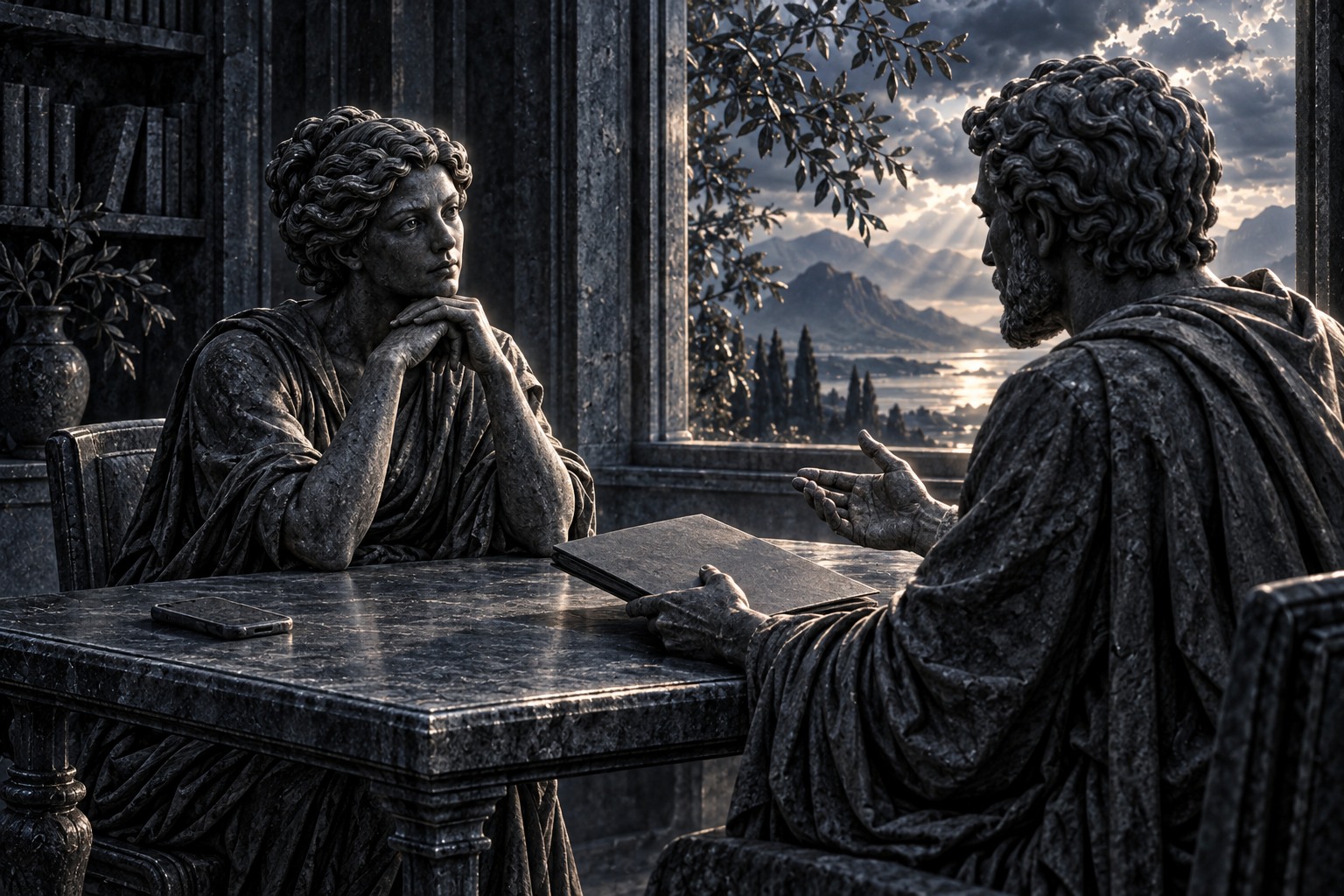
The magic of silence and the whisper of intuition—from the Delphic oracle to Galadriel
Andrey Zarinsh & Maria Evilkut · United Wisdom · Inner Transformation · Author series
Archival translator’s note. This translation preserves the archived essay’s arguments and wording of certainty. Its equation of archetypes with neuroscience, generalizations across religious traditions, and claims about the healing power of silence are authorial interpretations, not conclusions newly verified here. The cited mouse study does not by itself establish benefits of a human “day of silence.” The archetype is not a diagnostic category or a guarantee that intuition is correct.
“I am all that has been, is, and shall be, and no mortal has ever lifted my veil.”
— Inscription at the temple of Neith in Sais, transmitted by Plutarch (Veil of Isis)
What This Article Is About
There are people whose strength lies not in words but in their absence. They do not argue, persuade, or compete for the spotlight—and yet they are the ones people turn to for a final word of advice. This is the High Priestess archetype: not the one who changes the outer world by force of will—that is the Magician—but the one who hears the world before it has time to announce itself. Her tools are silence, a pause, and intuition. We will travel from the Jungian anima and the second Tarot trump through hesychasm, the Tao, and Delphi to the neuroscience of intuition and silence, examine the archetype’s light and shadow, and end with a practice for restoring contact with the inner voice.
I. Who Is the Priestess? The Effect of Presence
The Priestess is not immediately noticed; she is felt. She is rarely the life of the party and does not fight for attention, but something changes in a room when she is there: a sense of depth, calm, and slight detachment appears, as though the person knows something she is not saying. Her greatest superpower is being a Listener: even people she barely knows begin pouring out their hearts to her. She says little herself, but her rare remarks hit their mark. She is the colleague who, before a questionable deal, quietly says, “I wouldn’t go there. I have a bad feeling”—and later, when everything falls apart, does not say “I told you so,” but simply nods in silence.
In analytical psychology, Carl Gustav Jung described this image through the anima, Latin for soul: the feminine image of the soul in a man’s psyche, a bridge between consciousness and the collective unconscious. “The anima is the archetype of life itself,” he wrote (Jung, CW9i §66). Jung distinguished four stages of its development: Eve, Helen, Mary, and finally Sophia-Wisdom, a guide to inner life. It is this highest stage that is the High Priestess (Jung NY Center). In his typology, too—Psychological Types, 1921—she embodies the function of intuition: a perception that grasps the whole without passing through analysis. She knows without knowing how she knows.
The image on the card itself—the second Tarot trump—is a cipher for the archetype. In the Rider–Waite deck, created by Arthur Edward Waite and artist Pamela Colman Smith in 1909, the Priestess sits between the two pillars of Solomon’s Temple: white Jachin and black Boaz. She holds a scroll inscribed TORA; behind her is a veil patterned with palms and pomegranates; a crescent moon lies at her feet; the crown of Hathor rests on her head (The High Priestess). Waite explicitly identified her with the Shekhinah, the feminine presence of God. The veil behind her is that very “veil of Isis”: knowledge exists, but remains hidden from those not ready to lift it.
II. The Light Side: Emotional X-Ray Vision and the Power of a Pause
The Priestess’s first gift is intuition as a precise instrument, not a vague “hunch.” She reads undertones, hints, and hidden motives; she is difficult to deceive because she hears the mismatch between words and nonverbal expression. Neuroscience calls this the work of the fast system. In Thinking, Fast and Slow (2011), Daniel Kahneman described System 1—instantaneous, automatic, intuitive—as the “secret author of many of our choices,” which the slow System 2 merely endorses afterward (Thinking, Fast and Slow). In Blink (2005), Malcolm Gladwell called this mechanism thin-slicing: expert art historians sensed a forgery before they had time to analyze it (NPR).
Yet the Priestess’s intuition is neither magic nor whim. Studying fire commanders, Gary Klein described Recognition-Primed Decision-making: an expert does not run through alternatives but instantly recognizes a situation as a familiar pattern. In their joint paper of 2009, he and Kahneman agreed on a strict condition: expert intuition is reliable only where the environment is predictable and there has been prolonged feedback (Gary Klein, RPD). In Descartes’ Error (1994), Antonio Damasio showed that intuition is literally embodied: his somatic marker hypothesis explains how bodily signals guide choice. Patients who had lost contact with those signals retained their intelligence but could not make decisions (Somatic marker hypothesis). The Priestess is a person who has learned to trust this bodily compass.
Her second gift is the power of a pause. Unlike the impulsive Magician, the Priestess knows that not every door should be forced open. She sits down beside it and waits for the situation to reveal itself. This is not passivity but a strategy, one with a physiological basis as well. Luciano Bernardi and colleagues, writing in Heart in 2006, discovered a paradox: two-minute silent pauses between musical excerpts lowered blood pressure and pulse more than the most relaxing music. Silence proved more powerful than sound (Bernardi et al., Heart). And Marcus Raichle, in 2001, described the brain’s Default Mode Network, which becomes active precisely at rest and nourishes self-understanding, memory, and imagination—the soil of intuition (DMN).
The third gift is the capacity to hold. The Priestess contains other people’s emotions, keeps secrets, and does not chatter about what has been entrusted to her. This is psychological maturity: access to depth without the need to convert it immediately into words or influence.
III. The Dark Side: The Snow Queen
Every light has its shadow. When the archetype takes over the whole personality, contemplation degenerates into coldness. The first point of failure is alienation: the Priestess shuts herself away from the world and becomes an arrogantly inaccessible “thing in itself,” contemptuous of “worldly passions” and “foolish people.” Psychoanalysts—Karen Horney in The Neurotic Personality of Our Time (1937), and Donald Winnicott—described this schizoid detachment as a defense. “I am too deep to explain” is a convenient formula for letting no one in.
The second trap is passive manipulation. The Priestess’s shadow turns silence into a weapon. Knowing other people’s weaknesses, she weaves invisible intrigues, sets people against one another, and stands aside wearing a saintly expression. In everyday life, this is punishment through silence and being ignored. In experiments using the game Cyberball, Kip Williams of Purdue University demonstrated that even brief ostracism strikes at four basic needs: belonging, self-esteem, a sense of control, and meaningful existence. The brain experiences the “silent treatment” as pain (Williams, 2007). The silence that healed begins to wound.
The third abyss is retreat into illusion. Instead of dealing with earthly tasks, a person flies away into endless analyses of dreams, signs, and card readings. Intuition here degenerates into escapism: reading cards instead of acting, seeking “signs” instead of looking honestly at facts. Viktor Frankl would have called this a form of existential vacuum: when the inner voice falls silent and external rituals take its place. The Priestess’s shadow is no longer silence, but muteness.
IV. Echoes of Traditions: Knowledge Beyond Words
It is remarkable how dissimilar cultures converged on one point: the highest knowledge comes not through speech but through silence and inner openness.
In Orthodox Christianity, this is hesychasm, from the Greek ἡσυχία, hesychia, “silence, stillness,” systematized by Gregory Palamas, circa 1296–1359: the unceasing Jesus Prayer in the rhythm of breathing, “noetic work” that brings the mind into the heart. The teaching was affirmed by the councils of 1341 and 1351 (Gregory Palamas). Pseudo-Dionysius the Areopagite, at the turn of the fifth and sixth centuries, took this logic to its limit in apophatic theology, via negativa: God is “better characterized through negations than through affirmations,” because God exceeds every word (SEP). In Taoism, the same thought sounds in chapter 56 of Laozi’s Dao De Jing: “One who knows does not speak; one who speaks does not know.” The principle of wu wei, “non-action,” teaches following the current rather than imposing one’s will (Dao De Jing, chapter 56). And Quakers, the Society of Friends dating from the 1650s, pray in complete silence, awaiting the “inner light” without priests or rituals (Quakers).
The most ancient Priestess is the oracle. The Pythia, Apollo’s high priestess at Delphi, spoke on behalf of the god. The maxim γνῶθι σεαυτόν, gnōthi seauton, “Know thyself,” was carved on a pillar of the temple: self-knowledge as the first step toward intuitive knowledge (Pythia). In Kabbalah, the feminine presence of God is called the Shekhinah: the tenth sefirah, the “Mother of Israel,” invisible yet palpable (Shekhinah). In Sufism, the organ of true knowledge is the qalb, the heart: a mirror reflecting truth when properly purified, as al-Ghazali and Ibn al-Arabi taught (Qalb). Everywhere, the same idea: knowledge comes not through logic but through inner openness and silence.
V. The Priestess on Screen and in Brands
The archetype is alive today; it has merely changed into a seer’s robe or a dressing gown.
Galadriel in J. R. R. Tolkien’s The Lord of the Rings (1954–1955) is the most exact embodiment of the Priestess in twentieth-century literature. Her mirror, a silver basin filled with water, shows “things that were, things that are, and things that yet may be.” When Frodo offers her the Ring, she refuses, saying, “I pass the test,” choosing to remain herself instead of becoming a dark queen (Mirror of Galadriel). Her power lies in abstaining from power. The Oracle in The Matrix, directed by the Wachowski sisters in 1999, is an older woman baking cookies in her kitchen. Above her door hangs the inscription Temet Nosce, “Know thyself.” She never speaks directly: she asks questions and gives precisely the hint Neo is ready for. The filmmakers deliberately alluded to Delphi (The Matrix, Temet Nosce). Master Yoda, teaching through silence and questions in the swamps of Dagobah, belongs to the same line.
The same archetype has long been at work in branding. In The Hero and the Outlaw (2001), Margaret Mark and Carol Pearson identified the Sage among twelve brand archetypes: its promise is knowledge, clarity, and expertise (Mark & Pearson). Private clubs and speakeasy bars are built on silence and secrecy: heirs to the clandestine establishments of Prohibition, 1920–1933, that admitted only insiders with a password (Speakeasy). The same logic appears in the niche “quiet luxury” of perfumery—Serge Lutens and Le Labo. Fragrances are not advertised or explained; the maker waits for the buyer to “grow into” them (niche perfumery). Value here is born not from shouting, but from silence.
VI. A Lesson for the Reader: Awakening the Inner Priestess
If you live in a state of endless hurry, your brain torn apart by information noise, your decisions driven by panic, and your contact with your body and inner voice lost, you need the Priestess. She begins not with a new action but with a stop.
The “Day of Silence” practice: give yourself an information detox for at least a couple of hours, preferably a whole day. Turn off notifications; spend time alone without music or podcasts; simply observe your thoughts. Allow yourself not to decide anything right now. There is a rigorous scientific justification for this pause. As early as 1926, Graham Wallas described four stages of creativity—preparation, incubation, illumination, verification. Insight is born precisely during incubation, when consciousness is distracted and the unconscious works freely (Wallas, The Art of Thought). Imke Kirste and colleagues showed in 2013 that even in mice, two hours of silence a day produced the most sustained increase in new hippocampal neurons, greater than music or noise (Is silence golden?). The answer comes by itself when the mental storm subsides.
But remember the shadow. The Priestess’s silence remains alive as long as it is open to the world rather than walled off from it. Silence used to punish, and detachment used to express contempt, are no longer depth but muteness. We discussed the discipline of inner silence that heals rather than wounds in detail in the United Wisdom article “Twenty Minutes of Silence.”
Here is the essence. The Magician teaches mastery of the external world: changing reality through focused will. The Priestess reminds us of the opposite, equally necessary truth: without an alliance with our own inner world, every external success will prove hollow. The Magician builds. The Priestess hears what is worth building. She is the quiet mirror of our soul: look into it before acting. The most important knowledge is already within you. Be silent—and you will hear.
Key Quotation
“One who knows does not speak; one who speaks does not know.”
— Laozi, Dao De Jing, chapter 56
Connections Between Traditions
- The veil of Isis, Egypt and Plutarch ↔ the High Priestess’s veil in Waite’s Tarot ↔ Pseudo-Dionysius’s apophatic theology: knowledge exists but is concealed beyond words.
- Hesychasm and Palamas’s “noetic work” ↔ Laozi’s wu wei ↔ Quaker silent worship: the highest truth comes in silence, not in speech.
- Jung’s intuition function ↔ Kahneman’s System 1 ↔ Damasio’s somatic markers: the ancient archetype and modern neuroscience describe the same gift of holistic knowing.
- Delphi’s “Know thyself,” γνῶθι σεαυτόν ↔ the Oracle’s Temet Nosce in The Matrix ↔ the Sufi mirror-heart, qalb: self-knowledge as a condition of all intuition.
- The Magician, will and outward doing ↔ the Priestess, intuition and inward listening: two neighboring archetypes; one changes the world, the other knows what in it to change.
Sources Listed in the Archive
- Jung, C. G. (1921). Psychological Types (CW6): anima, the intuition function. Animus-Anima; four stages of the anima.
- Jung, C. G. & Pauli, W. (1952). Synchronicity: An Acausal Connecting Principle (CW8 §850). IAAP.
- The High Priestess, second trump, Waite–Smith deck (1909): TORA, Boaz–Jachin pillars, Shekhinah. Wikipedia.
- The veil of Isis: Plutarch; Schiller, 1795. Veil of Isis.
- Gregory Palamas (1296–1359): hesychasm, Jesus Prayer, councils of 1341/1351. Gregory Palamas; Jesus Prayer.
- Pseudo-Dionysius the Areopagite: apophatic theology, via negativa. SEP.
- Laozi, Dao De Jing, chapter 56; wu wei.
- Quakers, the Society of Friends: silent worship.
- Pythia, Delphi: “Know thyself,” γνῶθι σεαυτόν. Pythia; Know thyself.
- Shekhinah, Kabbalah, the Zohar.
- The Sufi heart, qalb: al-Ghazali, Ibn al-Arabi.
- Kahneman, D. (2011). Thinking, Fast and Slow: Systems 1 and 2. Wikipedia.
- Klein, G. Recognition-Primed Decision; Klein & Kahneman (2009). RPD.
- Damasio, A. (1994). Descartes’ Error: the somatic marker hypothesis.
- Gladwell, M. (2005). Blink: thin-slicing. NPR.
- Raichle, M. et al. (2001). Default Mode Network. DMN.
- Bernardi, L. et al. (2006). Heart 92(4):445–452: silent pauses. Heart/BMJ.
- Kirste, I. et al. (2013). Brain Structure and Function: silence and neurogenesis. PubMed.
- Wallas, G. (1926). The Art of Thought: four stages of creativity, incubation. The Marginalian.
- Williams, K. D. (2007). Ostracism: Cyberball, silent treatment. Annual Review of Psychology.
- Tolkien, J. R. R. (1954–55). The Lord of the Rings: the Mirror of Galadriel.
- The Matrix (1999, the Wachowskis): Temet Nosce, the Oracle.
- Mark, M. & Pearson, C. (2001). The Hero and the Outlaw: the Sage archetype. Brand archetypes.
- Speakeasies, the Prohibition era (1920–1933).
Tags
High Priestess archetype, anima, intuition, silence, pause, collective unconscious, System 1, somatic markers, Default Mode Network, incubation, oracle, Pythia, know thyself, hesychasm, wu wei, apophatic theology, Shekhinah, qalb, Tarot, veil of Isis, ostracism, silent treatment, Galadriel, the Matrix Oracle, Jung, Kahneman, Damasio, United Wisdom.
About the Authors
Andrey Zarinsh (@andrey.zarinsh) and Maria Evilkut (@ilkutki) are the author duo behind United Wisdom. We bring together the precision of science and the depth of traditions to discuss inner transformation without esoteric simplifications: with names, dates, and verifiable sources.
Andrey Zarinsh & Maria Evilkut · United Wisdom · Laboratory of Integrated Wisdom.
References Inherited from the Archive
These source links were inherited, not newly verified.
- PDF-L001 — source PDF page 2.
- PDF-L002 — source PDF page 2.
- PDF-L003 — source PDF page 2.
- PDF-L004 — source PDF page 3.
- PDF-L005 — source PDF page 3.
- PDF-L006 — source PDF page 3.
- PDF-L007 — source PDF page 3.
- PDF-L008 — source PDF page 3.
- PDF-L009 — source PDF page 4.
- PDF-L010 — source PDF page 4.
- PDF-L011 — source PDF page 4.
- PDF-L012 — source PDF page 5.
- PDF-L013 — source PDF page 5.
- PDF-L014 — source PDF page 5.
- PDF-L015 — source PDF page 5.
- PDF-L016 — source PDF page 5.
- PDF-L017 — source PDF page 5.
- PDF-L018 — source PDF page 5.
- PDF-L019 — source PDF page 5.
- PDF-L020 — source PDF page 5.
- PDF-L021 — source PDF page 6.
- PDF-L022 — source PDF page 6.
- PDF-L023 — source PDF page 6.
- PDF-L024 — source PDF page 6.
- PDF-L025 — source PDF page 6.
- PDF-L026 — source PDF page 7.
- PDF-L027 — source PDF page 7.
- PDF-L028 — source PDF page 8.
Keep what resonates with you.