
Inner world
Comparing bodies and the invisible cost of an ideal
How body comparison turns a preference into an overall ranking; see an ideal’s cost and return to a specific task while retaining beauty and participation.
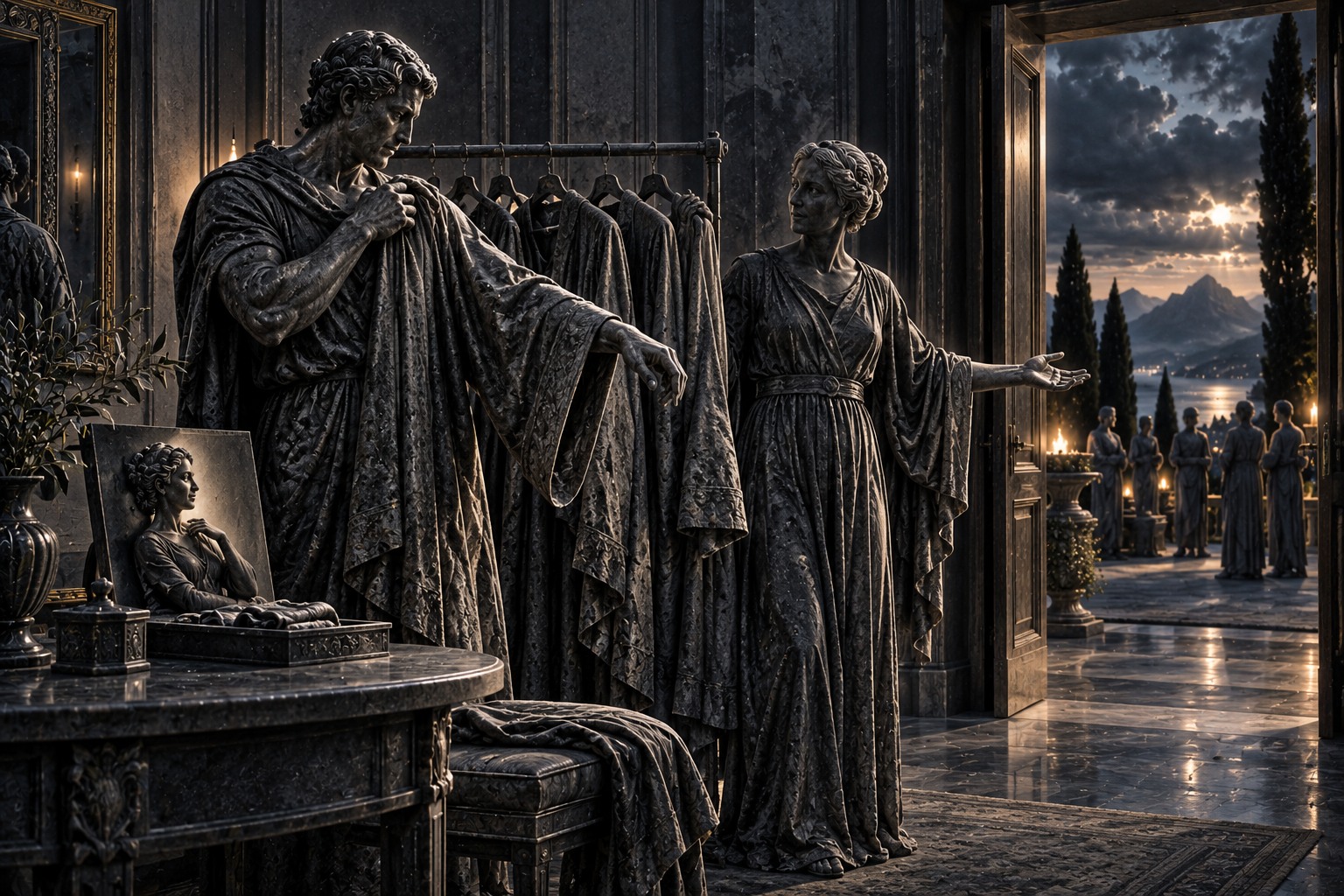
Epigraph
“I am better.”
Epictetus, Enchiridion, §44, translated by Elizabeth Carter. A brief fragment of an invalid conclusion which the author examines and rejects. [S2]
What this article is about
A woman is choosing a dress for a gathering of friends and opens photographs of a previous celebration. Initially she needs a colour and a cut. A few minutes later, the question changes: why does another guest's body look different? The dress has not been chosen, but a new list of faults has appeared. Comparison did not necessarily begin with someone else's demand. It may have quietly turned a useful search for clothing into an assessment of her right to attend.
This article examines body comparison and the cost of an ideal which an image usually leaves invisible. We consider the move from a particular feature to an overall ranking of a person, the uncertainty of the standard, and the resources required to meet it. You can notice beauty, learn about style, and have your own preferences without declaring every difference a defeat. An actual study of brief contact with a social network and a Stoic examination of a faulty inference offer limited points of reference. The main discussion uses hypothetical scenes: how to recognise what you are comparing, for which task, and what the cost of a chosen ideal changes in your life.
I. The question itself can change within one comparison
A comparison starts with two objects and a particular feature, but it does not always end there. You might notice that two dresses have different lengths or that two people look different in a photograph. A different question then appears: which person is better overall? The first observation does not necessarily provide grounds for this transition. The feature may be real while the overall conclusion still requires separate examination. This change of question is particularly easy to miss when an image provokes a strong response.
In the opening scene, the woman wanted clothing for an evening gathering. Relevant information concerned size, colour, comfort, weather, and the kind of occasion. Someone else's photograph could help her see a combination of fabrics. But if she postpones the decision until her body changes, the task has expanded. She now needs to meet a condition which the invitation did not contain. It helps to name that condition directly: to go, I seem to have to look like the person in the picture first. She can then examine who actually imposed this condition and what function it serves.
We should not declare every comparison pointless in advance. Sometimes comparison reveals a preference: you like a loose cut, want a different sleeve fit, or find a bright colour interesting. These results relate to an available choice. A difference arises when a preference becomes a compulsory measure of human worth. An item may not suit someone, but this does not yet mean that its intended wearer is worse than others or should disappear from a shared event.
A useful practical question concerns the output of comparison. What decision does it enable? If it helps you choose a specific cut, there is something concrete to work on. If every choice merely exposes another fault, it is worth clarifying which task is now being addressed. This is neither a diagnosis nor proof of a hidden motive. It observes the course of one episode: an initial aim, a new requirement, a postponed action. That sequence allows more precise work than a general exhortation to stop looking at other people.
II. An image does not show all the conditions of its creation
A photograph shows part of a result while many conditions remain unknown. Lighting, camera position, the selected moment, clothing, and opportunities to select images affect what enters the frame. Yet you cannot confidently declare every attractive image edited or artificial. What is unknown should remain unknown. The task is to examine which information the image actually provides for your decision, rather than to expose the person in the photograph.
Imagine a man comparing his appearance after an ordinary working day with a photograph of an acquaintance on a beach. Both pictures might be accurate. Accuracy, however, does not make the conditions identical. In one case someone sits in a shirt under office lighting; in the other, someone stands in sunlight in a chosen pose. You can see a difference between bodies and a difference between conditions simultaneously. You do not need to prove that someone else's figure is unreal to decline an unfair precision in the comparison.
Another unknown is the picture's purpose. Personal memory, clothing advertising, a sports report, and a portrait for a professional profile may use the body differently. If an advertising image becomes the compulsory appearance for an everyday breakfast, the standard's area of application changes. The picture itself did not request that transfer. The viewer or surrounding culture makes it, and this transfer can be examined without accusing the photographer of intending to determine your entire life.
It helps to record both the visible feature and the missing conditions. You know that you like the line of the shoulders; you do not know the other person's routine, preparation costs, or relationship to that picture. Missing information does not become proof of a high cost. Perhaps the appearance requires little additional work for that person. It means only that the price for your life cannot be calculated from an image of someone else's. It needs separate consideration in light of available circumstances and your own possibilities.
III. Research does not make every comparison identical
Scientific evidence is useful when it preserves distinctions instead of turning a social network into a universal cause of dissatisfaction. In a 2015 experiment involving 112 young women, Fardouly and colleagues found more negative mood after Facebook than after a neutral website. They did not establish a direct effect on body satisfaction. [S1] Selected parts of the primary paper were read; a brief exposure result offers neither a diagnosis of a reader nor a forecast of all their subsequent decisions.
For this editorial discussion, observation of your own episode remains necessary. After viewing images, one person wants to save an interesting clothing combination. Another notices that they are delaying going out. A third experiences an unpleasant feeling but does not change their decision. We cannot assign them one result simply because they used the same platform. We can ask what happened in the chosen episode: which images appeared, which question emerged, and which action became differently organised.
Unpleasant mood and a wish to change a particular feature are also different. Someone might be upset by another person's celebration rather than the body in the photograph. Someone might become interested in a hairstyle while remaining comfortable with their appearance. It helps, therefore, not to supply a missing sequence. If viewing and irritation are known, the reason for that irritation still needs examination. This article does not reconstruct it from an application's name or one general word about comparison.
Finally, a personal record does not become a sufficiently strong experiment simply because it includes two days and two ratings. Sleep, work, company, and the purpose of browsing might differ on Tuesday and Thursday. You can obtain a useful observation without declaring causation established. For example: after these particular pictures, I started checking my body instead of choosing clothes. This is limited knowledge of a sequence. It may guide a small next choice, but it does not require a story in which you have already discovered the single mechanism behind every relationship with appearance.
IV. An ideal requires clarification of what counts as completion
An ideal often has no visible stopping condition. Someone knows that they should look better, but does not know which result would be sufficient. After one change, another is noticed. The cost then includes both the effort of reaching a goal and the inability to call the task complete. Appearance receives an endless assignment: every new image must prove that the previous dissatisfaction has finally been settled.
Imagine someone preparing for a photograph for a family album. First they want comfortable clothing. Then a different complexion, a less noticeable fold, a more successful smile. Each individual wish may be understandable. The question concerns what happens to the picture's purpose. If a memory of the gathering is permitted only after every possible objection has been removed, the album begins to preserve waiting instead of the event. Someone may prefer flattering photographs while examining whether selection has become an unattainable condition of presence.
For a small decision, it helps to name both the object and what is sufficient. You need a photograph showing the participants which everyone agrees to keep. You need clothing suited to its purpose and comfortable in movement. You need a colour you like in the present lighting. These criteria do not replace every aesthetic preference. They allow a specific task to end without demanding general recognition of superiority over every other image.
A stopping condition may change when new information arrives. An item proves uncomfortable while walking; a picture is blurred; a participant does not consent to publication. Revision then has a new object. The mere appearance of another attractive person does not necessarily change your task's conditions. You can notice interest in their appearance and keep the decision you have already made. This possibility does not require defeating comparison forever. It helps avoid granting the next incidental image the authority to cancel a completed, specific choice.
V. The cost includes time, money, and postponed life
The cost of an ideal concerns what meeting it would require specifically from you. An image may suggest a desired result, but it does not allocate your budget or time. Some preferences are available through a small choice. Others entail regular care, purchases, changes of routine, and giving up other activities. These circumstances do not make the wish wrong. They need to appear alongside the result's appeal so that the choice does not present itself as a free movement towards an obvious good.
In a hypothetical scene, someone considers an elaborate hairstyle they saw on an acquaintance. They really like the appearance. On investigation, daily styling would take time currently used for an unhurried breakfast with their child. This does not entitle the article to choose either breakfast or the hairstyle for them. They can name both values and examine an available form: another styling method, occasional use, a different morning routine. A considered choice does not require declaring either side unworthy of attention.
There is also the cost of postponement. If visiting friends is permitted only after the desired appearance has been achieved, the gathering itself is missed. Sometimes a pause is chosen and has a clear reason. Sometimes the condition repeats without a stated deadline. It then matters to ask which life the person expects to begin after meeting the ideal, and which part of that life could happen now. This question does not claim that all participation is safe or pleasant. It examines the connection between an appearance standard and an actually postponed action.
For precision, consider available resources instead of the imagined discipline of an ideal person. There is a particular sum of money, available time, access to shops, and other people's participation. If the desired option does not fit these, you can change its scale, timing, or the choice itself. Unavailability does not prove insufficient willpower. Availability does not oblige you to use an option either: someone may have money and time but prefer to direct them elsewhere, retaining their own relationship to beauty without implementing every appealing example.
VI. A bodily feature does not determine a person's overall rank
In §44 of the Enchiridion, Epictetus separates comparisons of property or speech from a conclusion about a person's superiority. This is a philosophical argument, not body image research. [S2] We compare only the change of scale: a visible difference becomes an overall rank. Our everyday scene concerns appearance and retains its own circumstances; the Stoic text is not used to demand abandonment of bodily pleasure or to declare external harm insignificant.
Someone in a photograph may meet a particular aesthetic preference better than you do. It does not follow that they have a greater right to speak, be loved, occupy a seat at the table, or receive respectful treatment. This is an editorial distinction between assessing a feature and relationships between people. It does not require prohibiting beauty or regarding every visible feature as identical. It prevents a single ranking from quietly acquiring authority to distribute human dignity.
In a workplace scene, an employee might think that a more attractive colleague finds it easier to be heard. Appearance might indeed affect treatment in that particular environment. This question, however, needs observations of behaviour: who gets interrupted, whose proposals are considered, and how speaking rules work. A possible injustice cannot be cancelled by one sentence about inner worth. Equally, unfair treatment does not turn an appearance ranking into a proper measure of whose proposal deserves substantive examination.
For the next step, distinguish two tasks. What would you like to change about your appearance? What treatment do you consider acceptable in this situation? You can choose clothing and also ask people not to comment on your body during a work meeting. One action should not serve as payment for the other. Respect does not become a reward granted only after successful adaptation to someone else's ideal. This boundary reduces comparison's authority: it may convey a preference, but it does not assign the only language for every relationship with yourself and others.
VII. A shared conversation can quietly reinforce the measure
An ideal is sometimes supported by ordinary remarks: who gained weight, who looks younger, who managed to regain their previous shape. Such conversations do not have identical meanings for everyone involved. People can discuss clothing and appearance with interest. Yet if a shared conversation constantly reduces people to body rankings, participating may require an assessment someone does not want to give themselves or another person. This concerns how communication is organised; it does not prove every speaker has a bad character.
Imagine a family lunch where changes in weight are discussed before news about work and life. One participant jokes, another stays silent, a third becomes irritated. Their true attitudes cannot be read from one gesture. You can ask about acceptable subjects and suggest a specific change: let us discuss the trip and leave appearance aside today. Such a request need not explain an entire history of feelings or require agreement that the conversation is forbidden forever in principle.
It matters not to replace one ranking with another. Someone declining to discuss bodies does not automatically become more mature than someone interested in fashion. You can respect an interest and establish a boundary concerning its form. If you like a dress, discuss its fabric and colour. If you want to give a compliment, consider how the other person prefers to receive attention. Your request should not become a new norm in which any words about beauty indicate insufficient development.
If an agreement is not respected, examine the observable repetition. You asked for no comments about weight, and a remark occurred again. This provides a sufficient subject for a reminder or a change in participation, without diagnosing the speaker. You can leave intention unknown and act on the treatment you know. The ideal's cost becomes visible here as a cost within a shared environment: who must defend a subject, who defines the measure, and how much room remains for other aspects of a person. The decision may concern conversation instead of trying finally to meet its assessment.
VIII. A counterexample: comparison can teach something
Declining an overall ranking does not mean declining to learn from others. Comparison sometimes reveals a solution that had not occurred to you: a colour combination, a lighting arrangement, a comfortable cut, or another way of moving through a space. What matters is the object of transfer. Someone can adopt an element of style while retaining their own body and conditions. A useful suggestion need not become an obligation to reproduce the entire image along with the life of the person it shows.
In a hypothetical scene, a woman notices that a loose shirt looks composed on an acquaintance. She tries a similar item and discovers that she prefers a different collar. Comparison started the search, and trying the item herself refined the decision. A difference between bodies did not become an overall failure. It required another implementation of the idea. A useful result need not lead to declaring complete independence from external examples: this choice emerged in dialogue with them.
The opposite result is possible too. Someone else's idea appealed in a photograph but proved unappealing in use. The fabric irritates, the colour is difficult to combine with existing clothes, or care does not fit into the week. This answer does not prove the initial interest was mistaken. It adds information about your task. Declining the option may be a precise outcome of comparison instead of a defeat before an ideal. Preserve the discovered limitation instead of concluding that a good item suits everyone except you.
This counterexample prevents the article from imposing a universal prohibition. You do not need to stop looking at beautiful images to have a proper relationship with your body. You can clarify what you want to take from them, which conditions are available, and which result you will examine. If the transfer involves substantial health matters or an irreversible change, an editorial trial does not assess its safety or necessity. In an ordinary, limited choice, however, you can learn without complete self-rejection and decline without compulsory indifference to outward beauty.
IX. A cost does not prove that a wish must be cancelled
Clarifying a cost should not become a concealed prohibition. An adult may choose an expensive, difficult, or time-consuming aesthetic task while understanding its conditions and consequences. This article does not assign convenience as everyone's highest value. Its question is whether the cost appears in the decision and whether the chosen direction belongs to the person. A wish does not require compulsory justification through usefulness, but implementing it concerns resources and sometimes other participants in life.
Imagine someone who enjoys carefully assembling a stage appearance. Preparation takes an evening and may be a pleasure in itself rather than a symptom of dependence on assessment. Declaring the time wasted simply because the result concerns appearance would be inaccurate. You can ask whether the process meets its purpose, quietly displaces an important agreement, or leaves room to choose another scale. The answers need not match someone else's idea of sensible care.
In another case, someone discovers that a desired appearance is maintained for an indefinite approval which constantly recedes. Revision may then be useful, but we cannot decide beforehand that this is the sole reason behind every effort. One choice can include pleasure, habit, a professional condition, and a wish to appeal to others. You can name several grounds and examine which sets the limit on spending and time. A decision does not need to be cleansed of every social influence before it becomes available for your own consideration.
A clear choice sometimes retains the earlier action. Someone continues preparing an appearance but declines to compare it with every new photograph. Sometimes they alter the scale or direct part of the money elsewhere. Sometimes they do not yet know what they will choose. These options require different information, not one attractive ending. A visible cost permits a more precise decision; it does not prove that every wish for beauty is wrong or oblige someone immediately to abandon what retains significance for them.
X. Return a limited task to comparison
Comparison becomes less commanding when its result has a particular destination. Find a colour for an occasion, understand clothing fit, choose a picture, name an unacceptable remark. This does not guarantee the disappearance of envy, irritation, or interest. It allows a feeling to be separated from authority over the whole next day. An image may remain attractive without an obligation to turn your body into a copy or postpone life until complete outward conformity.
The woman from the opening returns to choosing a dress. She notices that she wanted to look composed and move freely, rather than defeat her acquaintance in an overall ranking. Perhaps the dress is already available. Perhaps another item or clarification of the gathering's conditions is needed. The decision need not end in delight at her reflection. It is sufficient that the chosen action answers the actual task and considers available resources. Comparison has not disappeared from experience, but it no longer automatically acquires the right to cancel participation.
To examine the result, retain the fact: an item was chosen, the gathering happened, the request was heard or was not. A successful evening should not be declared proof of completely overcoming comparison. Another situation may arise next time. An unsuccessful result likewise does not mean returning to a universal body ranking. You can clarify what did not suit you and which information has now appeared. A small examination learns about its subject rather than producing another rating of your maturity.
The ideal continues to exist as an image, a preference, or a shared standard in a particular environment. The question concerns its authority. You can see someone else's beauty and remain a participant in your own life. You can choose an appearance while retaining the right to speak, rest, meet others, and receive respectful treatment before reaching any model. The ideal's cost becomes visible when time, money, conditions, and postponed events appear beside the image. Comparison then ceases to be an unnamed verdict and returns to the question you actually want to answer.
What this means in practice
Take one moderate episode of comparison and record the original task. What were you going to choose or find out before viewing the image? Then name the compared feature and the conclusion that appeared. For example: I liked the cut; I decided I could not attend with my present body. Separate observation, preference, and a condition of participation. Do not derive a diagnosis or a complete history of self-esteem from the record.
Alongside it, list the image's known and unknown conditions. Do not invent editing, spending, or another person's suffering to make a convenient explanation. Then consider the desired option's cost for you: time, money, care, shared agreements, and postponed actions. Choose a sufficient criterion for one task. It can change with significant new information, but you need not reopen the decision after each subsequent beautiful photograph.
If you want to adopt an element, choose a small, reversible way to examine it. Try a colour or another cut; experiment with lighting; discuss acceptable comments. These actions are not intended to assess substantial medical or irreversible procedures. The practice is editorial, and its clinical effectiveness has not been established. It preserves choice rather than promising to eliminate unpleasant feelings or confirm a correct personality.
After acting, note the result and what remains unknown. Was the original task addressed? Which limitation became visible? What actually required revision? Continued comparison does not cancel the concrete answer you found. You can stop there and return when a new task appears. The available outcome is modest: you know what you wanted to take from the example, what it costs, and why the next step has grounds in your life.
Key quotation
“reasonings are unconnected.”
Epictetus, Enchiridion, §44: a fragment assessing an inference from comparative advantage to a person's superiority. Translated by Elizabeth Carter. [S2]
Connections between traditions
| Comparison | Similarity | Boundary |
|---|---|---|
| Fardouly's experiment and the editorial viewing scene | Different outcomes of contact with images are considered. | A brief experiment does not establish the cause of an individual episode or validate the practice. |
| Epictetus and body comparison | The move from a particular advantage to overall rank is examined. | Stoic moral argument is not a contemporary theory of appearance; beauty is not prohibited. |
These lines meet around a limited question while retaining different methods and aims. A scientific result does not prove a philosophy, and a philosophy does not replace observations.
Primary sources
- S1. Jasmine Fardouly, Phillippa C. Diedrichs, Lenny R. Vartanian, Emma Halliwell. Social comparisons on social media: The impact of Facebook on young women's body image concerns and mood. Body Image13, 2015, 38–45; DOI10.1016/j.bodyim.2014.12.002. The abstract, selected methods, results, and discussion/limitations were read; not the whole paper.
- S2. Epictetus. Enchiridion, §44. Elizabeth Carter translation, Internet Classics Archive; the page's print edition date was not established. The selected section and neighbouring context were read; not the whole book.
Tags
Body comparison, body image, ideal, appearance, photograph, social network, Facebook, aesthetic preference, condition of participation, cost of choice, time, budget, clothing, care, dignity, overall ranking, boundaries, comment, external approval, image conditions, unknown, reversible choice, sufficient result, philosophy, Stoicism, Epictetus, Fardouly, United Wisdom.
About the authors
Andrey Zarinsh is the author and founder of United Wisdom. He explores inner transformation, the unity of traditions, intercultural dialogue, and contemporary spiritual discipline. Instagram: @andrey.zarinsh.
Maria Evilkut is a coauthor of United Wisdom. Alongside her research, she seeks to examine these ideas in practice and observe how principles of unity and mutual understanding work in real life between people and cultures. Instagram: @ilkutki.
Keep what resonates with you.