
Inner world
Attention to the outside world and attention to ourselves
Distinguish an observed condition, a personal experience, and an assumed cause; clarify each question within its own scope.
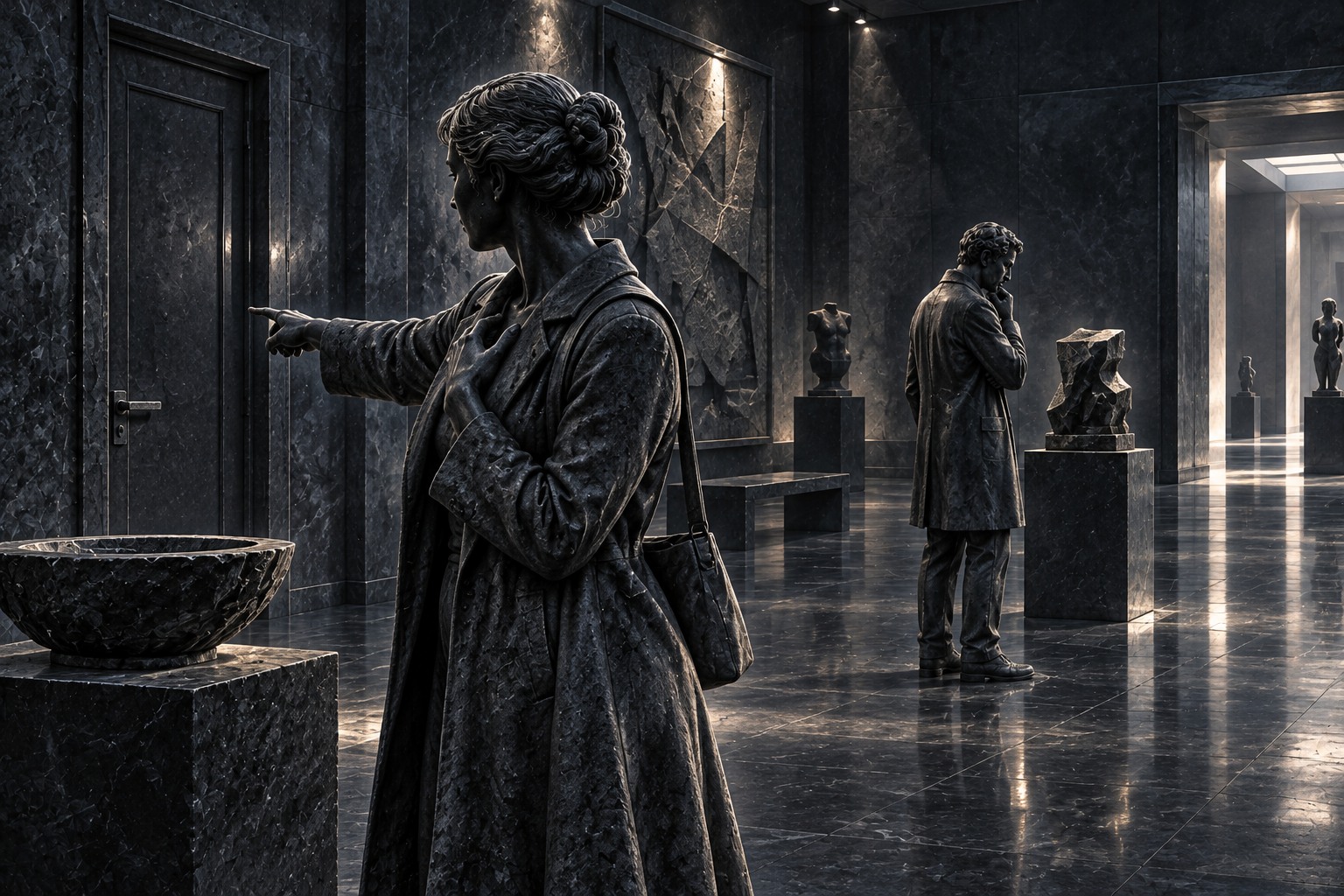
Epigraph
thine own eye
Gospel of Matthew, 7:3, a short fragment from the King James Version, BibleGateway. The Russian text uses our own translation. The image belongs to religious counsel about judgment; it neither describes the mechanism of sight nor forbids checking other people's actions.
What this article is about
A person arrives at an exhibition they had intended to visit at leisure. The first room is crowded, a sign points to a closed door, and their companion answers briefly. The visitor notices irritation and quickly connects everything into one account: the place is poorly organized, the companion is displeased, and once again they themselves cannot relax. Some of that account may eventually be confirmed. For now, however, it combines different kinds of information: the position of a door, a personal experience, and explanations of someone else's behavior. Attention to oneself can help name the experience; attention to the world can check the door and route. Neither direction alone establishes every cause of what is happening.
In this article we propose distinguishing the objects of attention according to the grounds available. What happened in the chosen place? What do I notice in my own experience? What am I assuming about the connection between them? These are editorial questions about an ordinary case, rather than a measurement of a person's inner workings. Answering does not require observing every sensation, achieving an absence of thought, or continually collecting information about others. We can limit ourselves to an episode already noticed and finish when the immediate question is clear. The purpose is to preserve accuracy in what we say and the possibility of action, without claiming the privilege of an infallible observer.
Marcus Aurelius's philosophical text, a Gospel image, and a psychological paper offer different grounds for discussion. The first proposes turning inward within a Stoic position; the second addresses moral judgment. The scientific paper discusses limits of verbal explanations of cognitive processes. We do not combine them into a single proven attention program. The authors of these sources did not test our everyday note, and it promises neither calm, treatment, nor a correct decision. It allows for an unknown cause and distinguishes respect for experience, checking an event, and responsibility for a chosen action in a situation involving other people.
I. Each question has its own object
In the chosen scene, the closed door is an object of external checking. We can read a notice, look for an available route, or ask a member of staff. Irritation names what the visitor notices in their own experience. An assumption about the companion's displeasure concerns another person and requires a different basis. One does not become the other simply because they arose almost simultaneously. We do not need an exhaustive inventory of everything in the room. It is enough to locate where the account moved from an available observation to an assertion that still needs clarification. This boundary does not decide the issue in advance, but it shows which next step actually belongs to it.
Even an external description has limits. The visitor may have seen the door only from one side, missed another notice, or remembered yesterday's schedule. It can therefore help to specify the time and accessible part: the door is closed now, and no route has been found on this sign. That is more precise than a general claim that the exhibition is badly organized. Finding another passage later would not necessarily mean the original observation was invented. The scope of the conclusion would change. The observer can revise the assessment of organization while retaining the fact of their difficulty. Checking need not become proof that they are either wholly right or entirely incapable of perceiving what happens around them.
An internal description can also remain limited. I am irritated in this episode is different from I am always an irritable person. I want to leave is different from the exhibition has no value. There is no need to find a deep explanation for every such report. We can recognize it as sufficient for a small request or the choice of an available place. An experience need not first obtain other people's agreement in order to be named. At the same time, it does not automatically certify the companion's intentions, the quality of every exhibit, or the cause of one's own reaction. Different assertions remain different even within a short sentence.
The choice of object depends on the task. Finding an exit requires information about the route; deciding whether to continue the visit may involve a personal preference; changing a shared plan requires a conversation with a participant. We can address these questions in sequence without assigning permanent superiority to one direction of attention. Sometimes it makes more sense to check a practical condition first. Sometimes saying that we want a break is enough, without explaining the entire situation. A necessary action need not wait for complete inner clarity. Our format concerns an ordinary episode and does not establish an order for every circumstance, duty, or relationship.
II. Turning inward and returning
In Meditations, IV, 3, Marcus Aurelius proposes turning inward toward one's principles. This is philosophical counsel, rather than a study of an exercise's effectiveness. In our reading, what matters is the direction of subsequent action: we can reconsider our position before returning to a shared activity. We do not adopt this passage's strong claims about the soul's immunity to harm and the complete removal of discontent as modern facts. A reader can examine a judgment while retaining the right to acknowledge actual damage, inconvenience, or an unjust condition. The philosophical proposal does not make external checking unnecessary or oblige an injured person to transform their experience for someone else's convenience.
In the exhibition scene, turning inward could mean asking a brief question about one's own aim. Did the visitor come to see a particular work or to spend time together? An answer does not explain the irritation, but it may clarify which question matters now. If the work matters, another passage can be sought. If the shared outing matters, a new route can be discussed. These are our possibilities, rather than an exact instruction from the ancient author or a promise that reconsidering an aim will relieve tension. A person can know what they wanted and still remain displeased. The next action is checked through its result, regardless of the elegance of the stated intention.
Turning to oneself need not require a secluded place. We can simply acknowledge that we do not want to argue about the route now and name an available request. But the right to personal reflection does not include the right to silently change a shared agreement. If the companion is waiting by a particular work, that fact matters. If we promised to return at an appointed time, the promise remains a matter for communication. Inner clarity and an agreed plan have different grounds. Our decision can be formulated without the other person's participation, whereas changing a shared commitment requires an appropriate conversation and a reply when agreement depends on one.
There is also a limit to this question's usefulness. If a person keeps reconsidering motives without obtaining information needed for the next step, the reflection can end. They do not have to earn their way out through an impeccably calm state. They can check the sign, ask for help, or decline an optional activity. We do not derive a general rule of avoiding unpleasant sensations from this. We are limiting a particular note that has ceased to serve the chosen task. Neither the duration of reflection nor the depth of its language measures a person's worth. Part of the inner experience can remain unexplained while an available action proceeds.
III. Checking oneself does not cancel a question for another
Matthew 7:1–5 uses an image of an obstruction in one's own sight in counsel about judgment. Our comparison concerns examining one's statement before evaluating another person, without claiming historical influence on psychology. In the scene, the visitor can notice that they called the companion displeased on the basis of one brief answer. That basis may be insufficient. But acknowledging insufficient grounds does not mean acknowledging that every possible complaint is false. Someone else's action may need discussion. Checking oneself does not replace checking an event or oblige a person to explain harm solely through their own inability to look or feel correctly.
We can examine our statement without passing a moral sentence on ourselves. The visitor did hear a brief answer. They do not necessarily know why it was brief. Clarification preserves the first part and limits the second. They can then ask about the plan or name a particular difficulty, if conversation is appropriate. They need not first prove the purity of their own intentions. Such a requirement would make any discussion endless. For an ordinary agreement, it is enough to name the object, distinguish what is known from what is assumed, and allow the participant to reply. A reply can change the understanding; its absence is not agreement with the original explanation of the other person's state.
Checking oneself must not become a compulsory admission of guilt. If a staff member gave the wrong route, the fact can be clarified independently of the visitor's tone. If the companion broke a promise, the promise can be discussed without establishing its hidden cause. One's own actions do not disappear either. If the visitor spoke sharply, they can name that action and change the next response. There is no need to choose a single person to blame for the entire episode. Different actions can involve different participants and consequences. Accuracy here means being able to discuss each available object without reducing the whole case to a moral characterization of one side.
There are situations in which continuing the conversation now is inappropriate. A person can choose distance, help, or a practical action without waiting for full agreement on evaluations. Our note does not require remaining in unsafe conditions and does not replace needed support. Even in an ordinary episode, an optional discussion can be postponed. What matters is clarity about what has actually been decided: the conversation has stopped for now, the route has changed, a meeting is being rescheduled, or a question remains open. Internally acknowledging an experience does not mean the other person accepted a new plan. Declining an immediate explanation of causes does not remove the part of an actual agreement that needs communicating.
IV. Noticing an experience and explaining a process
In their 1977 paper, Nisbett and Wilson discuss verbal reports about cognitive processes. In the selected section they distinguish content available to a person from an explanation of the process that produced it. This is no basis for treating every self-report as false. Their review and theoretical position are neither a study of our exercise nor a current review of the entire science of attention. We use a limited distinction: a report of an experience is not identical to an established cause. We apply no laboratory measures to the visitor and do not promise that a few questions will reconstruct a hidden mechanism of reaction they had not previously noticed.
In our episode, a person can confidently say they wanted to leave and explain less confidently why. Both levels of confidence can be retained. They need not abandon a preference merely because its cause is unknown. To propose another route, naming an available choice and its conditions is enough. Claiming that a particular action by the companion caused the reaction is already a more definite explanation. It may require additional grounds. The word possibly does not make every assumption useful. We can omit the causal account altogether when it is not needed for the next step and is unsupported by available information.
Sequence alone does not establish a mechanism either. The visitor first saw a closed door and then noticed irritation. This can be enough to describe the chosen episode without supporting a general theory of their behavior. Unknown conditions are not necessarily secrets to be uncovered at any cost. They may not remember part of the conversation or may not have recorded preceding circumstances. It is better to name that limit than fill it with a persuasive story. Our note does not require repeating an unpleasant case to prove a cause. It does not propose conducting a covert experiment on the companion, changing their behavior, or observing a reaction without consent.
Checking a cause and choosing an action can take place at different times. A person can move to an available place while the causal question remains open. They can revise an evaluation later without cancelling the fact of their former state. If no information emerges, the case need not end with a final explanation. Sometimes a sufficient outcome is that the route is known and a preference has been stated. This is a modest result, but it can be checked within its scope. Our approach does not require every episode to become a lesson about character. It leaves room for an ordinary decision without complete knowledge of how thoughts, evaluations, and sensations arose.
V. An observer does not gain access to everything
An outside view matters, but the position of an observer does not automatically provide access to another person's experience. The companion can see the visitor move away from an exhibit; this does not disclose every reason for the movement. They can ask if the question is appropriate and receive a limited answer. A person need not reveal details of their own history to agree on a meeting place. Our accuracy also concerns statements about someone else. A visible action can be named without adding a diagnosis, hidden motive, or general conclusion about the ability to relax. Lack of access is not filled by an observer's authority or confidence in their version.
The visitor, in turn, should not require an inner explanation to become a shared fact. They may regard a particular detail as the cause of irritation, while the companion remembers a different sequence. Disagreement is not always resolved by choosing the most confident participant. The available route, time, and content of an agreement can be checked. A personal explanation can remain personal when it is unnecessary for a shared decision. This does not prohibit discussing experiences. A conversation allows several reports that participants cannot check in identical ways. Respecting them does not require erasing the distinction between a person's account of themselves and an agreed description of events.
Not every question is appropriate just because it could provide more information. Asking to see private correspondence or to explain every pause may exceed the task's scope. Changing a route requires less. We can name the necessary practical part and allow the rest to remain private. A participant may decline an optional question. This is not proof of hostility or a hidden cause. At the same time, a shared plan may still need a clear answer about place and time. The right not to disclose personal content and the need to communicate an accepted agreement concern different objects of conversation.
The note should not become surveillance of the companion. There is no need to count their glances, record every word, or secretly test whether their mood changes after particular actions. Our object is one personal formulation and an available next step. If a joint assessment of the visit's organization is needed, an appropriate conversation should be chosen for it. A personal exercise does not automatically obtain another person's consent. Even an accurate external note does not authorize publishing their story. For one's own reminder, an anonymous object is often enough: a closed passage, a proposed route, an agreed time, a remaining question. Details of relationships can be left unrecorded.
VI. How the direction of attention changes
We can begin with a question that has already arisen and choose a source of an available answer. The visitor does not know why the door is closed: they look at the notice. They do not know whether they want to continue in this room: they turn to their preference. They do not know where to meet the companion: they discuss an agreement. This is a sequence of different actions, rather than training in ideal alternation between external and internal attention. There is no need to assign an exact duration to each phase. We propose no neurobiological scheme and measure no transitions. Direction is determined by the question's object and the possibility of an answer, rather than a mandatory proportion for one's whole life.
During a transition it can help to preserve the boundary of the previous answer. Checking a route is not yet checking the cause of irritation. Naming a preference is not yet the companion's agreement. Receiving an answer about time is not a complete account of their state. This order helps describe a result without extra promises. We do not claim that it is always convenient, however. Sometimes every question is addressed in a brief exchange. Then it is enough not to confuse the grounds of conclusions. Ordinary communication need not be rewritten into a complicated table when a person can clearly name an available fact and request in a few words.
Changing direction does not require abandoning an earlier experience. The visitor can find a passage and still want to end the visit. They can feel relief and still regard the organization as inconvenient. These combinations need not be turned into a contradiction proving insincerity. An inner state and an assessment of a particular condition can change differently. For our note, it is enough to name what is known now without presenting it as an unchanging outcome. If a person decides to continue, they need not declare the initial reaction a mistake. If they decide to leave, the passage they found does not cancel their right to an available choice.
We can also stop between questions. There is no need to immediately explain every relationship, assess the exhibition as a whole, and reconsider personal habits. A verified route can complete the episode's practical part. A named question can be left for a suitable time. A postponed question is not resolved, but it need not accompany every subsequent action either. Our note allows a limited ending. This matters especially when attention to oneself starts demanding ever more explanations, and attention to the world ever more data without a clear object. Complete observation is not a mandatory goal of this small format.
VII. Different ways of checking
An external condition can be checked by an action relevant to it: reading a current notice, finding an available passage, clarifying a time. For checking a personal report, another format may suffice: rereading one's formulation and seeing whether it corresponds to what is noticed now. This does not authenticate its causal explanation. A shared agreement requires a participant's reply and appropriate confirmation of the content. All checks cannot be replaced by a single feeling of clarity. Nor can external proof be demanded for every named experience, as though it had the right to exist only after independent measurement and another person's agreement.
Every check has a scope. A passage found does not evaluate the organization of the entire museum. A clarified preference does not describe a personality for years to come. An agreed route does not prove the quality of a relationship. A result can be used within the scope in which it was obtained. This lets us avoid creating a vast conclusion from a small improvement. If a meeting place was previously unclear and is now agreed, that result need not be supplemented with a story of inner transformation. Ordinary clarity about a condition is substantial enough in itself when that condition was what prevented the chosen activity from continuing.
An unsuccessful check does not disclose everything either. A staff member may not know the answer, a notice may be outdated, a participant may be unavailable. This leaves a question open; it proves neither hidden hostility, the pointlessness of the visit, nor the visitor's inability to decide. Another accessible source can be chosen, the plan's size changed, or an optional part stopped. There is no need to repeat the same question endlessly until a convenient answer appears. If the grounds do not change, the note can honestly end with something unknown. A subsequent decision is then made with this limit, rather than on the basis of an invented confirmation of the initial explanation.
Preparation must be distinguished from an actual result. A formulated request is not yet a received answer. A notice found is not yet a route traversed. A decision to take a break is not yet an agreed rescheduling of a meeting. An inner choice can be complete while the external part remains unfinished. This boundary does not devalue the choice; it clarifies its consequences. Once an action has actually been performed, the relevant result can be checked. If it depends on another person, personal readiness does not replace their participation. Our note serves to describe these distinctions and gives no certificate of successful attention after its lines are filled in correctly.
VIII. When the question has become unnecessary
A sign of completion can be a clear next step or a named limit of knowledge. Full certainty about causes is unnecessary. If the visitor found an available route and communicated a meeting place, the practical part can be complete. The inner question can remain open. If the note demands increasingly detailed observation unrelated to the chosen task, it can stop. This is neither a diagnosis nor proof of an incorrect way of attending. The format has simply ceased to be proportionate to the episode. A person need not continue it to obtain an elegant conclusion, maintain consistency in a practice, or validate the original decision.
If questions about oneself intensify an unpleasant state, the article does not require pursuing them more deeply. We can return to an ordinary available action and choose appropriate support when needed. This text offers no clinical assessment and establishes no cause of the state. It does not replace help or propose independently correcting a serious difficulty through attention to the world. Even in an ordinary case, declining the exercise without explanation is allowed. Voluntariness applies to the entire format, rather than only the choice of a first example. An unsuccessful note does not become an unsuccessful person and does not require proving the method's usefulness through further effort.
External checking should have a limit too. Enough information about a route can be gathered without inspecting every door. A reply can be heard without demanding access to every cause. A promise can be checked without compiling a dossier on a participant. If a new question does not change the immediate decision, it may be optional. This is an editorial criterion of proportion, rather than a prohibition on exploring the world more deeply in another task. A tour, study, or shared discussion will require a different scope. Our small episode should not quietly expand into continuous observation merely because another detail can always be learned.
Completion does not mean attention must now remain in the chosen direction. A person can turn again to a work, a conversation, or a preference when an appropriate question arises. There is no need to keep a continuous report of every transition. A useful formulation can be retained without revisiting it for no reason. If the situation changes, the previous result is checked again within the necessary scope. It does not become false simply because conditions changed. Accuracy requires the time and scope of an assertion, rather than an observer's eternal constancy. This allows the note to remain finished and life to continue without a duty to evaluate its quality constantly.
IX. Attention without a judge's privilege
Internal and external attention answer different questions. A person can name an experience, check an available condition, and acknowledge the insufficiency of a causal explanation. They need not choose between complete faith in every inner account and complete distrust of themselves. Nor must an external observer be given the final word on everything. In our episode, it is enough to preserve the distinction between a visible door, a personal preference, and a shared agreement. These are different objects with different means of clarification. None provides complete knowledge of the personalities, intentions, and hidden processes of every participant.
The visit can end differently from the plan without turning this into a compulsory lesson. The viewing can continue without declaring the initial irritation conquered. An inconvenient route can be discussed without proving inner purity. The possibility of an ordinary decision remains central. If a new account of causes is unsupported and unnecessary, it need not be written. If the question matters, it can have a separate appropriate conversation. Our note neither replaces that conversation nor announces its outcome in advance. Prepared reflection, a performed action, and an agreed plan remain separate results, assessed in relation to their own objects.
Attention to oneself can preserve the honesty of the first person; attention to the world can correct the description of an available event. This article establishes no single ladder between them or mandatory proportion. There is a task, information, a limit of knowledge, and an available next step. A person can stop when that scope is clear. They need not obtain a final explanation of a reaction in order to acknowledge it, nor abandon checking circumstances in order to respect their experience. Accuracy here does not promise infallibility. It means being able to revise a conclusion, retain the value of an experience, and refrain from claiming knowledge of another person beyond available grounds.
What this means in practice
If the format suits you, choose an ordinary episode you have already noticed. Name an available external condition, a personal experience or preference, and a separate assumption about the cause, if one actually arose. Do not fill an empty space with a compulsory version. Specify what can be clarified through an appropriate action and what remains a personal report. To change a shared plan, identify the question that requires a participant's reply. This is a voluntary editorial note, rather than an experiment, diagnosis, therapy, or reconstruction of a hidden process. It does not require closing your eyes, intensifying observation of sensations, repeating an unpleasant case, or reporting every thought precisely.
You can check a notice, name a request, agree on an available route, or leave the cause unknown. Preserve privacy, collect no private correspondence, and conduct no covert tests of another person. Do not postpone a necessary action for the exercise or treat someone else's silence as agreement. Stop when the next step is clear, the limit of knowledge is named, or the note has become an unnecessary burden. A prepared request, a received answer, and a performed action are checked separately. One episode establishes neither character, the quality of relationships, the cause of a state, nor a universal order of attention. The reader can decline to continue at any stage without having to justify that choice to this text.
Key quotation
retire into thyself
Marcus Aurelius, Meditations, IV, 3, George Long, Internet Classics Archive, displayed line 29. The Russian text uses our own translation of the short fragment. The print edition's year and printed page for this online version are unestablished; the counsel does not promise to remove actual harm or every form of discontent.
Connections between traditions
Stoic inward reflection and Gospel self-examination retain different philosophical and religious grounds. The psychological paper distinguishes the content of experience from explanation of a process. The comparison is editorial, without a shared attention theory, historical influence, or tested program. Self-examination does not justify harm, an outside view does not cancel experience, and a causal explanation needs its own grounds. Our questions about an episode are not instructions from the primary authors and establish no superiority of an internal or external direction.
Primary sources
- Marcus Aurelius, Meditations, IV, 3, George Long, Internet Classics Archive. The header and selected IV, 3 passage with displayed neighboring text were actually read, rather than the entire work. Print edition, year, and page are unestablished. A primary philosophical text, rather than an experiment; international rights UNKNOWN, no full import.
- Matthew 7:1–5, King James Version, BibleGateway. All five selected verses and version information were read, rather than the entire chapter or Gospel. Religious counsel, rather than a clinical or neurobiological explanation. Historical personal authorship is unestablished; a territorial public-domain label is not universal permission, international rights UNKNOWN.
- Richard E. Nisbett, Timothy DeCamp Wilson, Telling More Than We Can Know: Verbal Reports on Mental Processes, Psychological Review, 1977, 84(3):231–259. The header, abstract, opening, and selected discussion of content and process on pp.255–256 were read, rather than the entire paper, original studies, or calculations. A review and theoretical argument, rather than a test of our note. ©APA1977; no open license established, no full import or vectorization of the source text, no direct scientific quotations; limited original exposition and a link.
Tags
attention, outside world, experience, preference, cause, explanation, observation, checking, self-report, content, process, question, route, exhibition, door, agreement, action, result, unknown, privacy, consent, responsibility, self-examination, Marcus Aurelius, George Long, Matthew, Nisbett, Wilson, United Wisdom
About the authors
Andrey Zarinsh is the author and founder of United Wisdom. He explores inner transformation, the unity of traditions, intercultural dialogue, and contemporary spiritual discipline. Instagram: @andrey.zarinsh.
Maria Evilkut is a coauthor of United Wisdom. Alongside research, she aims to test these ideas in practice and observe how principles of unity and mutual understanding work in real life between people and cultures. Instagram: @ilkutki.
Keep what resonates with you.