
Inner world
Contemplation without a requirement to stop thoughts
Voluntarily considering an ordinary object permits thoughts; their disappearance is no condition. Sources are distinguished, a personal pause does not cancel a responsibility, and no therapeutic result is claimed.
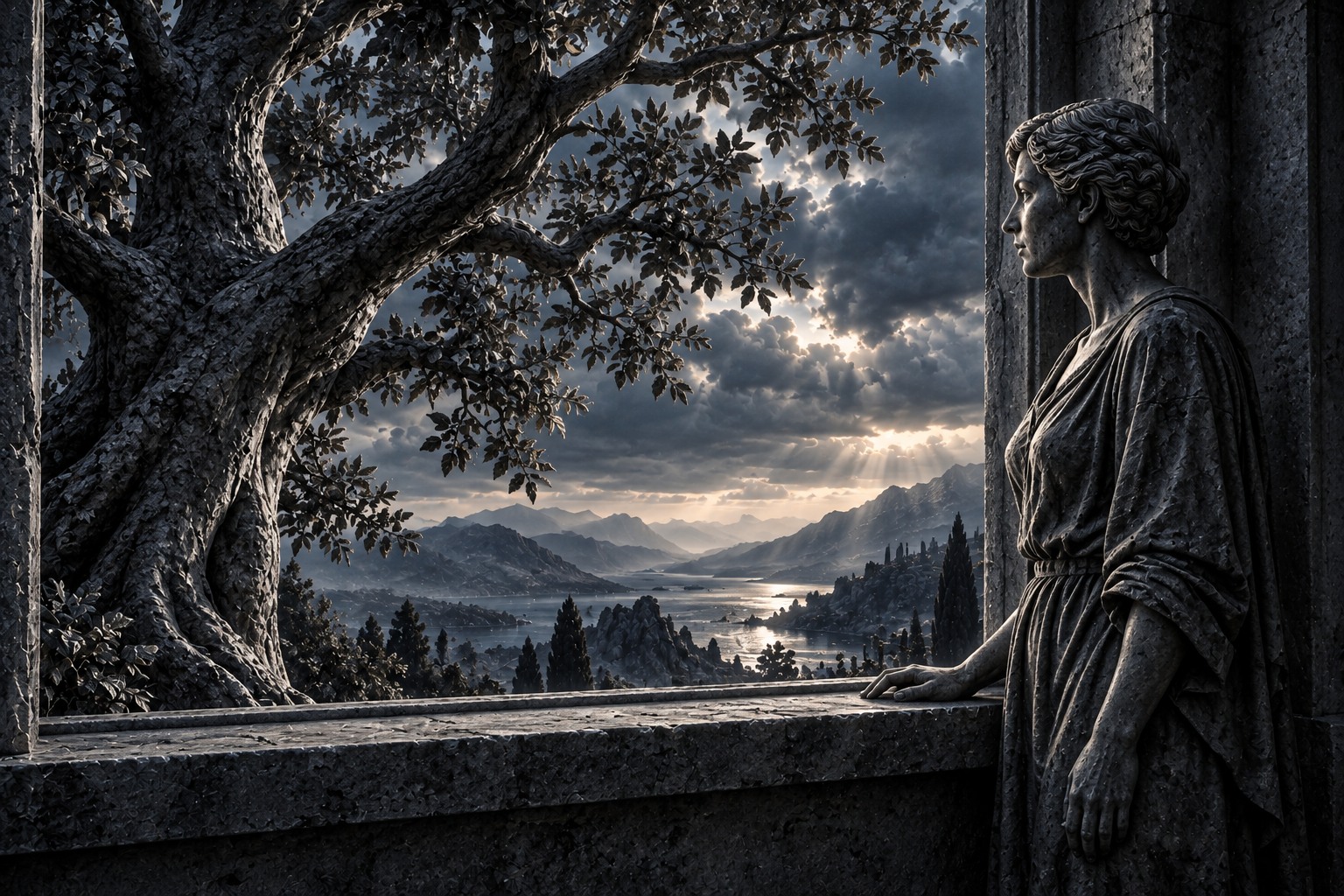
Epigraph
Be still
Psalm 46:10, a short fragment from the King James Version. The entire selected chapter concerns God, upheaval, and the ending of wars. The fragment is not an instruction to eliminate thinking or a promise of a psychological result.
What this article is about
A person looks through a window at a tree after an ordinary conversation about work. They wanted to linger briefly before their next task. Almost immediately, however, they remember a message they have not sent, notice a sign across the road, and invent a name for the color they see. Then another requirement appears: if this is contemplation, there ought to be no thoughts. Instead of the tree, they are now checking whether their mind is sufficiently empty. Our example neither establishes the cause of distraction nor assesses their condition. It shows a possible change of subject: an available look at a tree becomes the fulfillment of a previously imagined condition for proper silence.
Here, contemplation means a voluntary opportunity to consider an available object for a while or reflect on a short passage already read, without having to reach an immediate decision. This is a working meaning for our article, rather than a definition of all religious traditions or a description of a clinical program. One can see a branch, notice a comparison that has arisen, turn to the object again, or finish. There is no requirement to close one's eyes, change one's breathing, seek a special inner state, or count thoughts. The question is not how to force them to disappear. It is what the person is considering now and what sense their chosen requirement for this activity makes.
We turn to a selected chapter of the Dhammapada, a psalm, and an early experimental paper about the suppression of a particular thought. Their subjects, language, and grounds differ. The comparison proves no shared technology and promises no therapeutic effect. Our everyday opportunity was not tested by these authors. It proposes distinguishing the content of a thought, one's relation to the content that has appeared, and the action that life actually requires. Not every reminder needs to be acted on immediately; some responsibilities, conversely, cannot be canceled by giving a pause an attractive name. One may stop without reporting the depth of one's contemplation or drawing a conclusion about one's spiritual maturity.
I. An object that need not become an assignment
A tree can be considered without a list of details that must be discovered. The person sees a branching point, the movement of light, and a patch of bark. They may name these in words, but naming does not become an examination of their powers of observation. If they do not know the species, they can leave it unknown. Our scene does not demand botanical precision where no botanical conclusion is being drawn. If a wish to identify the species arises, a separate question appears, with its own way of checking. Observation and a search for an answer can coexist, but the first need not quietly turn into the second merely to prove that the time was spent usefully.
In another case, the object will be a short literary paragraph. A reader can return to an image and consider why it attracted their attention. This does not establish the author's intention. They can distinguish the words read, their own emerging interpretation, and a question about the work's context. If that context has not been read, it remains unknown. A contemplative pause confers no right to attribute one's own experience to an author. It may end with the passage still unclear or uninteresting. Such an outcome does not require inventing a profound connection. The selected object remains available within its scope even if the reader obtains no complete explanation.
An object is not always suitable for this opportunity. On a busy road, it matters to look with traffic in mind, and during someone else's account it may be necessary to respond and hear the speaker. The activity's name does not cancel the situation. One can choose an ordinary safe place where there is no need to monitor another task at the same time, if such a place is available. This is no requirement to arrange an ideal room or buy equipment. Sometimes conditions are unsuitable now, and acknowledging that is enough. We do not assess a person's ability to contemplate by whether they managed to set aside a place in circumstances they cannot control alone.
An object may have a natural endpoint: the branch disappeared from view, the paragraph has been reread, or the next step is already clear. There is no need to prolong the activity so that it matches an idea of serious practice. One can finish before a special feeling appears. One need not begin at all if the proposed approach seems unnecessary. Voluntariness here applies to choosing the object, continuing, and finishing. It creates no promise to other people. If the person separately agreed on a meeting time or a reply, that agreement remains its own responsibility and is not changed by an inner decision to look at the tree a little longer.
II. A thought as content that has appeared
In our scene, a name for a color appears. The name itself does not make the act of looking incorrect. It may be part of how the person describes what they see, or it may lead to another question. One can notice that a comparison has arisen and decide whether to pursue it. We propose no established brain mechanism and do not claim that noticing in this way will necessarily improve attention. What is at issue is an available description of the episode. The visible branch, one's comparison, and a decision to write it down belong to different actions. None of these needs a moral judgment merely because the person expected silence.
The thought of an unsent message has a different subject. One can check whether it concerns an actual deadline already accepted. If so, the necessary action may matter more than voluntarily considering the tree. If it is merely a possible subject for a letter, without an agreed urgency, it can be left for a separate choice. A recollection alone cannot establish someone else's expectation. It matters to distinguish one's own reminder from an actual agreement. Our format does not propose ignoring responsibilities or require a response to every association that arises. It retains the possibility of clarifying which question needs an answer now and on what grounds that is known.
There is no need to seek a meaning in every image that appears. A remembered courtyard need not symbolize a hidden need, and comparing a branch to a hand does not prove an inner conflict. If one wishes to reflect on an image, that is a voluntary interpretation that can be called one's own. It does not become a discovered fact about the past or another person. We offer no dictionary of symbols. Our interest concerns one's relation to content: should this thought be pursued, should one return to the object, or should the activity end? The question may remain open without requiring an explanation that makes every moment part of a single story about personality.
The appearance of a thought obliges neither following it nor banning it. These alternatives cannot be assessed in advance without their subject. Sometimes it is useful to write down a necessary point; sometimes another look at the branch is enough; sometimes an actual task should follow. We do not claim that a single sequence fits every circumstance. In the proposed scene, the person chooses an available action without a general promise to govern all thinking. If the choice is unclear for now, that too is an acceptable description. One need not turn uncertainty into evidence of inadequate discipline or declare every refusal of an inner prohibition proof of special wisdom.
III. What the selected traditional text says
In the selected third chapter of the Dhammapada, Max Müller's translation concerns unsteady thought and care for its direction. This is a moral and religious text, with its own imagery and strong promises. We do not use it as modern research on attention. Nor do we transfer the chapter's statements into medical advice or an assessment of harm experienced. A limited question matters for our comparison: in this passage, thought is an object of discernment and direction, rather than simply a technical counter that the reader must bring to zero. This is an editorial reading of the selected context, not a definition of all Buddhist practice.
The short quotation below concerns the difficulty of noticing thought. It cannot become a promise that any attempt to observe will provide accurate knowledge of the cause of one's condition. One may know what one is thinking about without knowing why it arose. One may name the content but be mistaken in the explanation. The distinction remains important in our everyday example. If the person noticed a word about the tree, they reported available content rather than investigating that thought's origin. If they decided not to pursue the comparison, the decision does not prove that all further thoughts will be subject to their control.
The chapter uses religious language belonging to its tradition. It should not be quietly replaced with a modern model of the brain or turned into a general formula for anyone. Our words about the tree do not retell the entire teaching or present an authoritative instruction in traditional contemplation. We take a limited occasion for a question about thought's direction while preserving the difference between contexts. The comparison allows the reader to disagree with the interpretation offered. It does not require accepting religious grounds in order to consider the everyday scene, nor does it permit claiming that the religious meaning is fully exhausted by our practical question.
Reading a source also has a limit. The heading and selected chapter of the available translation have actually been read, rather than an entire tradition's corpus or the history of all its interpretations. This electronic copy's printed edition has not been established. We do not present it as the personally recorded speech of a historical teacher. These limitations do not prevent us from identifying the place of the fragment used. They do prevent attributing broader proof to it. A reader can open the selected text and check the context without accepting our comparison as a compulsory conclusion. The right to a different reading remains after a particular short quotation has been checked.
IV. A pause in the psalm's context
The epigraph comes from a psalm concerning upheaval, refuge in God, and the ending of wars. Its religious meaning cannot be reduced to a task of removing inner words. In our comparison, a pause becomes a question about the demand a person is making of themselves now. But this is our editorial question, rather than a proven instruction in the psalm about attention. We do not claim that the Christian and Buddhist contexts are identical. Nor do we assume historical influence between the selected passages. Their differences remain part of reading even when short fragments make it possible to place two questions about human action alongside each other.
One can stop an unnecessary demand and continue thinking about the selected object. For example, one might stop checking for the absence of words and look at the branching point again. This is a possibility within our scene, rather than an established result of reading the psalm. We do not promise that the demand will easily disappear or that such a choice will bring calm. A person may discover that they simply do not wish to continue now. Finishing is then available too. The question concerns which task has actually been chosen, rather than how precisely a personal experience matches the epigraph's symbolic depth, with which the reader may disagree altogether.
A pause must not mean refusing to notice external harm or necessary action. If it is necessary to leave an unsuitable place, take responsibility for an accepted promise, or seek support, the name of contemplation imposes no contrary duty. The article neither establishes the cause of distress nor replaces professional help. It contains no requirement to remain with unpleasant content to prove maturity. One may end the proposed opportunity entirely. The traditional passage is not used as grounds for accusing someone of insufficient faith if they feel no silence, do not wish to continue, or choose a different way to relate to what is happening.
Our example preserves the distinction between poetic and religious language, one's own interpretation, and actual action. One source gives no universal instruction to another context. One can name the meaning a reader found in the epigraph and, separately, what they did at the window. If they sent a necessary message, this is checked by the sending and an appropriate reply, rather than a degree of inner stillness. If they merely considered the tree, that does not confirm an agreement was fulfilled. Different results may occur at different times or fail to occur at all. They need not be combined for an attractive conclusion about the power of a single pause.
V. Suppressing a particular thought and our question
The 1987 paper by Wegner, Schneider, Carter, and White investigated the suppression of a specified thought under laboratory conditions. Participants reported the content of their thinking; the instruction concerned a white bear. In the selected comparison, attempted suppression was associated with a subsequent increase in reports about this subject. This is a particular experimental result, rather than a rule that all inner control always fails. The study was not a test of our scene at the window. It does not determine a clinical cause of a reader's experiences or permit assessing personality by whether a person managed to forget some content during a voluntary activity.
The authors discuss the limits of transferring results beyond the specified subject and laboratory conditions. It matters to retain this beside the conclusion rather than only in a separate bibliography. There are no grounds here for turning an early paper into a final assessment of every way of relating to a thought. We neither reproduced calculations nor read all the studies discussed. We do not propose that readers repeat the laboratory procedure at home. Our question is smaller: was it necessary to prohibit the appearance of any content in order to consider a tree? It concerns the selected purpose, rather than measuring a supposed suppression effect in a particular person.
A laboratory instruction and an everyday intention have different structures. In one case, a particular subject, order of actions, and reporting method are specified. In the other, the person chooses whether to look at a tree, read, or finish. These activities cannot be called identical merely because thoughts appear in both. A similarity of theme permits a question, but does not transfer a result automatically. Our opportunity is not a scientifically tested alternative to suppression. It promises neither fewer thoughts, greater productivity, nor prevention of obsession. The available outcome is to name more precisely the chosen action and the limits of its justification in this episode.
One can change the formulation of one's purpose without drawing a conclusion about a medical condition. Instead of checking for ideal emptiness, one might choose to consider a branch or a paragraph, if that is genuinely interesting. But the new object must not become another mandatory test. There is no need now to require every return to the branch to happen correctly and without delay. If a person is increasingly occupied with evaluating the activity, they can stop. Our article does not establish why this evaluation arose. It retains the option of rejecting the proposed format without defending it with scientific or religious references against the actual experience of someone for whom it is unsuitable.
VI. Do not turn an impression into a general conclusion
After looking at a tree, the person may say they liked the color. This is a report about this impression, rather than a measurement of sustained attention. It can be kept without expansion into a story about a new character. If they did not like the color, that is no failure either. Our opportunity sets no positive feeling as a compulsory result. A person is entitled to consider an object and remain indifferent. There is no need to look for hidden gratitude so that the activity has an acceptable outcome. It is enough that the chosen object was available and the person decided whether to continue, switch to a necessary task, or leave everything without a note.
An impression may be strong, but strength does not prove an interpretation. If the tree recalled an old meeting, one can name the memory without attributing its content to today's conversation partner. If a thought of writing to an acquaintance arose, contact is a separate choice that takes actual relationships into account. An imagined response does not replace the person's response. A contemplative pause gives no access to other people's intentions and no permission to bypass refusal or boundaries of communication. Our format remains personal reflection until an appropriate external action is taken, requiring its own consent, grounds, and means of checking.
Silence around a person and an absence of inner content are not the same. A room may be quiet while the person continues composing a letter. Ordinary noise may be audible outside while the chosen branch remains available to look at. This distinction cannot establish suitable conditions for everyone in advance. It merely helps avoid confusing external sound with an assessment of correct thinking. If noise really interferes or a place is unsuitable, another opportunity can be chosen if access is available. There is no requirement to endure discomfort to prove freedom from circumstances. Nor is there a requirement to promise ideal surroundings in which all thoughts will automatically change.
One can dispense with the idea of contemplation altogether. The person looked at a tree and moved on. A name need not give the episode a special status. If the word helps designate a voluntary pause, it can be used in the stipulated sense. If it creates demands and comparison with other people's descriptions, ordinary words about looking and reflecting can remain. This is no decision about the value of traditional practices. It concerns whether this term is needed for this episode. A reader need not learn our vocabulary to retain their own right to a simple interest in an object without reporting the depth obtained.
VII. A personal note and the shared world
If one wishes to leave a note, describing the object and a question that arose is enough. The note need not contain the names of participants in the work conversation, private messages, or guesses about someone else's life. One can retain only one's own impression and available action. We do not propose covert observation of how others relate to silence or turn their reactions into personal practice material without consent. Contemplating a shared space does not mean a right to record all its participants. A personal note remains within the scope actually needed by the person and compatible with the privacy of those who did not choose to participate.
If another person is nearby, their silence does not confirm a shared meaning of the pause. They may be waiting for a reply, resting, looking elsewhere, or thinking about their own task. Appearance does not establish whether they are contemplating. Shared time can be agreed upon if appropriate, but agreement requires an appropriate response. Our example does not propose guessing people's maturity from their ability to sit for a long time without talking. It does not make an absence of conversation a sign of special unity. A personal impression of closeness and an actual agreement remain different subjects, even if the person enjoys being alongside someone without immediately having to explain something.
A shared responsibility may have a clear deadline. If one needs to return to work, collect something, or make a promised call, that action becomes no less real because of an interesting impression. An available limit for the pause can be chosen in advance, but it need not become a competitive duration standard. A particular transition to a task matters, rather than a record for inner silence. If a deadline changes, an appropriate message to the participant is required. Our format does not shift responsibility to a traditional text, a mood, or the flow of thoughts. It does not claim that a voluntary activity always matters more than an everyday agreement already accepted.
A note may end without being passed to anyone. Not every personal question needs a public explanation or evaluation. If the person wishes to discuss it, they can choose a recipient and an appropriate scope, preserving others' privacy. The conversation partner's response may differ from the expectation. This does not make the initial look at the tree a mistake. It does, however, make the discussion a new action with another participant. Our article does not promise that inner reflection will prepare the only correct answer. It allows that a conversation may require clarification and a personal note may prove unnecessary and be left without further use.
VIII. The right to an ordinary ending
One can finish when the object ceases to be interesting. There is no need to wait for a complete absence of words, a sense of clarity, or special understanding. If the next thoughts concern a necessary task, one can turn to it. If one simply wishes to rest without observing, that is another acceptable choice. We do not call it a missed stage of development. The proposed opportunity must not capture every free moment or turn every glance into a report. Its limit belongs to the episode itself: an object was selected, some content arose, and the person decided what to do next. The cause of every transition may remain unknown without needing immediate investigation.
There is no need to record the number of returns to the object and compare it with the previous day. Our article has no standards by which such a count would establish success. If a reader is interested in measuring attention, that is a separate research task with a suitable method and limitations. An everyday impression does not replace it. One can finish a note without creating an ongoing journal of inner control. The right to decline also applies to notes already begun. One need not continue merely because they have an attractive name, relate to a source read, or seem a mandatory sign of taking oneself seriously.
If the activity increases strain, it can be stopped and appropriate support chosen. The article establishes no diagnosis and does not require experiencing unpleasant content alone. It proposes no intensive procedures, change of breathing, or refusal of necessary help. The everyday opportunity must remain within an available scope rather than become a test of endurance. Declining need not be explained in terms of spiritual unreadiness. One may say this approach is unsuitable now. Such an answer does not need confirmation from a religious text or a laboratory paper, because none of the chosen sources tested the suitability of our scene for this reader.
An ordinary ending may be entirely unremarkable. The person moved away from the window, found the necessary message, and decided whether to send it now. They need not connect this choice to the branch they saw. Perhaps the pause had its own interest, and the next action arose for another reason. We demand no single story of change. It is enough to distinguish what was considered and what was actually done. If no note remains, that does not cancel the available episode. If an impression remains, it need not become evidence of our proposal's effectiveness or grounds for recommending it to everyone in similar circumstances.
IX. Direction without a promise of emptiness
The contemplative opportunity in our working sense allows thoughts, words, and questions. It does not set their disappearance as a condition of correctness. One can consider an object, notice one's own interpretation, and choose whether to pursue it. Such a choice guarantees no calm and confirms no knowledge of a hidden cause. It preserves the episode's specificity. A tree need not become a symbol, a paragraph a revelation, or a pause a new stage of personality. Each of these objects may have its own meanings, but those must be designated as interpretation rather than deduced from the mere fact that a person lingered before their next task.
A traditional text, a religious chapter, and a laboratory paper offer different grounds for discussion. Our comparison does not eliminate differences or turn sources into a single authoritative answer. One can check a quotation's location, name a scientific result's limitation, and consider one's selected object separately. These actions need not finish simultaneously. A reader may disagree with our connection while retaining a useful question about an unnecessary demand. They may agree with the question but reject the proposed note. Neither alternative requires an assessment of their maturity by their degree of agreement with an editorial proposal from United Wisdom.
The opportunity to look must not become an obligation to stop all thinking. One can choose an available object, leave content that appears without a hasty explanation, and finish when that is enough. One can move to actual action if it is required. A prepared text, a personal impression, and a fulfilled agreement have different checks. We do not promise that such precision will change a condition or habits. It allows the boundary of our example to be named honestly: a voluntary episode of reflection without a test of emptiness or transferring a scientific or religious reference to the reader's personality. The further choice remains their own.
What this means in practice
If appropriate and interesting, choose an available ordinary object or a short passage already read. There is no need to close your eyes, regulate breathing, or arrange a thought-suppression test. You can look, notice a word or question that has arisen, and decide whether to pursue it, return to the object, or finish. A note is optional; if needed, identifying the object and your own interpretation separately from a verified fact is enough. Do not include other people's private information. Do not test their reactions covertly. This is an editorial opportunity rather than therapy, a diagnostic test, or a validated attention program.
Finish within an available scope. Check separately whether an actual action is connected to an accepted deadline or agreement; a personal pause does not cancel it. You can leave the cause of a thought's appearance unknown and decline further recording. Do not assess the outcome by the number of thoughts, the duration of silence, or the strength of an impression. If the activity increases strain, stop it and choose appropriate support. A personal note, a completed task, and shared agreement are not the same. Sources do not confirm the proposed episode's effectiveness; you can stop without explaining your refusal through insufficient faith, discipline, or maturity.
Key quotation
difficult to perceive
Dhammapada, III, 36, a short fragment from Max Müller, Project Gutenberg No.2017, displayed line 129. The context is moral and religious; the fragment proves neither a thought's cause nor the necessity of an empty consciousness. The electronic copy's printed edition, year, and page have not been established.
Connections between traditions
The direction of thought in the selected Dhammapada, a pause in the psalm's religious context, and laboratory suppression of a specified subject are not identical. The connection is editorial, without a claim of historical influence or a shared tested program. Our meaning of contemplation is limited to an everyday opportunity rather than the entire corpus of traditions. The presence of thought, selected action, and fulfillment of a shared duty are distinguished. A short quotation does not transfer a source's authority to an exercise's effectiveness or a spiritual assessment of the reader.
Primary sources
- Dhammapada, III, 33–43, Max Müller, Project Gutenberg No.2017. The heading and entire selected chapter with displayed neighboring text were read, not the entire work or tradition. Printed edition, year, and page are unestablished; this is not a personal historical record of the Buddha's speech. Moral and religious statements are not modern medical facts; international rights UNKNOWN, no full import. A combined budget for the entire work includes I45.
- Psalm 46:1–11, King James Version, Bible Gateway. The heading, all 11 verses of the selected chapter, and the version/Public Domain label were read, not the entire book of Psalms. Printed page and personal historical authorship are unestablished. Religious context is retained; this is no clinical instruction or promise of calm. Territorial rights UNKNOWN, no full import.
- Daniel M. Wegner, David J. Schneider, Samuel R. Carter III, Teri L. White, Paradoxical Effects of Thought Suppression, Journal of Personality and Social Psychology, 1987, 53(1):5–13, PMID 3612492, DOI 10.1037//0022-3514.53.1.5 as indexed by PubMed. The complete primary PubMed abstract/bibliography, original PDF heading/abstract, and selected method and discussion passages including transfer limitations were read; not the entire text, calculations, or cited studies. This is a laboratory paper rather than a test of our episode; © APA 1987, no open license established. No full import, vectorization, dissemination of the source PDF, or scientific direct quotations; limited original exposition and a link.
Tags
contemplation, thought, direction, tree, window, object, looking, word, interpretation, fact, context, pause, voluntariness, completion, responsibility, agreement, privacy, boundary, attention, suppression, laboratory, source, Dhammapada, Max Müller, psalm, Wegner, Schneider, Carter, White, United Wisdom
About the authors
Andrey Zarinsh is the author and founder of United Wisdom. He explores inner transformation, unity among traditions, intercultural dialogue, and contemporary spiritual discipline. Instagram: @andrey.zarinsh.
Maria Evilkut is a coauthor of United Wisdom. Alongside her research, she aims to test these ideas in practice and observe how principles of unity and mutual understanding work in real life between people and cultures. Instagram: @ilkutki.
Keep what resonates with you.