
Inner world
Observation, meditation, and prayer: different intentions
Distinguishing intentions and contexts in observation, meditation, and prayer.
Epigraph
“Our Father”.
Matthew 6:9, World English Bible, engwebp. A brief fragment of the address; the Russian companion gives a translation made for this article.
What this article is about
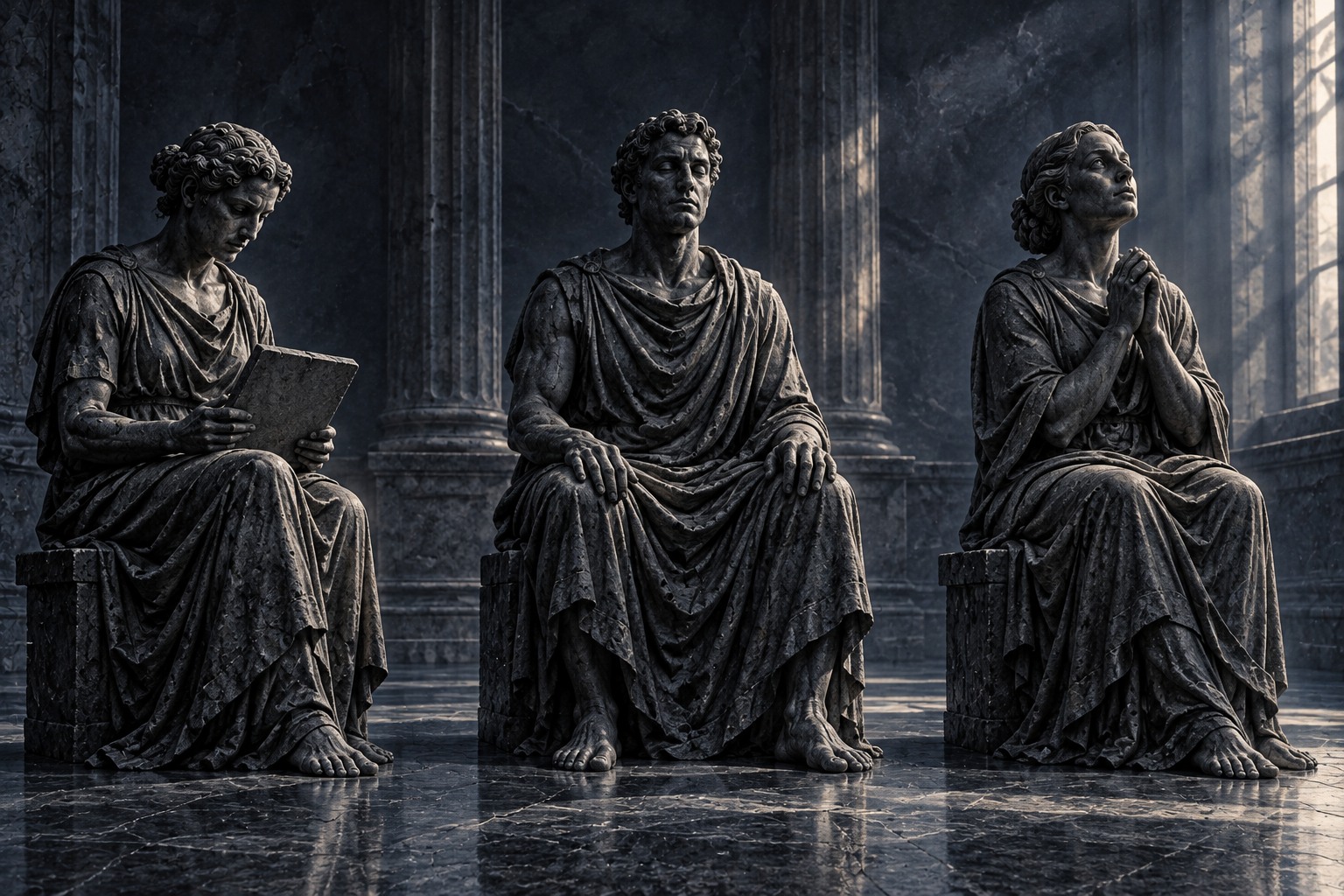
Three people sit in the same quiet room. One is trying to notice how they distract themselves before a difficult conversation. Another follows a familiar attention practice. The third prays for someone they love. A photograph would tell us little about the difference. A similar posture reveals neither their intentions nor the meaning of their words, nor what each would consider a significant outcome. Trouble begins when all three receive a single instruction: switch off your thoughts and feel better.
This article suggests a more precise conversation. Everyday observation can clarify an episode; meditation calls for an account of the particular practice and its framework; prayer in the Christian sources considered here involves addressing God. These areas overlap. What follows is neither a complete map of religions nor a medical guide. It is a way to ask what someone is doing, why they choose it, and which conclusions their experience actually supports. Hypothetical scenes help examine the differences without requiring anyone to accept another person's faith or method.
I. The same posture, different questions
Imagine the evening before an important meeting. Someone notices that they have opened their email for the fourth time, although a reply will not arrive until morning. They sit in the kitchen for a few minutes and watch for the urge to check the screen. Their question is specific: when does waiting turn into an action? They can note the time, a thought about tomorrow's meeting, and the movement of a hand. Such a record leaves room for several explanations. They do not yet know whether checking helps them prepare or merely occupies the pause briefly.
Nearby, someone else follows instructions learned in a particular school. Their task might involve returning attention to a chosen object, examining a particular process, or carrying out a religious discipline. Calling it meditation does not recover the content of the activity. We would need to know the actual instructions, how distractions are understood, and who can explain its meaning. Visible stillness supplies none of these details. Nor does an observer's guess become an account of someone else's practice simply because it sounds plausible.
A third person says a prayer before the same meeting. They might ask for help, give thanks, acknowledge wrongdoing, or pray for another person. If they later feel calmer, that is one experience during the evening. The meaning of prayer for them might concern their relationship with God and how they intend to act, even while nervousness remains. When a listener requires success to be proved solely through reduced anxiety, the listener has already replaced the person's criterion with their own.
The conversation becomes clearer with a simple question: what matters most to you in this activity? The answer need not fit a single word. Someone may be trying to gather themselves while also addressing God; they may not yet know why they sat down in silence. That uncertainty can be named instead of assigning a practice on the strength of a posture, an app, or an appealing description. For the next step, this honesty is more useful than confidently classifying an unfamiliar inner experience.
II. Observation clarifies what is accessible
In everyday self-inquiry, the object of observation might be a small episode: I interrupted someone, postponed a letter, or checked my messages again. It helps to distinguish an observed action, one's own experience, and a proposed explanation. The time a message was sent can be checked. Tension while waiting is described in the first person. The idea that the recipient deliberately made someone wait needs other grounds. The three entries have different kinds of support, although on a journal page they all look like sentences.
In the first chapter of How We Think, Dewey considers a difficulty and the search for grounds of a suggestion. One limited move is taken from this philosophical account: the question directs the search. The selected passage, chapter I, sections 3–4, is not a clinical technique and does not establish the cause of a reader's behaviour. The email-checking application below is an editorial example.
Such observation allows the question to change. At first, the person wanted to know how often they checked their email. Then they noticed that checking followed a glance at the calendar. They can now ask what they expect from the meeting and what preparation remains possible today. The connection is provisional: looking at the calendar and checking email might have coincided for another reason. Nevertheless, it makes a subsequent action more specific. They can finish their meeting plan, clarify a deadline for a reply, or leave the evening free.
An observer can also decide not to investigate further just now. They may have enough material for a small choice. They may be tired, or discover that the question requires a conversation with someone involved. A completed entry does not have to produce a final theory of personality. Its value can lie in an accurate account of one evening and an indication of what remains unknown. There is no demand here for constant self-monitoring: attention to an episode has an object, a limit, and permission to end.
III. “Meditation” needs a framework
The NCCIH information page describes meditation as a varied field of practices. Examples include maintaining attention on a sensation, a sound, or an image, as well as mindfulness practices. This is an overview for a discussion of health, rather than a definition of every spiritual tradition. Even this framework is enough to show why the word alone cannot yield a single instruction. This article uses the definitions and cautions, without transferring the results of treatment programmes to a reader's independent activity.
Suppose a friend says, “I meditated for ten minutes.” Understanding still requires details. Did they listen to recorded instructions or work from memory? Were they returning attention to the breath or reflecting on a text? Did they choose the activity for rest, for learning within their tradition, or on a professional's recommendation? Equal duration does not make these activities identical. An absence of thoughts does not recover the method or its meaning; the presence of thoughts does not, by itself, establish whether the person followed the instructions.
Clarifying the framework also protects against premature comparison. One participant describes a vivid experience, another ordinary distractions. Comparing the activities would first require an account of their aims, circumstances, preparation, and the meanings of their terms. Even then, two accounts would not constitute an effectiveness study. That level of checking may be excessive for a friendly conversation; acknowledging different experiences can be enough. But when a story becomes the basis for promising another person a guaranteed outcome, the missing information matters.
A useful question is simple: which practice do you mean, and where can I read its own explanation? The answer may be brief. Someone can name a particular course, text, or teacher, or say openly that this is an independent experience without a defined school. The last option can also be discussed; it should simply not be given the authority of an entire tradition. Clarifying a name does not diminish an experience. It separates a personal account from a claim about what a substantial historical or professional context teaches.
IV. Prayer has an addressee
In Matthew 6:5–13, prayer is presented through addressing the Father, making requests, forgiveness, and the direction of human willing. The Catholic Catechism, paragraphs 2558–2565, describes prayer within the relationship between human beings and God. This is a particular Christian framework, not an account of every religion. The Gospel passage and the Catechism give reason to preserve the addressee and the meaning of the address, even when an observer is primarily interested in the praying person's state.
Imagine someone praying for an ill relative. We can ask how they are experiencing the wait, what help they are prepared to offer the family, and whether they would like to talk. Reducing their prayer to self-regulation, however, would replace their understanding of the event. They are addressing God on someone else's behalf within their faith. An article can respect this meaning without asserting a supernatural result or requiring a nonreligious reader to accept the theological grounds of the address.
The praying person's feelings may also change. They may experience comfort, remain bewildered, or find no suitable words. These descriptions matter as accounts of experience. They do not supply an outside observer with a ready-made scale of closeness to God, nor allow a prayer to be declared unsuccessful on one emotional sign. If someone wants to discuss the religious meaning of a difficulty, a conversation with someone familiar with their tradition is appropriate. Questions of health or immediate support for the family call for the relevant actions and expertise.
The addressee becomes especially apparent when the language of faith is translated into everyday psychological language. We can say that prayer involved attention, words, and a pause. This describes certain aspects of the event. It becomes inaccurate when presented as an exhaustive explanation that excludes what the person is praying for. The reverse substitution is possible too: ordinary observation of waiting need not be called hidden prayer without consent and grounds. People have the right to name their intentions and keep part of their experience private.
V. Overlap does not establish identity
It is particularly useful to examine the familiar picture of meditation and prayer in separate, sealed boxes. In paragraphs 2705–2708, the Catholic Catechism discusses meditation within Christian prayer: reflection involves thought, imagination, feelings, and desire while remaining directed towards Christ. This section on meditation shows a specific overlap. It does not establish that every practice called meditation is Christian prayer.
The overlap supports a cautious conclusion: the words name areas whose boundaries depend on context. One person reads a religious text, reflects on it, and prays. Another examines notes about yesterday's conversation, trying to reconstruct the sequence of events. Both activities involve attention; images and feelings may arise. But a shared element does not make the grounds of knowledge, the addressee, or the commitments identical. A cook and a musician both use hearing and hand movements; that is not enough to replace learning one activity with learning the other.
The appeal of a single scheme is understandable. It promises a quick explanation of unfamiliar habits and a common language. Yet joining things too soon usually requires removing inconvenient differences. Faith turns into a metaphor, a particular instruction into general advice, and observation into a claim about a spiritual path. The reader then loses sight of which part of the description belongs to a tradition and which the article's compilers propose. A comparison becomes more convincing when these origins can be traced and disagreements remain on the page.
Practices can be compared on a limited question: what role does returning attention play, how is distraction understood, and to whom are the words addressed? Answers will differ and sometimes require knowledge of a language or an explanation from a knowledgeable participant. There may be similarity in one area and incompatibility in another. Such a map leaves room for dialogue. It does not require choosing a winner or asserting a common goal for everyone who sits quietly. Respecting difference becomes a condition of substantive comparison.
VI. Intention becomes clearer through chosen actions
“I want to become more aware” does not yet tell us what will happen next. For one person, it means noticing the moment they interrupt a conversation. For another, it means regularly following a familiar discipline. For a third, it means reading a prayer text more attentively. All may use the word attention, but their next actions will differ. It helps to express an intention in a sentence with an object and a circumstance: I want to understand this episode; I intend to follow these instructions; I want to make this request.
Return to the evening before the meeting. If someone is investigating email checking, they can record its circumstances. If they are following particular practice instructions, recording every distraction might interfere unnecessarily with the activity; this should be clarified within its own framework. If they are praying, endless measurement of their state might occupy the time they intended to devote to the address. These are hypothetical possibilities, not established universal effects. They show why the usefulness of an action depends on the task in which it is included.
An intention can change during the evening. Someone begins by examining a habit and then wants to call a loved one. Or they feel a need to pray instead of continuing the entry. A change need not mean failure. It can be named: I am now choosing another action for another reason. Trouble arises when the new choice is silently presented as the outcome of the earlier task. Feeling better after the conversation does not yet answer the question of how often, and under which circumstances, email was opened.
In a group practice, changing intentions also concerns agreements. If an activity is described as secular, a participant needs to understand which texts and addresses are offered. If it is religious, its content should not be concealed behind a promise of relaxation. Someone can agree, decline, ask for an explanation, or choose another format. Clarity does not require a long lecture before every exercise. An honest account of the aim and content is enough to allow participation to correspond to what the person actually agreed to.
VII. Calm is one possible experience
Suppose that after ten minutes someone feels relief. This is a fact of their experience that can be noted with its circumstances. The causal explanation remains open, however. The activity changed, time passed, a message arrived, preparations ended, or the house became quieter. Claiming that the chosen practice caused the relief and will cause it again would need additional grounds. A domestic account can remain an account, without becoming either proof or a reason to dismiss everything the person experienced.
Now imagine the opposite evening: there is no calm, but the entry has become more accurate. The person notices that they expect the meeting to answer a question no one has promised to address. This may be a significant clarification for observation. It need not be pleasant, nor does it automatically constitute a benefit for everyone. What matters is a change in understanding of a specific situation and an available choice: clarify the agenda, prepare a separate question, or revise the expectation. The criterion relates to the original task, rather than a compulsory pleasant state.
In religious practice, emotional criteria require further care. Another person's degree of calm does not establish their spiritual quality. Within the selected framework of prayer, a relationship with God and the direction of life cannot be exhausted by one evening's sensation. At the same time, religious meaning does not require neglecting well-being. Someone can report a difficulty, discuss how to participate, and seek suitable help. Respect for faith includes respect for the possibility of speaking about real limits without a public test of endurance.
Distinguishing criteria does not justify any practice through any outcome. A promised effect can be examined. If someone repeatedly feels worse, that is a reason to reconsider participation and discuss the situation, rather than automatically declaring it a necessary stage of growth. A clear aim helps people ask questions. It does not give a practitioner, teacher, or group an unconditional right to continue against a person's wishes. The ability to stop remains part of a considered choice, whatever appealing name a practice carries.
VIII. What another person's account can tell us
After an activity, a friend says they felt God's presence for the first time. Another describes gathered attention. A third noticed a recurring thought about an unsent letter. These accounts can be heard without immediately translating them into a single theory. People report experiences and give them meaning. We can ask which words they mean literally, which figuratively, and whether they want to explain further at all. Testimony about an inner event does not give a listener access to all its causes.
Respecting an account differs from a duty to agree with every explanation. It is possible to acknowledge that an experience mattered to someone while preserving one's position on a religious assertion or causal interpretation. In conversation, it helps to distinguish: I hear what you describe; I understand how you interpret it; I share that interpretation. These are three different responses. When they are blended, disagreement begins to look like rejection of the person, while courtesy looks like agreement with a conclusion the listener never reached.
There is also a right not to tell. A group does not own a participant's whole inner life merely because the activity took place together. Someone can comment on whether the instructions were workable, ask about a next step, and keep personal experiences to themselves. They can say that they have no words yet. A request for detailed disclosure needs a clear purpose and voluntary agreement. This is an editorial principle for respectful conversation; the article does not claim that every historical school formulates the boundary identically.
When someone else's account is used as advice, another question helps: what exactly is being suggested for transfer? A person can recommend exploring a source, choosing a suitable interlocutor, or trying an activity they understand. Their personal result does not become a guarantee for someone else. Particular care is needed with accounts of treatment, escape from difficulties, or sudden resolution of every question. These call for a different level of checking from a friendly exchange of impressions after a quiet evening.
IX. The limits of inquiry also matter
Asking about intention does not replace asking about health. If an activity causes marked distress, maintaining its chosen framework does not mean continuing at any cost. The NCCIH page discusses safety with cautions about incomplete research, and its practical advice does not treat meditation as a replacement for ordinary care. This boundary concerns competence and decisions, rather than a person's worth. The article cannot establish a diagnosis or choose treatment for a particular reader.
In everyday observation, the limit may be much simpler: someone is tired, the record yields no new information, or the question concerns another participant in the conversation. Ending the entry, postponing a conclusion, or asking someone about an accessible fact may then be appropriate. Examining one's waiting does not automatically reveal another person's schedule. Meditation need not be a way to prepare a business agenda. Prayer does not remove the need to call a doctor, drive a relative somewhere, or complete a promised share of the work. Each chosen activity takes its place among other actions.
The distribution of competence matters too. A teacher can explain a practice within their tradition; a health professional assesses health questions within their profession; a meeting participant clarifies the meeting's content. One person may hold several roles, but a move between them should be named. Trust in one area does not establish knowledge in every other area. This allows someone to ask for suitable help without condemning their entire path or requiring one authority to answer every question.
A limit protects against endless self-testing. Today someone may examine a habit, tomorrow follow familiar instructions, and at another time pray. Each decision need not prove the superiority of a chosen way of life. Understanding the current task and conditions of participation is enough. Substantial doubts can be discussed separately while preserving time for ordinary activities and relationships. Quiet remains part of life, rather than a place where people must deliver a final verdict on themselves every time.
X. Different intentions make dialogue more precise
In a shared conversation about inner life, we may want words that suit everyone. This wish can help people with different experiences meet. But a common phrase becomes useful only when we know which differences it leaves visible. In a broad sense, we can say that people attend to their experience. It does not follow that they address the same recipient, accept identical grounds, or expect the same changes. At this point, the common language needs clarification.
Imagine a small group discussing evening activities. One person talks about prayer, another about a meditation course, and a third about notes made after a conversation. Instead of debating the best method, they can each answer three questions: what is the activity devoted to, what framework supports it, and which next step makes sense to them? Then they can find an area for joint discussion, such as their relationship to distraction or the possibility of asking the facilitator questions. Different religious convictions need not be removed for this limited subject.
The same approach can help someone who uses several forms of practice. In the morning they follow attention instructions, in the evening they make an entry, and on particular days they participate in religious life. It helps to understand the meaning of each action in their own life and any questions of compatibility within their tradition. This article does not decide those questions for them. It suggests neither explaining every experience through one pleasant outcome nor concealing contradictions behind a universal name. Difference may call for conversation and a considered choice.
The resulting clarity is modest: today I am observing this episode; here I am following this practice; now I am making this prayer. Such sentences can be changed, clarified, or left unfinished. They promise no special state. They do allow a distinction between personal experience, the source of instructions, and a subsequent action. This is a sufficient beginning for a conversation in which people are heard in their own language and retain the possibility of disagreeing, asking more, ending participation, or choosing another way to care for their lives.
What this means in practice
Choose one familiar activity that you want to name more accurately. This editorial trial requires no new meditation, religious recitation, or change in treatment. An ordinary entry after a conversation will do. Having finished it, try to state its object in one sentence: which episode was I describing? Separately, note why you did it. Clarifying a sequence, finding a question for another person, and becoming calmer are different intentions; several may have been combined in your case.
Next, name the framework. Were you acting independently, following particular instructions, or participating in a practice within your tradition? If you used a text, keep its title. If certain words remain unclear, record a question instead of filling the gap with a guess. In conversation, you can ask someone to explain their activity using words they consider accurate. They are free to answer briefly or keep the personal part of the experience private.
The third entry concerns the result. What can you actually report: a new fact, a changed state, an emerging question, or an entry brought to an end? Separate this from an explanation of the cause and a large conclusion about yourself. If you felt calm, write that with the circumstances. If you did not, do not adjust the account to fit an expected picture. The chosen criterion should relate to the task; a promised outcome calls for its own examination.
Finally, choose an available next step: end the reflection, check a fact, ask a suitable interlocutor a question, or return to ordinary activities. If you feel unwell, you can stop the trial and seek appropriate help; health questions are addressed separately. These four entries serve accurate description, rather than measurement of a spiritual level. You can make them mentally or on paper and show them to no one. Sometimes a useful conclusion is simply that today you need a different action.
Key quotation
“Suspended conclusion”.
John Dewey, How We Think, chapter I, section 4. This short fragment concerns looking for grounds of judgement. It does not define prayer or every form of meditation.
Connections between traditions
- Dewey's reflective inquiry: examining a suggestion through additional evidence. The comparison with everyday observation concerns grounds for a conclusion; it is a philosophical argument, rather than a religious practice or clinical trial.
- Prayer in Matthew and the Catholic Catechism: addressing God within a particular faith. Similarities in attention do not remove the addressee or theological meaning.
- Christian meditation in paragraphs 2705–2708: a specific overlap of meditation and prayer. It challenges a picture of sealed, mutually exclusive categories without establishing a single aim for all meditations.
- The NCCIH overview: demonstrates varied usage within a health context. This information framework does not replace religious traditions' own explanations.
- The article's editorial bridge: clarify the object, intention, framework, and reportable outcome. The compilers propose the bridge for conversation; the sources are not presented as members of one common teaching.
Sources
- John Dewey, How We Think, 1910, Project Gutenberg 37423. Metadata and selected paragraphs of chapter I, sections 3–4, on the question, grounds, and suspending a conclusion were read. Not the whole book.
- Matthew 6:5–13, World English Bible, engwebp. The selected passage and the textual note on 6:13 were read; public-domain status and edition name were checked against the publisher's description. The short Russian phrase is a translation made for this article, rather than the name of a Russian WEB edition.
- Catechism of the Catholic Church, paragraphs 2558–2565. Prayer in the Christian Life was read; this is a particular Catholic account, not representation of all Christians and religions.
- Catechism of the Catholic Church, paragraphs 2705–2708, II. Meditation. The complete short section on Christian meditation was read; not the whole Catechism. Entries 3 and 4 concern the same work.
- NCCIH, Meditation and Mindfulness: Effectiveness and Safety. Definitions, safety cautions, and the advice against replacing ordinary care were read. Effectiveness of particular treatment programmes is not assessed here.
Tags
observation, meditation, prayer, intention, attention, quiet, self-inquiry, question, description, conclusion, uncertainty, reflection, Dewey, Christianity, Gospel, Matthew, Catechism, religion, faith, address, practice, context, source, testimony, dialogue, consent, personal boundaries, choice, safety, competence
About the authors
Andrey Zarinsh is the author and founder of United Wisdom. He explores inner transformation, the unity of traditions, intercultural dialogue, and contemporary spiritual discipline. Instagram: @andrey.zarinsh.
Maria Evilkut is a co-author of United Wisdom. Alongside her research, she seeks to test these ideas in practice and observe how principles of unity and mutual understanding work in real life between people and cultures. Instagram: @ilkutki.
Keep what resonates with you.