
Inner world
Playful Interest and Automatic Consumption
Participation, feedback and completion in a safe episode of play.
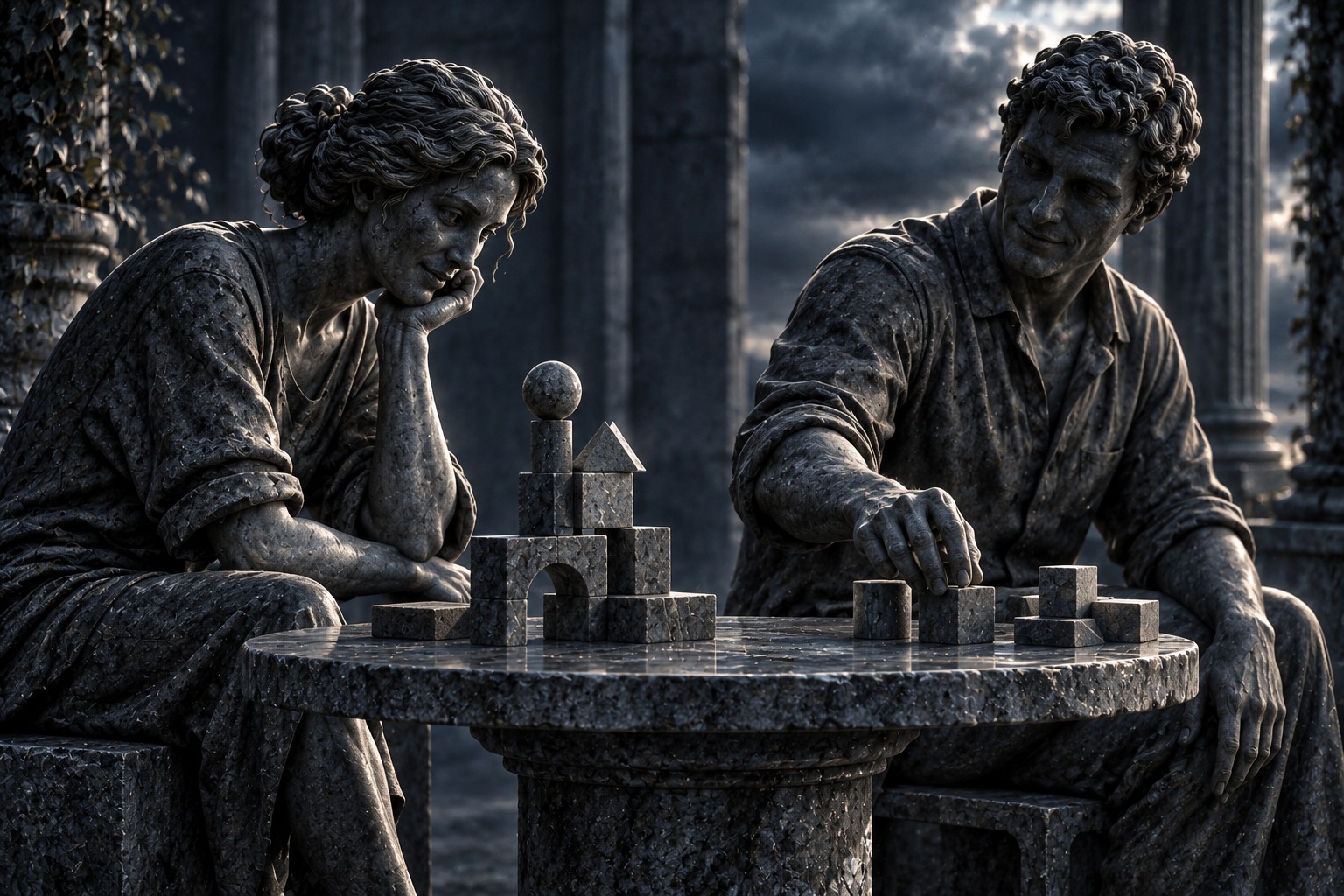
Epigraph
“Living form.” — Friedrich Schiller, Letters on the Aesthetical Education of Man, XV. Short fragment from the selected English edition; display capitalisation only.
What this article is about
At the beginning of an evening, you want to play one round, assemble an unusual structure or try a new approach to a familiar challenge. Some time later, the activity continues, but the original question is difficult to recall. What remains is obtaining the next item, maintaining a daily streak or completing one more cycle. Sometimes this still holds your interest. Sometimes you are waiting for a convenient place to leave, and each such place becomes the start of another action. The distinction is not always visible on a screen: the same buttons are pressed in both cases. It appears in what you are trying to do now and how well the activity answers that intention.
Imagine a fictional episode. Oleg is playing a board game with friends and enjoys devising an unusual move, even if it will not bring victory. Later, at home, he opens a digital game. Initially, he wants to test a new tactic; then he completes several familiar tasks for a completion marker. Once he receives the marker, another task is offered. Oleg has not yet decided whether he wants to continue, but he has already begun. This example establishes no superiority of board games over digital ones. Both can offer exploration, habit, companionship or pressure. Our interest lies in a transition within a particular activity.
Here, playful interest means wanting to participate in an unfolding possibility: trying a move, noticing a response, revising a plan or sharing a surprise. Automatic consumption will mean an episode in which continuation happens mainly because it has already been offered, although the person has not chosen it afresh. This is an editorial distinction, not a diagnostic scale. Familiar actions can support rest and learning; interest need not be intense every minute. This article offers a few understandable questions for examining a safe personal episode, without turning enjoyment into a report on usefulness or using enjoyment to justify every consequence.
I. What do I want to try?
Before a game, intention often sounds broad: you want a distraction, entertainment or something to do. There is nothing wrong with this. During the activity, however, a more specific wish may appear: seeing whether another route works, making an amusing combination, understanding a partner’s move or simply spending time in a familiar world without a difficult decision. These answers help reveal what you are receiving now. They do not require planning your entertainment in advance. You can notice an intention after several minutes or acknowledge that familiar repetition is what you want today. The answer needs to concern current participation, rather than explain only why the game was opened an hour ago.
Oleg notices that testing his new tactic finished earlier than he expected. He is now doing familiar tasks. He may decide that this is precisely what feels pleasant: a predictable rhythm after a difficult day is not necessarily less worthwhile than experimentation. He may also discover something different: the tasks no longer interest him, but leaving feels inconvenient because a progress bar will remain unfilled. These situations call for different decisions. In the first, he chooses a familiar activity. In the second, he can ask what he expects from filling the bar and whether that reason will remain after another reward. The same repetition supplies no answer without context.
A useful question concerns the nearest possibility, rather than a final justification for playing. What do I want to try in the next short episode? The answer may be simple: seeing a new landscape or talking to a friend during a shared task. If there is no answer yet, you need not immediately close everything and do something serious. You can leave the question open and notice where the next step comes from. Is it chosen for a particular experience, suggested by the interface, needed by the team under an agreement or simply convenient? Several reasons can operate together. Distinguishing them widens choice without requiring the elimination of every habit.
II. Participation need not mean producing something
Games are easily judged through achievements: levels completed, objects created or skills improved. Yet a person can participate actively without an external result. They notice a change of tone in a story, choose an absurd reply, follow a beautiful sound or find an unexpected way to negotiate with a partner. Experiencing and responding cannot be reduced to a useful product. The distinction between interest and consumption should therefore not become a demand to create something of your own at all times. A receptive participant also makes distinctions. The question is whether space for response and choice remains, rather than how many things have been produced.
In Letter XV, Friedrich Schiller considers the interplay of sensuous and formal impulses in aesthetic experience. His argument concerns beauty and human completeness; it does not make every popular game an embodiment of his ideal. For this topic, that philosophical perspective invites a question about combining what is received with what a person helps shape. This is a limited comparison, not a conclusion about players’ health. Selected passages from the English edition do not replace reading Schiller’s entire system, and his conception of play is not identical to today’s range of entertainments.
In an ordinary episode, this combination can appear without ceremony. A child and an adult invent amusing names for a drawing; two friends enact a familiar scene differently; someone chooses a route through a virtual world for the view rather than a reward. Nobody has to demonstrate originality continuously. Sometimes interest is supported by the possibility of changing direction, even when that possibility is not currently used. Sometimes rules temporarily restrict choice and thereby make a move expressive. Freedom of participation does not mean the absence of form. It includes a relationship to form: understanding why you accept a constraint now and being able to discuss conditions when they no longer fit.
III. What supports the wish to play?
The abstract of Ryan, Rigby and Przybylski’s 2006 paper describes four studies of video games within self-determination theory. The authors consider perceived autonomy, competence and, in an online-community study, relatedness in relation to enjoyment and interest in further play. The publisher’s abstract was read here, rather than the full methods or data. These findings provide a limited research context. They cannot assess this particular Oleg, establish a single motive for him or demonstrate universal benefits of games for every person.
For personal reflection, these directions can cautiously be translated into ordinary questions. Does the activity leave room for a decision I consider my own? Do I notice something gradually becoming easier or clearer? Is there enjoyable companionship here, if social contact is part of my intention? These questions neither reproduce a research procedure nor measure needs. Answers may differ. Someone willingly chooses a difficult challenge but does not want conversation today; someone else comes for company without seeking technical mastery. The absence of one answer makes neither the game bad nor the person deficient. Context permits a suitable combination to be chosen.
It also helps to distinguish enjoyment of participation from relief at completing an obligation. Both can coexist. A shared game requires arriving on time, and that agreement helps the meeting happen. Yet a requirement to appear daily to maintain a streak may begin to outweigh the game itself. Then it is useful to name the price of continuing: time, fatigue, money or a missed agreement. This is not a proposal to calculate the value of every pleasure. It asks which conditions support the chosen activity and which have become pressures in their own right. When conditions change, a previous decision to participate need not remain binding indefinitely simply because it was once made willingly.
IV. Repetition and inertia can look alike
Playful interest does not disappear with repetition. A musician repeatedly returns to a familiar melody, a puzzle enthusiast to similar challenges and a group to the same board game. A recognisable form allows subtle changes to be noticed that were inaccessible at first. Sometimes repetition is enjoyable precisely because it offers no major surprises. The number of identical actions is therefore insufficient evidence of automatic consumption. It is more useful to ask what those actions mean in this episode. Is the person choosing a familiar rhythm, trying a small variation or continuing simply because the next action has begun? Outward similarity does not erase different relationships to the activity.
Inertia does not necessarily indicate a serious problem either. One evening, you may notice a few unnecessary transitions and finish calmly. Some actions are performed automatically so that every detail need not be decided afresh; this is an ordinary part of familiar activity. The question matters more when repetition no longer matches the chosen experience and changing course is scarcely considered. Oleg need not catch every automatic response. One clear boundary is enough: the original experiment is finished, the reward has arrived or the conversation has ended. At such a boundary, it is easier to see whether there is a personal reason for another episode. When there is, continuing can be deliberate without involving a new discovery.
Fresh stimulation also provides no guarantee of participation. You can move between constantly changing tasks while hardly noticing what happens in them. You can spend a long time on one challenge and remain engaged. Our question therefore differs from a search for novelty. It concerns the relationship among action, response and the possibility of revising an intention. Does what I see change my next move? Do I notice when the task is no longer one I want? Sometimes the answer appears after the session rather than during it. That is still usable observation: it can inform another evening without demanding constant internal monitoring of every movement.
V. Feedback differs from the promise of a reward
A game’s response can tell you a great deal about a move. A structure collapses at an unexpected point; a partner sees a possibility you missed; another route turns out to be shorter. This feedback allows a plan to be refined. A reward may accompany it, but does not replace the content of the response. Sometimes a marker merely reports that an action has been performed the required number of times. A person may enjoy that too. The distinction becomes useful when anticipation of the marker begins to obscure the experience itself. Then you can ask what became clearer or more interesting independently of the token received. The answer need not be profound: inventing an amusing move is already a particular event.
The cook narrative in chapter III of the Zhuangzi depicts action responsive to encountered structure and difficulty. In the Herbert Giles translation read here, the character becomes especially attentive at a difficult point, acts carefully and tends to his tool after finishing. This is a literary narrative, not an experiment or instructions for handling dangerous objects. The translator’s commentary must be distinguished from the narrative. Our limited comparison concerns responsiveness and completion, without making the story a required model for games or evidence of modern psychology.
In a safe playful activity, a related question can be asked without copying the story. What changed my next step? Perhaps you reduced the difficulty, asked for a rule to be explained, tried another approach or decided that today’s session was sufficient. Such answers maintain a connection between experience and action. If everything instead leads equally to another press of a button, that uniform connection is worth noticing. It may be convenient for brief relaxation, or it may have stopped satisfying you. Observation alone prescribes no decision. It restores the possibility of choosing a response to what is happening, instead of requiring either continuation or termination.
VI. Duration does not explain the whole episode
Duration establishes an important fact, but not every cause or consequence of an activity. A long, agreed meeting with friends differs from an unexpectedly prolonged evening alone. A short episode can also leave discomfort if it displaced an important agreement or involved unwanted spending. Time is therefore useful alongside conditions, rather than as the only indicator. How did the game fit among sleep, food, care, work, study and relationships? Was that period actually free? This question allows different answers for different people and days without setting a universal number of hours.
Johannes, Vuorre and Przybylski’s 2021 study combined actual play data with players’ reports about well-being and motivation in two particular games. The abstract read reports a small positive association between play and affective well-being. Association does not establish that playing caused improvement; the findings do not encompass every game, circumstance or person. Full methods and data were not read here. This source therefore neither permits ignoring personal consequences nor establishes a universal prohibition. It encourages caution about simple conclusions based on duration alone.
Oleg may find that an enjoyable game lasted longer than expected and nevertheless displaced sleep. Enjoyment and its cost can be acknowledged together. There is no need to declare the whole evening meaningless to change the conditions of another one. Perhaps a shorter format would fit, an ending could be agreed before a meeting or playing could be skipped when almost no free time remains. The particular change depends on the circumstances. A scientific headline does not cancel a personal schedule, and guilt does not replace examining it. A decision rests on the observed consequence and available alternatives rather than a general verdict on entertainment.
VII. Ending need not devalue the game
Sometimes leaving feels like admitting that your interest was unreal or previous effort was wasted. Yet an activity can end precisely because it has taken place. The round was good; the conversation brought joy; the idea was tested. Another episode is a new proposal rather than an obligation attached to the experience already received. This is especially apparent when a game has no clear final ending and keeps offering new goals. A person can choose their own completion. It need not coincide with the last available task, the maximum reward or the moment everything stops being enjoyable. Sufficiency can arrive before possibilities are exhausted.
When others depend on participation, ending involves agreements. You can give notice before a round, choose a suitable format, discuss transferring a role or agree a boundary in advance. Freedom does not justify disappearing during a shared activity you have promised to join. An agreement, however, does not imply unconditional availability at every moment. When a format repeatedly fails to fit real life, the agreement itself can be reconsidered. Perhaps the group can find another arrangement; perhaps some meetings will have to be missed. Conditions can be discussed directly without declaring friends bad or treating a wish to leave as weakness. Mutual participation includes being able to speak about limits.
Ending may leave a wish to return. That alone proves no dependence and does not require immediately destroying the game. Pleasant possibilities often remain attractive after stopping. You can notice the wish and still move to your chosen next activity. If stopping repeatedly feels unavailable, substantial consequences arise and changing the situation alone is difficult, discussing it with a suitable professional is worthwhile. Everyday observation can help describe episodes, but establishes no diagnosis. Needed help should not be postponed until a personal trial succeeds or because of a promise to manage through willpower alone.
VIII. Play need not earn the right to exist
A hidden requirement may emerge: pleasure is permissible only if it develops you, heals you, increases productivity or strengthens relationships. Every gaming evening then becomes an examination in usefulness. Even rest has to be defended as an investment in later work. Our distinction is not intended for that examination. Interest can be a sufficient reason for safe recreation when actual conditions and obligations are considered. Play can remain play. It need not yield a spiritual lesson, a communication skill or a creative product. The question of choice helps preserve your relationship to an activity rather than issue permission for enjoyment.
This does not remove responsibility for consequences. A right to recreation does not make spending, neglected care or broken promises insignificant. A particular consequence can be discussed without debating the moral worth of every game. For example, the problem may be a purchase you did not wish to make or routinely postponed sleep. The subject of change is then clearer than an accusation that your life is empty. Choosing one observable connection and examining an available condition can help. Avoiding a moral verdict makes the conversation more precise; it need not become a justification for every continuing action.
Different traditions and studies should not issue one combined certificate of gaming’s acceptability either. Schiller’s aesthetic argument, the Daoist literary image and modern research on players address different questions. They can reveal different aspects of participation, but do not combine into proof that a particular format benefits everyone. A person may recognise their experience through one perspective without accepting another. A conversation needs only to show where comparison begins and ends. Shared words about interest and freedom neither make philosophical premises identical nor replace information about a particular episode.
IX. A small trial at a natural boundary
If you want to examine the distinction, choose one safe, voluntary activity: a familiar puzzle, a short board game, drawing or an ordinary gaming episode without financial betting. There is no need to extend the time deliberately, choose an arduous test or deprive yourself of necessary rest. Before beginning, simply name the nearest wish: what you want to try or receive. If the goal is a pleasant familiar rhythm, that is an acceptable answer. Then select a natural boundary: a completed task, the end of a round or a finished drawing. It is a place for a question, not a mandatory exit point. The trial can be cancelled or ended earlier.
At that boundary, briefly notice three things. What was interesting in the participation itself? What is now offering continuation? Do I have my own reason to accept that offer, considering the time left and my next activity? Answers can remain in memory or be written privately without other people’s names or details of their conversations. There is no requirement to publish results, provide screenshots or test friends. If observation disrupts the game or increases unpleasant tension, it can be abandoned. This is an editorial trial for clarifying one choice, not a verified therapeutic programme or a competition in self-control.
After the episode, one particular finding is enough. Perhaps interest came from an unusual solution, and after it was tested, continuation became mainly anticipation of a reward. Perhaps familiar tasks remained pleasant, but the chosen format did not fit before sleep. Perhaps the activity mattered mainly because of conversation, suggesting a shorter shared meeting next time. No answer has to extend to every future evening. If no finding emerges, uncertainty can remain. Observation is valuable insofar as it clarifies an available decision, rather than according to the persuasiveness of a theory about your entire personality.
X. Participation remains when choice can be renewed
The distinction between interest and automatic continuation is not a permanent boundary between good and bad games. It can appear within one evening and change with fatigue, company, format and expectation. A person need not always stand on one side. Sometimes they willingly accept a familiar rhythm, sometimes seek an unusual move and sometimes notice that a goal has been reached. Such variation does not undermine a coherent life. It allows decisions to consider present conditions rather than carry out an original intention indefinitely. What matters is being able to notice a transition and renew a choice where that is actually needed.
Renewal does not always require giving something up. You can change a task, lower the difficulty, choose a game without a daily obligation, discuss a meeting’s duration or leave everything as it is because the conditions fit. You can finish before irritation arrives. You can continue for a possibility you can name. Not every suggested option is available to everyone: constraints of health, money, work and relationships are real. A good decision need not be ideal. Sometimes it involves a small adjustment between enjoyment and the next necessary activity; sometimes it means acknowledging that changing a recurring difficulty alone is not currently possible and a conversation about help is needed.
Oleg need not become an observer of every response he makes. Returning to one moment when a new task began before he had decided about it is enough. He can now distinguish an experience already received from an offer not yet chosen. Another evening, he may willingly accept that offer. Today, he may finish and let the game remain enjoyable. This possibility makes ending part of participation: a person not only enters a game but also decides how it will fit into life. Interest stays connected with unfolding experience when the next step allows a response and ending allows respectful acknowledgement of what has already taken place this time.
What this means in practice
Do not judge a game solely by its medium, novelty, duration or number of repetitions. Choose one safe episode and name the nearest wish. At a natural boundary, ask what was interesting in participating and why you want to continue now. Familiar repetition, companionship and simple pleasure are acceptable answers. Consider them alongside actual conditions: sleep, care, work, expenses and agreements. Every evening need not demonstrate developmental benefits. It is enough to notice one place where offered continuation can become your decision, change or end.
The personal trial is voluntary, includes no financial betting, dangerous action or tests of other people, and can be stopped. Any note remains private; having no conclusion is acceptable. When stopping regularly proves difficult and brings substantial consequences, discussing suitable help matters more than completing the trial. Neither interest nor duration alone establishes a diagnosis. A game can remain pleasant after ending, and a wish to return need not be enacted immediately. The practical outcome is a clearer decision for one episode, preserving necessary care and a right to enjoyment.
Key quotation
“I stay my hand.” — Chuang Tzu, chapter III, the cook narrative; Herbert Giles translation,1889. In the story, this is a moment of care at a difficult point, rather than a prescribed gaming exercise.
Connections between traditions
- Schiller, Letter XV: aesthetic interplay of sensuous and formal impulses; a limited comparison with receptive and responsive participation. Not every commercial game embodies the philosophical ideal.
- Zhuangzi, chapter III: a literary image of responsive action, care and completion. Neither a psychological experiment nor instructions for dangerous practical action.
- Motivation and video-game research: bounded empirical questions about experiencing play and well-being. Abstracts supply no individual diagnosis; correlation does not establish causal benefit.
- Editorial comparison: noticing a possibility, a response and an episode boundary. Similar questions do not establish identical doctrines or a universal gaming standard.
Sources
- Friedrich Schiller. Letters on the Aesthetical Education of Man, XV, in Aesthetical and Philosophical Essays, Project Gutenberg6798. Selected XV passages and context distinguishing the aesthetic ideal from popular games were read, not the whole collection. This edition’s English translator was not established. A global reuse licence was not established; source text is neither imported nor vectorised.
- Chuang Tzu, chapter III, selected cook narrative. Herbert Allen Giles, translator; London: Bernard Quaritch,1889, Project Gutenberg59709. The narrative was read, with translator commentary distinguished; not the whole work. Linked digital-edition rights: UNKNOWN, without a blanket permission inference; source text is neither imported nor vectorised.
- Richard M.Ryan, C.Scott Rigby, Andrew Przybylski. The Motivational Pull of Video Games: A Self-Determination Theory Approach. Motivation and Emotion2006;30:344–360. DOI10.1007/s11031-006-9051-8. Publisher abstract and metadata were read; full text is subscription-restricted, with methods and data unread. The access boundary is retained; source abstract is not imported, vectorised or used for training.
- Niklas Johannes, Matti Vuorre, Andrew K.Przybylski. Video game play is positively correlated with well-being. Royal Society Open Science2021;8(2):202049. DOI10.1098/rsos.202049, PMC record. Indexed abstract and primary author-copy first-page excerpt were read; full methods and data remain unread. The author-copy first page explicitly states CC BY4.0; direct CAPTCHA and publisher-page failure were not bypassed. The licence implies no author endorsement of this article; source text is not imported, vectorised or used for training.
Tags
play, playful interest, participation, choice, enjoyment, rest, repetition, inertia, automatic consumption, feedback, reward, completion, sufficiency, intention, attention, curiosity, possibility, rules, autonomy, competence, companionship, agreements, boundaries, time, digital games, board games, creativity, aesthetics, Schiller, Zhuangzi, motivation, self-observation
About the authors
Andrey Zarinsh is the author and founder of United Wisdom. He explores inner transformation, the unity of traditions, intercultural dialogue, and contemporary spiritual discipline. Instagram: @andrey.zarinsh.
Maria Evilkut is a co-author of United Wisdom. Alongside her research, she seeks to test these ideas in practice and observe how principles of unity and mutual understanding work in real life between people and cultures. Instagram: @ilkutki.
Keep what resonates with you.