
World & consciousness
The I Ching: a text of change, its interpretations, and symbolic use
The I Ching's textual layers, Qian and Xu, interpretive disputes, and the boundary between a symbolic question and a forecast.
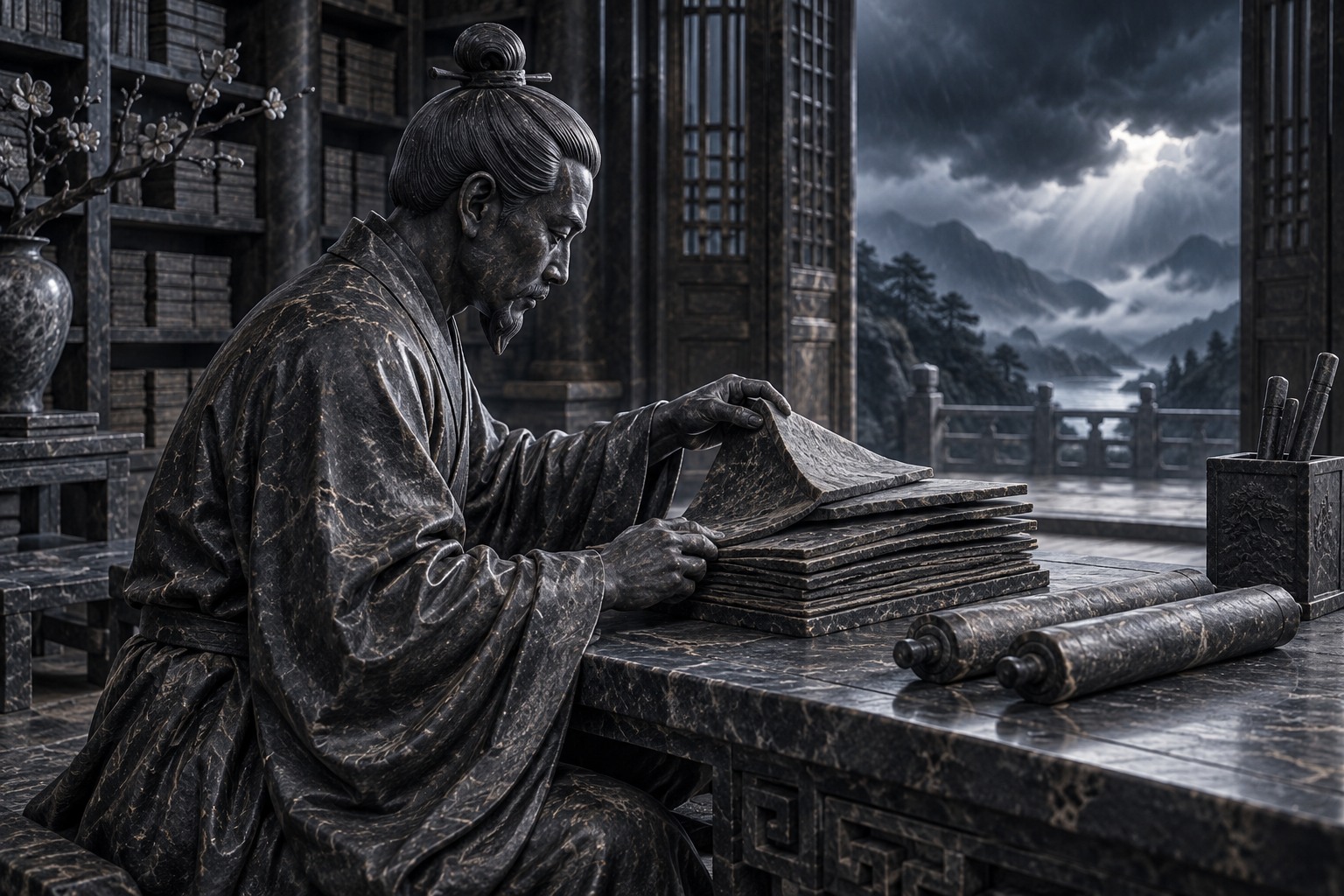
“It is not the time for active action.”
I Ching, Qian, first line; James Legge’s English translation. Here and below, the English quotations are editorial translations through the approved Russian article, whose quotations were translated by the article’s authors from the specified English text. They are not presented as Legge’s published English wording.
About this article
Six lines can provoke more disagreement than a long explanation. Some see an answer about the future in them, others the structure of the world, and others an opportunity to admit which answer they hoped to receive. Before choosing between these versions, we should notice that they answer different questions.
The I Ching, or Classic of Changes, is associated with divination, but its history also includes debates about action, timing, power, and ways of reading. We will examine early statements, hexagrams, the Ten Wings, and later commentaries. Recognizing the textual layer changes whom we credit with an idea. We will then consider what an image contributes to reflection and what it does not establish about the future. Our central examples are the dragon of Qian, waiting in Xu, and differing interpretive approaches. The practical section proposes a modern reading in which a symbol opens a question while the decision remains the reader’s responsibility. This use is not declared the book’s only authentic purpose: respect for its history is compatible with testing a present-day conclusion.
I. A book with more than one historical moment
The I Ching is better understood as a history of accumulated layers than as a message from a single sage. At its foundation stands the Zhouyi, the Changes of Zhou, an early divinatory text with figures and brief statements. It is joined by a body of commentary known as the Ten Wings. These were traditionally associated with Confucius; that is a traditional attribution, not authorship established by modern research. The precise dating of individual parts remains debated. This distinction already explains why neighboring pages can speak in such different voices. Historical overview in IEP.
The early text often appears awkward to a reader expecting an abstract treatise. It contains journeys, animals, dangerous crossings, social positions, and favorable or unfavorable outcomes. A later commentary may draw cosmological or moral meaning from this material. We cannot automatically attribute a later interpreter’s entire philosophy to an early formula. Nor should we dismiss commentary as mere distortion: it is itself a significant part of the history of Chinese thought.
The difference resembles that between an old judicial decision, a later legal commentary, and a modern essay on justice. All three may appear under one cover, but they do not belong to one genre or one historical moment. A reader who misses the change of voice takes the result of centuries of work for a complete message from a single ancient source.
It helps, therefore, to ask a page two questions: what exactly am I reading, and who is making the next inference? It may be a line statement, an explanation of an image, a translator’s note, or a modern application. In Russian, the smoothness of a translation can further conceal the difference. A coherent paragraph may sound as though all its meaning originally belonged to one author. A good edition helps recover the boundaries.
Historical layering does not diminish the book’s significance. It changes the reason for that significance. We encounter a text around which generations learned to debate change, rather than a stationary storehouse of answers. Respect begins with a willingness to distinguish these generations instead of combining them into an attractive legend.
II. What six lines show
A hexagram is a figure of six lines arranged above one another. The lines may be unbroken or broken; combinations of the two types produce sixty-four figures. This structure is easy to describe mathematically. Understanding the meanings assigned to it in a particular text and school is much harder.
Position matters. A bottom and a top line are not interchangeable merely because both are unbroken. The figure is read as an arrangement of relationships, stages, and possibilities. Various procedures identify changing lines, producing a second figure. Yet the system’s ability to depict change does not establish that every transition corresponds to a future event in the questioner’s life.
The first hexagram, Qian, consists of six unbroken lines. In James Legge’s translation, its line statements carry the dragon image from concealment to appearance and ascent; the top line connects exceeding the proper measure with regret. What matters here is the movement of the image, rather than declaring the dragon a secret name for the reader’s personality. Qian in Legge’s translation.
Consider a hypothetical example: someone starts a project and particularly likes the image of flight. They may decide that the book confirms their exceptional success. But the same sequence raises questions about appearing prematurely and exceeding the proper measure. By selecting only a convenient image, they are supplying their confidence with symbolic decoration rather than reading the text. A closer reading asks: which stage am I assuming, what observations support that assumption, and what am I ignoring?
The scheme does not remove the need to describe the actual situation. It may give that description a form. This is a possible intellectual strength: the reader sees not merely a quality—strong, weak, fortunate—but a position within a changing whole. The scheme becomes misleading, however, when its appeal is taken as sufficient confirmation that it fits.
We must also distinguish vividness from universality. Six lines offer a compact language, but a compact language need not explain every circumstance. A medical assessment, an agreement, or another person’s action contains information that does not arise from the figure. It must be obtained separately for a decision.
III. Change does not mean that everything is equally permissible
The modern word “change” can easily become permission for endless flexibility: one thing is right today and its opposite tomorrow, so there are no stable grounds. Reading the I Ching need not lead to that conclusion. Its images allow us to discuss the appropriateness of action: whether an act fits its time, position, and relationships.
Appropriateness differs from convenience. Remaining silent may be convenient when someone needs protection. Delaying an intervention may be appropriate even when silence feels uncomfortable. To distinguish these cases, a general appeal to “feel the moment” is insufficient. We must name what changed, whom the decision affects, and which obligations remain.
Xu, a hexagram usually associated with waiting, distinguishes the waiting person’s positions in Legge’s translation: far from danger, on sand, in mud, and further on. Waiting is not portrayed as a single, unconditionally good posture. The reader encounters different situations under a common name. Xu in Legge’s translation.
We can apply this distinction to postponing a difficult conversation. A pause to obtain information differs from a pause during which harm continues to grow. In the first case, time serves understanding; in the second, inaction is already an action with consequences. The text does not know which case the reader faces. The symbol helps if it raises the question, rather than authorizing avoidance in advance.
Not every change requires an immediate response. Not every form of stability means rigidity. Sound reflection should leave both possibilities open. If a symbolic system always produces the same choice—always take a risk, always wait, or always seek a hidden sign—its use has become poorer than human experience itself.
Change has another uncomfortable side: as circumstances change, we must update our explanation. Someone may assess a project’s beginning correctly and be wrong six months later because they keep acting from the old map. Reflection on time then means a willingness to revise the map, rather than confidence that an ancient figure fixed the necessary strategy forever.
IV. Why interpreters need not agree
The history of I Ching commentary includes different approaches: cosmological constructions, attention to images and numbers, moral reasoning, and divinatory uses. Wang Bi, a third-century thinker, is especially important to a line of inquiry concerning meaning and its relation to images and words. We should not turn the contrast between schools into a perfectly rigid division: actual interpretations may combine several tasks. SEP overview of the philosophy of change.
Wang Bi’s question about words, images, and meaning illuminates a familiar problem of reading. Suppose an image makes a thought accessible. Once the thought is understood, holding on to every outward feature of the image may obstruct understanding. But abandoning the image too quickly is also dangerous: the reader retains their own general idea rather than the text’s meaning. We need to work through the text to have grounds for moving beyond it.
This is not a dispute between superstitious and rational people in the modern senses of those words. Historical participants could accept shared cosmological assumptions while disagreeing about how to explain the book. When modern readers assign ancient authors to their ready-made camps, they often lose the authors’ actual disagreements.
Different interpretations also show why “the I Ching says” needs a continuation. Which passage? In which translation? With which commentary? The same decision may look different depending on whether priority is given to a line’s position, the figure’s name, its overall image, or the acting person’s moral character. This is not permission to invent any answer. It requires us to specify the route from text to answer.
A useful reading discipline emerges: compare interpretations by what they explain, not by how pleasant their results are. An interpretation that always announces the questioner’s hidden greatness is emotionally attractive. But it may bypass difficult passages and the actual consequences of an action. Another commentary may be less comforting while making the problem more precise.
When comparing, distinguish disagreement over the text’s meaning from disagreement over whether it fits the case. Imagine two readers discussing the start of shared work. Both understand a warning against premature action in the same way. But the first believes that the participants have not agreed on their goal; the second is certain the goal is clear and delay is already obstructive. Their disagreement primarily concerns the circumstances. Choosing a more authoritative commentary will not establish whether agreement was reached.
The reverse is possible: the circumstances are described identically, but the readers understand the image’s role differently. One sees a requirement to remain cautious; the other an invitation to test readiness. They should then return to the particular line, neighboring statements, and the translator’s explanation. Saying that the first person is braver or that the second senses change better cannot settle the dispute: a characterization of the reader does not replace an argument about what was read.
There are thus two directions of correction. If the transition from line to meaning is inaccurate, closer reading is needed. If the transition from meaning to situation is inaccurate, better knowledge of the situation is needed. Sometimes both steps are necessary. This allows people to discuss the book together without forcing every dissenter to choose between submitting to someone else’s interpretation and rejecting the text itself.
We need not become specialists in every historical school. It is enough not to present the first interpretation we encounter as the sole Chinese tradition. A book spanning centuries deserves at least this small space for disagreement.
V. Translation already involves a decision
A reader of the Russian I Ching encounters more than ancient statements. Between them and the reader stand choices of words, an edition’s arrangement, and a translator’s work. Rendering one word as “fidelity,” another as “correctness,” and a third as “persistence” may alter the practical conclusion. A figure’s name is not a ready-made diagnosis of a situation either.
In Legge’s old translation, a brief formula is accompanied by bracketed explanations and historical notes. These are useful, but an explanation and the original formula are different elements of the page. Legge himself included a separate introduction to the appendixes, showing that the book’s structure requires explanation. Introduction to the commentaries and appendixes.
The choice of translation matters especially in symbolic use. If a translator introduces a word close to contemporary psychology, the reader may take its psychological meaning for an original ancient category. A highly archaic translation carries the opposite danger: obscurity begins to look like depth. In both cases, we should distinguish the effect of language from the thought’s content.
Practically comparing two translations does not require a verdict on which is absolutely correct. We can locate a passage where the conclusion depends on one word and check its commentary. For instance, a call for steadiness may concern maintaining an obligation rather than stubbornly repeating an ineffective strategy. The distinction is substantial. One Russian version may reveal it while another conceals it.
This observation should not become endless doubt that makes reading impossible. Translation enables reading; it simply does not eliminate mediation. We trust translated books every day while distinguishing a confident meaning from a disputed detail. The I Ching calls for the same mature caution.
A good habit is to record where a formulation comes from. “This image spoke to me in this translation” is more precise than “the ancient Chinese command me to act this way.” The first leaves room for discussion; the second turns a translator’s choice into an order issued in the name of an enormous tradition.
VI. Symbolic recognition and evidence about the future
A symbol can speak accurately to someone’s experience without supplying a new fact about the external world. These two kinds of accuracy must be separated. An image of waiting may help someone acknowledge their indecision. It does not follow that it predicted the outcome of negotiations.
The historical existence of divinatory procedures confirms that people approached the book in this way. It does not test those procedures’ accuracy. The historical and philosophical sources examined here provide no empirical basis for promising that a randomly obtained hexagram reliably predicts a particular event. This is a limit of the present inquiry, not an attempt to declare all human symbolic life meaningless.
A testable predictive claim needs an appropriate test: a forecast recorded in advance, clear conditions for success and error, attention to failures, and comparison with an alternative explanation. Recognizing a fitting image after the event does not replace that test. A text that can be associated with either success or failure afterward may be meaningful for reflection, but for precisely that reason it is difficult to treat as a precise forecast.
Consider a hypothetical example: two people receive the same image before job interviews. One sees a promise of advancement; the other a warning of danger. After different outcomes, both believe the book was confirmed. Perhaps both learned something about themselves. Their satisfaction, however, does not allow us to calculate the method’s predictive accuracy. Personal significance and external testability differ.
An honest modern symbolic reading can ask which assumption the figure made us notice, rather than whether it disclosed another person’s hidden intentions. If the assumption matters, we test it through conversation, observation, or a document. A symbol opens a question; information helps answer it.
This separation does not impoverish experience. It releases the image from the obligation to be a forecasting device, and the person from the need to subordinate actual circumstances to an attractive coincidence. A meaningful symbol can remain meaningful without the right to decide for us.
VII. Responsibility cannot be handed to a book
Even a convinced participant in a divinatory tradition remains the person who formulates a question, chooses a procedure and interpretation, and then acts. Invoking the answer does not erase this chain of decisions. Remembering it matters especially when the consequences affect someone else.
Suppose a manager explains an employee’s dismissal by saying that “change requires a separation.” This formula may conceal unclear criteria, an unspoken conflict, or a wish to remove an inconvenience. Symbolic language elevates the decision, but the employee needs concrete grounds and a fair process. Respect for a tradition does not require accepting a symbol instead of an explanation.
The I Ching can become a subject of shared discussion when all participants freely choose that language. One person may not impose its authority on another as verified knowledge of the other’s motives. If a conversation partner does not share the worldview, discussion should concern actual circumstances: what happened, which agreements were broken, and which options exist.
A quieter transfer of responsibility is also possible. Someone consults the book endlessly because no answer removes the anxiety of choosing. A new checking procedure arises instead of clarity. It helps to ask what they expect: another thought, or a guarantee against regret? The book can offer a thought. A guarantee of that kind may be unavailable to the decision itself.
Responsibility is not omnipotence. People do not fully control outcomes and may err even when choosing conscientiously. This is easier to acknowledge when the decision rested on available information and explainable grounds. It can then be revised. A decision shielded by an untestable command is harder to update: admitting error begins to feel like betraying a sacred authority.
The useful boundary is simple: symbolic reading may participate in reflection but should not close discussion. The more significant the consequences, the more important it becomes to let the question move from symbolic language into the language of reasons, rights, possibilities, and testable conditions.
VIII. Chance, ritual, and the right to stop
Obtaining a figure and interpreting it are different events. A random selection may interrupt habitual thinking by presenting an image the reader would not have chosen. But this does not make interpretation random in the same sense. Readers bring expectations, fears, knowledge of the situation, and preferred conclusions to it.
This clarifies a possible benefit of consulting the book. When someone always reasons in one direction, an unexpected image may suggest a different question. The benefit then lies in expanding what is considered. For it to occur, we must allow that the new question may be inappropriate. Otherwise every random result automatically gains binding authority over the decision.
The ritual aspect also deserves respectful understanding. Repeated actions, a pause, and attention to procedure may mean more to a participant than obtaining a number. Within a historical tradition they are connected with a particular view of the world; present-day reading cannot retroactively declare them merely a productivity technique. A modern reader can nevertheless recognize the value of a pause without thereby asserting the entire cosmology’s truth.
In a hypothetical example, someone opens the text before an important choice and slows their usual decision. They then notice that they have not asked another participant’s opinion. This is useful. Yet we do not know whether obtaining the figure was necessary: a walk, conversation, or written account of the arguments might have created a similar pause. Personal experience supports “it helped me,” not “everyone needs this procedure.”
There is also the question of completion. If consultation is repeated whenever the previous answer was unwelcome, the book may become a way of postponing the decision indefinitely. The reader is no longer open to chance: they search through it until a convenient sign appears. It matters to decide beforehand why the consultation is undertaken and what would count as enough. For instance, obtain one new question and then return to ordinary checks of the circumstances.
The right to stop belongs to the person. There is no need to obtain another figure if reading increases confusion. A lack of resonance need not be treated as spiritual incapacity. Respect for a significant text is compatible with recognizing that it is not helpful now. The book does not become less interesting because it need not accompany every choice.
This also applies to digital applications. A quick result on a screen does not change the nature of knowledge: software may reproduce the line-generating procedure accurately while knowing nothing of your circumstances. Technical correctness in generating a figure and substantive grounds for advice are independent questions. The more convenient the tool, the more useful this distinction becomes. An attractive interface is not another commentator that has earned trust simply by appearing.
IX. Reading change without abolishing the unknown
The I Ching’s strength emerges when it makes us consider action within relationships and time. The same effort may be timely, premature, or late. Yet knowledge of change is not omniscience. Limits of understanding remain part of the human position.
Historical reading preserves several voices: early statements, later commentaries, translators, and modern interpreters. Symbolic reading preserves the difference between image and fact. Responsible application preserves the person who must choose and face the consequences. These boundaries are needed to read the book more attentively, rather than to neutralize it.
We may leave it with a new question and no ready prediction. For example: “Am I really waiting for the right time, or protecting myself from the need to act?” That question offers no guarantee. But it makes visible a fork previously concealed by a general phrase about destiny.
The I Ching need become neither a universal decision algorithm nor a museum object incapable of reaching today’s reader. Between these extremes lies a difficult, productive reading: respect another history, test our own conclusions, and do not call the unknown already settled. Six lines then do not close the future. They help us examine more closely the position from which we approach it.
What this means in practice
A modern reading of the I Ching can be an exercise in changing the question. This is the application proposed here, not a reconstruction of one uniform ancient procedure. Tossing coins is unnecessary. You can choose a particular hexagram and read it with an identified commentary.
Begin with a short account of the situation without symbols. What happened? What is directly known? What do you not know? Which decision actually belongs to you? If this account cannot be written, obtaining a figure will not fill the factual gap.
Then read the image in full, including uncomfortable elements. Do not seek only a phrase confirming the desired outcome. Formulate two different questions arising from the text. An image of waiting might raise: “Which information could still change the decision?” and “What harm does delay cause?” They point in opposite directions and therefore help avoid an answer chosen in advance.
Next, separate analogy from assertion. “My project resembles an early stage” is an analogy. “My partner will certainly betray me” is a claim about another person. The latter needs grounds the former does not provide. If the image arouses a strong feeling, name it separately: fear, relief, a wish for permission. The feeling shows your response to reading, not your partner’s intentions.
Finally, choose a small step that ordinary means can check. Clarify an agreement’s condition. Obtain a missing number. Ask about a deadline. Discuss a limit of risk. Or acknowledge that there is not yet enough support for a decision. After the step, return to the initial account and correct what proved inaccurate.
You can keep two neighboring records: “what the image suggested” and “what I could verify.” They need not match. Sometimes a check will overturn the first impression; this is a useful result of reflection, not its failure. Reading supports learning when it leaves room to discover error. Learning becomes impossible when every check must confirm the symbol in advance.
Returning to verification need not impoverish symbolic reading. An image can matter even when the first guess was wrong: it helped reveal the expectations we brought to the situation. Its value then concerns clarification of our question. This does not require declaring the book a source of information about other people’s intentions or events that have not occurred. Responsibility includes naming accurately what was obtained.
Key quotation
“The top nine, unbroken, shows a dragon exceeding its proper limits. There will be cause for regret.”
I Ching, Qian, top or sixth line; James Legge’s translation. Editorial English translation through the approved Russian rendering by the article’s authors, not a reproduction of Legge’s published English wording. In context, the passage concerns exceeding the proper measure. It returns us to timing; it does not tell a present-day reader which particular decision to make.
Connections across traditions
These are our analytical comparisons. They identify a shared question and a boundary between answers; by themselves, they do not establish historical influence.
| Question | Positions and sources | Actual similarity | Boundary of comparison |
|---|---|---|---|
| Numbers and meaning | Cosmological interpretations and Wang Bi: words, images, meaning | One canon supports questions about the structure of change and about understanding a situation. | Interpreting through numbers and moving from words and images to meaning are not one technique; the overview describes different approaches. |
| Act or wait | Qian, lines 1–6 and Xu, the positions of waiting | Action is assessed in relation to position and timing. | Waiting is not the general opposite of activity: different passages offer different grounds for a decision. |
| Oracle and duty | Qian and Epictetus, §32 | A question about the future does not remove the question of right action. | Epictetus himself allows divination in limited cases; he is neither a modern critic of all oracles nor an interpreter of the I Ching. |
| Action and outcome | Qian, first and top lines and Gita, II.47–48; III.4–9 | The strength of a desire does not guarantee a favorable outcome; the relation to action requires discipline. | The Gita concerns duty and freedom from attachment to the fruit, rather than hexagram reading or Chinese cosmology. |
| Distinguishing positions and tasks | Xu, first and third lines, Legge’s translation and SN 56.11: four tasks | Waiting far from danger and waiting near a dangerous current receive different assessments; likewise, understanding, abandoning, realizing, and developing in the sutta cannot be replaced by a single action. | Xu distinguishes symbolic positions within a situation; the four truths’ tasks belong to the path ending suffering. Similar distinctions do not establish an identical method or an oracle’s effectiveness. |
Sources
-
I Ching, Xu, first and third lines, James Legge’s translation: an additional hosting: specific differences between positions of waiting support the last map row. This is the same translation, not a new independent work.
-
Ronnie Littlejohn. Chinese Philosophy: Overview of History, Internet Encyclopedia of Philosophy, section on the Great Commentary: textual layers and the traditional attribution of the Ten Wings.
-
Tze-Ki Hon. Chinese Philosophy of Change (Yijing), Stanford Encyclopedia of Philosophy: interpretive approaches and the relation of words, images, and meaning.
-
I Ching, translated by James Legge. I. The Khien Hexagram: the first hexagram and the sequence of dragon images.
-
I Ching, translated by James Legge. V. The Hsü Hexagram: differing positions of waiting.
-
James Legge. Chapter III: The Appendixes: the arrangement of commentary in the historical edition. His historical reconstructions are not automatically accepted as present scholarly consensus.
-
I Ching. Qian, lines 1 and 6, translated by James Legge, comparative hosting at Baharna: verification of the two short quotations concerning Qian’s first and top lines; modern translations are not reproduced.
-
Epictetus. Enchiridion, §§1, 5, 31–32, translated by Elizabeth Carter: the Stoic distinction between one’s action and the external outcome; divination does not replace a duty already known.
-
Bhagavad Gita, chapters II–III, translated by Edwin Arnold, The Song Celestial, 1900 edition: action without attachment to its fruit (II.47–48; III.4–9), comparing attitudes to action and outcome without equating karma yoga with reading the I Ching.
-
Dhammacakkappavattana Sutta, SN 56.11, translated by Ṭhānissaro Bhikkhu: four distinct tasks—understand suffering, abandon its origin, realize cessation, and develop the path. Comparing distinctions does not make the I Ching a Buddhist method.
Tags
I Ching, Zhouyi, Classic of Changes, Chinese philosophy, hexagram, trigram, yin, yang, sixty-four hexagrams, Ten Wings, Confucius, traditional attribution, Wang Bi, James Legge, Qian, Xu, symbol, image, interpretation, time, timing, waiting, action, measure, divination, prediction, responsibility, decision, comparative philosophy, textual history
About the authors
Andrey Zarinsh is the author and founder of United Wisdom. He explores inner transformation, the unity of traditions, intercultural dialogue, and contemporary spiritual discipline. Instagram: @andrey.zarinsh.
Maria Evilkut is a coauthor of United Wisdom. Alongside her research, she seeks to test these ideas in practice and observe how principles of unity and mutual understanding work in real life between people and cultures. Instagram: @ilkutki.
Keep what resonates with you.