
Meaning & path
The Spiral of Maturity: Discipline, Form, Delegation, System
Four turns of an authorial maturity model—discipline, quality, delegation, and system—explored through craft, religion, philosophy, and management.
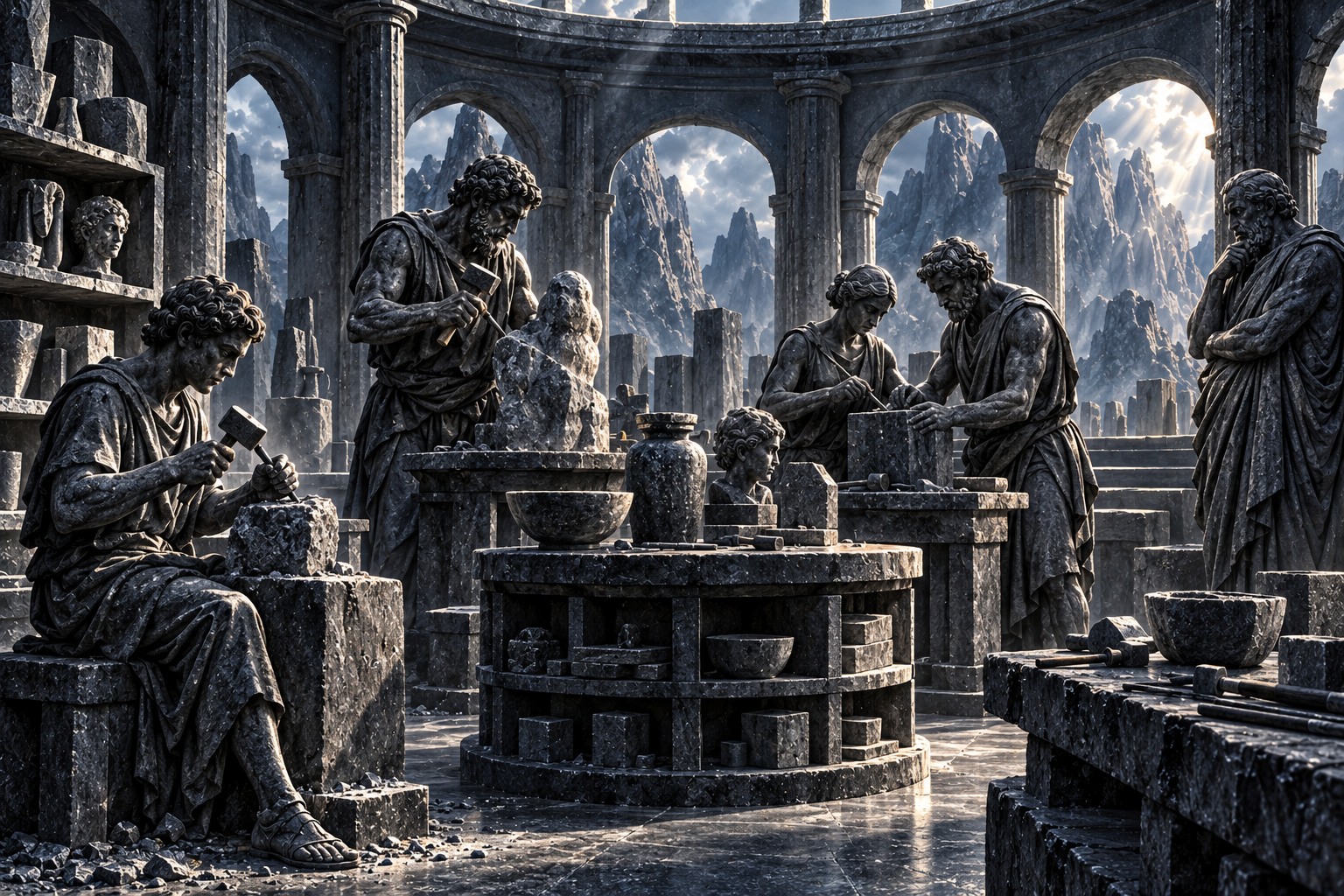
Discipline, form, delegation, system
Andrey Zarinsh & Maria Evilkut · United Wisdom · Inner Transformation
Archival translator’s note. This essay’s spiral is an authorial comparison across traditions, craft, management, and economics, not a validated measure of a person’s maturity. Its historical and neuroscientific claims and quotations are inherited and have not been independently verified here. Passages endorsing complete submission describe the archive’s position; they do not justify coercion, abuse, unsafe training, or surrendering the right to refuse. Religious initiation does not universally confer authority to teach, and the discussion of capital is a metaphorical comparison, not financial advice or a promise of returns. Quotations below are translated from the Russian archive.
Epigraph
“At seventy, I followed the desires of my heart without overstepping the measure.”
— Confucius, Analects 2.4
What This Article Is About
Freedom rarely arrives as a gift. It comes as the final stage of a long discipline, and someone who skips the stages usually loses both the fruit and the freedom. This article describes a structure in which a mature person’s experience develops spirally: first direct effort, then form, then the right to delegate, then a system in which influence continues without direct action. In this logic, things usually kept apart coincide: craft and capital, the monastic rule and operations management, ascetic discipline and the master’s condition. On every turn, the same figure appears—duty rising to a new level of generalization. Confucius calls the summit “following the heart without overstepping the measure.” The Gita calls it karma yoga without attachment to the fruit. Benedict calls it ora et labora. The Dreyfus brothers call it expertise. They all speak of one structure: discipline is the root of freedom, rather than its opposite.
I. A Spiral, Not a Ladder
The development of experience is easily pictured as a ladder: upward, step by step. That picture does not withstand observation. Someone who has traveled the path returns to the beginning with different knowledge and does the same thing again: repeats, maintains form, endures. A spiral is therefore more accurate: the same figures recur on a new level.
The Indian tradition describes this structure through the four purusharthas—dharma, artha, kama, and moksha—where each stage includes the previous one as its foundation rather than cancelling it (Britannica · Purushartha). In the famous autobiographical passage of the Analects (2.4), Confucius describes six points in his life: at fifteen, turning toward learning; at thirty, standing firm; at forty, freedom from illusions; at fifty, knowing Heaven’s mandate; at sixty, an attuned ear; at seventy, following the heart without overstepping the measure (IEP · Confucius). This is a sequence of nested circles, rather than a ladder: each new condition holds all the earlier ones within it.
In the Zen instruction shu-ha-ri, three characters fix the same figure: follow the form, break the form, depart from the form. The phrase is attributed to the tea master Sen no Rikyu (1522–1591) and was brought into wider use by Kawakami Fuhaku in the eighteenth century (Wikipedia · Shuhari). The third stage, ri, does not mean anarchy; it is the level at which a master is free because the form has become the master. In their modern model of skill acquisition, the Dreyfus brothers identify five stages—novice, advanced beginner, competent, proficient, expert—and a sixth stage of mastery (Wikipedia · Dreyfus model). At the summit, the conscious rule disappears: the expert “demonstrates a seamless integration of perception and action.”
The spiral means this: freedom at the summit is the same discipline at the foundation, internalized more deeply than the thought of it.
One thing must be established immediately to avoid a common misunderstanding. The spiral is not a metaphor of progress in which a person moves “higher and higher.” Its geometry is that a turn returns above the previous one: tasks recur, but the angle from which they are seen changes. Someone teaching another to maintain form once learned to maintain it under a teacher—and continues to maintain it today, now without visible effort. That is precisely why none of these traditions proposes “finishing” discipline. They propose changing one’s relationship to it: from an external prescription to second nature, and from second nature to the structural organization of life. At seventy, Confucius is not liberated from li: he becomes someone in whom li coincides with desire. That coincidence is maturity.
II. The First Turn: Discipline and Duty
The entrance is always rough. A person takes up a task without knowing it, and at first has only a form imposed from outside: a teacher, rule, model, or ritual. At this stage the person does not choose; the person repeats.
Benedict of Nursia, around 480–550, formulates this in one line of his Rule: “Idleness is the enemy of the soul” (RB 48.1). His monastic day is divided into three approximately equal parts: five to six hours of liturgical prayer, five hours of manual work, and four hours reading Scripture and spiritual books (Britannica · Benedictine Rule). The motto ora et labora, “pray and work,” is a structure, not a slogan. A Benedictine’s freedom appears within the strict horarium, rather than in its place (Wikipedia · Ora et labora).
The Sufi tradition calls the first series of stages maqamat. For al-Qushayri (986–1072) and al-Ghazali, the path begins with tawba, return; waraʿ, fear before God; zuhd, renunciation; faqr, poverty; and sabr, patience. These are not states of inspiration but stations in which the student must remain for a long time (Britannica · Maqām; Wikipedia · Maqam (Sufism)). Al-Ghazali describes sabr as “bearing a burden for the Most High until the time of difficulty passes.” This is the form of the first turn: a burden a person learns to bear.
In the Greek tradition, Aristotle calls such a stable disposition hexis (ἕξις), a condition formed by habit. “One must first practice just actions, perhaps under the guidance of teachers, in order to develop good habits” (Nicomachean Ethics, SEP · Aristotle’s Ethics). Virtue here is second nature developed through repetition, rather than a choice or impulse.
The Gita formulates the same logic from within. Krishna addresses Arjuna: “You have a right only to action, never to its fruit; let the fruit not be your motive, but do not take refuge in inaction either” (Bhagavad Gita 2.47, Wikipedia · Karma Yoga). This is a technique for maintaining form when motivation naturally pulls aside, rather than a call to aimless stoicism.
On this turn, a person does the work personally. Repeats. Endures. Learns to maintain form. Quality is not yet their own; it is borrowed from the tradition.
In the Spiritual Exercises, Ignatius of Loyola formulates the same logic in Western monastic prose: the novice must be “like a corpse in the hands of the washer,” perinde ac cadaver (Wikipedia · Perinde ac cadaver). The image is harsh, but the meaning is exact: while students set themselves against the form, they cannot master it. Only after passing through a period of complete submission to an external order does a person gain the chance to see that the order has an inner logic and holds not the person, but something through the person. The same thought appears in the Zen requirement to sit in zazen so that “the back is straight, there is no moisture on the tongue, and you are attached to nothing” (Dogen, Fukan-zazengi). On the first turn, the student has neither taste nor understanding nor a right to interpretation. There is only the sitting posture, breathing, and time.
III. The Second Turn: From Form to Quality
An understanding of principle is born from form that has been maintained. This is the least conspicuous transition on the spiral because outwardly nothing changes: the same movements, schedule, and work. What changes is what a person sees within those movements.
The Dreyfus brothers describe this transition as a shift from rules to the situation. A novice applies “context-free rules”; a competent practitioner starts grouping facts by relevance; the proficient practitioner sees the situation as a whole, a gestalt; the expert stops thinking about rules because rules are no longer needed (Wikipedia · Dreyfus model). The change is structural rather than quantitative: knowledge becomes perceptual.
Neuroscience calls this automaticity. With repetition, a motor skill shifts from the prefrontal cortex into subcortical basal-ganglia circuits and the cerebellum; learning becomes procedural rather than declarative (PMC · Cortical and basal ganglia contributions to habit learning; PMC · Neural Correlates of Motor Skill Automaticity). Schneider and Shiffrin formulated the criteria of automatic behavior in 1977: the trigger almost always evokes the action, and the action can be performed alongside another task. In other words, form stops occupying conscious attention and frees it for the next level: evaluating the whole.
In the tea ceremony, this transition is marked by the second stage of shu-ha-ri: ha, “break.” This is not rebellion; it is the moment when a student first departs from the teacher’s letter because they have begun to hear the principle behind it (Wikipedia · Shuhari). The aesthetics of wabi-cha, perfected by Sen no Rikyu, rest on a quality of perception rather than rules: the small nijiriguchi door, sixty by sixty centimeters, made samurai and merchant equal through the organization of space itself rather than a prescription (SEP · Japanese Aesthetics).
In Advaita Vedanta, this is a transition to adhikara, eligibility for knowledge. Shankara and his school hold that not everyone is capable of receiving the highest teaching: the student must reach a condition in which the mind has become one-pointed and pure, ekagrata and citta-shuddhi (Wikipedia · Anubandha chatushtaya). Adhikara is a level of inner readiness attained through discipline, rather than a privilege of birth. Here “eligibility” is ontological rather than social: a taste for the result appears no earlier than the moment form becomes transparent.
Quality is the ability to see a process as a whole before it is finished. On this turn there appears what Aristotle calls phronesis, practical wisdom, as distinct from techne, craft skill (SEP · Episteme and Techne).
The difference between techne and phronesis is easily tested with a simple example. A craftsperson who has mastered techne knows how to make a table: which tools, which sequence of operations, which tolerances. But deciding what particular table is needed in this room, for this family, at this time of year is already phronesis. The first kind of knowledge is replicable; the second is situational. In Scala Claustralium in the twelfth century, Guigo II describes an analogous transition within Lectio Divina: from lectio, literal reading, to meditatio, reflection on meaning, then oratio, prayerful address, and contemplatio, contemplation. Each stage retains the previous one—literal reading remains the foundation—but shifts the center of gravity from an operation to the perception of a text. This is the second turn in a Christian framework: the text does not change; the reader does.
IV. The Third Turn: The Right to Delegate
Here the spiral makes a movement that is usually misunderstood. When a master acquires the right to delegate, the master distributes the work rather than withdrawing from it, because now they know exactly what they are passing on.
Delegation without the second turn becomes shoddy work and loss. Someone who has never done the work personally cannot set a task, assess its execution, or catch the moment when the person doing it departs from its essence. That is why traditional schools always place delegation after a long apprenticeship. In the Indian guru-shishya parampara, students live with a teacher for years before gaining the right to teach others; the formal moment of diksha recognizes that readiness (Wikipedia · Guru–shishya tradition). In the Japanese tea tradition, this transition is formalized in the iemoto system: the head of a school does not perform every ritual personally but maintains the form of an entire lineage (Wikipedia · Schools of Japanese tea).
For Benedict, the abbot does not do the monks’ work for them, but distributes it while ensuring that “each person’s occupations correspond to their abilities” (Rule, chapter 48, CATHOLIC ENCYCLOPEDIA · Rule of St. Benedict). The abbot remains within the system but shifts from the level of action to that of assessment. Chapter 21 prescribes appointing deans over every ten monks: operations management in its pure form, grown out of ascetic practice.
The Gita returns to this subject in the Vyadha Gita, in the Mahabharata’s Vana Parva: the story of a sannyasin who considers himself above others and learns about dharma from a butcher. The butcher says: “There is no dirty work, no impure work—everything depends on how it is done” (Wikipedia · Vyadha Gita). This is the key to delegation: quality comes from the way a task is held, rather than the choice of task. Someone who knows this from within can entrust work to another because they understand what preserves the result and what is merely external noise.
Delegation on this turn is the conferral of authority, rather than its surrender. The master passes on a piece of their own form, rather than simply a task.
That is why transmission is formalized ritually rather than administratively in most traditions. In the Indian framework, diksha is initiation in which a student receives a mantra and with it the right to transmit the lineage (Wikipedia · Diksha). In the Islamic tradition, ijazah is a teacher’s written permission to continue teaching a text or practice; without it, knowledge is considered incomplete (Wikipedia · Ijazah). In the iemoto system, the head of the school issues named certificates establishing students’ positions in the line of transmission. This formalism is a guarantee that delegation will not break the chain of quality, rather than bureaucracy. Modern management, detached from this logic, often misses what traditions considered obvious: the right to delegate must itself be delegated—and confirmed by someone who has received it.
V. The Fourth Turn: Duty as a System
At the highest turn, direct action becomes optional. The master can step away and fruit will continue to appear, because duty is now embodied in a structure rather than in the master’s hands.
Confucius names this summit in words difficult to translate exactly: cong xin suo yu, bu yu ju, “following the desires of the heart without overstepping the measure” (Analects 2.4). In his twelfth-century commentary, Zhu Xi emphasizes that this is the complete internalization of the measure rather than liberation from it: the moral norm has become so inward that desire and norm coincide (SEP · Zhu Xi). This is the master’s condition: discipline has not disappeared, but has ceased to be external.
The Daoist tradition calls this wu wei, “non-action.” It is not passivity. “The Way does nothing, yet nothing remains undone”—wu wei er wu bu wei, Dao De Jing—is a formula in which the structure of the world takes over what the person previously did (Britannica · Wuwei; IEP · Daoist Philosophy). Zhuangzi explains it through the technique of xinzhai, “fasting of the heart,” in which the sage acts without claiming the action as their own (IEP · Zhuangzi).
In the Islamic tradition, this level is designated by ihsan. In the famous hadith of Gabriel, the Prophet answers the question of what ihsan is: “That you worship Allah as though you see Him; for if you do not see Him, He sees you” (Wikipedia · Tazkiyah). This is the level at which the outward prescription of sharia has already been internalized as an inward quality. The Sufi path proceeds through tariqa, the rules of the path, to haqiqa, reality; both stages rest on sharia as their foundation (Britannica · Sufism: The path).
In modern economics, the same figure works literally. Capital is institutionalized duty: accumulated value continuing to produce fruit without the owner’s daily presence. An abbey maintaining its rule across generations and a company maintaining operational discipline through a system of processes are described by the same structure: personal form has become institutional. Reflecting on the Benedictines in Past and Present (1843), Carlyle formulates this in one phrase: “Laborare est Orare, work is worship” (Wikipedia · Ora et labora).
This is the transformation of material labor into capital and spiritual practice into a state of being. On this turn, duty is not cancelled; it simply ceases to be a personal task and becomes a form of the world.
In this logic, capital is accumulated form rather than accumulated money. A field cultivated by monks for three hundred years according to one calendar becomes more than fertile land: it becomes a structure holding a way of cultivation within itself. The next generation receives both the land and a script for handling it. A manager passing a company to a successor passes on the rhythm of decisions by which its assets retain their value, rather than just the assets. A teacher leaving a school passes on a way of holding the pause between question and answer, rather than a name. In all three cases, the subject is the same: duty that has become institutional memory.
VI. What Keeps the Spiral from Breaking Down
The spiral can break down easily, and its failures are predictable. It is useful to name them.
The first failure is premature delegation. A person who has not passed through the second turn delegates what they do not understand and loses quality. In Dreyfus terms, it is an expert’s attempt to bypass competence and act “intuitively” with an intuition they do not possess (Wikipedia · Dreyfus model). In Sufi terminology, it is self-appointed wilaya: a claim to a station the student has not reached.
The second failure is becoming stuck in form. Someone who stops at the first turn makes discipline an end in itself. Benedict explicitly warns that the rule is a means, not the goal; the abbot must “not exhaust the body through asceticism so that it becomes unfit for work” (CATHOLIC ENCYCLOPEDIA · Rule of St. Benedict). In Zen, this is called attachment to shu, an inability to move to ha.
The third failure is abandoning duty under the guise of freedom. Confucius describes the freedom of seventy as the complete internalization of the measure, not its absence. Someone hearing only the formula’s first half—“follow your heart”—loses its second half and ends up in arbitrariness that resembles maturity from outside but is regression from within. In Advaita Vedanta this is called viparyasa: an illusion of advancement that deceives the practitioner (Britannica · Hinduism: Bhagavadgita).
The fourth failure is capital without form. Institutional fruit without a sustaining discipline decays within a generation. Abbeys that lost their horarium became estates; companies that lost their operating form became assets to sell off. The Gita’s karma yoga states the inverse: “Avoiding work or being unwilling to begin work is not the path to liberation” (Bhagavad Gita 3.4, Wikipedia · Karma yoga).
Every failure is an attempt to obtain the fruit of the next turn without passing through the previous one. The spiral does not forgive omissions; it reveals them.
VII. Where the Traditions Differ
It would be dishonest to pretend that all these traditions say the same thing. They describe one structure from different positions, and those positions are sometimes incompatible.
The Gita and Daoism understand the spiral’s goal differently. For Krishna, the summit is dharmic action without attachment to its fruit: a person continues to participate in the world as warrior, householder, or king. For Laozi, the summit is ziran, naturalness, in which even the distinction between action and non-action disappears (SEP · Laozi). The Gita retains the role; the Dao dissolves it.
Benedict and Shankara differ on the body. Benedict builds the spiral around labor—labor manuum, the monk’s manual work that physically sustains the community (Wikipedia · Rule of Saint Benedict). Shankara regards work as a stage of purification followed by sannyasa: withdrawal from activity for the sake of jnana yoga (IEP · Hindu Philosophy). For a Benedictine, the system of work is itself the state of being; for an Advaitin, it is a ladder to be discarded.
Confucianism and Theravada Buddhism differ in their understanding of duty. For Confucius, duty is a network of relationships, li and ren, that is never abolished, because a human being is social by nature (Britannica · Confucianism). Theravada leads to nibbana, in which a social role no longer determines action.
These differences matter: they show that the spiral of maturity is a family of stories rather than a single story, with the same figure carrying different content.
VIII. What This Means in Practice
The spiral of maturity is not a theoretical model; it functions as a diagnostic. Several practical implications follow.
First, recognizing the turn one occupies matters more than striving for the next. The Dreyfus brothers observe that a competent person’s attempt to act like an expert usually worsens the result: the expert no longer uses rules, whereas the competent person still becomes lost without them (Wikipedia · Dreyfus model). Before delegating, it is useful to ask: can I already assess the result as precisely as I can produce it myself?
Second, form is not cancelled. Confucius at seventy did not stop observing li; he simply stopped noticing the observance. In maturity, Benedict did not abolish the horarium; he maintained it. The spiral works only if earlier turns continue to be present as its underlying fabric.
Third, delegation is work rather than rest. Someone passing on a task takes on a subtler task: maintaining a standard in other people’s hands. Benedict’s abbot works no less than a monk; he works differently—watching quality, correcting deviations, restoring form. Delegation is possible only when a living system of oversight exists.
Fourth, capital has an inner obligation. Accumulated value requires a structure to keep it from decay. This concerns financial capital and a spiritual condition equally: both disintegrate without the daily form that sustains them.
Fifth, freedom is a side effect rather than the goal. Someone aiming at freedom as the first good does not obtain it; someone maintaining form accurately for a long time discovers freedom as a natural condition in which form ceases to be visible.
IX. Key Quotation
“You have a right only to action, never to its fruit; let the fruit not be your motive, but do not take refuge in inaction either. Establish yourself in yoga, abandoning attachment, with an even mind in success and failure—for evenness of mind is yoga.”
— Bhagavad Gita 2.47–2.48 (Wikipedia · Karma yoga)
The whole spiral is compressed into these two verses. The right to action is the first turn. Indifference to the fruit is the condition under which form becomes transparent, the second turn. Evenness of mind in success and failure is the state in which delegation and systems cease to threaten the ego, the third and fourth turns. Yoga here is neither posture nor breathing; it is a person’s structural position in which duty has become their nature.
X. Connections Between Traditions
| Turn | India | Japan / Zen | Islam / Sufism | Christian monastic tradition | Greek / Western philosophy | Confucianism / Dao | Modern science |
|---|---|---|---|---|---|---|---|
| Discipline and form | Tapas, sadhana | Shu: follow the rule | Tawba, sabr, zuhd | Ora et labora, horarium | Hexis as habit | Ages 15–30: “learning and standing firm” (Analects 2.4) | Declarative learning, prefrontal cortex |
| Quality and principle | Adhikara, viveka | Ha: break the letter for the essence | Al-Qushayri’s maqamat | Lectio Divina, meditatio | Phronesis, techne | Ages 40–60: “without illusions, attuned hearing” | Procedural memory, basal ganglia |
| Right to delegate | Guru-shishya, diksha | Iemoto, transmission of a school | Sheikh, ijazah | Abbot, deans (Rule, chapter 21) | Aristotle’s school, the Lyceum | Mandate of Heaven, tianming | Expert pattern recognition, Dreyfus stage 5 |
| Duty as a system | Dharma as cosmic order | School lineage across generations | Tariqa and ihsan | Benedictine congregation | Politeia as a form of life | Wu wei: “the Way does nothing, yet everything is done” | Institutional capital, operating systems |
| Breakdown | Viparyasa, illusion of advancement | Remaining stuck in shu | Self-appointed wilaya | Abandoned horarium | Akrasia | Arbitrariness under the guise of cong xin suo yu | Dunning–Kruger effect, premature automaticity |
These rows do not reduce the traditions to one meaning. They show a recurring structure: each school describes the four turns in its own words, and each turn has its characteristic possible failure.
XI. Sources Listed in the Archive
- Bhagavad Gita, chapters 2–3: “You have a right only to action.” Wikipedia · Karma yoga; Britannica · Hinduism: Bhagavadgita.
- Analects 2.4: Confucius’s autobiographical passage on six points in life. Britannica · Confucius; IEP · Confucius.
- Dao De Jing: wu wei as “non-action” in which nothing remains undone. Britannica · Wuwei; SEP · Laozi.
- Zhuangzi, chapter 4: xinzhai, “fasting of the heart.” IEP · Zhuangzi.
- Zhu Xi’s commentaries on the Analects: daily cultivation, jing, as a path to moral freedom. SEP · Zhu Xi.
- Shankara and Advaita Vedanta: adhikara and anubandha-chatushtaya. Wikipedia · Anubandha chatushtaya; IEP · Hindu Philosophy.
- Vyadha Gita, Mahabharata, Vana Parva: the butcher teaching a sannyasin. Wikipedia · Vyadha Gita.
- Aristotle, Nicomachean Ethics: virtue as hexis formed by habit. SEP · Aristotle’s Ethics; Wikipedia · Hexis.
- Aristotle on techne and episteme: craft knowledge and theoretical understanding. SEP · Episteme and Techne.
- Rule of Benedict, around 530: ora et labora, the monastic horarium. Wikipedia · Rule of Saint Benedict; Britannica · Benedictine Rule; CATHOLIC ENCYCLOPEDIA · Rule of St. Benedict.
- Lectio Divina: Guigo II’s four stages—lectio, meditatio, oratio, contemplatio. Wikipedia · Lectio Divina.
- Al-Qushayri, Risala: seven maqamat. Wikipedia · Maqam (Sufism); Wikipedia · Al-Qushayri.
- The Sufi path: sharia → tariqa → haqiqa; ihsan as the highest stage. Britannica · Sufism: The path; Wikipedia · Tazkiyah.
- Sen no Rikyu (1522–1591): shu-ha-ri as a three-stage model of mastery. Wikipedia · Shuhari; Britannica · Sen Rikyū.
- Wabi-cha aesthetics and the tea room’s organization as a form of equality. SEP · Japanese Aesthetics.
- Guru-shishya parampara and formal diksha as a transition to the right to teach others. Wikipedia · Guru–shishya tradition.
- Hubert and Stuart Dreyfus, skill-acquisition model: five stages plus mastery. Wikipedia · Dreyfus model of skill acquisition; Wikipedia · Hubert Dreyfus’s views on AI.
- Schneider and Shiffrin (1977), criteria for automatic behavior. PMC · Cortical and basal ganglia contributions to habit learning.
- Neuroanatomy of skill automaticity: basal ganglia, cerebellum, procedural memory. PMC · Neural Correlates of Motor Skill Automaticity; PMC · Basal ganglia in learning and memory; PMC · Parallel basal ganglia circuits for voluntary and automatic movements.
- Guigo II, Scala Claustralium, twelfth century: four stages of Lectio Divina. Wikipedia · Lectio Divina.
- The iemoto system in Japanese tea: transmitting a school across generations. Wikipedia · Schools of Japanese tea; Wikipedia · Japanese tea ceremony.
- Nishkama karma and tyaga: inward renunciation of the fruit of action. Wikipedia · Nishkama Karma; Wikipedia · Tyāga.
- Purusharthas: the four human aims as nested stages. Wikipedia · Puruṣārtha.
XII. Tags
Spiral of maturity, discipline, duty, form, delegation, system, karma yoga, dharma, nishkama karma, tyaga, adhikara, guru-shishya, shu-ha-ri, wabi-cha, Sen no Rikyu, iemoto, ihsan, maqamat, tawba, sabr, tariqa, haqiqa, al-Qushayri, al-Ghazali, Benedict of Nursia, ora et labora, horarium, Lectio Divina, hexis, phronesis, techne, Aristotle, Confucius, Zhu Xi, wu wei, ziran, Laozi, Zhuangzi, xinzhai, Dreyfus model, skill automaticity, basal ganglia, procedural memory, capital, institutional duty, viparyasa, Vyadha Gita.
XIII. About the Authors
Andrey Zarinsh is the author and founder of United Wisdom. He explores inner transformation, the unity of traditions, intercultural dialogue, and contemporary spiritual discipline. Instagram: @andrey.zarinsh
Maria Evilkut is a coauthor of United Wisdom. Alongside research, she seeks to test these ideas in practice and observe how principles of unity and mutual understanding work in real life between people and cultures. Instagram: @ilkutki
References Inherited from the Archive
These links accompanied the archived original and have not been newly verified.
- PDF-L001 — source PDF page 2.
- PDF-L002 — source PDF page 2.
- PDF-L003 — source PDF page 3.
- PDF-L004 — source PDF page 3.
- PDF-L005 — source PDF page 3.
- PDF-L006 — source PDF page 3.
- PDF-L007 — source PDF page 3.
- PDF-L008 — source PDF page 4.
- PDF-L009 — source PDF page 4.
- PDF-L010 — source PDF page 4.
- PDF-L011 — source PDF page 4.
- PDF-L012 — source PDF page 4.
- PDF-L013 — source PDF page 5.
- PDF-L014 — source PDF page 5.
- PDF-L015 — source PDF page 5.
- PDF-L016 — source PDF page 5.
- PDF-L017 — source PDF page 5.
- PDF-L018 — source PDF page 6.
- PDF-L019 — source PDF page 6.
- PDF-L020 — source PDF page 6.
- PDF-L021 — source PDF page 6.
- PDF-L022 — source PDF page 6.
- PDF-L023 — source PDF page 6.
- PDF-L024 — source PDF page 7.
- PDF-L025 — source PDF page 7.
- PDF-L026 — source PDF page 7.
- PDF-L027 — source PDF page 7.
- PDF-L028 — source PDF page 7.
- PDF-L029 — source PDF page 7.
- PDF-L030 — source PDF page 8.
- PDF-L031 — source PDF page 9.
- PDF-L032 — source PDF page 9.
- PDF-L033 — source PDF page 9.
- PDF-L034 — source PDF page 9.
- PDF-L035 — source PDF page 12.
- PDF-L036 — source PDF page 12.
- PDF-L037 — source PDF page 12.
- PDF-L038 — source PDF page 12.
- PDF-L039 — source PDF page 12.
- PDF-L040 — source PDF page 12.
- PDF-L041 — source PDF page 12.
- PDF-L042 — source PDF page 12.
- PDF-L043 — source PDF page 12.
- PDF-L044 — source PDF page 12.
- PDF-L045 — source PDF page 12.
- PDF-L046 — source PDF page 13.
- PDF-L047 — source PDF page 13.
Keep what resonates with you.