
Meaning & path
Suffering as a Teacher
Religious and philosophical responses to pain, from Job and Buddhist dukkha to Weil, Frankl, and posttraumatic growth. The proposed six-part structure is the authors' comparative interpretation.
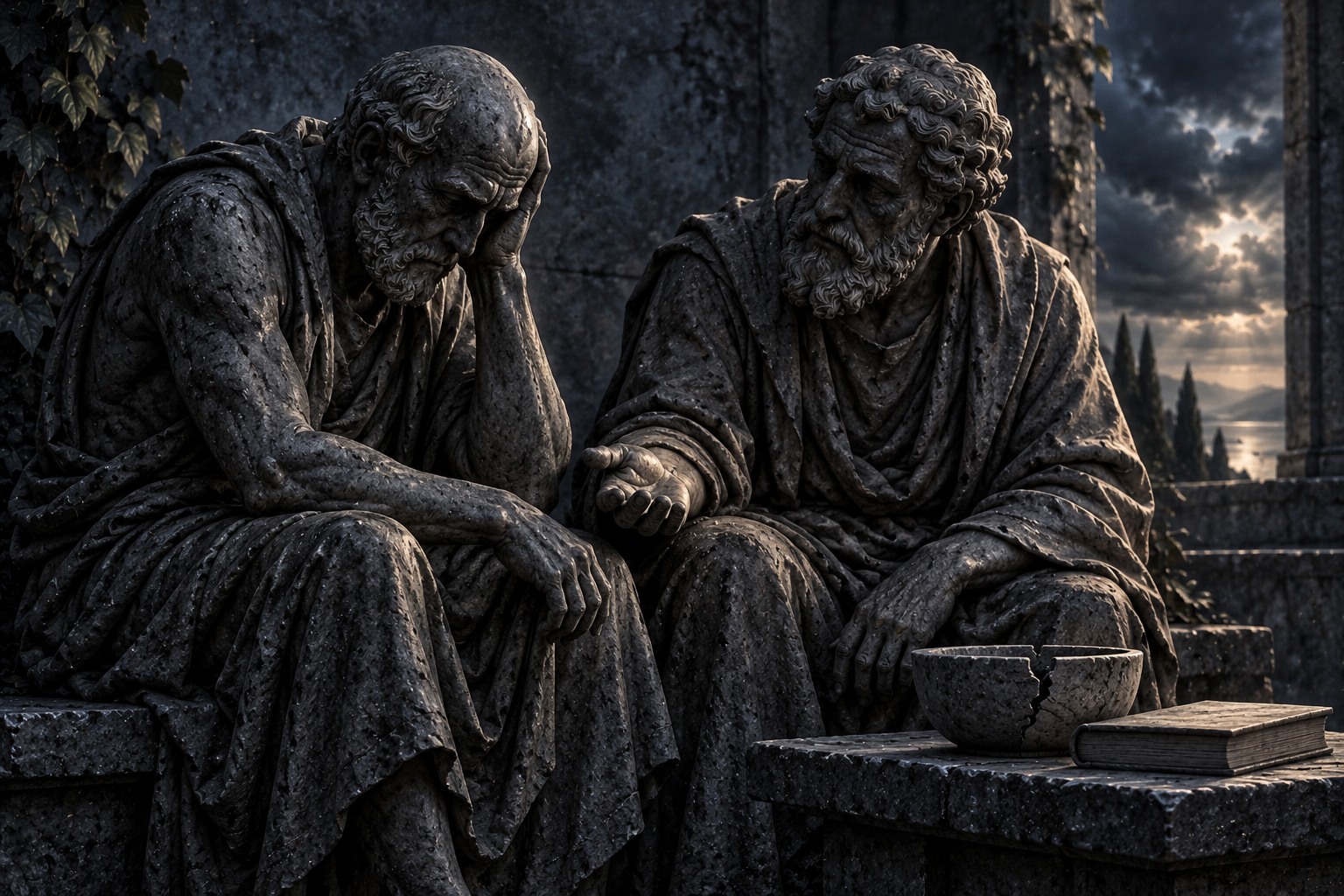
Why Different Traditions Describe Similar Ways of Working with Pain
Andrey Zarinsh & Maria Evilkut
Inner Transformation · An authorial series
The archive brings together what it calls sixteen traditions—Buddhism, Hinduism, Jainism, Judaism, Greek tragedy, Stoicism, Christianity, Sufism, Daoism, Sikhism, Shinto, the Bahá’í Faith, Lakota tradition, Kierkegaard, Dostoevsky, Weil, Frankl, Jung, and contemporary research on posttraumatic growth. The list actually includes more than sixteen and combines religions, thinkers, and a research field. The authors propose a common architecture: attention, naming, acknowledgment, meaning, action, transformation.
Archival editorial note. The shared architecture is the authors’ comparative interpretation, not a clinically validated universal sequence. The translation preserves the essay’s examples and strong conclusions with their attribution; it does not endorse its claims that conscious suffering necessarily purifies, that one approach is the only route out of psychological symptoms, or that survival proves a philosophy. Ritual descriptions are cultural references, not instructions to undertake fasting, isolation, cold exposure, or other ordeals. Quotations, historical claims, and inherited links have not been newly verified.
I. Pain That Does Not Go Away
Modern people have a troubled relationship with pain. For too long, we have been promised its elimination: through medicine, technology, the right way of thinking, a meditative practice, the right partner, or a move to another country. When the promise fails, pain becomes not only a fact but an accusation against oneself: “I failed.” “I haven’t grown enough.” “I must have made a mistake.”
This essay abolishes nothing. It does not say suffering is useful. It does not say suffering has a purpose. It does not offer “accept it and let it go.” It proposes something different: from roughly the sixth century BCE, with some roots earlier still, mature traditions described similar inward movements in responding to pain. Their answers to “why?” differed, yet the authors discern a recurring sequence: attention, naming, acknowledgment, the search for meaning, action, transformation.
The archive goes further, asserting that these traditions developed without systematic contact and that twentieth-century secular psychology measured and confirmed their shared structure. Those are substantive historical and scientific claims that this translation cannot certify. The authors see the monk in Benares, the sage in Babylon, the philosopher in Athens, the mystic in Baghdad, and the prisoner in Auschwitz as converging on something intrinsic to human life, rather than the discovery of a single school.
II. What This Essay Does Not Do
It does not justify another person’s pain. Justifying someone else’s suffering is never our task.
It does not claim that suffering inevitably leads to wisdom. Some people are shattered by profound suffering; some become harsher and more cynical. Transformation carries no guarantee. “What does not kill us makes us stronger” can function as an anesthetic rather than an observation.
It does not replace trauma treatment. Clinical psychotherapy has its own tools, and acute distress calls for appropriate professional care. This essay concerns the framework through which people understand everyday life, including life during and beyond therapy; it cannot determine which treatment an individual requires.
Nor does it tell people to “find meaning in suffering.” The authors regard that as a simplification of Frankl against which he objected. In their formulation, meaning is not sought inside pain itself; it is found in what a person does while pain continues.
III. A Map of the Proposed Structure
Traditions speak in different languages and conceptual frameworks. Yet, placed alongside one another, their texts suggest a common sequence to the authors.
The first movement is attention: not turning away from what hurts. The second is naming: saying precisely what is happening. The third is acknowledgment: this is happening to me, and I do not pretend I am absent from my own experience.
The fourth is meaning: not “Why?” but “For the sake of what will I live with this?” The fifth is action: what the hand does while the heart hurts. The sixth is transformation: what could not be made whole becomes meaningful without ceasing to be a wound.
The archive introduces the following passages as fifteen voices, one from each major tradition. The sequence ultimately ranges more widely than that count, and the six movements remain its organizing interpretation rather than a required course for every person.
IV. The Buddha: A Systematic Map of Suffering
At the Deer Park near Benares, traditionally situated around the middle of the fifth century BCE in the archive, the Buddha delivers the Dhammacakkappavattana Sutta, the Discourse on Setting the Wheel of Dhamma in Motion. Its Four Noble Truths begin with suffering. The source cites a Buddhanet translation:
This, monks, is the noble truth of suffering. Birth is suffering, aging is suffering, illness is suffering, death is suffering; association with what is unloved is suffering, separation from what is loved is suffering; not obtaining what one wants is suffering.
Then comes its origin: taṇhā, craving. Then the possibility of cessation. Then the path: the Noble Eightfold Path.
The authors call this the first systematic map of working with suffering in human history. That priority claim is not established by the references as reviewed here. Their central observation concerns its structure: recognition, an account of the cause, the possibility of change, and concrete steps. Earlier texts also discussed suffering; the essay emphasizes the Buddha’s navigable framework.
Buddhism also distinguishes three forms of dukkha, as the archive explains with references to Lion’s Roar and Pure Dhamma. Dukkha-dukkha is ordinary bodily and emotional pain: injury, illness, loss. Vipariṇāma-dukkha concerns change, including the passing of pleasure. Saṅkhāra-dukkha concerns the unsatisfactoriness of conditioned existence itself. Pain ceases to be one undifferentiated block and becomes something whose forms can be distinguished.
V. Jewish Tradition: Examination, Then Argument
The essay turns to the Talmud, Berakhot 5a–b, citing Torah.org and Hadran. In the archive’s attribution to Rav Hisda, a person who sees suffering coming upon them should examine their conduct. If no cause is found there, they should consider neglect of Torah; if none is found there either, the suffering is called yissurim shel ahavah, “sufferings of love.” The attribution and sequence are inherited and require checking against the passage itself.
That is the first part. The Talmud also tells of Rabbi Yohanan visiting the sick Rabbi Hiyya and asking whether his suffering is precious to him. Rabbi Hiyya answers that he wants neither the suffering nor its reward. Rabbi Yohanan then heals him, in the account cited by the archive’s Yissurim Shel Ahavah PDF.
For the authors, this is a striking pair: first, serious self-examination; then, the right to refuse suffering. The tradition does not simply turn suffering into a religious fetish. It makes the encounter a mature conversation.
VI. Job: A Question Without an Explanation
The Book of Job, probably many centuries older than the Talmud, offers another voice. Job loses his children, livestock, and health. His friends arrive with explanations that the article groups into four familiar forms: you sinned; you sinned secretly; this is a test; this is purification. Job rejects them, in the reading supported in the archive by HTS Theological Studies and the Times of Israel.
At the end, God does not answer “Why?” in the expected way. The answer comes from the whirlwind and opens onto Leviathan, Behemoth, the foundations of the earth, and the morning star. The authors read it as a return to a reality larger than the individual and the individual’s pain.
In their interpretation, Job falls silent not because an argument has convinced him but because he has encountered something before which his original question changes its meaning. They call Job humanity’s most honest text about suffering: a refusal of theodicy in favor of encounter. That is an authorial judgment, not the sole possible interpretation of the book.
VII. The Stoics: Attention as a Method
Epictetus, once enslaved and with an injured leg, and Marcus Aurelius, the philosopher-emperor, articulate what becomes central to Stoic practice: prosochē, vigilant attention. The archive refers to Traditional Stoicism and Pigliucci.
In the Enchiridion, Epictetus distinguishes events from the judgments that disturb us about them. The essay reads this not as denial of pain but as recognition that a layer of judgment can lie between pain and our response to it. Some work with that layer may remain possible even when the painful fact cannot be undone.
The Stoic does not say, “It does not hurt.” The stance proposed here is: “It hurts, and I am attentive to what within this situation is up to me and what is not.”
The essay also names praemeditatio malorum, considering possible adversity beforehand—not to attract it, but to meet it with prepared attention. It associates amor fati, love of fate, with Marcus Aurelius and later Nietzsche, reading it as participation in what exists rather than mere submission. The terminology and historical attribution should not erase differences between the thinkers.
VIII. Greek Tragedy: Pathei Mathos
In Aeschylus’s Agamemnon, around 458 BCE, the chorus voices pathei mathos: learning through suffering. The archive, citing Goodreads and Shmoop, renders the thought as Zeus setting humanity on the path of wisdom through the law that suffering brings knowledge.
The essay does not read this as an invitation to seek suffering. Knowledge acquired through experience has a different quality from knowledge read in a book—not automatically better or higher, but different. In Aeschylus the authors see a divinely established law; in Sophocles and Euripides, a tragic feature of human destiny.
Their conclusion, with a reference to David Myatt, is that tragedy gives lived knowledge a particular authority without thereby proving suffering beneficial.
IX. The Christian Cross: Suffering as a Place of Encounter
Paul writes in Colossians 1:24 of filling up in his flesh what is lacking in Christ’s afflictions. The essay emphasizes “filling up,” reading human suffering as participation in God’s redemptive work, with references to Crossway and Lutherans For Life.
John Paul II’s apostolic letter Salvifici Doloris (1984) expresses the thought, in the wording inherited through Coming Home Network, that on Christ’s cross redemption was accomplished through suffering and human suffering itself was redeemed.
The authors find this a remarkable construction: suffering itself receives redemption. It is neither eliminated nor explained away; its nature changes, as metal changes in fire while remaining metal. This is a theological metaphor, not a medical claim.
The essay then turns to monastic Christianity, from Anthony the Great to John Climacus, and nepsis, watchfulness: calm, open attention to movements of the soul, including pain, without fusion or flight. It compares this with Buddhist vipassanā and Stoic prosochē. The comparison concerns attention; their purposes and doctrinal settings remain different.
X. Sufism: Yā Qābiḍ, Yā Bāsiṭ
Among the divine names discussed in Islamic mystical tradition are al-Qābiḍ, the Withholder or Contractor, and al-Bāsiṭ, the Expander. The archive cites Patheos / Living Tradition.
The essay relates pain to qabḍ, contraction, and relief to basṭ, expansion. It pictures them as a rhythm in the breathing of existence rather than simply a malfunction or punishment: inhalation and exhalation on another level.
It attributes to Rumi, in thirteenth-century Konya, the familiar image of a wound as the place through which light enters. The quotation’s provenance is not verified here. The authors interpret the image carefully: light does not originate in the wound; the wound marks where a blow has passed and left an opening.
Turning to Ibn Arabi, whose life links twelfth- and thirteenth-century Andalusia and Damascus, the essay cites the Meccan Openings through the Ibn Arabi Society. It presents balāʾ, trial, as pressure preceding an opening of the heart: not punishment, but a circumstance in which a person may cease to be deaf to experience.
The archive further says contemporary Sufi psychology works with trauma as a phase of contraction to pass through without further constriction or escape, citing PMC and Kyokan. That broad description is inherited; it does not establish an effective or appropriate trauma treatment for an individual.
XI. Hindu Fire: From Tāpa to Tapas
The Sanskrit root tap means to heat, burn, or shine. The essay associates tāpa with affliction that burns within, and tapas with the voluntary, purifying heat of discipline, citing Wikipedia’s Tapas entry. One root supports a contrast: what burns a person can, in the authors’ metaphor, become the fire through which obscurations are worked upon. An anomalous Russian adjective attached to pain in the extraction has no clear technical meaning; “affliction” carries the intelligible sense here.
The archive describes three forms of suffering, tāpa-traya. Ādhyātmika concerns body and mind; ādhibhautika, other beings and the external world; ādhidaivika, forces beyond comprehension, elemental events, and fate. The authors compare this with Buddhism’s threefold distinction, although the classifications are not equivalent.
Patanjali’s Yoga Sūtra 2.43, cited through Integral Yoga Magazine, is rendered as teaching that tapas removes impurities and perfects body and senses.
The authors hear the same fire metaphor in Stoicism, Christian mysticism, and Bahá’u’lláh: fire passing through consciousness purifies, while fire without consciousness destroys. This is the essay’s comparative metaphor, not a guarantee that awareness makes suffering safe or beneficial.
XII. Jainism: Saṃvara and Nirjarā
In Jain metaphysics, karma is described as subtle matter that adheres to the soul, not merely a metaphor. The archive cites Britannica and Jaina and distinguishes four processes: āsrava, the influx of karma; bandha, bondage or attachment; saṃvara, stopping the influx; and nirjarā, shedding accumulated karma.
The article presents nirjarā as a Jain response to suffering. It can occur naturally, as karma matures and falls away, or intentionally through tapas and the twelve forms of austerity mentioned in its Muniadarsh reference.
In the authors’ simplified account, one neither flees pain in a way that creates further influx nor clings in a way that reinforces bondage, but allows karma to be exhausted with equanimity. Nirjarā is then understood as release rather than additional torment. This describes a religious framework; it is not a recommendation to practice austerity or withhold pain relief.
XIII. Daoism: Wuwei in the Presence of Suffering
The Daoist response is the quietest in the authors’ comparison. Wuwei, non-forcing, means here not resisting in a way that intensifies pain, and not clinging so tightly to relief that relief becomes another craving.
The archive attributes to Zhuangzi the image of a bird that reads the wind instead of resisting it. The attribution is unverified. It also gives the Daodejing, chapter 22:
What is bent will become whole; what is crooked will be straightened; what is empty will be filled.
The essay’s Daoist figure does not ask us to love suffering. Flexibility permits restoration where rigid resistance can break. In this reading, that is not passivity but exact attention: moving along the line of what is necessary with less needless friction.
XIV. Sikhism: Hukam
In Sikhism, the essay turns to hukam, divine order, when considering what cannot be undone. It cites a Sikh subreddit, Kaur Life, and Basics of Sikhi.
Accepting hukam does not mean folding one’s hands and doing nothing. The authors understand it as seeing how reality operates and acting accordingly. They emphasize that Guru Nanak did not simply label exploitation and oppression God’s will; he exposed and opposed them.
Illness, loss, and the natural course of things are discussed here within hukam, and fruitless resistance is described as exhausting. This should not be read as forbidding treatment, reform, or efforts to change what can be changed. The comparison’s central distinction is between what responds to effort and what calls for a changed relationship to what has happened.
XV. Shinto: Kegare and Misogi
The archive presents suffering and kegare, ritual impurity, as conditions calling for purification rather than personal shame. It identifies misogi, ritual ablution associated with waterfalls, rivers, and the sea, citing Japan National Tourism and Joseph Anew.
The authors interpret its demanding bodily conditions as a voluntary encounter with difficulty in order to renew a relationship with purity. They compare this with Hindu tapas and Christian fasting: intentionally meeting a smaller difficulty as preparation for an unavoidable larger one. That is their comparison, not a complete account of Shinto ritual meaning or an invitation to cold exposure.
Their emphasis is on embodied action. In this reading, purification gives inward work a physical form, rather than supplying an explanation for why pain exists.
XVI. The Bahá’í Faith: The Fire of Tests
The archive attributes to Bahá’u’lláh, whose nineteenth-century life led from Iran to Palestine, an image of gold tested by fire and a person tested by suffering. Pure gold is distinguished from its alloy through the test. It cites BahaiTeachings.org and Sifter of Dust; the exact quotation remains inherited.
The essay connects this fire with Hindu tapas, Malachi 3:2 and its refiner’s fire, Stoicism, Christian mysticism, Jainism, and Sufism. Fire becomes the point at which a material reveals its nature.
It further attributes to Bahá’u’lláh a distinction between destructive fire and a test encountered with awareness, claiming this distinction is less explicit in earlier traditions. That comparative priority claim is not verified here. The authors’ intended point is that conscious encounter changes the interpretation of an ordeal; it does not follow that awareness prevents injury.
XVII. Lakota Tradition: Crying for a Vision
In Lakota tradition, the essay names Hanblecheyapi, “crying for a vision,” as one of seven sacred rites, citing the Akta Lakota Museum and Plough. It describes a person going onto a mountain, fasting for several days, and undergoing physical and spiritual difficulty in which a vision may come to orient their life. This is a cultural description, not a practice guide.
Black Elk’s great vision, the archive says, came during a serious childhood illness. It refers to Quest for Vision and to Black Elk Speaks, an influential twentieth-century account of Indigenous spirituality. The extraction calls him “Nicholas Black Elk” and uses the unclear Russian word “виник”; the English retains his identifiable name without inventing an equivalent for that label.
The authors discern a sequence: entering difficulty, openness, encounter, and return with knowledge. They compare it with misogi, the Christian desert, Buddhist retreat, and tapas. The archive treats this as evidence of a structural property of consciousness, asserting there had never been contact between Lakota people and Buddhists. That sweeping historical assertion is not established here. Comparison must also respect the rite’s community, relationships, and distinct meanings.
XVIII. Kierkegaard: Possibility as a Way to Breathe
The essay turns to Søren Kierkegaard’s The Sickness unto Death, citing Wikipedia and Cloister Notes. It describes despair as a condition in which a person can no longer see possibility—not necessarily because possibility is absent, but because it has disappeared from view. It also asserts that totalitarian systems exploit this human capacity for despair.
The archive renders Kierkegaard’s appeal as: “Create possibility, create possibility! Then the person in despair can breathe again.” The emphasis falls on creating, not merely finding an exit already waiting to be picked up. Possibility becomes a movement of perception and consciousness. The wording and characterization as a therapeutic formula are inherited, not a clinical endorsement.
Applied to suffering, the thought is this: when pain fills the entire field of vision, nothing else seems to exist. Seeing that even one other thing remains possible may restore pain to its place within something larger. Pain is not abolished. The image offers a philosophical perspective, not a demand that someone in despair simply exert more will.
XIX. Dostoevsky: Suffering and Consciousness
In Notes from Underground, Part I, chapter IX, the underground man declares suffering to be the sole cause of consciousness. The archive cites PageByPage Books and Goodreads.
The distinction matters: this is spoken by a fictional character in an agitated argument, not simply by Dostoevsky in his own voice. Yet the authors find the thought serious enough to consider. In a “crystal palace” of absolute well-being, they suggest, consciousness would have no friction to work upon. It becomes conspicuous where desire meets reality, where “ought” meets “is.”
They present this as an observation about human experience, not a justification of suffering. They also imagine a Buddhist parallel: when everything runs smoothly, one may remain asleep to it; dukkha can become a point of awakening. That is a comparison, not evidence that suffering is the sole biological or philosophical condition of consciousness.
XX. Simone Weil: Affliction and Attention
Simone Weil distinguished ordinary pain, douleur, from malheur, affliction understood as a condition that seizes the whole person, figured as being nailed down. The archive cites Wisdom2be, JHI Blog, and an essay PDF.
It renders her thought through the image of affliction making God absent more absolutely than dead light in an empty room, while love must continue loving within that absence. The wording is inherited rather than newly verified.
The authors find no easy consolation here. They find a discipline: continuing to attend when one has nothing to offer. They cite the familiar statement that attention is the rarest and purest form of generosity.
When we cannot remove our own or another’s affliction, we may still offer full, nonjudgmental attention. The essay calls that the last available act of love. It hears resonances of Stoic prosochē, Christian watchfulness, and Buddhist vipassanā, while those traditions retain their differences.
XXI. Viktor Frankl: Meaning in Spite of Suffering
The archive recounts Frankl’s survival of four Nazi concentration camps and the deaths of his wife, parents, and brother. Its compressed biographical wording requires checking; it should not be used as a precise chronology of each family member’s death.
In the account associated with Man’s Search for Meaning (1946), the authors present logotherapy as centering the search for meaning, contrasting it with pleasure attributed to Freud and power attributed to Adler. Those contrasts simplify complex theories, and logotherapy’s development cannot be reduced to the postwar book alone. The archive cites Wikipedia and PMC.
Its key quotation says suffering ceases to be suffering when it finds meaning, for example the meaning of sacrifice. The essay emphasizes an active discovery by the person rather than passive receipt of a gift. Its Russian distinction between two verbs for finding or acquiring meaning carries that emphasis; it does not establish a philological claim about Frankl’s original wording.
A second quotation concerns changing oneself when a situation can no longer be changed. The authors see here a secular formulation of attention, acknowledgment, meaning, and action. They also claim Frankl’s survival confirms the framework because he relied on it in the camps. Survival cannot establish that causal conclusion, and people who died must never be implied to have lacked meaning or resolve.
XXII. Jung: Suffering by an Indirect Route
The archive cites through Goodreads the statement attributed to Jung that neurosis is always a substitute for legitimate suffering.
It interprets “legitimate” as suffering that belongs to a person’s actual situation: a real loss, fear, or conflict. In its account, refusing to experience that pain does not erase it; it can return through anxiety, phobia, bodily symptoms, or recurring destructive relationship dynamics.
The authors call neurosis pain that has not been admitted to consciousness and has taken an indirect route. They then assert that the only way out is to return to the original suffering and meet it openly. This is an inherited psychodynamic interpretation, not an established universal cause of symptoms or an exclusive treatment rule.
They compare it with the Buddha, the Talmud, and Epictetus through a forceful metaphor: pain met consciously does not destroy, while pain excluded from consciousness continues to damage whatever it touches. The absoluteness belongs to the essay’s rhetoric. Conscious awareness does not guarantee safety, and symptoms require individual assessment rather than this formula alone.
XXIII. Posttraumatic Growth
Richard Tedeschi and Lawrence Calhoun developed research on posttraumatic growth in the early 1990s, the archive explains, citing a 1996 PubMed record and a PDF on clinical applications of the Posttraumatic Growth Inventory.
It describes five areas of reported change following profound adversity: a changed sense of personal strength, closer relationships, appreciation of life, spiritual change, and new possibilities. The archive says this occurs in a substantial proportion of people but gives no sufficiently specified population or measure here to support a general rate.
This does not mean trauma is useful. It means some people report constructive changes in its aftermath. Posttraumatic growth does not cancel posttraumatic stress; the two can coexist.
The authors interpret the findings as the same transformation described in the traditions and conclude that science made an old insight measurable. That is their synthesis. Research on reported growth does not by itself validate the essay’s entire six-part sequence, establish objective growth in every case, or make trauma necessary for development.
XXIV. Kintsugi: An Image to Carry Forward
Kintsugi is the Japanese art of repairing broken ceramics with joins highlighted by gold or silver, as described in the archive’s Lakeside Pottery reference. The seam is made visible rather than concealed. The essay imagines a repaired bowl becoming more precious because its history can now be seen.
This is neither a theory nor a theology. It is an image in which the preceding voices meet: the Buddha and Tedeschi, the Talmud and Kierkegaard, a Lakota visionary and Simone Weil. In the authors’ reading, conscious work with pain does not restore an untouched past.
What emerges is different, and may sometimes be stronger, more visible, or more precise. The “sometimes” is essential. A person is not a broken bowl required to become more valuable through suffering.
XXV. Where the Authors Find Convergence
Placed together, the religions, philosophers, writers, and psychological approaches produce, for the authors, a six-part pattern. The archive itself acknowledges that its “sixteen traditions” have become more than sixteen.
Attention. Not turning away; ceasing to drown out experience. The comparisons are Buddhist vipassanā, Stoic prosochē, Sufi ḥuḍūr, Christian nepsis, Weil’s attention, and mindful processing in accounts of posttraumatic growth.
Naming. Identifying precisely what hurts. The examples are distinctions within dukkha, Hindu tāpa-traya, Jewish examination of conduct, and a Daoist reading of the situation’s configuration.
Acknowledgment. This is part of my experience; I am here. The authors connect Jung’s “legitimate suffering,” Jewish teshuvah, Christian metanoia, and Stoic assent. These terms are compared, not made interchangeable.
Meaning. For the sake of what will I continue living with this? The examples are Frankl’s logotherapy, Job’s encounter from the whirlwind, the Christian cross, and the image of gold in fire attributed to Bahá’u’lláh.
Action. What the hand does while the heart hurts. The Eightfold Path, Jain nirjarā, mitzvot, living according to hukam, and Kierkegaard’s appeal to possibility appear side by side.
Transformation. The wound remains, but its place or meaning changes. The authors compare nibbāna in this life, liberation through tapas, redeemed suffering, kintsugi, posttraumatic growth, and Aeschylus’s pathei mathos. These are very different claims about liberation, redemption, experience, and repair.
The archive finds it striking that a Lakota visionary, a medieval Sufi, and a psychologist in North Carolina can be read together. It argues that traditions retain what works and discard what does not. That is an idealized account of cultural transmission, not proof of effectiveness or independent origin. The six movements remain an interpretive map offered by the authors.
XXVI. Where the Traditions Differ
Honesty also requires attending to disagreement. Structural resemblance does not erase substantive differences.
The essay contrasts craving in Buddhism, the fallen condition of the world in Christianity, forgetfulness of God in Islam, and mistaken judgments in Stoicism. These are broad summaries rather than exhaustive doctrines. Their paths also differ: the Eightfold Path, redemption, worship, philosophical practice.
Judaism permits argument with God and, as in Rabbi Hiyya’s reply, refusal of suffering and its reward. Catholic Christianity can give suffering a redemptive meaning not identical to Jewish accounts. Buddhism addresses dukkha through its path; Stoicism considers adversity material for the work of reason; Sufism may portray contraction and expansion within a relationship with the Beloved.
These differences are serious and cannot be reduced to one teaching. The authors nevertheless maintain that a similar movement through pain can be discerned across them. Their claim is not that every religion says the same thing, but that their chosen comparisons reveal a recurring architecture of practice. Whether every mature tradition fits it remains unproved.
XXVII. What Must Be Said at the End
This essay does not make suffering useful. “Useful” belongs to the world of instruments; suffering is not an instrument. The authors hope to show that suffering met with awareness can become something more than destruction without ceasing to be suffering. That possibility must not be turned into an obligation or guarantee.
A person living with pain finds a large company in these pages: Job on the ashes; the Buddha sitting beneath a tree after years of unsuccessful asceticism—the archive says seven; Epictetus recalling his injured leg, which tradition associates with his master; Simone Weil limiting her food in solidarity with people in occupied France; Frankl counting steps toward another barracks; a Bengali woman who has lost a child; a Lakota adolescent crying for a vision on a mountain. Some details are compressed or historically disputed. The authors bring them together through an imagined common structure, not a demonstrated identity of experience.
When pain comes, the essay offers something to lean on: no promise that life will become easier, no guarantee that meaning will arrive, but a vocabulary of movement—attention, naming, acknowledgment, meaning, action, transformation.
The archive calls these six concrete steps tested by forty centuries of human effort. It closes by invoking Job, the Buddha, the Talmud, Epictetus, Paul, Rumi, Ibn Arabi, Shantideva, Zhuangzi, Guru Nanak, Bahá’u’lláh, Black Elk, Kierkegaard, Dostoevsky, Weil, Frankl, Jung, and “several thousand clinical studies,” saying this is enough to make one’s way through. Neither that research count nor the promise of sufficiency is demonstrated in the supplied material.
The humane aspiration can stand without the guarantee: this may be little against grief, yet a language of attention, relationship, meaning, and action can help someone feel less alone. No one’s continuing pain proves they have failed to follow it.
— · —
United Wisdom — an authorial series on inner transformation.
One source, many languages.
References Inherited from the Archive
These links preserve the archive’s reference record; their contents were not newly checked for this translation.
- PDF-L001 — original PDF page 3
- PDF-L002 — original PDF page 3
- PDF-L003 — original PDF page 4
- PDF-L004 — original PDF page 4
- PDF-L005 — original PDF page 4
- PDF-L006 — original PDF page 4
- PDF-L007 — original PDF page 4
- PDF-L008 — original PDF page 5
- PDF-L009 — original PDF page 5
- PDF-L010 — original PDF page 5
- PDF-L011 — original PDF page 5
- PDF-L012 — original PDF page 5
- PDF-L013 — original PDF page 5
- PDF-L014 — original PDF page 6
- PDF-L015 — original PDF page 6
- PDF-L016 — original PDF page 6
- PDF-L017 — original PDF page 6
- PDF-L018 — original PDF page 6
- PDF-L019 — original PDF page 7
- PDF-L020 — original PDF page 7
- PDF-L021 — original PDF page 7
- PDF-L022 — original PDF page 7
- PDF-L023 — original PDF page 7
- PDF-L024 — original PDF page 7
- PDF-L025 — original PDF page 7
- PDF-L026 — original PDF page 8
- PDF-L027 — original PDF page 8
- PDF-L028 — original PDF page 8
- PDF-L029 — original PDF page 8
- PDF-L030 — original PDF page 9
- PDF-L031 — original PDF page 9
- PDF-L032 — original PDF page 9
- PDF-L033 — original PDF page 9
- PDF-L034 — original PDF page 9
- PDF-L035 — original PDF page 9
- PDF-L036 — original PDF page 10
- PDF-L037 — original PDF page 10
- PDF-L038 — original PDF page 10
- PDF-L039 — original PDF page 10
- PDF-L040 — original PDF page 10
- PDF-L041 — original PDF page 11
- PDF-L042 — original PDF page 11
- PDF-L043 — original PDF page 11
- PDF-L044 — original PDF page 11
- PDF-L045 — original PDF page 11
- PDF-L046 — original PDF page 12
- PDF-L047 — original PDF page 12
- PDF-L048 — original PDF page 12
- PDF-L049 — original PDF page 13
Keep what resonates with you.