
Meaning & path
Pilgrimage and the road: what we seek when we change place
What we seek on the road: distinct religious grounds, changed perspective, actual conditions, and return without guaranteed transformation.
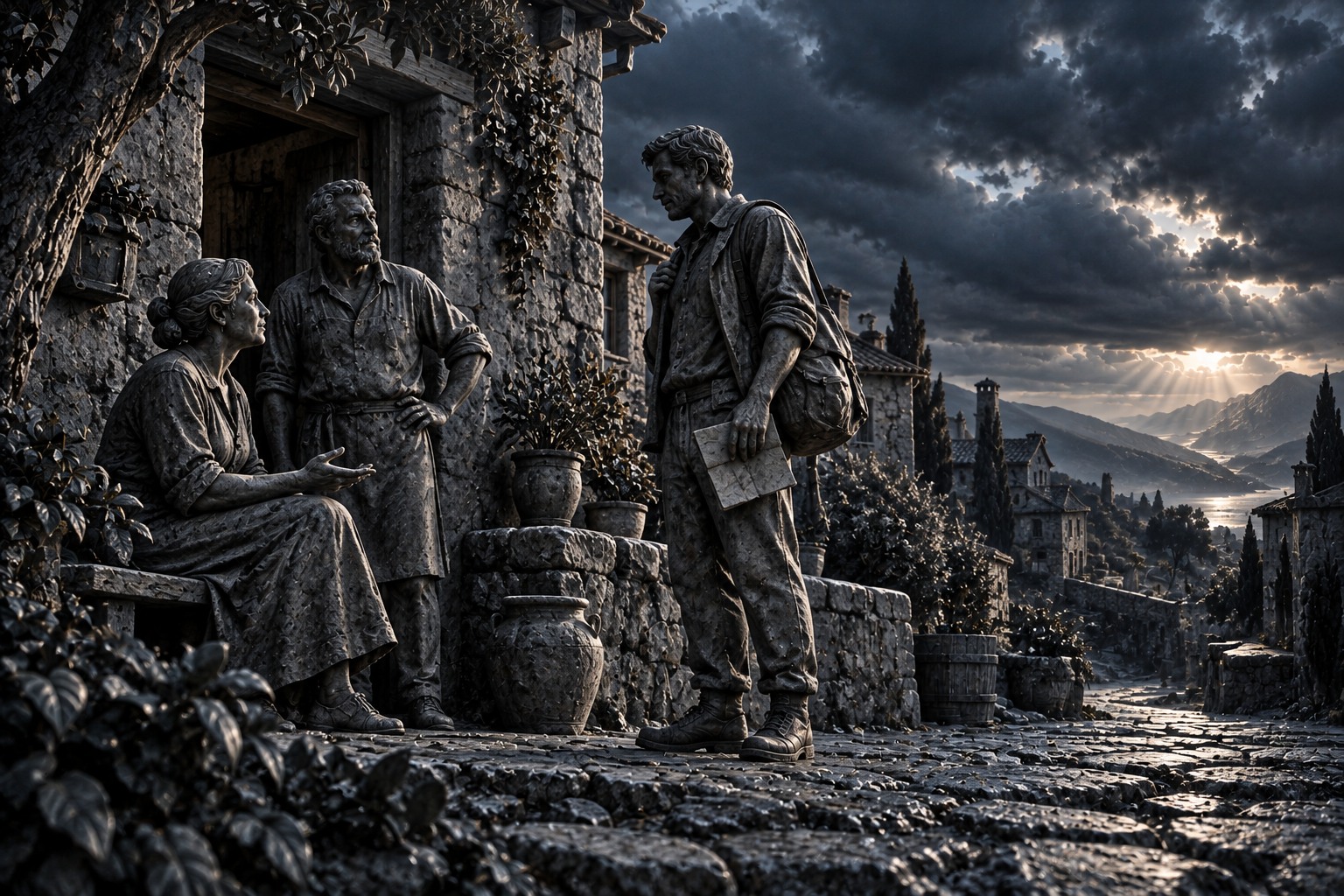
Epigraph
The person you are matters more than the place to which you go;
Seneca, Moral Letters to Lucilius, 28.4, translated by Richard M. Gummere. The moral observation does not deny the actual importance of a safe place.
What this article is about
People leave home to see something new, fulfil a religious obligation, or spend time outside their familiar roles. These journeys may look alike without sharing the same meaning. Pilgrimage belongs to a particular tradition, place, memory, and action; an ordinary journey does not become a pilgrimage simply because it produces a powerful experience. This article considers a change of place as an opportunity to see relationships between attention, the body, history, and one's own life differently. We read Seneca, biblical scenes of bringing first fruits and travelling to Emmaus, a Quranic passage about pilgrimage, and a Buddhist image of the path. There are no routes to purchase, judgements about the correctness of someone else's faith, or promises of inevitable transformation. The practical question is different: what do I hope to find on the road, what actual conditions would that require, and what could I carry carefully into life after returning?
I. One road, different questions
Imagine someone deciding to leave their familiar city for a few days. They say they want to understand their life. That phrase may contain different tasks: resting from noise, seeing a significant place, discussing a difficult choice with a companion, or temporarily not answering work messages. If all of them are combined into the demand to find oneself, the journey receives a promise almost impossible to fulfil. The place must provide rest, an answer, a new identity, and proof that the money was well spent. A more precise question reduces this load. The person may want time for one conversation, an encounter with a historical connection, or an ordinary break. None of these meanings diminishes the journey by being modest. The hypothetical scene shows how clarifying an intention changes expectations; it does not demonstrate the benefit of a particular kind of travel.
The word pilgrimage is best used with respect for differences. For someone within a religious tradition, the road may be an approach to a sacred place, fulfilment of a prescription, thanksgiving, or participation in communal memory. A nonreligious journey to a place connected with family history can be deeply significant, but that significance does not make all religious forms identical. Similarities of experience can be discussed without borrowing another's name without explanation. Living practices should especially not be described as a collection of instruments for personal spiritual tourism. A place also exists for those who live and worship there, rather than only for an arriving observer. Attending to their rules and voices belongs to the journey even when the traveller does not share their faith. Sometimes meaning appears precisely in recognising that not everything here is intended for me.
Some journeys cannot be freely chosen: relocation for work, the need to care for a loved one, or forced flight. They should not be romanticised through the language of pilgrimage. A person may discover meaning within a difficult change, but another's interpretation must not erase loss or compulsion. Whenever this article discusses a voluntary journey, that limit remains explicit. The possibility of temporarily changing surroundings depends on money, documents, time, health, and obligations. Lacking that possibility says nothing about spiritual maturity. Someone staying home can ask serious questions; someone moving continually need not experience every move as a revelation. The road is one form of meeting life, rather than certification of a person's depth. Its value can therefore be discussed without ranking biographies by the number of borders crossed.
II. What changes when the place changes
New surroundings change more than the picture before one's eyes. In a familiar place, action often starts before attention: we know where to go, what to answer, and who occupies which role. On the road, some familiar answers stop working. We need to ask, wait, read a sign, or notice a different sequence of actions. This may provide an opportunity to see our expectations. An opportunity, however, is no guarantee: the whole route can be completed while interacting only with one's screen and demanding familiar service from the surroundings. The inward significance of a journey therefore depends on more than kilometres. It concerns how someone meets the unfamiliar and whether they can acknowledge limits to their knowledge. This is an editorial observation about experience, rather than an experimental finding that travel inevitably changes personality. A journey opens differently to different people and circumstances.
Temporary distance from familiar roles matters too. Someone continually asked to organise things at home may become an ordinary participant. Someone accustomed to knowing the answers will depend on a stranger's directions. These changes can broaden a view, but are easily turned into a game without consequences: be free for a week, then return to treating others as before. The journey becomes significant not because it removes obligations, but because it shows their arrangement from another position. A traveller might notice the invisible work needed for them to follow a route peacefully, and later see workers in their own city differently. This is a possible connection, rather than a promise of moral improvement. It requires an action after the trip. Without that action, even sincere admiration for someone else's care may remain only an attractive element in a story.
A change of place can also improve actual conditions: less noise, more safe space, or freedom from pressure in a particular environment. Everything should not be attributed to an inward outlook, making a person responsible for finding an unsuitable environment difficult. If leaving danger makes things better, that improvement need not be metaphorical. A journey therefore needs consideration on two levels: what changed outside, and what the person notices within. The levels connect but do not replace one another. A quiet room does not prove reconciliation with the past; finding an answer does not make every room safe. This distinction respects material life. We can seek meaning while arranging accommodation, transport, rest, and support. A philosophical conversation should not demand that these conditions be abandoned to prove strength of spirit.
III. Seneca: the self cannot be left at the station
In Letter 28, Seneca answers Lucilius, who has not escaped a sense of heaviness through travelling. The opening thought is sharp: the soul needs changing, rather than the climate. Later comes an image of cargo shifting disorderly aboard a ship and making its movement more dangerous. The letter's moral subject is one's dispositions and work upon them. Seneca offers no itinerary, investigates no modern travellers' wellbeing, and does not speak for everyone compelled to leave. Keeping that subject in view reveals a limit to expectation: new scenery need not resolve a question I avoid formulating. I can change hotels and continue the same correspondence, argument, or attempt to prove myself right. The changed picture has then not become a changed way of relating to life, although it may have provided pleasure or rest.
At the same time, in 28.6–7 Seneca acknowledges surroundings: some places are unhealthy for someone not yet steady, and the wise person can endure difficulty without deliberately choosing it. This passage protects against the convenient summary that everything is only within. A preference for more peaceful conditions is present in the text. The epigraph saying the person matters more than the place should therefore be read as an arrangement of moral emphasis, rather than an absolute comparison of all circumstances. A contemporary reader need not prove philosophical maturity by remaining under threat, or feel ashamed of wanting to change difficult conditions. We can choose a useful outward change while recognising that some questions will travel with us. The choices are compatible: arrange the journey and continue discussing what the journey itself cannot settle.
The letter also helps distinguish fleeing a question from gaining distance that makes it visible. From outside, the two may look alike: someone leaves for a week, puts familiar duties aside, and walks a great deal. The difference appears in their response to a returning thought. One demands that impressions drown it out; another gives it precise words and seeks needed information. Not every avoidance needs harsh exposure: sometimes rest must come before conversation. What matters is neither presenting rest as an answer nor devaluing it because it supplied no answer. Seneca's moral language belongs to its time. We can read him seriously without repeating the severe self-accusing tone at the letter's end as a compulsory way of caring for ourselves. The examination concerns expectations of the road, rather than a person's right to be tired.
IV. A religious journey is more than an impression
In Deuteronomy 26:1–11, bringing first fruits involves travelling to a chosen place, speaking before a priest, and recounting a people's past. The fruits connect land, labour, gift, and the memory of liberation; the ending includes rejoicing with the household, the Levite, and the stranger. The road has meaning within relationships and a narrative, rather than only within the traveller's feeling. We are reading a particular biblical passage, not describing all contemporary Jewish practice from it. Its difference matters: movement is directed towards an established place and action, with personal novelty no principal criterion. An observer may see a beautiful rite; the participant tells a history through which they understand their position. Similarity in a physical journey does not mean similarity in who speaks, whom they address, or what obligation they recognise.
Quran 22:27–29 connects the call to pilgrimage with remembering God, feeding those in need, fulfilling vows, and circling the Ancient House. This is a read religious passage, rather than a complete Hajj instruction. It cannot be replaced by the general promise that a trip will change one's life. Address, action, and relations to others matter here. More generally, comparison between traditions' journeys should ask what participants do, rather than only what they feel. A strong feeling may accompany a rite, but the absence of an unusual experience does not prove that the action is empty. The reverse mistake is possible too: someone experiences an upheaval and assumes that all obligations are thereby fulfilled. This article establishes no religious criteria of validity. It shows why a tourist impression and participation within a tradition require different language, even when they occur in the same place.
The road to Emmaus in Luke 24:13–35 differs further. Two people walk after events they do not understand; conversation, interpretation of scripture, and breaking bread connect with recognising the risen Christ and returning to Jerusalem. This is a theological narrative, rather than evidence that every walking conversation uncovers hidden truth. Its form nevertheless lets us notice a connection between movement and a changed understanding of the past. Meaning does not arise solely from reaching a distant point. It involves a companion, a narrative, and returning to others. Comparing these three passages reveals different grounds: memory and offering, religious prescription and care for those in need, and Christian recognition and witness. Reducing them to an identical technique for changing perspective would lose precisely what makes each text significant for its readers.
V. The path as an image of practice
Chapter XX of the Buddhist Dhammapada speaks of a path connected with release from suffering, rather than compulsory movement across a geographical map. Verse 276 stresses the need for one's own effort. The image does not establish that pilgrimage is useless. It limits a different substitution: a teaching or direction cannot perform the participant's practice for them. The F. Max Müller translation used here is historical, and its wording should not silently be treated as the only possible rendering of Pali concepts. We take a particular meaning from the passage while retaining its religious aim. A contemporary person may compare this with the difference between receiving a suggestion and performing an action. That is our transition, rather than a claim that Buddhist release equals successful daily organisation. In one vocabulary, the road denotes space; in another, a way of living and practising.
The road metaphor attracts through its sequence: departure, turning, difficulty, arrival. Human life does not always take that shape. There is waiting, repetition, returning to an old question, and several obligations at once. If constant progress towards a final point is required, every pause becomes defeat. The metaphor is therefore useful within limits. It can help identify the next action without having to explain a whole biography. On a journey, someone notices the next stretch; at home they can also distinguish one conversation or promise. This does not require pretending that a household task is identical to religious practice. The similarity concerns the need to participate; the difference concerns ground and aim. Comparison thereby remains useful without taking possession of another's ideal. It supplies language for a question while leaving the reader free to choose a way of answering.
A significant place need not become the final answer for the encounter to be valuable. Someone may learn an important historical fact, feel connected to family, experience prayer, or see the limit of a previous expectation. Sometimes the result is disagreement: the journey helps them realise that a particular form of participation does not fit. This need not devalue the place or make the person mistaken. A meaningful outcome allows freedom of interpretation, provided it neither substitutes for another's tradition nor attributes unsaid claims to a source. Leaving with a more precise question may matter more than leaving with a grand explanation of everything. Yet this result must not become a new requirement. If the trip was merely enjoyable or difficult, its participant need not immediately extract a lesson. Meaning may appear later, remain partial, or never become the journey's principal content.
VI. The body, possibility, and respect for a place
A physical journey makes the body noticeable: pace, fatigue, water, accessibility, and the need for pauses. For some these conditions open a significant experience; for others they become barriers. Difficulty should not become a universal criterion of spiritual authenticity. Religious traditions have their own rules and exceptions; this article neither summarises them from a few passages nor gives personalised advice about physical exertion. The general question is simpler: am I promising the body something it currently cannot do? Planning accessibility and assistance need not destroy a journey's meaning. Sometimes the possibility of travelling with support makes participation real. A person who needs another pace or accompaniment is no less worthy a participant. Their conditions deserve specific discussion rather than being closed by an elevated command to overcome themselves at any cost.
A place has material life beyond the visitor's experience. People work there, rules exist, and visits leave traces. Attention to this is not an external interruption of spiritual content. It shows whether we recognise a world beyond our own impression. Not every scene should be photographed, every action opened to visitors, or local resident expected to explain their faith. We can learn acceptable participation beforehand and accept that some boundaries will not be removed for our wishes. This is not a tourist checklist, but a question of relationship. If someone seeks release from habitual self-preoccupation, demanding limitless service undermines the intention. Sometimes the most significant action on the road is quietly respecting a limit: not entering, not filming, waiting, giving space, or asking before turning an encounter into a story of one's own.
Companions are not instruments of personal experience either. One connects the route with prayer, another with family history, and a third with architecture. These differences do not require immediately deciding whose journey is deeper. Shared movement needs agreements about pace, conversation, and the possibility of silence. People can walk together without sharing everything. Compelled disclosure is particularly easy to conceal in claims that a special place requires everyone to open up. A significant experience remains human only when privacy can be retained. If a group promises guaranteed rebirth and demands control over decisions after the journey, its authority and participation conditions need separate examination. A powerful feeling does not establish another's right to direct your life. Respect for the road includes freedom to return with your own question and your own decision.
VII. Returning tests the expectation
Returning is often contrasted with the supposedly real life of the road: there things mattered; here ordinary life resumes. That contrast may be an understandable feeling without needing to become life's final arrangement. During the trip, others temporarily handled some daily tasks; at home they become visible again. Losing a sense of lightness does not prove the experience false. It shows a change of conditions. What element truly mattered: time without messages, a shared meal, walking, an unhurried conversation, or a particular religious practice? Not everything can be transferred, and not everything should be copied. One element may nevertheless be arranged in ordinary life without declaring everything before it wrong. This is not a method of guaranteed integration, but an editorial proposal to test how specifically someone has expressed the meaning they want to retain after returning.
The experience may concern relationships. Someone notices on the road that they listen to a stranger more patiently than to a loved one. They can return without ordering the family to change, and make their own correction instead: give one conversation more time and fewer ready answers. This does not prove profound transformation, but makes the observation examinable. Another person notices how necessary rest is and discusses their workload. A third discovers that a historical narrative needs further reading and checks its source rather than confidently repeating it. Such continuations connect an impression with daily life and need not be grand. Experience should especially not become an advantage in an argument: 'I have been there, so I know your life better.' An experience broadens a personal perspective without removing another's right to speak for themselves.
Sometimes an answer remains unclear after returning. There is no need immediately to repeat the journey to fill the uncertainty, or declare oneself incapable of spiritual experience. We can record what is known and what we merely wish to regard as known. A significant place need not issue a judgement on an entire life. Travel may open a question requiring time, conversation, or professional information. Further action can then fit the question's subject. Work calls for employment conditions; faith may call for a suitable conversation within a chosen tradition; health calls for qualified care. A journey may accompany these steps without replacing them. Leaving part of the meaning unfinished allows respect for an experience without dependence on it. We retain the encounter and continue living, rather than demanding that it permanently free us from choosing.
VIII. Not every journey has to transform us
A story of the road is often constructed afterwards. Expressive scenes are selected from many minutes, difficulties joined into a plot, and an accidental conversation becomes a turning point. Such a narrative can be honest when its partial character is acknowledged. It ceases to be honest when a personal story establishes a compulsory result for everyone. One returns with clarity, another with a question, and a third with enjoyment of what they saw. No outcome must become the standard for someone else's journey. A story can communicate significance without guaranteeing repetition. This distinction lets us share an experience without selling a promise. We can name what happened to us, under which conditions, and what remains unclear. Another person retains the right to listen, disbelieve, choose another road, or stay home. The experience keeps its dignity without extending authority over someone else's life.
Letting go of a guarantee does not impoverish pilgrimage. For a believer, meaning may lie in fidelity to an action, prayer, or communal connection even when feeling is quiet. For someone else, encountering family memory or personal finitude may matter. These possibilities do not become identical because we decline to rank them. Their differences are clearer when everyone is not promised the same effect. A route one does not choose can be respected, and one's own acknowledged without proving its superiority. Comparative reading creates no universal religion of the road. It helps hear different answers to questions about movement, effort, memory, and return. The sources ground particular narratives. Contemporary readers decide how those narratives relate to their circumstances while retaining the right to disagree and understand only partly.
In the end, 'Where should I go to become different?' can gently be divided. Where do I actually want or need to go? What conditions do I need? What am I hoping for? Which action remains mine regardless of place? The answers may differ. Someone travels for beauty while separately having a difficult conversation. Another stays home but maintains a religious or family connection in an accessible way. A third returns and discovers that the journey was never obliged to fix anything: it was already part of a life being lived. These possibilities do not deny the profound changes that do occur. They release change from the demand to be inevitable. A place can then be met with less appropriation, the self with less judgement, and the return with a question concrete enough for a next step and open enough to continue.
What this means in practice
This optional experiment can be used before or after a journey; no travel is required for the exercise. It promises no change of state and does not replace needed information about safety, accessibility, or religious rules.
Divide a page into four parts: place, conditions, expectation, and continuation. First, name why this particular place matters. Distinguish interest, personal memory, participation within a tradition, and simply wanting a change. In the second part, record actual conditions: time, resources, opportunities to rest, duties towards others, and suitable support. Private details need not be disclosed to anyone; the record belongs to you.
Under expectation, formulate one question without promising to become another person. Note what the place is not obliged to give you. A beautiful route need not solve a work conflict, and a powerful prayer does not make every subsequent guess factual. If the question calls for a professional's competence, record a separate action for obtaining information.
Finally, choose a possible continuation after returning: one conversation, an additional reading, a review of workload, or retaining an accessible practice. The continuation needs an object, rather than a demand to preserve an unusual feeling constantly. If the trip has already happened, add an observation you actually remember and separately your present interpretation. Compare them without forcing agreement.
You might finish: 'I encountered this; my nearest question now is this.' If that question remains unclear, another sentence is allowed: 'I want to give this time.' Both retain the experience without a universal promise and leave the decision about the further road with the person.
Key quotation
You yourself must make an effort.
Dhammapada, 276, opening sentence, translated by F. Max Müller. Chapter XX concerns the Buddhist path of release, rather than purchasing a journey.
Connections between traditions
| Source and tradition | Question about the road | Difference and limit |
|---|---|---|
| Seneca, Letter28; Stoicism | Can new surroundings perform moral work for me? | Personal moral correction; favourable surroundings also matter |
| Deuteronomy26:1–11; biblical Israel | How does a journey connect memory, land, and gift? | Prescribed offering; no account of all contemporary practice |
| Luke24:13–35; Christianity | How does a road connect conversation, recognition, and return? | A theological account of the risen Christ; no universal technique |
| Quran22:27–29; Islam | Which actions belong to a religious journey? | Pilgrimage, vows, and care; no complete Hajj instruction |
| Dhammapada273–281; Buddhism | Who performs effort on the path? | Religious release rather than a geographical route |
Primary sources
- Seneca. Letter28, Richard M. Gummere translation; full letter read, especially28.1–7.
- Deuteronomy26:1–11, KJV; the whole specified passage.
- Luke24:13–35, KJV; the full narrative within that range.
- Quran22:27–29; the displayed English text of three verses read, without full commentary or legal instructions.
- Dhammapada273–281, F. Max Müller translation, Sacred Books of the East X; historical English text, not collation of the Pali original.
Tags
pilgrimage, road, path, travel, meaning, return, place, memory, intention, expectation, effort, attention, body, accessibility, freedom, traditions, Seneca, Stoicism, Deuteronomy, Emmaus, Christianity, Quran, Islam, Dhammapada, Buddhism, community, experience, perspective
About the authors
Andrey Zarinsh is the author and founder of United Wisdom. He explores inner transformation, the unity of traditions, intercultural dialogue, and contemporary spiritual discipline. Instagram: @andrey.zarinsh.
Maria Evilkut is a co-author of United Wisdom. Alongside her research, she seeks to test these ideas in practice and observe how principles of unity and mutual understanding work in real life between people and cultures. Instagram: @ilkutki.
Keep what resonates with you.