
Meaning & path
The Wave That Wanted to Stop the Sea
Why preserving what matters can require new forms: an immortality thought experiment, dynamic systems, psychology, and the wave metaphor.
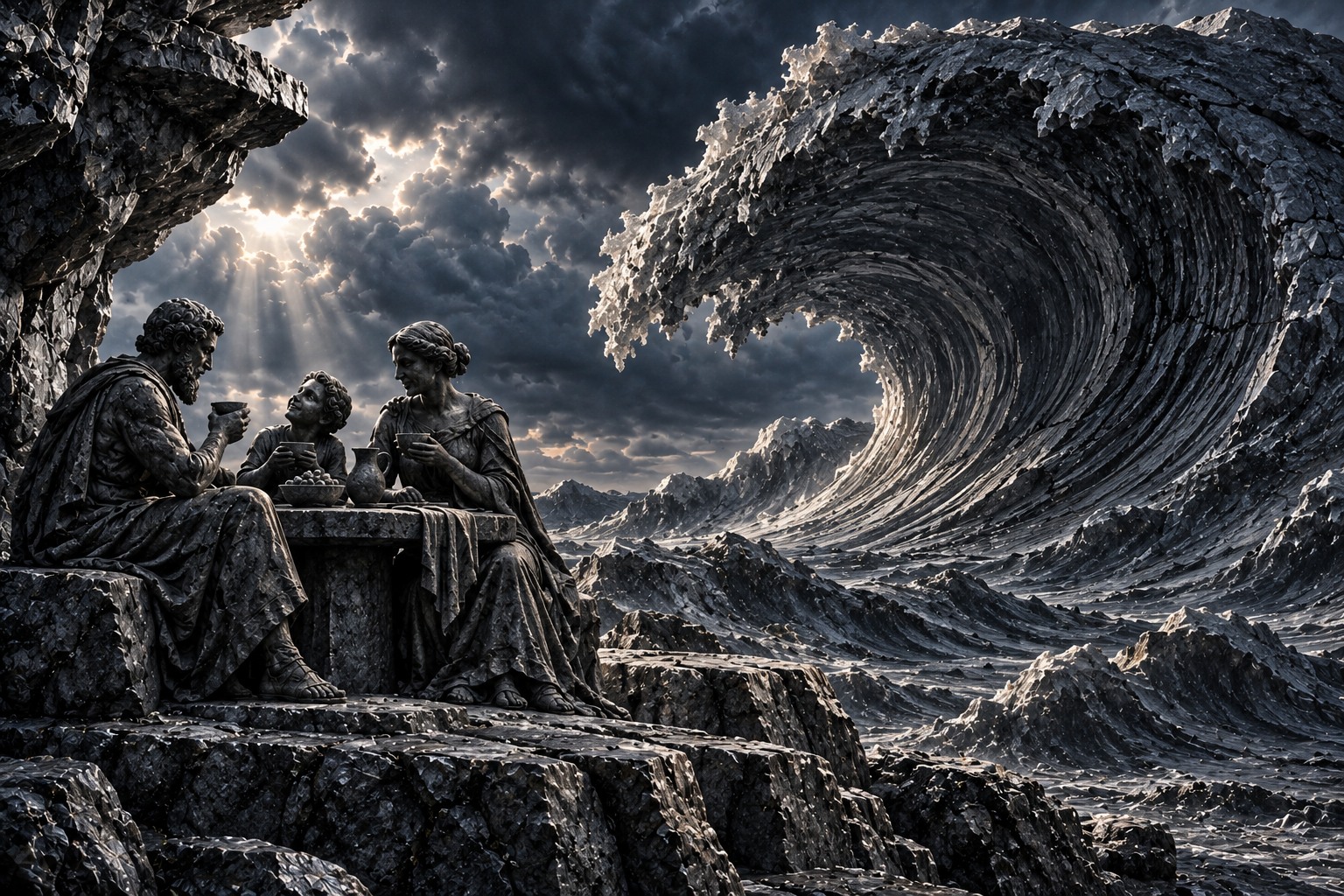
Imagine an evening when, at last, everything is all right. The people you love are around the table. The work is done. No one is ill. A child laughs at something insignificant, which makes it all the funnier. Outside, darkness is falling. For a few seconds, the need to hurry somewhere or achieve something disappears.
At such moments a thought arises almost by itself: let it always be like this.
There is so much humanity in that thought that arguing with it seems cruel. We grow tired of losing things. Tired of piecing life together again, getting used to people, learning the unfamiliar. We want, at last, to find a place where we can stop and have nothing more to fear.
But let us try granting that wish literally. For the evening to remain the same, the child must not grow up. Our loved ones must discover nothing within themselves that might change the relationship. Work must confront us with no new questions. Even we ourselves must stop becoming different: otherwise, one day today’s happiness may no longer be enough, or we may need it in another form.
We asked to preserve something beautiful. What emerged was a demand to stop everyone who makes it alive.
Perhaps this is where our central quarrel with change begins. We want life to continue, but decide in advance the only form in which we will agree to receive it.
Let us take the thought to its limit. Imagine biological immortality has become possible: a person no longer ages and can live indefinitely. Their character, habits, and attitude toward ownership do not automatically change.
At first, everything looks like a dream fulfilled. A researcher gains centuries for their work. Loved ones no longer have to part because of aging. We can master dozens of professions, see distant places, finish what life once left no time for.
But immortality comes not only to the scientist, but to the owner of the only water source. Not only to the loving parent, but to the ruler convinced that only he can govern the country. Not only to the person eager to learn, but to the manager accustomed to deciding who gets access to work at all.
A hundred years pass. Then five hundred. New people are born, but the key positions remain occupied. Their holders have had time to accumulate connections, influence, and ways of protecting their position. A newcomer faces a competitor who has had several centuries longer to consolidate an advantage.
This thought experiment does not even require exceptional cruelty. Familiar explanations will do: I built this; I understand the risks better; others will ruin everything; my loved ones need protection. Care for what is ours quietly becomes the conviction that what is mine should continue indefinitely.
Here self-centeredness becomes especially clear: the future is treated as an extension of my biography. Others are invited to live inside a world I have already occupied.
Of course, immortality does not imply inevitable eternal monopoly. People can share and leave their positions. Technologies create new possibilities. Rules can limit power and open access to resources. Mortality itself does not ensure justice: property and privilege can be inherited. The more precise question is therefore: what happens if we extend human life while leaving unrestricted a person’s ability to hold on to other people’s future?
Some goods can be multiplied. Knowledge shared remains with the person who passed it on. But a particular plot of land, a leadership position, or the right to make the final decision cannot be given to everyone at once. Where access is limited, the possibility of renewal becomes a question of justice.
Imagine a library whose first readers were granted the right never to return its books. Formally, the library exists. It has a collection, a catalog, and rules. For those who arrived later, its promise no longer works. Or a conversation in which the first speaker receives the microphone forever. The voice goes on sounding. The possibility of conversation disappears.
There is an empirical echo of this thought. Pierre Azoulay, Christian Fons-Rosen, and Joshua Graff Zivin studied how the premature deaths of eminent life scientists changed their research fields. Publication output by collaborators declined, while contributions from researchers outside the former circle increased; new work more often drew on a different body of ideas. This is a finding about a particular scientific environment, not a universal law of generational succession. Yet it allows us to see that a recognized leader’s influence can support some directions while making it harder for others to emerge. Azoulay, Fons-Rosen, Graff Zivin, 2019.
A thoroughly human conclusion follows: it is worth creating room for successors while we are still alive. Hand over authority, share access, allow our decisions to be challenged. A long life calls for a culture of voluntarily making room—at least in roles that need not belong to us forever.
Now let us look at the idea of stillness itself. Sometimes we want to say that a system in which nothing happens is no longer a system. Physically, that is incorrect. A crystal, a body in mechanical equilibrium, a switched-off mechanism all remain systems. A system requires neither consciousness, life, nor a useful output to exist.
But physics helps us distinguish two very different ways of persisting. One object is relatively stable without noticeable restructuring. Another retains a recognizable appearance thanks to processes that never stop.
A candle flame seems to be one and the same thing. But it exists while fuel arrives, a reaction takes place, and its products are carried away. You cannot preserve the flame by forbidding it to consume the candle. A whirlpool looks like a stable figure, though water passes through it. Stop the motion and the water remains, but the whirlpool disappears.
Nonequilibrium thermodynamics, whose development was the subject of Ilya Prigogine’s work, considers structures sustained by flows of energy and matter. For our subject, what matters is the possibility of order maintained through a process. Applying that observation to human life is a philosophical analogy. Prigogine, “Time, Structure and Fluctuations,” Nobel lecture, 1977.
In an organism the connection is clearer still. A relatively constant body temperature is maintained by many changing responses: heat loss increases or decreases, blood vessels respond, metabolism continues. Homeostasis actively maintains vital variables within acceptable limits. Outward calm may result from continuous internal work. OpenStax, “Homeostasis”.
A thermostat maintains a room’s temperature by turning the heating on and off. A musician sustains a melody by moving from one note to another. People in conversation maintain contact by changing their words in response to what they hear. Across these different levels, a familiar relationship recurs: the constancy of a whole sometimes requires changes in its parts.
A different image of reliability grows from this. We can count on everything remaining the same forever. Or we can develop the ability to preserve what matters as circumstances change. A family that learns to negotiate after a child’s birth, a move, or children’s growing up maintains its connection through change. Relationships must find new forms if living people are to continue fitting inside them.
At the cellular level, renewal also includes dismantling the cell’s own components. Autophagy, whose mechanisms Yoshinori Ohsumi investigated, participates in recycling them. Preserving a cell requires working with what is already inside it. Ohsumi on his autophagy research.
This biological detail has a powerful human echo. Our experience, too, remains useful as long as we can reconsider how we apply it. Once, silence helped us survive a dangerous conflict. Later, the habit of silence may prevent us from speaking with someone ready to listen. Once, total control made it possible to build a business from nothing. Later, it may prevent a team from growing. Gratitude for a former way of living is entirely compatible with deciding no longer to obey it.
But here it is easy to fall into the opposite extreme: treating every pause as a defeat. Biology itself challenges that haste. Seeds can remain viable while growth is suspended; this is one of the foundations of seed-bank storage. The absence of visible development does not yet mean the loss of the capacity for it. Royal Botanic Gardens, Kew, “Seeds for life”.
A person, too, may rest, recover, reflect on what has happened, live quietly. They do not have to display constant achievement for their life to have value. Sometimes the necessary change is precisely to stop driving themselves forward. A pause can be part of movement, as silence can be part of conversation.
Thus “stasis equals death” is powerful as an image of an absolute refusal of renewal, but inaccurate as a literal law. Physical and chemical changes continue after death as well. What matters for a living thing is whether it retains an organized capacity to sustain itself and respond to what is happening.
Nor should change and progress be literally equated. Biological evolution means changes in inherited characteristics of populations across generations; it promises no movement toward perfection. Human changes, too, can help, harm, or produce mixed results. Development requires change, but its direction must be judged separately. University of California, Berkeley: misconceptions about evolution.
Why, then, accept uncertainty? Because the option of changing nothing often exists only in our imagination. Even if we retain our earlier decisions, the world around us keeps moving. An approach that worked yesterday may no longer fit today’s conditions.
A traveler may treasure an old map for years. Meanwhile, new roads appear on the ground and bridges disappear. At some point, loyalty to the route begins to lead the traveler away from the destination. Revising the map then becomes a way of preserving direction.
Psychologically, this is difficult. The familiar option has an advantage simply because it is familiar and was chosen before. In William Samuelson and Richard Zeckhauser’s experiments, participants disproportionately retained the initial option. The researchers called this tendency status quo bias. It does not mean that every instance of caution is mistaken; it invites us to examine what exactly we are holding on to. Samuelson, Zeckhauser, 1988.
For example, a person says, “I need this particular job.” Different needs may lie behind that statement: income, respect, a familiar social circle, confidence in their competence. As long as those needs are fused with a single job title, any change looks like a threat to the whole of life. Once they can be distinguished, separate tasks appear—tasks something can be done about.
Harder still is giving up the thought that the person within us now is the final version. In a study by Jordi Quoidbach, Daniel Gilbert, and Timothy Wilson, participants of different ages reported substantial changes over past years but expected comparatively little change in the future. The authors called this the “end-of-history illusion.” Quoidbach, Gilbert, Wilson, 2013.
Our past tastes readily seem temporary. Our current ones feel like precise self-knowledge. At fifteen, we may have dreamed of a life we no longer want at all. Yet today we are once again ready to declare: now, at last, I have figured myself out forever.
We try to reserve the future for the person we are now, leaving no room for whoever we might yet become. The immortal owner from the thought experiment turns out to be a familiar inner figure: he wants indefinite authority over territory he once acquired.
Yet the ability to change has a material dimension. In work by Bogdan Draganski and colleagues, learning to juggle was accompanied by selective, transient structural changes detected in adult participants’ brain scans. This is a specific finding about skill training, not a promise of unlimited personality reconstruction. It reminds us how literally new experience can leave a trace within us. Draganski and colleagues, 2004.
Fear of the future often contains another hidden conviction: I already know what I will feel if everything changes. Research on affective forecasting gives us reason to treat that certainty more cautiously. Timothy Wilson and Daniel Gilbert reviewed work in which people overestimated the intensity or duration of future emotional reactions. Imagining an event, a person may underestimate how time, other events, and their own ways of coping will influence the experience. Wilson, Gilbert, “Affective Forecasting,” 2003.
This is no guarantee of a good outcome. Loss can have lasting consequences. But a great distance lies between “I am frightened to imagine this now” and “I know my life will be meaningless forever afterward.” Fear is real as an experience. Its forecast remains a forecast.
We do not know the whole future. That uncertainty has two sides: it leaves room for danger, and for good things we cannot yet picture. Honest hope begins by acknowledging the incompleteness of our knowledge.
The happiness we so want to secure need not remain an identical experience either. Research on hedonic adaptation examines how emotional responses to circumstances change. Yet, as Richard Lucas emphasized, adaptation is far from always complete, and major events may alter well-being for a long time. Lucas, 2007.
It does not follow that joy is doomed to disappear and must endlessly be replaced. Rather, it is difficult to demand that one event reproduce its first delight for a lifetime. Beloved music need not sound every time as it did on the day we discovered it. Intimacy may move from discovering one another to trust, shared work, care. If we recognize only the feeling’s first form as happiness, later forms are easily mistaken for its absence.
Psychology has a concept of flexibility: the capacity to take account of a situation and change behavior, or persist in a chosen action, according to what helps us live in line with what matters. Todd Kashdan and Jonathan Rottenberg examine its relationship with well-being in their review. Understood this way, flexibility also includes perseverance: sometimes we need to change how we act, and sometimes to endure a difficult stretch of the path. Kashdan, Rottenberg, 2010.
A person who values closeness can learn to speak differently. Someone who values mastery can learn new tools. Someone who values care can notice when help should give way to trust. A value can last longer than its familiar embodiment.
Here science meets philosophy and spiritual traditions. Research describes observable processes. Philosophical and spiritual texts offer ways of understanding ourselves and relating to what happens. Meaningful similarities can be found between them while preserving the differences in their foundations.
Verse 277 of the Dhammapada speaks of the impermanence of conditioned phenomena. In its Buddhist context, this belongs to a path of liberation from suffering and clinging; it cannot be reduced to advice to seek new experiences more often. What matters for our argument is a question: what are we demanding from things that arose through changing conditions? Dhammapada, chapter XX, translated from Pali by Thanissaro Bhikkhu.
Love develops between two people, each of whose lives continues. Work exists in a changing environment. Even the feeling of home depends on relationships, memory, and the condition of the body. Demanding that all of this guarantee complete immutability places an impossible burden on the very thing being asked.
Chapter 76 of the Dao De Jing compares the softness of the living with the rigidity and dryness of the dead. This is a philosophical image, not a universal biological criterion. It offers another view of strength: yielding to an influence, bending, and changing position sometimes preserve what direct resistance would destroy. Dao De Jing, chapter 76, English translation by James Legge.
Epictetus begins the Enchiridion by distinguishing what depends on us from what does not. This boundary helps us distribute our efforts more accurately. We can care about the quality of our work but cannot appoint ourselves to everlasting recognition. We can participate in relationships but cannot manage another person as an extension of our own will. Epictetus, Enchiridion, §1, translated by Elizabeth Carter.
In esoteric literature, a related theme appears in The Kybalion, published in 1908 under the name “Three Initiates.” The chapter on rhythm describes alternating rise and fall, ebb and flow, as a universal principle. This is an early twentieth-century esoteric teaching; physics has not established its universality. But the image of rhythm is useful for reflection: a decline in activity need not mean collapse, and a period of clarity offers no promise that we will never doubt again. The Kybalion, chapter XI.
The image does not imply that every joy must be assigned an equal suffering. It is more useful to see it as permission not to treat every change of state as a personal failure. Life is not obliged to sustain one emotional note forever.
These traditions differ in their understandings of the world, personhood, and liberation. Placing them side by side nevertheless allows a question common to our subject: how much does our anxiety intensify when we demand permanence from something that never promised to be permanent?
The most precise image here is a wave.
Imagine it becomes aware of itself at its crest. Light passes through its ridge. It sees the shore, feels its height, and decides: this is my true state. Everything before was preparation. Now I must remain like this forever.
The wave begins resisting its descent. It feels that the sea is taking away what it has achieved. It could blame the wind, neighboring waves, the water itself—and fail to notice that its height arose through the very movement now changing its form.
Physically, a wave is a propagating disturbance; its recognizable form is not a separate, stationary object resting on the water. The medium participates in the movement of an ocean wave, and energy transmission cannot be reduced to one unchanged “piece of water” traveling with the crest. NOAA: how ocean waves form.
Thich Nhat Hanh and the Plum Village tradition use the image of wave and water in spiritual reflection on birth and death. A wave recognizing its watery nature stops seeing itself as entirely separate from the whole. This is a contemplative perspective; a physical description of waves does not itself prove the continuation of personal consciousness after death. Plum Village, “The Three Earth Touchings,” third practice.
Yet even without answering the question of an afterlife, the metaphor changes how we see daily life. A position, age, success, family role—each of these forms can be an important part of life without exhausting it. Losing a familiar form can hurt. That pain does not yet mean every way of being ourselves has ended.
This is why the call not to fear change is best understood gently. A person has the right to be afraid. Change has real costs: moving requires energy, separation hurts, learning something new may mean losing familiar confidence. Where a choice exists, it is reasonable to consider pace, support, obligations, and the possibility of retreat. Where change has already happened, time for grief and recovery may be needed first.
The point is not to give fear an indefinite right to decide for us. We can examine what, specifically, is threatened. We can separate a value from the only familiar way of preserving it. We can take a small, reversible step, talk, try, gather more information. The next movement does not always require seeing the entire path in advance.
Sometimes that step is handing over some authority. Sometimes it is letting a child choose. Sometimes it is acknowledging that an old dream has been fulfilled and need no longer occupy the whole of life. And sometimes it is agreeing to stay where things are good while continuing to care for that goodness’s ability to change with us.
Let us return to the evening around the table. The child will grow up. The joke will be forgotten. The conversation will end. The next happy evening will be different, and no one can describe every detail of it in advance.
We can try to oblige life to reproduce today’s frame endlessly. Or we can inhabit it attentively, keep our gratitude, and allow the people in the scene to have a future.
Our happiness arises among other lives. They, too, have the right to continue, grow, and take forms we did not order.
The wave does not know what comes next. But it appeared because the sea did not stop at the wave before it.
References Inherited from the Archive
These links accompanied the archived original and have not been newly verified.
- volna-i-peremeny-source-01 — source PDF page unspecified.
- volna-i-peremeny-source-02 — source PDF page unspecified.
- volna-i-peremeny-source-03 — source PDF page unspecified.
- volna-i-peremeny-source-04 — source PDF page unspecified.
- volna-i-peremeny-source-05 — source PDF page unspecified.
- volna-i-peremeny-source-06 — source PDF page unspecified.
- volna-i-peremeny-source-07 — source PDF page unspecified.
- volna-i-peremeny-source-08 — source PDF page unspecified.
- volna-i-peremeny-source-09 — source PDF page unspecified.
- volna-i-peremeny-source-10 — source PDF page unspecified.
- volna-i-peremeny-source-11 — source PDF page unspecified.
- volna-i-peremeny-source-12 — source PDF page unspecified.
- volna-i-peremeny-source-13 — source PDF page unspecified.
- volna-i-peremeny-source-14 — source PDF page unspecified.
- volna-i-peremeny-source-15 — source PDF page unspecified.
- volna-i-peremeny-source-16 — source PDF page unspecified.
- volna-i-peremeny-source-17 — source PDF page unspecified.
- volna-i-peremeny-source-18 — source PDF page unspecified.
Keep what resonates with you.