
Meaning & path
A Joke That Opens Room and a Joke That Humiliates
An essay distinguishing a joke that opens another reading of a situation from one that fixes someone in an entertaining role, through Aristotle, Bergson and Malvolio.
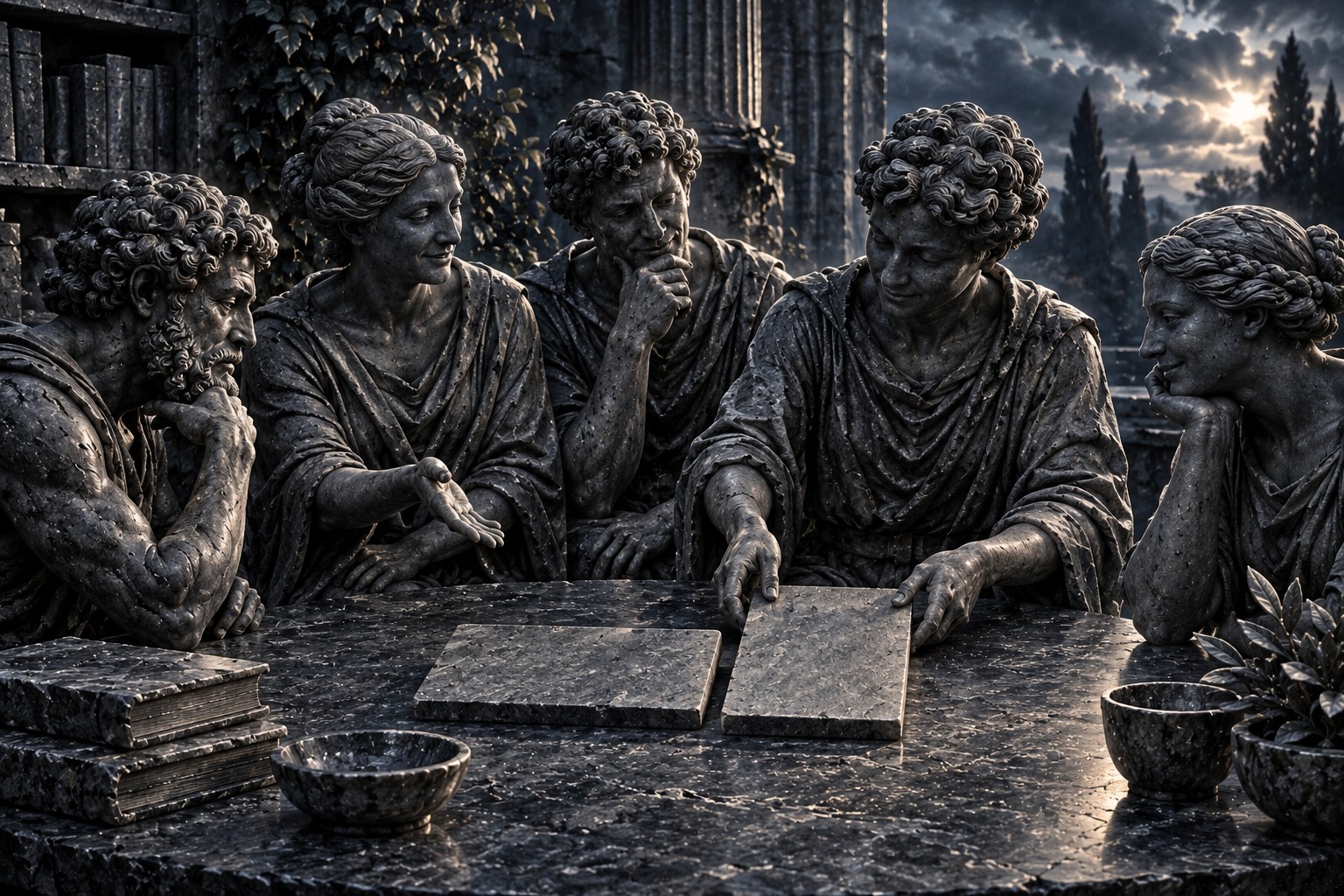
Epigraph
“Our laughter is always the laughter of a group.”
Henri Bergson, Laughter, chapter I, subsection I, paragraph on an echo; Cloudesley Brereton and Fred Rothwell translation.
What this article is about
A joke can make a situation available for another look: an unsuccessful plan need no longer be defended, an exaggeration becomes visible, or a conversation regains movement. Laughter can also establish a different relation. One person receives the role of being funny while everyone else assumes permission to continue without their participation. Wit and the number of people laughing do not settle the difference. What becomes the joke’s object, who can answer, and whether anyone can leave the proposed game all matter. We compare Aristotle’s chapter on conversation during leisure, Henri Bergson’s selected account of laughter’s social surroundings, and the Malvolio episode in Shakespeare’s Twelfth Night. These are ethical reflection, a historical theory of comedy and a dramatic scene, rather than three versions of a mood improvement technique. Contemporary examples are invented for reflection. Nobody is required to joke, laugh at themselves or express gratitude for an unpleasant joke. Not laughing calls for neither diagnosis nor justification.
I. What becomes the object of the joke
Imagine a small group arranging a reading meeting. A shared note accidentally contains two different dates. Someone remarks, “Our calendar has decided to read the book twice.” This is an invented scene, not evidence of humour’s demonstrated benefit. The remark might name a contradiction without requiring a lengthy defence from the note’s author. Its object is a shared document that can be corrected. What follows still matters. If discussion returns to choosing a date, the joke remains a way of noticing an error. If every later confusion is attached to the author’s name, the common calendar becomes a pretext for assigning a permanent role. The first remark alone cannot guarantee which conversation develops, even when its speaker intended nothing more than a passing observation.
“Opening room” can name a limited possibility rather than a special class of joke. People can reconsider a particular plan without defending it as proof of their own infallibility. That is neither release from every tension nor a new personality characteristic. Someone might dislike the remark yet agree to correct the date, or enjoy it and ask that the mistake not be mentioned again. Both responses are compatible with participation in the shared activity. A small change should not be replaced with a grand promise: a smile alone establishes neither trust nor agreement nor relief. It remains one visible response among others, while subsequent words and actions help clarify the relation between the participants and what they actually want to do next.
The opposite movement can also begin with something small. A discussion of the note turns into “our permanent muddler.” What is offered now is not correction of a record but recognition of a person through a repeated trait. This does not mean that every nickname necessarily humiliates, or that a narrator can determine another person’s experience in advance. The scene’s structure has nevertheless changed. A particular mistake becomes material for a lasting image, and its subject must either accept that image or explain a refusal. Our concern is this shift in the object of attention. Can the participant describe themselves differently and return to the activity without giving another performance? Neither the joker’s intention nor the volume of collective laughter supplies the answer.
II. Wit includes the person who hears
Book IV, chapter 8 of the Nicomachean Ethics considers conversation during rest and amusement. Aristotle asks not only what someone can say to entertain, but also what they are prepared to hear. W. D. Ross’s translation distinguishes trying to produce laughter at any cost, avoiding jokes entirely and behaviour fitted to the circumstances. We do not adopt the scheme as a contemporary obligation to be moderately cheerful. The ancient text contains judgements about breeding and social position that cannot become a present scale of human worth. A different point matters here: a remark enters a relation between people. The ability to invent it therefore leaves open the question of how its speaker treats the person who hears it and what room that person retains to respond.
Aristotle also observes that different hearers find different things pleasant or objectionable. This does not provide a universal dictionary of permitted jokes. A remark may depend on shared experience familiar to one person but unavailable to another, or concern a detail whose importance its speaker has misjudged. That uncertainty cannot be removed by making one’s own taste the standard for every response. In our invented group, a calendar remark may require no personal explanation, while a repeated nickname raises another question about its addressee. The contemporary possibility of declining is editorial reasoning introduced here. It relates to attention to a hearer without being presented as the literal meaning of ancient good breeding or as a summary of Aristotle’s complete philosophical doctrine.
The selected key fragment concerns jokes a person will not make. Such a boundary need not mean a prohibition list prepared in advance. We can consider the ability to withhold an effective remark when its continuation would deprive someone else of room to answer. Wit does not disappear because one possible line goes unused. This contemporary formulation must nevertheless not be attributed to Ross as a literal translation. Aristotle discusses character and fitting conduct within his own cultural arrangement. We draw a limited question from the chosen chapter: does the joker’s relation to the hearer matter, or does producing an effect suffice regardless of the position in which that person is left afterwards? The distinction concerns the use of an ability, rather than its mere possession.
III. Shared laughter and the limits of approval
At the beginning of Laughter, Bergson connects the comic with human surroundings and describes laughter’s need for an echo. Our epigraph belongs to that argument: it asserts laughter’s group character. This is a strong generalisation by a historical author, not a law independently verified here that explains every smile. In subsection I of chapter I, shared references and a particular way of looking matter to the comic. Even without another person nearby, someone may have access to familiar images, voices and expectations from a social setting. For our topic, this raises a question about belonging. Who understands the allusion, who is included in discussing it, and whose perspective remains outside once the group is already certain that everything is obvious to everyone involved?
An echo is not permission. Several people can understand the same allusion and laugh, yet the number of responses does not establish how someone who becomes its object should be treated. In our scene, everyone can see the calendar error. It does not follow that the author agreed to become a permanent picture of absent-mindedness. Bergson helps us notice comedy’s social arrangement, but description of that arrangement cannot quietly turn into ethical approval. A question remains between “this amused us” and “we may continue this way.” Answering it may require an ordinary conversation rather than a stronger joke. The participant who raises it need not first demonstrate membership, competence in understanding allusions or a capacity to laugh at personal failings.
Bergson also treats temporary emotional distance as a condition of the comic outlook. We retain this as a proposition of his theory, without recommending reduced compassion as preparation for an enjoyable meeting. Distance in an account of someone’s embarrassment may make certain details more visible to listeners while leaving others unnoticed: the need to answer, the right to end the story or the consequences of repetition. An explanation’s power does not remove those questions. We can consider how an effect arose without treating the effect as sufficient grounds for continuing. Description and permission especially need distinguishing where a group response seems most persuasive. Shared laughter shows a degree of common perspective; it does not exhaust the relations between the people positioned within the scene.
IV. When a scene is arranged without its subject
In the chosen opening of Act 3, scene 4 of Twelfth Night, Malvolio acts on a letter he understands as a sign of Olivia’s feelings. His smiling and yellow stockings mean one thing to him and another to her. The audience knows more about the situation’s origins than the character does. The selected exchanges show more than a comic accident shared by everyone. Some participants already know how the deception is arranged and can interpret Malvolio’s replies to their own advantage. We consider this bounded episode without passing judgement on the whole play or every character. The dramatic difference in knowledge raises a question: who controls the joke’s circumstances, and who must answer without access to the conditions through which those circumstances were produced?
In the selected paragraphs of chapter I, subsection II, Bergson distinguishes accidental awkwardness from circumstances deliberately arranged for a comic effect. His example of an external obstacle is not equivalent to Shakespeare’s complex scene: hope, a household position, different relationships and Malvolio’s own words are involved. The comparison nevertheless makes a causal question visible. Noticing a contradiction together differs from creating one for another person and displaying each response as another amusing detail. No such device needs reproducing to understand the distinction. In our contemporary reasoning, freedom to answer requires at least a possibility of knowing what conversation is taking place. Laughter from those present does not automatically restore that possibility when one side retains the rules and the original information.
At the chosen episode’s end, assurances of gentle treatment give way to Sir Toby’s proposal to bind Malvolio and place him in a dark room for amusement and punishment. The proposal must not be described here as an action already carried out. Nor should characters’ language about madness become a medical conclusion. The visible transition is sufficient for our topic: the organisers’ pleasure becomes grounds for controlling someone else’s position. Malvolio also speaks with hostility and arrogance; that does not make every response to him permissible. The dramatic scene lets us retain both sides. The character’s complexity remains, while the others’ permission to continue cannot be deduced from the audience’s invitation to laugh at his mistaken reading of the letter.
V. A mistake need not become a name
Return to our invented meeting note. Two dates can be corrected without deciding which participant is always accurate and which is permanently funny. A calendar joke can leave the mistake as a particular event. A nickname offers a different arrangement: the person’s later actions are read as confirmation of an image already established. Clarifying the time becomes another muddle, while silence receives its own ready explanation. A closed interpretation develops that is difficult to leave through an ordinary answer. This is an editorial model of a situation, not a demonstrated regularity of every group. It helps reveal a question easily lost behind an effective remark: can someone perform the next action without reenacting the character that has been assigned to them?
The Malvolio scene displays a related arrangement, although it cannot be transferred to a reading meeting as an exact match. The organisers know the deception and use his replies within their own explanation. Our scene differs substantially: nobody forges a letter, and the original calendar error may be accidental. The resemblance concerns a narrower mechanism. Another person’s responses stop clarifying a conversation and become material for preserving a predetermined image. Such a comparison requires neither naming every joker a manipulator nor treating every addressee as helpless. It leaves room to change what follows. A particular error can be acknowledged, the repeated name dropped and discussion returned to the date, without demanding public proof that the person can take everything lightly.
A person’s connection with a mistake can be stated precisely when the shared activity requires it: who prepared the note, what was corrected and which date was agreed. Such precision differs from an image that persists independently of the discussion’s object. Humour may still be present, but its role need not expand. Sometimes one brief remark is enough and nobody performs again afterwards. Sometimes participants prefer to omit it entirely. The absence of a joke does not make a correction heavier by definition; a conversation’s weight cannot be calculated in advance from the number of amusing words. Limited relief remains connected with a particular contradiction. A humiliating continuation requires the person to become a convenient object again, beyond resolving the original question.
VI. A smile leaves questions open
An addressee’s position is not always immediately visible. Someone may smile to maintain the conversation’s pace, because the remark was genuinely enjoyable, or for a reason nobody present knows. This article does not propose choosing a hidden explanation for them. Ambiguity instead limits the observer’s conclusions. A smile alone establishes neither pleasure nor concealed suffering. Continuing can be discussed when necessary, without demanding disclosure of an inner state before the group. Available and unknown information can remain distinct: a response occurred, its complete meaning has not been established, and the conversation can still change without solving a supposed puzzle about someone else’s character.
Someone who does not laugh also conveys no complete attitude towards others through silence alone. They may be occupied with another question, miss an allusion or simply decline participation. Aristotle’s negative assessment of avoiding jokes entirely is therefore not transferred to a contemporary group. It belongs to the chosen ethical scheme rather than establishing an obligation to smile. We can retain interest in his attention to hearers while declining to make an ancient assessment of a silent participant our judgement. This does not require dismissing the whole source. It requires naming which thought assists the discussion and which cultural assumption remains separate from present conduct.
Clarification can be brief and need not be ceremonial. In our invented scene, someone can say that the date is corrected and the nickname is unwelcome. No account of sensitivity or proof of an adequate sense of humour is required. The answer need not become another joke that discounts the statement. A question about a particular repetition can be accepted at that scale. This promises neither immediate understanding nor disappearance of tension. It preserves the subject’s precision: continuation of a remark is being discussed, rather than the participant’s right to be themselves. Ordinary answers especially matter when joking has started deciding what another person ought to feel.
VII. An effective line can go unused
Withholding a line need not mean renouncing humour altogether. It can be a local decision: a particular joke requires information the speaker does not own, or a continuation difficult for someone else to leave. Sometimes a witty formulation arrives after the question is settled. Sometimes it depends on revisiting a mistake others asked to drop. None of these cases makes the speaker permanently unfunny. Attention to circumstances leaves the capacity for joking broader than one unused option. Aristotle’s fragment about jokes someone will not make helps pose this boundary question. Our particular description of declining remains contemporary reasoning rather than a ready instruction supplied by the ancient author.
The remark’s object can also change. A contradiction in a shared plan can replace a personal trait; information available to everyone can replace a private detail. Such substitutions are no universal method for making a joke safe. A common situation may carry different weight for participants, and public information does not authorise every use. Technical conditions should not be assembled and mistaken for verified relationships. The revised joke remains an invitation to look, which can be declined. After the calendar remark, choosing a date can suffice. If everyone’s willingness to laugh is tested instead, changing the object has not preserved the original possibility: people must now certify a shared mood.
The joker has a particular freedom here: a line’s value need not be proved through compulsory success. An unsuccessful option can be left behind, explained plainly or replaced with another topic. Missing laughter need not become an argument about who understood. Discussing humour remains possible if participants want that discussion. The distinction is whether it becomes a voluntary question or a defence of continuing against an addressee’s wishes. Bergson’s account of group echoes guarantees no acceptance. Even a remark based on genuinely shared experience remains a particular action. A joke can be acknowledged as an attempt without requiring others to complete it through the prescribed response or explain that response’s absence.
VIII. Joking about oneself grants no general permission
Someone may tell their own calendar mistake as a funny story. They choose its moment, details and ending, unlike another person assigning a permanent role. Even here, release cannot be promised in advance. Self-directed humour may be enjoyed, go unanswered or become unnecessary to its speaker. Our topic does not require turning it into a useful habit. A particular story should instead remain distinct from permission for others to reproduce it whenever they choose. Laughing once at one’s note establishes no future agreement about a nickname. The person’s later relation to that story may change, without constituting an inconsistency that the group must correct through another joke.
Bergson’s group account helps us notice that even a story about oneself exists among other people’s expectations. Others may await a continuation, recognise a familiar role or adopt its details. These are possibilities, not claims that all self-directed humour conceals pressure. A speaker can participate willingly and stop. Their present choice should not be replaced by a past habit. Someone who usually jokes may prefer a precise, unfunny explanation today; someone who rarely jokes may offer an effective remark. Neither case must confirm a permanent character type. The question remains situational: what conversation is proposed now, and who can influence its continuation, including declining an already familiar form?
A story’s author also differs from the owner of all its circumstances. Stories about oneself often include other people, their words or private information. Choosing one’s own image does not automatically authorise disclosure of someone else’s details. We name this boundary without offering a legal assessment. It shows why “I am only joking about myself” cannot settle every relational question. A calendar story limited to the shared note has a small scope. Adding others’ explanations for absence introduces a new subject and new uncertainty. Humour does not cancel the need to distinguish these subjects; an amusing narrative’s coherence does not make every included detail equally available for use.
IX. An ordinary conversation can follow an unwelcome joke
When a remark is unwelcome, what follows need not be still wittier. A particular objection can be heard and one’s action named without an extensive defensive story. This guarantees no restored relationship and imposes no script on the addressee, who may decline further discussion. Distinguishing responsibility from outcome prevents explanation from becoming another obligation: because I clarified my intention, you must feel relief. Intention matters for understanding an action but neither cancels what happened nor determines someone else’s answer. Our invented group can acknowledge repeating the nickname and stop using it without requiring an immediate shared smile to certify that the question is conclusively settled.
In Shakespeare’s chosen episode, assurances of gentle care do not prevent a subsequent proposal for punishment. That dramatic combination of words and intentions proves neither that all apologies are hypocritical nor that they must be rejected. It raises a narrower question: does the promised treatment match the continuation actually offered? In our scene, a declaration of good intentions changes little if the nickname immediately returns as a new example. Non-repetition can be visible in action without measuring repentance’s depth. Such precision permits no deadline for another person’s acceptance. An ordinary conversation retains the possibility of different responses and incompletion without turning either into further comic material.
Sometimes the conversation’s former small object can simply be restored. The dates differed; one is now chosen. A note was corrected; additional character judgements are unnecessary. This neither orders forgetting nor pretends that relationships are repaired. The practical question can end while a personal answer remains open. Such an ending differs from a comic resolution in which everyone must affirm a shared mood. A joke need not become the meeting’s main event merely because it occurred. Participants may discuss it separately if they want; the reading itself also retains its place. Returning to the activity should require neither a contented performance from the addressee nor a declaration that every tension is resolved.
X. Opening room means leaving space for an answer
Within this essay, a joke that opens room is neither treatment nor evidence of a special moral level. It may create a small space for reading a situation differently: a plan was absurd, an expectation excessive, an error correctable. People can use that space differently. One laughs, another agrees to amend the note, a third continues without smiling. The possibility needs no uniform response. This distinguishes it from a scene where the addressee must affirm an assigned image for conversation to continue. We establish no universal formula for good jokes, retaining a question about freedom in the next answer. If that answer already counts as proof of a comic role, someone else’s explanation occupies the space.
The sources retain different aspects of the question. Aristotle considers character and wit’s limits; Bergson explains the comic through social surroundings and distance; Shakespeare presents unequal knowledge in a particular fictional scene. They cannot form a ready rule or independently verify a contemporary technique. Each leaves a precise question: what is someone prepared not to say, whose perspective supports laughter, and who controls the scene’s arrangement? Our distinction between voluntary participation and declining is formulated through comparison. It erases neither the sources’ cultural assumptions nor the difference between fiction and research on real groups. Retaining those differences matters more than an attractive claim that every author always taught identical kindness.
Humiliation here concerns an arrangement in which entertainment takes precedence over someone’s ability to determine their participation. This is a relational description, not a diagnosis or final judgement of the joker’s character. Particular continuations can be considered: is an ordinary answer possible, can repetition stop, and does a mistake remain an event? The alternative need not prove that everyone feels better. A possibility can simply remain open: something amusing helped name an object while people retained different answers and their own words. If humour is unnecessary today, the same right remains. Freedom in a relationship depends on no duty to be cheerful, and a worthwhile conversation can continue without another effective line.
What this means in practice
Choose a recent remark only if you want to return to it. Name its object plainly: a shared plan, a particular mistake, one’s exaggeration or a lasting image of someone. This neither evaluates a personality nor searches for concealed harm in every joke. If others are involved, private details need not be disclosed and the scene should not be reenacted to test their reactions.
Distinguish what is known from what was inferred. Who could answer? Was the situation understandable? What did participants actually say, and what conclusions were drawn from laughter or silence? Unknown information can remain unknown. This gives no permission to explain someone else’s state, and requires no assurance that everybody enjoyed the remark.
Name one possible continuation within your own participation: omit a nickname, correct the note, explain plainly or add nothing. The addressee need not accept an explanation, and its author need not devise another comic form. The reflection can end with this small choice. No relief, repaired relationship or compulsory personal growth is promised.
Key quotation
“There are, then, jokes he will not make…”
Aristotle, Nicomachean Ethics, IV.8, paragraph beginning There are, then; selected opening clause; W. D. Ross translation.
Connections between traditions
-
The hearer: Aristotle IV.8 and Bergson I.I. Aristotle relates fitting speech and listening to the addressee and differences in what people find pleasant; Bergson’s echo paragraphs place comedy within particular social surroundings. The shared question concerns what makes a remark understandable and effective beyond its formulation. Both passages include relations with others: a proposal exists beyond its teller’s mind. For this topic, a common allusion must remain distinct from a particular hearer’s position. The boundary matters: Aristotle’s ethical assessment differs from Bergson’s explanatory theory. A group echo establishes no virtue, while ancient good breeding imposes no contemporary duty to laugh.
-
Laughter at any cost: Aristotle IV.8 and the end of Twelfth Night’s chosen 3.4 episode. Aristotle describes excessive efforts to amuse and jokes a person will not make. Sir Toby instead proposes further control of Malvolio’s position, linking the organisers’ pleasure with punishment. Is an entertaining effect sufficient reason to continue? The resemblance concerns subordinating treatment of someone else to the aim of amusement. Distinguishing room from humiliation requires considering limits on the use of another’s responses. The boundary: philosophy assesses character; drama presents particular speeches and a proposed action. The chosen scene supplies neither a diagnosis nor proof that the proposed confinement has already occurred.
-
Accident and arrangement: Bergson I.II’s fall and deliberate obstacle paragraphs, and the letter in Twelfth Night 3.4. Bergson distinguishes accidental awkwardness from circumstances arranged for comedy; Malvolio responds without knowing what the deception’s organisers know. Who controls the funny situation’s cause? Both sides reveal a spectator’s or organiser’s knowledge advantage over the person responding. Responses may consequently become material for another’s plan instead of opportunities to clarify conditions. The boundary: Bergson’s external device differs from the drama of hope and household relationships. The comparison recommends no reproduction of deception and identifies no single mechanism behind every joke.
-
Distance and care: Bergson I.I and assurances of gentleness in Twelfth Night 3.4. Bergson connects the comic outlook with temporary emotional distance. Assurances of care in the play coexist with a subsequent proposal to restrict Malvolio. What might be omitted from the amused participants’ perspective? The limited resemblance concerns distance between an observed image and an acting person’s position: a response can be treated as an effect without examining its conditions. This topic therefore calls for attention to continuations, rather than accepting tone as sufficient. The boundary: a historical explanation recommends no reduced compassion; dramatic irony proves neither that every gentle word is false nor that audiences must react identically.
-
Different readings: Aristotle IV.8 and Olivia with Malvolio at 3.4’s opening. Aristotle notes that hearers differ in what they find pleasant or objectionable. Shakespeare’s smile and stockings acquire different meanings: one character follows an expectation based on a letter; the other does not share that initial knowledge. Why does one visible response establish no identical meaning for everyone? Both sides make understanding depend on the participant’s position. This limits deductions from a smile: it cannot become ready agreement to continue. The boundary: ancient questions of taste and fittingness differ from contemporary consent. Dramatic misunderstanding explains neither every real smile nor anyone’s undisclosed inner state.
-
Echo and limit: Bergson I.I and Aristotle IV.8’s speech and listening paragraphs. Bergson relates laughter to shared references and perspectives; Aristotle discusses limits on what someone says and accepts during amusement. Does belonging to shared laughter equal permission to continue? The comparison retains two sides: effects occur among others, while speaking includes choices about using an ability. This leaves room for ordinary refusal and unfunny answers formulated through our editorial reasoning. The boundary: Bergson’s social account grants no moral permission to a majority, and Aristotle’s mean character requires no uniform contemporary cheerfulness. Declining and possible relief are not clinical conclusions here.
Primary sources
Aristotle. Nicomachean Ethics IV.8; W. D. Ross’s English translation, Internet Classics Archive. The entire chosen chapter was read: speech and listening during leisure, differences between hearers, laughter at any cost and limits on jokes. The key fragment is the opening clause of the paragraph beginning There are, then, before its semicolon. Ancient breeding assessments are not adopted as contemporary rankings of worth. Text of IV.8
Henri Bergson. Laughter, chapter I: introduction, complete subsection I, and selected subsection II paragraphs on accidental awkwardness and a deliberately arranged obstacle. Cloudesley Brereton and Fred Rothwell’s English translation; this particular printed carrier’s year is not established here. The epigraph appears in the echo paragraph. Historical theory is not presented as a verified psychological law; subsequent II paragraphs were read as context, not as the entire book’s theory. Chosen chapter
William Shakespeare. Twelfth Night, Act 3, scene 4, the opening Malvolio episode: Olivia and Maria’s entrance through Sir Toby’s proposal and Sir Andrew’s arrival, local scene lines 1–150. Folger Shakespeare Library’s English text is used. Unequal knowledge and a proposed continuation are considered; the whole play and subsequent action are not represented as read here. No direct Shakespeare quotation is included. Episode text
The article’s Russian fragments of Aristotle and Bergson are translated from the identified English translations. Greek and French originals were not collated. Shakespeare’s episode is paraphrased from original English in the named edition. Comparisons retain the distinction between ethical reflection, historical explanation and dramatic action. Contemporary scenes and the question of declining participation belong to this essay.
Tags
humour, joke, laughter, humiliation, freedom to answer, wit, hearer, conversation, dignity, boundaries, participation, declining, self-directed humour, shared experience, nickname, mistake, intention, responsibility, explanation, repetition, Aristotle, Bergson, Shakespeare, Malvolio, comedy, dramatic irony, social echo, leisure, tact, meaning
About the authors
Andrey Zarinsh is the author and founder of United Wisdom. He explores inner transformation, the unity of traditions, intercultural dialogue, and contemporary spiritual discipline. Instagram: @andrey.zarinsh.
Maria Evilkut is a co-author of United Wisdom. Alongside her research, she seeks to test these ideas in practice and observe how principles of unity and mutual understanding work in real life between people and cultures. Instagram: @ilkutki.
Keep what resonates with you.