
Meaning & path
Play Without a Compulsory Outcome
Play can have a purpose and rules without a compulsory product, growth report or proof of usefulness. Consent, resources and the possibility of stopping remain.
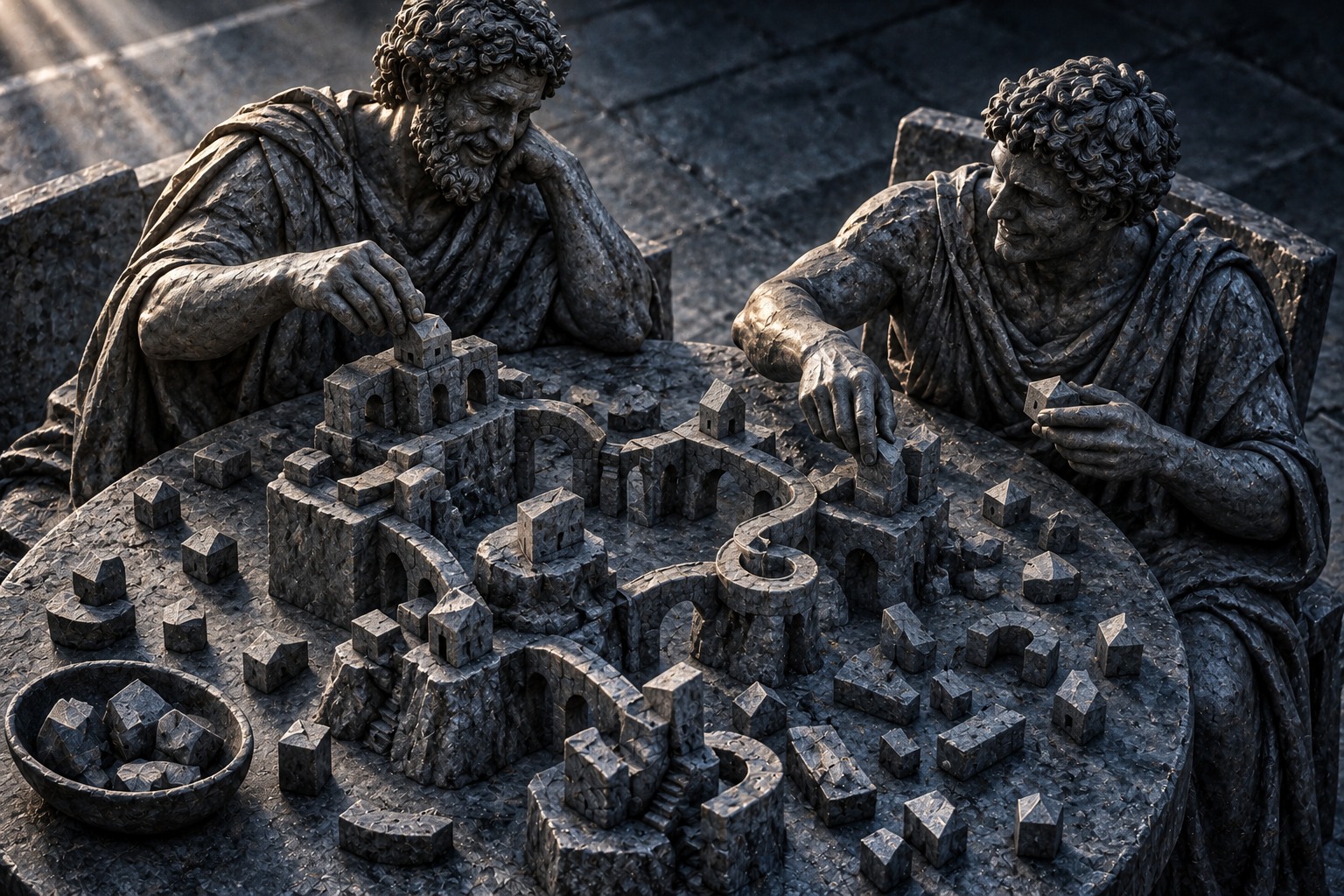
Epigraph
boys and girls playing in the streets thereof.
— Zechariah 8:5, final fragment; King James Version. Its omitted opening names the city’s streets; the image belongs to a religious promise concerning Jerusalem.
What this article is about
Someone may be willing to try an unusual activity yet immediately ask what it will produce: a useful object, a skill, a good photograph, or evidence that the evening was properly spent. Play allows another relationship with time. It can have a purpose, rules and even a score, without every action needing an external report of achievement. This article distinguishes freedom from a compulsory outcome from inattention to consequences. An invented encounter between two adults is compared with Dewey's educational argument, Aristotle's ethics and a religious image in Zechariah. Their grounds differ. Play here is neither a remedy nor a test of maturity or a promised new outlook. It can remain a particular activity someone joined and can end while keeping actual agreements with others.
I. Doing Something and Presenting an Achievement
Imagine Ira and Timur laying blank sheets on the table after an ordinary dinner. They suggest inventing a city with impossible names: quiet thunder square, forgotten keys lane, a street leading back to its own beginning. This is a hypothetical example, not a report of a tested activity. Initially, the question is simple: which name will continue a neighbouring story? Then Ira asks whether the sheets should become a beautiful map. That choice could introduce new conditions: a shared size, neatness and a completion time. They have not made it yet. The possibility of building a map differs from an obligation to finish something that must subsequently be kept, displayed or measured against a predetermined model.
This distinction does not make outcomes suspect. Timur may want an actual map; Ira may like the thought of giving it to a friend. They can then discuss another purpose. A useful product, however, need not become the hidden debt of everyone sitting at the table. They can invent three names and stop, or spend time moving sheets without sticking anything together. They are still doing something: responding to words, noticing an odd adjacency, choosing a continuation. The absence of a finished object does not mean that nothing happened. Equally, the occasion need not acquire a grand significance merely because we have decided to describe it as play.
An external report appears when a second question silently joins the activity: what now certifies your inventiveness, closeness to a friend or ability to rest? The ordinary meeting acquires an unannounced examiner, demanding that the activity justify its time and reveal a desired quality. Declining that report does not forbid talking about what happened. Ira can say she liked a name; Timur can say he became tired. These responses concern a particular evening. They establish neither a final transformation nor a shortage of imagination. Play can remain small when its participants are not assigned the task of proving through it what kinds of people they have become.
II. A Purpose Can Guide without Fixing the Ending
In Chapter XV of Democracy and Education, Dewey distinguishes the direction of play from a predetermined external product. His account does not equate play with aimless movement: a possible subsequent activity can guide the present one. This is an educational philosophical view, connected to his account of schooling, rather than research into our invented evening. The question matters here: must a guiding purpose always coincide with an object that can be presented at the end? Ira and Timur can understand what they are playing without yet knowing whether the city has a square, who lives there, or whether its map will survive the gathering.
Direction appears in their responses. A forgotten keys lane might suggest a house whose door opens with its visitor's name. The next remark supports a continuation instead of fulfilling a compulsory project item. Ira can suggest that the house has no doors; Timur can notice that this changes the earlier story. Their actions are not arbitrary simply because the ending is undetermined. They relate to something already said. Attention and distinction remain, while external usefulness need not be the criterion. Sometimes a new move's continuation of the accepted possibility is enough, together with both participants' understanding of the change now being proposed rather than a future product it will yield.
Meaning can change along the way. The city becomes a route, then a list of places that cannot be found. This is neither an automatically better path nor proof of exceptional freedom. Some prefer a game with a definite ending: completing a picture, following a route, finishing a round. That choice is possible too. Uncertainty is not declared life's highest form. Preliminary clarity can be distinguished from a demand to justify every future experience beforehand. Someone can know how to begin and what to agree to now, leaving subsequent decisions open. Openness then has a particular subject instead of becoming a duty to surprise oneself and everyone else continually.
III. Rules Belong to the Game; Consent Belongs to People
Play without a compulsory finished object can still have rules. Ira suggests adding only one sentence to each name; Timur wants to change earlier writing sometimes. These conditions can be agreed and later reconsidered. A rule distinguishes a move from interference with somebody else's contribution. If a name was to remain until the next round, its unexpected disappearance needs explaining. Flexibility does not authorise one participant to declare every previous decision irrelevant. Sometimes a restriction makes continuation interesting, because a response must be found within the accepted form. That restriction differs from an external duty to produce something useful, although both can look like a requirement to observe a condition.
The invented city permits impossible doors, while real people retain ordinary boundaries. Ira may not want a street named after her personal history. Timur can agree to play without agreeing to a recording of the conversation. A general invitation to try something does not permit every action that someone finds amusing. This is the article's contemporary editorial boundary, not a law of play attributed to ancient sources. It can take a concrete form: suggesting different material, asking about a separate condition, stopping an uncomfortable move. Nobody needs to prove that the other person is insufficiently open. Different preferences can remain different without evaluating someone's capacity to participate in life.
Conditions sometimes conflict. One person wants to change every word freely; another cares about keeping their own notes. Further explanation does not resolve every difference. They can separate the sheets, choose another activity or finish the meeting. Stopping need not be failure and will not necessarily preserve a good mood. It can identify the actual limit of a shared purpose. Respecting it does not mean declaring all proposed actions equally suitable. Ira has her response and Timur his; common play exists only where they actually agree. Without this distinction, freedom starts describing one person's access to another's attention rather than explaining the participation they have both chosen.
IV. Winning Need Not Become a Verdict
Someone can play to win without requiring victory to provide external justification. In another version of our scene, the friends choose a board game with an exact score. Its local aim is clear: collecting a particular number of points. That does not remove the article's question. A compulsory outcome appears when the score must also prove a person's worth, the evening's efficiency or fidelity to a relationship. Points show the outcome of one round under particular rules, rather than a participant's whole history of abilities. Moves can be followed seriously and victory desired without turning the ending into a general account of who is always cleverer, stronger or more worthy of attention.
Losing can be disappointing. Nobody must immediately smile, call defeat useful or extract a lesson convenient for the company. Disappointment nevertheless grants no permission to damage another's belongings or alter the score without agreement. Feelings and actions have different subjects of consideration. Someone can ask for a pause, choose another format or acknowledge that continuing is unwanted today. These possibilities are no instruction promising rapid emotional change. They concern an ordinary situation. When they do not fit, the absence of an easy option should not become a personal shortcoming. This article makes no diagnosis from the calmness with which someone receives the result of a game.
Competition also has different conditions. A friendly round, an agreed tournament and paid professional work involve different relationships with timing and outcomes. Calling something a game cannot cancel accepted promises. Our example concerns an ordinary voluntary activity between adults, rather than a determination of contractual rights. An actual promise to host a meeting or complete a particular stage is considered separately. Freedom from a report of personal growth does not make a concrete agreement retrospectively provisional. This boundary gives play a place beside responsibility: someone may want to win without being required to prove through victory that they deserve respect from the people with whom they are playing.
V. Usefulness Can Appear without Becoming a Condition
In Nicomachean Ethics X.6, Aristotle places amusement below final happiness and relates relaxation to subsequent activity. This substantively differs from the possibility considered here of play without external justification. His ethical hierarchy does not become our rule for judging participants, and the historical exclusion based on a person's status is not adopted. The comparison highlights our own question: do we allow an activity only as preparation for something more important? Ira might use an invented name in tomorrow's story. Today's evening, however, need not wait for tomorrow's application before its participants can acknowledge that they genuinely spent it together, even without a completed product.
When usefulness appears, it can be noticed without a promise to repeat it. Timur discovers a convenient way to explain a route; Ira finds a word for an old impression. These are possible details of our invented example, not established effects of play. Another evening might produce nothing similar. An achievement need not be supplied retrospectively because the time has already passed. Such justification can narrow attention to what fits a report, overlooking an action that found no application. Both possibilities can remain: a chance continuation and no continuation. A useful discovery then stays a discovery rather than becoming the condition under which every preceding minute earns permission to exist.
A transition into work can be welcome. Ira asks Timur to help turn the names into an actual gift. They can specify a time, choose materials and decide their contributions. A playful origin makes this work no less serious. The new goal nevertheless needs fresh agreement: earlier willingness to invent is not a promise to manufacture something. One part can be accepted and another declined. Play should not be opposed to work as freedom to unfreedom; work too can be chosen and interesting. The distinction concerns a particular continuation: are new commitments being discussed, or assumed to have arisen automatically from an evening that happened to go well?
VI. A Place where Playing Is Possible
In Zechariah 8:4–5, old inhabitants and playing children appear in Jerusalem's streets within a religious promise. The image retains its named city and divine grounds; it is not a secular programme for arranging every contemporary street. A limited question about place can be asked here: what lets play appear among other activities? The possibility does not always depend solely on a personal decision. Ira and Timur have a table, some time and sheets they can use. Someone without those conditions need not find the same freedom through imagination alone. This comparison does not claim that playing proves complete safety or well-being throughout the surrounding life.
A place involves other people's interests. The table may be needed for work, a neighbour may need quiet, and a participant may need free space. Fewer sheets, another time or a quieter activity can sometimes be chosen. Sometimes no suitable option is available now. Acknowledging that limit differs from demanding the correct attitude: it concerns the situation's arrangements rather than a final account of the person. Changing a room is not promised to make play accessible to everyone. A particular obstacle can be clarified without making it an assignment the invited person must overcome alone. The right to decline remains beside an attempt to offer a possibility.
Shared space also requires no identical feeling. One person invents names, another listens, and a third prefers their own activity. Every adjacency need not become a game. In our scene, the friends can acknowledge different interests today and put the sheets away without promising to return. This proves no lack of closeness. Participation can be brief and need show no visible delight. The contemporary conclusion is editorial: an opportunity matters through its particular form, rather than a requirement to use it every time. The religious image remains an image of the promised city; no individual must certify its meaning through compulsory happiness or constant readiness to play with others.
VII. A Surprise Need Not Be a Revelation
A move can surprise without surprise becoming a compulsory reward. Timur suggests naming a street after a teaspoon; Ira responds with an ordinary word. The evening can proceed quietly, through repetitions and pauses. Requiring an unusual answer every time creates another examination: be original, or your contribution was inadequate. The demand easily hides inside a friendly invitation to try something different. An alternative form nevertheless differs from a duty to manufacture novelty continually. Someone can use a familiar word, repeat a move or decline to continue. Not every repetition is automatic consumption; it can be a chosen part of this particular interaction instead of an escape from attending to it.
An unexpected result sometimes needs care. A name reminds Ira of an unpleasant occasion that Timur could not have known about beforehand. The uncomfortable move need not continue for the sake of courage or useful experience. A word can be changed, a sheet removed, or the activity stopped. Attention to that choice does not make playful freedom false. It distinguishes freedom of invention from permission to test somebody without consent. This article neither explains severe experiences through a few moves nor offers treatment through returning to an unpleasant subject. In our ordinary example, a surprise need not suit the person encountering it, even when nobody planned to cause discomfort.
No new understanding may emerge afterwards. Ira need not explain what she discovered about herself, nor Timur find significance in every pause. A separate conversation is possible if wanted, with the answer left open. The absence of a conclusion proves neither an empty evening nor a deeper experience. These are particular ways of finishing. A report of achievement should not be replaced by a report of correct non-obligation. Someone can simply say that names were invented without adding testimony of transformation. That account preserves what happened instead of extending it into claims its participants do not know or feelings they do not actually have.
VIII. Imagined Actions and Actual Resources
One word can build a bridge in an imagined city. The actual sheet still belongs to someone, while the occupied table and time have conditions of use. Freedom from a compulsory product is not freedom from costs. Ira can offer her drafts; Timur can clarify which notes should be left alone. Available materials or purely spoken play might be preferable. A modest form is not automatically more authentic; it answers particular possibilities. When resources are unavailable, a lack of imagination need not justify declining. A shared purpose creates neither means nor another's consent to spend them merely because it promises to be light and pleasant for the people involved.
Preparation can also become an invisible duty. One participant always invents rules, finds objects and attends to everyone else's comfort, then hears that play demands nothing. Its arrangements actually demand that person's attention. This part can be discussed, the purpose reduced or initiative offered to someone willing. Every minute need not be distributed equally; possibilities and interests differ. Habitual help should nevertheless not become an inexhaustible personal quality. Timur can suggest a rule today without promising every future gathering. Ira can use the suggestion without acquiring a right to a next one equally successful. Willingness to join does not become a permanent role serving somebody else's free time.
Consequences remain after make-believe actions. If a sheet carrying a personal note is accidentally damaged, saying that they were only playing does not settle what happened. The mistake can be acknowledged, possible repair discussed, and restoration not promised where it is unavailable. A published photograph or careless remark needs similar consideration. The playful circumstance helps explain the event without deciding for another person whether the harm matters. No general legal conclusion is given here. This is our ordinary example's boundary: forgoing an external report of achievement is compatible with attention to actual objects and people, who do not become imaginary when an activity is called a game.
IX. Ending before a Beautiful Finale
The evening need not end only when the imagined city is complete. Timur notices tiredness; Ira needs the table cleared. The limit can be named and sheets collected without a final phrase explaining everything before it. Sometimes ending is awkward: one person wanted to continue, while another does not. That discomfort need not prove incorrect participation. It concerns differing present possibilities. An accepted timing or commitment needs separate consideration. Without such a promise, beginning voluntary play is not consent to continue until the company receives a satisfactory outcome, the desired mood or convenient proof of good relationships. The ending can have a reason without having a beautifully completed form.
Keeping the map is optional too. Ira may want a sheet saved; Timur may prefer no photographs. Someone can keep their own work, ask permission concerning shared material, or decline publication. Documentation neither certifies the event's reality nor, by its absence, erases it. Every experience need not become an archive presented later as an outcome. Equally, memories can be kept and enjoyed. Lightness is not defined by a duty to destroy everything. A possible continuation differs from a prescribed ending: an object important to one person gains no automatic right to preserve or reveal everything belonging to their shared conversation and the other's contribution.
Ordinary tasks can return without a noticeable change. The morning retains the same jobs and conditions. Their new ease need not be tested before the evening counts as having happened. A difference can be noticed if it actually appears, or no difference found. Neither response sets the norm for everyone. Our sources ask different questions about activity, happiness and religious promise without offering a common measure of this return. An individual need not turn a private episode into evidence that traditions agree. Several invented names can remain several names beside the rest of life, which they are required neither to replace nor to explain.
X. Another Relationship with the Familiar Remains a Possibility
In play, a familiar object can gain another meaning: a sheet becomes a square, the table an imagined route, an ordinary word a house's name. This change belongs to a particular activity. It requires neither denial of things' ordinary uses nor a verdict that daily life is insufficient. The table serves dinner again afterwards; the sheet may carry a list. Seeing differently remains beside those uses. Nobody must always prefer the unusual to the familiar. An ordinary form sometimes suits better, without making life closed. The article concerns an additional space of decision, rather than a new norm requiring every minute to leave the ordinary behind in order to matter.
That space does not measure human completeness. Some enjoy playing; others seldom find a suitable form or lack time now. These circumstances establish no final quality of inner life. An invitation can remain a proposal without judging those who decline. This matters to the organiser too: freedom from outcomes need not be demonstrated through unusual behaviour or indifference to scores. An interesting continuation, neat object or victory can be wanted when the desire is named instead of attributed to everyone. Different aims can coexist or conflict. Participation begins where people have actually distinguished these conditions, rather than where one person has found a beautiful explanation on behalf of all the others.
Play without a compulsory outcome therefore means neither directionless life nor absent responsibility. It names a bounded possibility of acting without adding a predetermined external proof of usefulness, transformation or worth. Local aims, actual relationships and reconsideration of continuation remain. The sources help distinguish these questions while retaining irreducibly different grounds. The contemporary response stays discussable: sometimes a proposed move can simply be tried to see whether it suits participants now. Sometimes the response is refusal or unsuitable conditions. Play can happen, end without a product and become neither a programme of growth nor a final explanation of the person. Its place is determined by particular agreement and action rather than an obligation to justify an entire life.
What this means in practice
If you want to consider playing, choose an ordinary safe example suited to current conditions: a word, an imagined route or a small rearrangement of a familiar story. Identify what you actually offer another person. Must an object be finished or a score kept, or can the continuation change? This is a voluntary conversation about a particular form, not an exercise that needs completion.
The conditions that remain can be clarified separately: available belongings, present time, matters requiring consent and ways to stop. A useful idea needs fresh discussion of its continuation. Earlier participation promises neither a manufactured object nor a recording or future repetition. Failure to agree can remain a sufficient reason to choose another activity.
No report of discovery, improved mood or growth is required afterwards. What actually happened can be described, one detail kept by agreement, or everything left without further use. This consideration recommends no unsafe contact, financial risk or attempt to overcome severe distress through play. Without suitable desire and conditions now, declining need not become a description of the person.
Key quotation
Consequently play is free, plastic.
— John Dewey, Democracy and Education, XV.3, “The point of these remarks,” final sentence; original English. The context concerns directed continuation rather than aimlessness.
Connections between traditions
1. Direction and an external outcome. Dewey XV.3, carrier 1361–1367, distinguishes a directing idea from a particular external product; Aristotle X.6, 94–100, distinguishes activity for itself from relaxation for subsequent activity. The concepts are an aim within action and its instrumental purpose. The article asks what is expected from this evening: continuation of play or proof of future usefulness? Dewey concerns educational arrangements; Aristotle concerns a hierarchy of happiness and virtue. They supply no common permission for every game, establish no identical view of amusement and cancel no actual promises.
2. A move and a place for it. In Dewey XV.3, 1365–1367, a purpose can continue with changed material; Zechariah 8:4–5 names old inhabitants and playing children within Jerusalem's streets. The concepts are play's movement and space for its appearance. Our question concerns what is available to participants, so a possibility does not become a demand to imagine absent conditions. Educational adaptability and prophetic religious promise nevertheless have different grounds. Playing proves no complete well-being; rearranged objects guarantee neither safety nor happiness. The named city and divine voice are not replaced by a universal plan for a contemporary room.
3. Evaluation and an image of the future. Aristotle X.6, 99–102, denies amusement the position of final happiness; Zechariah 8:1–8 includes children playing in a promised return and covenantal relationship. The concepts are normative evaluation and religious imagery. The comparison asks which ground is added when one particular game must explain an entire life. Aristotle's ethical hierarchy is not a prophetic promise; Zechariah's image is not a general philosophical classification of activities. Historical exclusion based on status is not adopted. Neither text makes today's score a measure of human worth or a demonstrated forecast.
4. Conditions and possible action. Dewey XV.2, 1323–1328, considers arrangements of materials and scope for independent judgment; Zechariah 8:4–5 presents old people and children within shared urban presence. The concepts are conditions of action and a place in common life. The editorial mechanism is that participation depends on a particular situation, rather than a demand that somebody want it. Educational arrangements differ from the religious image of a restored city. This comparison gives no upbringing instruction, promises no removal of access barriers and establishes no duty to play. Modern consent and refusal remain our boundaries, not claims attributed to the sources.
5. External demands and subsequent usefulness. Dewey XV.3, 1372–1375, distinguishes an occupation's own significance from activity under external pressure; Aristotle X.6, 100–101, relates amusement to a return to more serious activity. The concepts are an imposed purpose and justification of a pause. Our example asks whether a useful discovery creates a commitment or needs fresh agreement. The views differ: Dewey considers social conditions of work and education; Aristotle retains his ethical hierarchy. Work is not declared always unfree, play guarantees no rest, and possible usefulness grants no authority over another's time.
6. Anticipation and a guarantee. Dewey XV.3, 1362–1365, retains anticipation of subsequent action; Zechariah 8:6–8 places future life within divine address and covenant. The concepts are a local expectation and a religious promise. The article distinguishes hoping for an interesting continuation from a duty to provide it to someone. Playful anticipation is not the prophetic text's faith, nor is its religious voice replaced by our agreement. The sources guarantee no novelty, calm or growth from a proposed game. A move can remain open while its possible future is acknowledged as neither a known outcome nor another person's consent.
Primary sources
-
John Dewey, Democracy and Education, XV, “Play and Work in the Curriculum”. Original English in Project Gutenberg 852; title and transcriber's note checked. The complete selected chapter, XV.1–3 and Summary, carrier 1307–1384, was read. The key quotation is the final sentence of “The point of these remarks” in XV.3, 1365. Educational and social grounds are retained; historical health, growth and recreation claims are not adopted as contemporary clinical evidence. No whole book reading is claimed or print-edition year inferred from absent data.
-
Aristotle, Nicomachean Ethics X.6, W. D. Ross English translation as labelled by the Internet Classics Archive. The complete selected section 91–102 and translator information 18–24 were read. There is no direct quotation. The hierarchy of amusement, activity and happiness is considered as a difference rather than agreement with our editorial position. Historical exclusion based on status is not adopted as a rule of human worth. No full Book X, wholework or Greek reading is claimed; the page establishes no print-edition year for this English translation.
-
Zechariah 8:1–8, King James Version. All eight selected verses and the version label were read. The epigraph is 8:5's final fragment; its omitted opening names the city's streets. Prophetic address, Jerusalem and covenantal grounds are retained. Playing children are not a secular programme, contemporary political forecast or measured effect of play. No wholechapter/book or Hebrew reading is claimed. Both Russian quotations are United Wisdom's own translations from the identified English texts. Ira and Timur are invented contemporary participants; consent and actual commitments are independent editorial distinctions.
Tags
play, outcome, purpose, rules, imagination, aim, continuation, cultural experience, ordinary life, relationship, Dewey, Aristotle, Zechariah, education, ethics, religious image, differing grounds, consent, boundaries, attention, resources, time, commitment, score, winning, usefulness, declining, ending, memory, voluntariness
About the authors
Andrey Zarinsh is the author and founder of United Wisdom. He explores inner transformation, the unity of traditions, intercultural dialogue, and contemporary spiritual discipline. Instagram: @andrey.zarinsh.
Maria Evilkut is a co-author of United Wisdom. Alongside her research, she seeks to test these ideas in practice and observe how principles of unity and mutual understanding work in real life between people and cultures. Instagram: @ilkutki.
Keep what resonates with you.