
Meaning & path
A Festival as a Temporary Change of Order
A festival changes ordinary time and participation for a limited period. Different traditions, access, work and responsibility without compulsory happiness.
Epigraph
For one may keep holiday without extravagance.
Seneca, Letter XVIII.4, final sentence; Richard M. Gummere translation.
What this article is about
On an ordinary day, a table serves as a workplace, time is divided into tasks, and familiar roles suggest who starts a conversation and who listens. During a celebration, the same table can become a shared one, the usual sequence can pause, and someone may have room to act differently. What changes, and for how long? A temporary exception can open another way of being together while preserving responsibility for space, work and participants' boundaries. It can also become another obligation simply named enjoyment. This article considers three different grounds: Seneca's letter on choosing within a public custom, the opening of Plato's second book of Laws on rhythm and education, and Deuteronomy's festival commands. Their philosophical and religious differences matter. Contemporary examples are invented, not a universal festive code. We ask who actually gets a pause, who can participate and how the exception ends, without requiring equal happiness, reconciliation or a changed life.
I. An unusual evening in a familiar room
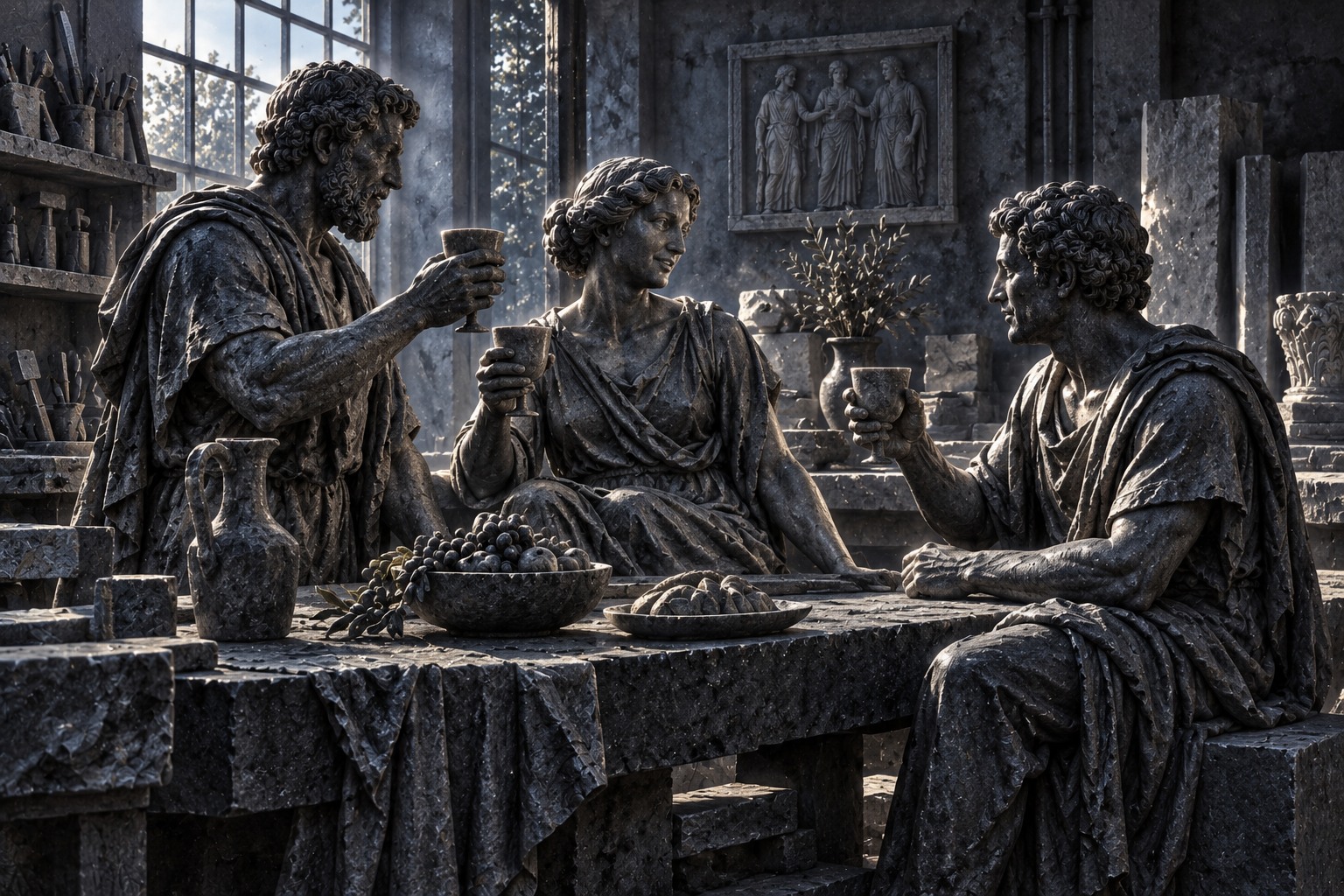
Imagine a small workshop where neighbours repair things together on Fridays. For its anniversary, participants decide to finish early and share a meal. Cups appear where tools normally lie; someone who rarely speaks brings an old photograph of the room. The change looks obvious, yet consists of several decisions: stop taking jobs at a particular hour, move the tools and make space for a gathering. No decision alone guarantees closeness. Together, however, they allow attention for which the ordinary timetable left no time. In this invented example, the festive quality comes less from a special object than from an agreed change in the use of a familiar place and the time assigned to it. The room has not become a different institution.
Some arrangements still hold. The exit must remain clear, another person's belongings cannot be used without permission, and the key holder still has responsibility for locking up. This need not spoil the evening's unusual character. Distinguishing what remains in force helps everyone understand the actual exception being offered. A working session can become dinner, but the promise to return a neighbour's lamp does not disappear with the tools. If a celebration begins with an undefined permission to do anything, participants must guess the limits. One person's temporary freedom can then become another person's unexpected burden. Ordinary agreements are not necessarily obstacles to celebration; some make it possible to enter the altered arrangement without having to surrender familiar protections.
Changing order therefore has a limited meaning here. It concerns neither the destruction of every norm nor a requirement that every festival overturn a hierarchy. For a few hours, people can sit differently, redistribute attention, slow a conversation or make room for play. What actually happens depends on the gathering's arrangements rather than its name. Quiet tea may alter the ordinary day more than an expensive event full of the usual authoritative speeches. Conversely, a familiar meal can matter precisely because its form is recognisable. This article does not rank these possibilities. It asks what the chosen change makes available, who can use that possibility, and what remains when the rearranged table becomes a workplace again.
II. Time that differs from the ordinary
At the opening of Laws II, Plato connects divinely appointed festivals with respite from work and education. This is a particular religious and civic argument, not a modern theory of the weekend. It raises a question about different kinds of time: if life is arranged in the same way throughout, how is a pause recognised? Our contemporary example supplies its own answer. The workshop changes its finishing time, puts away the list of urgent jobs and allows conversation to lead nowhere immediately. These choices prove neither Plato's account of the gods nor his conception of proper education. They show how this invented gathering marks another use of a few hours, without declaring work itself an inferior human activity.
Free hours cannot simply be announced. If the same jobs must be completed overnight, an early dinner may merely move the burden. If one participant cooks, clears up and answers work calls throughout, their pause exists mainly in the invitation. That is a reason to clarify the material arrangements, rather than an argument against celebrating. Which tasks are genuinely postponed, which are transferred by agreement, and which remain necessary? The use of time includes travel, preparation, care for people needing assistance and restoration of the room. Treating these parts as unsuitable subjects for a festive conversation makes the pause depend on unacknowledged work that everyone else preferred not to ask about beforehand. A changed timetable should be examined from more than one seat.
Nor must a pause justify itself through later productivity. Someone may want to spend an evening with others because the meeting matters now, rather than because they will work better tomorrow. This separates an occasion from a report of usefulness. An occasion helps explain why this particular time was chosen; a report demands evidence of a result. For our gathering, the anniversary and a wish to encounter familiar surroundings differently are sufficient. A new acquaintance, memory or idea might emerge, but their absence does not make the evening a failure. The temporary alteration can have value as time lived, without requiring every impression to be converted into an achievement, lesson or final statement about the person who attended.
III. Joining while keeping one's own manner
In Letter XVIII, Seneca considers conduct within a public festive custom. Its first four sections distinguish changed dress, daily habits and the possibility of participating differently from the surrounding crowd. His grounds are constancy and self-command, rather than our notion of free cultural choice. The distinction between ways of joining nevertheless helps with this article's question. A person can come to a shared table without repeating every action of those nearby. Their participation need not therefore be false or incomplete. Our contemporary editorial boundary is that outward resemblance should not become a test of inward loyalty. Dinner, clothes and conversation can remain shared signs of the occasion without certifying identical motives in everyone present or requiring a single approved emotional response.
For example, one workshop participant gladly brings a photograph but does not want to wear a suggested costume. Another enjoys a game yet prefers to leave before the group picture. A change of form should be distinguished from an enlargement of other people's permissions: unusual clothing authorises no unwanted touch, and an invitation does not establish consent to photography or circulation of an image. These are contemporary editorial boundaries, not ready-made rules extracted from Seneca's letter. They help show where an invitation remains open. When several ways of participating are acknowledged in advance, declining one detail need not be interpreted as rejection of the whole company. The special evening can accommodate a difference ordinarily obscured by hurry or habit.
Participation cannot always be divided into convenient pieces. A festival may have an integral religious form, and someone who does not accept its grounds need not perform agreement. Organisers can describe the gathering clearly; an invited person can decide whether it suits them. No wording of an invitation guarantees that every conflict will disappear. Sometimes a difference remains and requires separate decisions. A secular dinner can be agreed in our workshop; elsewhere, that may be impossible without changing the event itself. Respect for difference does not mean erasing this obstacle. It means avoiding the claim that one available way of participating is universally available, and declining to assign guilt to someone whose decision is different from the organiser's hope.
IV. A shared rhythm and different movements
In the selected opening of Plato's Laws, shared song and dance belong to an argument about education. Rhythm is more than decoration: it forms part of a particular account of the proper ordering of pleasure and pain. This cannot quietly become a promise that any coordinated movement unites people. Our workshop's shared rhythm has different grounds: tea is served, those interested look at photographs, and a small game begins later. The sequence helps participants understand what is happening without demanding the same action from everyone. The comparison concerns the form of shared time, rather than transferring Plato's image of an educated citizen to invited neighbours. This modern gathering permits one person to watch, another to join and a third to leave briefly.
A recognisable form can sometimes make an unfamiliar company easier to enter. Nobody has to invent a remark continuously or guess the right moment to speak: an object, some music or a sequence offers a shared reference. Yet that reference becomes an obstacle if only one manner of moving counts as correct. Someone who finds standing difficult should be able to participate seated, rather than receive a merely indulgent exception. Listening can be sufficient for someone who does not want to sing. These choices guarantee neither belonging nor a remedy for every inaccessible room. They alter the particular organisation of this gathering. An invitation differs from an examination when participants need not prove their suitability through a predetermined expressive performance.
A shared rhythm need not conceal pauses or awkwardness. The evening may slow down, a game may be confusing, or the music may not please everyone. If these occurrences are allowed to belong to the gathering, organisers need not urgently turn every minute into entertainment. They can explain a rule, offer another possibility or end an activity early. Sometimes the most significant change in the ordinary arrangement is permission not to speed up. People have time to look, listen and respond without the familiar measurement of efficiency. A beautiful schedule alone cannot establish that possibility. It becomes visible in the response to an unplanned pause and to someone whose movement does not match the original plan's tempo.
V. Who is named as a participant
Deuteronomy 16:11 and 16:14 name festival participants, including dependent and socially vulnerable people. These commands belong to a covenantal religious order with its own duties and differences of position. They do not say that every hierarchy is abolished during a festival. Another feature matters for this article: the company is named rather than left indefinite. Our contemporary editorial question is what everyone means in the workshop's invitation. It might refer only to regular participants, include neighbours who brought objects for repair, or remain unclear. Each choice has consequences. An organiser cannot first assume universal accessibility and then treat an unexpected guest as violating an arrangement that was never stated. The comparison asks about a named company without equating ancient and modern institutions.
Access involves more than opening a door. A free event can still require an expensive costume or gift; an invitation to everyone can begin when some people have nobody to look after their child. Organisers cannot remove every obstacle. They can avoid converting a limitation into a judgment about the person: absence proves neither indifference, lack of generosity nor unwillingness to belong. Sometimes another time, a short visit or removal of a compulsory contribution is possible. Sometimes it is more honest to acknowledge that a particular gathering is not accessible to everyone. That admission does not make the celebration pointless. It limits the organisers' claim to speak for the entire community and distinguishes an actual invitation from an attractive formula.
A temporary exchange of roles deserves particular care. If the usual leader serves tea for an evening, that may be a welcome change, but establishes neither equality nor a remedy for ordinary injustice by itself. A participant should not be assigned gratitude for an attractive gesture that left their circumstances unchanged. The gesture is not necessarily empty either: its meaning can be discussed without promising a complete transformation of relationships. In our example, it lies in a particular action here and now. Work and responsibility can still be discussed separately afterwards. The festive episode should not become a reason to close that conversation on the grounds that everyone has already sat at one table and smiled together.
VI. Someone works behind the changed form
The festive room seldom appears by itself. Our imagined workshop needs tools put away, food bought, chairs moved and information about suitable meals checked. If one person always does these things, the shared celebration can reproduce the ordinary arrangement under different lighting. The point is neither to identify a culprit nor to count every minute as a mutual debt. It is to understand what lets participants genuinely share the evening. Who agreed to prepare food, who has time, where is paid assistance necessary, and what need not be done at all? Removing elaborate decoration sometimes opens more possibilities than expanding the programme. The festive form can then respond to work instead of hiding it behind an impression of effortless ease.
Voluntary help differs from an obligation created because someone usually agrees. A person can enjoy cooking yet not want to cook this time. Bringing one dish need not mean taking charge of dinner. An agreement can therefore concern a particular action and period, rather than a general reputation for generosity. This is a contemporary organisational judgment in the article; Seneca, Plato and Deuteronomy do not prove its universality. It follows from our example: a changed working arrangement should not automatically turn another person's habitual willingness into an unlimited resource. If help is unavailable, organisers can change the plan. A decorative idea left unrealised need not mean that somebody failed to care enough about the company or its occasion.
Finishing the work also belongs to the festive agreement. Cleaning can be arranged beforehand, the room left usable for the following day, or some objects deliberately put away later. If one person remains with a room full of tasks after the guests leave, the exception has ended differently for different participants. This requires no perfect symmetry: capacities differ, and help can take different forms. The difference should nevertheless be explicit rather than explained away as the natural order. In the workshop, someone unable to carry chairs might confirm guest numbers beforehand; another might pay for delivery. The agreement can recognise particular possibilities without demanding that everyone prove participation through an identical amount of physical work at the evening's end.
VII. Enough without a competition
Letter XVIII moves from festive custom to training with sparse food and clothing. Seneca distinguishes a voluntary trial from daily compelled poverty. For contemporary discussion, that boundary matters more than an invitation to repeat the exercise. This article recommends neither deprivation of necessities nor the belief that a decision of the will removes material dependence. Its question is different: when do festive expenses stop serving the meeting and become a test of a participant's worth? If a gift must certify loyalty to a group, someone may feel obliged to spend money they do not have. A modest form solves no general financial difficulty, but can avoid increasing the burden for outward conformity. A spending limit can be stated without disclosing an entire personal history.
In Deuteronomy 16:17, the measure of the gift is related to ability and God's blessing. It belongs to a religious command, not contemporary consumer advice. The comparison can ask about proportion while retaining different grounds. Our workshop's conclusion remains editorial: a voluntary contribution should carry no hidden minimum price of respect. A small sum, a dish or attendance without a gift can be acknowledged in advance as possible choices. These choices should not be declared equally available to everyone: some lack cooking time, while others find a money contribution harder. The agreement matters because it removes a test invented for somebody else without knowledge of their actual possibilities. It does not convert the ancient command into optional secular etiquette.
Enough does not mean that beautiful decoration or a generous gift is suspect. Someone may choose them because they want to please others and have the means. The boundary appears when that choice becomes a norm for everyone else or a right to demand a reciprocal feeling. A recipient can appreciate attention without the expected delight; a group can accept a gift without changing its rules to suit the donor. These situations have different conditions, and the word modesty resolves none of them by itself. It is more useful to ask what was offered, what obligation arises and whether it was agreed. The celebration's size then cannot replace the question of its arrangements, and enjoyment need demonstrate neither wealth nor moral purity.
VIII. A festive day and a different feeling
A date can coordinate timetables without making feelings identical. One person looks forward to the anniversary, another remembers an absent participant, and a third is simply tired. Within the religious source, the command to rejoice has its own grounds; transferring it into a demand on every guest at a modern gathering would be a separate decision that this article does not make. Distinguishing a common form from a personal feeling prevents the invitation from becoming an emotional obligation. The room can remain festive while someone sits quietly by the window or leaves early. The question is not how successfully they portray the required state, but whether they can be present without that performance or a public explanation of its causes.
An organiser may feel disappointed when a hoped-for evening fails to produce the expected response. That feeling is not necessarily unfair or shameful, but confers no right to another person's happiness. They can discuss convenience, ask about future preferences or acknowledge that the plan did not suit someone. One restrained response does not establish ingratitude or lack of attachment. In our example, a participant values the workshop but dislikes group games; the refusal concerns a particular form. If affection for the group must be proved through every suggested ritual, the temporary exception becomes another system of compulsory behaviour. The celebration can then lose precisely the openness for which the day's arrangement was changed in the first place.
Permission not to participate matters especially when a gathering requires unsafe or unwanted contact. A festive occasion does not cancel the right to keep a distance; this article does not recommend returning to a harmful relationship for a group photograph or symbolic reconciliation. Someone can greet safe loved ones separately, choose another form or leave the date unmarked. These decisions need not become a new image of the ideal festival. They remain possibilities for a particular person in particular circumstances. No diagnosis is made from a response to celebration, and no relief from loss is promised. The discussion concerns the gathering's boundaries; a difficult situation owes us no example of the supposed benefits of changing an ordinary arrangement.
IX. Playing with roles does not cancel consequences
At a celebration, familiar roles can be used differently: a newcomer becomes the host, a serious conversation gives way to play, or a familiar rule takes an unexpected turn for a while. A temporary playful role does not change actual permissions. If participants agree that someone acts as a stern organiser, that is not consent to obey every command they invent. The game has content and limits that may be understood by only part of the company. Being able to stop matters more than assuming that everyone automatically understands a joke in a festive setting. Confusion need not prove excessive seriousness. Sometimes a person was never given the rule or did not accept a condition everyone else treated as obvious without checking.
A changed arrangement can reveal an acquaintance doing something new without disclosing their final essence. Someone who hosts a game cheerfully is not necessarily always sociable; today's quiet participant is not necessarily withdrawn. The temporary form shows an interaction under particular conditions. Turning it into a final account of the person restores the examination function from which we have tried to distinguish celebration. In the workshop, someone brings music once, and thanks for that music are enough. They need not be appointed permanent entertainer for the company. Otherwise, a welcome surprise becomes a lifetime assignment, and the opportunity to try something different disappears behind a demand to continue the image that happened to please others on one occasion.
Consequences can remain real even when an action is make-believe. A photograph circulates beyond the room, a harsh remark is remembered, and a damaged object needs repair. Festive excitement describes a circumstance without cancelling discussion of harm. An error can be acknowledged, an image removed where possible, damage repaired or an activity stopped. Not every consequence can be completely undone, and a request for forgiveness need not be accepted. For this article, the temporary rearrangement therefore needs to retain responsibility. That need not be solemn or moralising: it is enough not to use enjoyment as a universal release from consequences borne by somebody else. The limits protect the possibility of play rather than assigning every mistake a permanent identity.
X. When the exception ends
Festive time differs from the ordinary partly because it has a boundary. A likely departure time can be known, objects returned by agreement, and the gathering brought quietly to an end. Deuteronomy names a religious festival's duration and place; Seneca considers conduct within a particular custom. These different grounds supply no ready-made modern timetable, but help us avoid treating an exception as endless. If every attempt to leave is interpreted as betrayal of the company, the invitation has changed meaning. A person can finish the evening while others want to continue. A limit can be stated beforehand or discovered during the gathering. In either case, ending participation need not mean rejecting what happened or denying its significance for others.
The return to ordinary arrangements may be gentle, but is not always happy. A participant sees tools again, unfinished jobs and the following day's limits. The celebration need not transform that return into a new stage of life. Sometimes a particular memory remains; sometimes the evening reveals an inconvenience worth discussing separately. A liked detail can be retained, but the group owes no permanent repetition of the discovered form. Distinguishing a trace of the meeting from a demand to prolong it is useful. The workshop can keep a photograph on the wall by agreement while ending the unusual division of roles with dinner. A lasting change, if wanted, requires another discussion rather than an appeal to everyone's festive mood.
A festival can therefore be considered a bounded opportunity to use the familiar differently. Its significance lies less in scale, required happiness or a proven result than in particular arrangements of time, participation and care. Different primary texts raise these questions while retaining their different grounds; contemporary answers remain conditional and open to discussion. Someone may participate, decline, choose a small form or find no suitable option. No choice alone establishes a final attitude towards life. When the table is clear and the door closed, the gathering can remain a gathering: an actual occasion that need not become a remedy, a promise of a new society or a test of human worth. Its temporary character need not be a defect; sometimes it makes an altered few hours possible.
What this means in practice
If you want to consider an ordinary gathering of your own, first identify one change: what will differ this time in timing, space or manner of participation? Then distinguish the conditions that remain: whose belongings and promises are protected, who needs a free exit, and which action requires separate consent? No large celebration or account of your entire biography is needed. One particular example suited to present circumstances is enough.
The next question concerns resources. Who prepares the gathering, how much time does it actually take, and which expenses are voluntary? The plan can be reduced, several ways of participating offered, or a limitation stated honestly. Every obstacle need not be removed; what matters is avoiding the assignment of duties on the basis of somebody else's unknown possibilities. Declining a detail, attending briefly or being absent should not serve as evidence of ingratitude.
Finally, identify the ending: when people can leave, who restores the space, and which decisions require fresh agreement after the celebration. This is voluntary consideration, not an exercise to complete. It requires neither happiness, reconciliation, unsafe contact nor a promise of growth. If celebrating is unwanted or impossible now, the absence of a suitable form can remain a sufficient answer.
Key quotation
Every man shall give as he is able,
Deuteronomy 16:17, opening clause; King James Version. The remainder relates the gift to the Lord’s blessing.
Connections between traditions
1. Separate time and its grounds. In Plato's Laws II, carrier 1987–1988, respite and festivals belong to divinely appointed education; Deuteronomy 16:13–15 names seven days and a religious occasion. The compared concepts are alternation and duration. A temporal boundary makes another use of the day recognisable: our workshop can name its pause and return beforehand. Yet Platonic education and covenantal command are not a single doctrine of calendars. The comparison proves neither that every day off educates, that the ancient festival is voluntary, nor that a contemporary gathering needs religious grounds.
2. Manner of attendance and named company. Seneca XVIII.2–4 distinguishes ordinary forms and ways of joining a custom; Deuteronomy 16:11,14 explicitly names the festive company. The concepts are manner of participation and a definite invitation. The article asks both who is invited and what is offered: sharing a table need not require identical actions from every guest. This is a contemporary editorial possibility, not a common ancient thesis. Stoic self-command differs from religious duty. Deuteronomy does not abolish social position, and Seneca's letter establishes neither a universal right to decline nor a modern agreement about consent.
3. Visible form and the object of judgment. Laws II, 1990–1998 and 2009–2013, relates chorus to rhythm and distinguishes skill from proper orientation; Seneca XVIII.4 distinguishes outward custom from the measure of one's action. The concepts are form and its criterion of judgment. The mechanism here is that an identical gesture does not disclose why someone participates or what is possible for them. Platonic civic education and Senecan personal constancy nevertheless have different goals. This proves neither that singing makes a society good, that a guest's unspoken motives are known, nor that the article endorses compulsory testing of character.
4. Means and measure. Seneca XVIII.7–8 distinguishes voluntarily sparse food from compelled deprivation; Deuteronomy 16:17 connects a gift with ability and blessing. The concepts are a chosen trial and a proportionate offering. The contemporary mechanism is to discuss expenses and preparation in relation to actual possibilities, without pricing membership through gifts. Yet a Stoic exercise is not the same as a covenantal duty or a compulsory budget model. The comparison promises no escape from poverty, recommends no deprivation of necessities, and does not turn blessing into a universal financial formula.
5. Remembered dependence and a chosen trial. Deuteronomy 16:12 retains memory of Egyptian bondage; Seneca XVIII.5–8 addresses a voluntary trial while explicitly distinguishing those who live with deprivation continually. The concepts are memory of unfreedom and chosen training. Their difference helps the article avoid treating another person's need as festive decoration: temporarily changing one's own arrangements does not authorise control over another life. This inference is editorial. Religious memory is not reducible to a personal exercise, and an exercise certifies no knowledge of an enslaved person's experience. Neither equivalence between these positions nor a need to reproduce deprivation is asserted.
6. Festivity and an order that remains. In Laws II, 1984–1988 and 2009–2013, festive form remains within a particular moral education; in Deuteronomy 16:10–17, rejoicing has religious duties and temporal limits. The compared concepts are an unusual form and a retained normative ground. An exception can be marked without cancelling responsibility: our workshop keeps agreed protections for belongings, promises and leaving a game. The modern boundaries are not attributed to the sources. They prove no ancient agreement with contemporary pluralism, establish no compulsory happiness and grant a festival no right to erase the consequences of harm.
Primary sources
-
Seneca, Letter XVIII. The complete selected letter, sections 1–15 and displayed notes, was read; Richard M. Gummere translation. The epigraph is XVIII.4's final sentence. The later sparse-food exercise remains a Stoic ground, not a prescribed modern practice.
-
Plato, Laws II. The continuous selected opening, carrier 1977–2013, was read; Benjamin Jowett. Religious civic education and normative evaluation of rhythm remain distinct; no whole-dialogue or Greek reading is claimed.
-
Deuteronomy 16:9–17, KJV. All nine selected verses were read. The key quotation is 16:17's opening clause; its blessing context is retained. Religious obligation is not presented as secular voluntariness.
Both Russian quotations are United Wisdom's own translations from the identified English editions; literal English fragments were checked against Gummere and KJV. The modern workshop is invented, while voluntariness, accessibility, work and responsibility are identified editorial comparisons.
Tags
festival, temporariness, order, cultural experience, participation, calendar, respite, time, space, shared table, rhythm, play, roles, Seneca, Plato, Deuteronomy, Stoicism, religious memory, different traditions, voluntariness, consent, accessibility, invisible work, expenses, gift, enough, boundaries, responsibility, ending a gathering, everyday life
About the authors
Andrey Zarinsh is the author and founder of United Wisdom. He explores inner transformation, the unity of traditions, intercultural dialogue, and contemporary spiritual discipline. Instagram: @andrey.zarinsh.
Maria Evilkut is a co-author of United Wisdom. Alongside her research, she seeks to test these ideas in practice and observe how principles of unity and mutual understanding work in real life between people and cultures. Instagram: @ilkutki.
Keep what resonates with you.