
Meaning & path
Dance as a way of being present in your own body
Dance, attention to movement, and chosen form: learning, partners, an outside view, and the possibility of finishing.
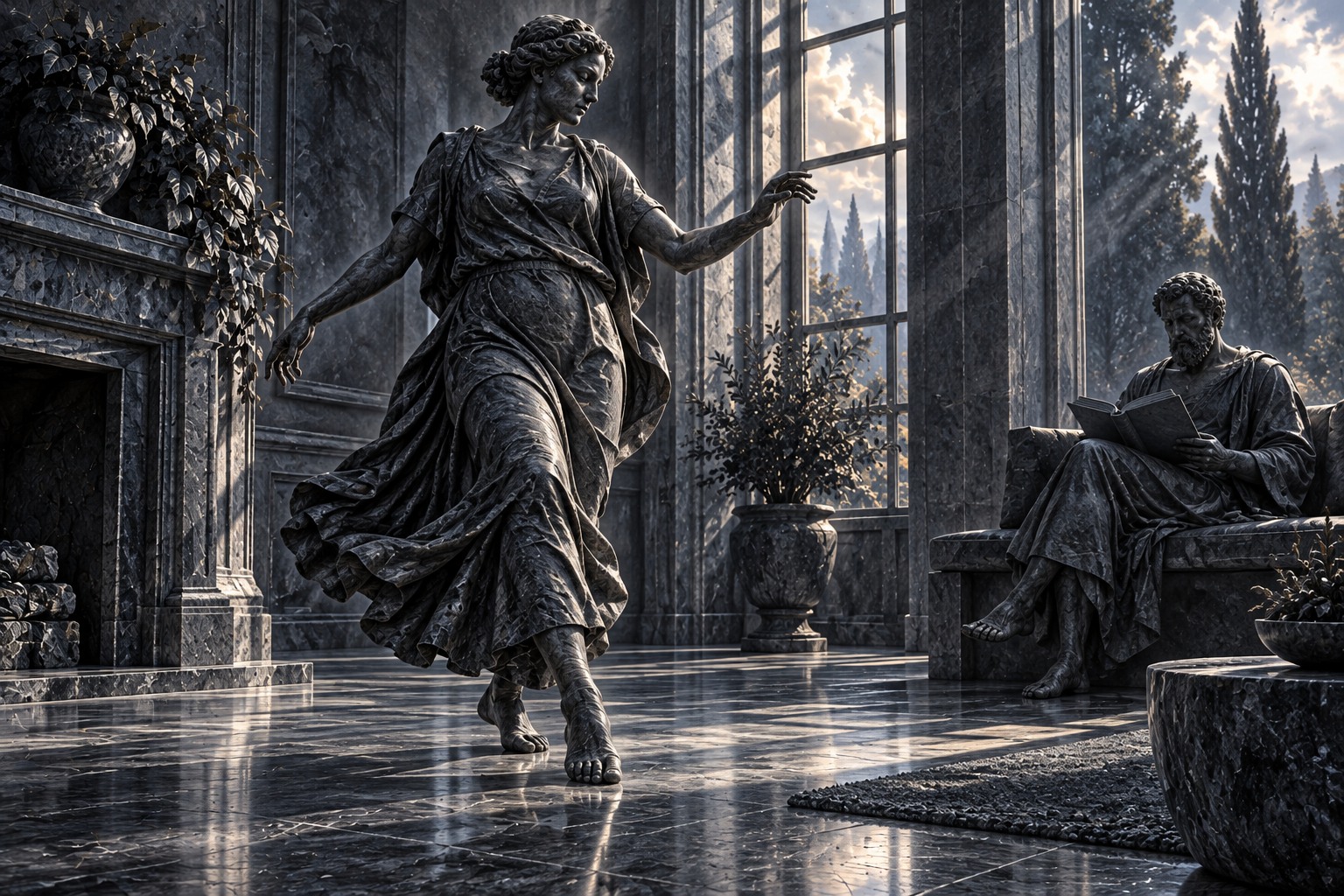
Epigraph
harmony and rhythm
Plato, Laws, Book II, opening educational discussion, Benjamin Jowett; short exact fragment. The normative educational purpose becomes no contemporary technique of unrestricted movement.
What this article is about
Dance can offer a way to notice yourself in motion: how you enter a chosen rhythm, what pattern you repeat, where you change it, and when you prefer to stop. You need not look uninhibited, forget everything else, or discover a profound cause behind every gesture. This article treats presence as attention to a particular kind of participation available now. Plato's discussion of education through the chorus, Buddhist discernment of bodily posture, and a biblical scene of dancing before the Lord raise different questions; their purposes do not combine into one technique. The practical task is modest: choose an intelligible form of movement, distinguish your attention from outside judgment, agree on participation alongside others, and let the dance end without a compulsory story of transformation.
I. Presence begins with a particular action
Someone turns on music and shifts their weight from one foot to the other several times. They may call this dancing, warming up, or simply moving to music. The label does not make the action more or less real. Another distinction matters: are they noticing what they do, or mainly considering what identity to claim afterward? Presence in one's body here means an available account of current participation: I move this way, hear this rhythm, and choose whether to continue or change. It neither measures the depth of a personality nor promises an exceptional state.
This account helps distinguish participation from an ideal of total immersion. You can dance while remembering that guests will arrive soon, noticing a door, or attending to the space beside a partner. These conditions belong to the situation; they need not destroy it. Requiring yourself to forget everything else turns attention into another examination. A more precise question replaces 'Am I present enough?': what needs my attention now, and what movement am I actually choosing under these circumstances? The question concerns this occasion rather than a permanent standard for inner life.
Participation need not be expansive or conspicuous. One person follows familiar steps, another moves their arms while seated, and another marks a rhythm with a small turn. Their actions differ in form. Their range of movement does not rank their inner freedom. This article neither prescribes exertion nor evaluates bodily capacity. A person chooses an available form; the substantive question concerns their relation to that choice. Can I notice the action, change it, and stop without having to earn the right to take part through an impressive performance?
Consider an evening at home: one person wants to move for a while; another keeps reading. The first need not turn movement into a show, and the second need not certify its importance. They can agree on music and space so that different activities coexist. This ordinary example shows why presence has conditions. Attention to yourself does not cancel attention to the room, time, or other people. It becomes more specific when you know what space is available and what response you can reasonably expect from those around you.
II. A learned pattern can also be living participation
At the beginning of Book II of Plato's Laws, in Benjamin Jowett's translation, education is discussed through pleasure, habit, and the chorus, which combines dance and song. The conversation has its own political and moral purpose: desirable forms depend on an account of good education. It does not endorse the modern slogan that any movement expresses freedom. For our subject, the text permits a limited question: what can a person notice and learn when movement already has a shared pattern?
Sometimes genuine presence seems possible only through improvisation. Repeating another person's step then appears to mean losing yourself. Yet a learner can attend closely to a sequence, distinguish the beginning and end of a turn, understand a mistake, and try again. This is a definite form of participation. It does not become insincere because someone else devised the pattern. Freedom may lie in agreeing to learn this particular form, choosing a suitable learning pace, and being able to ask questions about what remains unclear.
A pattern also has requirements. If someone came to learn a particular dance, a teacher can explain how their performance differs from the example. It helps to identify the subject of the comment: the direction of a step, the sequence, or coordination between partners. A comment about form establishes no general conclusion about a person's worth, character, or capacity for joy. Useful feedback stays connected to an action that can be shown and discussed. Saying someone is 'too closed off,' without explaining the particular task, provides no comparable clarity.
Improvisation has conditions too: music, the size of a room, habitual gestures, or a chosen restriction may shape it. The opposition between 'someone else's scheme' and 'my authentic self' is therefore too crude. You can repeat a sequence with interest or improvise to obtain expected praise. The practical distinction concerns your relation to the action. Do I understand what I agreed to, what I am trying, and how I can change my participation? Plato's educational question helps us consider form; it establishes no compulsory educational system for the reader.
Repetition can be assessed within the lesson. If a sequence is not yet remembered, that tells us about a current learning task, rather than proving an inability to pay attention. A teacher can demonstrate one part, explain it differently, or identify the element raising a question. A learner can decide whether this format suits them. Neither persistence at any cost nor immediate withdrawal becomes a universal rule. Keeping the subject clear matters more: what are we learning, and what assistance actually addresses this action?
III. Notice posture without demanding a hidden explanation
In MN 10, the Satipatthana Sutta, Thanissaro Bhikkhu's English version on Access to Insight distinguishes walking, standing, sitting, and lying down in its posture section; the following section concerns alertness in actions. The text's overall purpose belongs to the Buddhist path of liberation. It is neither a dance manual nor a study of dancing's effects. Only a cautious comparison is appropriate here: notice bodily position and the action taking place before assigning them a large inner meaning.
In dance, this can be quite ordinary. Someone notices that they mainly watch other participants, although they wanted to follow their own step. They need not conclude that they fear life or have lost contact with themselves. Start with a description: I seek an example because I do not yet know the sequence. That description leaves room to learn. It is more precise than treating each placement of the hands as immediate evidence of a hidden prohibition, an old trauma, or a particular personality type.
Sometimes movement brings a memory or feeling that a person considers significant. They can acknowledge it as their own experience: this gesture reminds me of a particular evening now. The gesture itself, however, does not authenticate the history someone wants to construct around it. An association remains different from a verified event. There is no duty to search for forgotten material, decipher the body, or ask another participant what their movement 'really means.' Describing movement and recounting a memory can coexist without replacing each other.
Attention can shift. At one moment the sequence matters, at another the distance from a neighbor, and then your wish to pause. Nobody must sustain identical concentration throughout the music. You can notice where attention went and decide what is appropriate now. The Buddhist text helps distinguish an observable action from an added explanation only within this comparison. Its religious purpose, other exercises, and promises concerning the path have not been transferred to a few minutes of dancing at home.
IV. Dance can address something beyond personal impressions
In Second Samuel 6:12–23, David dances before the Lord as the ark is brought in; Michal watches and later disputes his conduct. The whole scene was read in the King James Version, including sacrifices, blessing, the return home, and its last statement about Michal. This dance has a religious and public address. It is not presented as an exercise for feeling better. The episode therefore cannot prove that any movement liberates a person or makes outside judgment irrelevant.
The scene allows a distinction between an inner impression and the subject of participation. Someone may dance for a celebration, a performance, prayer within their tradition, or the continuation of a shared pattern. Their attention need not center exclusively on how they feel. Presence also includes a relation to what the action serves. In contemporary life, ask what this particular dance addresses: am I learning, playing, performing, marking an event, or participating in a rite I know? The answer specifies requirements better than a general promise to 'open up through the body.'
David and Michal's dispute supplies no simple rule for every couple. Readers can notice their differing judgments without casting each contemporary critic as one of those characters. The final statement about Michal's childlessness likewise becomes neither a medical explanation nor a rule for punishing women. Those conclusions would exceed our subject and the scene read. This substantive boundary matters: a religious narrative retains its own circumstances instead of becoming a ready distribution of right and wrong among participants in an ordinary disagreement.
If someone chooses a dance belonging to a particular culture or religious practice, it is reasonable to learn its purpose from people who actually transmit it. A name, costume, or isolated gesture does not explain the context. Moving to music ordinarily also requires no claim to be performing a rite. You can name your own activity honestly without attributing an imported sacred power to it. Respect for a form begins with a distinction: what am I learning, from whom, and what meaning can I reasonably report about my participation?
V. An outside view can coexist with your attention
A mirror, audience, or camera changes the conditions of dance. Someone may watch the pattern of their movement to prepare a performance or simply to see what happened. This need not obstruct presence. The question is what place the outside view receives. When it serves a definite task, that task can be named and the result discussed. When every movement is checked for whether the person deserves approval, the task becomes different: obtaining confirmation of personal acceptability. Distinguish these purposes without condemning the wish to look good.
For example, someone rehearses a short passage before a mirror. They notice that a turn begins before the music and adjust the sequence. That is specific work. But if every attempt ends with the question of whether they look ridiculous altogether, the answer to the technical task disappears. Return the conversation to the chosen action: which passage are we examining, what does it require, and how will we decide that we can move on? The question does not require awkwardness to disappear completely before useful work becomes possible.
Awkwardness alone proves neither that dance is unsuitable nor that the person must undergo a public trial to overcome it. They can prefer another place, fewer spectators, a familiar sequence, or participation without performance. Changing conditions serves the possibility of doing the chosen activity, rather than acquiring universal confidence. Nobody should promise that a few songs will end another person's embarrassment. Offer an intelligible form of participation and accept their answer, including a refusal, without turning it into a judgment about their willingness to live.
Recording deserves a separate decision. Agreeing to move during a lesson does not communicate a wish to appear in someone else's video collection. This concerns voluntary agreement rather than legal analysis. Before recording, people can specify its purpose, viewers, and intended use; changed conditions call for another conversation. The outside view then becomes an identifiable circumstance. A person can decide what participation they want instead of discovering afterward that their movement has become part of somebody else's public narrative about the occasion.
VI. Presence alongside others includes coordination
In partner dance, your attention relates to another person's actions. You need to understand the chosen pattern, your partner's position, and the contacts agreed on. Inspiration does not replace that understanding. Even familiar partners may prefer a different pace, less proximity, or another mode of interaction this time. Past experience gives them a shared history, not a completed answer to today's invitation. Participation becomes clearer when its conditions can be named in ordinary words before anyone has to guess them through movement.
Contact need not be explained away by the leader's intention. If someone does not want a particular touch, changing the form or stopping helps more than proving they misread friendliness. This decision concerns a specific interaction; it requires neither a diagnosis of mistrust nor a general judgment of the relationship. Partners can agree on another pattern, dance alongside one another without contact, or finish. Presence in your own body includes communicating a choice; attention to another person includes accepting theirs without publicly examining its causes.
A group has a similar distinction between a shared pattern and identical experience. People can perform one sequence and relate differently to the occasion. One is interested in learning, another enjoys familiar company, and another simply accepted an invitation. Nobody needs to obtain one account of unity from everyone. Understand the shared task and allow impressions to differ. If movement requires definite coordination, discuss it specifically. A coordinated step establishes no identical faith, closeness, or willingness to continue a relationship outside the activity.
There is also ordinary attention to space. A place suitable for one movement may be occupied by a participant or an object; a shared evening has limits of time and sound. These conditions do not make dance less real. They help people choose a form that exists here, rather than in an imagined empty room. An organizer can explain where the activity occurs, what sequence is planned, and how to leave the circle. Participants then need not prove serious intent by tolerating conditions they do not understand.
Roles also have limits. The usual leader need not lead every meeting, and a beginner need not always follow. If the form allows a change, discuss it beforehand; if it does not, knowing that helps when choosing an activity. The distribution of roles does not describe these people's relationship in every other circumstance. Who sets the pattern now, who accepts the invitation, and when does the agreement end? These separate questions make participation clearer without turning a few steps into an unspoken agreement about an entire shared life.
VII. A pause belongs to the action rather than cancelling it
The music continues while someone stops moving. This may be an ordinary change of participation: they want to watch, consider a sequence, make room, or finish. The pause alone supplies no cause. Do not immediately label it resistance, loss of bodily contact, or insufficient courage. Presence may consist precisely in a clear decision to stop. If leaving a pair needs coordination, the person communicates it. If they were dancing alone, recognizing their own choice suffices without an obligation to explain themselves to an imaginary observer.
A pause can also mark the boundary between tasks. During a lesson, it permits a question about form; at a celebration, a conversation; at home, finishing a passage and returning to an ordinary activity. Every ending need not have the same ceremony. You can select a short musical passage beforehand and then decide whether you want more. This establishes neither a prescribed duration nor a promised effect within a time limit. It simply gives an intelligible scope to an action that need not be prolonged to prove its value.
Pain or substantial discomfort should not be treated as compulsory material to interpret and overcome through dance. This article offers neither treatment nor a rule for exertion. It does not settle medical questions from an account of movement. Its practical task only requires that continuation should not become a moral duty: someone can end the chosen activity. People inviting others should avoid promising that an unpleasant sensation proves proper unfolding, or suggesting that refusal deprives someone of an indispensable experience they owe themselves.
Sometimes a person returns after a pause; sometimes they do not. Neither option alone determines whether the occasion succeeded. Assess what actually occurred: understanding a sequence, agreeing on participation, or trying a familiar movement in another rhythm. These are limited results, not stages of compulsory transformation. If dance leaves a question, keep it if you wish. If nothing exceptional remains, no hidden meaning needs invention. Participation was a finite action; a lengthy inner afterword is not required to certify that it happened.
VIII. The meaning of experience remains open to clarification
After dancing, someone may say, 'Moving among other people felt easier today.' This is a substantive observation about a particular evening. It differs from concluding that all difficult conversations will now be easy. Transferring an experience into another area requires a separate basis. Dance does not decide questions about work, relationships, or group membership for anyone. It may provide an example of choosing a form and communicating participation, but that example guarantees no repetition under different circumstances. Its scope can remain clear without making it insignificant.
Someone else notices that favorite music did not produce the expected joy. Here too, leave several possibilities open: the evening differed, the form did not suit them, attention concerned another task, or the expectation was overly specific. Do not assign one profound cause from the absence of a desired feeling. Describe what was chosen and what the person wanted to change. Such an account preserves the right to try again or choose another activity, without declaring dance a universal route back to oneself.
Meaning may concern a movement's culture. Learning one sequence means discovering something about its form, but need not make you a bearer of the community's entire experience. Value the knowledge and name its limits honestly. This matters particularly when describing participation to others: what were you actually taught, what context was explained, and what did you add as a personal association? Distinguishing them does not impoverish the experience. It allows discussion without appropriating another history or making a teacher represent everyone within that tradition.
If you want to keep an impression, choose a small means: note the movement's name, record an interesting question, or agree on another lesson. Such a trace differs from the duty to formulate a new life position immediately. Keeping nothing is also possible. Dance does not lose meaning because there is no written account or publication. Continuing is a decision about its own subject: do I want to learn this form further, meet these people, or move to this music? Each answer has its own scope.
IX. Returning to ordinary life completes the form
Ordinary tasks remain after dance: putting objects away, turning off music, answering a message, or going home. This does not mean a decline from an achieved level of presence. The action occurred within life and ends there. Do not oppose a few minutes of movement to the rest of the day as its only authentic time. That opposition invites devaluing activities in which someone acts differently. You can be present in a chosen dance and in the next conversation; forms of attention differ without competing for the right to be called life.
For continuation, a specific agreement matters more than the intensity of a final impression. A learner can confirm the next lesson, partners can choose a convenient format, and hosts can decide whether to repeat the evening. If no shared wish exists, participation already completed is not cancelled. Previous agreement creates no duty to attend forever. Finitude protects the substance of an occasion: people met for a definite action and can assess it without proving eternal closeness or preserving the same state until the next meeting.
The three lines read leave different questions. Plato's conversation concerns education and judgment of form; the Buddhist text, observation within liberation's path; the biblical episode, a religious event and a dispute about it. None certifies contemporary bodily presence. Their difference encourages care: not every observation is liberation, not all learning endorses a political ideal, and not every festive movement is a rite. The contemporary practical task remains our own comparison, open to discussion, rather than a hidden common doctrine attributed to the sources.
Dance as a way of being present in your body can therefore be understood through several clear relations: chosen movement, attention to what occurs, coordination alongside others, and the possibility of finishing. You need not look a particular way or feel what somebody else's account promises. Distinguish an action from its explanation, notice your choice, and avoid presenting a limited experience as final self-knowledge. Dance then remains a person's particular activity: expressive, learned, simple, or festive, within the scope they actually chose.
Continuation may become a habit, but a habit need not demand daily proof. A missed evening alone neither destroys a learned form nor exposes secretly unserious intentions. Someone can consider time, place, and other activities when choosing to return. A finite agreement is more precise than promising never to lose contact with yourself. It allows you to pursue an interest without turning every morning into a test of an achieved state, or comparing days by the brightness of their experiences.
What this means in practice
Choose a familiar, available form of movement: a short passage from a learned dance or ordinary movement to music. Name the task in your own words: repeat a sequence, try a different pattern, or join an occasion. Set no compulsory feeling that must occur. Do not use this practice to assess health or hidden causes of experience.
Describe one observable action without interpreting character: where your gaze goes, which step repeats, or where your hands change position. Then name your impression separately, if there is one. An association may matter, but alone it confirms no past event and requires no search for secret material.
If other people are nearby, clarify space, contact, and the possibility of finishing. Recording and later viewing call for a separate intelligible conversation about voluntary participation. You can change the form, pause, listen, or decline. None of these decisions must be accompanied by a defense of personal worth.
After the chosen passage, decide what you actually want to continue: movement, learning, meeting, or none of them. One particular observation about the action suffices. Return to the next ordinary activity. An ending requires no story of transformation and does not cancel what occurred.
Key quotation
however his body is disposed
MN 10, Satipatthana Sutta, A.2, Thanissaro Bhikkhu, displayed Access to Insight version; short exact clause. Discernment of posture belongs to the Buddhist path rather than a promise about dance.
Connections between traditions
| Line | Source | Subject and comparison boundary |
|---|---|---|
| Learning a form | Plato, Laws II, Jowett | Education and normative judgment of the chorus; no modern freedom of all movement. |
| Discernment of posture | MN 10, A.2–3, Thanissaro | Observation within liberation's path; no dance exercise or treatment. |
| Religious address | 2 Samuel 6:12–23, KJV | Ark, Lord, and dispute; no ready vindication of every dancer. |
| Participation alongside others | Original partner and group examples | Agreement on form and contact has scope; past experience is not today's invitation. |
| Ending and meaning | Original lesson and evening examples | Limited experience supplies no final self-diagnosis or duty to continue. |
Primary sources
-
Plato, Laws, Book II, opening discussion of education, habit, pleasure, and the chorus. Benjamin Jowett, Internet Classics Archive. The opening context through the question of a poet's freedom to choose forms was actually read; the page names the translator. The displayed edition's exact year was not established. The epigraph is a short exact fragment, translated into RU by UW. The political and moral purpose remains distinct. https://classics.mit.edu/Plato/laws.2.ii.html
-
MN 10, Satipatthana Sutta: Frames of Reference, A.2–3. Thanissaro Bhikkhu, Access to Insight, displayed revision 30 November 2013. Postures, actions, and the religious introduction were read. Header date 2008 and footer date 1995 differ; no unified year was invented. The key is a short clause from A.2, translated into RU by UW. Other exercises and outcome timeframes are not transferred to dance. https://accesstoinsight.org/tipitaka/mn/mn.010.than.html
-
Second Samuel 6:12–23. King James Version, Bible Gateway. All twelve verses and version identification were actually read. Dancing before the Lord, the ark's arrival, and the dispute retain their own context. The final statement about Michal becomes neither medical causation nor a punitive rule. https://www.biblegateway.com/passage/?search=2%20Samuel%206%3A12-23&version=KJV
Tags
dance, body, presence, attention, movement, rhythm, form, learning, repetition, improvisation, posture, action, observation, interpretation, memory, association, partner, group, consent, contact, pause, ending, mirror, recording, performance, Plato, Laws, Buddhist tradition, David, Michal, biblical tradition, culture
About the authors
Andrey Zarinsh is the author and founder of United Wisdom. He explores inner transformation, the unity of traditions, intercultural dialogue, and contemporary spiritual discipline. Instagram: @andrey.zarinsh.
Maria Evilkut is a co-author of United Wisdom. Alongside her research, she seeks to test these ideas in practice and observe how principles of unity and mutual understanding work in real life between people and cultures. Instagram: @ilkutki.
Keep what resonates with you.