
Meaning & path
Silence after music: what remains of experience
Silence after music: sounding's end, memory's trace, and a separate next choice without a compulsory report.
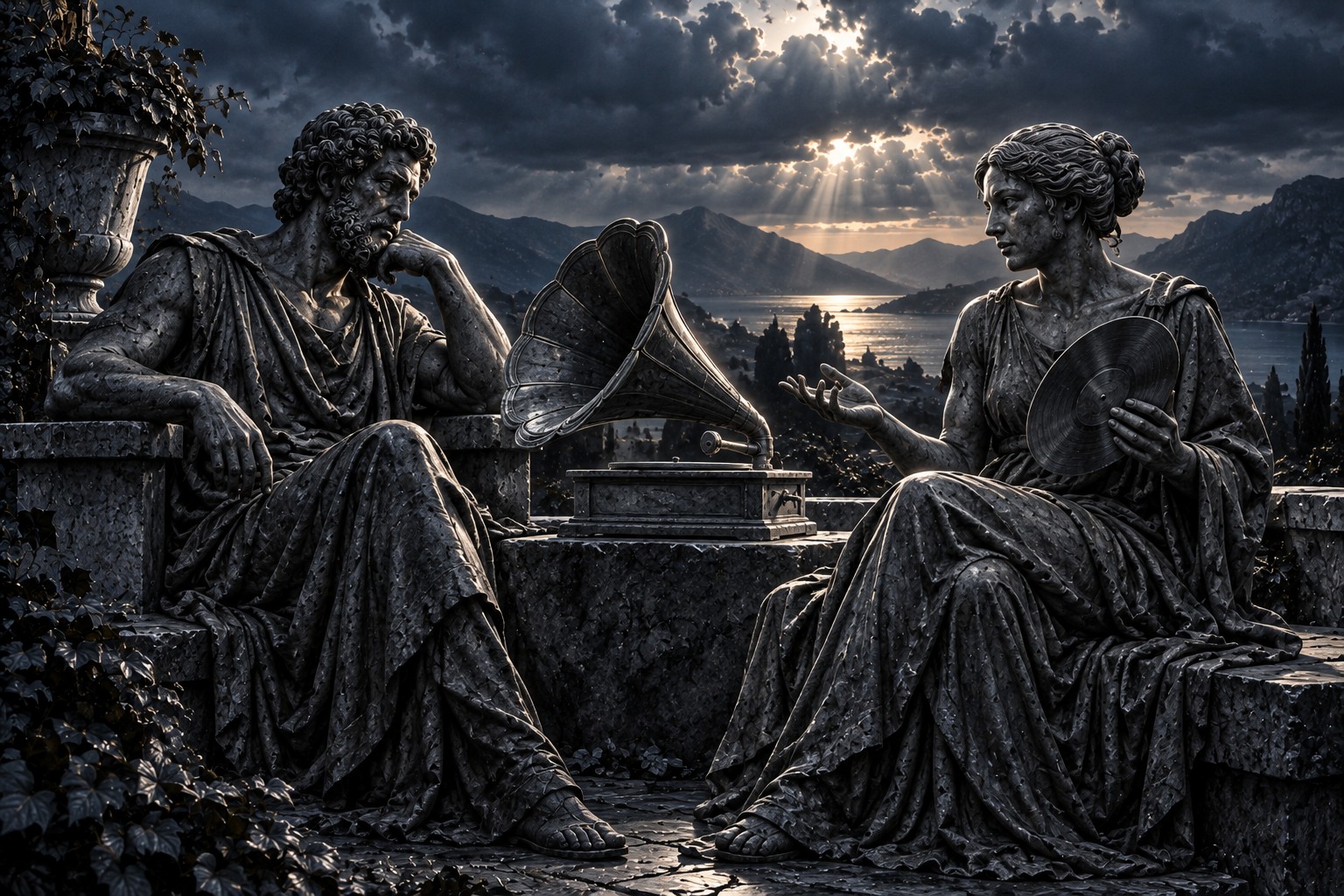
Epigraph
and thus on to the conclusion.
Analects III.23 in James Legge's numbered edition; short exact closing clause. The subject is musical performance's course rather than compulsory silence by a listener.
What this article is about
When music ends, you can choose another recording, speak, remain without music for a while, or turn to an ordinary activity. None of these responses alone measures the depth of experience. Silence after music matters as a boundary: sounding has ended, while memory, impressions, and the wish to continue may follow other timescales. This article distinguishes them without requiring a pause to produce exceptional self-knowledge. Augustine considers time through voice, memory, and expectation; Confucius discusses musical form proceeding toward its conclusion; a biblical call to stillness addresses God within a particular context. Their different subjects help specify a contemporary question: what actually remains from listening, and what next action do I choose now?
I. The end of sounding is a definite boundary
Someone listens to a piece at home. Its last passage ends, the player does not advance, and ordinary room sounds become audible. Music has ended even though the mood has not changed and a motif comes to mind. There is no contradiction: the sounding event and your relation to it have different boundaries. First name what actually finished. Then the recording need not remain on endless repeat to prove the impression was real, nor must an impression be considered gone at the first ordinary sound.
In this article, 'silence' primarily means that the chosen music is no longer continuing, rather than absolute soundlessness. Equipment may operate in the room, people may pass outside, and family may talk nearby. These conditions do not make an ending fail. Demanding an ideal absence of sound replaces the specific possibility of stopping listening with a condition that is not always available. Notice a change in this place: the selected musical sequence no longer directs attention's course, and another way of participating in the situation becomes possible.
Sometimes a pause already belongs to a piece. A performer or listener expects continuation after a short interruption; calling the action finished would then be premature. Elsewhere a recording really has ended, but the person chooses to remain without new music. These situations differ in subject: hearing a pause within a form and choosing how to spend time afterward. An ordinary decision requires understanding what happens now. Every interval need not harbor exceptional spiritual depth, and every ending need not become an exercise with a compulsory duration.
Suppose two people heard an album together. One considers its last track the evening's end; the other wants another recording. Naming their wishes clarifies the difference better than debating who heard music correctly. The first may want time without a recording; the second, more music. Their impressions need not match. Discuss the next particular step, available time, and the room's shared sound. The pause itself grants neither participant exclusive authority to determine the occasion's meaning for the other.
II. Remembering sound is different from sound continuing
In Confessions XI.27–28, Augustine, translated by J. G. Pilkington, discusses a voice that sounds and stops, the remaining impression, and the performance of a familiar psalm. Expectation of what has not been performed, attention to the current action, and memory of what passed help him consider time. This is philosophical reflection addressed to God, rather than a contemporary theory of the brain. A limited distinction matters here: after sounding ends, someone can attend to what remains in memory without treating that trace as the event itself continuing.
A motif may be remembered clearly; another person retains only an impression of a transition or a general sense of completion. These accounts should not rank listeners by correctness. Assessing performance requires musical grounds; describing your impression requires naming its subject honestly. 'I remember the last notes' differs from 'What stayed with me was how unexpected the ending felt.' In either case, you describe what is available now. You need not display precise memory to prove that you took a work seriously or deserve to discuss it.
Augustine's use of memory in his reflection on time promises readers no unchanging preservation of every experience. A short quotation about a fixed trace therefore supplies no universal guarantee of recollection's accuracy. Distinguish what you can actually reproduce, what you describe approximately, and what you learned later from someone else's account. A review read afterward can offer language for a question. Its wording need not become your own account of the original auditory impression. Naming the source of such an account keeps the distinction clear.
Another distinction concerns expectation. When familiar music ends, someone may mentally anticipate its usual beginning again. They know that the recording can be restarted. Yet the possibility of repeating a piece does not mean the previous moment remains unfinished. Another hearing will be a new action under today's conditions. This does not devalue recognition. Expectation of what follows, memory of what passed, and the choice of another recording need not merge into one endless process supposedly required to preserve the initial feeling without change.
Sometimes memory concerns the overall form; sometimes one episode, such as an instrument's entry, a performer, or an unexpected ending. These parts need not immediately assemble into a full reconstruction. Name the limit of your account: I remember this moment but cannot yet describe the rest of the sequence. Admitting that limit does not empty the experience. It separates an available trace from demands that arose afterward. If musical discussion requires precision, return to the recording. An account of personal impressions can allow incompleteness.
III. Completion can belong to the musical form
In Analects III.23, in James Legge's numbered edition, Confucius addresses Lu's chief musician and describes a beginning, the coordinated course of distinguishable parts, and movement toward a conclusion. The whole saying was read, rather than an isolated word about harmony. Its subject is musical performance. It supplies no rule that every listener must be silent after the final note. It does, however, help raise another question: what completion belongs to the form itself before we assign a personal meaning to the pause afterward?
Someone may hear an ending as prepared, unexpected, open, or solemn. This remains their description, which further acquaintance with the piece can clarify. Do not confuse a musical characteristic with a verdict on your condition. An open ending need not signify an unfinished listener's life; a clear conclusion need not resolve that person's questions. Music has a course discussable through its own material. A personal association can also matter if it is called an association rather than replacing an account of what was actually performed.
In conversation after a concert, one participant notices that the final passage returned to the opening theme; another mentions calm. These answers concern different subjects and need not conflict. One describes the performance's structure, the other a personal impression. Ask further about either without making someone prove a feeling through technical terminology or replacing a musical observation with an emotional slogan. The difference preserves both interest in form and a person's response, without requiring everyone to share the same vocabulary before a useful conversation can occur.
Distinguish the end of a work from the end of your chosen listening. A recording may contain several movements, of which you chose one today; a concert may continue after an interval. Stopping does not rewrite the music's structure. Say where your participation ended and what remained unheard. The pause following a selected passage then need not be presented as the entire work's natural finale. An honest account of listening's scope makes discussion more precise, particularly when an impression later becomes a recommendation or account for other people.
IV. Not every call to stillness concerns a musical pause
Psalm 46:8–11 in the King James Version places its call to stillness and knowledge of God alongside wars ceasing, weapons destroyed, and the Lord as refuge. All four verses were read together. A familiar brief phrase should therefore not quietly become a promise of relaxation after listening. Its subject is religious, and its surrounding text addresses larger events. For this article, the question of address matters: toward what does a particular silence or cessation turn when a person gives it spiritual significance?
After sacred music, someone may wish to pray within their tradition. Another may prefer considering the musical form or simply going home. Neither response represents everyone's inward truth. When an occasion has a religious purpose stated beforehand, understand it in that context. With ordinary listening, do not declare the following pause a rite solely from your own impression. The subject of participation and your personal relation to it can be named separately, each retaining its actual scope without having to absorb all the other listeners' responses.
A religious text also supplies no authority to require silence from someone who wants to ask a question or express disagreement. Silence gains substance through intelligible conditions and a chosen relation to them. Enforcing a particular outward appearance certifies no inward prayer, attention, or acceptance. For our contemporary practical task, voluntarily agreeing on time without another recording suffices. This is an original response to an ordinary situation, rather than transferring an ancient address to God into a universal conduct rule for every listener.
The three lines thus remain different. Augustine considers time and memory's trace, the Confucian saying considers performance toward a conclusion, and the psalm concerns the Lord and religious stillness. They cannot combine to prove that silence automatically reveals experience's meaning. They can encourage a more attentive question about this case: is a form ending, am I remembering sound, am I turning to prayer, or am I choosing no new recording? The question specifies an action without prescribing the spiritual height a pause must attain.
V. Describe an impression without an immediate verdict on life
After music, you may want to say that everything became clear. A sense of clarity can be acknowledged, but a definite conclusion needs its own subject. What became clearer: a distinction between musical passages, your relation to a recollection, or the wish to hear a performer again? If the subject is a decision about work or a relationship, the impression's force alone cannot establish that decision's conditions. Silence can provide room to formulate a question. It cannot supply absent information, another person's agreement, or an action's consequences.
Instead of 'It changed me,' keep a more limited observation: I unexpectedly heard a familiar passage differently; I wanted to learn the context; I preferred not to start the next recording. Such sentences do not impoverish the occasion. They show what an account can actually contain now. If its meaning later changes, the initial formulation need not disappear. It describes one moment of your relation, rather than signing a permanent contract with yourself. No expression must be found immediately to complete the interpretation of the experience forever.
Sometimes suitable words are absent. Someone knows that listening mattered but cannot yet explain it. This proves neither secret depth nor an empty experience. Leave a question open instead of replacing your uncertainty with another person's solemn phrase. If discussion calls for an account, say simply what stayed with you or what remained unclear. Withholding a final explanation preserves the possibility of a later conversation. It should not become a new duty to speak mysteriously all the time, as though plain speech would betray the music.
An unpleasant impression need not indicate successful passage through difficult music. Someone may want no continuation, misunderstand the form, or reject the words heard. These responses differ and deserve their own language. This article offers no listening treatment and no rule that music must be endured to open oneself. Clarify your response and choose further participation. Wanting to study a work is a separate interest. Wanting to end an evening requires no proof of the music's artistic inadequacy to earn the right to leave.
VI. A shared pause requires no identical inward response
After shared listening, people may want different things: discussion, silence, checking the time, or going outside. An organizer may propose a short pause without another recording. Name what is offered and how participation works. The absence of conversation then becomes no unspoken promise of identical experience. One person recalls music attentively, another rests from company, and another thinks about the next task. Similar outward behavior offers no completed knowledge of everyone's reasons and establishes no measure of each person's closeness to the group.
Agree on a sequence if useful: time without music first, then discussion for those who want it. This arrangement belongs to a particular gathering; it need not be best for every occasion. Participants can know beforehand that discussion is optional and leaving is possible. That helps especially if personal storytelling was not part of the invitation. Coming to listen does not necessarily mean coming to explain feelings publicly. A shared ending becomes clearer when its conditions are named before declining begins to look like a lack of gratitude.
A pause at home also has the conditions of shared space. One person wants silence while another continues an ordinary activity that makes sound. Preserving an impression creates no unlimited demand on everyone else. Agree on a place, time, or another way to finish your own listening. Do not present everyday sound as proof that a family disrespects music or a listener's inner life. A particular request is more precise: I want no new recording yet and some time in another room; what is possible under today's conditions?
After a shared concert, distinguish gratitude to performers, musical judgment, and personal storytelling. Someone can appreciate the work without promising identical enthusiasm. They can discuss form without discussing their biography. None of these responses defines their entire relation to the occasion. The pause and ensuing conversation remain available actions instead of an examination of the audience's correctness. If a group expects a concluding discussion, explain that expectation as part of the gathering and let participants decide whether this particular format suits them.
Not every question after silence requires an immediate answer. Agree to return to musical discussion later if time is limited. But postponement should not quietly promise future closeness or compulsory disclosure. Name what was actually agreed: sending a piece's title, discussing performance, meeting again, or leaving the conversation without continuation. That clarity protects the completed occasion's meaning. A pause can be shared while later intentions differ. One finished evening need not create a permanent role for every listener who happened to take part.
VII. Repeating music is a new action, not the return of a moment
The wish to hear a piece again can be specific. Someone wants to hear a missed transition, compare a performance, continue getting acquainted, or simply spend more time with favorite music. These tasks need no justification that the first hearing was insufficient. Name repetition's subject and choose it. Yet restarting cannot restore every condition of a previous moment: conversation, expectation, place, and your relation may have changed. Expecting an exact match of impressions therefore often places an overly narrow condition on another hearing.
Sometimes someone repeats music to sustain a feeling it brought. Notice the wish without condemnation. The next practical question is whether you now want to listen or want to avoid recognizing the previous occasion's end. The answer need not be immediate or final. Choose another hearing, a pause, or a different activity. This article establishes no correct number of repetitions. It distinguishes their subject so music need not become compulsory maintenance for a feeling someone believes must be preserved continuously to remain valid.
Elsewhere repetition shows that a first description was approximate. An apparently abrupt ending turns out to have preparation; a remembered voice appears elsewhere in the sequence. Clarifying a musical observation need not cancel a personal impression. You can say that you first heard it differently and now understand the form more fully. These are accounts of different moments of participation. An honest correction need not accuse you of experiencing music incorrectly or demand that every future impression be free from error in advance.
Keep a recording for another day without assigning yourself a compulsory return. The title, performer, and selected movement help locate it if interest arises again. Such a trace differs from a promise to reproduce an evening's entire atmosphere. You need not collect proof that music changed life forever. Sometimes a work becoming familiar suffices; sometimes it remains a single occasion. Future listening has room precisely because it does not cancel the previous action's finitude or turn a wish into a debt owed to experience.
VIII. The next ordinary activity need not destroy an impression
After music, dishes need putting away, belongings need preparation, or someone close needs an answer. These actions are not inherently intrusions into a pure experience. Listening happened within a day containing other tasks. Choose a brief pause if available, then move to the next action. You need not carry the mood into every detail of an evening to certify its meaning. A musical experience can remain a particular event, and daily life can continue without an obligation to conform to its tonality.
Distinguish attentive continuation from an emotional command. After calm music, someone may still face a difficult conversation; after joyful music, they may want no celebration. The next situation's substance does not disappear because of a recording's character. A decision calls for clarifying its actual conditions; caring for another calls for considering their response today. Silence does not make an inner feeling the universal criterion of correct action. It can leave room to notice the next subject, which has its own requirements and need not obey the recent impression.
Sometimes you want to tell another person about music. Share a title, a limited observation, or an invitation to listen without expecting the same result. Another listener encounters the work under their conditions. A different response does not strip the original occasion of meaning. If an account becomes public, distinguish a performance description from your association, and avoid speaking for every participant. Keep the subject specific: what I heard, what I personally noticed, and which part of the shared occasion I can actually describe.
If nothing definite remains, leave an evening without a memorable formula. Every experience need not be useful, instructive, or suitable for storytelling. This does not declare music meaningless; it recognizes the limit of today's response. A person can listen, finish, and produce no inward report. Such a limit protects the possibility of meeting a work without demanding immediate benefit. Consider meaning later if it appears. Lacking a ready conclusion now requires no invention of one to make an ending complete or legitimate.
IX. Name what remains within its actual scope
Experience may leave a musical observation, memory of an episode, interest in a performer, wish for conversation, or simply the fact of listening completed. These traces form no compulsory ladder from superficial to profound. Their meaning depends on a particular subject. Learning a piece's name can matter in becoming acquainted; wanting another performance can begin a new question; preferring to finish can express today's choice clearly. Silence lets you avoid rushing to combine everything into a large verdict about the person you have become.
Ask about three boundaries: what ended in sounding, what is available in memory, and what you want next. The answers need not follow the same timetable. A recording ended; recollection remains unclear; another meeting is undecided. Such separateness does not fragment experience. It makes the account precise and leaves room for clarification. You need not preserve an unchanged feeling to retain the right to a memory, or immediately schedule another hearing to certify an interest. An event's ending can be definite while its meaning remains open.
The sources help through their different purposes. Augustine's reflection becomes no scientific mechanism, the Confucian musical form no compulsory rule of silence, and the religious psalm no relaxation technique. A contemporary sequence remains an original proposal: distinguish a trace, an ending, and a further choice. Someone who does not share the sources' religious foundations can use that proposal while keeping the comparison honest. Nobody needs to accept a common metaphysics of music to describe their particular response to a work that has finished.
Silence after music can be a simple place between actions. Recall what you heard, explain nothing, agree on continuation, or notice the next task. It guarantees no wisdom and need not deliver a hidden final lesson. Let sounding end, distinguish memory from a continuing event, and choose the next step under its actual conditions. Finitude then need not appear as lost value. Music was heard, and whatever remains can be named later, within the scope actually available to the person who listened.
That later naming need not be the last either. Over time, someone may understand a performance differently, find another context, or lose interest in a familiar recording. An earlier account remains evidence of an earlier relation if kept honestly. It need neither be defended as final truth nor destroyed for a new formulation. Musical experience then gains a history without a promise of unchanging meaning. Silence ends one moment; further significance develops through particular encounters and decisions, each of which can be considered on its own.
What this means in practice
Name the actual scope of your chosen listening: an entire work, a movement, or a passage. If possible and wanted, avoid starting another recording immediately. Prescribe neither a duration of silence nor a required state. Consider the place's conditions and other people.
Separate three questions: what ended in sounding, what memory makes available now, and what you want next. One specific observation suffices. Name an approximate trace, another person's account, and musical knowledge separately. A pause does not authenticate memory's precision.
If you listened together, clarify the next format: conversation, time without music, or the gathering's end. Personal storytelling is optional unless agreed otherwise. Your impression should not represent everyone's inward response. Discuss differing wishes in ordinary words.
Choose the next step for its own subject: keep a title, hear a passage again, learn context, agree on another meeting, or return to an ordinary task. Do not make an impression's intensity the ground for an unrelated decision. Finishing without a conclusion is possible; experience's meaning requires no immediate report.
Key quotation
something in my memory, which remains fixed.
Augustine, Confessions XI.27.35, J. G. Pilkington, New Advent revision; short exact clause. A trace of passed sounding in reflection on time guarantees no unchanging or accurate memory of every experience.
Connections between traditions
| Line | Source | Subject and boundary |
|---|---|---|
| Sounding and memory | Augustine, Confessions XI.27–28, Pilkington | Philosophical reflection on time before God; no brain mechanism or accuracy of all recollection. |
| Course toward conclusion | Analects III.23, Legge | Musical performance; no prescribed silence after a concert. |
| Religious stillness | Psalm 46:8–11, KJV numbering | Lord, wars, weapons, and refuge; no relaxation technique. |
| Shared pause | Original gathering and home examples | Similar outward responses establish no identical experience; conditions are agreed. |
| Trace and further choice | Original repetition and ordinary-task examples | Impression's intensity does not ground an unrelated decision; finish without a report. |
Primary sources
-
Augustine, Confessions XI.27–28, §§34–38. J. G. Pilkington, Nicene and Post-Nicene Fathers, First Series, volume 1, Philip Schaff, 1887; displayed New Advent revision by Kevin Knight. Both chapters were read completely, including sounding and silence, memory, and a familiar psalm's performance. Translation metadata was checked on the page. The key is a short clause from XI.27.35, translated into RU by UW. Philosophical reflection becomes neither a scientific model nor a promise of accurate memory. https://www.newadvent.org/fathers/110111.htm
-
Analects III.23, James Legge's numbered edition, The Chinese Classics, volume 1, Wikisource. The complete saying to Lu's chief musician was freshly read. Identification with Legge's 1893 edition was checked earlier during this task. The epigraph is its exact closing clause, translated into RU by UW. Musical form retains its own subject; compulsory audience silence is not inferred. https://en.wikisource.org/wiki/The_Chinese_Classics/Volume_1/Confucian_Analects/III
-
Psalm 46:8–11, King James Version numbering, Bible Gateway. All four verses and version identification were actually read; neighboring wars, weapons, and the Lord as refuge retain their place. The call to stillness becomes no promise of relaxation after music. https://www.biblegateway.com/passage/?search=Psalm%2046%3A8-11&version=KJV
Tags
silence, music, completion, sounding, memory, expectation, attention, impression, pause, listening, form, repetition, recording, performance, concert, conversation, group, agreement, ordinary life, choice, Augustine, Confessions, Confucius, Analects, Psalm, Christian tradition, Confucian tradition, religious stillness, context, finitude, meaning, description
About the authors
Andrey Zarinsh is the author and founder of United Wisdom. He explores inner transformation, the unity of traditions, intercultural dialogue, and contemporary spiritual discipline. Instagram: @andrey.zarinsh.
Maria Evilkut is a co-author of United Wisdom. Alongside her research, she seeks to test these ideas in practice and observe how principles of unity and mutual understanding work in real life between people and cultures. Instagram: @ilkutki.
Keep what resonates with you.