
Meaning & path
Place memory and the meaning of personal return
Place memory without compulsory restoration: observation, recollection, testimony, and voluntary return.
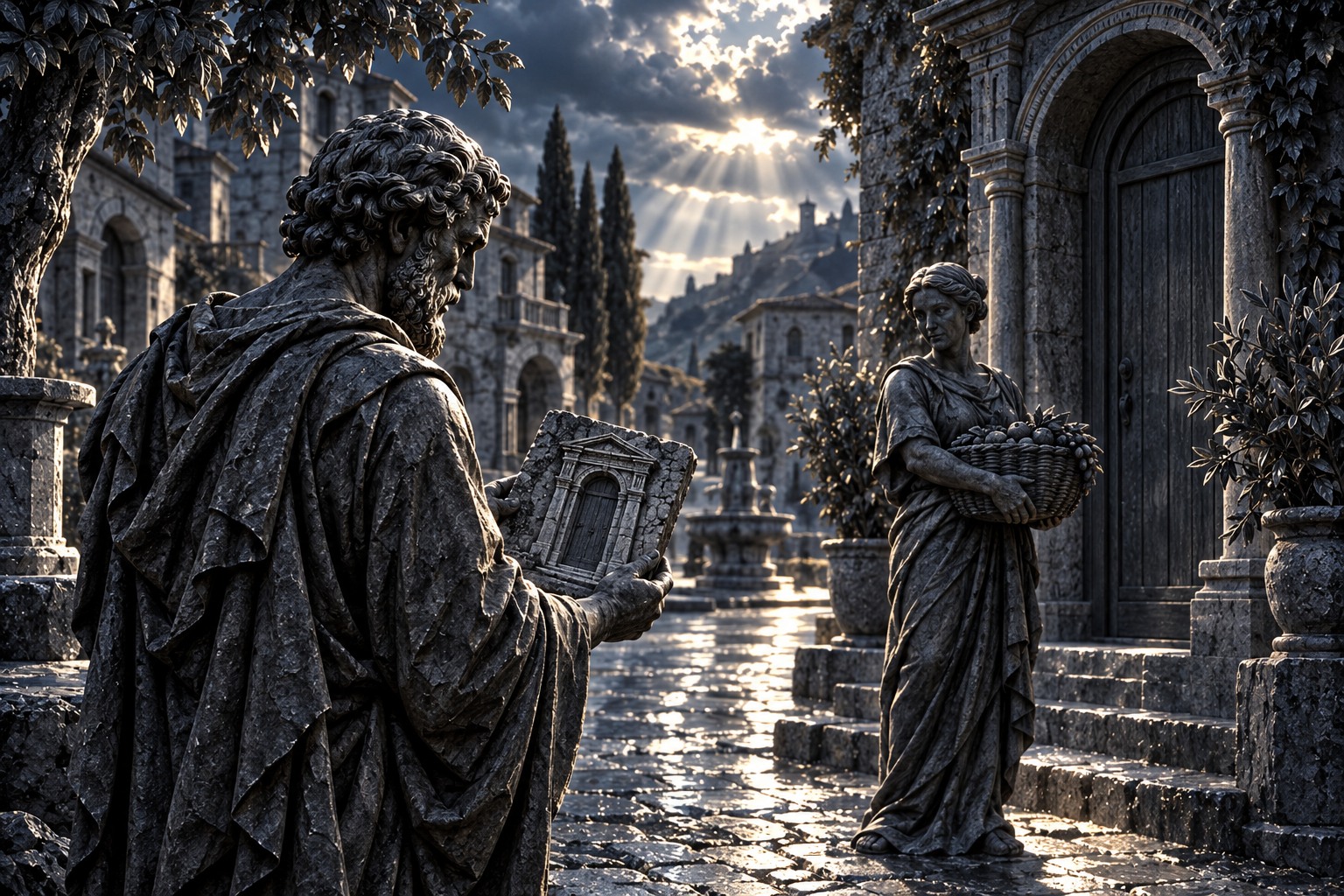
Epigraph
nor are they themselves with me, but their images only.
— Augustine, Confessions X.8; E. B. Pusey translation. The exact clause concerns remembered external objects in a theological examination of memory.
What this article is about
Returning to a familiar street brings someone into contact with a place and a retained image of their life. The address may be unchanged while the encounter feels new. This article distinguishes present observation, personal recollection, and accounts received from others. Augustine, Ruskin, Thoreau, the Dao De Jing, and the Analects help examine place memory without requiring complete restoration of the past. The texts retain their own grounds: theology does not become experimental psychology, return to the root does not prescribe a journey, and transmitting tradition does not confer authority over present listeners. Imagined everyday scenes draw attention to current inhabitants and other histories. A reader may choose a small voluntary visit, another connection, or no return. None promises healing. The purpose is to name what was received accurately, keep questions open, and avoid demanding that a place undo time.
I. Two places on one street
Someone returns to the school where they waited for friends years ago. The address is unchanged, but a tree is gone, the entrance has a different fence, and the road looks narrower. They might conclude that the place has been spoiled or that memory has failed. A third question is available: which two experiences are meeting here? One belongs to an earlier life, the other to today's visit. This imagined scene needs no immediate winner. The school may indeed have changed, while an adult's viewpoint has changed too. Comparison becomes more precise when we stop demanding that the present street reproduce a stored impression and distinguish the event, its recollection, and a new encounter.
A personal return often begins with an expectation: now I will understand who I was, recover a former closeness, or finish something left unfinished. A place may support that conversation, but it has not promised to deliver a required experience. A visitor may find an ordinary courtyard occupied by other people's present lives. Disappointment need not establish that the past was invented. It may identify a difference between the purpose of a journey and what an address can provide. A less ceremonial result is allowed: noticing actual changes, remembering one conversation, or deciding against another visit. A visit need not transform a life to matter to the person who chose it.
In Confessions X, Augustine distinguishes objects from images available in memory: a mountain or sea does not enter a person as a physical thing. This is a theological examination of inner life, not a contemporary experimental model of memory. It supplies a limited distinction for this article: a retained image of a place is not identical with the place itself. A valued recollection is therefore not automatically an accurate street plan. Someone may recognise a feeling confidently but be uncertain where a bench stood. 'I felt free there' and 'the bench stood on the left' have different grounds. Neither automatically confirms the other, and a mistaken location does not by itself erase an experience's meaning.
Distinguishing these levels releases a return from being an examination of personal completeness. Failing to recall a corridor's smell does not establish that part of the self is lost. Feeling no joy does not establish ingratitude. An encounter occurs on a particular day, with its weather, tiredness, companions, and access. Recognise those conditions before reaching a conclusion about an entire life. Sometimes it is enough to say, 'Today I saw this place differently.' That does not explain everything, but it preserves both sides of the experience without demanding an instant account of who a person has become. A more attentive conversation can begin with that limited observation if it is needed.
II. A trace and its story differ
A rectangle of lighter paint appears on an old wall. One person recalls a cupboard, another a family portrait. The trace itself shows a difference in the surface; the object, date, and cause need further grounds. This matters particularly when a confident, elegant story is tempting. The story can be retained with attribution: 'According to my grandmother, a picture hung here.' A photograph may be added, or the lack of verification acknowledged. Not every family tradition must become historical proof, and an unverified detail is not necessarily meaningless. Its status is distinguished so another person can see where observation ends and a transmitted account begins.
In The Lamp of Memory, Ruskin links an old building's significance with time and human history, not only materials. This architectural judgement belongs to his Christian worldview. It draws attention to traces but does not make every crack a readable story. Wear has several possible causes. An attractive explanation does not become true because a wall is old or our reaction strong. For a personal visit, record two things: what was actually observed and what it recalled. The past remains approachable while the present object is not assigned somebody else's biography without grounds or required to confirm an established legend.
Imagine someone showing a sibling a photograph of stairs: 'We always sat here.' The reply is, 'I remember this place quite differently.' The discussion can become a contest of better memory although the speakers describe different events and ages. First clarify the period, role, and particular episode. One came home from school; the other visited only in summer. A single staircase participated in two lives. The difference need not disappear; the result may be two attributed accounts. An honest place history permits that limit instead of forcing a family into one attractive memory that can never subsequently be challenged.
Recording also requires respect for the person whose past is involved. A personal archive does not automatically entitle someone to publish another person's story, photograph, or address. A conversation about a recollection's origin can remain within a family rather than immediately becoming public material. This article does not determine the legal status of particular documents; its concern is proportionate consideration for participants. Asking what can be shown, to whom, and under what name often matters more than finding a striking caption. Memory becomes shared when other people retain the ability to define their participation, not simply when one person has collected all the information.
III. The place has a present life
A returning visitor may feel that an old courtyard is still theirs. Childhood unfolded there; they know the windows, neighbours, and a shop's former name. Personal attachment, however, is not a present right to enter, photograph residents, or move objects. The place has current users, rules, and changed boundaries. An encounter begins by respecting that fact. Calling ahead, asking permission, looking from the street, and accepting refusal preserve the dignity of a recollection without turning it into a claim against current residents. Sometimes being unable to enter clarifies that the past can be remembered without continuing to control its address.
New inhabitants need not guard our version of a place. They may change a wall's colour, rename a garden, remove a bench, or know nothing about previous residents. Regret does not itself impose an obligation on them. If an object has public or family significance, a specific discussion is needed about preservation, capacities, and responsibility. 'You do not understand history' rarely explains who should pay to maintain it or why. Memory becomes more persuasive when it can explain value without threats, recognise limited authority, and offer manageable participation rather than transfer all care to a stranger.
In Walden's chapter on former inhabitants, Thoreau encounters traces of people whose histories are not exhausted by his own stay. He describes Cato Ingraham, Zilpha, and Brister Freeman, including enslavement and lost dwellings. The text contains historical language and authorial judgements that should not become contemporary neutral descriptions of people. The relevant shift is narrower: a familiar landscape has earlier human histories. 'My life began here' does not mean nothing happened before my arrival. A return can raise questions about traces previously overlooked and accounts available only through someone else's testimony.
Every walk need not become research into an entire district. One unfamiliar detail can be noted without turning it into a confident conclusion. A neighbour may know a workshop's former name, an archive may hold a plan, or a public plaque may supply a date. Conflicting sources may leave a question open. Curiosity about other histories can deepen attachment without appropriating another person's memory. Accounts of loss or forced movement need particular care. Their participants may decline to tell a visitor. Attention to absent people remains possible even when a detailed account is unavailable and cannot be restored by us with adequate permission or consideration.
IV. What returning can mean
Dao De Jing sixteen describes return to the root through living movement and stillness. This is cosmological and philosophical reflection, not an instruction to travel to one's birthplace. A shared word can create a false identity, as though a hometown visit and Daoist return meant the same thing. Their grounds and purposes differ. Two questions can stand alongside each other without being merged: what provides a sense of grounding in my life, and must the answer have an address? One person values a street, another a language, craft, or maintained relationship. The text appoints no correct option and does not rank people by the depth of their roots.
In Walden's conclusion, Thoreau says that he left the woods for as good a reason as he went there. He then describes a familiar path and the possibility of other lives. Leaving does not cancel the significance of having stayed. The distinction helps with personal return: valuing a period does not require repeating it. Revisiting a loved place may clarify that present life needs another space. That need not betray one's origins; it can acknowledge time. Something important happened here, while its continuation now takes another form. The historical text supports a question but cannot decide when a reader should leave or stay.
A return can also concern an activity rather than territory. Someone takes up an instrument, makes a familiar dish, reads a letter, or meets an old friend. Place may appear indirectly through a sequence of actions or a shared account. That experience need not be declared a substitute for a real visit. It is a form of connection in its own right, particularly when a journey is closed, expensive, or unwanted. Availability differs from completeness. We can undertake what is available without claiming to recreate an earlier life, and without denying its significance because a fuller encounter is impossible for now.
'Where am I returning?' benefits from a second question: 'Why now?' Curiosity, meeting someone, checking a family history, and hoping to ease a difficult experience are different purposes. They need different expectations and sometimes different companions. A place cannot fulfil every purpose. If the main need is conversation with a living person, a street walk need not replace it. If an event needs confirmation, recognition alone is insufficient. Clarifying purpose does not remove poetry from return. It leaves poetry with experience and verification with a verifiable question, without demanding that either perform the other's work.
V. Keep an account without making it exclusive
In Analects VII.1, Confucius calls himself a transmitter rather than a maker and aligns himself with antiquity. This concerns tradition and teaching, not a promise to preserve every account literally. It invites a question about personal transmission: what do we pass to the next person—details, meaning, a way of living, or an evaluation? Combining those levels can make a story demand agreement with everything at once. We may accept that a grandmother loved her home without adopting her assessment of every resident. We may retain a letter without accepting its view of duty. Passing on memory need not pass on its author's authority over present listeners.
A family account can be stronger when it preserves a voice and marks what is unknown. 'She called this room her workshop; no photographs survive' communicates both connection and limit. Inventing details for completeness produces a smooth account while concealing its origin. A gap is better than an unmarked confident guess. Gaps need not be a family's shame. Not everyone documented their life, documents may not survive moves, and some recollections remain inaccessible to a speaker. An honest 'I do not know' leaves room for another testimony rather than making today's narrative a final judgement on people who cannot reply.
A shared account is sometimes needed to caption a photograph, devise a route, or explain an object's origin. Established details and an agreed description can then be marked separately. Agreement does not make an unreliable date factual. Grounds remain distinct from convenience. Where accounts conflict, a caption may record two possibilities or a broader period. That is less striking than an exact day but conveys the actual state of knowledge. The same consideration applies to names and roles: somebody should not vanish from a history merely because one narrator remembers them poorly or finds their contribution unsuited to an attractive story.
A return may produce a small new item: a note, drawing, surface photograph, or conversation with a relative. Record today's date and conditions rather than blending a new observation with an old event. 'Photographed during an October visit' and 'this is how the house looked in childhood' differ. An archive becomes more useful when readers can distinguish them without guessing. This does not turn personal memory into a scientific project. It retains distinctions already discovered instead of presenting a current emotion as a historical document. A living account can remain free while making the origin of each important detail clear enough.
VI. When returning is unnecessary
A place may involve experience a person does not want to approach. Others may insist they must return, forgive, close a chapter, or recover roots. Philosophical texts on memory do not authorise prescribing that journey. Returning is not compulsory for a worthy life. People may remember at a distance, postpone a visit, or never make it. They need not prove that the place is sufficiently bad; acknowledging a present boundary is enough. This article neither diagnoses a condition nor assesses which response to difficult experience is therapeutically effective. It defends a simpler principle: the significance of memory does not entitle others to determine someone's approach to it.
Even a voluntary visit can be stopped. A person arrives and does not want to enter the courtyard; a companion's conversation becomes unwelcome, or an expected meeting fails to happen. Paying for a journey does not oblige completion of a route. Changing a decision need not make the journey pointless. New information may emerge in refusal: I am not ready now; another format would suit; I wanted to see a person, not a building. Those conclusions differ from the general accusation that one cannot face the past. A specific boundary is less blaming and clarifies an available next step, if a next step is needed at all.
Where a visit involves an actual threat, safety matters more than symbolic completion. Nobody should be required to enter a dangerous building, meet a threatening person, or cross a prohibited boundary for an appealing return story. Ruskin or Augustine cannot authorise disregarding current circumstances. No individual safety plan is supplied here; that depends on the situation and available assistance. The editorial limit must nevertheless be clear. Memory can be retained without repeated risk. Declining a journey does not invalidate someone's account of what happened or reduce their right to seek support under conditions they can accept today.
There may also be an ordinary reason not to return: the place no longer helps with a current question. Life continues, contact is maintained differently, and a journey would merely satisfy another person's expectations. Gratitude to the past does not require a visit. People need not value every former address equally. Some remain important, some become neutral, and some are best left alone. This article does not derive a personality theory from that variation. It distinguishes choosing a connection from continually having to demonstrate one. Return retains its human value when it remains a possibility rather than a moral examination with a prescribed emotional answer.
VII. Meeting the unfamiliar in the familiar
Memory may guide the eye along an old route: a particular window, familiar turn, or former meeting point. New details then recede into background. To see today's address, set aside recognition briefly. Who uses the space now? How have sounds, passages, and the building's purpose changed? This does not require intruding into private life or reporting on strangers. It returns attention to the present. The place continues independently of our visit, and its current life need not support only our memories. Recognition can become less possessive: I am a visitor here, even if I once knew every stone.
A drawing or note helps when it distinguishes something newly observed from something recalled. Name one visible detail and one recollection without imposing a causal explanation. A sound may recall a conversation without establishing why that scene appeared now. Every impression need not receive a ready psychological theory. Attention can stop earlier: I noticed, remembered, and do not yet understand the connection. That limit helps with companions too. Instead of 'This means I always wanted to return,' say, 'Here I suddenly remembered that evening.' The latter retains the experience without enlarging it into a final explanation of a biography.
A familiar place may expose an earlier view's unfairness. Someone remembers a tidy courtyard but overlooked who cleaned it each morning. They recall a family celebration but not the labour of the cook who could not join it. These imagined examples establish nothing about a particular family. They invite a question: whom does my account leave outside the frame? The answer need not become punishment for incomplete memory. Add a name, request an account, recognise a contribution, or stop describing the event as though it happened by itself. Return can then broaden attention to participants rather than require restoration of an unchanged picture.
A newer perspective is not necessarily truer in every respect. An adult has more language and different experience but still sees selectively. Do not replace romanticised childhood with equally confident denunciation. What now looks difficult may previously have contained actual joy; joy does not excuse difficulty, and later understanding does not erase joy's existence. Two descriptions can hold within different limits. Someone may retain complexity without immediately judging a whole period. This return offers no final good-or-bad answer. It permits more precise naming of events, relationships, and one's present response while retaining the limits of what is known.
VIII. Take a question, not an entire former world
On leaving, someone may seek a sign that the visit succeeded: tears, relief, a clear answer, or a photograph to show everyone. Experience need not be validated by an intense effect. The result may be one distinction: a house changed, an account was inaccurate, or a meeting mattered more than a building. Nothing clear may emerge. Meaning need not be invented hurriedly to justify time and expense. Record the actual visit and return to that note later if desired. A place need not answer for our ability to formulate a story instantly, and a person need not announce a completed conclusion before it exists.
What can travel home? Information verified, a question remaining, and an image one wants to share with participants' consent. Those are different results. A confirmed date can enter a caption, an open question a later conversation, and a personal image a letter. They need not become one striking narrative. Keeping them distinct preserves their value without raising their status. Similarly, today's intention differs from a permanent promise: I want to meet the neighbour again but do not yet know when. Connection continues through actual actions rather than the ceremony of announced commitments.
If return raises a question about the future, a small step may answer it: call a relative, caption a photograph, retain a story, or visit a new place long postponed. None must symbolically complete a biography. It responds to something important today. Declining a further step remains possible; attentive visiting may itself suffice. A practice of memory should not endlessly manufacture assignments. Participation includes rest from explanation and permission for an experience to remain part of life without a separate project, report, or public presentation.
Personal return becomes more considerate when the past, the place, and the present visitor can exist separately. The past need not be corrected into an ideal. The place need not be frozen. Someone need not become their former self to acknowledge a connection. Precise words, attention to other histories, and admitted uncertainty can connect these sides. Historical texts support distinctions without supplying a compulsory route. Encounter what is available, refrain from possessing what is not, and take only what was actually received. Return can then become a new meeting instead of a demand that today's address undo time and restore an entire former life.
What this means in practice
Choose a familiar place you want to approach. A visit is optional: your own photograph, a letter, or an account can be used. Name the purpose first: notice change, recall an event, check a detail, or meet someone. An unclear purpose can remain a question; do not prescribe an intense feeling as a required outcome.
Make three short notes. First: what I observe now and under which conditions. Second: what I personally remember and how certain I am about the detail. Third: what I learned from someone else, from whom, and when. Do not fill gaps with guesses for completeness. Keep disagreements between sources visible. One question may be checked through an available document or voluntary conversation; no answer is also a result.
Respect current access and privacy: agree on entry, photography, and sharing another person's account. You may stop a visit or never begin it. Where a threat exists, safety takes priority; this exercise neither replaces assistance nor constitutes treatment. Finish by recording one distinction noticed and, if wanted, one manageable step. You can end without another assignment. Do not assess yourself by emotional intensity or require a companion's memory to match. A sufficient result is distinguishing observation, recollection, and transmitted accounts while retaining the right not to know, share, or return.
Key quotation
I left the woods for as good a reason as I went there.
— Henry David Thoreau, Walden, Conclusion; English original. The next sentences concern other lives and a familiar path. This is no instruction to leave one’s own place.
Connections between traditions
| Primary text | Question for returning | Difference |
|---|---|---|
| Augustine, Confessions X.8 [1] | How does an image differ from an external place? | Theological introspection is not an experimental memory model. |
| Ruskin, The Lamp of Memory VI, IX–XI [2] | Which traces of time do we notice? | A trace's architectural value does not confirm a particular legend. |
| Thoreau, Former Inhabitants and Conclusion [3] | Who lived here earlier, and may I leave? | Historical authorial testimony is limited; departure does not cancel a stay's value. |
| Dao De Jing16 [4] | Must grounding have an address? | Cosmological return to a root is not a birthplace visit. |
| Analects VII.1–3 [5] | What exactly do we transmit? | A stance toward teaching does not require accepting every family evaluation of the past. |
This is a limited editorial comparison. Different grounds are not merged into a single doctrine or used to prove a journey's therapeutic benefit.
Primary sources
[1] Augustine of Hippo. Confessions, Book X. Late fourth century CE. X.8: fields and palaces of memory; nor are they themselves with me; X.14–17 selections. E. B. Pusey historical English translation, Project Gutenberg #3296. Actually read: Displayed BookX passage from fields and palaces of memory through image/object distinction in X.8; selected later paragraphs on affections and forgetfulness read, not whole work
[2] John Ruskin. The Seven Lamps of Architecture. 1849. ChapterVI, The Lamp of Memory VI and IX–XI. Project Gutenberg #35898, English original. Actually read: Selected ChapterVI passages on historical homes, ageing and later inhabitants read
[3] Henry David Thoreau. Walden. 1854. Former Inhabitants and Winter Visitors, opening through Brister Freeman; Conclusion, I left the woods paragraph. Project Gutenberg #205, English original. Actually read: FormerInhabitants opening and narratives Cato/Zilpha/Brister read; Conclusion departure/path paragraph with neighbouring context read
[4] Laozi. The Tao Teh King / Dao De Jing. Ancient text; Legge translation 1891. Chapter16 in full. James Legge English translation, Project Gutenberg #216. Actually read: Complete Chapter16 and adjoining15/17 as displayed read
[5] Confucius / Analects compilers. The Analects. Ancient compilation; historical Legge translation. BookVII.1–3. James Legge English translation, Project Gutenberg #3330. Actually read: BookVII.1–3 transmission, learning and cultivation read
Tags
memory, place, return, home, street, childhood, past, present, observation, testimony, narrative, archive, photography, trace, history, privacy, access, boundaries, autonomy, change, Augustine, Ruskin, Thoreau, Laozi, Confucius, philosophy, tradition, transmission, uncertainty, participation
About the authors
Andrey Zarinsh is the author and founder of United Wisdom. He explores inner transformation, the unity of traditions, intercultural dialogue, and contemporary spiritual discipline. Instagram: @andrey.zarinsh.
Maria Evilkut is a co-author of United Wisdom. Alongside her research, she seeks to test these ideas in practice and observe how principles of unity and mutual understanding work in real life between people and cultures. Instagram: @ilkutki.
Keep what resonates with you.