
Meaning & path
Caring for a space that will outlive us
Care for space after departure: safety, traces, maintenance, intelligible handover, and a successor’s freedom.
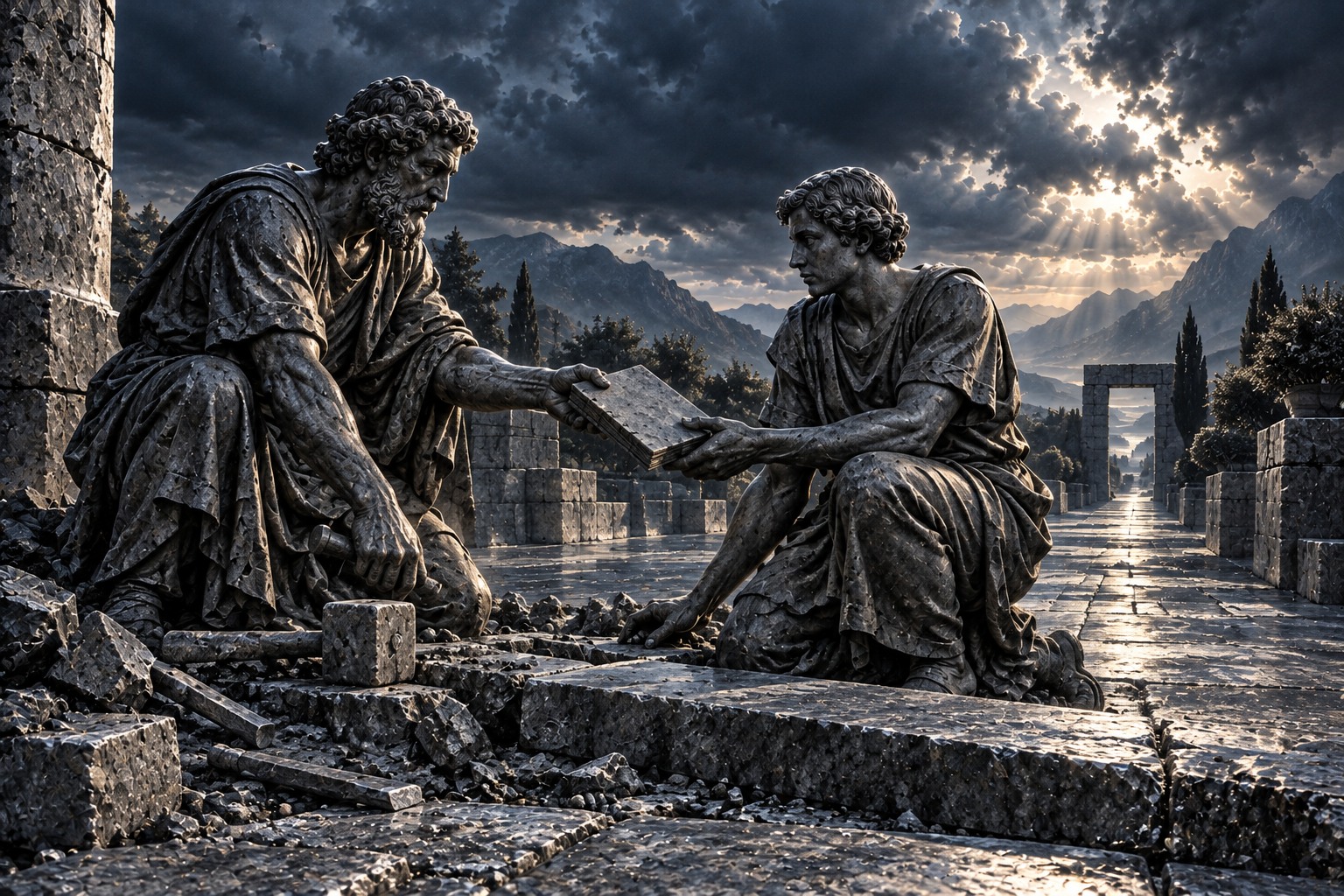
Epigraph
He plants the trees to serve another age,
— Caecilius Statius, Young Comrades, quoted by Cicero, On Old Age, 24–25; W. A. Falconer, 1923 translation. The line is known here through Cicero, not an independently read lost play. Terminal comma retained from the displayed text.
What this article is about
Space continues after we leave. People live, work, meet, and ask questions there without knowing former habits. Care for continuation need not require a grand legacy. It may transmit important knowledge, notice an obstruction, retain an account's origin, or acknowledge others' work. Here Cicero's and Seneca's Roman reflections, Ruskin's architectural ethics, a particular biblical verse, and Dao De Jing offer different grounds for considering future users. They are neither merged into one doctrine nor turned into construction, legal, or therapeutic instructions. We examine safety, memory, maintenance, hidden costs, and a new participant's freedom to alter form. A short exercise identifies one intelligible handover. A future person deserves attention, while the present person retains permission not to sacrifice their life to an imagined perpetual arrangement.
I. A place after we leave
A person finishes work in a room where colleagues have met for years. They know how a difficult window opens, where a spare item is kept, and why one doorway is usually left clear. The next group sees only a room. This imagined scene makes a simple fact visible: space continues after our involvement, while knowledge may leave with us. Future care need not begin with a grand legacy. It may mean explaining one important feature and removing an obstruction everybody learnt to avoid. The question concerns access for someone absent from the place's earlier life, rather than its author's immortality.
A future user may differ in age, bodily possibilities, language, and purpose. We need no exact portrait to recognise that difference. Ask which decisions depend excessively on personal knowledge. A sign only relatives understand, confusing storage, or the rule that everybody already knows can become a new difficulty. This is neither error-frequency research nor a professional building-accessibility assessment. It is an editorial question about an ordinary place: what would someone have to guess without us? A concrete answer clarifies a next step—an explanation, conversation with a responsible person, or examination of a condition long obscured by familiarity.
In On Old Age, 24–25, Cicero's Cato quotes Caecilius Statius on planting trees for another age. The farmer then connects receiving from ancestors to transmitting to posterity and the immortal gods. This is Roman reflection on active old age and continuity, not an anonymous Greek proverb. Its grounds cannot become merely an appealing image of shade. A limited distinction matters here: an action may have recipients beyond its actor's remaining lifetime. That does not prove that elders always understand younger people's needs better. Historical praise of age becomes neither contemporary medical theory nor permission to control another life in the name of experience.
Future conditions remain partly unknown. Care therefore need not construct a permanently correct final form. It may preserve the ability to understand and alter what was done. A good handover sometimes supplies clear incompleteness: this question remains open, this limit exists, this decision fitted these conditions. A new participant gains support without having to treat it as the last word. A space outlives us as a place for further life, rather than an obedient copy of an intention. A sufficient task may leave less unnecessary guessing and more capacity for intelligible action without appropriating future people's choices before they even arrive.
II. A future person is present in today's decision
Deuteronomy 22:8 connects building a new house with providing a roof battlement so a person does not fall and blood does not come upon the house. We read one particular KJV verse, not an entire ancient legal system. It supplies no contemporary dimensions, materials, or safety requirements. The scene nevertheless contains a clear distinction: a builder considers another person's possible action. A house is assessed beyond its owner's intention. This grounds a limited question about use: consider not only what I meant to create but what another person encounters when entering it.
Familiar exceptions deserve this question. 'We know it is awkward', 'hardly anyone uses it', and 'a guest will work it out' can transfer the entire difficulty to someone else. Not every feature can be changed promptly or unaided. Inability to correct something immediately nevertheless differs from silently denying a problem. Name the condition, notify the responsible person, and clarify available action. Structural, electrical, fire, and other hazards require competent assessment rather than instructions from this article. Philosophical attention cannot replace technical knowledge. It helps us stop treating the absence of a previous incident as sufficient grounds for overlooking a significant question.
Future care must not cost present people's safety. Nobody should be required to remain in danger, endure violence, or perform unsuitable work to preserve a place. If circumstances require leaving or restricting access, symbolic importance does not cancel that condition. No individual safety plan is provided. The reasoning has a boundary: memory and transmission cannot authorise additional exposure to risk. Accounts, appropriately obtained photographs, and information can survive without preserving the old pattern of presence. Losing a form may be sad, but sadness cannot establish a duty to pay with well-being or freedom to decide where to be today.
Assistance may be ordinary: intelligible signs, available information, or a clear route within agreed arrangements. Check whether a measure actually helps an intended action instead of merely looking considerate. An unfamiliar user may notice difficulty a regular participant no longer sees. Listen without defending personal expertise. This need not become concealed observation or an examination of a guest. Request voluntary feedback openly: what was understandable and what required clarification? Distinguish preferences, significant obstructions, and specialist questions. Respectful participation accommodates someone else's experience without making it match our explanation of the room.
III. Retaining traces without substituting for life
In The Lamp of Memory, XVIII–XX, Ruskin sharply opposes restoration that destroys old work while presenting new work as its continuation. XIX also urges timely maintenance; his position is not complete inactivity. XX relates rights to makers and future generations. This is nineteenth-century architectural ethics with forceful claims, not a present universal rule for every repair. Its absolute rejection of destruction is not adopted as the answer to every contemporary case. A narrower question remains: when altering a trace, do we understand the loss and avoid calling an actual replacement preservation?
Ordinary homes contain things of different significance: a child's height mark, an old letter, a damaged shelf, an obsolete device. They require no identical decision. Meaning may concern a person, account, material, or use. Before preserving something, ask what we intend to transmit. Sometimes a record with provenance suffices; sometimes the object matters; sometimes its presence obstructs life more than it supports memory. This makes decisions more understandable without making them effortless. Discarding an object cannot automatically mean rejecting a person. Nor does an object retain a relationship completely. A trace can support an account without replacing its participants.
Future residents need not live among all our possessions. Transmitting memory can quietly become requiring a room to remain a monument to one biography. Separate a request from a condition intended to control people after handover. Explain an object's value, propose retaining information, and hear refusal. This is no legal discussion of inheritance arrangements, which require appropriate local competence. It concerns a human relationship. A gift becomes harder to receive when it includes an endless duty to demonstrate gratitude through correct furniture placement. Memory deserves an intelligible account, and a new participant deserves an actual life rather than performing perpetual continuation of our scene.
Preservation also requires selection and provenance. An uncaptioned photograph may lose meaning; a confident invented date produces false clarity. Distinguish what is known, transmitted by someone, and unknown. Different recollections can be retained without appointing the eldest person final authority. Care for space then includes care for testimony. No comprehensive family archive is demanded. Identifying one account's origin and available support may suffice. Such a trace enables a later reader to understand grounds and ask another question. We transmit not only an answer but permission to question an attractive version without adequate information.
IV. Maintaining before restoring
A conspicuous alteration attracts more attention than maintenance. It offers visible results, photographs, and a story of decisive action. Care rarely looks equally eventful. Yet a place may continue through acts nobody considers achievements. Ruskin contrasts timely attention with neglect followed by restoration. His historical roof and wall examples are not instructions for present structures. They reveal a temporal distinction: a small act before deterioration and extensive alteration afterwards express different relationships. Practical decisions require appropriate knowledge, but attention to recurring tasks can precede a heroic rescue narrative.
Maintenance begins with clarity: who is responsible, what is known, and how is change reported? In shared premises, this information may matter more than an impressive new object. Where an organisation or owner holds a duty, a participant should not automatically assume it without access and authority. Notice a question and communicate it to someone entitled to decide. Responsibility does not mean personally performing every task. Agreed arrangements during absence are preferable to expecting someone's limitless readiness to rescue a situation. No management standard is established here. A place becomes more dependent on one person when important knowledge and authority remain obscure to others.
Durability includes subsequent care. An attractive object may require time, money, or skill unavailable to its next user. Before naming it a legacy, ask which duties accompany it. The simplest or cheapest choice is not compulsory. Make continuation costs visible and compare them with actual conditions. This is neither an ownership-cost calculation nor a product recommendation; precise data must fit the decision's subject. A good intention can transmit hidden work. Acknowledging it beforehand gives someone else the opportunity to agree, suggest an alternative, or decline a form they cannot sustain.
Real people perform maintenance. Their work does not disappear when a room seems naturally tidy. Ask which conditions make a task possible; do not demand unchanged results after resources vanish. Hired workers deserve clear tasks and agreements, while relatives deserve voluntary discussion. Love for a place replaces neither payment nor consent. Durability may mean simplifying arrangements to reduce invisible burdens on those who clean or explain. Space's future passes through present efforts. 'What will remain after us?' cannot honestly be separated from 'Who currently pays for continuation with their time and possibilities?'
V. Economy without passing on hidden costs
In Legge's Dao De Jing 67, the three treasures include gentleness, economy, and shrinking from precedence over others. Gentleness is then connected with victory in battle and Heaven's protection. This is no present household-saving checklist or evidence for a particular environmental technology. A limited comparison concerns proportion and precedence: wanting a large visible legacy may conflict with consideration. A place sometimes needs fewer unnecessary duties rather than another sign of our importance. No performance of modesty is required. Ask whether the chosen form serves people or primarily its author's wish to remain the principal name in a place's history.
Economy can be honest or transferred. If an object is inexpensive because its next user must spend time deciphering, correcting, or enduring it, the purchase price incompletely describes the outcome. An expensive object is not automatically responsible either. Identify available information and uncertainties: what is known about care, which conditions will change, and who decides emerging questions? No financial recommendation is offered. The concern is a complete human account. Saving one person's resources through another's unagreed labour cannot simply be called one's thrift. People may distribute costs differently where agreement is genuinely voluntary.
Repair and reuse can matter without every preservation fitting circumstances. Uncertain condition cannot prove virtue through use at any cost. Safety requirements and relevant knowledge remain distinct. Passing on information and choosing another form may be more honest than requiring continuation of a questionable practice to demonstrate thrift. No material selection or technical suitability assessment is supplied. These questions can be asked without moral accusation. Wishing to use fewer resources can coexist with recognising that an item requires competent examination or replacement. Proportion means no predetermined answer; it means wanting to see a decision's actual costs, including consequences initially overlooked.
The future cannot justify every present deprivation. Someone with limited means need not select the most durable option if it is unaffordable. Someone lacking authority need not alter another's system. In On Old Age, 8, Cicero acknowledges that want matters even for a wise person. That qualification helps avoid turning a philosophical ideal into an accusation against poverty. No contemporary social model is inferred. Material conditions simply remain in the conversation. An available improvement may be small; sometimes identifying a limit and promising no impossibility is the responsible choice. Care remains human when its proportion considers the present actor alongside the person imagined to arrive later.
VI. Passing on knowledge with permission to add
In Letter 64.7, Seneca compares inherited wisdom to careful household stewardship: received wealth should increase, while later generations retain opportunities to add. His subject is philosophical work, not property disposal. Later passages discuss applying earlier discoveries through a medical analogy; that is a historical metaphor, not present treatment guidance. Respect for predecessors does not close continuation. Something valuable may be received without declaring the undertaking finished. Space also holds knowledge: reasons for decisions, considered constraints, and remaining questions. This is an editorial comparison preserving the difference between Stoic philosophy and handing over a room or shared place.
A useful description transmits grounds alongside arrangements. 'We put the table here because a clear route was needed' allows more freedom than insisting it must always stand there. A new user may preserve the purpose differently. An established requirement cannot be reduced to taste: name its actual source and verify relevance locally. If a rule suited one group's convenience, say so. This distinguishes changed form from violation of a significant condition. Handover needs no exhaustive manual. Identify information without which the next person must either repeat blindly or guess an important reason afresh.
Paper does not create understanding by itself. Information may be lengthy, outdated, or unavailable where a question arises. A brief conversation with room to ask and restate may help. It is no examination in respect for a predecessor. Check whether important knowledge was transmitted. Invite a voluntary account of what is clear and what needs clarification. Difficulty in an answer may call for changing the explanation rather than blaming a listener. The person handing over may also limit time. Sustainable transmission requires no promise to answer every question forever; it identifies available information and an intelligible further source of help.
A decision history permits revision. Changed conditions need not preserve a former arrangement merely because it once worked. A good record allows: this was reasonable then; another approach is needed now. Distinguish revision from dismissive erasure of someone's work. Acknowledge contribution, explain new grounds, and retain the earlier decision's account without repeating its form perpetually. Seneca's prospect of addition does not make every novelty an improvement; new choices also require grounds. Inheritance supplies material for continued understanding rather than one era's authority over every later person living, working, and asking questions in altered space.
VII. Gratitude must not bind a future person
Leaving something useful may include a concealed request: remember me in exactly this way. A room, object, or garden passes on with an expectation that its style continues. The hope is understandable but differs from care for use. Discuss memory openly and retain a decision's authorship or an object's provenance where appropriate. Gratitude must not become endless maintenance of our image. Changing curtains or a room's purpose need not show contempt. Distinguish actual harm, loss of a significant trace, and a difference of taste before deciding what happened and which request has intelligible grounds.
Future people include those we did not choose: non-relatives, people with other convictions, and those who do not continue our faith. A place serving one circle acquires another life. Care can acknowledge this without erasing its former meaning. Explain why space mattered without requiring it to matter identically to everyone. A particular community's conditions require actual discussion rather than casually renaming its place universal. Even within communities, people differ. Transmitting clear grounds helps respect real relationships without inventing a future where nobody ever asks new questions.
A commemorative object can be valuable and burdensome to its recipient. They need not choose between their life and proof of love. Keeping part, transferring it to an appropriate willing recipient, or retaining an account may be possibilities. These are not prescribed outcomes and do not cancel applicable legal conditions. Human meaning does not always equal keeping everything continuously. Conversation may include sadness and disagreement. It remains respectful when an unwelcome answer is permitted. Refusal need not destroy connection; it may preserve connection without a concealed debt nobody can finish paying correctly enough.
People may also decline to create a legacy. Participation can end without a commemorative project, exhaustive archive, or instruction to descendants. That does not diminish a life. Accepted duties require separate attention to completion; permission to leave no monument does not cancel a promise. Existence itself nevertheless imposes no duty to maintain an eternal presence. Care may be ordinary and temporary: help a place serve now, pass on knowledge, thank participants, and leave. What outlives us need not bear our name. A freer continuation sometimes begins when recipients need no longer answer continually to an imagined former owner's gaze.
VIII. One intelligible handover
An oversized image of the future can obstruct available action. Thinking about every generation at once may leave today's difficulty unexplained. Return to the nearest handover: who will encounter this place after me, and what information will actually help? It may concern tomorrow's visitor, a successor at work, or a later resident. They need not represent all humanity. A concrete recipient does not diminish care; it helps select a manageable form and identify what can be checked now. Unknown futures cannot be guaranteed, but one present decision can become less confined to our familiar viewpoint.
Handover includes limits to promises. Say what is known, checked, and unconfirmed. Protect other people's privacy instead of disclosing everything for a complete history. Where authority belongs to another person, passing a question does not acquire that authority. With unfinished work, naming the remainder helps more than concealing it beneath 'ready'. Recipients see actual conditions rather than an ideal result, and can ask, seek appropriate assistance, and decide. Clarity requires no dramatic farewell. It often arises in a short conversation where both participants understand what passes between them.
After transfer, distinguish necessary clarification from continuing control. Answer an agreed question without returning endlessly to details. New participants may learn differently and alter appearance. Significant obligations require their actual grounds rather than personal hurt. Departure may remain emotionally incomplete: someone misses the place or wishes to see it as before. That feeling is permissible without becoming authority. Remembering a place need not determine its next day. Care for space that outlives us includes leaving another era room to act, even when the outcome no longer resembles our final photograph.
Cicero, Ruskin, Seneca, the biblical verse, and Dao De Jing provide no single instruction for every place. They relate action, continuity, responsibility, and proportion differently. This limited comparison asks a contemporary question: how can benefits pass on without unnecessary guessing, hidden costs, or compulsory repetition of ourselves? An answer need not be large. It may clarify one condition, pass a question promptly, or recognise someone's work. Space continues under unknown conditions we cannot own in advance. We can nevertheless attend to the share of continuation that depends on today's action without requiring another person to abandon their own life.
What this means in practice
Choose a place for which you have actual responsibility or agreed access. Consider its nearest next user rather than imagining every future generation. Without authority, the exercise may concern a question for the responsible person instead of an alteration.
Identify one feature understandable to you that another person might have to guess. Separate knowledge, assumptions, and habit. A technical or legal question needs appropriate knowledge rather than an answer from this article. Actual danger does not become a symbolic-preservation task.
Ask which benefit and duty the chosen form transfers. Who maintains it, what resources are needed, and is agreement voluntary? A smaller commitment, another form, or an intelligible account may be chosen. Do not require gratitude for participation someone never accepted.
Make a short handover: what is known, why the arrangement was chosen, which question remains, and where available information is kept. Protect others' privacy. With a recipient, invite voluntary clarification without making it an examination.
Finish: 'I pass on these grounds; the later form may change.' One understandable benefit without a concealed promise of perpetual control is sufficient. The exercise establishes no ownership rights, inheritance rules, or professional operating procedure.
Key quotation
But we should play the part of a careful householder; we should increase what we have inherited.
— Seneca, Letter 64.7; Richard M. Gummere translation. Exact complete sentence, concerning inherited wisdom and further addition, not property disposal.
Connections between traditions
| Primary text | Question about continuation | Difference and limit |
|---|---|---|
| Cicero, On Old Age, 24–25, 8 [1] | Can action serve someone arriving later? | Cato's speech and Statius's line; Roman continuity gives elders no authority over future people. |
| Ruskin, The Lamp of Memory, XVIII–XX [2] | What is retained and what replaced? | Historical architectural ethics; absolute anti-destruction claims are not universal present norms. |
| Deuteronomy 22:8 [3] | Is another person's possible action considered? | One religious verse establishes no current construction or legal requirements. |
| Seneca, Letter 64.7–9 [4] | Does room remain for further addition? | Wisdom inheritance is editorially compared with knowledge handover, not identified with property. |
| Dao De Jing 67 [5] | Does form serve people or our precedence? | Three treasures in political/cosmological context, not a household-saving programme. |
The comparison concerns limited article questions. Different grounds become no single doctrine; a present handover exercise remains a voluntary editorial proposal.
Primary sources
[1] Cicero. Cato Maior de Senectute, VII.24–25; III.8 and context 21–26. W. A. Falconer, Loeb Classical Library XX, 1923. Caecilius Statius’s line is transmitted through Cicero’s Cato; historical rhetoric about age establishes no present hierarchy between generations.
[2] John Ruskin. The Seven Lamps of Architecture, VI, The Lamp of Memory, XVII–XX. English original, 1849; historical Gutenberg 35898 edition. Restoration and maintenance are the subject; absolute prohibitions and historical social assumptions become no modern conservation or safety requirements.
[3] Deuteronomy 22:8. King James Version, historical English translation, 1611. The religious roof-battlement injunction is no current construction or legal instruction.
[4] Seneca. Moral Letters to Lucilius, Letter 64, §§1–10, especially 7–9. Richard M. Gummere, 1917. Inheritance concerns wisdom; the medical comparison remains a historical application metaphor.
[5] Laozi, received textual tradition. Dao De Jing, chapter 67, §§1–4, context 66 and 68. James Legge, 1891. Three treasures retain political, military, and Heaven context; no contemporary household or environmental programme is inferred.
Tags
space, care, future, handover, home, place, continuity, memory, trace, history, safety, use, access, responsibility, knowledge, grounds, maintenance, labour, consent, privacy, proportion, economy, autonomy, change, Cicero, Statius, Ruskin, Seneca, Deuteronomy, Laozi, philosophy, legacy
About the authors
Andrey Zarinsh is the author and founder of United Wisdom. He explores inner transformation, the unity of traditions, intercultural dialogue, and contemporary spiritual discipline. Instagram: @andrey.zarinsh.
Maria Evilkut is a co-author of United Wisdom. Alongside her research, she seeks to test these ideas in practice and observe how principles of unity and mutual understanding work in real life between people and cultures. Instagram: @ilkutki.
Keep what resonates with you.