
Relationships
Beyond Boundaries: Living with Difference
An archival manifesto about crystal and facets: cultural exchange, languages, listening, and the limits of a perennialist hypothesis.
Andrey Zarinsh & Maria Evilkut
Inner transformation · An archival manifesto
Differences are not the enemy. The enemy, in this essay's image, is believing that my facet of the crystal is the whole crystal. This manifesto asks how an understanding of a connected world might make forgiveness, compromise, and cultural exchange part of ordinary life rather than distant aspirations.
We live in a world with more and more boundaries, and less and less meaning in some of them. Doctrinal walls rise between religions; trenches of terminology divide philosophical schools. Between states, a line that yesterday was a river or mountain becomes a front. Between languages stand invisible customs posts where ideas are detained. Yet anyone who has seriously entered another tradition may discover something unexpected: different words sometimes carry a familiar intuition.
This is a United Wisdom manifesto from the archive. It is neither a call to melt everything into a featureless whole nor an innocent dream of universal brotherhood. It proposes a working hypothesis: if enough people genuinely came to see the world as one interconnected system, with religious, philosophical, cultural, and political forms as facets of a great crystal of truth, many present fractures might no longer seem necessary. They would not instantly disappear. They might cease to appear inevitable.
The project's phrase is simple: “ONE SOURCE · MANY LANGUAGES.” The essay unfolds that phrase across personal, cultural, political, and digital life. Its claim of a single underlying source is the manifesto's philosophical position, not an independently established fact.
Part I. Where All These Boundaries Come From
To understand how boundaries might become more permeable, we first have to look honestly at how they arise.
The essay begins with the proposition that a human boundary is first a line in the mind and only later a post, flag, symbol, or temple. States do not fall from the sky already formed; people draw and organize them. Religions do not emerge from the soil like trees; people articulate, codify, and defend them. Philosophical schools do not exist as ready-made Platonic ideas. People establish them when they judge a particular language of reality more precise than another.
There is nothing shameful in distinction. It is one of thought's oldest instruments. Without distinctions there can be no science, culture, law, or art. The problem is not our ability to distinguish, but our ability to forget that a distinction is a map rather than the territory. A map of Europe is not Europe. A doctrine concerning the Trinity is not identical to the mystery it addresses. A state boundary is not the people living on either side.
When that difference is forgotten, a boundary can stop being an instrument and become an idol. People may burn the territory to defend a map, deny an experience to preserve the wording that once pointed toward it, or forget human beings in the name of the state.
The manifesto advances a quiet but persistent idea: many modern conflicts occur at the level of maps, not only at the level of what they describe. It makes the stronger claim that most conflicts do so; that is its interpretation, not an empirical result established here. Its proposed response is not erasing differences, but returning them to the role of facets through which we can see, rather than walls we cannot see through.
Part II. The Crystal: One Source, Many Facets
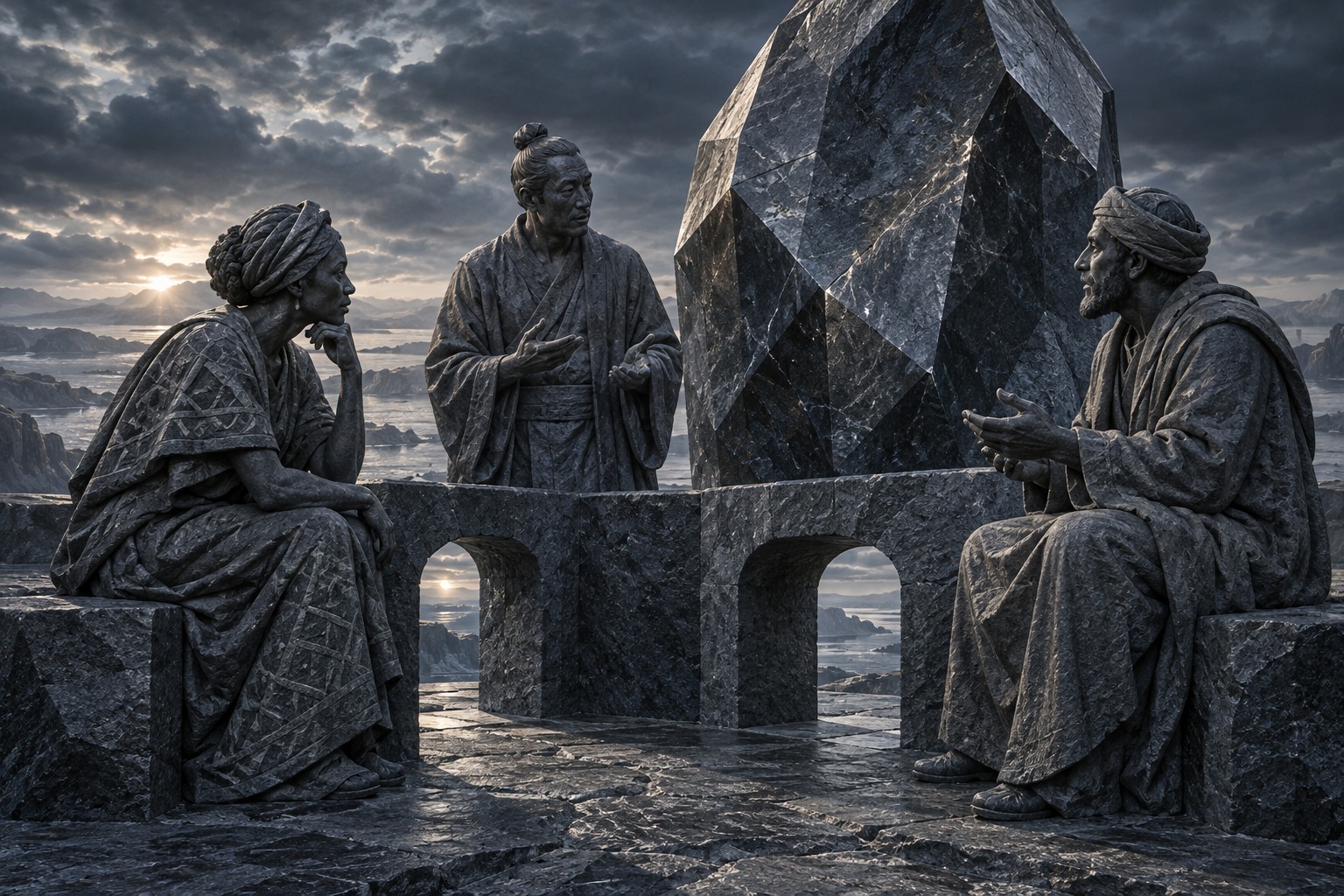
The crystal is chosen for several properties that express the proposed way of viewing traditions.
First, a crystal has an inner structure. Its facets arise from a lattice rather than being arbitrary decorations. Each face reveals an underlying arrangement from a particular angle.
Second, no face is the entire crystal. Taking one facet for the whole is, in the authors' metaphor, an optical mistake rather than an act of devotion. A facet can be great, exact, and beautiful, yet remain a facet.
Third, light passing through a crystal is refracted differently through different faces. The essay reads this not simply as distortion but as manifestation: each angle makes another aspect of the light visible.
Fourth, the crystal is not mechanically assembled from its faces. They are ways its structure appears. Remove that structure and the facets no longer hold together.
The authors find related images in spiritual and philosophical traditions. Their closest comparison is Indra's net, associated with the Avataṃsaka Sūtra: an endless net of jewels, each reflecting all the others (Wikipedia, “Indra's Net”). Each jewel can image the whole while remaining distinct. The essay uses it to suggest unity through mutual reflection, not the elimination of difference.
It then turns to Advaita Vedanta's Brahman and the world of names and forms (Stanford Encyclopedia of Philosophy, “Śaṅkara”); Ibn ʿArabī's unity of being and the Real, al-Ḥaqq (Ibn Arabi Society, “Oneness of Being”); and Nicholas of Cusa's coincidentia oppositorum, coincidence of opposites (Wikipedia, “Unity of Opposites”). It reads these as different formulations of a related intuition.
Aldous Huxley's twentieth-century philosophia perennis supplies another example: a proposed perennial core found in mature religious traditions (Wikipedia, “The Perennial Philosophy”). The claim of such a core belongs to perennialist philosophy and remains open to disagreement.
The manifesto's thesis is therefore not a proposal for a new religion or an indiscriminate mixture. It is a particular philosophical stance: religions, philosophies, myths, science, and symbols can be read as languages of one source. One crystal, different facets. The metaphor organizes the essay; it does not itself prove the stance.
Part III. Preserving Difference While Seeing Through It
A common objection to unity is that it requires mixing everything together, leveling differences, or abandoning the distinctiveness of traditions.
The authors reject that intention. A melting pot destroys form for the sake of a mass. Their proposal is to preserve each tradition's form while ceasing to mistake it for all reality.
The distinction is subtle but fundamental: erasing difference impoverishes the world; making it transparent allows a view through it.
A Sufi singing of the beloved is not simply saying what a monk says in hesychastic prayer. Languages, images, and disciplines differ. The manifesto nevertheless proposes that depth on either path may lead beyond language. Frithjof Schuon's The Transcendent Unity of Religions places religious unity not in outward forms but in an esoteric or metaphysical depth. In that account, form must not be abolished: without form there is no path. Yet form need not be mistaken for the summit.
Here lies the essay's ethical turn. Seeing one's tradition as a facet need not mean losing it. It may mean relinquishing a claim to exclusive possession of the whole and, with it, one basis for contempt toward other traditions.
The authors distinguish this from what they call relativism. Their position is not that no one can be right, but that each tradition may contain real insight without containing all truth. Their stronger assertion that all traditions ultimately point to the same thing remains the manifesto's perennialist commitment, not a demonstrated agreement among those traditions.
Part IV. States as Another Facet
State boundaries may seem an entirely different subject: geopolitics, economics, and security rather than metaphysics.
The manifesto argues that political institutions can be treated like doctrines: human arrangements turned into absolutes. A state is an institutional form through which people, culture, language, and shared history are organized. Remembered as an instrument, it serves people. Treated as an idol, it begins to demand sacrifices.
The authors see many examples of national identity hardening from a living fabric into an ideological wall. A people persuaded that its destiny is wholly separate, its truth exclusive, and its language superior may begin to perceive neighbors as threats to its own existence. This is the essay's political interpretation, not a denial that real security threats and material conflicts also exist.
Returning the state to the position of a facet changes the image. A people remains a people, a language a language, a culture a culture. Yet a boundary may become a membrane: something that both distinguishes and permits exchange.
This is not a proposal to abolish states. It is a different relationship to them: love one's people without regarding others as less valuable; honor one's language without declaring other languages impoverished; preserve one's history without turning it into a stage for contempt.
The essay invokes Pierre Teilhard de Chardin's noosphere, a sphere of collective thought developing through relations between minds, and his Omega Point as a theological image of culmination (Teilhard de Chardin's Vision of the Noosphere). One can dispute his theology while considering the intuition that deeper connection may change the function of older divisions. The article anticipates less rigid boundaries as people become more connected. That is a hopeful interpretation, not an inevitable historical law.
Part V. Listening, Forgiving, and Finding Compromise
The most practical part of the argument is ethical. If another person can be encountered as a different perspective rather than solely as a rival for exclusive truth, behavior may change.
Listening becomes interest rather than surrender. I listen not merely to win an argument, but to see light from another angle. Someone else's experience may disclose something within my own. I do not necessarily lose myself; I may widen my view.
Forgiveness becomes, in the authors' language, an act of clear sight rather than heroism. The essay traces many wounds to competing truths, each claiming to be the only one. Recognizing one's perspective as partial can make a distinction possible: this element of your account I cannot accept, while that element I can. The exchange need not remain all or nothing.
Compromise becomes a possible form of respect rather than an automatic sign of weakness. It requires recognizing that the other person's position has some origin or ground. Without that recognition, one imposes rather than negotiates. The manifesto insists that every position has a history, although not every position is right. Understanding that history is different from endorsing the position.
The essay connects this with its reading of Shankara's discernment (Stanford Encyclopedia of Philosophy, “Śaṅkara”), Cusa's coincidence of opposites (“Unity of Opposites”), and Huxley's account of a mystical summit where distinctions of nation and color dissolve in divine light (Aeon, “What Can We Learn from the Perennial Philosophy of Aldous Huxley?”). The authors emphasize the summit, not the everyday starting point.
Daily life takes place at the foot of the mountain. There, rather than a vision of ultimate light, the proposed ethics is modest: attentiveness, forgiveness where freely chosen, and compromise where appropriate. Understanding another person's grounds does not require excusing violence, relinquishing rights, or remaining in harm.
Part VI. Cultural Exchange as Change from Below
Long before philosophical manifestos, cultural exchange was quietly changing boundaries.
When someone seriously enters another tradition—learning its language, reading its texts, listening to its music, eating its food, forming friendships—something in their sense of belonging may expand. Not necessarily because they have betrayed themselves, but because they have enlarged what they can recognize as their own.
The process need not be coercive. Identity remains, but may cease to feel like a prison. Someone can remain Russian, Thai, Italian, Muslim, Buddhist, or agnostic without treating that description as a ceiling over the self.
The essay calls cultural exchange an erosion of boundaries from below. Philosophical manifestos work above; kitchens, songs, translations, friendships, mixed families, travel, and art work below. The latter can prove more durable. A decree can ban a manifesto more easily than it can remove a cuisine a country has come to love.
United Wisdom sees exchange not merely as a side effect of globalization, but as a way its idea of shared wisdom is already taking form. Someone in Bangkok hears blues rooted in the history of Mississippi and recognizes their own longing. A Japanese artist brings an Orthodox icon into conversation with calligraphic form without discarding either. Thai cooking becomes ordinary life in a Russian family's home in Pattaya. These are the essay's illustrative scenes of connection, not documented case reports.
Its proposed task is to notice and support such relations rather than invent them from nothing, and to resist ideologies that tear an already growing fabric.
Part VII. Multilingual Access as Infrastructure for Understanding
Another force changes what is possible: translation and access to knowledge across many languages, increasingly in near real time.
The authors consider this potentially one of the great changes in communication since the printing press.
Reading the Upanishads in the original requires Sanskrit; entering Persian or Arabic Sufi poetry involves those languages; Cusa's texts lead toward Latin; Japanese philosophy toward Japanese. The essay imagines each language as a separate planet, once accessible in depth to relatively few travelers.
Modern translation can make a conversation about meaning, truth, God, nature, and society available across languages at once. The manifesto calls this more than a technical shift: it changes the range of possible encounters. Cultural exchange need no longer remain the privilege of a few polyglots and travelers. Translation does not, however, make nuance automatic or remove the need to check source language and context.
United Wisdom is described as writing in Russian while understanding Russian as one facet. The project is prepared to translate, explain, and compare. It presents access to knowledge in one's own language as an ethical right rather than a luxury: a condition of more equal participation among cultures, not a legal claim established by this essay.
Multilingual form is therefore part of the manifesto's philosophical purpose, not simply a marketing option. In its crystal image, every language offers another angle of light. Losing a language closes one of those angles.
Part VIII. What May Change in the Person Who Looks This Way
The conclusion turns inward.
The essay offers unity as a way of looking rather than a demand for belief or an ideological program. It hopes that looking differently will also change the observer.
A person who sees facets rather than rival wholes may experience less inner warfare. Distinctions remain and may become more careful, but the urge to fight everything unfamiliar can loosen.
Such a person may hesitate before sorting others into “ours” and “theirs,” first asking where the other is standing and what becomes visible from there.
They need neither humiliate themselves in the name of tolerance nor elevate themselves as the sole owner of truth. Their own insight can be participation in a larger conversation rather than personal property.
This is not intended as naivety. Evil, falsehood, violence, and error remain visible. The manifesto argues that difference alone does not cause them; a significant danger lies in treating a partial perspective as the whole. Its broader causal claim is philosophical, not a complete explanation of wrongdoing.
Perhaps most personally, the image can offer companionship. Behind one's doubts, searches, disappointments, and small insights stand generations of other seekers: Sufis in Baghdad, sages in Varanasi, monks on Athos, philosophers in Athens, shamans in northern forests, poets in Japan. The reader becomes, in the essay's closing image, a jewel in Indra's net, reflecting other jewels without ceasing to be distinct.
In Place of a Conclusion
United Wisdom is presented here neither as a utopia nor as a theory of everything. It is a working hypothesis about how people might avoid some forms of injury they inflict on one another.
If enough people came to see religious, philosophical, and political differences as facets rather than entirely separate worlds, the manifesto hopes, some walls might gradually become membranes. Not in a day. Not necessarily in a generation. But within a human horizon.
The proposal does not require abolishing traditions, rewriting doctrines, or tearing down borders. It asks for something at once smaller and larger: returning differences to the function of paths rather than prisons, hearing an echo of one's own questions in another formulation, and admitting that one's facet is great while remaining only a facet.
If people do this in families, workplaces, writing, and conversation, the authors believe unity need not be manufactured. It may become more visible in relations already present. That is the essay's final conviction, not a guaranteed social outcome.
One source. Many languages. One crystal. Many facets. One light. Many angles.
And behind every facet: us.
Key Quotation
“The dividing line is horizontal and passes only once, cutting across the historical religions.”
— Frithjof Schuon, The Transcendent Unity of Religions, translated from the archive's Russian wording; exact edition wording not newly verified.
Connections with Other Traditions
Advaita Vedanta and Brahman; Ibn ʿArabī's Sufism and unity of being; Mahayana Buddhism and Indra's net; Christian mysticism and Nicholas of Cusa's coincidence of opposites; perennialism in Huxley and Schuon; Teilhard de Chardin's evolutionary theology and noosphere. These are the manifesto's selected comparisons, not proof of doctrinal identity.
Primary and Academic References Listed in the Archive
- Frithjof Schuon, The Transcendent Unity of Religions (PDF).
- Wikipedia, “The Perennial Philosophy.”
- Aeon, “What Can We Learn from the Perennial Philosophy of Aldous Huxley?”
- Stanford Encyclopedia of Philosophy, “Śaṅkara.”
- Ibn Arabi Society, “Oneness of Being,” waḥdat al-wujūd.
- Wikipedia, “Indra's Net.”
- Wikipedia, “Unity of Opposites,” coincidentia oppositorum.
- Teilhard de Chardin, “The Noosphere.”
Tags
Unity, perennialism, crystal of truth, intercultural dialogue, United Wisdom, manifesto, languages of one source.
About the Authors
Andrey Zarinsh is the author and founder of United Wisdom. He explores inner transformation, comparisons among traditions, intercultural dialogue, and contemporary spiritual discipline. Instagram: @andrey.zarinsh.
Maria Evilkut is a coauthor of United Wisdom. Alongside research, she seeks to test ideas in practice and observe how unity and mutual understanding work in actual relations between people and cultures. Instagram: @ilkutki.
Archival editorial note. This is an adaptation of a particular manifesto, not proof that religions share one metaphysical source or that most conflicts are only disagreements about words. Real differences, material interests, power, coercion, and security matter. Listening is compatible with refusal, boundaries, and accountability; forgiveness and compromise remain voluntary and context-dependent. The author's perennialist conviction must not erase a tradition's own disagreement with it. Translation improves access but does not guarantee accurate understanding. Sources and quotations are inherited and were not newly verified.
References Inherited from the Archive
These links preserve the archive’s reference record; their contents were not newly checked for this translation.
- PDF-L001 — original PDF page 4
- PDF-L002 — original PDF page 4
- PDF-L003 — original PDF page 4
- PDF-L004 — original PDF page 4
- PDF-L005 — original PDF page 4
- PDF-L006 — original PDF page 5
- PDF-L007 — original PDF page 6
- PDF-L008 — original PDF page 6
- PDF-L009 — original PDF page 10
- PDF-L010 — original PDF page 10
Keep what resonates with you.