
Relationships
Life without children: choice, circumstances and other people’s expectations
Distinguishing choice, circumstances and private history without diagnosing a cause or predicting regret from a life without children.
Epigraph
“…whose life is her own concern…”
Cicely Hamilton, Marriage as a Trade, 1909, chapter I, part of the author’s definition of a woman; primary text. This is a historical ethical position rather than a medical assessment or a current legal rule.
What this article is about
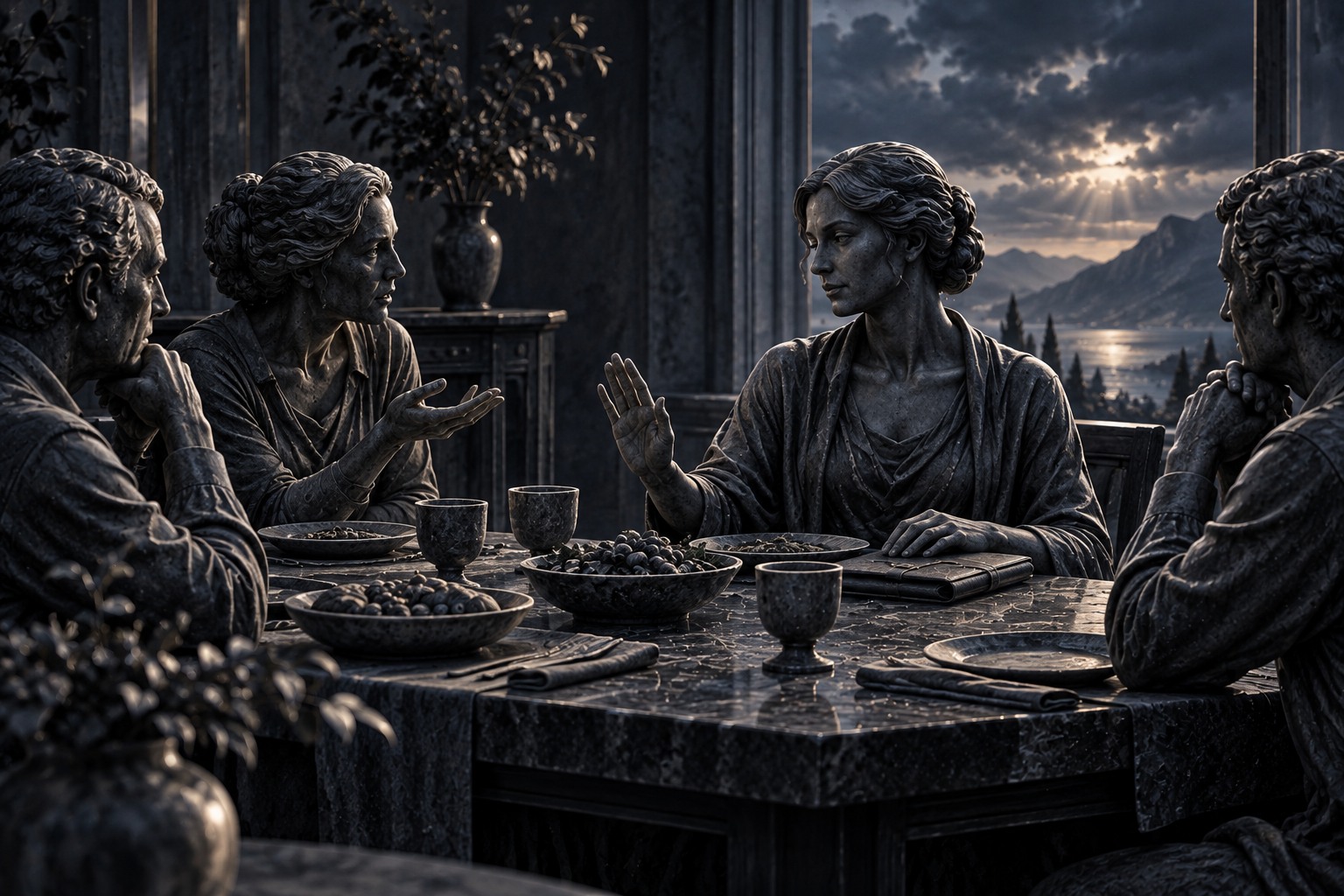
At a family dinner, someone is asked when they will finally have children. The question sounds like ordinary interest but already assumes that their present life is temporary and a suitable answer must explain the delay. They may not want children, may want them without having them, may not know their decision or may not want to discuss their personal history. From outside, these positions can look alike. Another person’s curiosity does not make them alike.
This article distinguishes an observable circumstance, an actual decision and other people’s expectations. Respect does not require treating every answer as final forever. Nor does it require allowing further questions until a sufficiently convincing explanation is found. What is unknown can remain unknown without becoming a diagnosis, secret regret or an obligation to prove a life’s completeness through other achievements.
We consider invented scenes, Hamilton’s historical argument and a limited question from a modern study. There is no advice about treatment, fertility or a reproductive procedure here. Future feelings are not predicted. Shared plans with a partner need their own conversation, but relatives, colleagues and acquaintances do not gain automatic access to the entire biography of someone without children.
I. Not having a child does not explain itself
In our invented scene, thirty-eight-year-old Irina visits her mother Vera. She does not want to become a parent and has said so before. At dinner, Vera offers to introduce her to someone who will supposedly help change her view of family. Irina hears an earlier decision about her rather than a new proposal: without children, the right life has not yet begun. We need not declare Vera heartless to see the subject of their disagreement.
Lena leaves the same gathering and also has no children. She wanted them but does not tell relatives the details of her history. These two invented women occupy different positions. If both decline to discuss the topic, refusal neither erases the difference nor confirms a shared hidden cause. A listener may be left with little information. Lack of information does not confer a right to choose the most convenient explanation for someone else.
An observable circumstance and an intention answer different questions. Having no child now does not necessarily mean not wanting one, being unable to have one or fearing responsibility. A person may have a plan, uncertainty or a past event the listener knows nothing about. This article does not distribute acquaintances among those possibilities. It invites us to notice where observation ends and an account constructed by others themselves only begins.
This distinction preserves the possibility of real participation. If Lena herself says she is struggling, she can be asked what support suits her. If Irina states a decision, it can be heard without an immediate offer to correct it. If someone has said nothing, the topic need not become central to the encounter. Each response has a different subject. The same persistence rarely constitutes precise participation simply because it is explained through the same good intention.
The word a person chooses for themselves matters too. They may describe themselves as childfree, simply speak of having no children or use no category at all. A word helps name a position but does not permit others to interrogate its reasons. Its absence does not automatically make someone indecisive either. The freedom not to discuss a history must not depend on knowing a suitable term, sounding confident or being able to answer briefly before the whole family.
Sometimes a question really is needed to arrange a particular gathering. How many people will come, is a separate bed needed, who is joining tomorrow’s trip? Then that can be asked directly. An answer about the present guest list does not require explaining why the family has that composition. If Vera is arranging a holiday together, she needs the actual conditions of participation rather than a final account of Irina’s reproductive history. This precision leaves room for care: the comfort of those present can be considered without making the absence of another participant compulsory dinner conversation or collecting information unnecessary to the present task.
II. Decisions, circumstances and uncertainty need not share one account
Irina has a decision of her own, but it need not take the form of an exhaustive treatise. She can know she does not want parenthood without being able to list every reason in order of importance. Consequences can be considered without making the ability to defend a choice at dinner a condition of independence. A weak reply under unexpected pressure does not prove the decision itself is weak. Someone is not obliged to agree because another person argues better.
Lena, in turn, need not publicly specify the circumstances that led to her present life. She may have feelings that do not fit a short explanation. We do not know those circumstances, and the scene does not permit inventing a medical cause. Support is possible at her own request. It does not require enough details first for those present to decide whether her experience deserves respect and whether they may stop giving advice.
Someone else does not yet know whether they want children. Uncertainty can have real content rather than disguise agreement with the family’s expectation. A person can think, discuss consequences and obtain relevant information without rushing to declare their inner history complete. Yet uncertainty does not promise a partner the desired outcome. Where shared plans are affected, what is unknown should also be named as unknown rather than maintaining another person’s convenient assumption through silence.
A changed decision does not automatically make the earlier statement dishonest. The time, what was known then and what was actually promised matter. If Irina someday wants another life, her relatives do not retrospectively receive proof that all their earlier pressure was helpful. If she does not change her decision, she need not demonstrate eternal certainty to justify her present choice. Independence is not an obligation never to encounter a new circumstance or a contradictory feeling.
Different histories therefore need not have one exemplary answer; they need room to retain their own form. One person finds a clear statement of choice suitable, another declines discussion, a third talks to a particular person. These forms need not be equally convenient to the listener. Their confusion can be acknowledged without giving them a right to appoint the details. The unknown part of a biography remains unknown even after the family has agreed to stop asking questions.
III. Hamilton: the person before the assigned function
At the beginning of Marriage as a Trade, Cicely Hamilton explains what she means by a woman. She refuses to evaluate personal worth through marriage or the capacity to bear children. This is the author’s normative argument from the early twentieth century. It does not prove that all women experience motherhood alike or establish a medical or legal norm. What matters for our topic is refusing to reduce a person encountered to one presumed function.
The historical work is broader than today’s question: Hamilton considers economic dependence and marriage as a livelihood. Her generalisations about men, women and earlier societies are not adopted here as verified modern facts. Nor are the religious, racial and evolutionary stereotypes found in the chapter. Choosing a limited ethical distinction does not mean accepting the author’s entire system as correct or receiving from it an answer to a present private history.
In Irina’s scene, that distinction changes the direction of attention. She came to talk about work, see her mother and spend an evening together. If every account is returned to the absence of children, her presence becomes preparation for a function not yet performed. A listener can sincerely love parenthood. But their own significant experience does not decide which part of another life must be central and which is permissible only until the correct stage arrives.
The reverse substitution is possible too. Irina may start presenting motherhood as a loss of independence in general to defend her decision. Then another obligatory picture replaces the first. A parent can love their life, a person without children theirs; both can face difficulties and change their forms of participation. Respect for difference does not require devaluing another path. It is not built on a competition over whose life is freer, more useful or more meaningful.
Hamilton is not appointed the voice of everyone without children, and the modern word childfree is not retrospectively attributed to her. Her text leaves a historical question about who is noticed behind a social assignment. We transfer that question editorially to a wider range of people, retaining the differences between periods and subjects. This transfer does not mean a dinner guest must accept the author’s philosophical position to have the freedom not to recount their life.
IV. A research category does not diagnose a neighbour
In Jennifer Watling Neal and Zachary Neal’s 2023 study, different positions among adults without children are distinguished through answers about plans and wishes. The data came from a survey of a thousand Michigan adults; this is a cross-sectional study rather than observation of their entire subsequent lives. A limited question matters here: having no children alone does not tell us how a person would answer about intentions. A research classification should not become an external diagnosis.
Such a diagnosis can be made subtly without medical vocabulary. Acquaintances decide that Irina will certainly change her mind while Lena is simply concealing her choice. They already know the entire history from one observable circumstance. Yet the study’s questions were addressed to participants themselves. Our everyday conclusion is more modest than its statistics: if an answer is unknown, it remains unknown. Another person’s decision cannot be obtained through confident supposition and then that person asked to justify deviating from it.
Categories can be needed for a particular task, but a person need not become a permanent questionnaire. A family dinner does not require establishing the research status of everyone present. Current experience can be discussed without assigning every relative to a final group. Irina can use her chosen word; Lena can choose none. No one needs to prove their history is typical for their statement or refusal to discuss it to be heard.
A sample from one region does not automatically describe every country and culture, while cross-sectional data do not predict an individual’s future decision or regret. There is therefore no conclusion here that the people in our scene will necessarily retain their present positions. Nor is there a statistical promise of freedom from pain. A research limit concerns the scale of knowledge; editorial respect concerns how we treat someone now, while the future remains unknown.
These areas cannot substitute for one another. We do not need a figure showing how many people resemble Lena to refrain from demanding a public explanation. A group’s general prevalence is insufficient for discussing plans with a partner. Research helps distinguish questions but does not choose participation for people. It neither makes the article’s practice clinically tested nor supplies universal permission to collect personal details out of an interest in the right category.
V. Shared plans need clarity rather than an audience
In another invented scene, Irina talks to her partner Alexey. He wants parenthood; she does not. This is a significant difference in future plans. It cannot be removed by saying relatives should not ask at dinner. A partner is affected in the arrangement of their own life and may need an honest conversation about compatibility. But participating in that conversation gives no right to demand a reproductive action, a promised change in feelings or public defence of a decision before the family.
Clarity can be unpleasant. Irina states her current decision without promising that suitable persuasion will change it. Alexey describes his desire without declaring it more mature or moral. A real difference now exists between them and needs consideration. It proves no lack of love on either side. Love does not guarantee the same plan or make relinquishing an important desire the only permissible way to preserve another person’s dignity.
Uncertainty has consequences too when it is real. A person may say they have not yet decided; their partner may understand they are not ready to build a life on those terms. Nobody receives a promise of the desired result after a stipulated period. They can agree when to return to the conversation without appointing an obligation to want by that date. A discussion date concerns availability for conversation rather than producing an inner response of the required content.
A detailed personal history and information about a shared plan do not coincide entirely. If Lena were discussing the future with a partner, she could name circumstances significant for participation without making them available to every acquaintance. This article determines neither the medical completeness of a statement nor legal disclosure obligations. Profile-specific decisions, where needed, are considered separately with a suitable professional. Our subject is not making the family dinner audience compulsory for every necessary private conversation.
Sometimes the next step is changing the relationship rather than one desire winning. Sometimes people find a suitable arrangement together; sometimes they acknowledge incompatibility. There is no demand to preserve every couple here and no advice to separate immediately. What matters is not presenting an uncertain promise as an agreed plan or turning the pain of difference into a right to coerce. An honest answer can limit a shared path while retaining recognition of both people with their intentions and limits.
VI. Future regret does not permit present pressure
Vera tells Irina she will regret her decision later. Irina may respond with a counter-promise that she will never regret it. But the conversation then becomes a competition between predictions for which neither has the entire future life. It need not be won to preserve independence now. Unknown future feelings can be acknowledged while saying the present question already has an answer. Possible regret does not make another person the owner of the decision in the present.
Any significant path includes what did not happen. Someone can sometimes think about a possibility not chosen without regarding their entire life as a mistake. They can experience pain, joy and doubt at different times. This article appoints those feelings neither inevitable nor identical. It simply does not require a flawless emotional report to confirm a correct choice. One hard evening need not become an admission that all the other person’s persistence was care that should have been accepted.
Equally, accounts from people satisfied with life without children do not cancel the experience of those for whom the absence of parenthood is painful. Lena need not be happy to avoid confirming someone’s stereotype. Irina need not perform sadness to seem sufficiently profound. Both invented women can have a genuine feeling without becoming representatives of an entire category. A listener’s participation is more precise when it answers a reported experience rather than seeking convenient proof of a picture already chosen.
Vera is entitled to feel sadness about an unfulfilled expectation of grandchildren. Her experience is real but does not become an obligation for her daughter to enact the anticipated life. The mother can seek support from another adult, discuss her disappointment and change plans for spending time together. Irina can offer care without taking on the removal of that feeling through parenthood. Separating an experience from a demand does not prohibit relatives from having hopes; it prevents a hope being presented as another person’s existing debt.
Respect therefore does not depend on a guarantee of an error-free choice. It can remain when someone later thinks differently or acknowledges the complexity of their history. Support must not become a reward for proven correctness and disappear at the first doubt. But doubt is not an invitation to start persuading without asking again either. It can be clarified whether the person wants discussion, practical help or simply a listener, leaving room to decline each of those forms separately.
VII. Free time does not put you at others’ disposal
At work, Irina is asked to take the inconvenient shift every time because she has no children. Perhaps today she can help and wants to. But her household situation does not reveal all her commitments, rest and resources. This article establishes neither employment rights nor a particular organisation’s rota. It offers an editorial question: is each participant’s actual availability being discussed, or is the absence of one kind of care treated as automatic permission for any extra burden?
Irina can name a specific limit without producing evidence of an equally important family reason. She may have a meeting, a personal matter, necessary rest or a commitment whose details her colleagues need not know. This does not make the shared task disappear. It needs resolution through intelligible participation arrangements rather than a tacit assumption that one life is always more flexible than another. Someone’s resources cannot already be determined by the absence of a child in a photograph.
A similar question arises in the family when Lena is considered permanently available to care for relatives. She can love them, volunteer and also have a limit. She need not accept the whole burden first to prove that life without children also contains care. Refusal of a particular task does not exhaust a relationship. An actual commitment already accepted, however, should be fulfilled or honestly reconsidered; having no children does not automatically release someone from agreed participation.
The opposite extreme would present any help as surrender to social pressure. Someone may want to spend time with nieces and nephews, support friends or help parents. These wishes do not refute their decision about their own parenthood. Nor must they serve as a substitute that gives life permissible meaning. Care has a particular author and subject; it need not be forced to confirm a suitable explanation of why that author has no children.
Where a task is shared, naming the task and availability is preferable to demanding a whole biography. Who can actually participate today? What has already been accepted? How is the gap allocated if someone declines? Answers can be difficult and do not guarantee a fair agreement. Yet the subject remains visible. Irina discusses a shift, Lena a particular act of help for a relative; neither must first defend their household situation as morally serious enough to have a limit.
VIII. Life need not become a project of justification
After dinner, Irina wants to tell her mother about a walk and a book. Vera can hear this as an account of an actual life rather than filling time until children arrive. Listening in that way does not require agreeing in advance with every decision her daughter makes. It is enough not to translate every statement back into an unfulfilled assignment. The encounter acquires a present subject: two people can get to know each other without examining one of their life paths every time.
Irina need not present an outstanding career, travel or social benefit to counterbalance having no children. Lena need not prove that circumstances have already been transformed into wisdom. Ordinary life can contain work, shopping, fatigue, friendship and many small tasks. This article does not establish its worth through a comparative ranking of achievements. An especially attractive account need not be created for others to stop treating access to personal history as a compulsory condition of respect.
Yet talking about one’s life can be welcome. Irina can discuss choice, Lena an unfulfilled wish, someone else uncertainty. What matters is that a statement has an author, an audience and a present purpose. Wanting to speak once does not permit everyone there to ask at any time or repeat the account to others. A narrative’s boundaries can change. They neither devalue closeness already shared nor require earlier openness to be declared a mistake.
Hamilton’s historical position and the Neals’ research distinction answer different questions. The first does not reduce a person to a presumed function; the second shows why people’s own answers matter for a limited classification. They do not form one doctrine or prove an exercise’s effectiveness. Editorially, their intersection helps us pause before a conclusion usually drawn too quickly: having no child does not yet reveal a personal decision, an entire history or a future feeling.
At the beginning of dinner, the question already appointed a suitable ending. Now an encounter is possible without an ending written for someone else. Irina remains a person with her decision; Lena a person with a private history; Vera a person with expectations that do not become another’s debt. Differences can remain. This article does not promise to remove pain or conflict; it leaves room to discuss present participation without turning an entire life without children into an endless response to someone else’s demand for an explanation.
What this means in practice
If suitable and safe, recall one recent question about children rather than the entire relationship history. Name the known circumstance, your own response and the listener’s supposition separately. For example, there are no children now; you do not want to discuss the topic; the other person decided silence means doubt. Those three parts are not identical. They can be noticed alone without inviting a relative into a joint exercise or disclosing further details for a precise description.
Choose the amount of an answer you are actually willing to give. It may be a statement of a current decision, acknowledgement of uncertainty or simply refusal to discuss it. Do not add a medical cause, an invented promise or a long defence of your whole person for persuasiveness. If a particular shared plan is affected, name information about it separately. An important conversation with a partner need not permit a family interrogation to continue before another audience.
After answering, consider an action rather than victory in an argument. Did the question stop, the conversation change, the pressure continue or did you choose to end the encounter? These are possible observations rather than a diagnosis of another person or a guarantee of future respect. A personal history need not be repeated in ever more detail until it becomes sufficiently weighty. The next step depends on actual relationships, support available and your readiness to continue rather than an exercise’s compulsory success.
The practice can be skipped. It is editorial reflection rather than a clinical method, reproductive consultation or legal instruction. It does not guarantee agreement or predict regret. Where refusal brings threats, coercion or danger, protection does not await a successful phrase or a joint meeting; suitable local assistance needs its own consideration. Life without children need not be a public declaration to remain the actual life of the person being spoken to now.
Key quotation
“…I separate the woman from her attributes.”
Cicely Hamilton, Marriage as a Trade, 1909, chapter I, the final part of the second sentence in the paragraph on personal judgement of a woman; source. In this context she refers to marital and maternal attributes. The author’s distinction does not cancel the significance of relationships freely chosen.
Connections between traditions
| Lines of thought | Comparable question | Difference and limit |
|---|---|---|
| Hamilton, I ↔ a present family expectation | A person is not exhausted by a presumed function | Historical normative position rather than a modern scientific generalisation |
| Hamilton, preface ↔ editorial limits on participation | Economic circumstances and feeling are not identical | Historical marriage theory does not determine present employment or family rights |
| The Neals, methods ↔ an unknown personal history | Having no children does not equal one intention | Survey classification is not an external diagnosis |
| The Neals, limitations ↔ predicting another’s regret | The scale of knowledge is limited | Cross-sectional regional data do not predict an individual future |
| Historical argument ↔ modern research | A person can be distinguished from a ready explanation | Different genres and subjects; no consensus or proven effectiveness of the practice |
Sources
- Cicely Hamilton. Marriage as a Trade. New York: Moffat, Yard and Company, 1909; actual title and copyright page of the digital edition. Gutenberg 54704, release 2017-05-11, updated 2024-10-23. Metadata, the preface, all of chapter I and the selected opening of II were read; not the entire work. Two short roles from the author’s own voice rather than nested quotations; historical universals and stereotypes are not adopted as present facts.
- Jennifer Watling Neal, Zachary P. Neal. Prevalence, age of decision, and interpersonal warmth judgements of childfree adults: Replication and extensions. PLOS ONE 18(4), e0283301, 2023-04-05. Selected definitions, complete methods and discussion, displayed results and limitations were read; tables, data and code were not separately verified. The distinction between intentions and limits on regional cross-sectional knowledge is used rather than an individual regret prediction, diagnosis or clinical recommendation.
Tags
life without children, childfree, choice, circumstances, uncertainty, expectations, parenthood, motherhood, fatherhood, personal history, privacy, refusal, explanation, family, partner, compatibility, shared plans, regret, prediction, respect, care, availability, work, responsibility, pressure, independence, Hamilton, Michigan, research categories, voluntary practice
About the authors
Andrey Zarinsh is the author and founder of United Wisdom. He explores inner transformation, connections between traditions, intercultural dialogue and contemporary spiritual discipline. Instagram: @andrey.zarinsh.
Maria Evilkut is a co-author of United Wisdom. Alongside her research, she seeks to examine these ideas in practice and observe how principles of unity and mutual understanding work in real life between people and cultures. Instagram: @ilkutki.
Keep what resonates with you.