
Relationships
Rituals of belonging: how a group recognises its members
A repeated form, its understandable meaning, participation, observation, and refusal's cost in a group.
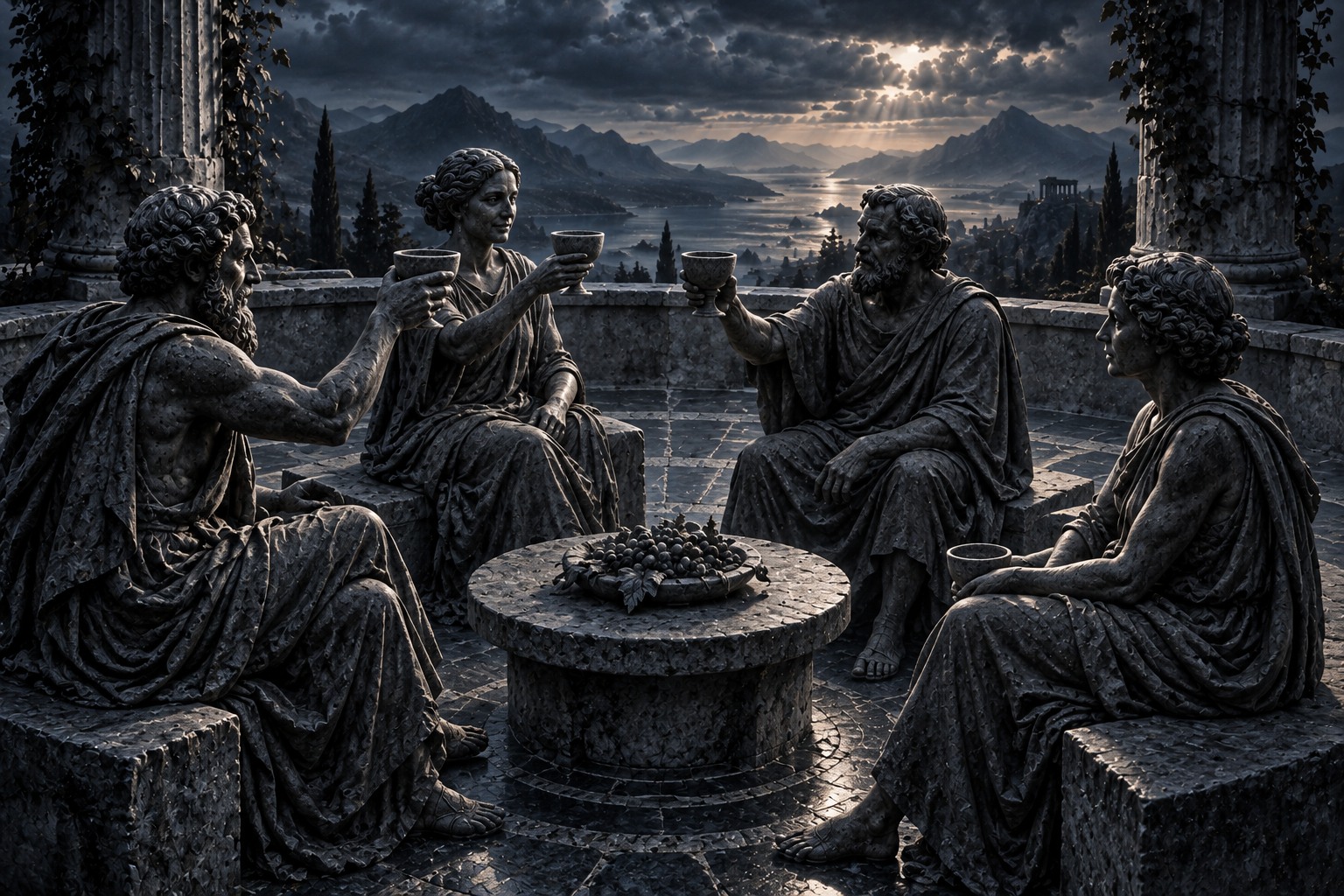
Epigraph
moral community
Émile Durkheim, The Elementary Forms of the Religious Life, translated by Joseph Ward Swain, Book I, Chapter I, IV, p.47; a short fragment of the definition of religion, web line513. This historical term neither declares every group religious nor establishes its moral correctness. Text.
What this article is about
One circle begins every meeting with a shared toast. Another asks newcomers to listen to the story of the place. A team ends its project with the same photograph, a family repeats a familiar greeting, and a community follows a particular way of welcoming people. These forms can help people recognise the continuation of a shared life. Yet identical actions do not automatically convey identical meanings. One person participates gladly, another makes a familiar gesture without any particular feeling, and a third does not understand what they are accepting. The ritual is visible; participants' experiences and meanings remain different.
Here we provisionally call a ritual a repeated, recognisable form to which participants give a shared meaning. This is an editorial description of everyday scenes, not a new scientific classification. Our question is when a form opens participation and when it becomes an examination of belonging. We consider meaning, roles, explanation to newcomers, observation, and the cost of refusal. Historical texts retain their religious and ethical contexts; they do not prove that a contemporary celebration works. Nobody must reject all traditions or necessarily join them to live appropriately among others.
I. Repetition makes a form recognisable
Imagine a small community meeting for dinner once a month. Before eating, participants take turns naming one event for which they are grateful. The order repeats, so familiar guests no longer need an explanation of how the evening begins. For Anna, the circle offers a way to hear about everyone's month. Pavel likes the pause before dinner, but finds it difficult to describe events. A newcomer, Lev, thinks he must choose an especially worthy answer. Everyone appears to sit at the same table, but their access to the form differs.
Familiarity helps only as far as the actual conditions are known. Anna understands that a contribution can be brief. Pavel is unsure whether he may pass. Lev does not even know whose idea this was or which answers people usually accept. A ritual's familiarity to its organisers does not make it understandable to everyone. Some conditions can be named: why the circle is offered, how long a contribution takes, and whether listening is possible. This explanation promises no closeness. It makes the proposed action accessible when it might otherwise look like a hidden requirement to say something correct.
There is an opposite counterexample: an excessively detailed instruction can turn a relaxed evening into a compulsory procedure. People who understand the form and encounter no difficulty need not continually account for every aspect of its meaning. A familiar habit can continue without separate analysis. These questions concern situations where uncertainty or a cost of participation has appeared. They do not require searching for oppression in every repeated gesture. A possibility of asking should remain when meaning stops being obvious or conditions change for someone at the table.
Repetition therefore deserves distinction from coercion. It can provide a convenient shared order, but the number of repetitions does not create everyone's indefinite consent. Pavel may have spoken gladly in previous months and prefer not to share now. Anna can value the circle without treating it as the only form of closeness. Lev can observe for the first time without choosing full participation. These possibilities do not establish a ritual's equal suitability for all. They show that a shared form and a personal response remain two sides of the encounter, even when most people know the form well.
II. An identical gesture does not certify a shared experience
Everyone raises a glass, and the organiser says that the evening demonstrated complete unity. The gesture alone does not establish this. For one person it expressed gratitude, for another politeness, and for a third a wish not to delay dinner. Such differences need not make an action false. People can participate together for different reasons if the meaning and conditions require nothing further. A substitution occurs when observable participation is declared proof of identical belief, identical feeling, or agreement with everything in the community, although nobody accepted that promise.
Sometimes a ritual does involve a particular belief. Organisers may regard agreement about meaning as essential to that ceremony. Then this condition should be named rather than presented as mere outward politeness. Lev can assess what is offered. Perhaps he will not join the ceremony; perhaps the group cannot offer another format here. The restriction remains real, but it should not expand into a general verdict on human worth. Refusing a particular symbolic act and being incapable of consideration for others are different claims.
Pavel may participate without strong feeling because he values the people and wants to support the evening. This is also his own reason if the action is voluntary. An inner change need not be demanded to recognise his participation as real. Equally, he need not say that such a change occurred. A named feeling should not become the only acceptable response. A group can recognise a shared gesture without claiming authority over all its performer's experiences. Inner life does not become transparent merely because the outward form was completed without error.
Someone may personally want to explore their experience through the ritual. This is an individual proposal, not everyone else's obligation. They might notice enjoyment, awkwardness, no response, or an unclear result. No such observation establishes a diagnosis or confirms the form's effectiveness. An organiser promising a particular experience to everyone needs other grounds. Our hypothetical scene supplies none. It is enough here to acknowledge that identical action can retain different meanings and that describing one's response honestly need not destroy respectful shared presence.
III. A community differs from an incidental audience
In Durkheim's Book I, Chapter I, the definition of religion includes shared beliefs and practices linking people. He distinguishes this community from a clientele whose members may not know each other. This is a historical theoretical argument about religion, not a rule for every contemporary group. It helps our question distinguish shared presence from participants' relationships. It does not establish that a repeated secular dinner necessarily creates a community or makes its participants morally better.
Twenty people can watch the same concert without any continuing connection to each other. Elsewhere, three people meet at a table, know each other's tasks, and are prepared to participate in certain ways later. The number present does not decide the question. Actual relationships matter alongside the shared symbol. Yet a lack of subsequent acquaintance does not make a concert unsuccessful: its audience may have gathered specifically for the event. A ritual need not create membership where people wanted a limited shared impression without a promise of common life.
A dinner organiser may expect the storytelling circle to make unfamiliar people close immediately. This is a desired outcome, not an established action of the form. Lev may hear interesting stories and remain a new visitor. Anna may enjoy the evening while having no time for additional meetings. If every participation automatically becomes entry into continuing obligations, the form acquires a hidden scope. Presence at an event, a wish to return, and acceptance of a particular role deserve distinction. They can coincide without all arising from a shared toast.
Genuine continuation is also possible: participants arrange another meeting, offer help with a particular task, or maintain interest in each other. Such actions can make a community more concrete if they actually happen. They should not be attributed to the ritual as a proven result. They belong to particular people and accepted arrangements. One can value the evening's shared order while recognising the organisation, time, and consent on which further participation depends. Symbolic recognition of members does not replace asking what people are prepared to do for each other beyond the ceremony.
IV. Explaining a form need not impose a belief
Anna tells Lev that the circle began after a difficult period when participants wanted to notice ordinary good things. This history explains its meaning to the organisers. It does not oblige Lev to experience the same thing or make his lack of similar experience a defect. A newcomer can understand why a form matters while retaining a different response. Explanation differs from an appeal requiring someone first to accept the group's biography as their own. Belonging should not depend on inventing a confession of always sharing a memory one encountered only today.
A form can carry several meanings within one group. For Anna it is memory; for another participant, conversational order; for an organiser, the beginning of dinner. If this difference suits people, no single inner version needs appointment. But if some regard a gesture as secular and others as confirmation of religious belief, ambiguity can carry a significant cost. Those different expectations deserve naming. Every difference need not disappear, but an important condition of consent should not hide behind a general statement that everyone understands things in their own way.
Lev might ask a simple question about the order and hear that members do not ask questions. This is an observable condition of participation, although the respondent's motive remains unknown. They might be hurried or unable to explain; perhaps questions really are forbidden. An appropriate clarification can establish what explanation is available. A newcomer is not required to pursue admission indefinitely. If meaning remains hidden while the group emphasises its importance, he can decline the action. Acknowledging uncertainty is more honest than pretending agreement or declaring everyone deliberately manipulative.
Explanation also has limits. Not every host can give a complete historical account of every gesture's origin. They can state their own meaning and what they do not know. This need not destroy the encounter's value. A conjecture should not become an ancient general law, and a tradition's name should not replace grounds. When a form comes from a particular religious context, that context deserves preservation within its actual scope. A contemporary wish for a warm evening does not turn different teachings into one source automatically confirming every new action.
V. Inner participation exceeds flawless performance
In Analects III.3–4 and III.12, in James Legge's English text, ritual is considered alongside humanity, feeling, and personal presence. This historical ethics of ritual relationships offers a question about outward observance, without transferring ancient roles to today's dinner or deciding a guest's moral worth from their feelings or refusal.
Pavel follows the order precisely but notices that he cares more about the correct phrase than the conversation. He can consider this observation without declaring the form empty for all. Anna, conversely, finds it meaningful. Different responses can coexist if no identical inner result is demanded. A performance error also supplies no complete knowledge of someone's attention. Lev confused the order because he misunderstood the explanation. Anna forgot the words but wanted to support someone. These hypothetical examples do not measure sincerity; they retain the limits of outward assessment.
A counterexample concerns responsibility for the shared form. If Pavel agreed to lead the circle and did not prepare its opening, others are affected. Personal detachment from the ritual does not cancel an accepted task. He can change the role beforehand, ask for help, or acknowledge an omission. This differs from requiring a correct feeling. The group can discuss performance of a particular promise while retaining the limits of knowledge about inner life. Responsibility and voluntary participation do not require choosing between complete control of experience and no consequences for shared work.
Deliberate imperfection should not be demanded as proof of sincerity either. Someone may enjoy performing a familiar form precisely. Attention to order need not conceal emptiness. The historical text poses a question without providing a contemporary instrument for reading another's heart. A difficulty in one's own participation can be named. Assessing others requires grounds beyond outward error or flawless performance. A ritual includes action, meaning, and relationship; no visible sign automatically reveals all three or allows definitive ranking of the people at the table.
VI. An observer is also present at the encounter
Lev wants first to listen without contributing his own story. If the group permits this form, observation becomes a defined participation rather than a secret failure. He hears the order, notices subjects, and can later decide whether the circle suits him. Organisers can name which parts are accessible to a guest. They need not promise that observation will necessarily lead to full membership. Presence, performance of a gesture, and acceptance of meaning can remain distinct. Each step has its own scope, which should not be silently added to the previous one.
Not every ritual allows outside observation, however. Some forms matter specifically to particular participants or involve confidential stories. The group can then explain its restriction without declaring someone unworthy. An accessible dinner and a closed part of the meeting may have different conditions. Where no alternative exists, this is a real limit of the space rather than a compulsory defect in the newcomer. An invitation should not appear open and then require full participation at the door. Honest conditions let someone assess the offer before having to refuse in front of everyone.
The observer can create a risk too. They might treat another's form as a spectacle, photograph participants without agreement, or mock its meaning. The right not to perform a gesture does not confer control over other people's stories. A group can restrict specific behaviour without cancelling voluntary refusal of the ritual. Someone can respect another's meaning without adopting it. Less extensive participation retains responsibility for actual actions, even when a person does not choose the whole form of belonging.
Anna may feel disappointed that Lev did not join. Her feeling also has a place, but it does not establish his obligation to repair her experience immediately. She can name the form's meaning and hear his response. He can acknowledge its importance without promising to participate. Incompatible expectations may keep their acquaintance limited. This disagreement need not hide behind compulsory optimism. An encounter can provide more precise knowledge of conditions without creating desired closeness. Observation is a possibility, not a universal way to make every ritual accessible to everyone.
VII. The cost of refusal can reveal a hidden condition
The organiser calls the circle voluntary, but after passing Pavel is no longer invited to ordinary discussions of shared matters. Another circumstance may have changed; the actual arrangement still needs establishing. If joining the toast really became a condition of unrelated access, this matters. Refusal affected more than one gesture. A word on an invitation cannot alone confirm voluntary participation. One can examine the consequences linked to a response and their relation to an accepted role. Missing explanation remains uncertainty, not grounds for automatically calling every reduced contact a punishment.
Some consequences relate directly to a form. A person who does not participate in preparing a performance may lack a particular role on stage. This differs from losing every opportunity to talk with friends. The distinction depends on the subject and facts. Pavel need not retain his former role at every level of participation; the group gains no right to humiliate him for changing. Refusal can carry a cost and remain his decision. Acknowledging that cost is more honest than promising that voluntary participation always leaves everyone without inconvenience.
A counterexample involves accepting a form to obtain another desired participation. This may be someone's decision under limited conditions, but those conditions cannot thereby be declared perfectly free. Available alternatives and organisers' power matter. This article does not determine how free a particular choice feels internally or require risky public refusal as a test. The link between a gesture and access can be noticed before action is chosen. A right to consider a condition should not become an additional obligation to demonstrate courage before people controlling its consequences.
If refusal involves threats or coercion, renewed participation or direct explanation is not prescribed practice. An appropriate order depends on circumstances and available support. The article promises no universally safe sequence. A private pause remains possible in less dangerous situations too: someone may not yet know what they want to change. A hidden condition can be named privately without immediate public contest. Rituals operate in actual lives where symbolic action can involve resources and relationships that a beautiful statement about freedom cannot cancel.
VIII. A repeated form requires someone's labour
Dinner seems to happen by itself because Anna brings dishes, chooses a time, and reminds everyone each month. During the circle she manages turns and introduces newcomers. Calling the action a tradition does not erase this labour. When everyone expects the familiar evening, it matters who makes it possible and under which conditions. Anna can value the role while wanting to reduce it. Shared memory does not create one person's indefinite agreement to maintain the form for everyone without reconsidering the load.
The group can share small tasks if people are prepared to accept them. Pavel organises the next evening, someone explains the circle to a newcomer, and another helps clear the table. These are concrete proposals, not guaranteed results of ritual. Roles may prove unsuitable or lack willing performers. The form would then need changing, shortening, or temporary suspension. The absence of dinner does not necessarily mean every relationship disappears. People can retain a separate conversation without the former organisation. Belonging exceeds one repeated event, although losing it may matter.
The opposite danger is making universal assistance the price of a place at the table. Not every guest can contribute equally. Time, capacities, and circumstances differ. A group can name necessary participation but should not hide it beneath an unconditional invitation. Different roles and limits can be discussed without promising that every allocation will be fair. Clarity and agreement matter here. Calling something a common ritual does not turn another's labour into an inexhaustible resource or entitle a newcomer to service without regard for their hosts' capacities.
The allocation of labour also changes symbolic meaning. If only one person can always lead, the circle communicates an arrangement of roles alongside community. This may fit the group's meaning; every stable role need not be judged oppressive in advance. Participants should nevertheless know what remains fixed and why. Declared equal participation alongside one person's exclusive, unquestioned right to begin and explain raises separate questions. Atmosphere alone cannot answer them. A warm evening and restricted access to a role can exist together.
IX. Changing a form need not mean forgetting the past
Pavel suggests sometimes skipping the storytelling circle and simply eating. Anna fears losing an important memory. Both subjects are real: the present form's suitability and the past's meaning. Frequency, contribution length, or a separate commemorative event can be considered if people want an alternative. A possible change should not be promised beforehand. Anna may regard the circle as essential to her gathering. Pavel may find no place in it. Retaining respect does not guarantee a single form satisfying everyone and reproducing former closeness without loss.
The selected Analects III.15 and III.17 place questions about order alongside preserving ceremony. They offer no contemporary collective revision procedure. Our comparison retains that tension without assigning ancient text a duty of free guest choice: Anna and Pavel must address their own conditions.
A counterexample appears when a new form is called identical despite substantially changed meaning. A gratitude circle becomes compulsory reporting of personal achievements. Earlier agreement to dinner does not automatically cover this expansion. The new proposal and response deserve naming. Conversely, outward words may change while participation's meaning remains for people. Change then need not destroy connection. Assessment depends on what actually matters to participants, rather than merely matching a former name, text, or sequence of gestures.
The past can remain valuable after a form ends. Anna can remember good evenings; Pavel need not continue each of them to recognise their significance. Lev, who arrived recently, need not claim equal memory either. Participants have different histories, which is precisely why a new arrangement may need explanation. Acknowledging differences does not dissolve a shared event. It allows remembrance without requiring everyone to feel the same in every future month. A ritual belongs to people's history, but history does not become the owner of each subsequent action.
X. Recognising members should leave room for a response
In one possible outcome, the group retains the circle while allowing people to pass and explaining the form to new guests beforehand. Anna continues valuing it, Pavel sometimes listens, and Lev chooses participation after learning the conditions. This is a hypothetical possibility, not evidence of the new arrangement's effectiveness. The format may still fail to suit someone. Its value here is that visible actions no longer become a complete inner response. Participants recognise the evening while distinguishing presence, storytelling, accepted meaning, and a further promise.
In another outcome, the circle remains compulsory for this meeting. Pavel chooses another way of relating if available, or acknowledges losing part of the connection. Anna may regret this without declaring him a worse human being. The group can retain its form without claiming authority to assess all his relationships beyond it. This outcome has a cost and need not be pleasant. The article does not require calling it success. Clear conditions can end in a separation that a more beautiful explanation of tradition or a promise of eventually feeling the same cannot repair.
Considering a ritual involves asking what it makes recognisable: shared memory, an event's beginning, an accepted obligation, or a particular belief. Then one can ask which participation is required and which responses are allowed. An exhaustive philosophical formula is unnecessary every time; what matters to the present difficulty can suffice. If the form became an examination, outward performance and admission's hidden scope need distinguishing. If it suits people, it can be valued without compulsory analysis. More checks do not make belonging more real, nor require finding a defect in every peaceful evening.
A repeated action can hold memory and open an encounter, but living people sustain its meaning. They explain, respond, bear labour, choose participation's scope, and change circumstances. A question about ritual therefore returns to an available form of relationship alongside correctness of gesture. People can recognise members through shared history without requiring identical experience or turning refusal into a complete moral verdict. A ritual remains a particular action with a defined meaning. Its value requires no endless power over those who once agreed to participate.
What this means in practice
If you wish, choose one repeated group gesture that has become unclear or difficult. In a private note, distinguish the outward action, its known shared meaning, and your own reason for participating. Do not establish another's feelings from how precisely they performed the form. Name only what is known and still unknown. The note need not be shown to participants or turned into immediate refusal. You may find that the form still suits you, a small explanation is needed, or no response is ready. None is a diagnosis or maturity examination.
When discussion is appropriate and voluntary, one condition can be clarified: observation, contribution length, a particular role, or a new gesture's meaning. Do not promise to change the entire tradition or demand that others stop valuing it. Name the participation you can actually offer while retaining another possible response. Consider refusal's real cost separately. Under threats or coercion, public testing and disclosure of plans are not prescribed; an appropriate safe order depends on circumstances. This article does not replace necessary information or suitable support in a particular situation.
After a possible conversation, notice changed conditions alongside the evening's mood. Did the form become clearer, the role more defined, or a pause more acceptable? Or did continuing disagreement emerge? The practice promises no acceptance and has not been tested as a way to strengthen a group. It offers distinctions among memory, action, labour, and consent. A shared gesture can then remain valuable within its scope without becoming compulsory confirmation of someone's entire inner life or creating a duty to keep experiencing feelings others would like to see.
Key quotation
eminently collective thing
Émile Durkheim, The Elementary Forms of the Religious Life, Joseph Ward Swain, Book I, Chapter I, IV, p.47, web line514. A short fragment of the author's own conclusion about religion. No extension to every secular ritual is claimed. Text.
Connections between traditions
| Read text | Question | Difference and limit |
|---|---|---|
| Durkheim, Book I, Chapter I, IV | How do shared practices differ from an audience or clientele? | A historical definition of religion proves no secular dinner effect and justifies no coercion |
| Analects III, Legge text | What does outward form express, and how is its meaning retained? | Historical role ethics supplies no contemporary right of voluntary participation or method of reading another's feelings |
| Hypothetical shared dinner | How do clarity, roles, and refusal affect access to a form? | Imagined outcomes test no effectiveness; acceptance and disagreement are possible |
Primary sources
- Émile Durkheim. The Elementary Forms of the Religious Life, translated by Joseph Ward Swain. Gutenberg 41360. First English publication 1915; the HTML lists editions through the fifth printing 1964 and a separate copyright notice. Read metadata 13–34 and selected Book I, Chapter I, IV context490–500 and510–514, pp.44–47, not the whole book. Rights UNKNOWN; reproduction is restricted with the stated research/criticism/review exception. Only short attributed fragments for critical comparison are used here, without full-text import or a universal licence claim.
- Confucius. The Chinese Classics, Volume 1, Confucian Analects, Book III, James Legge's English text. Wikisource. Read Book III's English main text, especially III.3–4, III.12, III.15, and III.17. No independent interpretation of the Chinese original is claimed; the print base and year are unestablished. Rights UNKNOWN; bounded paraphrase without direct quotation.
Tags
ritual, belonging, group, repetition, shared form, meaning, memory, participation, observation, refusal, consent, tradition, shared dinner, ceremony, symbol, experience, explanation, newcomer, role, labour, accessibility, conditions, change, dignity, uncertainty, responsibility, Durkheim, Swain, Confucius, Legge, historical limits, United Wisdom
About the authors
Andrey Zarinsh is the author and founder of United Wisdom. He explores inner transformation, the unity of traditions, intercultural dialogue, and contemporary spiritual discipline. Instagram: @andrey.zarinsh.
Maria Evilkut is a coauthor of United Wisdom. Alongside research, she seeks to test these ideas in practice and observe how the principles of unity and mutual understanding work in real life between people and cultures. Instagram: @ilkutki.
Keep what resonates with you.