
Relationships
A monument as a place of disagreement about the past
Distinguishing material testimony, family memory, and a monument's present public honour.
Epigraph
They are not ours
John Ruskin, The Seven Lamps of Architecture, VI, “The Lamp of Memory,” XX, authorial text, web line 1254, printed page 186. A brief fragment concerning buildings of the past. The author's position is no present legal prohibition or compulsory answer to every monument dispute.
What this article is about
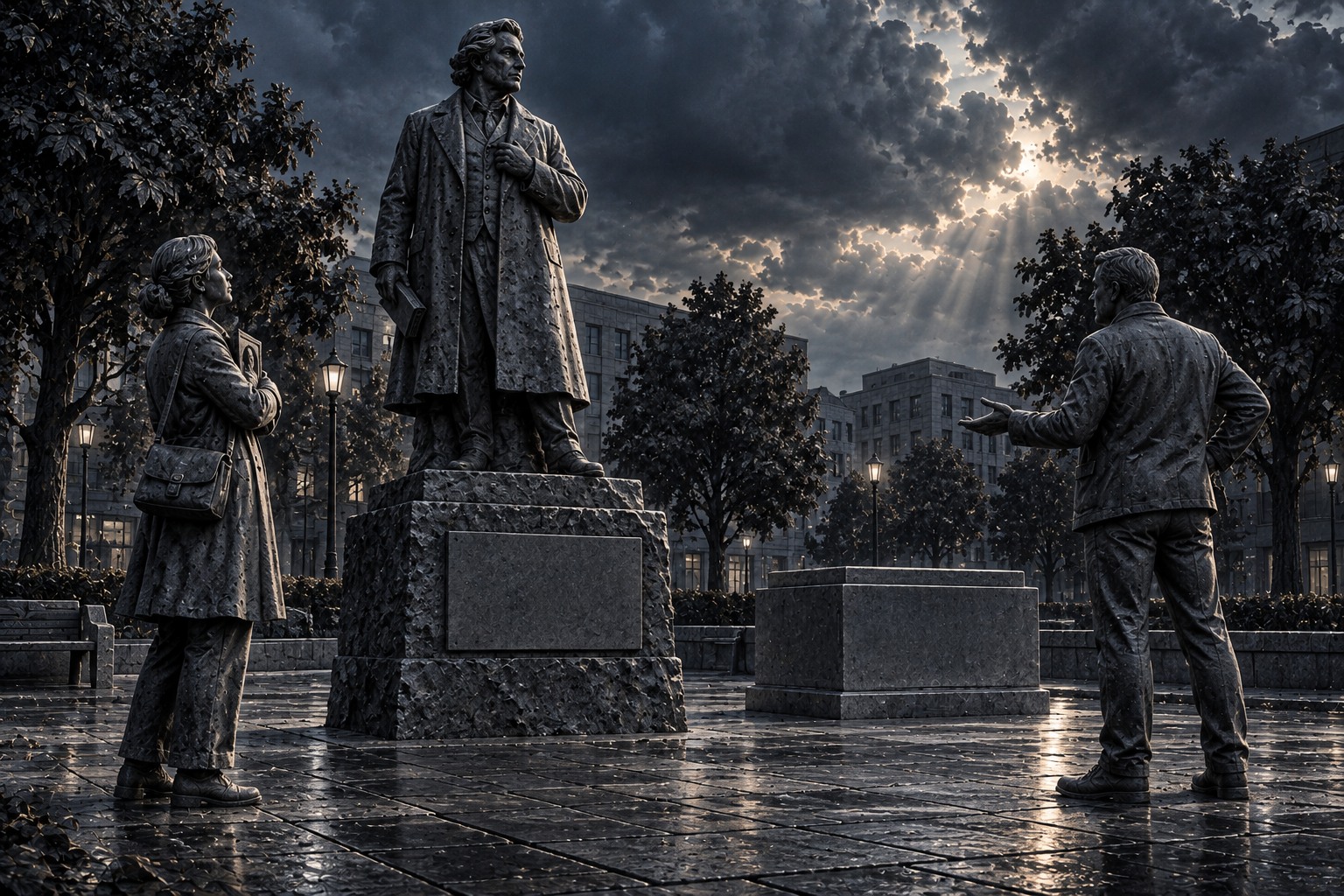
A hypothetical town is discussing a monument to someone its old inscription calls a builder of a common future. For Vera, the square connects with her grandfather's accounts of work and family visits. Nikolai considers the celebratory inscription a concealment of coercion and losses described in his family. Some propose retaining the object, others moving it, and others adding context. Town, figure, participants, and events are invented; the article establishes neither side's historical correctness. Its central question is what a present public place does with history when people disagree about who deserves honour and in what form.
A monument can be a material witness to a period, an artwork, a sign of official recognition, and a place of personal memory. These meanings can coexist without giving the same answer about its present position. Retaining information about the past need not require retaining a celebratory address to it. Changing public honour does not automatically refute every family account. Yet relocation or a new plaque can carry real costs and leave participants dissatisfied. The article distinguishes knowledge, memory, and public decision without a universal script for every town. A shared past is enough for disagreement; a shared judgement may remain absent after careful consideration.
I. What is being retained or changed?
Vera says “preserve memory,” Nikolai “stop glorifying.” Treating these as direct opposites already chooses the object for them. First notice several objects: sculpture, location, inscription, square name, ceremony, and information about installation. Someone can support preservation while rejecting present honour for the represented figure. Another can oppose relocation because of a family route while accepting altered wording. These are possible positions in our scene rather than survey findings. They show why being simply “for or against the monument” may obscure the actual actions requiring a response. A broader label should not decide the scope of a person's answer in advance.
Distinguishing objects must not become a way of declaring the dispute settled. For someone, the central location is precisely the main message. A small explanation may not change it enough to make it acceptable. For another, moving it breaks a connection between place and memory even if the sculpture remains accessible in a museum. Those grounds can be stated without promising a ready balance. Distinctions create a more precise question, not an obligation to accept whichever option looks most moderate. If public honour is disputed, preservation proposals must address that matter too, rather than only the object's material value.
The present task matters as well. Are participants selecting a location, writing context, arranging care, or preparing the next ceremony? One discussion can touch all these, while authority and completion differ. Cancelling a celebration does not establish a dismantling decision. Preparing text confirms neither approval nor installation. Considering relocation establishes no technical feasibility. These states should not be wrapped into “we changed it.” A present action needs a defined scope. Otherwise people answer different promises and later find a shared phrase concealed a decision some never accepted. The scope needs visibility before it becomes a claim of joint action.
II. An inscription is a statement made by the present place
An old inscription arose at a particular time. Studying who made it and why is one question; leaving it as the sole explanation for today's passer-by is another. A historical text can be retained as evidence of an earlier assessment without presenting that assessment as today's undisputed conclusion. The distinction needs to be visible in the arrangement, however. If context is hidden where few look, the official message may remain effectively unchanged. This concerns the design of our fictional place, not a measured effect of a specific plaque. What visitors can read and understand still requires actual examination on site.
New text is not neutral merely because it is new. Who writes it, which information enters it, what matters, and whose speech is identified as opinion? Describing an established fact as someone's grievance while leaving a familiar judgement unattributed distributes origins unequally. The reverse substitution is possible too: a family account becomes the sole established fact without checking. Testimony, confirmed events, assumptions, and present judgement need distinction. Historical explanation owes nobody an identical number of lines. Its accuracy depends on grounds and subject rather than symmetrical design. Equal-looking treatment can still conceal substantial differences in what is actually supported.
Sometimes a new text is too short for every important question. That is a real limit of the medium, not proof that context is unnecessary. Define what must be visible on site, where detailed material can be found, and which uncertainties are explicit. An archive link does not repair a false main sentence. A short inscription can limit its promise honestly rather than portray a complete history. If detailed material is not prepared, do not announce its existence early. A proposal for explanation and an accessible explanation are different results, even when many support the intention and work has already begun.
III. A family connection is not shared public honour
Vera remembers her grandfather bringing flowers. For her this may commemorate his labour and time rather than approve every decision made by the represented person. Nikolai should not assign her an entire historical position from one gesture. Nor can Vera demand that a family meaning determine wording for the whole town. Personal memory has its depth; public statements also address others. Distinguishing them diminishes neither. It avoids forcing someone to choose between respect for a relative and the right to discuss the present form of shared space, as though those two responses necessarily excluded each other before consideration.
Nikolai does not become a bearer of every memory of loss through his family connection either. He can state what he knows, identify the account's origins, and decline to answer for everyone. Other people may remember differently or want no discussion. Unknown views need not be filled with imagined unanimity among those harmed. Yet the absence of a collective representative does not make losses irrelevant. Confirmed events are considered on their evidence even if nobody living wants to speak in the square. Historical accuracy requires no additional public disclosure by a family as the price of admission to discussion.
Retaining a personal route can become a separate proposal. The town might preserve the square's history or a place for family remembrance while changing official wording. Such an alternative cannot be appointed sufficient on Vera's behalf. It need not satisfy Nikolai if the main form of honour remains. Discuss the actual alteration rather than declare every added corner final recognition of all voices. The response may be incomplete: some connection retained, some lost, assessment disputed. This can be difficult, yet more accurate than an invented story in which everyone finally acquires one correct relationship with the past. No common emotion is owed to the project.
IV. A factual dispute differs from a dispute about honour
Suppose participants find information about both construction and coercion. This is a condition of our scene, not a report of a real historical case. Vera acknowledges both and still considers the contribution worthy of a monument. Nikolai acknowledges construction while rejecting celebratory honour for someone associated with coercion. They now differ about assessment and present action. Another reference can refine history without necessarily aligning their choices. Sufficient knowledge does not always finish moral disagreement. It limits permissible factual claims; public recognition needs its own grounds. The distinction preserves historical checking without promising that it can choose every present response for them.
Distinguishing assessments does not make every account equally credible. If relevant evidence refutes a claim, revise it rather than retain it as equally valid memory for peace. People can speak of their experience, but experience establishes no complete sequence of events. Documents have scope too: a construction decision does not describe every way people participated. The absence of one testimony proves no absence of all losses. Specific checking must retain unequal grounds and uncertainty. One attractive general narrative cannot fill every blank in the past merely because it offers a convenient common account. Supported knowledge and a reassuring story are not interchangeable.
A present choice also needs its criterion. Someone prioritizes artistic value, another the character of public honour, another preservation of a material trace. These can conflict despite shared knowledge. Consider what each option retains and alters. Do not silently select one criterion as a technical fact everyone must obey. If an institution decides, it should answer for its grounds within its actual authority. Participants need not accept its assessment to understand which judgement led to the decision and which part remains open afterward. Authority to act can establish a decision without establishing unanimous evaluation of its historical meaning.
V. Options carry different costs and consequences
Leaving everything in place is also an action over time. The object needs care, the inscription addresses visitors, and ceremonies may recur. A present arrangement is not free from choice because it was made earlier. Change has consequences too, beyond its good purpose. Relocation may alter access, routes, and material preservation; competent people need to assess particular risks from the real object. This article makes no such assessment. Enthusiasm for change and an unsupported declaration of impossibility must not substitute for it. What is possible requires actual grounds, while the moral question still requires attention to what the chosen action means.
Added context retains the location but needs work on content, access, and its relationship to the sculpture. Relocation retains the object differently while changing its public position. Removing one element may be reversible and another irreversible; names establish no actual reversibility. What remains available to a future reader matters for each proposal. A photograph is not the object, a museum exhibit not the earlier civic sign, and a new ceremony does not recover an old route. These distinctions select no winner. They make actual losses discussable without promising to retain everything in every form. Each option needs an honest account of what it cannot preserve.
“Let the majority decide” is another possible proposal. Decision-making matters without certifying historical truth. Votes can choose a present action within an established process; they cannot make an unsupported event supported. Majority choice also does not mean everyone agrees or a minority has ceased to remember. The legality of a particular process is not assessed here. Retain the distinctions between authority to decide, grounds for information, and each person's agreement. Otherwise a public alteration may be called the final removal of disagreement merely because voting occurred and an official document appeared. Those events establish their own result rather than every result hoped for.
VI. Who speaks for shared space?
Proportion is another question: must a sculpture decision settle every associated name and account? Sometimes the connection matters and needs separate work. Sometimes discussion expands because people want a complete historical answer immediately. Neither narrowness nor breadth is automatically correct. Identify which next object the present action actually affects. Changing an inscription does not itself make family records erroneous. Moving an object does not automatically remove information about the former square. A retained name does not freeze every ceremony either. Each step has a scope. The shared subject of the past removes neither the need to examine that scope nor the limit on calling a particular decision an answer to the town's entire history.
Council, museum, residents, and families can have different roles. A museum can offer context without authority over the square. A resident may know a family account without acquiring power to define another person's memory. A council can decide within its domain without replacing separate examination of a historical claim. Consider actual subjects rather than an institution's general prestige. Unknown authority is part of the question. Do not portray any public meeting as a final decision or call discussion open when its outcome cannot actually change. The words describing participation need to match the available role rather than a preferred image of collective work.
Participation can be formal or substantive. People might be invited to state positions without a promise of adoption. This can be described accurately if it matches the real process. Do not later call unchanged policy their agreement. Conversely, a heard objection does not grant everyone a veto the process never provided. Conditions need clarity: why accounts are gathered, who answers, what can be reconsidered, and how disagreement is recorded. In our scene these are questions about discussion, not a ready public-governance procedure. Their practical answers depend on the actual place and authority. Asking them establishes no answer that the fictional example cannot supply.
Attend also to people who do not speak. Silence may mean no interest, time, access, or wish to disclose something personal. Choose no convenient cause without evidence. Retain the fact that their opinion was not obtained. Nobody owes public testimony to prove a right to memory. Under threats, direct participation is not prescribed. Another route or nonparticipation depends on circumstances; no universal safety is promised. Shared space does not imply one shared inward judgement. It remains a place where decisions also affect people whose responses were never heard. Their absence must not be transformed into an endorsement the process did not obtain.
VII. Care for the past includes a future reader
In the selected context of The Seven Lamps of Architecture, Ruskin defends old architecture as a connection with makers and future generations, sharply rejecting destruction and false restoration. This is his normative position rather than a neutral historical law. His absolute defence of buildings is not applied here to every monument. It asks what present action leaves to others without deciding the celebratory honour owed to our fictional figure.
A future person takes no part in today's discussion. Their judgement is unknown. Accessible evidence and a description of the present alteration can be retained without claiming their advance agreement. If relocated, the monument should not be described as always having stood in a museum. If the inscription changes, the old wording can be identified as earlier, retaining information about when and why alteration occurred where that is actually done. This does not bind future people to repeat our decision. It lets them see several historical layers, including today's dispute, instead of a smooth account in which change apparently never happened.
Preserving testimony has limits too. Complete memory of the town cannot be promised to the future. A document may cover only accessible discussion, a photograph one view, a family account one perspective. State these boundaries. If material is restricted by appropriate access conditions, a public report should not portray it as open. Knowing that a voice was not obtained or material is unavailable can serve a future reader better than confident collective endorsement. Attention to the future concerns accuracy of the retained trace. It does not appoint us sole defenders of every unborn person or grant authority to prohibit their own reconsideration.
VIII. A new location does not finish the historical question
Suppose the council chooses museum relocation with context. This might change public honour for Nikolai without repairing his family's losses. For Vera, a museum might preserve the object while removing a familiar place. A decision can have grounds without claiming to restore everything lost. Gratitude should not be required for a result someone assesses differently. Continuing disagreement does not automatically prove the work pointless either. Material action, historical explanation, and participants' inward responses have different completions. One can occur while another remains unfinished and painful. Describing that distinction retains what happened without appointing a single emotional outcome to the whole town.
If added wording is chosen for the square, examine its actual appearance and content. The proposed explanation may have been shortened until a significant distinction vanished. An installed plaque may contain a date error. These are possible fictional problems, not reports of a real object. Correction requires identifying the error and where it appeared. Not every objection demands cancellation of the whole decision. Yet a completed installation does not make wording infallible. Care of a public sign includes checking particular claims after the large dispute has become everyday work. A decision can stand while its factual description still needs a specific correction.
An earlier decision need not last forever. New information, altered use of the place, or discovered error can justify revisiting a particular part. Reconsideration need not automatically destroy all historical stability. Name what changed and why earlier grounds are insufficient. Repeated changes may carry costs for preservation and access too; those deserve examination. Our scene supplies no universal review interval. It asks that neither permanence nor change become a virtue by itself, detached from the particular object and what it tells people. The grounds for one revision must remain visible rather than being replaced by a general preference for keeping or changing everything.
IX. A conversation needs an honest outcome
The result might contain several statements: information clarified, wording prepared, location undecided, some people still opposed. This is more precise than an unsupported celebration of reconciliation. Participants can understand each other's grounds and retain different answers. They are not incapable of dialogue merely because they chose no single form of honour. Polite conversation certifies no accurate history either. A useful outcome links each achievement to its object: what was learned, decided, actually done, and what remains for further consideration. A limited result can have substance without being enlarged into final agreement about the past.
Further responsibilities need definition. Who checks wording, preserves information about the earlier position, and answers discovered errors? A shared wish to respect history performs none of this by itself. Missing resources or competence can limit a chosen option. Accessible museum context cannot be promised without a museum accepting the work. Documentation cannot be called preserved when only collection is planned. Practical limits settle no complete moral question but enter an honest account of the present step. Someone can support the intention while rejecting an unsupported promise. That distinction matters when a decision is described to people who will rely on it.
Vera may leave with a sense of loss and Nikolai with incomplete recognition. Neither response necessarily contradicts work actually completed. Retain them without appointing a common emotion. Further personal discussion is a separate voluntary choice. A public event should not become compulsory inward reconciliation. The monument remains disputed not only through missing knowledge but because present honour and personal connection have different grounds. Recognizing this describes disagreement more precisely without devaluing examination of evidence or consequences of the decision. The emotional question can remain open while specific factual and practical work has still reached a real result.
X. Memory can retain visible layers
Our town may end with a decision not everyone accepts. What makes its description honest? It erases no installation history, turns no personal connection into citywide endorsement, and makes no present body's decision a final judgement for all generations. It shows grounds and completed scope. Information about makers, the object's former public message, and the present alteration can be retained without promising one collective memory. Historical layers become visible when their differences are named rather than smoothed into a new celebratory account. An honest record includes change as part of history rather than treating today's preferred version as if it had always existed.
Nobody needs to stop remembering relatives to consider public honour. Nobody must accept an old inscription as a personal belief to acknowledge the sculpture's material history. Work remains between these responses: examining events, the place's meaning, authority, costs, and completed action. It may finish only partly. That does not make every decision equally good. It prevents evaluation solely through promises of final harmony unsupported by source or fictional scene, and perhaps never intended by the participants. A partial outcome deserves its actual scope rather than being inflated into a complete cure or dismissed because it is less than everything.
A monument connects with the past, while its present public position poses a current question. Retaining that distinction gives history greater accuracy and people room for their own responses. Testimony can be cared for, forms of honour changed, personal accounts retained, and a shared place seriously disputed. Not every option can coexist with every other. Respect therefore equals no predetermined choice to retain or remove. It appears in examination of grounds and consequences, acknowledgement of rejected answers, and what actually remains accessible after the decision: to today's passer-by and a future reader. The final description should answer for that result.
What this means in practice
If this concerns a discussion accessible to you, identify the particular action: wording, location, preservation, ceremony, or name. Separate known history, a family account, and present assessment. Require no personal disclosure to admit a historical question. Do not equalize confirmed and refuted information for apparent peace. Voting confirms neither an event nor everyone's agreement.
For one proposal, consider what it preserves and alters. Who has authority, what competence is needed, who performs the work, and what access remains? Real objects require separate examination of technical and legal conditions. If discussion is voluntary, another person's grounds can be clarified without promising acceptance. Under threats, direct discussion and public testimony are not prescribed. This article establishes no safe method for every situation.
After a decision, distinguish the plan, approved action, and actual result. Name errors, uncertainty, and continuing disagreement. This voluntary work measures no moral maturity, is no therapy, and does not guarantee reconciliation. Partial clarity or nonparticipation is possible. Its purpose is to prevent one monument demanding identical memory from everyone, and one present response hiding the history of how it came about.
Key quotation
all the generations of mankind
John Ruskin, The Seven Lamps of Architecture, VI, XX, authorial argument, web line 1254, printed page 186. A brief noun-phrase fragment. The author includes future generations in his case for preserving buildings. This is neither their obtained agreement nor a ready answer about our form of public honour.
Connections between traditions
| Perspective | Question | Difference and boundary |
|---|---|---|
| Ruskin, selected VI context | What do present people leave to the future? | His defence of architecture determines no universal monument policy |
| Personal family memory | How does a place connect with an account of a relative? | One connection becomes no collective endorsement of every decision |
| Historical explanation | What is confirmed and what remains unknown? | Examining information differs from choosing public honour |
| The fictional town's public decision | Who changes the place's current message? | Authority to decide establishes neither everyone's agreement nor historical truth |
Sources
-
John Ruskin. The Seven Lamps of Architecture (original work 1849). Project Gutenberg no. 35898. The actual print basis is titled Illustrated Cabinet Edition, Boston, Dana Estes & Company; no date appears on the title page read. Read metadata and title, web 0–38, and selected continuous VI context, web 1234–1257, printed pages 183–187. Neither the whole chapter nor book. The author's normative reasoning is used, not present conservation rules or law. Rights UNKNOWN; PG availability is not treated as universal permission and no full source is imported.
-
Library Edition editors, volume VIII, Bibliographical Note, page li; Lancaster University electronic edition. Read the displayed page, web 0–35; entry 4–6 verifies the first edition's 1849 title. Bibliographical evidence only; the physical 1849 volume and whole Library Edition were not read. It determines no PG print-basis year. No direct quotations; Rights UNKNOWN.
Tags
monument, past, public space, memory, history, disagreement, inscription, honour, preservation, relocation, context, family connection, sculpture, square, ceremony, testimony, fact, assessment, authority, museum, future generations, historical layer, decision, recognition, losses, correction, access, Ruskin, architecture, United Wisdom
About the authors
Andrey Zarinsh is the author and founder of United Wisdom. He explores inner transformation, unity among traditions, intercultural dialogue, and contemporary spiritual discipline. Instagram: @andrey.zarinsh.
Maria Evilkut is a coauthor of United Wisdom. Alongside her research, she seeks to test these ideas in practice and observe how principles of unity and mutual understanding work in real life between people and cultures. Instagram: @ilkutki.
Keep what resonates with you.