
Relationships
The common good and the majority's interest
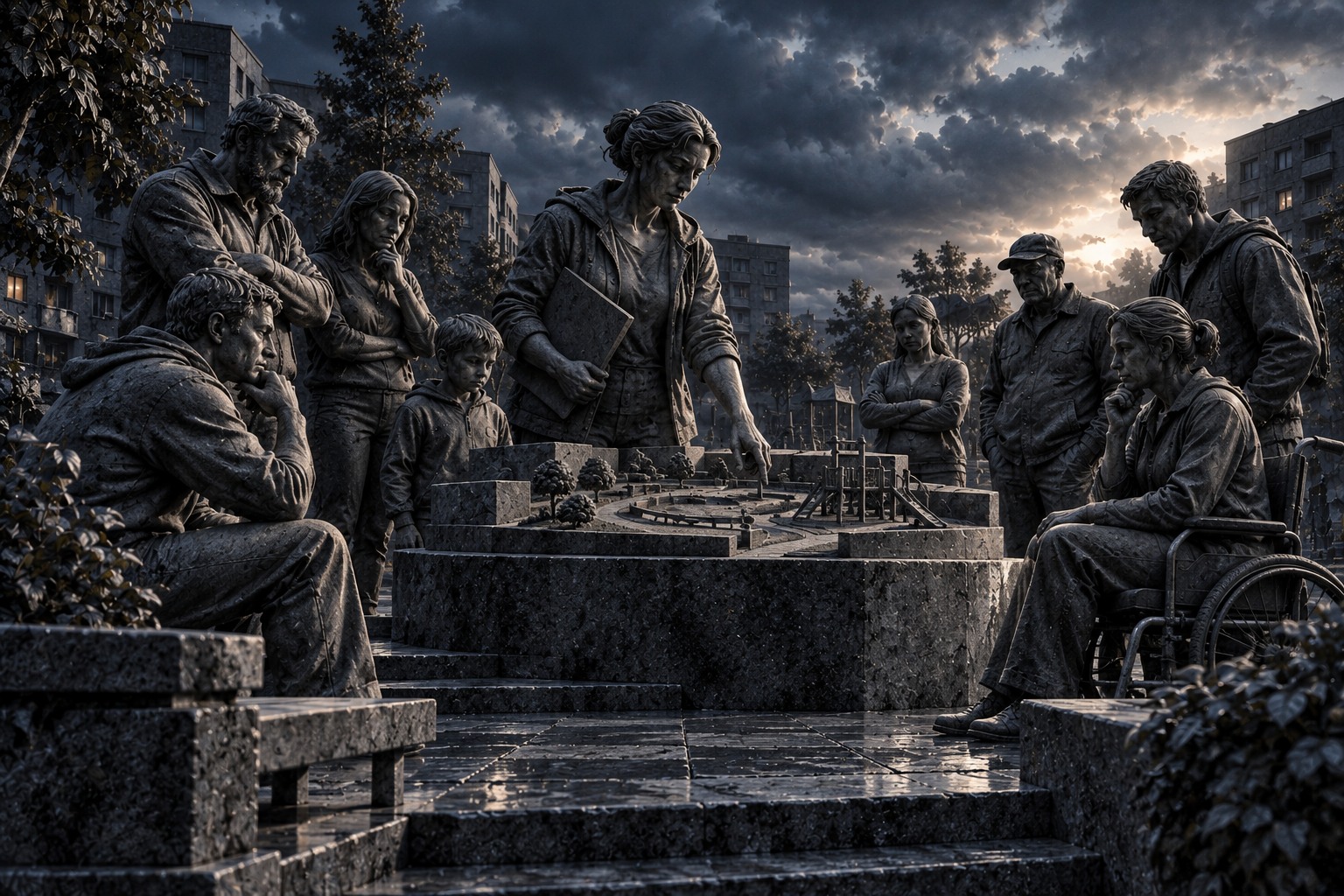
Vote numbers, the affected circle, and a collective decision's cost in a hypothetical courtyard.
Epigraph
give their votes
The Athenian Constitution, traditionally associated with Aristotle and his school, part42, first paragraph, Kenyon translation. Short fragment concerning admission to a citizen register, rather than participation by all inhabitants.
What this article is about
A majority can identify the option supported by more voters. That number does not itself show who benefits, who receives the work, or whose everyday possibility disappears afterward. The common good requires considering this wider subject. This article does so through a hypothetical shared courtyard where residents choose a place for gatherings. It offers its own editorial reasoning: no legal governance procedure, universal political algorithm, or demonstrated procedural effectiveness is established. The passage read from The Athenian Constitution shows a historical distinction between voting, eligibility, and appeal. Its exclusions and brutal consequences are not adopted as a model. The contemporary question is narrower: how can a decision's cost remain visible for fewer people, without automatically cancelling a collective choice or requiring an affected person to reveal their entire life publicly? One decision can be described, and the trial can finish with a clear remainder of disagreement.
I. A vote count answers a definite question
Imagine a courtyard where a voluntary group proposes placing a table beneath ground-floor windows. A majority in our invented vote supports the proposal. The table would allow shared readings and conversations, an understandable aim. Yet the vote has so far established only support for that location among those who voted. It has not described who currently uses the space, when gatherings would occur, or who would clean up. Immediately calling the decision useful for everyone fills these unknowns with a general word. A few ground-floor residents may receive less benefit and more noise; a person using the passage may lose a convenient route. These are hypothetical consequences still needing consideration, rather than established biographies of any actual residents.
The numerical answer becomes clearer through its boundaries. Who could participate, what precise question was posed, and which options were available? Supporting gatherings in general differs from supporting a table under this window. Choosing between two sites differs from choosing between gatherings and none. Someone may support the aim while having no chance to suggest a third site in the ready-made poll. This establishes no general defect in voting. It shows why a result belongs with the question's subject. Counting retains its role: it reveals the distribution of expressed choices. It does not establish consent to conditions that participants were not asked to consider, nor automatically describe costs beyond the question.
A decision need not require unanimity on every detail. A shared project may remain disputed and continue within an available scope. Recognizing disagreement, however, differs from saying a majority decision has removed its grounds. The resident beneath the window may retain a particular concern about timing. Fewer votes do not make that position mistaken. Nor does it automatically outrank every other person's need. The group faces another question: which concern remains unexamined, and can a condition change without cancelling the aim? Discussion then concerns time, location, passage, or cleanup. It need not decide who is generally the more caring neighbor or whose attitude toward shared work is more correct.
II. An aim's benefit does not describe the distribution of cost
Gatherings may matter to participants while a table's location separately distributes inconvenience. Someone visits for an hour, while another lives beside it continuously. One person brings a book; another moves furniture and removes litter afterward. Participation and cost do not coincide in time or in people. This cancels no gathering's value, but prevents that value from describing the entire decision. Our hypothetical scene can distinguish aim, means, and consequences: shared reading, a table at this site, additional noise and labor. The first can be supported while the second is disputed. Distinguishing them allows a different means to be discussed without treating an objection as refusal of all togetherness or care for the courtyard.
A combined quantity of inconvenience does not convey the whole subject either. A small loss of passage may affect someone every day, while a brief benefit reaches many guests once a month. Simply adding hypothetical minutes does not decide how these circumstances compare. This article offers no formula for exchanging a person's daily life for a number of pleased participants. Differences can first become visible: duration, repetition, available alternatives, and ability to end the effect. Some remain unknown without further conversation. An identified unknown is preferable to assuming fewer people must mean a smaller cost. The group obtains a subject for a further decision, rather than a completed mathematical verdict about fairness.
Naming a cost need not accuse those who supported the proposal. Someone voted for gatherings without knowing how the passage was used. New information does not establish deliberate disregard for a neighbor. It creates a new ground for examining a condition. This requires acknowledging the earlier question's limits, rather than a general admission of moral failure. An affected person can likewise clarify a cost without proving the whole project pointless. Precision matters for continuing discussion. When every new circumstance becomes an argument about character, correction of a particular location or time recedes. Responsibility for the next step becomes clearer when attached to an identified circumstance and available change, rather than a retrospective demand to have understood everything.
III. Those affected extend beyond those who voted
Only subscribers to a shared conversation may have voted. Others use the courtyard too: residents' relatives, assistants, visitors, or someone uninterested in common discussions. Their particular interests should not be invented in advance. Yet an absent poll response establishes no absence of impact. Belonging to a group differs from a relationship with a place. An organizer may hold a volunteer list that does not describe everybody using the passage. Calling something a common good requires at least questioning this boundary of representation. That does not promise an exhaustive survey and demands no disclosure of every resident's connections. It acknowledges the people about whom the number of replies currently says nothing.
An affected person's visibility should not depend solely on public speaking. A simple account of the intended change can be announced, with an accessible way to identify a specific consequence. Nobody must produce an extended objection or attend a meeting. Silence also cannot automatically become consent, fear, or indifference. It remains an absent expressed response with unknown reasons. If wider feedback is unavailable, that limit belongs in the decision's description. Sending a message cannot establish that everybody has been considered. Message delivery and a real opportunity to consider it have different subjects. That distinction matters without promising complete knowledge of every person and their circumstances.
Not everyone affected becomes a participant in collective management. Reporting that a table blocks a passage differs from authority to choose the entire gathering program. Access to consideration can remain without transferring a whole role. This prevents two overbroad conclusions: an outside voice is either entirely excluded or supposedly obliged to decide everything. Our courtyard can begin with a definite subject: a change of route, timing, or access. Someone retains the right not to join the reading project. The group retains an opportunity to organize gatherings under specified conditions. Their interaction concerns the overlap between two areas, rather than a demand that all users adopt a common identity and an identical view of shared reading's benefit.
IV. A minority is not one person with one aim
Several residents may object for different reasons. One prefers another site, another accepts a table without evening gatherings, and a third wants no courtyard change. Calling them one obstructive minority loses these different subjects. Some conditions may fit the project; others remain disputed. People should not receive a shared intention merely because their votes fall on the same side of a count. The numerical category describes a relationship to the specified option. It establishes no common biography, degree of vulnerability, or attitude toward neighbors. The same applies to a majority: table supporters may understand duration, cleanup, and acceptable hours differently. After voting, what is to be carried out together still needs clarification.
Small numbers do not make every demand fair either. Someone may propose a personally convenient condition transferring all work to another person. Their voice deserves consideration through its subject, without an unconditional right to dispose of another's resources. Moving the table in our example requires help not yet promised. This cost needs a name just like the cost of the original site. Otherwise correcting an unequal distribution creates another, merely less visible one. No rule is established here that a minority must always yield or always prevail. Separate questions remain: what impact was named, what change proposed, to whom does it transfer work, and is there consent to that work?
Respecting a voice does not promise execution of everything said. The group may be able to change the hours while finding no alternative site. Incompatible needs may remain. An honest response can name the ground considered, the available change, and what remains unresolved. That differs from refusing to listen because of vote totals. An affected person need not describe their personal boundary as a whim for the majority's convenience. Others need not guarantee the absence of every inconvenience. Between those excessive demands remains a particular decision and its cost. It may satisfy nobody entirely. But describing the remainder clarifies what the group accepted, what it did not correct, and which question requires separate further consideration.
V. Considering a voice differs from a duty to disclose
A resident beneath the window may value a quiet hour while their reason remains private. Health, work, or family information is not required for the group to consider timing. A consequence and a desired condition can first be named: quiet is needed during a certain interval; an evening table affects use of the room. This does not guarantee that every condition will be accepted. It separates discussion's subject from biographical examination. Requiring proof of exceptional personal hardship makes collective work depend on public disclosure. Being heard becomes a competition in detailed explanation, although the original issue concerns the location and timing of shared-space use.
Privacy does not remove the need to clarify a request. A vague demand that everybody always be comfortable is difficult to consider as a particular action. Time, a section of the passage, or an available alternative can be queried without demanding reasons for vulnerability. These clarifications identify a subject rather than rank people by deservingness. A boundary exists between adequately describing a consequence and explaining a whole personal life; it can be named beforehand. If even a limited message creates threat or pressure, the voluntary trial ends. The article recommends no pursuit of recognition through risky disclosure. Declining that conversation establishes no insignificance of an objection, and does not let unavailable information prove the absence of every cost.
A mediator can convey a particular question where that is comfortable and safe. Mediation nevertheless creates no authority to disclose everything known or negotiate every concession for someone. The assignment has a subject too: convey a time, location, or request without additional details. A partial message cannot be declared a complete representation of all the person's interests. This may seem excessively careful in a small project, but the boundary is simple: knowing someone's history differs from authority to speak about it. Making a cost visible does not require turning a person into a public example of suffering. A limited practical message may allow consideration without appropriating a whole life for collective discussion.
VI. Historical voting has a historical boundary
In part42 of The Athenian Constitution, admission to a citizen register involves voting by a specified group. The text also describes appeal to a court after rejection concerning free birth. Voting and further consideration appear as different actions. Yet this arrangement includes citizen parentage on both sides and a brutal consequence of losing the case: sale into slavery. An agreeable mention of appeal cannot be extracted to make the whole arrangement a model of contemporary respect. The source is used as a historical description, traditionally associated with Aristotle and his school, in Kenyon's English translation. It establishes neither present rights of participation nor contemporary effectiveness of reconsideration.
Parts43–45 continue describing assemblies, the Council, and its powers. They make a collective historical decision visible inside particular roles and boundaries. The reading does not establish that this arrangement covers every inhabitant's interests or supplies a universal formula for the common good. A citizen body must especially not replace all people affected by power. Our hypothetical scene has another boundary: conversation subscribers differ from everyone using the courtyard. This is an editorial analogy between questions about participation's scope, rather than identity between two societies. Preserving cost's visibility and a participant's privacy is a contemporary proposal, not something attributed to the ancient text. It needs assessment through the article's own argument and the action available.
This historical support does not decorate a claim that majorities must always be mistaken. The described appeal concerns a specific decision; it does not cancel every collective choice. Likewise, this article does not replace counting with permanent authority for one dissenter. It distinguishes response numbers, impact's scope, and consideration of a remaining subject. The source helps place the first questions beside each other while keeping its exclusions visible. The further argument belongs to this article. Other traditions are neither represented as read nor declared unanimous. This limited connection permits reference to the past without promising that it has already resolved a present conflict, or requiring inheritance of historical conditions alongside a useful distinction.
VII. Execution changes the subject of consent
Suppose residents supported one table and monthly daytime gatherings. After successful readings, the group proposes weekly evenings and more furniture. Support for an earlier option does not establish consent to the entire new scale. More gatherings may change the cost to nearby windows and cleanup workers. Renewed consideration is needed because execution's subject has changed, rather than because the original vote was meaningless. What is added, which earlier conditions remain, and where is fresh consent to resource use needed? This concerns a voluntary project and establishes no authorization procedure for actual property. Expansion creates no general duty to accept the project at any scale after the first successful gathering.
Those who promised work deserve separate attention. Agreeing to place a table once is not accepting permanent organization; cleaning after one gathering creates no endless duty. A numerical majority can support expansion without supplying another person's time automatically. Our new scope has no executor until someone accepts a definite part. This is a crucial common-good boundary: the program's benefit does not describe consent to particular labor. New resources can be sought, the plan reduced, or the proposal left unexecuted. An absent worker establishes no deficiency of care in the previous assistant. A completed assignment retains its own limit even while shared reading remains meaningful to a large group.
Reconsideration after execution may reveal an unexpected result. The passage is not blocked, but the table has become storage between gatherings. A new use is now discussed, rather than the earlier number of votes for reading. Factual observations within an appropriate scope help, without requiring surveillance of neighbors' private lives. The passage's condition can be noticed without names or suppositions about intentions. The group obtains a subject: storage, removal time, and responsibility for a personal object. Correcting a specific use proves no falsehood in the original aim. Nor does it guarantee that later changes will never be needed. A limited project can preserve clarity by distinguishing a new subject from earlier consent.
VIII. The common good remains a question about a shared world
Common here does not mean an identical benefit from every decision. People use the courtyard differently, and not every gathering is needed by all. A narrower requirement is that an aim's means should not hide an affected cost merely because fewer people bear it. This is the article's editorial position, rather than a final political definition. It distinguishes a useful project from conditions of continuation. The majority's benefit may be real within their experience. Yet extending it to a claim about the entire shared place requires naming remaining relationships: passage, everyday residence, labor, access to communication, and limits on another person's resource use.
This does not make every neighbor an identical project participant. One supports gatherings, another does not attend, and a third wants only the passage. Keeping different relationships to a common place becomes itself a condition of collective decision. Sharing does not necessarily demand one lifelong aim. A limited time can be agreed without agreement about the cultural value of chosen books. Someone can move a table without becoming a reader, or report a cost without discussing the program. These differences do not guarantee peaceful agreement. They prevent a whole personal position from being inferred from one vote, and preserve action where people can interact without handing a group complete definition of their interests.
A remainder of disagreement should be described directly. After a timing change, one resident may still consider the table inappropriate. The group can acknowledge that their objection remains. Acknowledgment is not automatic cancellation; continuation does not make the remainder nonexistent either. Which condition was considered, which resource is available, and what new circumstance would return the question? Consideration does not promise a desired result to the individual. The group does not promise universal satisfaction. This may look less celebratory than a photograph of a pleased majority. It nevertheless preserves the decision's subject, knowledge's boundary, and continuation's cost, otherwise easily hidden by the most visible participants' success.
IX. The next decision can be smaller than the whole dispute
Beginning with a definition of a fair society or complete courtyard reconstruction is unnecessary. The next hypothetical step may be small: specify one gathering's hours, leave a passage clear, find a consenting cleanup worker, and consider one consequence. Each part has an available resource and an end condition. None promises to resolve all neighborly relationships. A smaller subject makes actual acceptance and execution visible. Without a consenting worker or safe opportunity for discussion, the step can remain a proposal. Nonexecution proves no residents' moral failure. It identifies a present limit that belongs beside the aim, rather than an assumption that a significant benefit will automatically obtain another person's time and consent.
After a limited step, a definite result can be checked: passage remains clear, agreed hours are observed, or accepted work has finished. Such observations establish no universal inner satisfaction. A particular remaining consequence can be queried without demanding overall gratitude. A report that the problem remains creates a subject for available consideration. An absent response does not establish absence of cost. Checking an outcome differs from obtaining general approval. This also protects the project from endless waiting for emotional unanimity: a completed part may finish while a wider dispute remains. A further question receives a separate scope, without silently expanding an assistant's accepted work.
The common good remains a task of careful description, rather than a prize for winning a count. Vote numbers matter without exhausting the affected circle, cost distribution, or further consideration. A smaller voice stays visible without automatically controlling all resources. Limited decisions with an honestly named remainder are possible between them. This approach promises neither preserved trust nor conversion of every conflict into cooperation. A smaller change can be checked: is the next step clearer, is cost visible, and can someone still avoid revealing their entire life for one condition? If so, discussion has a definite subject. That is enough for another decision within an available scope, without claiming to speak for everyone forever.
What this means in practice
In a voluntary, safe situation, take one shared proposal and separately record its aim, particular option, and circle of received responses. Identify who else may be affected and what remains unknown. Inventing objections, gathering private information, or obtaining everyone's participation is unnecessary. The trial examines a boundary of knowledge, rather than researching people's whole lives. It can be declined without explanation of personal reasons.
Clarify one already expressed consequence: time, place, access, or work. Separately name an available change, whose resource it requires, and consent to that resource. Consideration does not promise execution of the request. If no alternative exists, record its absence and remaining disagreement. One condition for returning to the question can be chosen without requiring continual proof of a cost. Private reasons and vulnerable details are unnecessary to describe the practical consequence itself.
The result is a more precise decision subject, rather than a correct political algorithm. It does not guarantee peace, establishes no property right, and assesses no neighbors' maturity. Threats, pressure, or dangerous disclosure end the trial. It may finish with one accepted part completed, a question left open, or no available common step acknowledged. Remaining disagreement stays visible, and completed work retains its limit. A shared aim creates no automatic promise to continue every job until everyone is satisfied.
Key quotation
he appeals
The Athenian Constitution, part42, second paragraph, Kenyon translation. Short fragment concerning appeal after a particular citizen-registration decision; historical exclusions and consequences are not adopted.
Connections between traditions
The passage read supplies a historical description of voting within a limited circle and separate further consideration. The article connects it to the boundary of representation: voters differ from everyone affected. Contemporary reasoning about visible costs, privacy, and voluntary labor's limits belongs to this article. It is not attributed to the ancient arrangement or used to make it a common-good model. Other traditions are neither represented as read nor declared in agreement. The connection preserves different subjects, allowing readers to assess the argument without inheriting parentage as a condition of human dignity.
Sources
The Athenian Constitution, traditionally associated with Aristotle and his school. English translation by Sir Frederic G. Kenyon: Project Gutenberg, no.26095. Continuous parts42–45 were read; the entire treatise was not. Quotations use the narrator's own prose in part42, first and second paragraphs. The historical description establishes no contemporary rights, universal participation, or effective appeal. Short Russian fragments were translated for this article.
Tags
common good, majority, minority, voting, decision, cost, interest, courtyard, gathering, participation, representation, boundary, circle, consent, resource, labor, access, passage, privacy, consideration, appeal, remainder, disagreement, aim, means, execution, reconsideration, Aristotle, Athenian Constitution, United Wisdom
About the authors
Andrey Zarinsh is the author and founder of United Wisdom. He explores inner transformation, connections between traditions, intercultural dialogue, and contemporary spiritual discipline. Instagram: @andrey.zarinsh.
Maria Evilkut is a coauthor of United Wisdom. Alongside research, she seeks to test these ideas in practice and observe how unity and mutual understanding work in real life between people and cultures. Instagram: @ilkutki.
Keep what resonates with you.