
Relationships
Peaceful Resistance and the Cost of Participation
Accounting for unequal costs of peaceful participation while distinguishing consent to a purpose, method, and role.
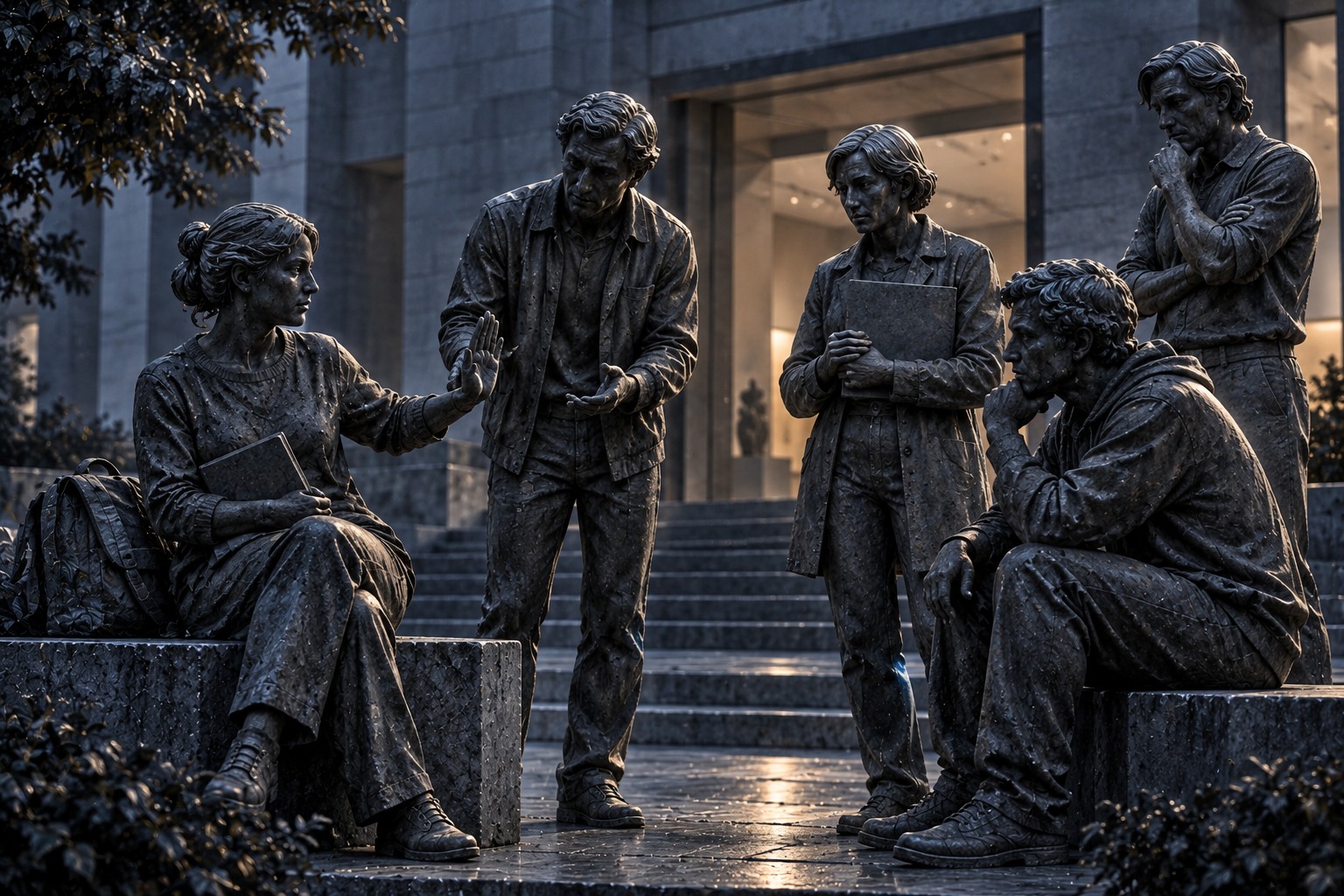
Epigraph
war against war
William James, The Moral Equivalent of War (1910), opening paragraph. A fragment of his metaphor for opposing war; military methods are not transferred to the suggested practice.
What this article is about
Nonviolent resistance may begin with refusing to support a decision, openly objecting, or jointly requesting a review. A peaceful method does not, however, make participation free. One person risks an evening, another an important source of income, and a third access to a place on which their everyday life depends. If organisers describe participation as a shared duty without examining these differences, the cost of a common purpose is allocated invisibly.
This article explores the ethics of that allocation through a hypothetical voluntary association. It offers no strategy for unlawful action, ways around restrictions, or prediction of a political movement's success. Its question is who may assign another person a cost of participation, and how the option to decline can remain available while a shared concern is supported. This requires distinctions between resistance's purpose, the chosen method, personal consent, and an accepted role. Peacefulness matters, but by itself does not show that relations among participants are free of pressure.
I. A peaceful method does not remove serious consequences
Imagine an association of craftspeople whose managing organisation proposes a new timetable for their shared space. A quiet room for individual work is to become a room for continuous public events. Several members believe the decision would remove an important working condition. They prepare an open letter and propose withdrawing from a joint exhibition for a week until the organisers hold a discussion. This is a hypothetical voluntary community; no rules of a particular organisation or country are established here.
Ilya, the initiator, says the method is peaceful: nobody intends to damage property or threaten people. That is an important boundary, but the conversation is not finished. Olga hoped to obtain commissions at the exhibition. Semyon runs a class for which participants have already paid. Vera can visit only when the space is quiet, and wants the room retained, but cannot attend lengthy joint meetings. They have different reasons to support the purpose and different capacities to bear the proposed action's consequences.
Peacefulness describes a way of dealing with others, rather than measuring a participant's burden. Withdrawing from an exhibition may involve a significant sacrifice without direct violence. An open letter may make someone visible who did not want to speak under their own name. An evening meeting may require impossible childcare arrangements or cancellation of paid work. When these circumstances are named, they become part of discussing the method. When left unnamed, an option available to one person appears natural for everyone.
Two extremes should be avoided. A cost does not mean resistance should always stop. People may knowingly accept serious consequences for something important to them. The significance of a shared purpose, however, does not establish that everyone has already accepted any price it requires. Agreeing to preserve a quiet room and agreeing to lose a week's commissions are different answers. The second answer is needed before a particular role is allocated, rather than after that role has been declared a moral duty.
The first step is therefore a simple expansion of the conversation. Discuss not only why the decision is unfair, but what the proposed objection will require of different people. This is not a calculation of who is brave enough. It describes resources, time, visibility, and dependencies. Even that description helps reveal where a uniform form of participation creates unequal burdens. Before it, organisers know their idea for resistance, but not yet the conditions under which others would carry it out.
II. Supporting a purpose does not mean accepting every method
Vera supports retaining the room but does not agree to sign a letter containing details of her private life. Ilya hears a contradiction: if the room is genuinely important, why will she not explain her situation to everyone? Yet her answer is coherent. She regards the timetable change as undesirable while limiting what information she is willing to disclose. Supporting a purpose does not turn her story into a shared resource for persuasion.
Olga agrees with the letter but not with withdrawing from the exhibition. She proposes discussing the instruction without cancelling work already prepared. Her suggestion may be inconvenient or seem insufficient to others. It can be discussed on its merits. But if refusing one method is immediately interpreted as covert support for management, members are offered only a complete package: purpose, form, timing, and personal cost. Consent then stops distinguishing its subjects, even though that distinction is needed for informed participation.
Organisers may explain why a particular method seems appropriate. They can say that a routine request has already gone unanswered, that a joint withdrawal conveys the seriousness of their position, or that the exhibition is connected to the disputed timetable. These are arguments someone can consider. They become pressure when explanation is replaced by a declaration of moral inferiority for giving a different answer. A strong argument permits questions about cost; a demand for loyalty treats such questions as suspicious in advance.
The ability to distinguish answers does not entitle someone to rewrite another person's initiative. If Ilya invites participation in a particular action, Olga may decline it. She is not entitled to have the whole plan changed to her preferred version. Her refusal, however, does not authorise him to declare her a participant, use her name, or penalise her for not joining the gesture. Each party has a limit: proposing a particular form, and deciding independently whether to enter it. That limit matters especially when some people have other commitments.
Further cooperation may be partial. Olga helps refine the general request, Vera describes only the room's necessary conditions, and Semyon asks whether the discussion can be rescheduled. Such contributions should not automatically be called equivalent to full participation or inadequate substitutes for it. They need accurate names. A shared purpose then remains possible, while the map of agreement becomes more honest: who supports what, which action they accepted, and which price they have not agreed to pay.
III. The option to refuse is tested after an inconvenient answer
An invitation often includes an assurance that participation is voluntary. That assurance can be tested only after a refusal. If Olga does not join the withdrawal, is her ordinary work still treated in the same way? Does she remain a member? Does she receive information available to others? Is her objection discussed separately from judgments of her character? Voluntariness exists in the consequences of an answer, rather than solely in the wording of an invitation.
Refusal naturally changes what a particular shared action can achieve. If Semyon does not cancel his class, he cannot be counted as part of the promised stoppage. Organisers should describe the initiative's scope without his name. This is a factual change, rather than a punishment. The distinction matters: a person may not receive a role in a project they declined, but should not automatically lose unrelated opportunities merely because their decision inconveniences its initiators.
Not every loss after refusal is intended as a sanction. The association may have few resources, the entire exhibition might be cancelled, or available rooms may change for external reasons. A member nevertheless needs an understandable answer: which change follows from the arrangement of this particular action, and which from a demand to agree? Coincidence does not establish punishment; a general reference to circumstances does not rule it out. Explaining decisions' grounds is useful where organisers actually control them.
A less visible cost may also arise. Someone who declines is not expelled, but stops being heard on common questions; their name attracts ridicule; they are continually asked to demonstrate commitment through another contribution. The scene cannot establish every participant's motive. It can describe an action: a question about a timetable has been replaced by a test of personal loyalty. Under that substitution, the promised option to refuse becomes difficult to use. The observable connection between refusal and demands supplies a subject for discussion.
In a safe voluntary group, an organiser can accept limits in advance: not including people without express agreement, not tying ordinary participation to support for a particular action, and not demanding a private explanation for refusal. These limits do not promise an absence of disappointment. Ilya may feel upset and regard Olga's decision as wrong. His feeling, however, does not create a new obligation for her. The possibility of retaining different evaluations and roles makes agreement more substantial than a general statement that participation is voluntary.
IV. A shared cause does not automatically acquire someone's resources
The cost of participation includes more than an obvious loss of money. Semyon is asked to cancel a class and explain to students why the association chose resistance. This requires time, reputation, and conversations with people whom the initiators did not invite into the dispute. Vera is asked to speak at a meeting despite explaining that she cannot stay for long. In both cases, another person's resource is already included in the plan before their answer.
Planning can make money visible while unpaid work disappears. Who will gather information, answer letters, support participants after a meeting, and explain changes to people outside the association? If that work is allocated according to customary availability, someone receives a few public minutes while someone else receives weeks of unseen work. Appeals to unity can conceal the difference, particularly when providing support is treated as a particular person's natural characteristic.
A proposed role therefore needs boundaries. Semyon can be asked whether he is willing to conduct one conversation, with its anticipated time and subject specified. Vera can be offered a written response limited to the room's necessary conditions. Agreement should not be followed by an expansion into representing everyone without a new arrangement. Accepting one meeting does not automatically mean accepting continual availability. Even an important purpose does not turn particular consent into indefinite control over a person.
Organisers also have resources and limits. They may be unable to provide a separate format for everyone or compensate every loss. An honest answer describes that limitation. Being unable to offer a workable form does not make the person who declines wrong. The proposed action can be acknowledged as unsuitable for some people at present. This is harder than speaking on behalf of the whole association, but more accurately describes the agreement reached and does not make someone's shame compensate for a gap in organisation.
For example, Ilya can prepare the letter but cannot conduct individual conversations with every student in Semyon's class. This need not be hidden. It means that the chosen method does not yet have all the agreed work it requires. A narrower plan is possible, or an invitation to people willing to accept a specified task. The shortage itself does not make Semyon an obligated worker or make his refusal the cause of every difficulty the initiative faces.
The history of participation itself can become a resource. After an action, initiators may want to describe who helped, who declined, and why. Voluntarily taking part in one action, however, is not agreement to every public account of oneself. This particularly concerns information supplied for organisational reasons: income, caring for relatives, or personal dependence on the space. Protecting its limits before a shared appearance helps prevent the option to decline from becoming a requirement to disclose private life in order to justify refusal.
V. Unequal costs need attention, not a measure of someone else's virtue
Ilya proposes an identical sacrifice: everyone misses one week of the exhibition. Formally, the condition is uniform. For him it is an inconvenience because most income comes from elsewhere. For Olga, that week accounts for a significant part of expected commissions. Semyon must answer to students already registered. Vera loses a chance to influence the discussion if participation is recognised only as prolonged attendance. The same action has different consequences.
In his historical essay on a peaceful alternative to war, William James notes unequal burdens in life and proposes universal compulsory service. We do not transfer that proposal to our example. Its compulsory character marks the comparison's limit: trying to share a burden does not authorise an organiser to assign someone's participation. The historical argument retains a question about cost, while the answer here centres on voluntary agreement, which James's own proposal does not secure.
Once differences are noticed, people may try to compare personal losses. That also has a limit. Olga need not disclose her household budget to establish the exhibition's importance. Vera need not supply a detailed account of her capacities. Her statement of an available form is enough for deciding her own role. An organiser may need particular information to allocate a resource; they should then explain what information is necessary and for which decision. Assessing the moral measure of a member's entire life is unnecessary.
Some differences can be accommodated within an initiative: choosing discussion times, retaining a written contribution, limiting a task, or changing participation's visibility. Others cannot be removed. Withdrawing from the exhibition may still cost commissions. Knowing this does not make the action pointless, but makes the invitation more honest. Someone should understand the available choice rather than discover an important consequence after organisers have already announced their support.
It is especially important not to turn a reduced cost into a debt. If Ilya helps Olga reduce some losses, she is not therefore obliged to join. Support may expand choice, but should not purchase a particular answer. Otherwise, new assistance merely changes pressure's form. The ethics of allocating costs remain connected to who decides their own participation. A shared purpose matters precisely to people whose conditions cannot be presumed to belong to the initiative.
VI. Peacefulness also concerns treatment of participants
A nonviolent form of resistance primarily limits methods of influencing the dispute's addressee. Inside a group, however, demands can contradict its stated respect. Ilya does not threaten management, yet tells Semyon that everyone will remember his refusal to cancel the class forever. Formally, the open letter remains peaceful. Relations between the initiator and a participant nevertheless already include pressure requiring separate discussion.
This distinction does not allow an entire movement to be assessed from one episode or its initiator to be declared a particular type of person. A particular demand and consequence can be named accurately. If an invitation includes a threat of an unrelated loss, voluntariness diminishes. If private information is used without agreement, its boundary is breached. If questions about burdens are called betrayal, discussion of the method closes. This vocabulary returns attention to an action inside the group while retaining its shared concern.
Participants need not be equally calm. They may become angry, dispute choices, or regard a situation as urgent. Disappointment and coercion differ through what someone demands and what backs the demand, rather than the volume of their voice. Olga can hear serious disagreement with her decision and remain free to maintain it. She can also hear a polite phrase backed by a real threat to access. Evaluating a conversation's form therefore requires a connection to people's available options.
Organisers should distinguish discipline within an accepted role from consent to enter it. If someone voluntarily promised a particular task, others can ask about its completion and reconsider the role when it is refused. The accepted obligation cannot, however, be expanded retrospectively. Semyon may have agreed to provide a room for one meeting, not to cancel every class. Examining an unfulfilled promise concerns that promise itself. It does not turn earlier participation into agreement to every subsequent plan.
Orwell's question about judging an action by its side applies here as a limited philosophical check: would participants consider the same threat acceptable if it came from management? The answer establishes no hidden motive on the initiator's part. It helps examine one's own standard. A shared purpose does not remove the obligation to describe one's action accurately. Peacefulness becomes more consistent when limits regarded as important outside the group also apply to its members.
VII. Revising participation should not require a new defence of one's character
The initiative lasts longer than expected. Olga initially accepted the letter, then receives requests to speak at several additional meetings. Semyon can help one evening, but not every week. Vera wants permission to describe her circumstances withdrawn because the message spread further than expected. These changes do not necessarily show diminished support for the purpose. They may show that the earlier arrangement no longer matches the proposed action.
An honest invitation therefore preserves revision. What exactly did someone accept? For how long? Which information could be used? What has changed since then? A new role requiring new resources needs new consent. Otherwise, an initial signature becomes indefinite permission to control a person. Stable promises make organisation easier, but stability cannot be produced merely by refusing to hear changed circumstances.
Withdrawing from a task can genuinely create difficulties. If Semyon cancels at the last moment, someone else is needed or the meeting must change. This consequence should be named, rather than hidden to preserve an attractive idea of free choice. Available ways of ending the role can be discussed: passing on collected information, notifying people to whom he made a promise, or explaining that he no longer represents the initiative. Inability to finish in a way convenient to others does not permit keeping him under threat or assigning endless compensation.
It also helps to distinguish leaving a particular action from rejecting earlier statements. Olga may still regard preserving the quiet room as important, while declining a new form of participation. Vera may change her opinion about the purpose itself; that possibility also exists. Organisers must then stop presenting her current position through an earlier agreement. Participation remains part of history, but cannot replace a present answer. This limit prevents public unity from appropriating someone's voice.
Not every revision can occur in a trusting conversation. Threats, disclosure of information, or strong dependency may require a pause and support outside the initiative. This article does not recommend obtaining organisers' agreement to every refusal. In a voluntary cause, costs can be explained, but people cannot be required to establish complete moral correctness before leaving. A narrow organisational question about a role should remain narrow even when the parties disagree about the movement as a whole.
VIII. A shared cause's dignity is visible in the limits of its demands
People may fear that the option to decline weakens resistance. Participation may shrink, a gesture lose force, or the dispute's addressee conclude that the issue is insignificant. Such consequences are possible; the article does not promise that retaining freedom of choice improves results. An absence of guaranteed success, however, does not give organisers authority to assign a price to others. Limiting a demand matters regardless of whether that limit benefits a particular initiative.
Voluntariness does not mean isolation. Participants can decide together which costs they are willing to share, assist with agreed work, and support someone who declines in what they actually accepted. Several accurately described contributions may replace an identical gesture. In another case, the group may retain one form and honestly acknowledge that only those who agreed take part. Both options require an account of the arrangement reached, rather than unity existing only in the initiators' story.
Our scene's possible outcome remains open. Management may revise the timetable, refuse, or propose a compromise. Ilya may change the method, Olga maintain her view, Semyon finish a limited role, and Vera describe only the room's necessary conditions. None of these outcomes establishes the scientific effectiveness of peaceful resistance. The example shows how a shared concern can remain visible without turning people into identical bearers of an assigned burden.
Distinguishing support from a method, a role from a person, and cost from consent does not remove moral difficulty. Someone may experience refusal as a painful choice without being obliged to disclose its reasons. An organiser may consider a method necessary while still hearing incomplete agreement. Shared care becomes practical when it includes these difficulties instead of explaining them as a lack of courage among people for whom participation costs more.
Participation's cost cannot always be equalised. It can be made visible, an accepted role limited, consequences clarified, and revision preserved. This is a small but substantial result. Peaceful resistance then concerns more than the external form of an action. Within it remain people who answer for their own agreement, limits, and changed decisions. A shared cause can remain shared because it does not claim every human resource available to it.
What this means in practice
Before accepting a role in a safe voluntary association, a short experiment is possible: separately identify the purpose you support, the proposed method, and what you are actually prepared to do. A specific scope is enough: one meeting, a defined task, permitted visibility, or limited time. You need not explain your entire private life. If consequences are unclear, you can request clarification or postpone an answer. This experiment is not intended for dangerous confrontation and does not replace necessary professional support.
An initiator can examine their invitation from the other side. Does the plan include names, time, or information before agreement? Can someone reject one method without losing unrelated opportunities? Which changes will require another conversation about the role? If you cannot reduce the cost or provide another form, state that directly. Do not turn an organisational limitation into a judgment of the participant. Offered help expands choice without creating a debt to accept your particular plan.
The intended result is limited: a clearer understanding of participation accepted and resources not yet offered. It does not guarantee agreement, success, or a continued relationship. After one action, revisit the arrangement and check whether the role grew unnoticed. A new duration, greater visibility, or additional risk requires a new answer. Earlier support remains part of history, rather than indefinite permission to control someone.
Stop the experiment if there is a threat, coercion, or disclosure of private information. Continuing an internal dispute to establish personal consistency is unnecessary. The option to decline remains available both to someone supporting the purpose and to someone who has changed their mind. The narrowest practical result is being able to state accurately which action you answer for and where consent ends. Such precision does not devalue a shared cause; it helps reveal the people who make it possible.
Key quotation
constructive interests
William James, The Moral Equivalent of War (1910), concluding argument about civic discipline. The historical proposal is considered critically.
Connections between traditions
James seeks a peaceful form of shared discipline. His compulsory-service proposal differs from the voluntary experiment offered here. The connection is limited to the question of cost; his solution is not adopted as an instruction.
Orwell helps examine whether a standard of judgment changes with a side's affiliation. Here that question concerns pressure inside one's own initiative, without assessing unknown motives or promising an outcome.
The article's editorial argument distinguishes a shared cause, personal consent, and a limited role. The sources are not credited with agreement about contemporary forms of resistance.
Sources
- William James. The Moral Equivalent of War (1910). Selected parts were read, including the concluding compulsory-service proposal: The Writing Textbook version.
- George Orwell. Notes on Nationalism (1945), selected portion of Indifference to Reality: Orwell Foundation version.
Tags
peaceful resistance, nonviolence, cost of participation, voluntariness, consent, refusal, limited role, shared cause, unequal burdens, visibility, private information, initiative group, revision, resources, obligation, chosen method, support for a purpose, shared voice, pressure, loyalty, participation, time, dependency, organisation, personal limits, support, safe conversation, hypothetical example, civic discipline, William James, George Orwell, moral choice
About the authors
Andrey Zarinsh is the author and founder of United Wisdom. He explores inner transformation, connections between traditions, intercultural dialogue, and contemporary spiritual discipline. Instagram: @andrey.zarinsh.
Maria Evilkut is a co-author of United Wisdom. Alongside her research, she seeks to test these ideas in practice and observe how principles of unity and mutual understanding work in real life between people and cultures. Instagram: @ilkutki.
Keep what resonates with you.