
World & consciousness
The Simulated World Across the Ages
An authorial historical comparison of maya, Plato's cave, the butterfly dream, idealism, and the simulation hypothesis.
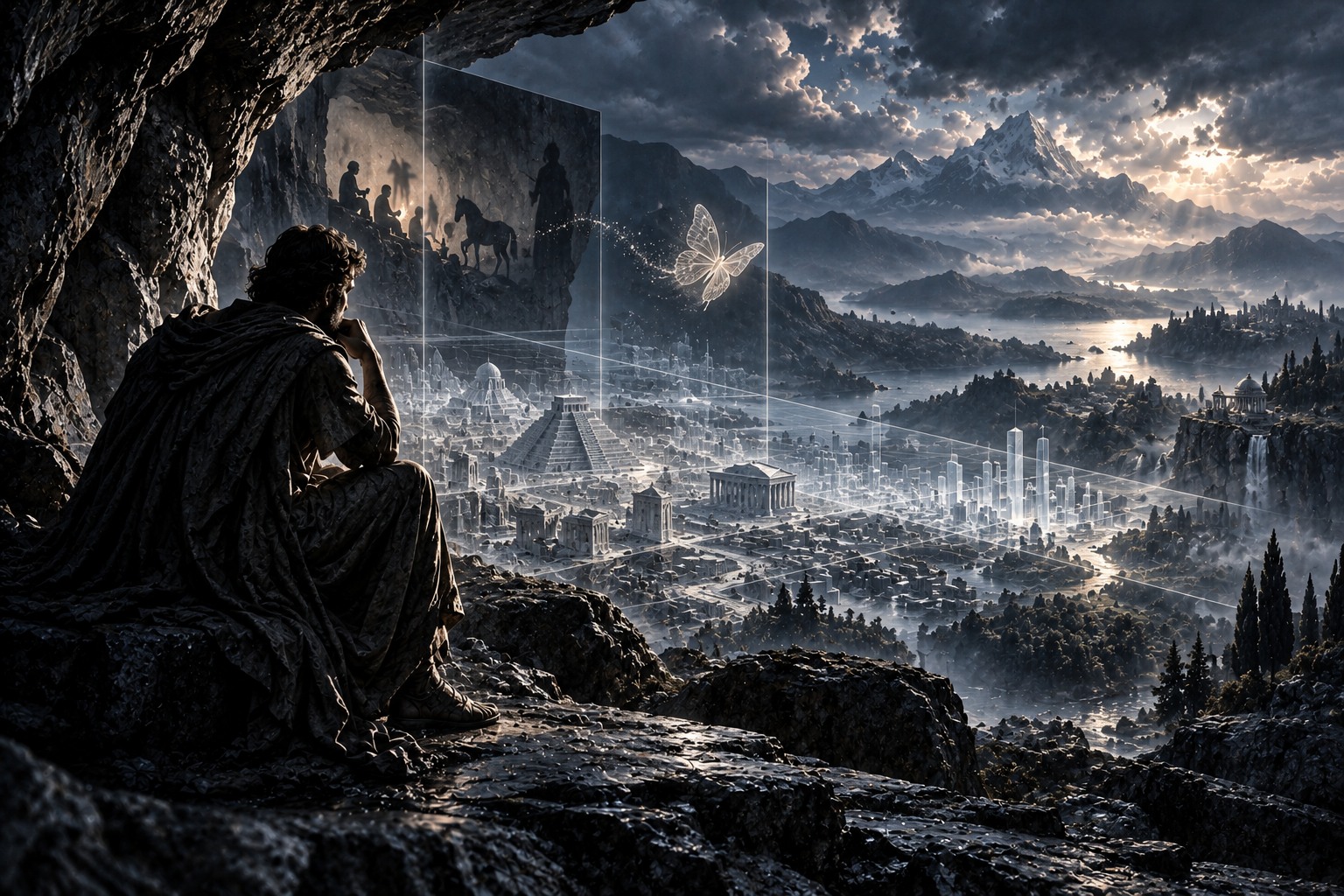
How the illusory nature of reality revealed itself to different traditions
Andrey Zarinsh & Maria Evilkut
United Wisdom · Inner Transformation · Mystical editorial edition
Archival editor's note. This full translation preserves an archival manifesto and its stated preference for Advaita. Its claims that traditions independently discovered one truth, that quantum physics establishes comparable conclusions, and that Bostrom's argument makes simulation statistically more likely are inherited authorial claims, not newly verified conclusions. These traditions differ substantively; structural resemblance does not establish a common source or absence of historical contact. The simulation argument is conditional, and neither it nor the physics analogies prove that ordinary reality is unreal. The article's account of the website is an archival project description, not verification of its present features. Sources and quotations have not been newly checked.
The question “Is this world real?” did not begin with The Matrix, and it will not end with Bostrom. It has accompanied humanity for millennia, changing only its language: maya in the Upanishads, shadows in Plato's cave, Zhuangzi's butterfly dream, khayal in Ibn Arabi, Descartes' demon, simulation on a server in a contemporary philosopher's account. This is a manifesto about how one intuition passed from age to age — and how United Wisdom gathers its facets into one crystal.
Lead
At first, the idea that “the world may be a simulation” seems to belong to the digital age. Computers, neural networks, virtual worlds — and now a twenty-first-century philosopher seriously asks whether our universe might be running on somebody's server.
But step back a little, and it turns out that humanity has almost always asked this question. The vocabulary changes: some called illusion maya, others shadows, others a dream, others representation, others simulation. Yet the intuition is one: what we take for ultimate reality is only its surface. Somewhere beneath it lies something truer, more enduring, more unified.
This article travels through the ages and traditions in which that intuition came alive. It is a route rather than a catalogue of doctrines: India, Greece, the Buddhist East, Daoist China, the Abrahamic religions, early modern Europe, the twentieth century, and the digital present. At the end we attempt to ask: who saw furthest? And, more importantly, why do different answers fit together as a single crystal rather than contradict one another?
Part I. Ancient India: maya and the dream of Brahman
The first developed theory of the world's illusory nature in humanity's written history comes from the Upanishads, texts composed in India between the eighth and fourth centuries BCE. Here appears a word destined to travel through the world's languages: maya, the power that turns unity into the appearance of multiplicity.
The world is not considered nonexistent; it is considered non-absolute. Brahman is real: the unified, indivisible, qualityless ground of everything. All else — mountains, bodies, events, names — manifests Brahman beneath the covering of maya, the power of creative illusion. Centuries later, the Indian philosopher Shankara, in the eighth century CE, would build a system from this intuition: Advaita Vedanta, the nondual teaching according to which only Brahman exists, while the world of names and forms is its manifestation through adhyasa, mistaken superimposition, as when a rope is taken for a snake at dusk (Stanford Encyclopedia of Philosophy: Śaṅkara).
Crucially, Advaita does not ask us to “cancel” the world. It asks us to see what the world points toward. The world is not a lie but a half-transparent window. Through it we can see what stands behind it, if we learn to look. This is the first thought in history to answer systematically: “If the world is not entirely real, what is real?” Its answer is the single consciousness that is your own atman.
Part II. Ancient Greece: shadows in the cave and Plotinus' One
In the fifth and fourth centuries BCE, almost at the same time as the Indian sages, the Greeks ask the same question in another language. In Book VII of the Republic, Plato tells the famous allegory of the cave: people are chained facing a wall; behind them a fire burns, and objects are carried before it. The prisoners see only shadows and take them for reality (Plato, Republic VII).
For Plato, the sensory world is not all of reality but a weakened reflection of it. Truly real is the world of ideas: eternal, unchanging, intelligible forms. A particular table copies the idea of a table. A particular instance of justice copies the idea of justice. What we see is only a clue to what we do not yet see.
Six centuries later, Plotinus, in the third century CE, would develop this thought into a system, Neoplatonism. Reality unfolds as a graduated outpouring from the One: first Intellect, nous, then Soul, then the material world, each level further from the source and more attenuated (IEP: Plotinus). The world is not a lie but an echo. Whoever hears the echo can follow it back to the voice.
What is remarkable about Greece is that, without any contact with India, its philosophers arrived at a structurally similar answer: the multiplicity of the world is not ultimate reality. Behind it lies unity.
Part III. Mahayana Buddhism: dream, echo, reflection in water
By the beginning of the Common Era, the Buddhist tradition deepens the Indian intuition of illusion and gives it a radical form. Nagarjuna, founder of Madhyamaka in the second century CE, formulates shunyata, emptiness. No phenomenon has an independent nature of its own; phenomena exist only in dependence on conditions and other phenomena, pratityasamutpada.
The famous lines of the Diamond Sutra summarize the intuition with poetic precision: “All conditioned phenomena are like a dream, an illusion, a bubble, a shadow; like a drop of dew and a flash of lightning — thus should they be seen” (Wikipedia: Diamond Sutra).
The Yogacara school, Vasubandhu and Asanga in the fourth and fifth centuries, takes another step and formulates vijnaptimatra, “consciousness only.” The world we experience does not exist as a material thing outside the mind; it is a structure of experience, a manifestation of consciousness (SEP: Yogācāra).
In the Chinese development of Mahayana Buddhism, the Huayan school produces one of the most beautiful images in the history of philosophy: Indra's net. An infinite net with a jewel at every node, each jewel reflecting all the others. The world is not illusion in the sense of “deception,” but mutual reflection, with every part carrying the whole within it (Wikipedia: Indra's net).
Part IV. Daoist China: the butterfly dream
In fourth-century BCE China, Zhuangzi tells one of the shortest and most precise stories about the nature of reality. “Once I, Zhuang Zhou, dreamed I was a butterfly, fluttering happily. I did not know I was Zhou. Suddenly I awoke and was Zhou again. Now I do not know: am I Zhou who dreamed he was a butterfly, or a butterfly dreaming it is Zhou?” (Wikipedia: Zhuangzi).
This is not an intellectual game. It attempts to show that the rigid boundaries dividing “waking” from “dream,” “self” from “not-self,” “real” from “illusory,” are themselves conditional. They work in practical life, then stop working when we seek a deeper understanding.
Daoist thought does not erect metaphysical scaffolding as Indian or Greek thought does. It works more subtly, pointing to the fluidity of forms and inviting us not to cling. If the world resembles a dream, the best we can do is move within it through wu wei, without effort, following its natural flow as water flows around stones.
Part V. Abrahamic traditions: vanity, shadow, the imagination of the Real
The world's illusory nature is not a central biblical theme, yet its voice can be heard, and strongly. Ecclesiastes opens with a word the Greeks translated as mataiotes, futility, while the original Hebrew is hevel: literally “vapor, breath, exhalation.” “Hevel hevelim — vapor of vapors, everything is vapor.” Not “everything is false,” but everything is fleeting, intangible, elusive (TheTorah: hevel).
With Augustine in the fourth and fifth centuries, a Christian version of the same intuition appears: the earthly city is passing, temporary, shadowlike; the heavenly city eternal and true. History and matter are real, but real in a derivative sense, dependent on the eternal (Wikipedia: The City of God).
Sufism went furthest in this direction. Ibn Arabi, the twelfth- and thirteenth-century Andalusian mystic, formulates wahdat al-wujud, the unity of being. Everything that exists manifests the one Real, al-Haqq. The world we live in is khayal, God's “imagination”: not illusion as deception but an image in the mirror of the Real's consciousness (SEP: Ibn ʿArabī).
In the fifteenth century, Nicholas of Cusa approaches the same thought through coincidentia oppositorum: opposites coincide in God, and every finite thing is only a limited expression of the infinite (Wikipedia: coincidentia oppositorum).
Part VI. Early modern Europe: demon, ideas, appearance
From the seventeenth century, the theme of illusion returns to the West as epistemology rather than mysticism. In Meditations on First Philosophy (1641), Descartes conducts his famous thought experiment: what if an evil demon deceives me and the entire world I experience is its illusion? He seeks what would remain true even then and arrives at cogito, ergo sum: I think, therefore I am (SEP: Descartes' Epistemology).
Half a century later, the Irish bishop Berkeley formulates radical idealism: esse est percipi, to be is to be perceived. Matter as such does not exist; there are only ideas in consciousness, ours and God's (SEP: George Berkeley). In the Critique of Pure Reason (1781), Kant draws the boundary between phenomenon, how a thing appears to us, and noumenon, the thing in itself, in principle inaccessible to us (SEP: Immanuel Kant).
All three say almost the same thing: the world we see is not the thing in itself but its appearance in consciousness. What was maya for the Indian and shadow for the Greek now becomes phenomenon, idea, representation. The vocabulary has changed; the question remains.
Part VII. The nineteenth and twentieth centuries: East meets West
In 1801, the Frenchman Anquetil-Duperron publishes a Latin translation of the Upanishads, Oupnek'hat. The young Schopenhauer reads it and later writes that it is “the most rewarding and elevating reading possible in the world.” In 1818 he publishes The World as Will and Representation. The title can be read as a formula: the world is representation, our inner stage; behind it lies will, a blind universal force (SEP: Arthur Schopenhauer).
Kant plus the Upanishads: for the first time in European thought, the Eastern intuition of illusion joins Western epistemology. From this moment, the conversation can no longer be “European” or “Eastern.” It becomes human.
In the twentieth century this line continues on two tracks at once. In The Perennial Philosophy (1945), Aldous Huxley gathers testimony from mystics of every tradition and shows their shared core: the teaching of the One and the illusory nature of the separate “I” (Wikipedia: The Perennial Philosophy).
Physics brings its own independent version of the same question. Quantum mechanics discovers that elementary particles have no definite state until measured. David Bohm proposes a “holographic” model of the universe: what we see is the explicate order, behind which lies the implicate order of a deeper level (Wikipedia: Implicate and explicate order). The holographic principle in theoretical physics proposes that all information within a three-dimensional volume can be encoded on its two-dimensional boundary (Wikipedia: Holographic principle).
Part VIII. The twenty-first century: the simulation argument and the digital age
In 2003, Swedish philosopher Nick Bostrom publishes “Are You Living in a Computer Simulation?” The argument's logic is rigorous. If an advanced civilization can create simulations of consciousness and at least one civilization in the universe wants to, there will be far more such simulations than “primary” worlds. Statistically, therefore, we are more likely to be in one of the simulations than in the original reality (simulation-argument.com).
Culture works alongside philosophical argument. The Matrix (1999), by the Wachowskis (now known as sisters), translates Plato's cave and Indian maya into the language of cinema and code. Two decades later, Elon Musk and David Chalmers publicly discuss the probability that our world is advanced VR. What was soteriology for Shankara and ontology for Plato becomes a podcast discussion (Wikipedia: Simulation hypothesis).
The digital age did not discover the idea of illusion; it translated it. The server replaces Brahman, the programmer replaces Descartes' demon, code replaces maya. Structurally, nothing has changed: behind the visible surface, another level is still proposed, where the “real” work takes place.
Part IX. Voices in one conversation
Set these traditions alongside one another, and a remarkable picture emerges. Different ages, languages, and methods — yet the same structure of answer.
All have two levels: the surface, the world we see, and something deeper behind it. All give the first level an intermediate status: neither “nothing” nor “everything,” but reflection, shadow, dream, appearance, representation, simulation. All offer a way to go deeper: through knowledge, jnana; contemplation of ideas; meditation on emptiness; mystical experience; philosophical discernment.
Their emphases differ. Plato emphasizes ontology, what is real. Nagarjuna emphasizes epistemology, how we go wrong. Zhuangzi emphasizes ethics, how to live in a dreamlike world. Descartes emphasizes a criterion of certainty. Bostrom emphasizes statistics and information. Each tradition sees one facet more precisely than the others.
Yet if we had to choose the one that encompasses the most at once, in our view it would be Shankara's Advaita Vedanta. It holds three things together. Ontology: there is one source, Brahman. Epistemology: we err by taking superimposition for reality; discrimination, viveka, restores sight. Ethics: the world is neither denied nor discarded but returned to its place as a manifestation of unity. This is the fullest map, with room for Buddhist emptiness, Sufi khayal, Kantian phenomenon, and even Bostrom's argument if “simulation” is read as a contemporary technical image of maya.
This does not mean Advaita is “more right” than the others. It means its language is the most capacious for a conversation involving all the others. It does not cancel them; it gives them a place.
Part X. United Wisdom: illusion as a facet of the crystal
Here the purpose of United Wisdom and the website unitedwisdom.world comes into view. We are building it as a space where different traditions — Indian, Greek, Buddhist, Daoist, Abrahamic, European philosophy, contemporary physics, and digital philosophy — stand beside one another not as competitors but as different facets of one crystal.
The world's illusory nature is one of the most revealing tests of this idea. If different cultures, ages, and disciplines that did not know one another reach structurally similar answers, it is no coincidence. It points to an actual common source beneath their different vocabularies. It means the project's motto, “One source · many languages,” is not a metaphor but a description of how things are.
On unitedwisdom.world, each such topic becomes a separate map showing how one intuition is voiced in Sanskrit, Greek, Chinese, Arabic, Latin, English, and programming code. Not to choose one version and reject the others, but to learn to see one truth in several forms at once.
Instead of a conclusion
The idea that the world is illusory is not a verdict against reality. It is an invitation to look more attentively. When an Indian says “maya,” a Greek “shadow,” a Buddhist “dream,” a Sufi “khayal,” a German “representation,” and an American “simulation,” all are saying one thing: do not mistake surface for depth.
If the world is a dream, it is one worth awakening within, not one to escape. If the world is a simulation, it is one in which someone — we ourselves — learns to see the code behind the image. If the world is a shadow, it points to the source of light; our work is to turn toward the light.
One source. Many languages. And behind every facet, we are speaking about the same thing.
Key quotation
“All conditioned phenomena are like a dream, an illusion, a bubble, a shadow; like a drop of dew and a flash of lightning — thus should they be seen.”
— Diamond Sutra (Wikipedia: Diamond Sutra).
Connections with other traditions
The Upanishads and Advaita Vedanta: maya, Brahman, adhyasa; Mahayana Buddhism: shunyata, vijnaptimatra, Indra's net; Daoism: Zhuangzi, the butterfly dream, wu wei; Platonism and Neoplatonism: the cave, the world of ideas, emanation from the One; biblical wisdom literature: Ecclesiastes, hevel; Christian mysticism: Augustine, Nicholas of Cusa, coincidentia oppositorum; Sufism: Ibn Arabi, wahdat al-wujud, khayal; early modern rationalism and idealism: Descartes, Berkeley, Kant, Schopenhauer; perennialism: Huxley, Schuon; contemporary physics: Bohm, the holographic principle; philosophy of simulation: Bostrom, Chalmers.
Primary sources and academic references
Stanford Encyclopedia of Philosophy: Śaṅkara; Yogācāra; Ibn ʿArabī; George Berkeley; Descartes' Epistemology; Immanuel Kant; Arthur Schopenhauer. Plato, Republic, Book VII, Allegory of the Cave, PDF. Internet Encyclopedia of Philosophy: Plotinus. Wikipedia: Diamond Sutra; Indra's net; Zhuangzi (book); The City of God; Coincidentia oppositorum; The Perennial Philosophy; Implicate and explicate order (David Bohm); Holographic principle; Simulation hypothesis. Nick Bostrom, “Are You Living in a Computer Simulation?” (2003, PDF). TheTorah.com, “Hevel: The Meaning of Life.”
Cover concept
A dark, almost charcoal background. At the center, a translucent multifaceted sphere, half crystal and half a mesh of extremely fine glowing lines, simultaneously recalling Indra's net and the framework of a digital model. A single cool beam passes through the sphere and splits within it into many soft rays in different shades of gray-blue, receding into darkness. No figures, no faces. A thin line along the lower edge carrying the words “ONE SOURCE · MANY LANGUAGES.” Mystical editorial style, left-aligned, minimalist sans serif.
References inherited from the archive
Recovered from supplied metadata; not newly read or verified.
Keep what resonates with you.