
World & consciousness
Creation and incarnation: two foundations of the Christian picture of the world
Creation from nothing, the Son's incarnation, Christ's two natures, and participation through grace: their connections and distinctions.
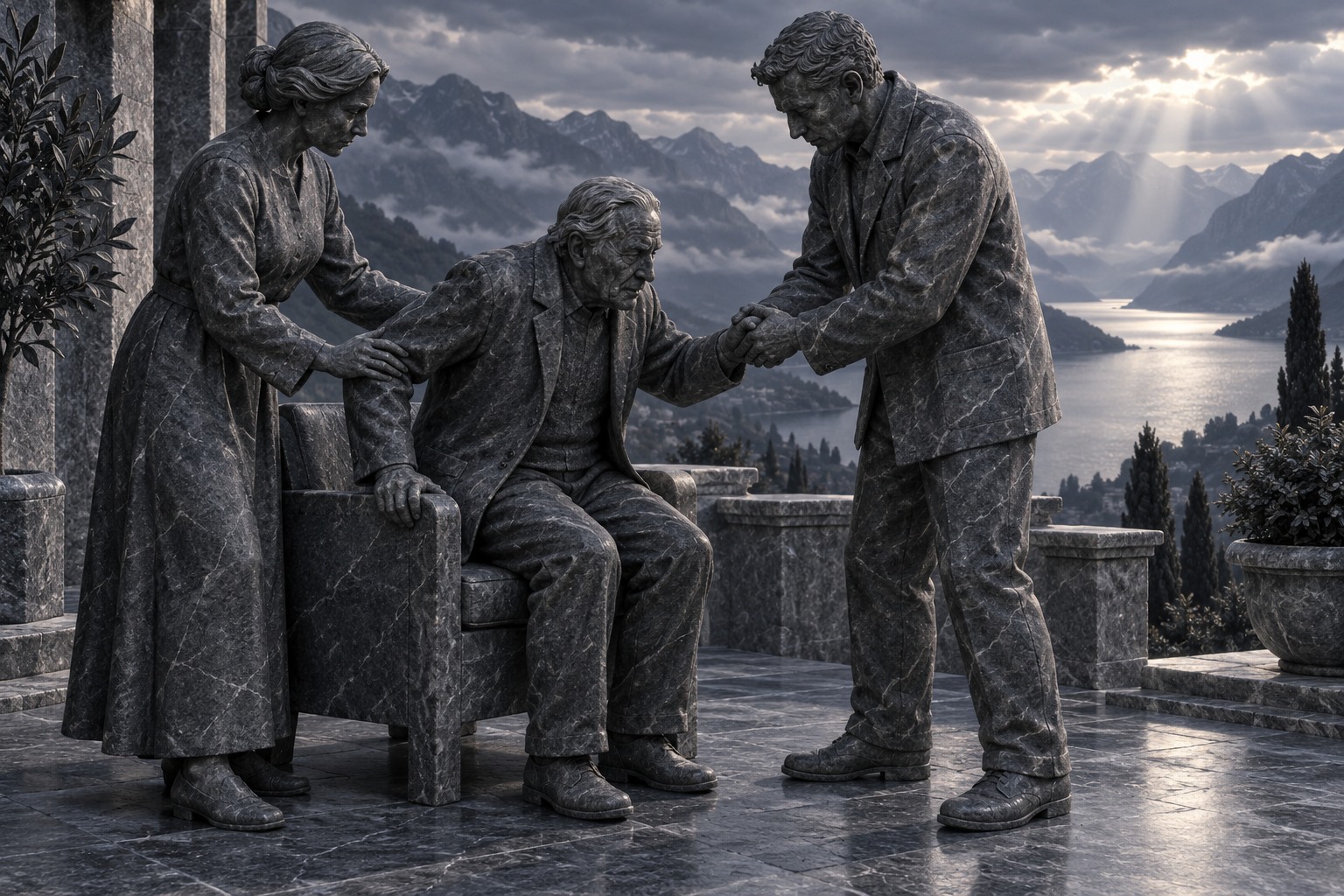
“Without confusion, without change.”
Council of Chalcedon, 451, Definition of Faith, the formula concerning Christ’s two natures. A fragment from the NPNF English translation. Quotations here are editorial English renderings through the approved Russian version, translated by the article’s authors from that source; they are not presented as its published English wording.
About this article
A Nativity image contains a baby, people, animals, and cramped surroundings. It is strikingly bodily for a religion sometimes presented as an attempt to escape matter. This contrast leads to two Christian claims: God created the world, and the Son of God became human. They are related, but not interchangeable.
Creation concerns the origin and dependence of everything that exists. Incarnation concerns the particular relation of divinity and humanity in Jesus Christ. We will examine creation from nothing, Aquinas on the world’s temporal beginning, Athanasius on creation’s restoration, and Chalcedon’s distinction between nature and person. Why is this no hypothesis about a physical vacuum? Why does participation through grace not make everyone another Christ? Modern applications concern bodies, dependence, and dignity while preserving the doctrines’ religious meaning. Comparisons with tzimtzum, discourse about Brahman, and Krishna’s manifestations show how related questions can receive different answers. Readers need not accept the faith to understand its distinctions accurately.
I. Creation: the world does not provide its own foundation
In Christian understanding, creation means that everything other than God receives being from God. This exceeds an account of making a complex object. A craftsperson works with existing material. Creation from nothing—creatio ex nihilo—denies the need for such prior material or the world’s necessary emanation from divine essence. Catechism, §§290–301.
“Nothing” can mislead. It means neither an unusual empty substance used to make the world nor the physical vacuum described by scientific theory. A vacuum already has properties and belongs to an existing order. The theological formula concerns the absence of material or a source of being independent of God.
This position distinguishes Creator from creation. The world matters and possesses its own reality, but is not part of a divine body. Dependence does not make it illusory. Creation really exists, although not from itself. Remove the first pole and the world becomes ghostlike; remove the second and creation’s Christian meaning disappears.
This also differs from a God who started a mechanism and ceased to concern himself with it. In classical theological language, dependence of being does not end at the first instant. The issue is existence’s foundation, rather than merely a distant event. This metaphysics is disputable, but describing how a process occurs within the world does not alone refute it.
Readers should separate how a particular phenomenon arises from why an order exists in which it can arise. Not every philosopher accepts that the second question requires a Christian answer. Yet the questions differ. Confusing them makes theology appear either obsolete physics or a scientifically established explanation. Neither description fits.
II. Time’s beginning and dependence of being
Christian confession includes the world’s beginning, but philosophical development of this claim did not always amount to proving a first instant. Aquinas distinguished the world’s dependence on its Creator from demonstrability of its temporal beginning. In the Summa Theologiae, he treats the world’s noneternity as accepted through faith, not demonstratively proved by reason alone. I, q.46, a.2.
The distinction sounds unexpectedly contemporary, though it should not become an anticipation of modern cosmology. It shows that medieval discussion of creation already exceeded a simple choice: either the world always existed, or someone created it. Duration and the source of being concern different aspects of explanation.
A hypothetical example clarifies this. Text on a screen depends on a functioning device whether it appeared a second ago or long before. The analogy is imperfect: device and text are within the world, whereas theology discusses the foundation of everything existing. Still, it distinguishes beginning from sustaining. An object’s longer history does not itself eliminate the question of dependence.
Scientific gaps should therefore not prove a particular theological claim. Present ignorance of a physical mechanism does not name its cause. Nor does discovering a mechanism automatically settle every philosophical question about existence’s foundation. Evaluate scientific explanations scientifically, and philosophical arguments through their premises and conclusions.
This separation has intellectual value. Believers can investigate the world without defending every older scientific scheme as doctrine. Nonbelievers can criticize religious metaphysics more precisely, rather than replace it with a disproved physical hypothesis.
The boundary is not always peaceful: Christian readers interpret biblical narratives and their relation to science differently. This article does not declare that internal history settled. It sets a modest condition: before disputing the answer, establish which question is being discussed.
III. The world’s goodness and the difficulty of evil
Creation does not allow the material world to be called, without qualification, an evil mistake to discard. Christian texts affirm creation’s goodness while recognizing sin, destruction, and death. These assertions create a difficulty rather than remove it.
The Catholic catechism describes creatures’ diversity as possessing its own goodness, order, and interdependence. §§337–344. This cannot make every existing arrangement just. A disease’s existence does not make it a moral ideal; a social order’s stability does not automatically make it God’s will.
Goodness of being differs fundamentally from the rightness of everything happening. If the world is good because created, violence does not become good because it occurs within it. Actions have their own moral characteristics. Otherwise, creation becomes a universal justification of the status quo.
Athanasius begins his treatise on incarnation with creation and the human condition. Salvation concerns creation’s restoration through the same Word through which it received being. On the Incarnation of the Word, §§1–4. Salvation is not simply escape from material originally alien to God. This theological account connects making, corruption, and restoration.
Yet the account cannot explain every particular loss someone else suffers. Recognizing a doctrine of a fallen world does not reveal why one’s neighbor became ill. Faith may ground hope without making the speaker an expert on each suffering’s hidden cause.
Evil remains a real difficulty. If a good God creates, how should we understand the world’s destructiveness? Christian answers develop through freedom, creation’s corruption, redemption, and hope of final restoration. This article cannot exhaust that dispute. A doctrine’s name is no ready answer to every sufferer. Sometimes belief in creation’s dignity most properly means helping a currently vulnerable body and life.
IV. Incarnation is not another name for creation
Incarnation asserts that the Son of God assumed human nature. It concerns Jesus Christ, not possession of divine nature by everyone in the same sense. Catholic exposition explicitly rejects a Christ partly God and partly human, or a mixture of two principles. Catechism, §§456–465.
The theological phrase “became human” does not mean the Son ceased to be God and turned into another being. Nor was humanity merely an appearance for an audience. The reality of human life—body, rational soul, history—and the preservation of divinity stand together at the center.
Incarnation relates to creation because the assumed human nature belongs to the created world. Relation does not erase difference. Creating a human and becoming human are different acts. The Creator’s relation to all existence is not identical with hypostatic union in Christ.
Replacing this specificity with “the divine is present in everything” introduces another, broader idea. It may have philosophical interest, but does not convey the doctrine’s full meaning. The Christian assertion about a particular event cannot become, without argument, a claim that everyone already is God incarnate.
Nor should incarnation become spiritual courage: Jesus supposedly demonstrates how everyone can realize their talent. Ordinary metaphorical uses of “incarnate” are permissible, but concern another subject. The doctrine concerns salvation, God’s relation to humanity, and Christ’s person, rather than completing a creative project.
Preserving the original claim’s unfamiliarity helps understanding. It need not become comfortable immediately. Christianity offers moral ideas alongside particular assertions of faith. Honest inquiry lets readers encounter them without first substituting acceptable self-help language.
V. Two natures and one person
Chalcedon’s definition of 451 maintains the same person of Christ and two natures, divine and human. Its limiting formulas protect distinction and union together. Neither nature may be confused into losing itself, nor may they be divided into two independent subjects instead of one Christ. Documents of the Council of Chalcedon.
“Nature” concerns what belongs to divinity and humanity. “Person,” or “hypostasis” here, concerns who exists and acts. This technical theological language should not transfer directly into modern descriptions of individuality, character, or psychological parts.
One misunderstanding treats two natures as a split personality, although the definition excludes two separate Christs. Another imagines a mixture: divinity and humanity form an intermediate third substance. Christ would then be neither fully human nor fully God in the asserted sense.
Thomas Hopko’s Orthodox instructional account stresses preservation of humanity and divinity in their union in Christ. The Orthodox Faith: Incarnation. This explains a particular tradition’s confession; it does not prove the doctrine to every reader.
Not every ancient Christian church accepted Chalcedon. Their disagreement cannot be reduced to one side defending true humanity while the other deliberately rejected it. Formulas, concerns, and polemical contexts differed. Here we examine the Chalcedonian line shared by Orthodox Christians, Catholics, and many Protestant churches, rather than a final map of all Christological disputes.
Why require difficult formulas? They sometimes seem an artificial verbal puzzle. Their purpose, however, is to prevent simple explanations that retain one side by sacrificing the other. Language develops to hold a tension. Its difficulty reflects the claim’s difficulty, not necessarily a wish to make faith inaccessible.
VI. Christ’s person and the distinction within the Trinity
“Person” requires further care. Modern readers often hear individual character, memories, or a sense of uniqueness. The doctrinal question differs: who is the subject of Christ’s divine and human life? Listing Jesus’s qualities does not settle unity. Strength, compassion, knowledge, and fatigue can be described while leaving unclear whose actions and states they are. The formula of one Christ maintains this single subject.
Incarnation therefore cannot mean a divine impulse periodically appearing in Jesus. Human life would become an exterior shell around an event whose actual subject existed separately. Adding two independent agents, one sometimes helping the other, does not solve this either. It places God and a human alongside each other without explaining God truly becoming human. Chalcedon resists both dissolving humanity and dividing the single Christ.
This question must also be distinguished from the Trinity. The Son becomes incarnate; the Christian formula does not say Father, Son, and Spirit become three humans, or the whole Trinity comprises one human person. Shared words, “unity” and “distinction,” do not make the doctrines interchangeable. One concerns a single divine nature and the distinction of Father, Son, and Spirit; the other, one Christ and the fullness of divine and human natures. Precision seems unnecessarily complex until we notice the substitutions it prevents.
VII. God’s image, grace, and deification
Being created in God’s image does not make human nature identical with divine nature. Deification—participation in divine life through grace—is likewise not the Son’s incarnation. Distinguishing nature from gift protects each concept’s meaning.
Orthodox spiritual exposition calls humans to likeness with God through grace: participation and transformation, not everyone becoming the source of divine being. The Orthodox Faith: God. Formulas of deification also exist beyond Orthodoxy, with differing developments and emphases.
Elevated words often begin doing psychological work. Reading about divine dignity, someone concludes that their immediate desire holds supreme authority. Dignity does not make every desire revelation. Christian participation in divine life concerns grace, love, and changed living, rather than infallibility of one’s feelings.
The opposite danger turns creaturehood and dependence into humiliation: because a person is not self-sufficient, their will supposedly means nothing. Yet dependence of existence and human dignity are compatible in the Christian picture. A doctrine of gift does not authorize another to control its recipient.
Suppose someone tells a loved one to abandon personal boundaries for spiritual growth. Who defines growth, and what consequences does the demand carry? Invoking deification answers neither question. Participation’s theological meaning does not let a speaker declare every wish a divine commission.
Respectful contemporary reading preserves three relations: humans are created; humans can participate through grace; the Son became incarnate. They belong to a shared Christian account without merging. The stronger the formulas, the more necessary the distinction. It allows human elevation without granting absolute power.
VIII. Embodiment: acceptance does not romanticize pain
Incarnation’s reality opposes treating the body as an incidental shell spiritual life may despise. This does not require idealizing every bodily pain or treating refusal of help as a sign of faith.
Christian history includes asceticism, fasting, care for the sick, discipline, and varied approaches to suffering. Their purposes and conditions differ. Freely chosen ascetic restraint is not forcibly depriving another of food or rest. The spiritual meaning someone gives their pain does not determine another’s pain without their participation.
Distinguish recognizing vulnerability from deliberately intensifying it. Fatigue, age, or illness do not diminish dignity. This may be an ethical implication of respect for humanity; it does not authorize telling a sick person that illness was necessary for their spiritual lesson.
In a hypothetical scene, a community member says their previous workload has become unbearable. “The body must be overcome” may obscure real circumstances. Asking about their condition, possible help, and revised duties gives embodiment practical respect. Theology neither supplies needed medical information nor grounds ignoring it.
Incarnation also preserves specificity. People inhabit more than abstract “humanity”: they have time, place, relationships, and limits. Help becomes real there too. Respect for embodied life notices that an offer manageable for one person may overwhelm another.
This is not the doctrine’s ultimate meaning. Christianity’s assertion about Christ exceeds modern care ethics. We draw a limited implication for reading and relationships, rather than replace faith with moral comfort. Keeping this boundary allows application without claiming the tradition’s entire content.
IX. What happens when doctrine becomes metaphor
Metaphor makes difficult ideas approachable. It becomes dangerous when quietly replacing the original assertion. “Creation” becomes any new project, “incarnation” an idea expressed in action, “salvation” feeling better. These ordinary transfers are permissible, but differ from theological content.
Someone says, “I want to embody my values,” meaning consistency between conviction and action. Christian incarnation is not merely an unusual way of saying this. It asserts who Christ is and the Son’s relation to humanity. Removing that content leaves an effective phrase but changes the subject.
Creation presents a similar problem. Making things from available resources matters, but does not make anyone a creator from nothing in the theological sense. Claiming this forgets material, language, education, others’ labor, and the conditions that enabled action.
A productive transfer first reconstructs the original meaning, then explicitly names the new application. “This reminds me of this human problem” leaves the tradition its content. “The doctrine really always meant only this” replaces inquiry with convenient appropriation.
This matters especially across religions. “Incarnation” may designate different teachings. Comparison must examine divinity, person, nature, and history. Repeating a common term does not establish a common thought beneath it.
Contemporary significance does not require complete identity. An old teaching can touch present life precisely by making an unfamiliar distinction visible. If everything first becomes familiar language, we never encounter the tradition. We hear our own ideas spoken more ceremoniously.
Suppose two people help a neighbor and discuss why. One invokes the dignity of a created human; the other, a commitment to caring for people. Agreement in action does not establish agreement about the Creator or incarnation. The first then says helping recalls bodily life’s significance in Christ. Two questions become clear: what the doctrine asserts, and what conclusion this person applies to the neighbor. The second may find the conclusion persuasive while rejecting its religious foundation. The first can name that foundation without treating shared care as hidden acceptance of faith. Cooperation and real disagreement survive together. If both instead call helping “incarnation’s true meaning,” doctrine quietly disappears: a common action supposedly confirms a teaching one participant does not profess. Recording the shared action and its two motivations afterward shows both agreement and continuing difference.
X. A world that need not be devalued for God’s sake
Creation and incarnation connect dependence with dignity, distinction with closeness. The world is not God, but its existence is no incidental obstacle to spirituality. Christ is not merely an unusually successful human, but his humanity is no appearance. These assertions remain together because removing one changes the picture.
They produce no quick technique for happiness. They call for more careful thought: separate physical explanation from metaphysics; do not justify evil through creation’s goodness; distinguish participation by grace from divine nature; do not derive an obligation to endure harm from respect for embodiment.
The Christian answer may remain unacceptable or open to readers. Understanding requires no pretended agreement. Substantive disagreement should concern the actual teaching, rather than its transformation into a mystical slogan of universal unity.
The baby among people and animals brings two lines together: the world matters, and the divine relation to humanity is asserted within a particular history. Seeing this meaning ends the exclusive search for spiritual depth in withdrawal from life. Sometimes a question about the highest leads to something ordinary: can we notice the body, person, and dependence already before us?
What this means in practice
Start by distinguishing kinds of questions. Discussing life’s origin, establish whether the issue is a biological mechanism, metaphysical foundation, or religious meaning. All three can be discussed without treating one level’s answer as the others’.
When reading Christianity, map briefly what concerns all creation, humans, Christ, and participation through grace. This guards against striking confusions. If a phrase describes humans becoming gods, check whether it concerns nature, grace, likeness, or a particular Christological claim. Context usually matters more than emotional force.
Then consider an ordinary relationship. A hypothetical parent sees a child mainly as an extension of their own plan. Distinguishing gift from ownership may show that a relationship’s origin creates no complete right to another’s life. This is a modern ethical application, not proof that creation alone settles parenting.
Another example concerns dependence. Someone ashamed of help equates dignity with independence. Received being permits another account: accepting support need not humiliate. Yet particular help requires examining conditions, consequences, and the possibility of refusal. A gift used for control needs a different assessment.
Choose a bodily and socially specific action: reduce an unbearable workload, clarify consent, meet an ordinary need, or state a boundary. This does not confirm doctrine. It reveals what relation to another your present understanding calls for.
This need not become a compulsory religious program. Believers may continue within church life; nonbelievers, through philosophical discussion. Preserve precision in either case: applying a thought to an episode and accepting an entire worldview remain different steps.
Key quotation
“He became human so that we might become gods.”
Athanasius of Alexandria, On the Incarnation of the Word, 54.3, the older NPNF English translation. Editorial English rendering through the authors’ approved Russian translation. Read the strong formula alongside restoration, immortality, and the distinction between participation through grace and divine nature. It does not declare everyone a separate incarnation of the Son.
Connections across traditions
These are our analytical comparisons. They identify a shared question and a boundary between answers; they do not themselves establish historical influence.
| Question | Positions and sources | Actual similarity | Boundary of comparison |
|---|---|---|---|
| Creation and time’s beginning | Aquinas, I q46 a2 and Catechism, §§290–301 | The world’s dependence on the Creator exceeds describing the first physical event. | For Aquinas, a temporal beginning is accepted through faith, not his proven cosmology or a rejection of church confession. |
| Incarnation and participation | Athanasius, 54.3 and Chalcedon’s definition | A divine relation to humanity need not destroy humanity. | Christ’s one person and human deification are different relations; participation through grace is no new hypostatic incarnation. |
| God and world without a bodily scheme | Catechism, §§290–301 and Shneur Zalman, Tanya, chapter 7 | Neither text allows God to be imagined as a departing body. | Nonliteral tzimtzum uses particular kabbalistic language and differs from Catholic exposition of creatio ex nihilo. |
| Divine manifestation | Chalcedon’s definition and Gita, IV.5–8 | Both religious discourses give a divine relation to humans concrete expression. | Krishna’s repeated manifestations at dharma’s decline and Christ’s two natures are different teachings; Sanskrit avatara is not exhaustively translated by “incarnation.” |
| Speaking about the foundation | Aquinas, I q46 a2 and Brihadaranyaka, II.3.1–6 | Our comparison asks whether familiar categories suffice for existence’s foundation. | Brahman’s two forms and negative instruction are not creation from nothing. This passage establishes no single cosmology for all Hindu traditions. |
Sources
-
Catechism of the Catholic Church. The Creator, §§279–324: creation from nothing, freedom of creation, and sustaining being.
-
Thomas Aquinas. Summa Theologiae I, q.46, a.2: the world’s temporal beginning and the limit of demonstrative proof.
-
Catechism. Heaven and Earth, §§325–354: creatures’ own goodness and interdependence.
-
Athanasius of Alexandria. On the Incarnation of the Word, §§1–4: creation and restoration through the Word.
-
Catechism. The Son of God Became Man, §§456–483: assuming human nature and distinguishing divinity and humanity.
-
Council of Chalcedon, 451, Definition of Faith: Christ’s one person and two natures.
-
Thomas Hopko. The Orthodox Faith: Incarnation, Orthodox Church in America: Orthodox exposition of Chalcedonian teaching.
-
Thomas Hopko. The Orthodox Faith: God: likeness to God through grace.
-
Shneur Zalman of Liadi. Tanya, Shaar Hayichud Vehaemunah, chapter 7, with Chabad commentary: nonliteral tzimtzum and the impossibility of attributing bodily movement to God.
-
Bhagavad Gita, chapters II–IV, translated by Edwin Arnold, The Song Celestial, 1900 edition: karma yoga and Krishna’s manifestations; comparisons do not equate avatara with Chalcedonian Christology.
-
Brihadaranyaka Upanishad, II.3.1–6, translated by F. Max Müller, SBE XV: negative instruction in its own discourse about Brahman, not proof of identity with Christianity.
Tags
creation, incarnation, Christianity, creatio ex nihilo, Creator, creation from nothing, Athanasius of Alexandria, Thomas Aquinas, Council of Chalcedon, Christ, Son of God, Word, Trinity, nature, hypostasis, person, two natures, image of God, grace, deification, embodiment, dignity, dependence, evil, time, metaphysics, cosmology, tzimtzum, avatara, comparative theology
About the authors
Andrey Zarinsh is the author and founder of United Wisdom. He explores inner transformation, the unity of traditions, intercultural dialogue, and contemporary spiritual discipline. Instagram: @andrey.zarinsh.
Maria Evilkut is a coauthor of United Wisdom. Alongside her research, she seeks to test these ideas in practice and observe how principles of unity and mutual understanding work in real life between people and cultures. Instagram: @ilkutki.
Keep what resonates with you.