
Meaning & path
Art That Unsettles Instead of Comforting
Why difficult art can matter: tragedy, feeling moved, artistic form, and the viewer’s freedom without making shock a measure of depth.
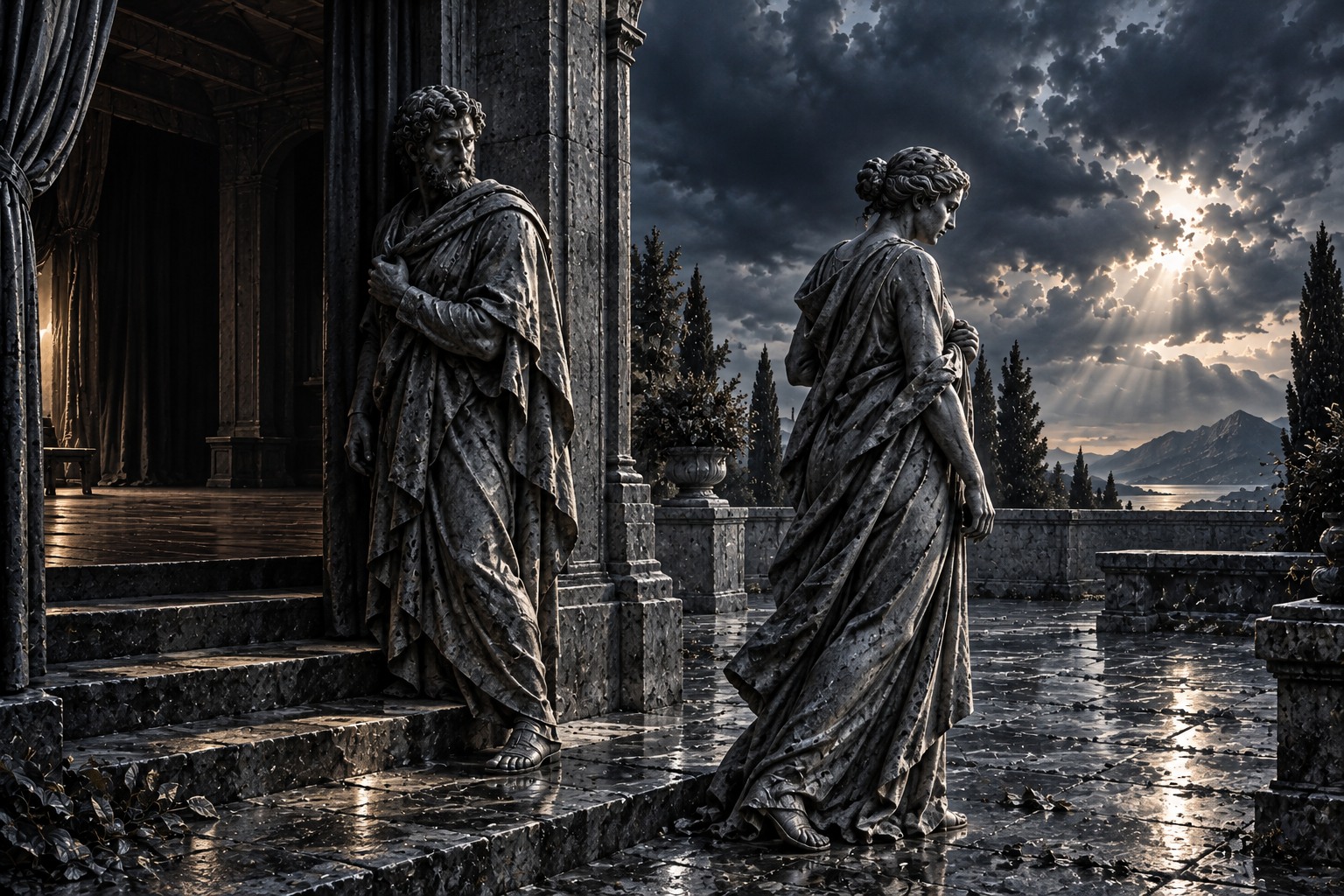
Why can a difficult work of art become meaningful?
United Wisdom · Meaning and the Path · P-20-N05
About this article
The film has ended and the room is brighter, but you are not ready to discuss dinner. You would wish nothing like what happened on screen on yourself or anyone close to you. Yet asked whether it was worth watching, you say yes. Every minute was not pleasant. Perhaps the story gave shape to a question you had managed to dismiss. Perhaps it became harder to say, “That could never happen to me,” or “There is nothing complicated here.”
We can call this a profound experience, but the label explains little. A powerful impression might have substance, touch a personal hurt by chance, or simply leave us exhausted. We will explore distinctions offered by the philosophy of tragedy, a study of sad films, and two artworks about war. Our subject is the encounter with art, without promises of therapy or inevitable moral growth. Everyday scenes are imagined; general theories cannot determine an individual viewer’s response.
1. An evening that did not become easier
Two people leave a cinema after a difficult film. One says, “I really did not need that today.” The other says, “I’m glad I saw it.” Both may describe their experience accurately. The first need not be shallow; the second need not enjoy suffering. They may have arrived with different expectations, noticed different details, and encountered different questions in the same story.
We often ask art to change our mood: to make us laugh, soothe us, or offer a break. That wish makes sense. A work can also hold us beside a contradiction, reveal the cost of a convenient decision, or deprive a character of a final excuse. The result may be difficulty bringing a thought to a premature end. We leave with a more precise question than the one we brought.
Imagine a fictional scene in which someone fails to answer a friend’s letter. At first, this looks like ordinary busyness. Several short scenes later, the unanswered letter becomes part of a prolonged absence. Almost nothing spectacular happens on screen. Yet the viewer begins to distinguish what a neutral phrase once concealed: “I didn’t have time.” The unease comes with a changed understanding of an action.
Four judgments help: Was it pleasant? Was it interesting? How is the work constructed? What does the encounter mean to me? Our answers may diverge. We can be interested in form without wanting the depicted experience in life, recognize skill without wishing to return, or feel intensely about a weak scene because it happens to meet a personal memory.
These distinctions release discussion from a single overall score. “It was hard for me” does not yet establish that a work is good or bad. It says something important about the encounter. We can then ask what happened: fear for a character, irritation with a technique, disagreement with the author, recognition of our own habit? Precision gives us less reason to measure quality by the amount of discomfort endured.
2. A representation of suffering and suffering itself
An encounter with art concerns how an event is represented. Words, sequence, an actor’s gesture, rhythm, and a chosen viewpoint stand between the event and the viewer. These can intensify feeling while also becoming objects of attention. We can notice what touched us: the event itself, or the way we were allowed to see it.
In the Poetics, Aristotle distinguishes the unpleasantness of certain objects from pleasure in their representation, connecting the latter partly with recognition and understanding. His definition of tragedy brings together action, pity, fear, and the purgation of these emotions. These are propositions in ancient poetics, not contemporary emotional-health research. Aristotle, Poetics, IV and VI, translated by S. H. Butcher.
“Catharsis” is often used as though every intense experience must end in beneficial release. That definition supplies no such recipe. A narrower distinction serves our purpose: a work organizes experience through action and form. We can follow how one decision changes another, how something unknown emerges, or why a familiar act becomes tragic under different circumstances.
Imagine a story about missing a train. In a brief summary, it is an everyday mishap. In the story, we first learn whom the traveler is visiting, notice why they hesitate, and only later understand the delay’s irreversible consequence. Meaning emerges through relationships. Adding more misfortunes cannot produce it automatically. Another disaster might merely drown out the question already taking shape.
This perspective has a practical implication for reading and discussion. Alongside wanting to be moved, we can examine construction: where does our knowledge change, whose action remains unseen, which possibility escapes the character? Attention to form can accompany involvement. It makes discussion specific enough to go beyond both a plot summary and an account of our tears. We can explain what the work does with the events it presents.
3. What holds us beside something painful?
If an unpleasant feeling were the whole point, voluntary returns to tragedy would remain puzzling. One answer says that we seek intense experiences of any kind. But this explains too much at once. Shock at bad news, anxiety while awaiting a call, and attention to a play become almost interchangeable, despite their different objects and conditions.
In “Of Tragedy,” David Hume asks how sorrow and fear can contribute to a spectator’s pleasure. His own explanation gives a central role to expressive power and the skill of representation. He also allows that depicted horror may remain painful without becoming pleasurable. Hume, “Of Tragedy,” §§1, 9–10, 20–24.
Hume’s question helps us notice expression at work. A precise sentence in which someone finally articulates loss can hold us, as can a pause after a line: the words have ended, but the relationship between the characters becomes more audible. We need not desire the represented misfortune to value the form through which it becomes perceptible. These are different objects of judgment, even when experience intertwines them.
Still, “suffering becomes pleasure” needs care. Sorrow may remain sorrow while coexisting with interest, admiration for skill, or gratitude for precision. One feeling need not disappear to make way for another. We can preserve that complexity: “I did not enjoy the character’s misfortune. It mattered how the film portrayed his isolation.” This explains more than a general declaration of love for sad stories.
A limit follows: even excellent form cannot guarantee a suitable experience. We read the same story differently on different days. Something that once offered room for reflection may now feel too close. The work need not have lost its quality, and the reader need not prove an unchanging taste. What becomes meaningful is an encounter under particular conditions, rather than a work that benefits everyone at every moment.
4. Sadness and the feeling of being moved
After a film, we might say, “I feel sad,” or “It moved me.” The second expression can contain more than one feeling: sadness about a loss alongside tenderness toward a relationship that has become visible. This distinction lets us consider an overall response without requiring every part of it to be pleasant.
In a study by Julian Hanich and colleagues, 76 participants watched 38 clips in which characters learn of a close person’s death. According to the abstract, feeling moved almost fully mediated the positive association between sadness and enjoyment. Hanich et al., 2014. This concerns specific material and self-reports; it does not show that sadness itself is beneficial or causes pleasure in every viewer.
Return to our imagined story of the unanswered letter. Suppose the character finally reads a few lines his friend managed to send. We might be touched both by a lost opportunity and by the care now revealed. Joy that two people mattered to each other does not make the loss joyful. Separating these aspects describes the experience more accurately without finding a positive explanation for everything painful.
The study does not supply the correct response for a spectator. It cannot establish that someone who remains dry-eyed failed to understand, or that being moved demonstrates moral maturity. An evaluation after a clip also cannot show that the person will be more attentive to loved ones tomorrow. Experiencing a work and changing one’s life are different questions requiring different evidence.
Ordinary conversation needs only a little precision: what moved me? The character’s vulnerability, another person’s unexpected care, a relationship recognized too late? An answer may remain incomplete. It still returns us to what was presented, allowing more than a choice between “It was pleasant” and “It was pointless.” An experience can have value that a single rating of mood cannot adequately express.
5. Form creates distance and brings us closer
Distance from a work need not mean coldness. In a theater, someone can see the stage and know they are watching a performance while following a character with suspense. A reader can close a book, yet a sentence on its open page can feel very close. The ability to interrupt an encounter can coexist with involvement in it.
Winfried Menninghaus and colleagues’ Distancing-Embracing model connects negative emotions in art reception with two groups of mechanisms: distance through artistic representation, and engagement through form, mixed emotions, and meaning-making. They propose an explanatory model requiring further testing, not a promise of safety or enjoyment. Menninghaus et al., 2017, abstract and §5.
We can consider this distinction in our own circumstances without turning the model into instructions. At home we can pause; a cinema has an exit; a paragraph can be revisited later. Yet the presence of a door does not mean leaving feels easy. Companions, a teacher’s expectations, or a wish to appear knowledgeable may complicate the choice. Freedom of attention also depends on the actual setting.
Form can bring us closer to difficult material indirectly. An empty place at a table can make a loss perceptible without depicting the death. A recurring sound connects two times. An awkward conversation reveals a rupture better than a grand declaration. Restraint may give the viewer room to observe. These are possible artistic choices, not universal rules for powerful work.
The quantity of difficult material is therefore only part of the question. Organization matters: what can we see, what remains unknown, is there room to think, does the work assign us a single response in advance? Sometimes attention is sustained because we are invited to participate. We remain beside something difficult voluntarily and can revise our relationship to it as the encounter develops, instead of proving that we felt what we were expected to feel.
6. When a painting refuses to settle the world
Pablo Picasso made Guernica in 1937 for the Spanish Pavilion in Paris. The Reina Sofía museum connects its creation with news of the bombing of the Basque town and discusses its gray palette, dramatic character, and symbolic language. Picasso, Guernica, museum record and commentary.
For our argument, the historical occasion and its representation need to remain distinct. A painting does not replace information about an event, a body of testimony, or a historian’s work. It offers another encounter: we may consider the collapse of a human world’s familiar stability. This is the reading proposed here, rather than a claim about the artist’s sole intention or every viewer’s inevitable feeling.
Unlike a story whose ending restores order, such a work can be experienced as a refusal to close the question quickly. The eye seeks a place where everything becomes proportionate and explicable again, without necessarily finding it. Unease may then come from difficulty reducing what is presented to a convenient phrase after which there is no further need to look. It need not depend on anticipating the next shock.
This possibility should not become an obligation. One viewer may stay, another study a single figure, a third first seek historical context. Different paths do not indicate different degrees of humanity. Asking what question the work makes possible is more useful than judging nearby visitors by their faces. A painting’s seriousness does not authorize us to prescribe the proper experience for others.
Artistic form can preserve something that everyday speech readily compresses into abstraction. “War,” “loss,” and “suffering” fit on a short line while referring to whole lives coming apart. A work may interrupt that compression. Attention becomes more responsible when facts and particular people remain alongside it. An intense encounter with a painting does not entitle us to claim that we now know another person’s experience from within.
7. Seeing a person without claiming their pain
Käthe Kollwitz offers another example. MoMA dates her woodcut The Mothers, from War, to 1921–1922, with publication in 1923. The museum reads the mothers as protecting children and places the series’ attention on those living with war’s consequences. Kollwitz, The Mothers, MoMA.
This motif permits another question: what do we notice when looking at vulnerability? We might seek the expressive force of grief or attend to an action: an effort to hold, protect, refuse to surrender. In the second reading, suffering does not exhaust the person. A relationship, an effort, and the direction of an action remain. This develops our question; it describes no measured effect of the print on viewers.
Imagine a conversation after an exhibition. Someone says, “Such powerful work. I feel devastated.” Someone else asks, “Why do we speak so little about those who have to carry on living?” Both remarks could come from the same person at different moments. One reports an impression; the other redirects attention. Gradually the center of discussion includes a previously neglected question alongside the viewer’s own sensitivity.
Feeling involved still does not give us ownership of another person’s story. “Now I know exactly what they experienced” goes beyond what viewing can establish. We encountered a representation by a particular artist, read from our own position. It can disrupt an indifferent generalization without erasing differences of experience. Respect sometimes begins with a more modest conclusion: “I realized what I had never asked about.”
Art can prompt that question; action does not follow automatically. Someone may read a document, conduct a conversation differently, or simply remember a gesture. Every encounter need not become an immediate deed. Yet a powerful feeling should not be presented as help already given. Sympathy, knowledge of circumstances, and action are connected by possibilities, rather than a guaranteed passage from one to the next.
8. Being shaken does not establish depth
Unsettling art has a convenient defense against criticism: if you feel uncomfortable, the work has succeeded. This makes it almost impossible to evaluate. An objection becomes proof of success; declining to watch becomes the viewer’s deficiency. Yet discomfort has many possible causes, including an unsuccessful device, predictable pressure, or disagreement about how people are represented.
In chapter XIV of the Poetics, Aristotle favors fear and pity arising from the arrangement of events over an effect produced by spectacle alone. Poetics, XIV. We need not accept his entire hierarchy to retain the question about form: how does a work achieve its effect, and what does that effect reveal?
Imagine two scenes. In one, a loud sound makes us jump, after which the story continues unchanged. In another, a character answers with a familiar phrase, and we realize that they failed to hear what was said a minute earlier. The first can be a successful genre device; the second a significant turn in a relationship. Neither is prohibited in advance. A sharp physical response and a change in meaning simply do not coincide automatically.
Disagreement also differs from misunderstanding. We can understand an author’s position and judge it unfair. We might notice that one character is allowed complexity while another serves as a convenient obstacle. We can ask whether a striking accusation has displaced attention to circumstances. Such questions remain relevant when a work is famous, difficult, or capable of making us cry. Aesthetic attention includes the ability to object.
Criticism gains substance when it returns to a detail: which scene, edit, or omission? “I’m being made to feel something” can become a more precise account of where another reading is excluded. Looking again might turn initial irritation into interest, or clarify the objection. Both outcomes offer more than a rule that the unpleasant is always profound and the comforting always shallow. We can judge what this particular work makes possible.
9. Stepping away belongs to the encounter too
Taking art seriously does not require constant readiness for difficulty. After a demanding day, someone may choose comedy, familiar music, or silence. They owe no justification to an imaginary cultural examiner. A work may be important while this evening is unsuitable for it. Its significance and a person’s readiness to engage remain different questions.
Among companions, this freedom can require simple words. “I’m going to step out.” “Could we discuss it without retelling that scene in detail?” “I’m interested, but I’ll stop for today.” These express a limit of participation without passing judgment on someone else’s taste. Another person may wish to continue; they need not persuade us to stay to validate their own experience.
There is an opposite difficulty: wanting to silence everything that disrupts a familiar perspective. If curiosity remains, a smaller step is possible: read a description, consider one detail, return later. There is no standard of endurance or promise that continuing will help. The decision depends on available interest and circumstances, rather than a contest in tolerating discomfort. Neither the reputation of a work nor someone else’s enthusiasm can decide those conditions for us.
Freedom of attention should not turn into another prescription: you must leave, must stay, or must process the experience. We can acknowledge that an encounter happened without explaining it yet. Every feeling need not immediately become a story of growth. Sometimes time is needed simply to distinguish the work’s impression from the exhaustion of the day.
Respect for this freedom matters when discussing art together. We can offer a reading without demanding agreement, ask whether someone wants to talk without extracting disclosures, and name a difficult subject beforehand without promising to predict every response. Conversation then accommodates different ways of participating. A demanding work remains an occasion for a meeting, rather than a test of intimacy or cultural competence.
10. What remains after the credits
Return to the room where the film has just ended. Dinner still needs preparing; tomorrow’s work has not disappeared. Declaring that two hours have changed a life would promise too much. Between total transformation and wasted time, however, lie many more modest outcomes.
Perhaps you distinguish a hurried excuse from an actual explanation more clearly. You hear silence in a conversation differently. A character’s face returns when you make a general judgment about people in similar circumstances. These are possible continuations of a particular encounter, not inevitable effects of a genre. We can notice what actually happens instead of assigning useful work to the film in advance.
Sometimes only disagreement remains. The film is skillful, but its outlook feels alien. The exhibition raises an important question in a way you find unfair. This can also be a considered outcome. Meaningful engagement need not end in surrender to the author. It can let us see our objection more clearly and explain it without dismissing another person’s experience.
Here we propose understanding unsettling art as a chance to remain beside something a habitual outlook simplifies too quickly. Form gives a question duration, definition, and a place in memory. Discomfort does not measure truth, shock does not guarantee depth, and depth does not oblige everyone to keep watching. These distinctions allow seriousness without coercion, including the seriousness of a reasoned refusal.
Perhaps the most accurate ending is quiet: “I don’t feel better, but I understand more clearly what I want to think about.” Or it may be: “I realized I don’t want to look at a person that way.” Both leave the viewer a position of their own. Art need not always comfort. Sometimes it can make an important question visible and leave us free to decide how to live beside that question afterward.
What this means in practice
Recall a work you have already encountered and feel interested in considering now. There is no need to seek the most difficult one. Choose an episode, page, or detail. This is an invitation to reflect on experience, proposed by the article, without claiming to be a psychological technique.
Name the impression as precisely as you can: frightening, sad, irritating, moving, objectionable? Several words may be more accurate than one. Find a related detail. What was shown, in what order, and through whose eyes? Separate an observation from an assumption about the author’s intention.
Distinguish three questions: what is represented, how is it made, and what happened to me during the encounter? Historical commentary may clarify the first; reading again may clarify the second. The third remains your account of experience and need not match a friend’s or a critic’s response.
Ask whether a new distinction appeared. Perhaps you saw an action more precisely, noticed someone’s effort, or understood your objection. “I don’t know yet” is also a possible answer. An intense feeling need not immediately become a lesson or a promise to change. It can remain something you are still finding words for.
Choose what follows according to interest and energy: talk, read a source, return later, or end the encounter. Allow someone discussing it with you the same possibilities. A good conversation does not require identical tears, endurance, or conclusions. It gives each person room to explain what they actually noticed.
One accurate sentence about the work, previously unavailable to you, may be a worthwhile result. It will not erase the weight of what was represented and need not improve your mood. It can preserve the encounter in your own words without treating the strength of your response as a final answer about art’s value.
Connections between approaches
| Approach | What it helps distinguish | Limit of the conclusion |
|---|---|---|
| Aristotle, Poetics | Event, representation, and the arrangement of action | Ancient poetics does not establish therapeutic release |
| Hume, Of Tragedy | Painful subject matter and expressive skill | His explanation does not guarantee pleasure |
| Hanich et al., 2014 | Sadness and feeling moved | 76 participants and specific clips; no universal law |
| Menninghaus et al., 2017 | Representational distance and engagement through form | An explanatory model, not a clinical protocol |
| Picasso, Guernica | Historical occasion and artistic representation | A painting does not replace historical evidence |
| Kollwitz, The Mothers | Vulnerability and the act of protection | A viewer’s response proves neither help nor complete understanding |
These are different questions placed alongside one another, not a single established theory. The contemporary model and the sad-film study share authors and do not count as two independent experimental confirmations.
Primary sources and research
-
Aristotle. Poetics. Translated by S. H. Butcher: chapters IV and VI, chapter XIV. Relevant passages were read. They are paraphrased; catharsis is not used as a clinical promise.
-
David Hume. Of Tragedy. Hume Texts Online. §§1, 9–10, 20–24 support the discussion of the paradox, expression, and limits. Hume’s position is distinguished from the views of Dubos and Fontenelle that he quotes.
-
Hanich, J., Wagner, V., Shah, M., Jacobsen, T., Menninghaus, W. 2014. Why We Like to Watch Sad Films. Psychology of Aesthetics, Creativity, and the Arts, 8(2), 130–143; DOI 10.1037/a0035690. The abstract and bibliographic record were read; the complete method and results were not checked. Correlation and statistical mediation are not presented as established causality.
-
Menninghaus, W., Wagner, V., Hanich, J., Wassiliwizky, E., Jacobsen, T., Koelsch, S. 2017. The Distancing-Embracing Model of the Enjoyment of Negative Emotions in Art Reception. Behavioral and Brain Sciences, 40, e347. The abstract, passage rejecting a complete conversion of negative into positive affect, and §5 on limitations were read. This is a theoretical model.
-
Pablo Picasso. Guernica. 1937. Museo Nacional Centro de Arte Reina Sofía. Collection record and commentary checked. The article distinguishes its proposed reading from facts. No image reproduction.
-
Käthe Kollwitz. The Mothers, from War. 1921–1922, published 1923. MoMA, 470.1992.6. Collection record and museum commentary read. No image reproduction or claim about measured effects of the print on viewers.
Tags
Art, aesthetic experience, unease, consolation, tragedy, sadness, compassion, fear, being moved, mixed emotions, form, plot, distance, attention, interpretation, catharsis, spectator, freedom of choice, provocation, criticism, memory, testimony, war, Aristotle, Hume, Picasso, Guernica, Kollwitz, United Wisdom.
About the project’s authors
Andrey Zarinsh is the author and founder of United Wisdom. He explores inner transformation, unity across traditions, intercultural dialogue, and contemporary spiritual discipline. Instagram: @andrey.zarinsh.
Maria Evilkut is a co-author of United Wisdom. Alongside her research, she seeks to test these ideas in practice and observe how principles of unity and mutual understanding work in real life between people and cultures. Instagram: @ilkutki.
Keep what resonates with you.