
World & consciousness
Map and territory: why a description of the world is not the world itself
Distinguishing a description from its subject, checking its purpose, and limiting the conclusions drawn from it.
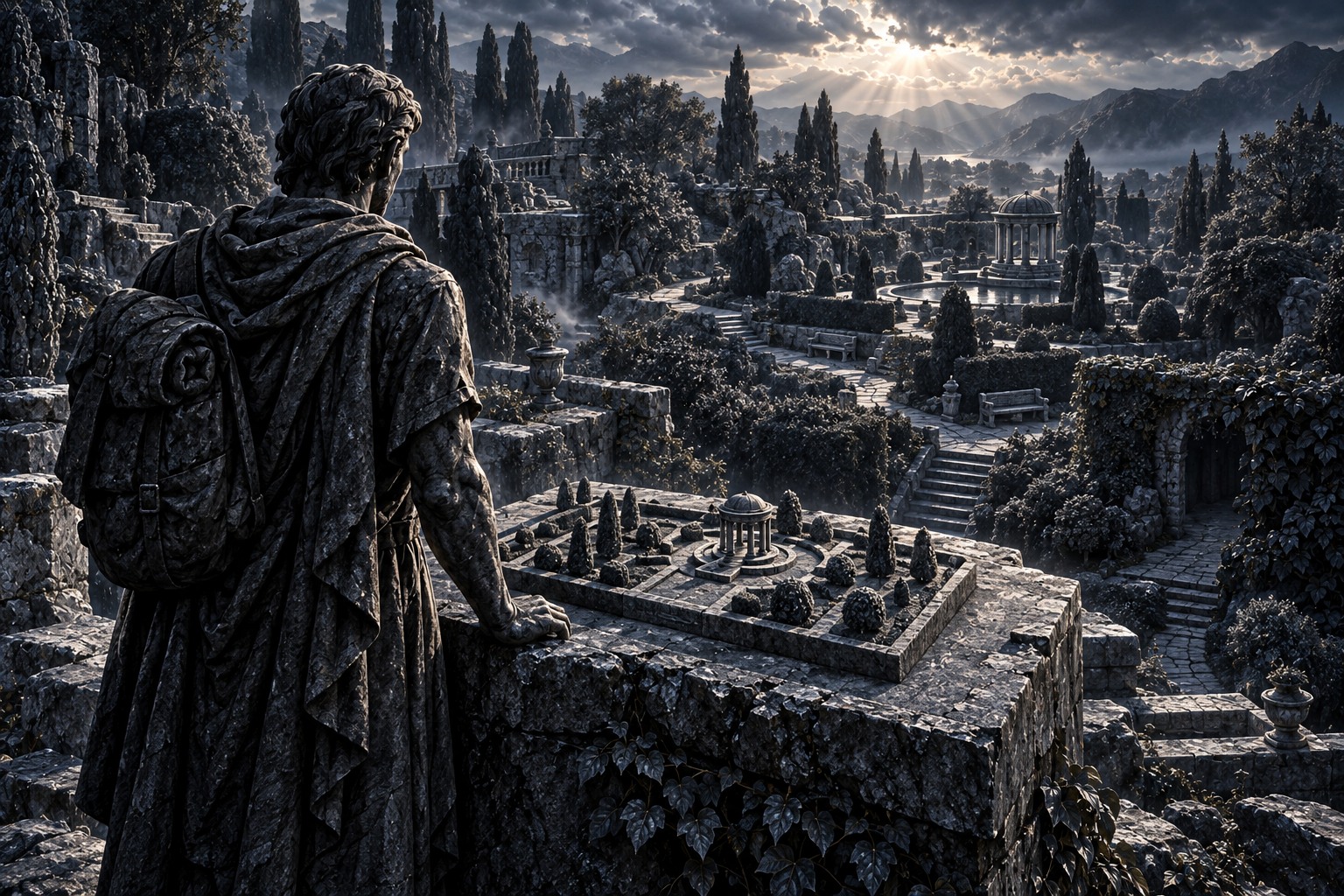
Epigraph
“A map is not the territory.”
Alfred Korzybski, selected passage from the 1931 presentation reproduced in Science and Sanity, proposition C(3). The Russian epigraph is United Wisdom’s own translation of this English sentence.
What this article is about
A description helps us find our way precisely because it leaves much outside our attention. A garden plan can mark paths without drawing every leaf; an account of a meeting can convey a decision without repeating every remark. Selection alone does not make a description false. Trouble begins when we forget its purpose and ask it to answer a different question. A plan showing where paths lie becomes a promise of an easy walk, while a brief decision record becomes the whole history of a relationship. This article distinguishes an object, its description, and the conclusion we draw from that description. Korzybski’s formula, Plato’s cave, and the first chapter of the Tao Teh King offer different comparisons while retaining their own meanings. Through one invented example, we will consider purpose, relevant omissions, updates, and a return to circumstances we can examine. The aim is a useful description open to correction, with room for each person’s choice of understanding.
I. Two visitors and a single plan
Imagine a small garden preparing for an open exhibition. This is an invented story, rather than an account of an actual place. An organiser sketches the entrance, three paths, a pavilion, and a space displaying participants’ work. One visitor wants to find the exhibition quickly. Another would like to look at plants quietly and sit down along the way. The same sheet may help both, but it chiefly answers a question about location. The length of a line between the entrance and pavilion does not, by itself, state how long the walk takes, how even the surface is, or whether a bench has a free seat. Such circumstances may matter to a particular person even though the person drawing the plan had a different task in mind.
The first mistake emerges in conversation before either visitor starts walking. The organiser says everything on the plan is nearby. A visitor understands this as a promise of an easy route. We need not immediately decide that truth has met falsehood: “nearby” might mean a short line on paper, a distance familiar to the organiser, or an easy walk. A direct question helps. Does the visitor need to know where the exhibition is, how long it takes to reach it, or whether the selected route works under today’s conditions? Clarification changes what we require of the description. It also lets a person explain what information is missing without having to treat someone else’s assessment of convenience as their own.
The plan remains an object with particular uses. In this story, it is good enough for finding the pavilion and insufficient for promising every detail of a walk. This does not mean its author must anticipate every possible question. A more limited responsibility follows: state the sheet’s purpose clearly and avoid presenting an unknown as established. A visitor can use the plan, supplement it with a question, or choose another source. This approach respects both the maker and the user. We can assess an incomplete description against a task, instead of declaring it either the final truth or a useless deception. Its limits become something people can discuss.
II. What survives when the world is reduced
The selected primary passage by Korzybski compares the order of three cities in a territory with their order on a diagram. Reversing the order misdirects a traveller. The author then distinguishes similar and dissimilar structures and states that a map is not its territory. Our limited question is which relationship a description must retain to help with a particular task. We do not adopt a general theory of the nervous system or a promise of psychological improvement from this passage. Indeed, the reproduced text introduces the discussion as a sketch without empirical data. The formula gives us a reason to examine how a representation works; it does not replace investigation with an authoritative phrase.
A garden plan can greatly reduce the distances shown while preserving the sequence of turns. A path’s colour on paper need not match its surface, and a circle can stand for the pavilion. These differences need not prevent someone from finding a place. But if the same circle stands for both the pavilion and the exhibition space, a user may misunderstand what they have found. A key becomes useful. We distinguish visual resemblance from the relationship supporting an action. A beautiful drawing may be poor for navigation; a plain diagram may help through its clear selection. This is our analysis of an invented example, rather than a historical claim that Korzybski described all kinds of maps in this way.
Definitions and explanations play a similar role in verbal descriptions. “Work by the pavilion” could mean beside it, inside it, or on the approach. If someone is bringing their own work to a particular place, the distinction matters. Discussing a description involves more than checking each word separately: we also need to examine the connection between those words and the expected action. Sometimes one clarification is enough; a completely new plan is unnecessary. A good correction retains what already works and resolves a particular uncertainty. It need not turn a diagram into a photograph, or a short account into a limitless list of details. Its scope can remain proportionate to its purpose.
III. Omissions and errors need different responses
No trees appear on the sheet. Compared with a complete view of the garden, this is an omission, but it may not hinder a visitor looking for the exhibition. The sheet places the entrance on the east side when it is actually on the west. That is an incorrect indication. The distinction matters: an omission may call for an addition, while an error calls for a claim to be corrected. If we call every selection a lie, no description can ever be finished. If we call every mistake acceptable simplification, there is no basis for asking for accuracy. A concrete question remains between these extremes: what does the description promise to tell us, and what information is needed for its proposed use? The task matters; a wish to declare oneself right does not settle the answer.
Suppose the second visitor asks where they can sit down. Benches now become part of that person’s task. The old sheet does not become a lie retrospectively; it remains a plan showing the exhibition’s location. The organiser can answer separately or add information. However, if the exhibition’s name is accompanied by a promise of a comfortable walk with places to rest, the description’s scope has expanded. Missing information then needs more careful explanation. We examine the representation together with its accompanying promise. An attractive phrase, a caption, or a spoken comment can quietly give a plan authority it did not previously possess. It is therefore useful to examine the whole passage from a description to an expectation.
This analysis does not require guesses about the organiser’s intentions. They might have been rushed, understood convenience differently, or overlooked the expanding promise. Identifying the particular gap and its relevance is enough. A visitor can decline the walk without proving that someone’s plan is bad. The organiser can acknowledge the sheet’s limits without reaching a humiliating conclusion about their own worth. The discussion stays with its subject. We do not need hidden motives or overall judgments of character to correct the entrance’s position, clarify whether a bench is available, or withdraw an overbroad promise. Care with descriptions can support people’s choices without becoming a means of assessing them as whole persons.
IV. The cave and the observer’s position
At the beginning of Republic VII, Plato describes people who see shadows while being unable to turn their heads towards the objects and the source of light. In the conversation that follows, release does not produce immediate clarity: unfamiliar sight needs time. Socrates relates the ascent to the intelligible realm and the idea of the good. This is a philosophical image of education and knowledge, rather than an account of our garden plan. We can compare a limited available view with a limited available description. That comparison does not entitle us to remove Plato’s distinction between the visible and intelligible and keep only a modern suggestion to check information. His text addresses a larger and differently organised question.
A useful question for our story is more modest: from what position could the maker see these particular things? The organiser walked from the entrance to the pavilion in the morning and knows a familiar route. A visitor has the sheet and their own question. Their access to the circumstances differs. We can explain that difference without assigning enlightenment to one person and imprisonment to the other. Having seen more details of a particular area does not establish someone’s general superiority. A person familiar with the garden may still overlook a condition that matters to someone else. An appeal to direct experience therefore benefits from specifying what was seen, when, and why it matters to the particular conclusion.
The image of the cave can also become a weapon: disagreement supposedly proves that someone remains among shadows, while agreement proves that they have seen the truth. We would then be using a literary comparison to distribute authority. This article grants no such right. We can ask about available observations, explain the sheet’s limits, and propose an examination of the circumstances. None of that establishes another person’s obligation to accept our view of the world. A feeling of clarity does not replace the grounds of a particular claim. Visitors need not compete for enlightenment. They can ask an ordinary question about an entrance or a bench, receive an answer, and decide whether the walk suits them. The discussion can stay proportionate to their needs.
V. A map can become out of date
Between the morning preparation and the exhibition opening in our story, some work moves from the pavilion to the display space. The plan may have been correct when it was drawn and cease to match today’s arrangement. This differs from an error in the initial observation. To understand it, we need to know which time the description concerns. Calling something “current” does not reveal that by itself without a date or some account of the check. An adequate clarification is simple here: the plan shows the morning arrangement, and the exhibition has since moved. We do not need to reconstruct the garden’s entire history to identify the change affecting the visitor’s search.
Descriptions of events and relationships have a time, too. “We agreed to meet at the pavilion” may accurately report yesterday’s agreement while failing to answer a question about today’s decision. A new message does not make the old record false, but it changes whether that record is suitable for action now. We can preserve the earlier record as history and identify the new one clearly. People can then see what changed without having to choose between accusing the earlier writer of lying and denying the present circumstances. A change of version becomes an understandable part of using a description. Responsibility lies in making the transition clear, rather than in demanding that everything once said remain unchanged forever.
Updating also has limits. The organiser checked the arrangement of the work, but did not examine every bench. A new date on the plan does not extend their knowledge to every detail of the garden. We can honestly confirm one thing and leave another open. This guards against a familiar leap: if a document is recent, everything connected with it must already be known. “What was actually checked?” is more useful than a general impression of freshness. A user may still find a partially checked plan sufficient; the decision depends on which circumstances matter to that person. A date helps us assess information, but it is not, by itself, evidence of completeness or freedom from error.
VI. Names enable reference without exhausting their subject
In James Legge’s translation, the first chapter of the Tao Teh King distinguishes a name that can be spoken from the enduring name, and a Tao that can be trodden from the enduring Tao. The selected chapter goes on to connect the nameless and named with the origin and mother of things, as well as mystery and manifestations. It cannot be reduced to instructions for drawing diagrams. Our comparison concerns only a limit of naming: being able to give something a name does not mean the word can contain everything named. The religious and philosophical account of Tao retains its own scale. Our contemporary garden question does not explain it completely or establish a single shared doctrine across Plato, Korzybski, and the Taoist text.
In the invented story, “garden” helps people agree on a location. It does not automatically tell us what each visitor will find: an exhibition, shade, quiet, or a crowded opening. Similarly, “open exhibition” does not determine every rule of participation. If someone wants to show their own work, they should ask about participation rather than infer permission from the event’s inviting name. A name can begin a conversation. We can keep its usefulness while declining overly broad implications. This attitude does not require suspicion of every designation. It lets us clarify precisely what affects a particular expectation or choice, without asking a single word to carry the whole account.
Names of people and groups call for particular care. “Organiser” in our story identifies a role in preparing an event. It does not supply complete knowledge of the person or authority over a visitor’s personal decisions. Even a friendly designation can conceal added expectations: a participant supposedly has to stay until the end, help with everything, or agree with an assessment of the exhibition. Such obligations need a separate conversation; they do not arise from a name. Our ethical conclusion remains our own: we prefer explicit conditions and room for someone to agree, decline, or seek clarification. We do not use the ancient text to announce contemporary obligations on its behalf.
VII. A description becomes a conclusion
Consider three statements. “The plan marks a path to the pavilion” tells us something about the sheet. “There is a path to the pavilion in the garden” tells us something about the place. “I will be able to walk comfortably to the exhibition today” already combines information about the place with present conditions and the visitor’s own circumstances. These transitions may be reasonable, but they do not make the statements identical. Evaluating the third requires more than the sheet provides. The distinction is especially useful when a description feels immediately clear: a familiar path symbol can invite us to complete a whole walk in our imagination. We can notice that move without declaring it a psychological law applying to everyone.
A recommendation comes next: the organiser suggests that the visitor take this route. A recommendation needs grounds connected with the visitor’s task. Knowing that a path leads to the pavilion may be sufficient to indicate a direction and insufficient to promise suitable conditions. The organiser can give a narrower answer, identify uncertainty, or suggest asking for more information. The visitor can change their goal and request an alternative. We distinguish a report, an assumption, and a proposed action so that each person can understand their part in the conversation. The distinction allows practical advice while helping us see what knowledge actually supports each suggestion. It does not turn all advice into something impossible to give.
Sometimes a plan is defended by citing its accuracy, although the dispute concerns an added conclusion. The sheet may show the location precisely without confirming an assessment of convenience. In that case, we need not change the positions on the plan; we need to withdraw or examine the inference. In other cases, questioning an inference reveals a genuine error in the sheet itself. No single response resolves every mismatch. We can examine the chain and ask at which transition the doubt arose. This allows discussion of the content without requiring the whole document to be discarded. A narrow error can receive a narrow correction; a changed purpose may require a new description or an explicit addition.
VIII. Several maps do not abolish the shared place
One visitor draws the exhibition’s location; another lists the sequence of plants that interest them. Their sheets differ, but two different gardens do not follow from that difference. Different questions permit different selections. We can respect both purposes and still check which side has the entrance. If two sheets answer the same question about the same time differently, the disagreement requires attention. “Everyone has their own map” does not settle it automatically. The phrase may explain where a difference comes from, but it does not make incompatible directions equally accurate. A shared subject makes examination possible even when nobody offers a complete description of it. Partial knowledge can still answer a limited question.
Working together begins with comparable questions. We need to establish whether we are describing the same place, time, and relationship. An exhibition plan and a list of favourite plants may not conflict at all. Two indications of today’s entrance can conflict directly. Access to the relevant circumstance then matters: a checked report, an observation, or a corrected plan. We do not promise that direct examination is always simple or available. It is possible in this invented story; in other situations access remains limited. When we cannot obtain it, we can honestly retain uncertainty. Uncertainty obliges us neither to select whichever claim appeals to us nor to pronounce the subject unknowable in principle.
Differences in assessment also deserve their own place. One visitor finds the garden peaceful; another finds it too lively. Their impressions may concern different times, areas, or expectations. We need not resolve every such difference by voting for the correct map. We can acknowledge both experiences, clarify their circumstances, and discuss each person’s choice. A personal assessment does not, however, redraw the entrance’s position. We retain distinctions between experience, a description of an available fact, and a general claim about the place. Respect for someone’s experience can then coexist with questions about accuracy, while examining accuracy need not discount everything the person felt. These are different parts of understanding the visit.
IX. Returning to the circumstances
Suppose a visitor reaches the pavilion and finds no exhibition. That observation does not yet tell us why the work is absent: it could have moved, closed temporarily, or be nearby but out of view. It does give a concrete reason to reconsider the expectation. The next question concerns the current arrangement, rather than the plan’s overall merit. The visitor can ask the organiser, notice a sign, or stop looking. Their choice depends on their purpose and wish to continue. We do not prescribe endless checking of every step. Sometimes it is enough to acknowledge that the available description does not support the present action and to stop. A person need not complete an investigation simply because a map left something unclear.
If the organiser learns that the exhibition has moved, correcting the plan and informing its users helps. The correction should identify what changed: the new location of the work. Promising that the plan now completely represents the garden would again be too broad. A good amendment restores the connection between a sign and a circumstance. It can also preserve history when history is useful: yesterday’s sheet may remain a record of the earlier arrangement with a clear date. Preserving the old version does not mean continuing to present it as current. Distinguishing those statuses lets a description serve both as a tool for today’s search and as a record of what has changed.
Examination can be verbal: a person clarifies what “nearby” meant and finds that different expectations were in dispute. It can concern the place: the entrance really is on another side. It can concern choice: the plan is accurate, but the proposed route does not suit the visitor. These cases need not be forced into one procedure. Their shared direction is a return from a broad word to the circumstance relevant now. We ask a question proportionate to the decision, acknowledge the answer’s limits, and allow reconsideration. This is an authorial proposal for reflection, rather than an established universal technology for removing errors, promising success under every set of conditions.
X. Using a description without making it sacred
We need a plan so that we do not have to keep the entire garden in memory, and language so that we can pass knowledge to one another. Conventions and selection give us no reason to abandon them. We can instead distinguish a purpose, the information supplied, and an added conclusion. A description then becomes a working tool: we understand what it helps us find, where it needs additional information, and what circumstance might require correction. Such clarity does not make anyone the owner of a final perspective. It allows responsible use of partial knowledge while leaving room for what that knowledge does not cover. Trust can coexist with attention to limits and with the freedom to change a decision.
The three texts considered here support different questions. In the selected passage, Korzybski draws attention to the structure of a representation and to the distinction between a word and a thing. Plato’s cave places a limited view within a philosophy of education and the good. The first chapter of the Tao Teh King addresses the limits of expression and naming within its own understanding of Tao. We do not combine them into proof of one contemporary method. Comparison invites questions about our descriptions; the answer to a particular garden question still has to come from particular circumstances. Historical writing can open reflection without certifying every practical suggestion we propose.
At the end of the invented story, a visitor can keep the sheet, add the exhibition’s new location, and choose a suitable walk. Someone else can prefer asking for directions and leave the plan unused. Both choices remain available. What matters is that a description does not replace an encounter with its subject or turn someone else’s assessment into a compulsory expectation. We can state what is known, what is assumed, and what lies beyond the sheet. Correction can then become an ordinary part of using knowledge. The world need not fit inside our diagram; the diagram can still help when it remains clear enough, limited in scope, and open to examination.
What this means in practice
You can choose one small description affecting a decision: a plan, a brief meeting record, or your own account of a place. Identify its subject and the question it was made to answer. Then separate what is written from the conclusion you add yourself. A path marked on a sheet and an expectation of a comfortable walk, for example, are different claims. Identify one detail that matters to your choice but is absent from the description. You need not hunt for every possible defect. The task is to understand the nearest transition from information to action.
Next, ask which time the description concerns and what was actually checked. If an amendment is needed, make it concrete: a different arrangement, an unclear symbol, or an overbroad promise. When a circumstance cannot be checked, you can leave the question open and limit the decision. The exercise does not require sharing private information, arguing with the maker, or continuing the search. Declining the exercise is also possible. One possible result is a clearer understanding of the selected description’s limits; improvement in every decision or relationship is not guaranteed.
Separately, note whether your question has changed. Perhaps you were looking for the exhibition before, but now want to choose a place for a quiet walk. Even a corrected exhibition plan need not answer the new question. You can keep it for its original purpose and select another description for the new task. This change is not a defeat in checking: it clarifies the help you want from information now.
Key quotation
“The name that can be named is not the enduring and unchanging name.”
Tao Teh King, chapter 1, James Legge’s translation. The Russian quotation is United Wisdom’s own translation through this identified English text. The chapter concerns Tao and naming; it does not supply a ready-made rule of contemporary cartography.
Connections between traditions
| Comparison | Shared question | Relevant difference |
|---|---|---|
| Korzybski and the garden plan | Which relationship does a description preserve? | A general-semantics passage; the modern garden is invented. |
| Plato and Korzybski | How does a representation differ from its subject? | Ascent to the good and the structure of language belong to different accounts. |
| Tao Teh King and Korzybski | Does a name exhaust what it names? | Tao cannot be reduced to map accuracy or word definition. |
| Plato and our analysis | From where is a particular view available? | Contemporary clarification of observation does not replace Plato’s philosophy of knowledge. |
| All three texts and the exercise | Where does expression reach a limit? | The exercise is authorial; no shared, proven technique is established. |
Primary sources
- Alfred Korzybski, selected Science and Sanity passage. English primary text through a web reproduction: introductory qualification, city-order example, and propositions 1–8. The entire displayed excerpt was read; website commentary is distinguished from the author’s words. No print collation or whole-book reading is claimed. Used for map/territory distinction and preserved relations; its general nervous-system theory is not adopted.
- Plato, Republic VII, opening cave passage, Benjamin Jowett’s translation. The opening of Book VII was read from the prisoners’ situation through the discussion of turning the capacity for knowledge. Used for the cave, gradual adjustment of sight, and relation to the good. Philosophical comparison, rather than a contemporary theory of observation; no Greek collation.
- Tao Teh King, chapter 1, James Legge’s translation. The selected chapter was read in full; the quotation follows this English text. Comparison retains its account of Tao, naming, mystery, and manifestations; no whole-treatise reading or comparison of Chinese editions is claimed.
Tags
map and territory, description, representation, knowledge, accuracy, partial knowledge, abstraction, structure, relationship, map key, language, naming, Korzybski, general semantics, Plato, cave, education, the good, Taoism, Tao Teh King, Legge, observation, context, time, updating, uncertainty, inference, verification, freedom of choice, limits of understanding
About the authors
Andrey Zarinsh is the author and founder of United Wisdom. He explores inner transformation, the unity of traditions, intercultural dialogue, and contemporary spiritual discipline. Instagram: @andrey.zarinsh.
Maria Evilkut is a co-author of United Wisdom. Alongside her research, she seeks to test these ideas in practice and observe how principles of unity and mutual understanding work in real life between people and cultures. Instagram: @ilkutki.
Keep what resonates with you.