
World & consciousness
Coincidences and patterns: why we look for connections
Coincidence, customary expectation, causes, intention and personal meaning: framing an examinable question while retaining wonder.
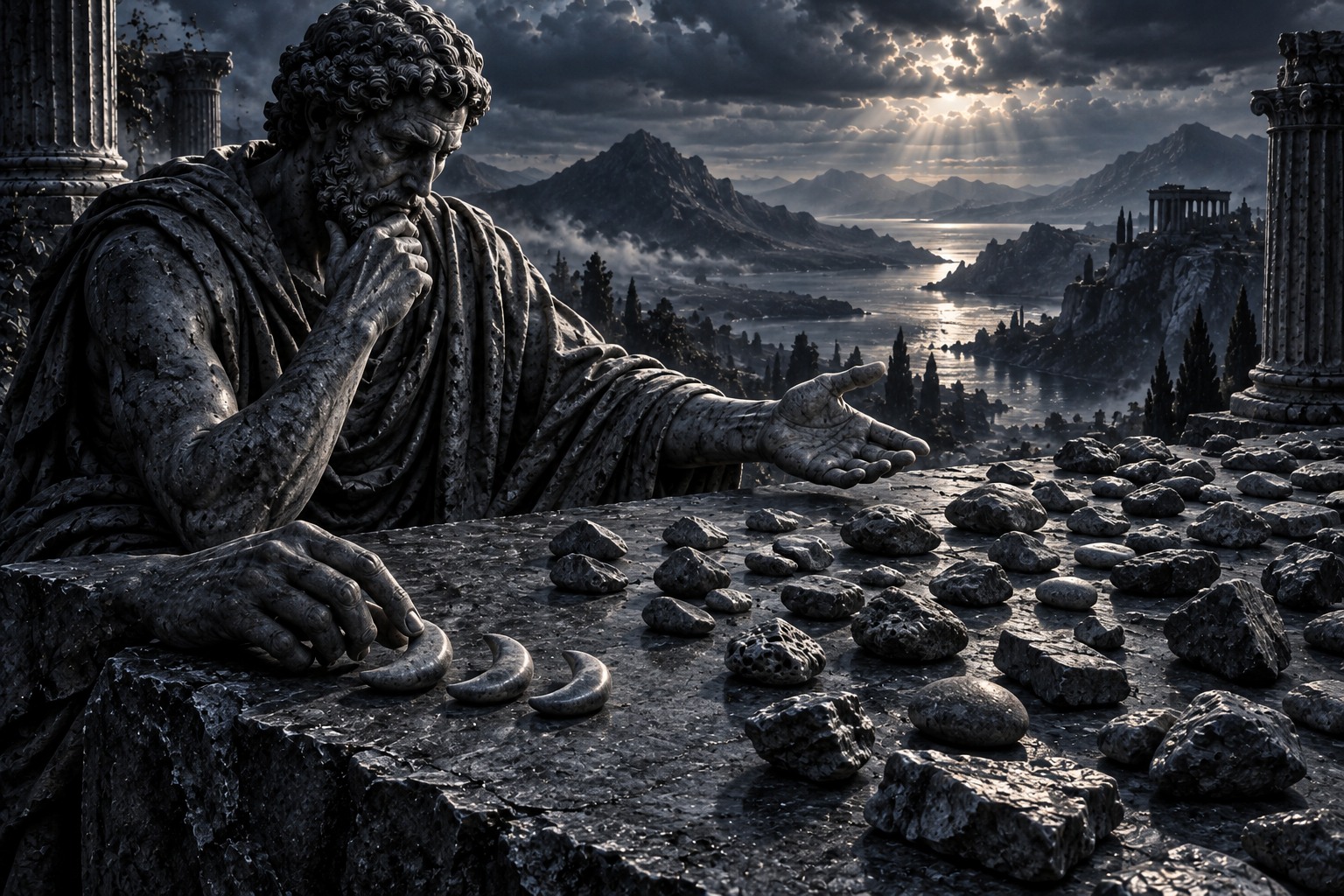
Epigraph
Custom, then, is the great guide of human life.
Hume, Enquiry concerning Human Understanding, V.6, opening sentence, displayed English text. A philosophical statement, not the result of a modern experiment.
What this article is about
Sometimes a connection appears before we have examined it: we remember someone and receive a letter, notice the same number in several places, or meet a friend in an unexpected city. An event like this may surprise us, bring pleasure, or open an important conversation. Its significance to us, however, does not by itself establish a stable pattern or explain its cause. This article distinguishes coincidence, observed recurrence, explanation, and personal meaning. Passages from Hume and Aristotle help clarify the questions; a bounded passage from Ecclesiastes considers limits on control over outcomes. These texts retain their respective purposes and do not become modern experiments. Through invented examples, we examine what counts as an observation, how the available comparisons affect an impression, and when a noticed connection becomes a testable proposal. The aim is to leave room for both wonder and responsible judgment, without making either certify the other.
I. Two events meeting does not explain their meeting
Imagine a musician who has been remembering an old friend and then encounters that friend outside a bookshop. This is an invented example, not testimony about an unusual phenomenon. We can distinguish at least two events: remembering and meeting. There is also an experience, pleasure at the surprise. If collaboration resumes after the conversation, there is a further consequence. Each answers a different question. The meeting happened; it mattered to a participant; collaboration resumed. None of these statements by itself establishes that remembering caused the friend to appear outside the shop, or that a similar sequence will recur.
Both people might independently have heard about a sale, lived nearby, or regularly visited on Saturdays. The availability of such an explanation does not establish its truth. It shows why the first story permits several continuations. Choosing between them requires further information: who decided to visit, when, and under which circumstances. If that information is unavailable, the cause can remain unknown. An explanation invented after the meeting remains a proposal even when it sounds ordinary and therefore plausible. Caution applies equally to an extraordinary account and to a familiar account that we have not checked.
Here, coincidence is a working term for events occurring together whose connection has not been established for the question under consideration. It does not claim that the events lack all causes, or resolve a dispute about destiny. A discovered cause can change our description. Personal significance can be described without making a causal claim. “This surprise encouraged me to write to my friend” concerns a decision in the speaker’s own history, insofar as that history is accessible. “My memory brought him to the shop” adds a separate claim about something beyond the speaker. Distinguishing them lets us preserve the first thought without automatically attaching the second.
II. What kind of connection are we describing?
Events can resemble each other in colour, occur close together in time, follow a shared timetable, or be connected by a sequence of actions. These relationships should not disappear into an unspecified connection. Matching book covers involve resemblance. Several evening letters involve a distribution over time. Replies to one invitation have a common occasion. If one correspondent encouraged another to write, there may be a path of transmission. Each requires different material. Photographs can establish colour, sending times can establish order, and correspondence can help investigate a transition between participants. Evidence useful for one relationship may leave another entirely unresolved.
Complete the sentence: “I noticed a connection between which things, and in what respect?” The impression then acquires a form we can examine. “More people write after rehearsals” differs from “The rehearsal makes my friends write.” The first requires defined days and a count of messages. The second adds a causal transition: the friends learned about the rehearsal, wrote because of it, and would not have written for another reason. We may examine the first without confirming the second. We may also discover that both events follow another circumstance, such as a shared day off that creates time for rehearsing and correspondence.
Working definitions need not suppress ordinary conversation. An evening can simply be described as wonderful. Greater precision matters when other people will use a conclusion. If someone proposes moving concerts to a special date because it supposedly ensures success, we need to know what success means and why that date should affect it. If the date commemorates a valued meeting, the question is different: does it suit the participants? A personal reason for choosing something need not become a general law to remain a real reason. Clearer language helps other people understand which proposal they are actually being asked to accept.
III. How the past enters expectation
In Part I of Section V of the Enquiry concerning Human Understanding, Hume considers the transition from an observed sequence to an expectation. He associates repeated conjunction with custom. His philosophical question concerns inference from experience: why does seeing one thing lead us to expect another? The consulted passage is neither a brain study nor a measurement of how often people make mistakes. It supplies a question for our account: what in the earlier experience makes this expectation intelligible? If memories of a friend seem to accompany letters, we should distinguish what was observed from what the explanation adds.
Our musician might often remember the friend after a shared performance. A letter might also follow that performance. The expectation did not arise from nothing, yet the familiar conjunction has not revealed the whole mechanism. We can distinguish practical orientation from confidence in explanation. Checking messages after an event may be convenient without claiming that thoughts attract messages. A suspected common occasion can be investigated by asking the friend why they wrote. A simple question sometimes clarifies more than elaborating the first attractive story. It can also reveal that two cases which looked alike had different immediate occasions.
This application is our reading proposal, not a claim that Hume supplied a completed theory of the contemporary person. The reliability of a particular habit remains a separate question. Some expectations meet repeated confirmation; others rest on a few striking cases. Assessing them requires recovering suitable observations. We need not start life afresh without experience whenever a connection appears. We need to notice when experience guides action, when an expectation can be compared with an outcome, and when familiarity quietly replaces a missing explanation. This boundary allows a habit to be useful while leaving it open to revision.
IV. How many opportunities did surprise have?
Consider another invented case: during one week the musician notices a favourite number on a ticket, in an address, and on a book page. Ask how many numbers were encountered, and which others could have been described as special. The three noticed appearances provide a possible numerator, but no denominator has yet been identified. There may have been dozens of addresses, prices, dates, and page numbers. Another person might have remembered a different number. This does not prove that the impression is mistaken. It explains why a narrative containing selected appearances does not immediately let us assess rarity.
For a simple calculation, define an artificial model. There are ten equally available cards, numbered one to ten. One is randomly selected and replaced before the next selection. The probability of a number specified beforehand is one tenth on a single draw. We invented these conditions; streets, shops, and messages need not obey them. If someone first draws a card and then declares its number special, the question has changed. Any of the ten numbers could become the chosen result. Specifying a number before the draw and attaching significance afterwards cannot be described as the same trial, even if the final card looks identical.
In an ordinary story, recovering every opportunity may be impossible. Name that limitation instead of substituting artificial precision for an unknown denominator. “I recorded three appearances but did not count the other numbers” preserves the observation while reducing the strength of a conclusion about rarity. If rarity matters for a decision, define what to record during a bounded future period. There is no need to monitor an entire life. Make the next question accessible to examination, and retain the difference between recording observations and telling a personal story about their significance. Both activities can remain worthwhile without pretending to produce the same result.
The number of available comparisons also changes with the group’s size. Five people form ten distinct pairs; ten people form forty-five. This is a simple count of pairs, not a model of real encounters: each participant is paired with the others, and reversing a pair does not create another one. “Does anyone share a resemblance?” therefore asks a wider question than “Does this previously selected pair share it?” The first offers more opportunities to find a striking result. Calculating a resemblance’s probability would additionally require specified features and their distribution. Counting pairs does not supply those conditions. It only shows why broadening a search changes the question, even when the resemblance criterion remains fixed and every individual pair has been accurately described.
V. Coincidence in relation to a purpose
In Parts 5–6 of Book II of the Physics, Aristotle considers chance and spontaneity within his account of causes and ends. His example involves someone visiting a place for one purpose and obtaining money without having gone there to collect it. The distinction concerns intention and actual outcome. It differs from calculating the share of equally possible results. The English translation by Hardie and Gaye makes this argument accessible, but does not turn ancient philosophy into contemporary statistics. Our limited application is that an outcome can have causes while remaining unintended in relation to the agent’s purpose.
The musician visited to buy a book and received a performance invitation. The shop existed, the friend came for particular reasons, and their conversation depended on concrete actions. Calling the invitation unexpected does not assert that every link was causeless. If the musician had arranged the meeting specifically to obtain an invitation, the description would change. An outwardly similar event, a conversation outside the shop, can occupy a different position in the history of intentions. Assessing a coincidence sometimes requires asking what the participants were seeking, alongside establishing what happened. Appearance alone cannot supply that part of the account.
An unexpected event need not be beneficial or prescribe a subsequent action. An invitation can be accepted, postponed, or declined. The circumstances in which it arose do not settle the suitability of the concert. Other claims in Aristotle’s text are not adopted here as rules for our decision. The comparison has a bounded purpose: distinguish absence of prior intention from absence of every cause. It also helps avoid rewriting the past after success, as though the fortunate result had always been everyone’s sole objective. A later benefit can matter without becoming an accurate description of the earlier plan.
VI. A rule discovered after the event
Suppose the musician concludes that the best meetings happen on days containing a favourite number. The initial examples were selected after a striking conversation. Clarify the proposed rule. Does the number count in the date, the time, an address, or a purchase price? Does any arrangement of its digits qualify? What makes a meeting successful: a pleasant conversation, an invitation, or a completed agreement? If the qualifying feature is selected after every outcome, almost any day can enter the story. The rule becomes a way to describe events, but has not yet become a way to distinguish expected from unexpected results.
This can change without contempt for the original impression. Specify a narrow feature beforehand, such as one day of the month, and one outcome, such as receiving an invitation. During an agreed period, record qualifying and nonqualifying days. The proposal can now meet an observation that does not fit it. Even that comparison does not guarantee a cause: invitations also depend on performances, messages, and available contacts. A further question concerns these conditions. One improvement in the inquiry should not be described as final proof of the complete explanation. A testable proposal remains a proposal while its possible confounding conditions are unresolved.
Sometimes prediction is not what the person wants. A date has been chosen as a private commemoration, with no promise to others. There is then no need to turn a preference into an experiment. Suitable language is enough. “I enjoy arranging this meeting on that day” describes a choice. “Meetings always succeed on that day” offers a considerably stronger rule. Freedom to make the first statement does not require protecting the second from examination. A symbol can survive the withdrawal of an unnecessary promise, allowing us to describe more accurately the thing we wanted to preserve in the first place.
Another change occurs when only successful days enter the account. Suppose the musician genuinely preserved three invitations but did not record days without them. The letters suit a remembrance of invitations; alone they do not suit a comparison of all days. This limitation concerns the material’s construction, not the narrator’s honesty. A calendar might supplement the record, or the necessary information may no longer be recoverable. A new record should include cases under a criterion chosen beforehand, rather than only those worth displaying. Each of the three invitations can still be supported by its letter. The error would concern the transition from accurate individual cases to a claim about a complete distribution which the available material does not contain.
VII. Shared conditions and concrete paths
If several friends write after concerts, a possible shared condition is visible: a concert reminds them of the musician or provides an occasion for conversation. Even an obvious account should be distinguished from an established fact. Someone may have written for another reason; someone may not have known about the performance. Comparing cases and asking participants can investigate the transition. One explanation need not cover every message. Similar outward sequences can arise through different causes. A pattern useful for organising correspondence may be less precise than the history of each individual letter, while still offering limited practical value.
Another example involves a shop visited by the same people at recurring times. Repeated encounters may reflect the timetable. Visiting at a different hour might reduce them. Changing a condition helps distinguish proposals, but the result concerns a particular place and period, not a universal law of acquaintance. Likewise, a shared news source may explain why friends discuss one topic simultaneously. Repeated phrases do not necessarily show that each independently discovered the connection. Investigate an accessible path of communication without accusing participants of deliberate insincerity. A common origin can be found without deciding every question about a speaker’s intentions.
Looking for a shared condition can make action possible. If correspondence follows concerts, allow time for replies. If encounters follow the shop timetable, arrange a particular visit. If the basis remains unknown, avoid building a promise upon it. An explanation does not become true because it is useful; usefulness does not remove the need to examine it either. We hold two questions together: what explains the observation, and what action is reasonable with the available information? Sometimes the second can be answered before the first is settled. The action should then preserve the relevant uncertainty rather than silently erase it.
VIII. Meaning need not be a mechanism
Meeting the friend may remind the musician of a friendship they did not want to lose. That significance can survive discovering that both attended an advertised sale. The advertisement explains part of the encounter, but does not decide what the musician should do about the friendship. Conversely, the encounter’s importance does not establish an unusual mechanism. These levels are compatible because they answer different questions: how did an event arise, and what place does a person give it in their life? Confusion begins when one answer is offered as proof of the other, or when explaining circumstances is assumed to cancel personal meaning.
In Ecclesiastes 9:7–12, consulted here in the King James Version, ordinary living appears beside recognition of limited control over outcomes. Verse 11 does not present ability as a guarantee of victory or prosperity. This is religious wisdom literature, not a probability table. It raises a question about effort and outcome while retaining its religious setting. It does not establish that preparation is useless, that every outcome is equally probable, or that a particular meeting has received divine endorsement. Those claims would need other grounds and are not made here. The passage is a bounded comparison, not a substitute for examining present events.
Readers may consider an encounter within their spiritual tradition, as a personal reminder, or as an ordinary surprise. The comparison does not impose an interpretation. For a shared decision, an accessible distinction remains: “This is how I understand the event’s meaning” differs from “On this basis I promise you a particular result.” The latter affects others’ expectations and needs suitable support. Freedom of interpretation does not disappear when we stop presenting it as a general guarantee. Sometimes this makes it easier to speak calmly and precisely about an experience that matters, because its value no longer depends on defending an unsupported prediction.
IX. An observation that could change the conclusion
A useful proposal does more than accommodate selected past cases. It identifies a new observation that could lead to revision. If a message supposedly follows a concert, ask the sender about its occasion. If the connection concerns a calendar date, record specified future outcomes. If a shared news source is suspected, examine publication times and transmission. These actions differ because each addresses a particular transition. “What could change my view?” becomes a meaningful question when a specific proposal has been named, instead of an undifferentiated confidence that all things are connected. A concrete answer makes inquiry possible without requiring certainty at its beginning.
An observation against an account need not destroy it altogether. One letter may have another occasion while several genuinely followed concerts. Narrow the rule and describe the mixed picture. But changing the criterion indefinitely just to preserve the original conclusion removes its capacity to distinguish results. If every exception becomes hidden confirmation, no outcome can test it. Keep the earlier formulation beside the revision: the proposal concerned all messages; it now concerns some messages and still needs investigation of their shared occasion. The record of change shows what was learned, rather than presenting the final version as something always known.
People need not examine every surprise before being allowed to enjoy it. Inquiry should fit the use of a conclusion. A pleasant memory requires an honest account. A timetable for several participants may require more examination. A promise with substantial consequences needs appropriate research, beyond this small note. Our reading exercise clarifies a question; it does not replace specialised investigation or guarantee protection from every error. Knowing its limits contributes to its usefulness. The point is not to turn attention into permanent surveillance, but to recognise when a private impression is being asked to carry a larger public claim.
X. An open question can coexist with action
After examining the encounter, several descriptions may remain available. The people met. Both enjoyed it. A sale may have been the shared occasion, but their decisions have not been established. The musician wants to resume contact. These facts already support a possible action: write to the friend and discuss collaboration. No universal law of surprising encounters is required. An unknown cause does not make the event unreal, and an open question does not prevent agreement about the next step. Avoid promising that the circumstances which produced the first conversation will ensure the success of everything that follows it.
If a timetable or mutual acquaintance later emerges, update the explanation. If the recorded date was wrong, correct the sequence itself. Sometimes only a personal story remains, with insufficient material for a conclusion about recurrence. That is a legitimate result. An interesting event need not become a law to belong in memory. Identify what was obtained: a recorded case, a clarified cause, a limited pattern, or a decision about further contact. Naming these results separately preserves acquired knowledge without extending it beyond its grounds. It also makes a later correction easier, because the parts of the account have not been fused together.
Seeking connections helps orientation, and part of its value lies in distinguishing what has been found. We can notice resemblance, record repetition, seek shared conditions, make predictions, and give events meaning. These activities need not converge on one answer. This article connects them through questions proposed by its authors: what happened, relative to what was it unusual, what connects the events, and what conclusion is currently warranted? Philosophical and religious passages help maintain different horizons of inquiry. Examination of a particular contemporary pattern must still rely on material appropriate to that pattern. The texts provide questions and distinctions, not automatic certificates for our conclusions.
What this means in practice
Choose a small coincidence you already want to discuss: an unexpected letter, a recurring topic, or an encounter. Record the event without explaining it. Separately identify what made it noticeable: pleasure, remembrance, or surprise at resemblance. Personal meaning need not shrink into counting; simply avoid using it as evidence of a cause.
Formulate one question about the connection. “Could the shared concert have prompted these messages?” is one possibility. Identify available information and one missing transition. Separate a causal proposal, an observed sequence, and a preference. If the question concerns frequency, specify the cases and period first. Without a total set of observations, leave the assessment of rarity open.
Choose one proportionate step: ask about the letter’s occasion, check a date, or compare specified future cases. Record any change in criteria rather than silently changing them after each result. State what the step confirmed, contradicted, or left unknown. Clarifying one connection does not certify all the others.
End by describing the decision: “The encounter means this to me; its possible explanation is this; therefore I will now take this step.” Avoid promising another person an outcome unsupported by the observation. If the purpose is only remembrance, it is fine to stop there. This is an authorial reading exercise, not a diagnostic procedure or a validated method for measuring unusual experiences. It gives each conclusion an appropriate place while preserving the possibility of wonder, conversation, and revision. Keep the note only as detailed as the question requires; the exercise does not ask for a record of every coincidence in daily life.
Key quotation
for some incidental causes are more relevant to the effect than others.
Clause from Aristotle’s Physics, II, Part5, after the money-collection example; Hardie and Gaye English translation. The term retains its position in the ancient causal discussion.
Connections between traditions
-
Hume / Aristotle: Hume considers recurrence and expectation; Aristotle considers chance in relation to purposes and causes. These are different philosophical questions, not two versions of one measured mechanism.
-
Aristotle / Ecclesiastes: an unplanned outcome connects questions of intention and control. Ancient causal philosophy and religious wisdom retain different grounds.
-
Hume / Ecclesiastes: expectation from experience can be considered beside absence of a guarantee for a desired outcome. The religious passage does not confirm the philosophy of custom.
-
Philosophical passages / our card model: questions about inference differ from calculation under stated equal-probability conditions. The cards and pair count are our examples, not ancient textual examples.
-
The three sources / a meeting’s personal meaning: this connection is the authors’ reading question. None of these passages certifies the origin of the invented meeting or a required spiritual interpretation.
Primary sources
Tags
coincidence, pattern, connection, cause, expectation, custom, Hume, Aristotle, Physics, Ecclesiastes, intention, chance, recurrence, observation, explanation, personal meaning, opportunity, comparison, number, denominator, hypothesis, criterion, common occasion, uncertainty, memory, spiritual interpretation, independent judgment, reading exercise, responsibility, decision
About the authors
Andrey Zarinsh is the author and founder of United Wisdom. He explores inner transformation, the unity of traditions, intercultural dialogue, and contemporary spiritual discipline. Instagram: @andrey.zarinsh.
Maria Evilkut is a co-author of United Wisdom. Alongside her research, she seeks to test these ideas in practice and observe how principles of unity and mutual understanding work in real life between people and cultures. Instagram: @ilkutki.
Keep what resonates with you.