
World & consciousness
The body as a participant in thinking
Body as a participant in thinking: action, observation, experience, inference and voluntary participation.
Epigraph
we need to disentangle and evaluate these diverse claims.
Clause from Margaret Wilson, Six views of embodied cognition, opening discussion of distinct claims. Original English; part of a sentence, not a universal maxim.
What this article is about
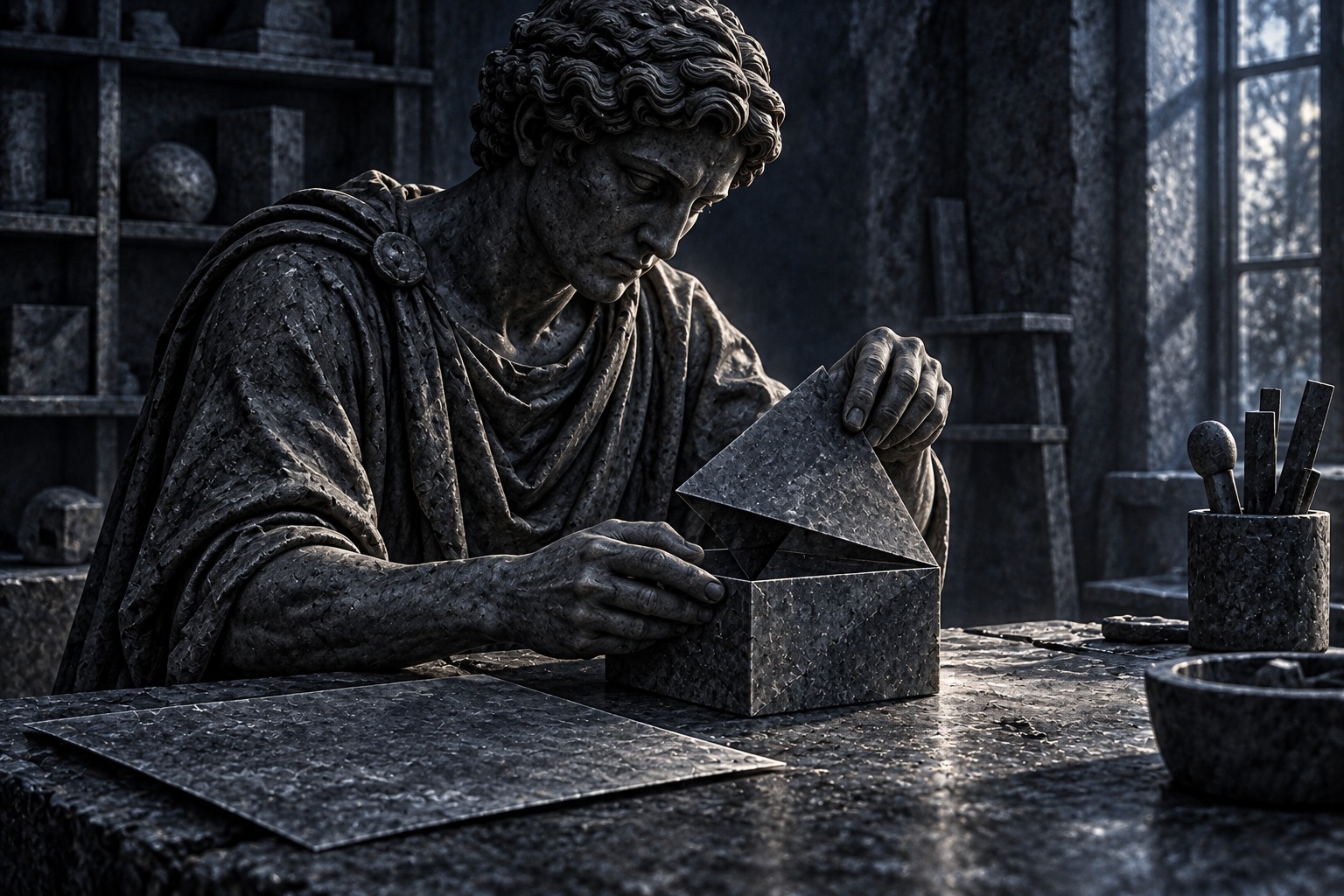
Sometimes a person turns an object to understand its shape, spreads their hands to explain a distance, or changes a sheet's position to read small print. The body participates in the organisation of the task rather than appearing only after a decision is complete. This observation opens a useful question about thinking, but supplies no general rule that every bodily feeling tells the truth. Someone can notice their condition carefully and still misunderstand what is happening. They can decline an uncomfortable action without proving someone else's design mistaken. This article distinguishes ways of obtaining information, personal experience, checking a conclusion and conditions of voluntary participation. Bounded scientific, philosophical and religious passages help identify different questions; we do not assemble them into one doctrine. The central story about a paper box is invented. It lets us follow what action changes, what remains unknown, and why respecting the body does not require making it an infallible judge.
I. More than one claim about the body
In Six views of embodied cognition, Margaret Wilson distinguishes several claims and evaluates them differently. A movement's name therefore does not by itself establish every proposition associated with it. Only the abstract and opening distinctions are used here, rather than the entire review or independent examination of its cited studies.
For our discussion, it helps to separate the phrase "the body participates" into questions with definite content. What information becomes available when someone repositions an object? What action allows alternatives to be compared? What conditions make that action accessible? What supports the conclusion reached afterwards? The answers need not coincide. The hand's participation in turning a sheet is apparent within the described scene, but its position does not establish the correctness of the words printed on the sheet. Investigating those words would require other information. This does not diminish the action; it identifies the particular task the action actually performs.
Imagine a workshop visitor attempting to make an open paper box from a drawing. They see fold lines, hold the sheet and decide which side to raise first. We can examine different transitions: from a drawing to the sheet's orientation, from movement to a newly visible shape, and from that shape to a proposed next step. Continuing this story requires no claims about brain structure or everyone thinking alike. We only need to follow the accessible actions of one invented participant. If another person approaches the same task differently, that is an opportunity to describe their route rather than declare their thinking wrong on the strength of one difference.
II. Action makes a new observation possible
The visitor raises two edges and notices one overlapping the other. The drawing previously supported imagining several possibilities; now a particular arrangement of paper lies before them. More than the description has changed: they have produced a position that can be inspected. Yet overlap alone does not establish that the instructions are mistaken. Perhaps that is how the join works, a different edge has been raised, or a line has been misread. The next question concerns how the observed result relates to the design, rather than how strongly the movement impressed the visitor. Separating these steps helps prevent a hasty move from noticing something to claiming to have proved it.
Turning the unfinished box provides a view of another side. This need not contradict the first view: both concern one object but reveal different parts. The visitor can compare them and refine an explanation. For the comparison to mean something, it helps to remember what action took place. Bending an edge back, reversing the sheet and placing it on another surface are different changes. Combining all of them into "I looked again" obscures the grounds for the revised conclusion. No detailed account of every movement is necessary; naming the change on which the relationship depends is enough.
Intervention also has limits. Repeated folding can leave a mark, so a second attempt already concerns an altered sheet. Concluding that paper always folds this way would go beyond the scene. This particular sheet has already been creased. The visitor can preserve that limit by saying "on this sheet, after that action." Such qualification does not turn an ordinary workshop into a laboratory. It retains the difference between observation and generalisation. Bodily participation here involves creating conditions for observation; the subsequent conclusion requires attention to the particular conditions created.
Imagine that a second observer cannot see the overlap from their position. The relevant part can first be shown to them, with the viewpoint used for the description identified. Different available views need not mean someone is inattentive or dishonest. Yet two observers agreeing does not settle the overlap's purpose in the design. They may jointly establish a visible arrangement while neither knows whether the drawing requires it. This gives two separate boundaries: access to one view for different people, and that view's sufficiency for the next conclusion. Repositioning may resolve the first; the second calls for other grounds.
III. Showing and explaining have different purposes
The instructor moves a hand along an edge and says, "Raise this side." The visitor sees a direction, but "this" depends on the speaker's position. Standing opposite each other, they may see the indicated side differently. An explicit reference helps: the side marked with a dot, nearest the window, or labelled with a letter on the drawing. A gesture can assist an instruction without eliminating questions about its meaning. Sometimes gesture together with a named reference makes the message definite. We are describing a possible situation, not measuring a universal advantage of one teaching method.
The instructor next shows a finished box. This gives the visitor an idea of the result while possibly leaving the sequence of actions unclear. An attractive finished example and an intelligible explanation of a transition are different achievements. The visitor may ask what happened between the flat sheet and the raised edge, even if the completed object seems obvious to the instructor. The question does not deny the instructor's skill. It identifies a point where the observer lacks information. Answering only by repeating a rapid movement may leave part of the task unresolved. Another pace or a separate image may suit this person; that is a possibility, not a promised outcome.
A demonstration does not authorise moving someone else's hand. One can offer to demonstrate alongside them, ask which explanation they prefer, and obtain agreement before helping physically. Declining touch does not mean declining understanding. It concerns participation conditions. In our scene, the visitor chooses to inspect a second sheet while the instructor slowly makes one fold. They preserve the task while changing how it is communicated. These arrangements belong to people in the situation; they do not follow automatically from the scientific name of an approach. Even a persuasive account of thinking does not remove the need to consider this participant's consent.
IV. Experience does not select its explanation for us
Holding both edges feels uncomfortable to the visitor. This is a genuine account of experience when they report their own feeling. But several explanations are possible: the sheet's position, the action selected, the table surface, or simply not wanting to continue in this way. A single statement does not establish the cause. Nor must the visitor prove a cause before requesting another way to participate. Their right to stop an uncomfortable action concerns their choice; explaining why it is uncomfortable concerns a separate question. This distinction respects their report while retaining honest uncertainty about its explanation.
Suppose they then say, "This feels unpleasant, so the box must have been designed incorrectly." The experience has become evidence about construction. Such a conclusion requires a connection between the feeling and the object's design. Our story has not established that connection. Folding this particular paper in this way may be uncomfortable even though the resulting shape matches the drawing. There may also be a drawing error that can be demonstrated independently of the unpleasant feeling. We need not select either possibility in advance. We can separate the report from the assessment and decide which part we actually want to investigate. Continuing remains voluntary.
The reverse argument is excessive too: "This feels easy, therefore I understand everything." An easy movement may produce a shape someone cannot explain or repeat with the sheet positioned differently. This does not make their completed work unreal. We distinguish successful action, understanding its grounds and transferring a procedure to a new situation. If the workshop's purpose is obtaining one box, that result may suffice. If it is explaining the fold's construction, another question arises. Assessment depends on the stated purpose rather than a general demand that thinking must always be difficult or always pleasurable.
V. Conditions belong in the task's description
Suppose the drawing hangs so high that the visitor struggles to compare it with the sheet on the table. Putting the drawing beside the sheet might remove part of that difficulty. This is a possible change in an invented scene, not an established effect for all learners. It shows why we should not describe a participant merely as understanding or failing to understand while omitting the task's conditions. In one arrangement, the person compares neighbouring images; in another, they repeatedly change their direction of view. Comparing the results is possible, but first we should notice the difference in how actions are organised. Otherwise a feature of the whole situation is mistakenly attributed to the person alone.
Attention to conditions does not require explaining everything through the environment. Misunderstanding a symbol may persist even with the drawing conveniently positioned. The change then improved access to the material without answering the question about the line's meaning. We can stop at that definite result: one difficulty has been removed and another identified. We need neither declare the change useless nor credit it with complete understanding. Partial results make an account more precise: what became accessible, what was checked, and what still requires explanation. Body and surroundings participate in this distinction without promising a finished solution.
The participant may request a larger drawing, a spoken description, or a chance to observe the fold from another position. These requests establish neither deficient ability nor special superiority of their approach. They communicate preferred conditions for this particular work. Where one method is inaccessible, seek another instead of turning an action into a compulsory test of human adequacy. Imagining a shape, following an explanation and moving paper can occur in different ways. Our story does not determine which combination suits everyone. It proposes treating accessibility as a question of task organisation while preserving the participant's dignity and freedom to decline an offered option.
Conditions include time. If a demonstration ends before the visitor can ask a question, the result cannot unconditionally be described as refusing to ask. An opportunity to question and a wish to use it differ. Participants might agree to pause after one step or keep the drawing accessible after the demonstration. This changes a definite condition rather than establishing the person's ability. We do not claim that extra time always helps or that a slow pace beats a fast one. We should not conceal a limitation relevant to what is being assessed: no question being asked, accurate repetition, or an independent explanation.
VI. Thinking about an action need not mean performing it
The visitor puts down the sheet and tries to explain the next step in words. No movement is immediately changing the paper, but the subject of reasoning remains. They can say they intend to raise the dotted side while leaving the other on the table. If they wish to continue, the description can subsequently be compared with an action. This is another way of checking a plan's relation to its result, not proof that words are always inferior to working by hand. Sometimes a verbal account reveals an ambiguity concealed by a quick demonstration. Both approaches in our story can address different portions of one task; neither must be declared the overall winner.
We should not demand visible movement alongside every thought. Someone can consider a possibility that cannot currently be enacted: the appearance of a larger box, explaining a fold over the telephone, or the consequences of a different symbol. This account does not establish the mechanisms of imagination. It simply shows that the object of reflection need not already exist within reach. A question about bodily participation does not without further grounds establish that whatever is physically absent is absent from thought. Discussing action should therefore leave room for a plan, description, memory and an open proposal.
The visitor may make a mistake in such a plan or discover a useful relationship. Either is possible after a direct fold too. The appropriate check depends on the question rather than a general preference for thinking or doing. A wall's size calls for a suitable measurement; understanding an instruction calls for clarifying its meaning; willingness to participate calls for the person's own report. Replacing these grounds with one universal procedure creates an unnecessary dispute. Touching the paper is not required to earn the right to decline the activity. Nor is stating a complex theory required to notice a genuinely visible mismatch between two edges.
VII. Philosophical unity retains its own question
In the selected Sixth Meditation passage, Descartes discusses mind-body unity while retaining their distinction. Nearby, he considers limits of sensory judgment. This is a philosophical argument within his system, with theological grounds, rather than modern embodied-cognition research. We do not make the historical author a supporter of a present-day theory.
For our reading, this invites care with the opposition between reason alone and body alone. Such an opposition can conceal the person's actual question. The visitor experiences effort while reasoning about a fold's direction. Separating these descriptions helps us avoid confusing their grounds. But analytical separation does not establish two independent participants in the situation, one issuing orders to the other. Naming different aspects of an event does not settle a metaphysical dispute about human nature. We can discuss action and experience without requiring every reader to accept a particular answer to that dispute.
The phrase "the body knows" deserves similar care. It can express respect for an acquired skill: someone folds the sheet without stating every step. That describes a possible ability rather than promising infallible information about every subject. If the expression becomes grounds for someone else's decision, ask what it means here. Does it name skill, experience, a proposal or a demand for obedience? One image should not silently move between these meanings. In our box-making scene, the visitor's voluntary action remains theirs; an authorial explanation gains no authority over them through an attractive image of unity.
VIII. Attention to bodily position has different purposes
In the consulted Satipatthana Sutta passage, discerning bodily position belongs to a religious practice with liberation as its stated purpose. It is not a truth test for every belief. We use a bounded English translation by Thanissaro Bhikkhu, rather than claiming the entire text, Pali comparison or clinical proof.
Our contemporary illustration asks a narrower question: can the visitor identify the position involved in the chosen action? They need not close their eyes, change their breathing or perform a special exercise. They can simply notice holding the sheet upright and decide whether this relates to difficulty making a comparison. Such ordinary observation is not described as completing the religious practice. We take an occasion to distinguish description from conclusion and identify our task separately. Respect for the source includes retaining this boundary. Otherwise someone else's spiritual purpose becomes decoration for a procedure the original passage did not propose in this contemporary form.
The visitor may also decide that attending to bodily position is unnecessary now. Readers need not turn attention inward to prove their reflection serious. Sometimes looking at the drawing or stopping is enough. Where personal experience produces anxiety or difficulty, this article determines neither its cause nor treatment through paper folding. Accessible participation is considered separately from questions of assistance when it is needed. Declining an offered practice preserves the person's right to understand the text, ask a question and seek another approach. That freedom prevents embodiment from becoming another requirement to feel correctly according to someone else's example.
IX. Information does not determine a result's value
Suppose the visitor likes a rounded shape that accidentally emerges during folding. They keep it even though it differs from the sample. Here the purpose matters. Freely inventing a new object can include such deviation; reproducing a specified drawing requires honestly acknowledging the difference. One result need not serve both purposes simultaneously. Enjoyment concerns the visitor's response, while comparison with the drawing concerns correspondence to a given shape. Respecting the former does not require hiding the latter; precision about the latter does not cancel the person's freedom to choose another creative route.
Can this new shape be offered to other participants? Its maker can show it and explain the change. But personal convenience does not establish convenience for everyone. Agreeing to try does not create an obligation to continue. If someone prefers the original drawing, the difference should not be explained as a lack of bodily wisdom. We have no grounds for that explanation. It is better to ask what each person's task is, which conditions are accessible and what result they want. In our story, cooperation begins with these definite reports rather than ranking people by closeness to their feelings or willingness to repeat the instructor's favourite action.
An ethical decision cannot be derived entirely from motor ease. Suppose quickly removing someone else's unfinished sheet would conveniently clear the table. The possibility of that movement does not answer whether its owner agrees. Relationships between participants must be considered. This makes the limit of the general participation claim especially visible: describing how an action occurs does not by itself determine whether it ought to occur. Our proposal to respect boundaries and ask before helping is the article authors' ethical position. It is not presented as a measured finding of Wilson's review or a shared agreement of all the traditions consulted.
When people make something jointly, personal preference may also be insufficient to change an agreed shape. Imagine that their boxes must fit beside one another within a model. The rounded form pleases its maker but occupies a different space. They can propose the change and show its consequences for the model. Group agreement concerns a shared design, while enjoyment concerns their own experience. Neither report replaces the other. If participants retain the earlier shape, its maker need not reject their idea: they can keep it as a separate work. This distinction allows discussion of compatible results without devaluing personal creativity.
X. Retain a definite conclusion
At the workshop's end, we can describe what happened without making the story proof of an entire theory of thought. The visitor turned the sheet, clarified a reference, requested another demonstration and obtained a chosen shape. They may call those steps helpful in this work. The account does not tell us which was decisive or whether the result will recur elsewhere. Investigating that would require a separate task with suitable grounds. An ordinary participant need not begin it. They can finish with an account of experience, retaining the distinction between satisfaction with the result and an explanation of what produced it.
If the box remains unfinished, no general verdict on body or reason is necessary. We can identify the unresolved part: an unclear symbol, unmatched edges, or a decision to stop. Each description requires its own information and has its own limits. Sometimes the next question concerns the drawing, sometimes accessibility, and sometimes willingness to pursue this activity. Choosing another task does not erase what has already happened. It allows a decision about continuing now. With this precision, bodily participation remains an ordinary aspect of human activity that can be considered without a contest between correct and incorrect ways of being human.
For a reader, the final question may be simple: what definite action or condition do I mean when I say the body helps thinking? A recoverable answer makes its limits easier to see. Turning provides another view, a gesture clarifies direction given an appropriate reference, and declining identifies a participation boundary. None of these results certifies every subsequent conclusion. We need neither discard bodily experience to retain checking nor declare it infallible to respect the person. We can organise a particular task more carefully, identify what has become known, and leave an unknown part open without an obligation to settle it immediately.
What this means in practice
If you want to try the distinction, choose an ordinary voluntary task involving something that can be inspected safely, such as finding a line on a sheet. Reproducing the box or experimenting with your condition is unnecessary. Name the question and one accessible action: repositioning the sheet, enlarging an image, or asking someone to read the line. Keeping the arrangement is another option. Choose according to your comfort; the task should require neither unpleasant effort nor someone else's touch without agreement.
Afterwards, identify precisely what became accessible. Being able to read the line differs from its content being correct. If the content has not been checked, retain that limit. Separately, you may describe your response: more convenient, unchanged, or not wishing to continue. These reports need not establish each other. No special feeling or explanation of every reaction is required. If useful, formulate one further question genuinely relevant to the chosen task.
You can finish without answering it. Retain the definite result and your decision about continuing. If assistance is needed, name a preferred approach; if an offer does not suit you, decline. This is an original reading exercise in making distinctions rather than a religious instruction, diagnosis or validated programme for improving cognition. Its purpose is clarity about your own task and freedom of choice, rather than reaching an externally prescribed bodily condition.
Key quotation
my mind and body compose a certain unity.
Clause within Descartes, Sixth Meditation§13, John Veitch’s displayed English translation. Philosophical context retained.
Connections between traditions
-
Wilson / our paper box: opening distinctions help identify questions; the invented scene reproduces no study and proves no entire theory.
-
Descartes / Wilson: both permit a question about body, while philosophical distinction and unity differ from the scientific review’s claims.
-
Descartes / our conclusion: experience and judgment about an object differ in our contemporary example; theological grounds remain separately identified.
-
Sutta / ordinary description: attention to bodily position is compared at the level of description; liberation and our voluntary task have different purposes.
-
Three sources / participation: consent, accessibility and freedom to stop are the authors’ ethical proposal, not a shared measured result of the traditions.
Primary sources
Tags
body, thinking, embodied cognition, action, observation, movement, gesture, object, perception, experience, inference, grounds, checking, accessibility, consent, refusal, choice, dignity, task, conditions, imagination, skill, paper, illustration, Wilson, Descartes, sutta, philosophy, religion, practice
About the authors
Andrey Zarinsh is the author and founder of United Wisdom. He explores inner transformation, the unity of traditions, intercultural dialogue, and contemporary spiritual discipline. Instagram: @andrey.zarinsh.
Maria Evilkut is a co-author of United Wisdom. Alongside her research, she seeks to test these ideas in practice and observe how principles of unity and mutual understanding work in real life between people and cultures. Instagram: @ilkutki.
Keep what resonates with you.