
World & consciousness
Chaos and Predictability: Why Exact Knowledge Can Be Insufficient
An exact rule differs from an exact forecast: initial data, calculation, tolerable error and horizon matter separately. Chaos predicts no personal fate.
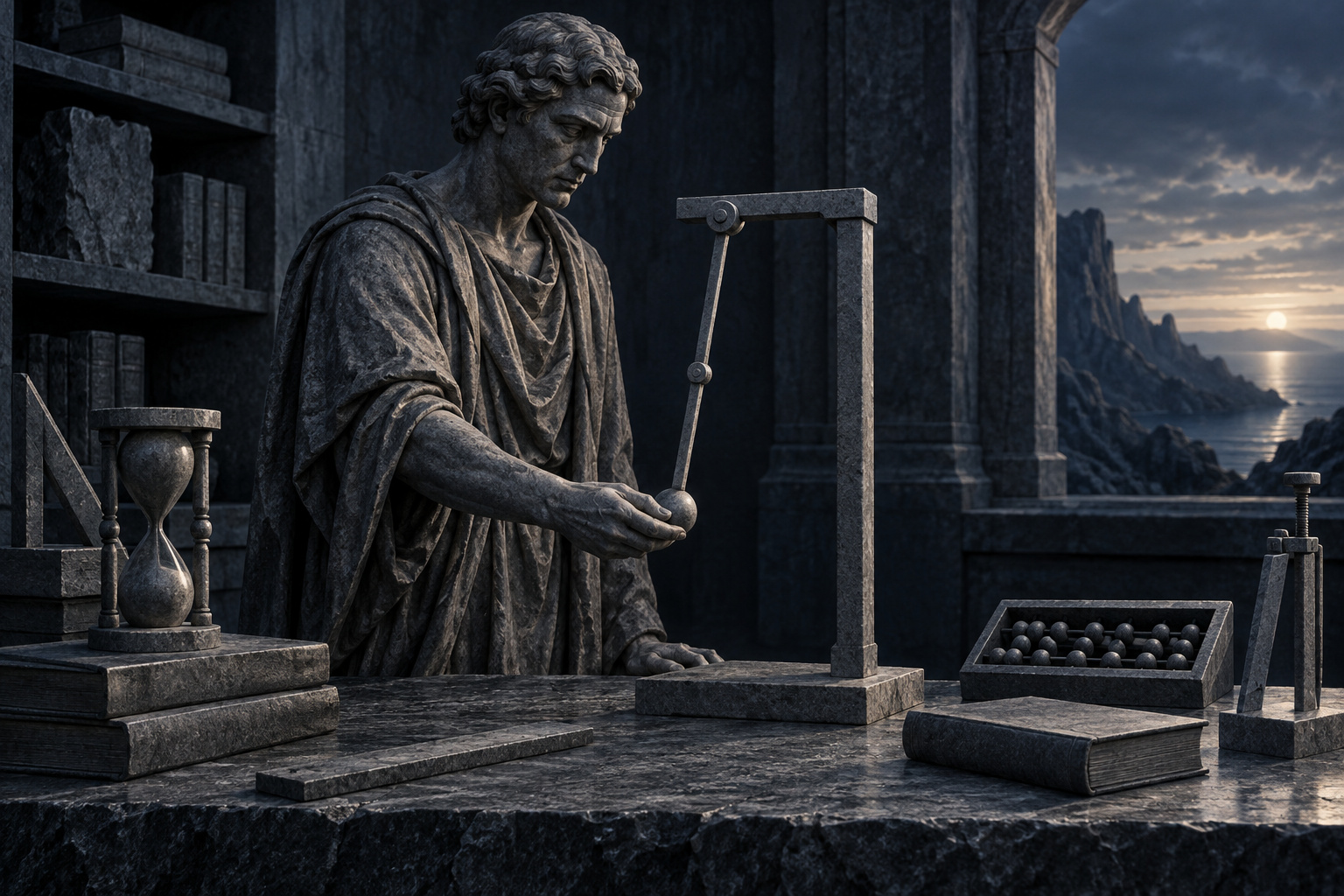
Epigraph
Prediction becomes impossible
Henri Poincaré, Science and Method, Book I, Chapter IV, “Chance,” II, p. 398, George Bruce Halsted’s authorised translation, 1913. Complete clause excerpt about amplified initial-data error under a known law, not the impossibility of every forecast.
What this article is about
An exact rule and an exact forecast require different information. We can know precisely which operation comes next without knowing its input precisely enough. When differences grow, an initial measurement’s limit matters for the subsequent answer. “Chaos” does not mean an absence of rules, and it explains no personal destiny. This article distinguishes law, state, calculation and required accuracy. An original numerical scheme lets us check a few steps. Bounded primary readings of Poincaré, Laplace and researchers studying an electronic generator show why that example cannot become a universal verdict against prediction. A statistical question also differs from asking for one future trajectory. UW’s application preserves both scales: respecting knowledge’s limits while acting within available conditions. Neither a failed forecast nor a deterministic rule establishes an inevitable human fate, the pointlessness of planning or demonstrated metaphysical freedom. The practical question remains what kind of answer is supported, for which task and for how long.
I. Knowing the rule and knowing the position
Take the rule “each next value is half the previous value.” Starting at eight gives four, two and one. Starting at ten gives five, two and a half, then one and a quarter. The rule stays unchanged; different beginnings give different answers. Calculating a particular case requires more than stating the law: we need an initial value and a step number. A physical problem would also require measurement units and circumstances in which the rule applies. This elementary distinction prevents a correct general formula from appearing to contain every datum about an object or to remove the need to observe that object before predicting its particular behaviour.
Laplace’s imagined intelligence knows forces and positions and can perform the necessary analysis. Comprehensive certainty is conditional on those requirements. The same chapter places human knowledge at a vast distance from this ideal. The famous image describes no available computer and proves no capacity to predict every deed. It helps formulate a question: what information has our actual calculation left out? This contemporary article does not adopt historical sufficient reason as a demonstrated law of every physical theory. It retains the difference between a conditional explanatory ideal and a particular observer’s capabilities within a particular problem, where information and analysis can both remain limited.
Poincaré considers a situation in which an approximate beginning does not yield an equally approximate end. His discussion of chance is not exhausted by “we do not know.” It considers different limitations and ways of obtaining probabilistic knowledge. Our selected passage concerns how an initial error’s size relates to a later error’s size. Historical weather examples establish no present-day reliable forecast horizon. That would require specific models, observations and a quality criterion. Here we need only identify a distinct question: how accurately must the beginning be known to obtain an answer of a specified accuracy after a specified number of steps?
Accuracy also depends on the request. Delivering an object may require a district, while joining a component may require a different tolerance. One calculation can help answer the first question and be insufficient for the second. Evaluating a forecast therefore starts with a criterion specified in advance. Changing it after an event can make almost any answer appear successful or unsuccessful. Stating the quantity, deadline and acceptable discrepancy before checking does not guarantee a correct model, but it makes the claim assessable. Readers can see what question the forecast addressed and distinguish it from stronger promises attached to it only after the outcome became known.
II. A small scheme with a growing difference
Construct an original teaching rule for numbers between zero and one. If a number is at most one half, its next value is twice the number. If it exceeds one half, the next value is twice the difference between one and that number. The graph resembles a triangular roof: a tent map, not a model of weather or human decisions. Both branches give one at one half, so their meeting point has no jump in value. Starting at one tenth gives two tenths, four tenths, eight tenths and four tenths again. The sequence follows the exact rule, though different branches apply on opposite sides of one half.
Now start at 0.100001 instead of 0.1. The first results are 0.200002, 0.400004, 0.800008 and 0.399984. The initial difference was one millionth; after four steps its magnitude is sixteen millionths. Ordinary multiplication and subtraction check every operation. While the two sequences choose the same branch at each step, the difference’s magnitude doubles. The final operation also changes its sign. This finite calculation demonstrates amplification of one particular difference. By itself it proves no general mathematical definition of chaos and describes no observed natural process. Its value is that the dependence and the extent of the check are visible rather than hidden behind a dramatic label.
The shared-branch condition matters. Once two values lie on opposite sides of one half, the same doubling argument cannot be applied unchanged. Indeed, values symmetric about one half give the same next result: 0.4 and 0.6 both become 0.8, after which their sequences coincide. “Every distinct beginning always separates” is already refuted within this scheme. Amplification in some cases can coexist with convergence or coincidence in others. This check is more useful than a sweeping image. It shows where the particular reasoning works and supplies a counterexample preventing a local observation from becoming a universal promise that every outcome must be unpredictable.
Every value remains between zero and one. A difference cannot grow without bound, even though it expands on certain parts of the evolution. Combining expansion and confinement requires care. Showing only the first four steps makes local behaviour look permanent; showing only the bounded range hides a loss of accuracy within it. We retain both the finite checkable table and its scope. Beyond the table, further calculation or a separate proof is needed. A small example can reveal a question without supplying all the work necessary for a stronger conclusion. Its simplicity makes this boundary easier to inspect, not less necessary to state.
III. A forecast includes a horizon
A difference of one millionth under repeated doubling reaches 0.008192 after thirteen steps and 0.016384 after fourteen. If an acceptable discrepancy is one hundredth, these values fall on opposite sides of the tolerance. The selected pair above does share branches up to this point, which a finite exact-fraction calculation can check. Fourteen is no natural constant of prediction. It comes from the chosen initial difference, rule and tolerance; changing those conditions changes the boundary. The example shows why horizon and accuracy belong together. The same answer can satisfy a request earlier and cease to satisfy it later without the underlying rule changing at all.
This pair is not a complete assessment of measurement error. An instrument may leave an entire interval of initial values unknown, while we compared only two. A guarantee for the interval would require checking all admissible values or using a separate bound. In our scheme a next-value difference is never greater than twice the input difference, even across different branches; the two linear pieces and their meeting point establish this. An upper bound does not promise that a difference reaches it. A two-trajectory demonstration, a worst-case estimate and a probabilistic account of many cases are different tasks. Confusing them supplies more certainty than the calculation supports.
Improving a measurement can extend a useful horizon without making it unlimited. Continued amplification can progressively use up additional accuracy. That is no argument against measurement: better observations can make a previously unavailable answer possible. Their cost should be related to the task. For a next-step decision, attempting a perfectly precise distant trajectory may be excessive. For a complex device’s safety, modest average accuracy may be inadequate. This article prescribes no universal observation budget. It identifies conditions that need to be stated before discussing whether additional data are useful or where prediction reaches a limit for a specified question.
Some questions remain answerable after a point forecast is lost. In our scheme every value remains inside the stipulated range, regardless of the starting point within that range. This is an exact restriction without specifying a particular trajectory’s next ten digits. “Prediction is impossible” therefore needs to identify which prediction. A narrow-tolerance position may be unavailable while a bound or a condition excluding an outcome is known. In other tasks even that bound is unsupported. Distinguishing these cases matters for decisions: losing one kind of knowledge proves neither an absence of all regularities nor the adequacy of any broader answer that happens to remain available.
IV. Chaos has definitional conditions
Mathematical “chaos” belongs to specified formulations rather than an everyday impression of disorder. The primary paper by Newcomb and El-Leithy states a conditional theorem for a continuous map taking an interval into itself. A particular pattern of iterates establishes a special set of nonperiodic starting points alongside periodic points of different periods. This concerns a model with assumptions, not every observed sequence. The criterion’s statement does not itself validate a particular device: its conditions must be established separately. The distinction needed here is that a mathematical criterion requires more than a few irregular values or an expressive picture whose appearance alone cannot establish the relevant conditions.
Within the stated chaotic set, sequences can repeatedly move apart and come arbitrarily close again. Continuous monotonic separation is not the criterion’s meaning. Periodic points in the same formulation also remain. A short repeated stretch does not prove that a system lacks all chaotic behaviour, just as an irregular stretch does not prove the opposite. We must ask about initial conditions, parameters and definition. “The system is chaotic” can conceal several different claims without those qualifications. One concerns the existence of a particular set of states; another concerns how representative an observed case is for the task we actually want to investigate.
The researchers’ concrete example is an electronic generator whose hysteretic switching joins segments of movement. They use a return map that relates successive crossings of a specified part of state space. Calculation and an electronic-circuit experiment are reported separately. This is a particular research procedure, not the general metaphor “everything returns.” The experiment remains an author-reported example from 1986. Transferring its explanation to another device requires retaining parameters and checking the model’s applicability. A theoretical criterion replaces no such check, and a report about one experiment establishes no behaviour for every possible device or comprehensive contemporary account of all chaotic dynamics.
This specificity prevents excessive transfer. The authors’ motivation mentions the heart, but the paper explicitly does not investigate it in detail. No medical assessment follows here from an electronic example. Similarly, recurring human relationships do not become a return map just because repetition occurs. Such a mathematical claim would need defined states, rules, measurements and scope. Missing those data does not make a person a technically “chaotic object”; it makes the account insufficiently specified. Respecting the subject’s boundary preserves scientific precision and a person’s right not to be explained by someone else’s model without the evidence needed to support that explanation.
V. Calculation error and model error
Numerical work adds rounding to uncertainty about the beginning. Storing 0.100001 to one decimal place turns it into 0.1. The calculated sequence in our example then matches the first sequence. This concerns representation, not the disappearance of a physical difference in an object. A displayed number and a state of the world are not the same event. Evaluation should separate initial measurement error, storage precision and algorithmic error. Improving one link then cannot silently appear to eliminate every other limitation. Even an exact calculation answers only the question whose data have actually been specified, rather than supplying missing facts through arithmetic precision alone.
Exact rational fractions suffice for our first steps. They remove rounding from this selected finite example without proving that every real process can be completely calculated in the same way. The fractions describe author-stipulated numbers; a measured value can already be approximate before calculation begins. If the initial assumption is wrong, exact arithmetic preserves it especially carefully. We therefore need a separate question about inputs: what was observed, with what error, and which element was introduced as a teaching assumption? These questions distinguish a transparent explanation from one that uses computational precision to give an unknown input a false appearance of certainty.
Applying our tent rule to a queue without evidence would be a model error. Every numerical operation could be correct while the chosen rule fails to describe the queue. We would need actual information about arrivals, service, resources and conditions for change. An impressive sequence of values replaces none of that evidence. Comparing models requires a criterion connected to observation, not mathematical beauty alone. We can compare their answers to a question set in advance, identify where the answers differ and seek an available observation. Without such evidence a strong claim remains a hypothesis; a complicated formula does not promote it into established knowledge about that queue.
The electronic paper distinguishes idealised continuity from analogue implementation, where parameters cannot be held with infinite accuracy. This is a limit on a particular transfer between mathematical scheme and experiment. It proves neither perfect identity between model and device nor the uselessness of modelling. A substantive check asks which observations agree with calculation and which requirements remain unmet. We have not carried out that technical validation of the authors’ device. The distinction itself is useful: a theoretical claim, an authors’ experimental report and an independently reproduced result rest on different evidence. They must not replace one another merely because they concern the same object.
VI. A distribution instead of a point?
When one future value is unknown, considering a range of possible values can sometimes help. A list of possibilities is not yet a probability distribution, however. Each case’s weight needs grounds. We can stipulate uniformly selected starting numbers in a teaching problem; that does not demonstrate uniformity in an actual instrument’s data. Changing the initial distribution can change an answer. Statistical description therefore has conditions too. “Everything is possible” is not equivalent to “everything is equally likely.” Confusing the two can support a decision with invented certainty while the original knowledge limit persists beneath an apparently reassuring set of numbers.
Poincaré considers mixing and limitations on conclusions about distributions. Conserved quantities and degenerate rules in his examples obstruct straightforward generalisation. The electronic paper likewise distinguishes mathematical descriptions of chaotic behaviour and qualifies the measure it discusses. These sources support keeping pointwise and statistical questions separate. They establish no current probability for particular weather, a conversation or a financial event; those answers would require other data and validation. The retained methodological distinction is that losing a reliable individual trajectory can sometimes coexist with a bounded distribution. It does not create that distribution by itself or specify its numerical weights without further assumptions.
Even a properly grounded distribution guarantees no individual outcome. If two results are possible, one result’s probability does not erase the other. A decision may depend on the cost of a rare case as well as the more frequent case. That concerns objectives and permissible consequences, which do not follow automatically from the mathematics. A backup option can be discussed without promising to avoid every loss. In our original everyday example, a backup might be another time or a smaller task. Its appropriateness depends on participants’ consent, resources and constraints. It is a practical proposal rather than physical probabilities applied as a law of human behaviour.
A statistical claim is checked differently from a single number. One less likely outcome does not by itself refute a well-grounded probability assessment. Nor can an invented probability be protected indefinitely by saying that the outcome was possible. We need an evaluation procedure chosen in advance and suitable observations. This article supplies no universal standard for statistical checking. It preserves the place of that necessary work rather than deciding a forecast’s quality from one convenient event. Readers can ask what evidence would change the assessment and who can obtain it. Without an answer, numerical confidence needs reconsideration instead of becoming immune to correction.
VII. Three different questions about the future
Determinism concerns further evolution fixed within the corresponding rule and initial state. Predictability concerns an observer’s obtainable answer given data, calculation and required accuracy. Fatalism makes a different claim: the outcome supposedly does not depend on what happens or what anyone does. These terms cannot substitute for each other. In our scheme changing the beginning changes the sequence precisely because the rule uses the beginning. Having a rule does not make conditions irrelevant. For human action, this distinction settles no complete debate about freedom, but it prevents the error that explaining causes itself declares deliberation and decisions unnecessary to the conditions of an outcome.
Irreversibility is another question. In the paper by Lebowitz, properties of microscopic description differ from macroscopic direction under specified conditions. Chaos in a few-body system alone does not explain the thermodynamic arrow of time. Growing forecast error therefore cannot be called entropy of personal life. It describes how our information relates to an answer, while physical entropy requires its own formulation. That boundary is central to a separate UW article. Here it prevents every limitation concerning the future from becoming one law. Prediction, statistics, direction of physical processes and the experience of uncertainty have different subjects and grounds.
Forecast difficulty also does not prove fundamental randomness. Its source can be incomplete data, an unsuitable model, calculation or specific dynamical properties. Another source of randomness requires independent grounds. The opposite mistake promises exact prediction merely because a deterministic description has been adopted. Between these extremes lies substantial partial knowledge: a range, a condition, a next-step estimate or a qualified probability. Its usefulness depends on the task. Readers need not choose between omniscience and abandoning observation because a distant pointwise answer is unavailable. We can identify which claim remains supported and which more ambitious claim has exceeded the data or the model.
Uncertainty can be experienced in different ways, but that experience does not measure mathematical chaos. Not knowing another person’s reply supplies no equation for their movement. Silence permits different circumstances, including an absence of time or desire to respond. Preserving that limit is preferable to explaining the unknown through special sensitivity to initial conditions. In UW’s application, it protects another participant’s autonomy: a plan can include our actions and available agreements while leaving their decision theirs. This is an original contemporary proposal. It establishes no exercise efficacy and authorises no reading of motives where the relevant information is absent.
VIII. A plan with revision conditions
Consider an original example: preparing a text for discussion. Available time and completed passages are known; reply timing and the possible extent of comments are unknown. A next step can avoid dependence on the unknown reply: check a passage or formulate a question. This is no victory over chaos and follows from no theorem. It is a bounded decision made with separated conditions. Confirming another time changes the plan through a new fact. No reply does not automatically become refusal, consent or a hidden cause. Revision thus keeps an observation distinct from our interpretation of it rather than giving uncertainty a convenient but unsupported meaning.
Identify what event would prompt revision. Comments may change the content, while confirmed unavailability may change the deadline. These grounds differ; one does not prove the other. A chosen reassessment time can preserve our right not to wait indefinitely. The plan remains an agreement or personal intention with conditions, rather than a forecast of someone else’s behaviour. Clarity matters to both participants: when an action affects another person, material conditions need to be shared and participation checked. A precise diagram of our own work creates no right to control their time or treat their consent as known before they have given it.
A backup must also be real. Reducing scope, postponing or declining part of the work can be available, but not to everyone at every moment. “Just allow a reserve” can conceal missing money, health, assistance or safe conditions. UW practice therefore demands no flawless control and measures no human worth by planning accuracy. It helps name an existing limit and choose an action that does not depend on invented certainty. Sometimes the honest result is that no available solution has yet been found. Identifying what information or assistance could change that situation can still clarify the problem without pretending the obstacle has already been removed.
Exact knowledge of a rule can be insufficient for exact knowledge of the future, but future questions are not equally closed. We can distinguish a trajectory from a range, arithmetic from measurement, mathematical criteria from impressions, and our plan from another person’s decision. Each distinction removes unnecessary promises and makes an available answer clearer. In UW’s World and Consciousness direction, respect for uncertainty connects with action through conditions and revision. It requires declaring the world neither meaningless nor already settled in every practical respect. Revising an explanation remains valuable even where a final forecast is unavailable and further observation has to proceed without a guarantee.
What this means in practice
Choose one personal near-term task that does not require predicting another person’s motives. Record the intended result, time and acceptable discrepancy between plan and fact. Where numerical precision makes no sense, state the criterion in words: what outcome could you actually recognise as completed?
Separate known, unknown and genuinely constrained conditions. Give an observation or agreement for each known condition; preserve a question for each unknown one. Assign no probabilities merely to fill a table. If someone else’s action matters, record the need for their response and consent rather than substituting a forecast.
Name an available next step and one reason to revise: new information, changed conditions or a chosen reassessment time. Check whether the step can obtain information or finish an independent part of the task. Promise yourself no control of an external outcome. Missing resources can justify reducing scope or declining a change for now.
Afterwards compare the outcome with the criterion and consider data, model and execution separately. One failed forecast does not demonstrate that every plan is useless. This is an original UW proposal, not a scientifically established way to remove anxiety or guarantee results. Constraints, safety, refusal and acknowledgement of the unknown remain available.
Key quotation
nothing would be uncertain
Pierre-Simon Laplace, A Philosophical Essay on Probabilities, Chapter II, Truscott and Emory, 1902. Complete clause excerpt. The imagined intelligence knows forces and positions and can analyse them; actual human knowledge is explicitly distinguished from the ideal.
Connections between traditions
| Question | Two sources | Comparison mechanism | Boundary retained |
|---|---|---|---|
| Law or initial data? | Laplace, II, ideal intelligence; Poincaré, I.IV.II, pp. 397–399 | Separate rule and initial accuracy | No available omniscient technology |
| What does separation mean? | Poincaré, I.IV.II and IV; Newcomb and El-Leithy, §§ 2 and 4.1 | Separate amplification and chaos criterion | Not every pair separates monotonically |
| What grounds probability? | Laplace, II, information examples; Newcomb and El-Leithy, §§ 4.1 and 6 | Separate possible states and individual sequence | No proof of fundamental random events |
| Point or distribution? | Poincaré, I.IV.VI; Newcomb and El-Leithy, § 6 | Change the question while retaining measure conditions | No arbitrary uniformity or current forecast |
| Chaos or time’s arrow? | Newcomb and El-Leithy, §§ 2 and 5; Lebowitz, pp. 32 and 38 | Distinguish dynamics and macroscopic direction | No spiritual entropy or personal fate |
| How can a plan change? | Poincaré, I.IV.VIII–IX; Laplace, II, actual human distance | Clarify conditions, information and criterion | Original UW application with no promised benefit |
Primary sources
- Henri Poincaré. Science and Method, Book I, Chapter IV, “Chance,” I–X, pp. 395–412, in The Foundations of Science. Authorised George Bruce Halsted translation, Science Press, 1913. Primary text. Historical examples establish no current weather forecast horizon.
- Pierre-Simon Laplace. A Philosophical Essay on Probabilities. Frederick Wilson Truscott and Frederick Lincoln Emory, from the sixth French edition, 1902. Primary text, I–II and opening III. French is not used here; the conditional intelligence is no available technology.
- Robert W. Newcomb, Nevine El-Leithy. Chaos Generation Using Binary Hysteresis. Circuits, Systems, and Signal Processing 5, no. 3, 1986, pp. 321–341. Primary paper, §§ 1–2, 4.1, 5–6. Specific electronic example; medical motivation is not a health investigation.
- Joel L. Lebowitz. Boltzmann’s Entropy and Time’s Arrow. Physics Today 46, September 1993, pp. 32–38. Primary paper. Statistical mechanics under specified conditions; chaos alone does not explain thermodynamic irreversibility.
Tags
chaos, predictability, initial conditions, sensitivity, measurement, accuracy, forecast, forecast horizon, determinism, randomness, probability, distribution, Poincaré, Laplace, Newcomb, El-Leithy, Lebowitz, hysteresis, mapping, trajectory, error, model, calculation, revision, World and Consciousness, United Wisdom, autonomy, conditions
About the authors
Andrey Zarinsh is the author and founder of United Wisdom. He explores inner transformation, the unity of traditions, intercultural dialogue, and contemporary spiritual discipline. Instagram: @andrey.zarinsh.
Maria Evilkut is a co-author of United Wisdom. Alongside her research, she seeks to test these ideas in practice and observe how principles of unity and mutual understanding work in real life between people and cultures. Instagram: @ilkutki.
Keep what resonates with you.