
World & consciousness
Does Mathematics Discover the World or Create a Language for It?
Plato, Kant, and Mill on number, construction, and experience: concrete examples distinguish foundations and conditions of mathematical application.
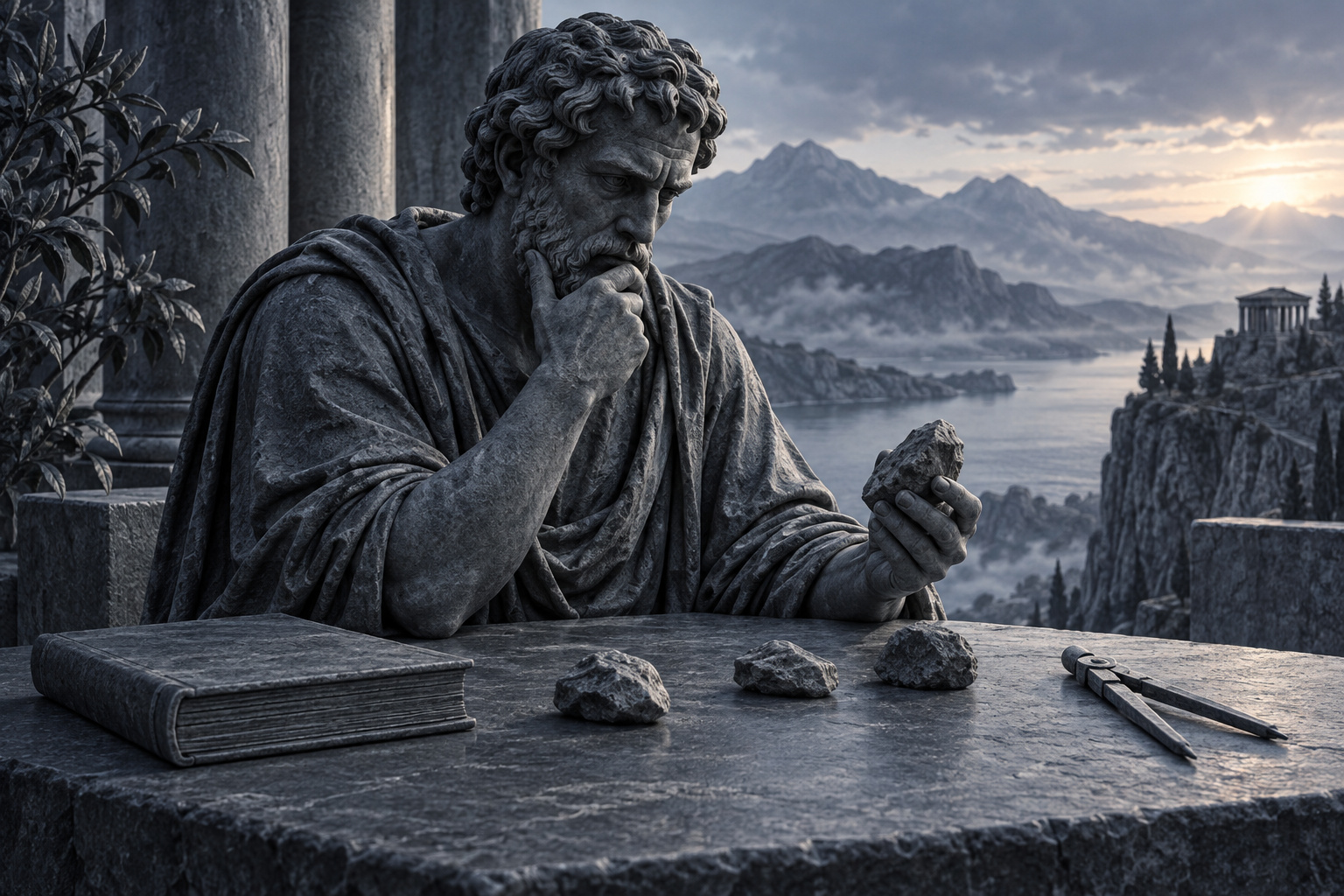
Epigraph
“geometry will draw the soul towards truth”
Plato, Republic, Book VII, internal clause of the sentence beginning “Then, my noble friend…”. Benjamin Jowett’s named English translation; the Russian version is our translation from that English, not from Greek.
What this article is about
When twelve stones are counted individually, the result seems to belong to the stones themselves. When twelve is written as XII, a human choice of notation becomes visible. When a theorem concerns a figure that no drawing can reproduce perfectly, a third question arises: what has actually been discovered? The debate about discovering or inventing mathematics combines different tasks, so a single answer can easily become too broad. We will compare three philosophical positions through addition, units, circles, geometric proof, and the application of a formula. Plato connects mathematical knowledge with a turn towards intelligible being. Kant explains it through construction in pure intuition. Mill seeks its foundations in experience and distinguishes an inference from its premises from the truth of those premises. Their positions do not form one doctrine. Their disagreements help us identify where we choose a language, where we establish a necessary consequence, and where we test a description against the world.
I. Four questions within one debate
Imagine a workshop containing seven separately counted parts and another five. A worker could count individually, add, or enter a table’s result. These operations yield twelve if the groups do not overlap and their membership remains unchanged during the count. But the questions about that result differ. Who devised the signs for numbers? Why does this addition produce this answer? Did the answer exist before human beings? Why can the calculation be used in the workshop? These concern notation, warrant, existence, and application respectively. Answering one does not answer the others. Explaining the origin of signs might leave necessary inference unexplained.
In ordinary language, discovery means finding something that does not depend on the finder’s wishes. Invention means creating a tool or a way of doing something. These meanings help until rigidly applied to every mathematical activity. A notation can be invented that enables someone to discover an unnoticed relation. Rules for a game can be chosen, followed by the discovery that a particular position is impossible under those rules. Choosing an initial system does not entail choosing any result one wishes. Conversely, a result’s resistance to our wishes does not establish that every mathematical object exists separately from thought. It establishes that conditions constrain the inference despite our wishes.
It therefore helps to distinguish notation, the object under consideration, the method of proof, and the domain of application. In the workshop the notation is 7 + 5. The objects could be the sizes of two disjoint groups; the inference gives their combined size; the application is an inventory of particular parts. If one part occurs in both groups, the mathematical equality has not become false. The situation no longer matches the premises for that count. Replacing the notation with Roman numerals changes the language. Asking why addition has necessary properties opens the philosophical debate. These distinctions preserve the debate without replacing numerical existence with convenient typography.
II. Plato: number leads beyond what is seen
In Book VII of the Republic, mathematics belongs to a discussion of the education of guardians and philosophers. Arithmetic has military applications, but Plato, through Socrates’ speech, does not confine it to arranging troops or calculating purchases. More important is the movement from changing things towards what thought considers stable. Visible things can produce contrasting impressions: a finger is large relative to one finger and small relative to another. Such difficulty prompts the mind to distinguish relations and ask what greatness or unity means. This describes reflection philosophically, not an experimentally studied brain mechanism. It explains arithmetic’s place in an educational and philosophical conception.
The discussion of units that are equal, unchanging, and indivisible for the calculation is particularly significant. The speakers assign these numbers to what is grasped in thought. A stone can be broken; a painted dot has thickness; its paint can flake away. A proof’s object need not change when these merely represent units. Imagine two groups of drawn dots, one large and one small. If the question concerns how many dots there are, increasing their size does not add another dot. Reasoning holds one relation steady while setting another aside. Plato’s position goes beyond this simple procedure: the mathematical direction of thought is connected with true being. Our distinction does not establish that stronger philosophy.
Geometry in the same dialogue should lead towards knowledge of what endures, rather than merely help someone set up a camp. The ordinary geometer’s language of constructing and applying figures is criticized when practical activity obscures the object of knowledge. Conversely, Plato acknowledges practical benefits without making them the study’s highest value. His assertions about the quickness of trained learners should not become a present promise that geometry will improve every ability. For our topic, the important feature is the orientation itself. On this account, a mathematician does more than assemble a convenient vocabulary for visible things. Mathematicians distinguish objects of thought beyond altered drawings or marketplace uses.
III. Kant: construction goes beyond analyzing a concept
In the Prolegomena, Kant distinguishes a judgment that clarifies what is already thought in a concept from one that extends knowledge. His example, 7 + 5 = 12, is meant to show that the concept of combining seven and five does not already explicitly supply twelve. Obtaining the sum requires a construction: units must be added successively. Kant mentions fingers and points as aids to representing the operation. But treating this as a straightforward claim that arithmetic is derived from observing fingers would change his argument. He asks about the foundation of necessary mathematical knowledge and connects it with pure intuition. Objects illustrate construction; Kant’s proposed foundation exceeds repeated successful observation.
The word intuition needs care here. The English edition edited by Paul Carus uses intuition alongside explanations in terms of visualization. The term does not mean a hunch about the answer or a feeling of personal certainty. Kant discusses immediate representation and forms of sensibility, especially space and time. The successive addition of units is associated with time; geometrical construction with space. Rejecting this account does not make mathematics an individual feeling. Pure intuition in Kant’s argument is meant to explain universally valid knowledge, rather than permit an individual result for each person. The necessity he seeks to account for distinguishes his question from an investigation of the differing habits people acquire when learning to count.
This position differs from Plato’s turn towards true being. Kant relates the accessibility of objects to the conditions under which they appear to us and distinguishes appearances from things in themselves. Yet he also rejects the conclusion that geometry is an arbitrary poetic invention. His solution is intended to explain both why knowledge is not obtained simply by dissecting concepts and why it has objective validity for objects of the senses. We retain that purpose as a specific philosophical position. Neither present perception research nor one diagram is offered as its proof. The next comparison asks how the stability of mathematical inference is explained by a thinker who locates the foundations of knowledge in experience.
IV. Mill: relations among things stand behind the signs
In Book II, Chapter VI of A System of Logic, Mill examines arithmetic as a difficult case for his account of deductive sciences. He rejects the view that a proposition about two and one merely reports an agreement to use the word three. Two stones alongside one, and those same stones gathered together, have the same membership but are presented in different relations. According to Mill, the possibility of dividing and rearranging a collection is learned through experience. He regards arithmetic’s foundations as generalizations of such experience. This is a disputed philosophical argument, not a contemporary measurement of how children acquire number concepts. His historical pedagogy does not establish present teaching effectiveness.
Mill also notes that during a long algebraic calculation a person can manipulate letters without keeping particular objects before the mind. At the beginning, the task is translated into signs; at the end, the result is translated back into things. This eases calculation without making inference mere renaming. A letter can represent different magnitudes, and the generality of notation permits a particular image to be set aside. The relation itself, he argues, concerns things. Mill therefore does not defend mathematics as merely invented language. He asks why language can carry an inference and seeks its evidential force beyond written marks. His answer differs substantially from Kant’s ground of necessity, although neither is satisfied with an agreement about words alone.
Consider our own hypothetical task. Two boxes contain equal numbers of tokens, and three tokens are added to each box. Algebraic notation lets us discuss any initial number without separately listing ten, twenty, or thirty cases. Tokens need not be pictured at every intermediate step. But applying the result requires equality at the beginning and equal additions. Mill would explain the basis of that transition through generalized experience of relations among things; Kant would seek the basis of necessary mathematical judgment differently. Successful notation preserves a task’s structure without selecting a philosophical winner. The philosophical question remains: what warrants that structure and our confidence in the corresponding inference?
V. What survives a change of notation
Compare 12 and XII. They differ in their structure, familiarity, and convenience for particular operations. If both designate the same quantity in specified systems of notation, replacing one with the other does not change the quantity. This gives a simple reason not to identify a number with its visible sign. An unknown quantity can also be named a and later renamed n. Provided meanings and rules are preserved, many transformations leave the content intact. Human decision is evident here: we choose the symbol, the arrangement, and the mode of representation. Yet choosing notation does not make every answer permissible. Two ways of expressing the same relation require a consistent translation, or they cease to describe the same thing.
Suppose a hypothetical task distributes twelve separate tokens equally among three people, with nothing left over. The notation for the result can change, but under these conditions each person receives four. If the author of a new notation writes five for each person, the system must explain which condition disappeared or where the extra tokens came from. Renaming does not produce them. In this sense, mathematical work encounters constraints even where people devise its language. Those constraints may be associated with chosen definitions and rules; claiming that they have a separate eternal existence requires another argument. A failed notation should not be presented as direct proof of a stronger metaphysical position. Independence from a calculator’s wishes admits more than one possible philosophical explanation.
Good language also makes distinctions visible. Replacing a single figure in a report with separate counts of unique parts and inventory entries can reveal double registration. This does not discover a new law of arithmetic; it identifies the object being counted more precisely. A change of language can nevertheless lead to discovering an error in the representation of a situation. Creation and discovery can therefore participate in the same activity. We devise a way of asking a question and encounter a relation that constrains its answer. This account of a working process does not replace Plato’s, Kant’s, or Mill’s philosophy of foundations. It prevents invention from covering typography and necessary consequence indiscriminately.
VI. A recount tests application, not an entire philosophy
Return to two lists containing seven and five parts. If the same part appears in both lists, there are eleven different parts. Twelve is the number of entries if each entry is counted separately. These are not two contradictory arithmetics; they count different objects. Subtracting the repeated inclusion requires recognizing the overlap between the lists. This hypothetical example shows how a mathematical inference depends on a description of the situation. A checker can recount the parts, compare identifiers, or inspect inventory records. These actions provide evidence about whether the initial description matches the actual collection. Application checks do not automatically settle the existence or foundations of numbers.
Mill specifically distinguishes a pure count of objects from equality in some other respect. Three people can be counted without assuming equal height or strength. But using that count as an exact index of combined weight requires information about the weights of the units. Our example is simple: two parcels remain two parcels when one weighs one kilogram and the other nine. Their average weight is five kilograms, but their combined weight cannot be obtained by multiplying the number of parcels by the weight of the first. The error lies in an added assumption of equal weight. Mathematical operations can be flawless while the description of the object is wrong. Both the calculation and the connection between the counting unit and the property of interest therefore require attention.
There is also a temporal condition. If a part is removed and another delivered during a workshop count, the result must refer to a moment or an agreed inventory procedure. A formula may describe fixed membership while the situation is changing. Revising the model does not mean arithmetic has stopped working. The model needs to include arrivals, departures, or a consistent time slice. This example does not establish Mill’s theory of the origin of mathematical foundations. It supports a narrower practical conclusion: physical applicability depends on what the unit represents, what differences have been set aside, and what changes are allowed. Plato’s interest in a stable object of thought and Kant’s question about necessary conditions of cognition retain their own significance after a particular inventory has been checked successfully.
VII. The circle and the pencil trace
Consider a circle as the set of points in a plane at the same distance from a chosen center. A pencil trace has thickness, and measurements depend on an instrument’s resolution. This does not make the geometric object empty: its properties are specified more precisely than those of any particular trace. Nor does it establish that every round object exactly realizes the definition. A geometrical argument can concern an ideal circle while a separate inquiry asks how well that model fits a wheel rim. The work then divides between proof and measurement. The first establishes a relation under stated conditions; the second investigates a particular object and limits of precision. Without that distinction, the debate can become a false choice between a perfect drawing and the meaninglessness of all geometry.
Plato’s text directs attention towards an object of knowledge that is not exhausted by practical drawing. Kant explains geometry through construction in pure intuition and the relation between spatial form and appearances. Mill instead discusses the hypothetical character of isolating some properties while setting others aside. On his account, a deduction may be reliable relative to its premises, although application requires assessing their approximation to a particular case. One uneven drawing neither refutes all three positions nor makes them identical. It offers common material, but their answers concern different foundations. Plato emphasizes the direction of cognition; Kant the condition of necessary knowledge; Mill the experiential basis and the separation of inference from the accuracy of its premises.
Ask instead what we learned by proving a property of a circle. If the proposition concerns a mathematically specified object, the new relation may be necessary within that account. If it subsequently helps explain a manufactured rim, checking the representation of a physical object becomes an additional task. Choosing a definition does not let us alter a proved relation at will while preserving the same premises. Success in a physical application does not automatically establish the truth of one philosophy of mathematical objects either. It demonstrates the usefulness of a particular description under the conditions investigated. This leaves room for devising means of thought, discovering consequences, and investigating the world. The activities require different checks, even when performed together.
VIII. Two triangles and the conditions of space
In Euclidean plane geometry, a triangle’s interior angles sum to one hundred and eighty degrees. To make the role of assumptions visible without measuring the actual Earth, consider a mathematical sphere. Connect its north pole to two equatorial points along meridians separated by ninety degrees, then join those points by a quarter of the equator. The angle at the pole is right by the choice of meridians. At each equatorial vertex, a meridian also meets the equator at a right angle. The resulting spherical triangle has three right angles, summing to two hundred and seventy degrees. This is our elementary model example. It is neither a report about survey errors nor a claim that a measured triangle overturned arithmetic or changed the meaning of ninety degrees.
The accounts differ in what counts as a side, a shortest path, and the space of the figure. Preserving all the conditions of one proof prevents us from replacing its result with a preferred answer. Moving to different conditions requires reformulating the proposition. Freedom to choose a mathematical object is therefore compatible with strict constraints on inferences. The example also encourages care with historical explanations of geometric necessity. In the text we read, Kant makes strong claims about space as a form of sensibility. We do not treat these as an account of every possible mathematical space, or attribute our spherical construction to him as an answer to a modern dispute. It is enough to recognize that the domain and meaning of a geometric proposition should be specified before drawing philosophical generalizations.
Does this establish that people invented space? No: constructing a mathematical description is not equivalent to creating a physical object. Does it establish that every chosen description fits nature equally well? Again no: that fit is investigated separately. Finally, two different spatial models do not make proof a matter of preference. Each requires consistent reasoning from its conditions. We have obtained a useful way of refining the debate: the choice of an initial account, the rigor of an inference, and physical applicability need not compete for one label. A proof about the sphere establishes a relation in the specified object. Choosing that object for a navigation problem would require further information. Our hypothetical example does not investigate that information and ends as an example of distinguishing premises.
IX. A model of the world and a successful calculation
Imagine a rectangular plot whose sides are exactly ten and twelve meters in a hypothetical task. The model’s area is one hundred and twenty square meters. An actual plot may have irregular boundaries, and its dimensions may be measured with limited precision. A useful formula does not eliminate these circumstances. The boundary can be described more accurately, the figure divided into parts, uncertainty estimated, and the adequacy of the result considered for a particular purpose. This is work with a description and data. The mathematical relation in the rectangular model does not become less necessary because an actual fence bends. Confidence in the formula should nevertheless not become confidence that every plot is rectangular. Good application preserves both a clear inference and responsibility for selecting its representation.
This experience helps distinguish two meanings of objectivity. One concerns the independence of a correctly inferred result from the calculator’s wishes. The other concerns a description’s ability to withstand comparison with particular objects and measurement procedures. They are connected but not identical. A consequence can be rigorously inferred from a false assumption about a plot’s shape. An approximately correct area can also result accidentally from a rough count whose procedure the calculator cannot justify. In the first case the data or model are inadequate; in the second, understanding of the inference is inadequate. Plato, Kant, and Mill raise a deeper question about the basis of mathematical validity. One successful practical calculation cannot settle it, although application supplies important material for discussing the relation between knowledge and the world.
Discovery can therefore have several objects. We may discover a consequence of selected rules, an unnoticed structure in a task, or a correspondence between a model and a phenomenon. Creation is similarly varied: people devise notation, definitions, questions, and construction procedures. Human participation does not make every result arbitrary, and stable results do not make every representation given without choice. A more precise discussion begins with an example and specifies which aspect needs explaining. It may end in a real disagreement about the nature of mathematical objects. Such disagreement is more valuable than artificial harmony in which Plato, Kant, and Mill supposedly say the same thing about everything being numbers. In the passages examined, they propose different foundations and different directions for the next question.
X. Freedom in the question, discipline in the answer
Human creativity is especially visible in posing mathematical questions. One may ask about the number of objects, their order, distances between them, or possible distributions. A single collection of tokens permits all these questions, but their answers concern different relations. Once a relation is chosen, we learn to hold it steady without substituting another. Plato’s insistence on an object of thought is useful here: knowledge demands more than a conspicuous sign or immediate usefulness. Kant’s question about the act of representation through which a new judgment is obtained, rather than words clarified, is useful too. Mill’s return from symbols to things finally reminds us to check that a result concerns the original task. These questions can be useful without making the three authors’ foundations compatible.
In practice, a solution can be written separately from its domain. For example: twelve tokens are distributed four to each of three people if the division is equal, the tokens are separate, and all must be distributed. A different question can then be asked: must the distribution be equal? The mathematics of the first solution does not establish the fairness of the chosen rule. When people are involved, the rule might depend on an agreement, a need, or an obligation, each requiring its own justification. This is not a defect in calculation: it clearly shows the consequences of one condition. A numerical relation should not be asked to answer a question omitted from the account. Separating these tasks allows mathematical precision to be useful without turning it into a justification for every selected decision.
The question in the title is thus best approached in parts. People develop mathematical languages. Consequences require discovery and proof because they cannot be selected at will. Application to the world requires specifying the object and checking conditions. The foundation of necessary knowledge and the existence of mathematical objects remain philosophical questions. Our examples provide ways to pose them while preserving the sources’ disagreements. A reader may prefer one position after seeing what difficulty it explains and what it leaves open. A practical discipline remains available throughout: state the unit, relation, assumptions, and method of verification. This allows a representation to change when a task requires it, while preserving the force of an inference where its conditions are already specified and genuinely satisfied.
What this means in practice
Choose a small calculation you actually need: unique items in two lists, a distribution of time, or the area of a hypothetical rectangle. Write the question in words first. Specify the unit, the time or membership considered, and whether one object might be included twice. Then calculate. This first action separates the mathematical inference from an accidentally unclear description. For overlapping lists, record the number of entries separately from the number of different items, so that each result has an explicit object.
On a second sheet, change the notation while preserving its meaning: use other letters, words, or a table. Check whether the result changes and explain each transition between representations. Next change one condition of the task itself: allow overlapping lists, unequal parcel weights, or another distribution rule. Identify what now requires recalculation and what concerns a choice of description or rule. Replacing a symbol and replacing a premise should remain two distinguishable actions.
Finally, write three short questions about your example: what exists independently of the notation, what act produces new knowledge, and what information is needed to apply the calculation to actual things? Compare these with the directions of questioning in Plato, Kant, and Mill without assigning each a ready-made answer to your situation. Finish with one precise sentence stating the domain of the result. The exercise does not settle the foundations of mathematics; it makes your next calculation and philosophical question more definite.
Key quotation
“Without this mathematics cannot take a single step”
Immanuel Kant, Prolegomena, §7: initial clause of the second sentence before the semicolon; this refers to pure intuition. Paul Carus’s English edition, Third Edition 1912. The Russian version is our translation from that English, not from German.
Connections between traditions
1. Abstract number: Plato ↔ Kant. In Republic VII, equal and unchanging units grasped in thought direct arithmetic towards the intelligible (passage 199–203). In Prolegomena §2c and §10, addition and number are explained through construction in pure intuition. Comparing them separates a mathematical object from accidental visible marks. But Plato’s turn towards being and Kant’s account of conditions of appearance offer different foundations. Their common subject does not establish one doctrine.
2. Addition extends knowledge: Kant ↔ Mill. Kant examines 7 + 5 as requiring successive addition of units (§2c). Mill discusses two pebbles and one as an experienced possibility of rearranging the same collection (Logic II VI §2). Both resist reducing calculation’s content to renaming. The comparison asks what warrants a new transition. Kant’s use of fingers does not turn his account of necessary knowledge into Mill’s induction from experience.
3. What a unit represents: Plato ↔ Mill. Plato’s units are grasped in thought and retain the equality specified in the account (Republic VII, 201–203). Mill insists that numbers concern things even though general signs permit particular images to be set aside during calculation (II VI §2, 1936–1946). These are different answers about what stands behind an identical numeral. Mill does not defend a view of words alone; Plato does not make every physical mark a perfect unit.
4. Geometry and application: Kant ↔ Mill. Kant connects geometric knowledge with space as a form of appearances (§§10–12, Remark I). Mill distinguishes reliability of an inference from the separate investigation of how its premises fit an object (II VI §§1, 3–4). Their common difficulty is the relation between a necessary inference and sensory objects. Their solutions differ: conditions of possible appearance in Kant, examination of assumptions in Mill. One imprecise diagram establishes neither the truth nor the falsity of an entire philosophy.
5. Usefulness and understanding: Plato ↔ Mill. Plato acknowledges military benefits without reducing knowledge to them (Republic VII, 191–197, 214–225). Mill describes translating a task from things into symbols and the result back into things (II VI §2, 1932–1946). Together the passages help ask what someone understands beyond a convenient calculation: the object investigated and the meaning of the result. The comparison connects educational and logical questions while preserving their different aims. It establishes neither historical influence nor one educational program.
6. Representation does not make the world arbitrary: Kant ↔ Mill. In Remark II to the Prolegomena, Kant acknowledges external things while distinguishing knowledge of appearances from knowledge of things in themselves. Mill permits consequences to be inferred from suppositions but leaves their actual truth to a separate inquiry (II VI §4). The mechanism is a distinction between constructing a description and warranting its relation to objects. Neither passage makes the physical world fictional or every consistent model equally adequate to nature. Their philosophical foundations remain different.
Primary sources
Plato, Republic, Book VII, Benjamin Jowett translation. The arithmetic and geometry discussions are used; educational assertions are not presented as contemporary empirical findings.
Immanuel Kant, Prolegomena, Paul Carus English edition, Third Edition 1912. The adopted passages are §2c, §§6–13, and Remarks I–II. Pure intuition is treated as a philosophical concept, not a personal hunch.
John Stuart Mill, A System of Logic, Eighth Edition, Harper 1882 carrier. Book II, Chapter VI, §§1–4 are used. Mill’s foundations are presented as his argument; inventory and model examples in this article are our constructions.
Tags
#mathematics, #philosophyofmathematics, #number, #unit, #arithmetic, #geometry, #addition, #proof, #model, #reality, #language, #symbol, #notation, #knowledge, #Plato, #Kant, #Mill, #intuition, #experience, #necessity, #premises, #application, #circle, #triangle, #abstraction, #measurement, #counting, #objectivity, #construction, #discovery, #invention, #UnitedWisdom
About the authors
Andrey Zarinsh is the author and founder of United Wisdom. He explores inner transformation, the unity of traditions, intercultural dialogue, and contemporary spiritual discipline. Instagram: @andrey.zarinsh.
Maria Evilkut is a co-author of United Wisdom. Alongside her research, she seeks to test these ideas in practice and observe how principles of unity and mutual understanding work in real life between people and cultures. Instagram: @ilkutki.
Keep what resonates with you.