
World & consciousness
Humans and Nature: What Changes When We See Ourselves as Part of a System
Humans within causal relations: counting scope, ethical grounds, and a particular decision.
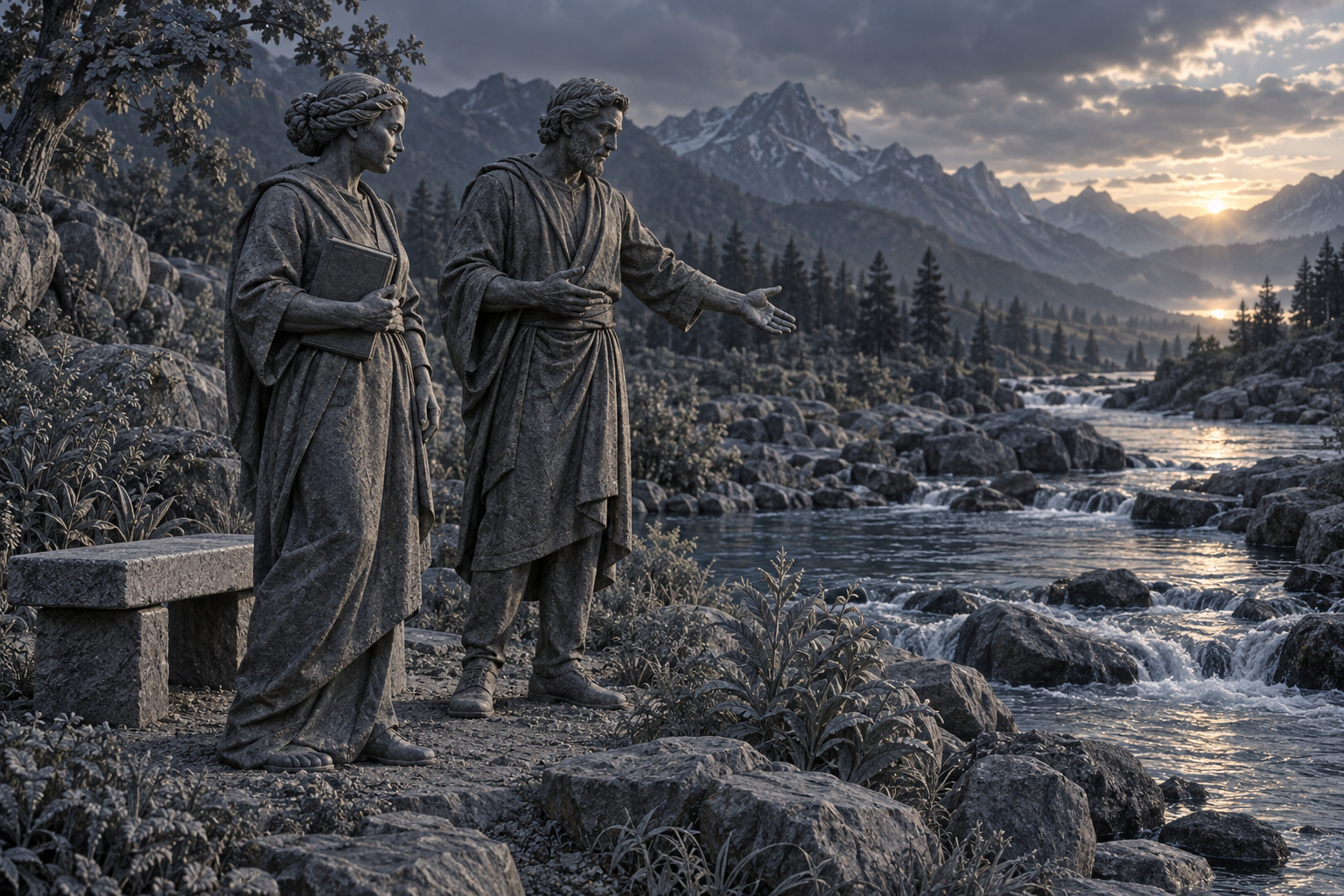
Epigraph
“It is impossible, that man should not be a part of Nature”
Benedictus de Spinoza, Ethics, Part IV, Proposition IV; labelled clause from the English translation by R. H. M. Elwes. The Russian version is the article author’s translation from this English text.
What this article is about
An imaginary town council is discussing a piece of land beside a stream. Its plan shows property boundaries, a path, and room for a bench. Other boundaries emerge in conversation: where the water goes, who uses the bank, which organisms live there, and who will answer for the effects of the work. Calling humans part of nature is easy; changing how we frame a question takes more care. It requires distinguishing causal connections, the object of measurement, and the grounds for a decision. An ecological experiment can reveal an unexpected effect without establishing a fair allocation of costs. A philosophical account can challenge the stance of an outside owner without supplying information about this particular place. Here a local sea-star experiment, a disagreement about counting diversity, Spinoza’s thought, and Aldo Leopold’s land ethic help us examine these distinctions. Our town case is entirely fictional: its numbers and alternatives serve reasoning, rather than an actual construction project or ecosystem assessment.
I. The Bank on a Plan and the Bank in Relationships
In our example, the site belongs to a community centre. The council wants more room for gatherings: it proposes a level meeting area and removal of a strip of vegetation. Marina presents a drawing in which every planned alteration stays inside the property line. Kirill asks whether that line is sufficient for the discussion. Even when the right to use the land has been established, water need not stop at a line on paper. Visitors arrive from neighbouring streets too. Kirill’s question does not demonstrate that the project is harmful. It identifies a possible difference between the legal territory of a decision and the territory of its effects. Until that difference has been described, the council’s confidence rests on an incomplete account of its task.
At first, the participants use “nature” to name the background: the stream, bushes, birds, and view from a window. This makes it easy to contrast nature with people who need an accessible path and somewhere to talk. Yet the planning itself already takes place within relationships with that background. Materials must be brought in, the surface maintained, and water directed somewhere. A new convenience has conditions of its own. As the council lists them, the human being ceases to appear solely as a spectator of a finished landscape. People become participants who change a place while depending on its properties. Calling them participants, however, still says nothing about whether the particular project is a sound choice.
The change is useful because it produces questions that can be investigated. Which connections have we actually observed? Which have we only assumed? Who could clarify them? Is there an account of the initial state against which a result could later be compared? Our fictional council might acknowledge that it currently knows only the planned dimensions and the visitors’ wishes. There is no need to shame it for an insufficient love of nature. There is a need to name the missing information and identify a next step. Seeing oneself as part of a system begins with recognising that an action has conditions and affected parties. It does not begin with promising an immediate understanding of everything happening around the site.
II. A Boundary Is Necessary, but It Must Be Named
Every discussion limits its subject. We cannot simultaneously describe every movement of water, every person’s history, and the entire composition of organisms. A system boundary is therefore not necessarily a mistake. A mistake arises when a chosen boundary is treated as the only boundary that exists. The council might discuss path accessibility at one meeting and water drainage at another. Separating the conversations does not mean that the questions have ceased to be connected. If one project affects both, there must be a point at which the findings meet. Otherwise, a well-supported decision about one aspect may remain a poorly supported decision about the project as a whole.
Imagine two descriptions of the same meeting area. The first includes only the centre’s property and the construction period. The second includes neighbouring land and subsequent maintenance. They answer different questions, so different conclusions need not imply dishonesty. What matters is identifying the processes left outside the first description. Suppose its estimate contains one hundred hypothetical units for constructing the surface, while next year’s maintenance is not considered at all. The figure of one hundred cannot establish the full cost of using the area. Recognising that omission requires no special ecological theory. It requires noticing that a conclusion has been announced for a broader object than the one actually counted.
A boundary also has a temporal aspect. A satisfactory outcome on opening day is not the same as a satisfactory outcome over several seasons. This does not make every short observation useless. It allows a judgement about what was actually observed during that period. The council can check whether visitors can pass comfortably now and leave the longer-term condition as a separate open question. Systemic consideration becomes clearer when a finding has both a noun and a date: the accessibility of this path in this condition, costs over this period, or the listed organisms in this survey. Participants can then discuss specified grounds instead of arguing about “nature in general.”
III. A Sea Star and an Indirect Effect
Robert T. Paine’s 1966 article describes removing Pisaster sea stars from a rocky shore at Mukkaw Bay, on a stretch about eight metres long and two metres in vertical extent, with an adjacent control area. Transects were taken irregularly. In the reported count, the area changed from fifteen species to eight. Paine related the change to competition for space. This was a local field experiment under stated conditions, rather than a rule about every predator’s value everywhere. Its relevance to our reasoning is that a change can be followed through relationships extending beyond direct contact between two species.
The experiment cannot decide what to do beside the town’s stream. The organisms, surface, purposes, and intervention differ. It nevertheless gives content to the question of an indirect effect. Removing one element can have consequences that depend on opportunities gained by others. An explanation needs to identify the path: which relationship disappeared, what became available, who used that availability, and what changed next. “Everything is connected” does not provide such a path. A sequence of events alone does not establish it either. More people might visit the altered meeting area because the centre changed its timetable at the same time. Distinguishing explanations would require information about the schedule and use of space. Without it, describing coincident changes is more accurate than announcing established causes. This is our own hypothetical alternative, rather than a result from the coastal experiment. It shows why a chronological account and an explanation of a mechanism perform different jobs.
Marina can now ask more precisely about the vegetation strip. The aim is not to assign it a useful role in advance, but to ask what it does here and what information could establish that role. If the council lacks an answer, it should not borrow the sea star’s role for a bush or turn the bank into an analogy for a laboratory apparatus. The comparison teaches a form of question without transferring the answer. Within that question, humans remain acting causes, but they are not the only causes of the eventual state. The difference between an intention and a chain of consequences becomes part of the decision’s description, rather than a later excuse for an unexpected outcome.
IV. What Exactly Are We Calling Diversity?
There is another reason to handle the famous experiment carefully. Paine explicitly noted that no data were available on microfaunal changes. In their 2016 historical comment, Kevin D. Lafferty and Thomas H. Suchanek distinguish primary space-holding species from the broader assemblage living in mussel beds. This illustrates why “predators increase diversity” needs a stated inclusion rule. It is not a new simultaneous census of every organism in the original area. Later material, other places, and a broader object of measurement should not be combined with the original fifteen as figures from one observation table.
A similar difficulty can arise in our town discussion without any animals. The council counts uses of the site. Before construction it records walking, reading, and conversation; afterwards, reading and conversation. Another participant also counts wheelchair access and the possibility of meeting under a canopy. The results differ because the list of included activities has changed. The broader account could be useful for assessment. It cannot, however, be presented as proof that the initial arithmetic was wrong. Both definitions must be retained, with an explanation of what each total means. A change in the measured object should be disclosed before the results are compared.
The same discipline is needed for words such as “health,” “stability,” and “environmental quality.” In a particular discussion, each needs specified indicators, duration, and scale. If a photograph contains more green, we can describe that photograph; a conclusion about an entire ecosystem requires other grounds. If visitors like the meeting area, their answers provide information about their judgement, rather than a complete assessment of the bank. Participants need not choose one number for every purpose. Several indicators can be retained and their differences discussed. Sometimes a difference exposes a cost of the decision that an overall description of the outcome as “better” had previously concealed.
V. Spinoza: Humans within Nature
In Part IV of Ethics, Spinoza treats humans as parts of Nature whose changes cannot be explained through themselves alone. This is a philosophical thesis within his argument about human dependence, not an account of a food web. In the preface, he also examines judging natural things against a preconceived human model. Calling a phenomenon imperfect can indicate a mismatch with our expectation; it does not establish a mistake by Nature. The English text used here is R. H. M. Elwes’s translation. The article’s Russian epigraph is translated from that English, without collation against the Latin original.
For the fictional council, this opens a question about calling the vegetation “disorderly.” The strip can look untidy beside a drawing of a neat meeting area. That is a real aesthetic judgement, available for discussion. The drawing is not independent evidence that the living place has been arranged incorrectly. Equally, challenging a projected expectation does not prohibit people from having purposes. An accessible path can matter even when the existing bank has made no mistake. The honest statement is that we want to alter a place for a specified task. A preference then becomes an openly stated ground for choice, instead of being presented as the correction of a defect in the universe.
The difference between the philosopher’s “Nature” and a “system” in a working description must also be retained. The council selects a project boundary for analysis; that choice does not reproduce Spinoza’s metaphysical account. Observing the stream does not test the whole of Ethics, and the philosophical text does not supply a drainage pattern. The questions can nonetheless enter a conversation: if humans depend on external conditions, the image of a completely independent owner deserves examination. Responsibility does not disappear. Participation in causal relations still leaves our actions open to discussion. It makes a more reasonable question possible: which conditions can we change, which must we account for, and which do we currently not understand?
VI. Leopold: From a Position to an Obligation
In “The Land Ethic,” Aldo Leopold expands community membership to include soils, waters, plants, and animals, and proposes the human role of member and citizen. This is a normative move: it concerns how other members and the community should be treated. Ecological connections help identify the subject of that ethic without replacing its grounds. Neither Paine’s experiment nor Spinoza’s thesis independently proves Leopold’s obligation. A reader can acknowledge environmental dependence while asking which duties are proposed and why those particular duties should follow.
The question does not undermine ethical conversation. It makes the proposal discussable. Our council might adopt the principle that visitors’ interests do not exhaust the grounds for a decision about the bank. It would then need to name the other grounds being considered and who could present them. A living place cannot address the meeting in a human voice. This does not entitle the first speaker to appoint themselves its sole representative. Information, intelligible criteria, and room for objections are needed. Someone can advocate retaining conditions for other organisms while acknowledging the limits of their knowledge about those conditions and the nature of the obligation being proposed.
Being a participant does not entail abandoning every use of land. Leopold does not simply propose abolishing all alteration. In our analysis, it helps to distinguish use, an unexamined appropriation of benefits, and a justified restriction of action. The council may seek space for people to meet while recognising that its chosen means are not the only imaginable means. Locations, extent of works, and schedules can be compared. This framing preserves a human need alongside the question of effects. Ethical thought becomes more than a ceremonial phrase before an unchanged plan when it actually alters the set of alternatives considered and the grounds for preferring one to another.
VII. A Connection Does Not Choose a Value for Us
Suppose two alternatives satisfy the centre’s main need. One is cheaper initially; the other retains more of the existing bank strip. These are conditions of a fictional problem. We have not declared the second ecologically preferable without a survey. Even with information, values would need discussion. What is the council willing to protect? Which uncertainty does it consider acceptable? Access to meetings, retention of a place, expense, and ease of maintenance can carry different weights for participants. “We are part of nature” does not supply a table of those weights. Acknowledging connections makes the need for a choice visible, where a slogan could conceal it behind apparent agreement.
It helps to check whether different objects are being compared under the same word, “benefit.” In Paine’s account, the standing crop increased while the stated species count decreased. Mass and count are not two names for one measure. Likewise, more room for benches does not automatically mean greater accessibility for every visitor. Accessibility depends on the visitors and conditions specified. Each finding must preserve its object. If the centre gains additional space, that gain can be acknowledged. If a barrier to some use appears at the same time, it does not vanish because the outcome has received a favourable overall description.
When discussing land’s value, it is useful to avoid reducing it to a future service that we might eventually discover. Leopold questions an exclusively commercial evaluation of the community. The council can take up that question without pretending already to know the price of every connection. Something can be preserved on an explicit ethical ground, rather than solely for a hidden economic benefit. That ground still needs discussion with the people affected. A value does not become uncontested merely because it has been named. Naming it openly does make it possible to examine it beside other values and identify the real point of disagreement.
VIII. Who Gains Convenience and Who Bears Costs?
Consider a simple hypothetical estimate. Option A requires one hundred units for construction and forty for maintenance over a specified period. Option B requires one hundred and twenty for construction and ten for maintenance over the same period. Under those assumptions, the totals are one hundred and forty and one hundred and thirty. This is arithmetic within an invented case, rather than an actual construction estimate or prediction of a natural process. It shows how a comparison changes when a previously excluded cost is included. If the council knows only the initial figures, it does not yet know these totals. Assumed maintenance figures must not quietly be presented as observed data.
Even a correct total does not answer the question of allocation. The centre might pay the hundred units, while someone else pays the forty. To the first payer, an option can appear more favourable than it does to all parties considered together. Noticing this requires no declaration that the payer is selfish. It requires establishing who is included in the total and who can influence the choice. If a neighbouring group acquires a maintenance obligation, its absence from the meeting does not make the work free. In relations with nature, the absence of a price in our own estimate must likewise be distinguished from the absence of an effect. Identifying human parties helps expose an omission; it does not exhaust an ecological description.
Participation in a system does not give every person identical powers. A visitor, landowner, contractor, and neighbouring household representative can know different things and control different actions. Responsibility becomes more concrete when those differences are named. Who can select the option? Who needs to verify the information? Who will observe the result and report a problem? Who can request a change? Without these questions, talk of unity can leave the previous decision process intact. With them, shared belonging to a place gains practical content: effects are discussed together with the ability to influence them, instead of being assigned to someone who lacks that ability.
IX. What We Do Not Know, What We Observe, and What Can Change
The council does not possess complete knowledge of the bank. That is no exceptional defeat: even a well-organised survey has a subject and limitations. We can ask which unknowns matter to the next decision. Not knowing each blade of grass’s exact history and not knowing where water would go after the proposed works have different relations to the project. This distinction supplies no ready answer about the stream. It supplies a way to organise questions: which information could change the choice, who can obtain it, and how much time is needed? It also helps to state in advance what the council will do if information remains incomplete, rather than treating every uncertainty as interchangeable.
Observation must match the result being claimed. A photograph after opening can preserve the surface’s appearance; an expense record can preserve expenses; a conversation with visitors can record their answers. None automatically replaces the others. If participants promised to assess several effects, several appropriate observations are needed. Gathering information also requires consent and a reasonable amount of work. Our example does not propose studying people without their knowledge or independently interfering with a stream. It illustrates that “we will check afterwards” acquires meaning only when the object, time, and person able to respond to the result have been identified.
Revision needs conditions too. The council can agree to consider important new information at its next meeting. If an alteration is irreversible, however, the meeting cannot itself restore the previous state. It helps to distinguish what can be corrected later from what needs assessment beforehand. This is a question about a particular project, rather than a universal prohibition on intervention. Waiting can have a cost as well. Participants need to make the grounds for acting and waiting visible without portraying either alternative as safe by definition. A systemic view preserves the possibility of deciding while making it harder to hide the decision’s significant conditions behind the word “natural.”
X. Belonging as a More Precise Conversation
The meeting may end without a selected project, yet the conversation has already changed. Instead of two camps, for people or for nature, there are questions that can receive different answers. People need an accessible meeting place; permission to alter a site has boundaries; effects have their own geography and duration; indicators describe different aspects of an outcome; values need open discussion. These statements can coexist. They need not immediately be collapsed into one number. It is more useful to identify where there is agreement, where information is missing, and where participants genuinely differ in the grounds for their preference.
Comparing sources preserves boundaries as well. Philosophical dependence on Nature, ethical citizenship in a land community, and an experimental chain of indirect effects are not three proofs of a single thesis. They offer three questions: where are we in causal relations, what deserves our attention, and what happened after a specified intervention? The sources become more useful when the questions remain distinct. We can challenge an ethical principle without denying an observation, or refine a measurement without declaring every value meaningless. This gives a conversation more precision than an attempt to support each thought with a universal appeal to the connectedness of everything.
Seeing ourselves as parts of a system therefore does not dissolve human action into an immense whole. There remains a particular council, a specified site, people able to decide, and people whose interests deserve to be heard. Their actions are considered within conditions they did not create alone and cannot cancel by intention alone. The perspective can change a project’s formulation before the bank is altered. “What can we take from this place?” becomes a fuller question: which task are we addressing, through which relationships are we acting, what grounds our choice, and how will we respond to information about its effects? That formulation can be discussed, checked, and corrected together.
What this means in practice
You can voluntarily examine a small fictional project without intervening in real land. Choose a task, such as a meeting place beside an imaginary stream. State who needs it and which specified convenience should appear. Draw two boundaries: the site participants can legitimately alter, and the area of possible effects worth asking about. Do not turn assumed connections into facts. Mark each one as observed, assumed, or unknown. The label preserves the difference between a question and an answer.
Name two alternatives and compare them over the same period. For an invented estimate, use the figures in Section VIII: one hundred plus forty, and one hundred and twenty plus ten. Check the totals yourself and identify who pays each part. Ask which matter important to the choice these sums do not describe at all. You do not have to assign it an arbitrary price to complete a table. It can remain a separate question. A numerical comparison can be correct while remaining incomplete for a decision.
Choose one value you are willing to discuss openly: visitors’ accessibility, retention of a particular place, or a fair distribution of work. State which information would help apply it and who should join the conversation. Suggest one possible check on the result, keeping its object and time clear. Finally, identify information that could change your chosen option. This is an original exercise in framing a question, rather than an ecological assessment, psychological test, or validated way to change behaviour. You can stop at any point. A real project needs information about the place and competent participants; the imagined exercise does not supply them.
Key quotation
“a land ethic changes the role of Homo sapiens from conqueror of the land-community to plain member and citizen of it.”
Aldo Leopold, “The Land Ethic,” The Community Concept, NeoHasid PDF, page 1, extraction lines 66–67; labelled lowercase fragment. Original English; the Russian quotation is the article author’s translation.
Connections between traditions
1. Belonging and obligation. Spinoza, IV.4, places humans within Nature; Leopold, The Community Concept, proposes citizenship in a land community. The comparison moves the question from an outside manager’s position to a participant’s relationships. Boundary: a philosophical claim about causal dependence does not prove the proposed ethical obligation; that transition requires its own grounds.
2. Partial cause and indirect effect. Spinoza, IV.2, considers external relations; Paine, pages 70–71, traces change after Pisaster removal through competition for space. The connection requires naming intermediate relationships instead of explaining an outcome solely through an actor’s intention. Boundary: a metaphysical claim is not a coastal model, and a local experiment does not establish every intervention’s properties.
3. A counting boundary and a conclusion’s boundary. Paine, page 71, notes missing microfaunal data; Lafferty and Suchanek’s Figure 1 and accompanying text distinguish primary space holders from mussel-bed inhabitants. Including another group changes the object called diversity. Boundary: these historical materials are not a single simultaneous recount of the original experimental area.
4. Quantity and value. Paine, page 70, distinguishes increased standing crop from a decrease in the stated species count; Leopold’s Substitutes for a Land Ethic challenges an exclusively commercial criterion. The comparison separates a measured outcome from the grounds for preferring it. Boundary: neither mass nor species count alone establishes a project’s moral conclusion.
5. Unknowns and a precise question. Leopold’s The Community Concept and closing Outlook connect ethical discussion with understanding a complex place; Lafferty and Suchanek show a conclusion’s dependence on the diversity measure. The connection makes a limit of knowledge part of the question’s formulation. Boundary: uncertainty alone neither proves harm nor removes the need for a particular decision.
6. Human purpose and an assumed purpose of nature. Spinoza’s Part IV preface examines a human model of perfection; Leopold’s Land Pyramid challenges a simple balance image, while his Outlook retains economic feasibility. The comparison proposes naming human purposes and describing the place separately. Boundary: a philosophical critique of purpose neither supplies ecological dynamics nor chooses participants’ values.
Primary sources
Benedictus de Spinoza, Ethics, Part IV, R. H. M. Elwes’s English translation, Project Gutenberg 971 transcription, updated 2013. Extraction lines 0–151 were actually read; the preface and propositions II–IV with proofs are used. Other parts and the Latin original were not collated. The philosophical argument is not treated as ecological research.
Aldo Leopold, The Land Ethic, from A Sand County Almanac, first published in 1949. The actual source is NeoHasid’s annotated transcription, with David Seidenberg’s 2007/2018 layout; its heading’s date of 1948 is distinct from first book publication. Lines 0–350 and 478–580 were actually read, including The Community Concept, selected Substitutes, the opening Land Pyramid, and The Outlook. Editorial annotations are distinguished from Leopold. Other essays and the entire intervening 351–477 range were not read. Normative and historical generalisations are not adopted as modern measured laws.
Robert T. Paine, Food Web Complexity and Species Diversity, The American Naturalist 100(910), 1966, pages 65–75, DOI 10.1086/282400. Selected primary article passages were actually read in Studyres’s OCR reproduction, particularly the continuous removal account and data limits, lines 452–496, printed pages 70–71. The publisher’s primary abstract was also read. Full visual reading of the scanned PDF and the entire article is not claimed. The local control and irregular transects do not establish a universal conclusion about predators.
Kevin D. Lafferty and Thomas H. Suchanek, Revisiting Paine’s 1966 Sea Star Removal Experiment, The American Naturalist 188, 2016, pages 365–378, DOI 10.1086/688045. The authors’ opening text and continuous selected range 572–940 were actually read. The abstract, measure distinction, Figure 1, and the appendix’s time and place information are used. The full species list and underlying observations were not independently reread or recomputed. This is a historical comment with expanded counting, rather than a new replication of the 1963 experiment.
Tags
humans, nature, ecology, system, boundary, causation, indirect effect, food relationships, diversity, species count, sea star, Paine, Lafferty, Suchanek, Spinoza, Leopold, land ethic, community, value, purpose, measurement, scale, time, participation, responsibility, cost allocation, uncertainty, observation, decision, revision
About the authors
Andrey Zarinsh is the author and founder of United Wisdom. He explores inner transformation, the unity of traditions, intercultural dialogue, and contemporary spiritual discipline. Instagram: @andrey.zarinsh.
Maria Evilkut is a co-author of United Wisdom. Alongside her research, she seeks to test these ideas in practice and observe how principles of unity and mutual understanding work in real life between people and cultures. Instagram: @ilkutki.
Keep what resonates with you.