
World & consciousness
How to revise a belief after discovering a false source
Revising belief after a false source: error scope, independent grounds, uncertainty and responsibility for our message.
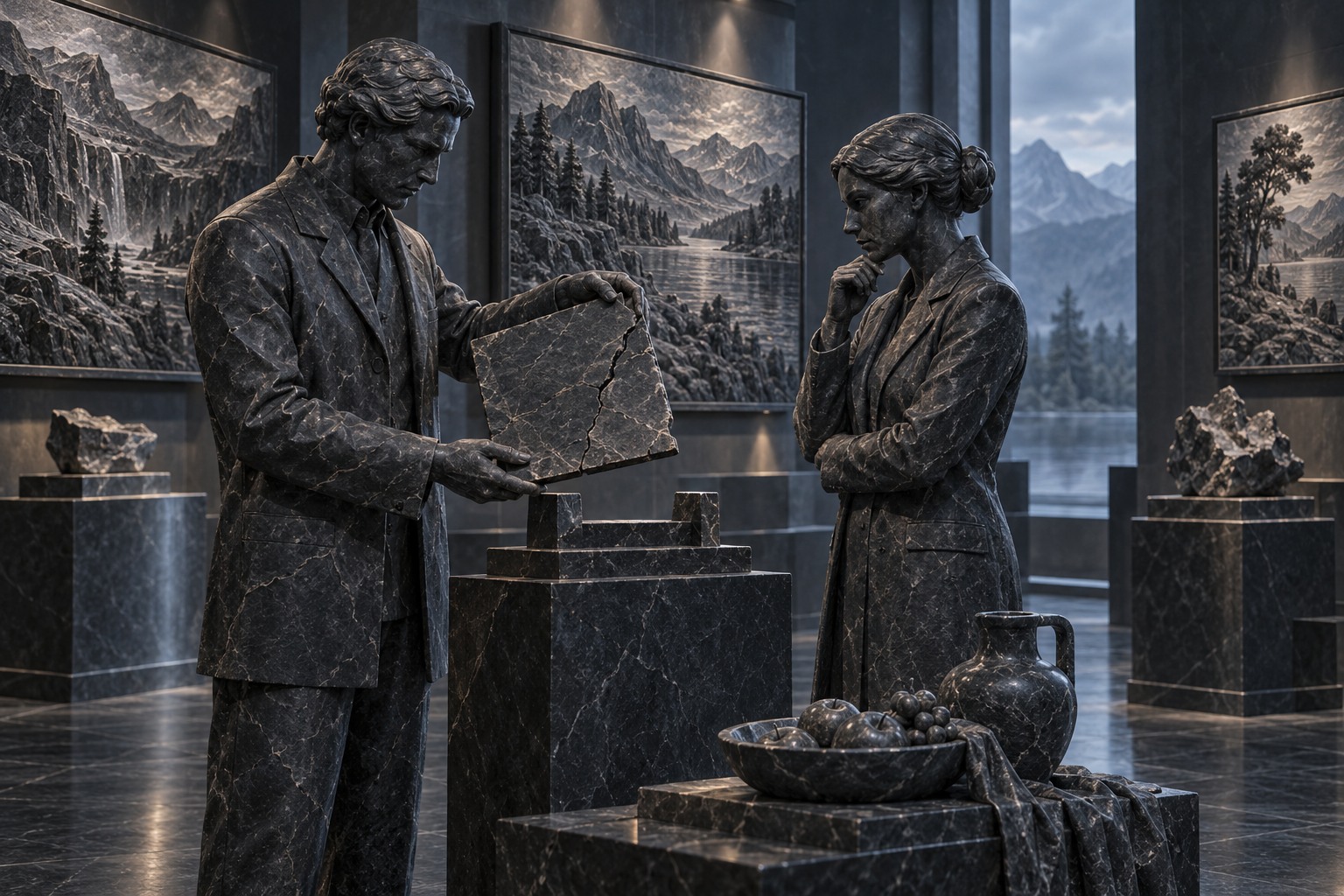
Epigraph
He is capable of rectifying his mistakes, by discussion and experience.
Mill, On Liberty, II; complete sentence within the argument about corrigible human judgment. Original English; no efficacy promise for every exercise.
What this article is about
Discovering a false source is uncomfortable, especially when its authority helped us decide or persuade other people. Correcting the situation involves more than deleting a link. We need to determine what failed: a document's existence, authorship, content, scope, or the conclusion we drew. Losing one foundation neither proves the opposite belief nor automatically removes every other ground. This article follows an invented exhibition whose organiser cited a nonexistent painter's letter. Mill's philosophical argument, a bounded research abstract and a religious account of examining what was heard offer different perspectives, rather than one tested technique for changing beliefs. The practical task is to recover the precise grounds of our position, identify what remains unknown and, where appropriate, correct our own message. A personal preference can survive while a historical assertion is withdrawn. That revision requires neither declaring ourselves incapable of judgment nor compelling others to accept the new account immediately.
I. What Do We Mean by a False Source?
Imagine a small exhibition of reproductions. Its organiser proposes arranging the works by their dates and explains that the painter supposedly wrote a letter requiring this order for every exhibition. Both painter and letter are invented here; no actual archive is being described. Another participant asks where the document can be read. After checking, the person who prepared the explanation acknowledges inventing the bibliographic entry as an illustration, then mistakenly moving it into a list of real evidence. For our example, suppose that origin is established. We have more than an unsuccessful search: there are grounds for regarding the citation presented to the group as invented.
Actual situations can differ. An inaccessible page does not show that a document never existed. An authentic letter may bear the wrong attribution; a real study may not contain the conclusion assigned to it. A retelling can remove a condition and make a limited source sound universal. The word “false” helps only when we specify the problem. Otherwise, unavailable access, invented provenance, inaccurate quotation and unsuitable application become one indistinct category. Each calls for a different next step: locating another edition, correcting a name, reading context or withdrawing the reference. Our disappointment or irritation with the person who supplied it does not establish which action fits.
Begin, then, with a small statement about the check's result. In this example: “The bibliographic entry for the letter was invented; it does not establish the painter's wishes.” We are not yet saying chronological exhibitions are bad, that the painter preferred random arrangements, or that everything the organiser reports is unreliable. Each extension needs separate support. Defining the error's scope allows us to correct it while retaining some shared work. It also protects others against accusations wider than the evidence. An acknowledged mistaken use of an illustrative entry tells us neither all the person's intentions nor their habits and relationships in other situations.
II. Return From an Impressive Citation to Your Own Claim
The organiser's explanation connects several propositions. A letter exists; the painter wrote it; it specifies an order; the requirement applies to this exhibition; therefore participants must choose that order. These form a staircase, but every step adds a question. Even an authentic letter might concern one particular display rather than all future exhibitions. An artist's preference, a historical description and a present obligation also differ. When the citation proves invented, reconstruct the propositions separately. What has disappeared becomes clearer: evidence of an authorial requirement, rather than our ability to arrange pictures chronologically and discuss that arrangement with the group on its own merits.
Ask what you believed because of the entry. Perhaps you accepted a historical claim about the painter's wishes. Perhaps you concluded that this arrangement helps visitors see stylistic development. Perhaps you agreed because you did not want an argument. Those answers require different revisions. The first needs new historical grounds or an acknowledgment of uncertainty. The second can be considered as an independent design proposal, without sheltering behind another person's name. The third concerns participation in a decision, rather than proof about art. Identifying our own transition does not require publicly explaining every personal reason for agreeing. It distinguishes those reasons from evidence we presented to others as fact.
Replacing the reference with another famous name can preserve the appearance of authority without improving the argument. The new source may exist but address something else: order in a book, rather than pictures on walls; one collection, rather than a universal rule. Checking an entry's existence is therefore insufficient. The particular passage must support the particular assertion. When that connection is missing, we can identify the proposal as our own and explain it through the exhibition's purpose. Our reasoning does not become weaker merely because a nonexistent letter no longer protects it. It becomes more available for substantive discussion and revision, with its actual grounds visible to other participants.
III. Losing Support Does Not Prove the Opposite
An invented letter does not show that the painter prohibited chronological order. We have lost particular evidence, not acquired evidence of the opposite. This matters when a discovery provokes a strong reaction. We may want to reverse the earlier conclusion entirely: because a false citation persuaded us, we must now do the reverse. But that opposite decision can still depend on the same citation, through negation. Instead of choosing independently, we continue letting the invented entry determine our action. A more precise position is modest: this letter does not establish the painter's wishes; the arrangement needs discussion on other grounds, if those grounds fit our present purpose.
Withdrawing the citation can nevertheless change a belief's strength substantially. If it was the only support for a historical assertion, we can no longer report that assertion as established. If independent documents exist, examine what they actually confirm. Several pages repeating one invented entry do not become several independent witnesses. Exhibition participants might have distributed an identical caption across different catalogues. The number of copies shows circulation, not the letter's origin. Independence concerns how information was obtained, rather than merely the number of addresses or differences in presentation. Investigate this sufficiently for the particular claim being corrected, without treating every item in the exhibition as requiring an exhaustive inquiry.
A correct outcome can also have been supported by a bad argument. Participants may already have agreed on chronology to create a comprehensible visitor route. The invented letter was then an extra endorsement, rather than the sole basis of their choice. They can retain the agreement, remove the false caption and identify the decision's actual grounds. Preserving the outcome does not excuse the argument. It remains erroneous even if no pictures move. Equally, correcting the argument need not destroy a working agreement. Check whether the group really agreed independently of the citation; do not retrospectively assign independent agreement to participants in place of discussing what persuaded them.
IV. Find the Conclusions That Depended on the Source
The false entry may have supported more than the initial proposition. The organiser used it to reject another layout, write a display caption and explain why further discussion was unnecessary. Examine those consequences separately after discovering the error. A caption can be corrected as our own communication. A plan can be reopened for discussion. We cannot make a past decision unhappen, but we can acknowledge that one offered reason did not support it. This list need not become an endless record of every thought. It helps revision reach the specific places where the false foundation still operates: a text, explanation, agreement or later conclusion about available choices.
Try a counterfactual question: if we remove the letter, what remains of the explanation? Perhaps route clarity, wall dimensions, available time and participants' preferences. These do not establish the painter's intention, but may matter to the current project. Perhaps nothing remains beyond familiarity with the chosen option. Familiarity exists, but cannot be renamed historical evidence. We may temporarily retain the layout to finish preparing, clearly stating that reason. A practical need to decide does not require inflated confidence about a decision's origin. An assertion about the past and a working choice for today can receive different statuses and different grounds, without either being concealed behind the other.
Dependence may be partial. A letter used only to choose the first room does not automatically determine date captions or the other rooms' order. Revision should match its area of application. Too narrow a correction leaves the old argument operating nearby; too broad a reversal discards things that never relied on it. Examine a few visible results rather than reconstruct every inward movement of thought: the display, the proposal to participants and the next public retelling, for example. If “the painter required this” still appears, correction is incomplete in those texts. This observes their content, rather than measuring the writer's memory or evaluating their character as a whole.
V. Do Not Fill the Unknown With Another Convenient Account
After withdrawing the letter, we still do not know how the painter wanted the works displayed. In this example, “we have not established that” is the honest answer. Continue searching if the question matters, but a complete historical story need not appear immediately. A newly invented motive, even a respectful one, does not restore knowledge. “Surely the painter would have preferred viewers' freedom” may express a present wish of ours. Suitable evidence is needed before it becomes the painter's position. Keep found testimony, supported supposition and our own design choice distinct. All can contribute to discussion when participants understand each proposition's role and where its support ends.
Locate uncertainty precisely. The painter's wishes are unknown, but the works' dates and the room's current constraints may be available. Losing the letter does not make every fact equally doubtful. We can say less about an alleged requirement while saying just as much about measured wall dimensions. That keeps a specific check from turning into universal distrust. After an error, believing nothing can seem safer. Yet that stance also erases differences between grounds. A substantive correction restores them: which information is confirmed, which connection has been rejected, where uncertainty remains, and which decision is still ours to make. Its scope is concrete rather than a verdict on knowledge altogether.
The search boundary depends on the task. A historical publication about authorial intention might require further archival work. For a small educational exhibition, withdrawing the unsupported caption and explaining the arrangement through our present aims may suffice. Keep those results distinct. A limited action can finish before the historical question is fully resolved, provided the action is not presented as proof. The right to stop concerns our own work's scope, rather than declaring the question meaningless for everybody. Another researcher may continue. Our present answer can remain open while being sufficient to stop relying on a document whose claimed provenance proved false.
VI. Mill: Confidence Can Allow Correction
In Chapter II of On Liberty, Mill connects human judgment's reliability with the capacity to correct mistakes through discussion and experience. The selected passage considers the freedom to object, interpretation of facts and comparison of positions. It provides no guaranteed exercise for every false citation. Its wider political and philosophical argument cannot be reduced to instructions for an exhibition organiser either. A bounded distinction helps here: confidence in our position and willingness to revise it need not exclude one another. Withdrawing an unsuitable foundation can make the remaining explanation more precise, if we actually examine what now supports it rather than merely declare ourselves open-minded.
The organiser might say, “I still prefer chronological order, but no longer regard it as the painter's requirement.” Revision has not required a total change of taste. The grounds presented to the group have changed. Discussion now concerns whether this arrangement serves their purposes, rather than fidelity to an invented command. Participants may propose a thematic route or retain the current one. Allowing objections does not mean promising to accept every objection; it leaves their content available for assessment. In applying the passage, we do not transfer all Mill's universal formulations and historical judgments into every present setting. We consider the specific question of corrigibility while preserving the original argument's scope.
Work already completed can make that transition difficult. A display is printed, explanations circulated and discussions have taken time. But effort spent does not bring the letter into existence. It affects the cost of correction, which can be reduced proportionately: replace one caption, add a clarification, or discuss only the affected part of the decision. Revision need not become a public trial of our good faith. We need an accessible corrected result, rather than a demonstration of perfect character. Openness appears in concrete language and action. It does not require disclosing feelings to everyone, securing participants' approval or promising never to make another sourcing mistake.
VII. Remembering the Correction and Revising the Reasoning
The complete publisher abstract of Ecker, Lewandowsky and Tang's 2010 study describes corrected information continuing to influence memory and reasoning even when the retraction is remembered. A specific warning reduced this influence in the reported experiments but did not eliminate it. Adding a plausible alternative explanation reduced it further, again without elimination. Only the abstract was consulted here, rather than the complete methods or data. It permits a limited question: does earlier content still enter a subsequent inference? It does not show that our fictional organiser inevitably retains an error, or measure the effectiveness of the exercise below for revising a bibliographic foundation. Those applications remain ours.
In this example, we can examine the distinction through the organiser's next sentence. They remember that the letter was invented but say, “The painter's wishes still matter more than our preferences.” What are they now calling the painter's wishes? Another document may have appeared, or the former authority may have returned without its citation. Clarify the proposition's support rather than predetermine why the person said it. The sentence alone does not establish whether they received the whole correction, dispute it or mean another source. An experiment does not confirm a particular letter's provenance. Checking the source and examining subsequent reasoning remain different tasks, although both clarify the present explanation.
Compare two subsequent assertions with their former support. If we still call the arrangement mandatory for every exhibition, what now supports that? If we call a different layout disrespectful, what establishes the artist's preference? An emphatic word may need weakening while a personal preference survives. This analysis is not a method for erasing information from memory. It examines reasons a person can currently present. We make no promise that writing one revised account prevents the previous content from ever influencing them again. We can correct a particular proposition, notice another error later and revise that error's specific scope too, without a diagnosis or a humiliating explanation of the speaker.
VIII. Religious Listening and Examination Have Their Own Subject
Acts 17:10–15 describes Berea, readiness to receive what was heard and daily examination of the scriptures to see whether those things were so. All six selected verses were read in the historical KJV, including the continuation about belief, opposition and Paul's journey towards Athens. This is a narrative concerning religious preaching and scripture. It cannot establish that every secular source check receives identical endorsement from every religious tradition. Our comparison concerns a question about readiness to listen alongside examination of material with a particular religious standing in this account. The Russian quotation is the authors' rendering through KJV, without comparison with the Greek original.
A present exhibition participant can listen generously while asking about a document. A request for clarification need not express contempt for the speaker. That connection is our proposal, however; the biblical account addresses neither museum plans nor present bibliographic mistakes. Religious authority does not replace archival checking, and accepting our correction is no measure of another person's faith. We cannot demand that someone adopt our arrangement as a spiritual obligation. The comparison invites reflection on our own speech: when listening, what do we receive, what do we consult to examine it, and on what grounds do we speak afterwards? It need not impose one answer on every reader.
The sources consequently help in different ways. Mill offers a philosophical argument about corrigibility and discussion. The abstract reports a bounded experimental finding. Acts retains its religious subject and narrative setting. No jointly measured procedure for correcting beliefs unites them. An authorial exercise can draw questions from these perspectives, provided its origin is identified. This distinction preserves comparison's usefulness: readers can see where a source's account ends and our proposal for the current situation begins. They may accept one question, reject another or continue reading within their own tradition. They need not treat the entire comparison as a compulsory unity of teachings or as an independently tested intervention.
IX. Correct Your Own Message While Respecting Others' Boundaries
If a false reference entered a public caption, privately acknowledging the mistake does not correct that caption for its readers. A clarification can identify the earlier assertion, the established provenance problem and the present boundary of knowledge. For example: “We previously described this order as the painter's requirement in a letter. The entry for that letter was invented. We are choosing this route ourselves; we have not established the painter's wishes about it.” The message corrects particular grounds without repeating every accusation or promising all visitors will notice. Its location depends on where the earlier version operated and who can access the clarification, rather than merely our wish to close an uncomfortable episode.
Keep a correction history insofar as it helps explain the change. A date and connection to the previous statement may be enough. No need to publish somebody else's private correspondence or interrogate the entry's compiler. If available material cannot substantiate the provenance finding, the public wording must reflect that limit. Someone can nevertheless stop using their own unsupported reference without disclosing every detail of the check. Distinguish withdrawing our foundation from making a proven accusation against another person. The latter requires its own support. An error in a list does not automatically authorise reporting personal motives, identifying participants in a private conversation or exposing their documents' contents.
Other people need not accept the revised explanation immediately. Show accessible grounds and clarify which part changed, but do not measure agreement by a sent message. Correcting a text, delivering the correction and changing another person's position are different outcomes. Our primary responsibility concerns what we continue asserting and circulating. We can offer a clear amendment to someone keeping an old catalogue; that does not entitle us to direct all their conclusions. Shared work after an error can proceed without demanding immediate forgiveness. Discuss available facts, the present task and the next concrete choice, rather than turning the discovered mistake into a complete description of someone's personality.
X. Choose an Action on Present Grounds
The participants may ultimately retain chronological order, change it or compare two routes. None follows automatically from the letter's invented provenance. The decision now rests on the exhibition's purpose, available space and participants' agreement. Visitors can be told that organisers designed this route for a particular way of encountering the works. That explanation does not substitute for the painter's unknown wishes. It returns responsibility for today's choice to those making it. Revision has been precise enough: the false foundation is removed, the historical question remains open, preference is identified and practical action receives separate grounds available for discussion rather than borrowing its former authority.
Keep three states alongside one another: something is confirmed; something is no longer considered confirmed; something is chosen as our own action under limited knowledge. They need not collapse into a single “believe” or “disbelieve.” We know the invented entry's origin, do not know an authorial requirement and prefer a clear chronological route. A genuine document discovered later may change the historical part. That would not make today's correction pointless. It removed a particular false witness from the present explanation and left room for further knowledge. It did not predetermine the outcome of a new search or what every participant must eventually decide about the display.
Discovering a false source can thus lead to a more intelligible judgment. We need not change our entire outlook, abandon our taste or immediately adopt the opposite position. Identify the lost argument and examine the conclusions that followed. The result may be new support, a narrower assertion or an honest “not yet established.” Any may suffice to stop a particular error. Corrigibility offers no promise of infallibility. It appears in our capacity to withdraw false support, show the present limits of confidence and speak so that another person can distinguish testimony, our reasoning and our freely chosen action. The exhibition need not supply a complete historical answer to make that distinction useful.
What this means in practice
Choose a small citation or message that you relied on and now have grounds to question. Use accessible or invented material. Specify the problem first: source not located, entry invented, authorship mistaken, quotation unmatched, or conclusion wider than the passage read. Do not turn an unsuccessful initial search into proof that a document never existed. Write one assertion the citation supported beside it. If checking provenance is unfinished, mark that present limit. This exercise does not require disclosing a private conversation or investigating the person who supplied the material. Its subject is the grounds of your own explanation, rather than a verdict on somebody else's character.
Remove the disputed foundation and examine two conclusions that depended on it. Name the independent support remaining for each, or reduce confidence. Mark personal preference and necessary action separately: these may survive without historical authority. Do not fill an unknown with a convenient new motive. If continuing the search, identify particular material needed for the next question. If stopping, retain honest uncertainty. This is an authorial, voluntary examination of your explanation's content. The cited sources do not establish its effectiveness or promise a guaranteed change of belief. A narrower assertion can be a sufficient result even before the whole topic is settled.
Where appropriate, prepare a correction to your message: what you claimed, which grounds proved unsuitable, what is now known and what remains open. Share it in a suitable place while respecting participants' privacy; sending it is not their agreement. Then read your own next account. Has the rejected authority returned under another name? If so, clarify that proposition specifically. You may finish once your speech is sufficiently corrected, without establishing the entire event's final history or controlling the beliefs of every audience member. The task is a concrete revision of what you can responsibly say now, with an open boundary for information that may appear later.
Key quotation
and searched the scriptures daily, whether those things were so.
Acts17:11, clause describing the Bereans, King James Version. Religious subject of scripture retained.
Connections between traditions
| Perspective | Connection to the question | Boundary of comparison |
|---|---|---|
| Mill, II | Corrigibility can coexist with confidence open to discussion | Philosophical argument, not measured exercise |
| Ecker, Lewandowsky, Tang,2010 | Remembered retraction differs from subsequent inferences | Complete abstract only, not methods or inevitability |
| Acts17:10–15,KJV | Readiness and examination of scriptures within religious narrative | Not secular protocol or universal religious rule |
| Authorial logical analysis | Losing support does not prove the opposite; dependent conclusions checked | Invented case, not an actual painter finding |
| Authorial exercise | Proportionate correction of own message with precise uncertainty | Voluntary, not measured efficacy or another person’s agreement |
Primary sources
Tags
source, belief, correction, checking, letter, authorship, provenance, quotation, context, grounds, inference, testimony, independence, uncertainty, preference, decision, Mill, liberty, discussion, experience, Ecker, Lewandowsky, Tang, Acts, Berea, scripture, responsibility, delivery, agreement, practice
About the authors
Andrey Zarinsh is the author and founder of United Wisdom. He explores inner transformation, the unity of traditions, intercultural dialogue, and contemporary spiritual discipline. Instagram: @andrey.zarinsh.
Maria Evilkut is a co-author of United Wisdom. Alongside her research, she seeks to test these ideas in practice and observe how principles of unity and mutual understanding work in real life between people and cultures. Instagram: @ilkutki.
Keep what resonates with you.