
World & consciousness
Illusion as a way to investigate ordinary perception
Illusion, measurement, and explanation: James’s and Descartes’s historical questions, Adelson’s bounded visual experiment, and clear demonstration reading.
Epigraph
But the process is the same, whether the perception be true or false.
William James, The Principles of Psychology, Volume II, XIX, discussion of illusions, printed p. 86; English text. This is James’s historical position, rather than a substitute for testing each proposed mechanism today.
What this article is about
An optical illusion can entertain, surprise, or raise an uncomfortable question: if I see a difference that measurement does not confirm, what can I trust? A particular mismatch need not become distrust of all perception. It can become a more precise task: which property was assessed, under what conditions did the answer occur, and what changes with the presentation? This article considers James’s historical explanation of illusion, Descartes’s philosophical scale of doubt, and Adelson’s primary brightness research. These sources do not form one complete theory. They help distinguish an experience, a correctness criterion, and an explanation of an outcome. We are not offering a picture-based diagnosis or asking readers to repeat historical physiological procedures. The practical aim is to read a demonstration with attention both to its effect and to the question it actually addresses, respecting a personal impression while preserving definite examination.
I. An illusion needs a definite comparison
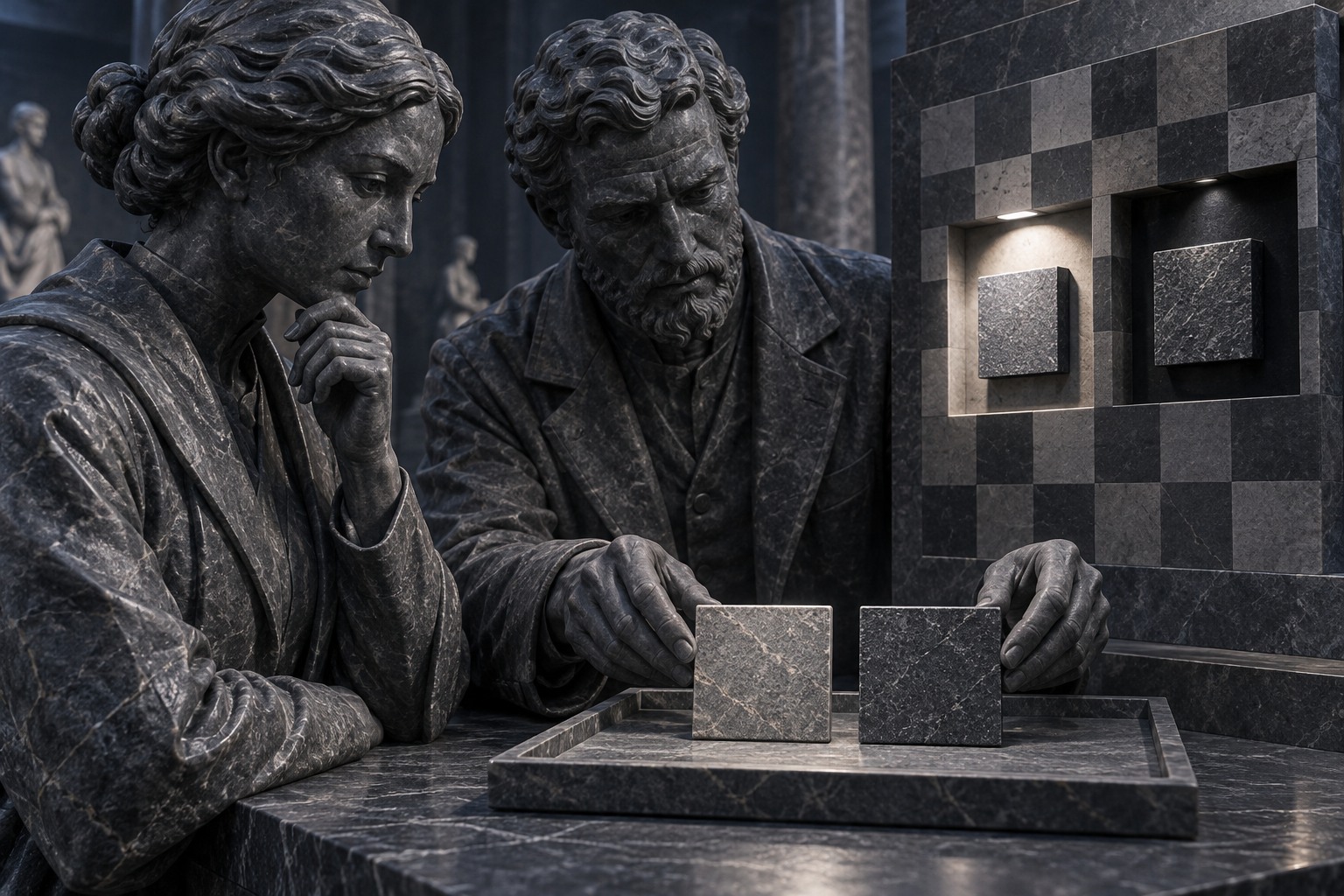
Imagine an exhibition board with two gray patches. Someone says one looks lighter; a caption says their source-file values are identical. This is an invented scene, not proof of an illusion in every visitor. It already contains two assertions: one about visual appearance and another about a specified digital property. Checking the second needs suitable file information; assessing the first needs an observer’s report under known conditions. The contrast becomes substantive when the comparison is definite. Otherwise ‘the values match’ can turn into ‘you saw nothing’, or ‘I see a difference’ into ‘the record must differ’. Neither transition is justified by the speaker’s confidence alone or completed by a demonstration’s impressive name.
We will discuss illusion through a bounded mismatch between a property judgment and a specified criterion. This is an editorial working frame, not a complete clinical vocabulary or definition of every false perception. The criterion itself needs explanation. Equal file values are not identical to measuring light emitted from each screen location. That is a logical distinction between assertion objects, not a measured display discrepancy established here. Research can control presentation conditions; an incidental exhibition may leave them unclear. First establish which result is actually shown. Two gray surfaces do not become a scientific experiment merely because a caption says ‘your brain deceives you’ and a viewer feels surprised by the result.
This approach does not cancel the pleasure of looking. We can examine an accessible neutral demonstration, describe an impression, and leave its explanation open. A substantive inference needs a subject: a surface’s shade, screen brightness, line length, or a detail’s position. Even the same word lighter can concern different properties. The task is to make that choice intelligible rather than prohibit impressions without instruments. Curiosity then has a next step: establish what the demonstration retains and what it alters. This need not begin by declaring oneself mistaken. It relates a personal answer to an examinable arrangement and shows what can follow from their encounter, and what remains beyond the grounds presently available.
II. James: error within an account of perception
In Chapter XIX of Volume II, James relates illusion to what is suggested by an immediately given sensation. This is a historical psychological position. It can be read as a question about transition from experience to assertion without establishing today’s neural sequence. Assessing such a sequence would need different grounds. We select a limited passage, leaving dated clinical and physiological propositions outside the present claim. Its role matters: a reader encounters an earlier problem formulation rather than a contemporary conclusion about every seeing person. Reading can remain substantive without accepting the whole historical work as a ready account of any present visual task.
At the fictional exhibition someone can see gray patches while making an inaccurate assertion about their specified values. Checking does not erase the impression’s occurrence. This example does not confirm James’s whole account; we constructed it to distinguish statements. His historical explanation needs its own assessment if adopted as a scientific model. A narrower reading outcome is available: error in one judgment neither denies an entire experience nor certifies every content within it. A transition has become questionable. What did someone conclude from what appeared? Which property was added? What grounds support that addition? Philosophical interest in perception can thereby become more definite without presenting a century-old formulation as today’s final scientific outcome.
An author’s name should not replace analysis. James’s claim about similar processes in true and false perception can be examined and discussed. It does not authorize treating every modern illusion as identical or every explanation as interchangeable. A definite study needs a named mechanism and data that could distinguish it from an alternative. A historical psychologist’s general connection does not replace that procedure. Readers retain two legitimate interests: understand the earlier question and learn how a contemporary investigation handles a specified effect. They need not choose between them. Different tasks make comparison substantive, allowing disagreement and the possibility that part of an earlier account remains productive while another part requires revision on newly supplied grounds.
III. Descartes: doubt’s scale differs from an experiment’s
In the First Meditation, Descartes undertakes philosophical examination of belief’s foundations. In the William Molyneux translation of 1680 actually read, he distinguishes proving every opinion false from finding an occasion for doubt. Near the end he specifies speculation rather than practical action. We do not turn that move into a visual laboratory finding or advice to doubt the world’s existence daily. His question differs: what survives a deliberately strict examination of grounds? No account of all six meditations is supplied here. The selected passage distinguishes a discovered possibility of error from all assertions having been proved false, two propositions sometimes merged after viewing an optical effect.
Return to the exhibition. A mismatch concerning one property supplies a definite question about that property under those conditions. It does not imply that the familiar exit disappeared or that every measurement deserves distrust. Those additional conclusions need separate grounds. A philosopher can deliberately expand doubt for a particular argument, but that transition and its purpose should be named. A visual encounter does not perform it automatically. This article does not resolve general skepticism; it constrains what one demonstration establishes. Retaining scale supports inquiry: if everything is already declared equally false, differing outcomes can no longer help choose between explanations, although that was the point of constructing the examination in the first place.
The distinction also protects personal confidence from an excessive trial. Nobody must refute all philosophical doubt before considering a picture’s caption and checking one part. An ordinary task may have a narrow object: does a stated property match an accessible source file? Its answer will not guarantee absolute certainty in every future experience. It can still supply suitable grounds for this assertion. Calling the outcome insufficient requires specifying a stronger task. Otherwise different scales obstruct one another: practical checking is dismissed for lacking philosophical finality, and a philosophical move becomes an everyday instruction. Both activities have a meaning when the question they address and the outcome they actually obtained are explicit rather than silently exchanged.
IV. What Adelson compared
In Adelson’s primary 1993 study, six naive observers made three judgments per pattern, adjusting diamond luminance after 0.5-second presentations. Matching differed with changed geometry and retained gray levels and edge adjacency. This is a compact report of a particular experiment. Naive retains the author’s label rather than asserting ignorance of instructions. Our reading asks which information is actually available. We read the named methods and selected comparison text, not every cited work. The outcome remains a report of a definite procedure. Further assertions about every perception or a precise processing location within the brain are not established by this small record and would require their own research grounds.
This account does more work than ‘gray depends on its background’ because the comparison is visible: a response task, altered condition, and retained properties are specified. A reader can ask how an explanation must accommodate the difference. This does not mean one publication excludes every alternative mechanism forever. Alternatives need their definite predictions assessed. No replication was performed for this article, so the primary result is reported at its own scale rather than presented as independently reproduced. Boundedness nevertheless does not empty the account. It identifies what the inference concerns instead of extending it to every perception, every person, or every emotional choice in which the everyday word illusion happened to suit a narrator’s story.
Another boundary lies between a publication and an image in its retelling. Monitor conditions, presentation time, and instructions enter the described investigation. An incidental phone copy does not automatically retain them. We neither compared devices nor establish the effect’s variation between them here. We identify insufficient grounds for ‘I exactly repeated the study’. Viewing can be an interesting demonstration and a personal answer an honest report. Reproducing a procedure needs further information and agreed conditions. A useful popular account can preserve both outcomes separately: a reader saw something, while researchers obtained definite data through a definite method. This respects the observer and the research by not requiring one incidental viewing to replace the whole route by which a finding was obtained.
V. Measurement and appearance answer different questions
A caption claiming equality under a specified value invites a question about a record. ‘They look different to me’ answers a question about appearance. We need not declare one assertion fictional to hear the other. In the hypothetical scene equal values and a continuing apparent difference can be acknowledged together. We do not claim this necessarily occurs in every reader; logical compatibility is not an empirical finding. It shows why knowledge of a condition and description of experience cannot immediately become one correctness scale. A general inference needs their relationship investigated. One viewing can more modestly retain two recorded lines and clarify the property at issue instead of arguing over who possesses the only possible truth.
A measured property should not receive more authority than its subject permits. Checking a file value does not answer whether someone likes the picture, what it recalls, or whether they want to continue looking. Those questions need not share a numerical answer. Conversely, a pleasant-color memory does not replace an appropriate check when the question concerns specified brightness. Significance follows the task. Respect for experience and measurement can support one another: the former prevents erasing a reported encounter, while the latter prevents assigning an established physical characteristic to it without grounds. This is a conceptual distinction, not a theory of which brain regions perform these tasks or how readily a person can switch between them in a real situation.
An exhibition can offer an intelligible instruction: describe the appearance first, then establish which source property is compared. That is our proposal for clear discussion rather than an established educational method. It need not produce an expected effect. If someone notices no difference, retain the response instead of explaining it by inadequate development. Noticing a difference likewise establishes no special suggestibility or ability. One viewing supports neither characterization. An organizer may honestly obtain varied reports under known limitations, but those reports do not become a scientific sample without an appropriate procedure. An available respectful beginning is to name the task, hear a definite answer, and avoid assigning a personal verdict the small encounter never promised to establish.
VI. What changes within a comparison
Changing a picture does not yet show which feature relates to the response. Consider our own teaching example: a gray rectangle appears first inside one drawn frame, then another. Simultaneously changing its size, position, frame shade, and instruction permits several explanations of a response difference. That does not make the encounter useless; it may generate a question without isolating an appropriate inference. Each alteration needs description and a narrower comparison. A particular frame cannot become an established cause merely because it changed too. We have neither conducted this experiment nor predicted an effect magnitude. We are examining the logical structure of a proposed comparison before deciding what evidence it would require.
Retained properties matter to an inference when choosing a comparison. Our hypothetical scene could keep the rectangle identical while changing one specified surrounding detail. This is not ready proof of that detail’s influence; an appropriate procedure and outcome description are still required. The question has nevertheless become more definite. A reader can list what the presenter called identical, what differed, and which answer was obtained. When information is absent, preserve that absence rather than adding a convenient control afterwards. Control then enters reasoning with a definite object and limit. The word controlled alone cannot make a particular scene evidence about every other picture or every condition we might wish to explain through it.
Suppose our viewer describes the rectangle differently after a frame change. Initially that records a sequence, rather than an established estimate of the frame’s contribution. The viewer has already seen the first version, may understand the task differently, and another condition may have changed unnoticed. These are procedural questions, not measured causes of that particular response. They need not postpone investigation forever. Choose which uncertainty matters next and how it might be reduced. Scientific interest lies partly in that possibility of refinement: an effect need not disappear for its initial explanation to become more precise or yield to an account better suited to the observed comparison.
VII. Naming an effect does not explain it
Words such as context and organization can point toward a question without answering it. If a gray patch looks different in another surround, ‘everything depends on context’ nearly repeats the scene’s description. A fuller explanation should specify which surrounding element matters, how it enters a model, and what outcome difference follows from altering it. This is a reasoning requirement, not a claim that a particular model is already verified. An effect can be persuasive while its sufficient explanation remains unknown. That does not make the observation fictional. It leaves the mechanism open instead of closing it with a familiar word that presently fails to distinguish several possible answers.
Adelson challenges selected low-level accounts’ sufficiency, a definite argument rather than a prohibition on every future model. More generally, ask how a proposed mechanism connects to an outcome. If an account has several components, one component’s failure need not refute all the others. A connection rule may need refinement, an initial assumption replacement, or a particular proposal rejection. This article makes no such decision for researchers; calculations and contrasts not reproduced here would be needed. Readers can ask which component gained support, which proved insufficient, and what could distinguish them further. That does not end a dispute but gives subsequent reading direction, allowing an account’s definite construction to matter more than its general label’s appeal.
For our rectangle scene, two unconfirmed proposals could be stated. One relates the response to immediately neighboring shades; another relates it to the frame’s depiction of a surface’s position. Ask whether a comparison could make their expectations diverge. These simple proposals are neither complete nor asserted to reproduce Adelson’s models. Their educational role is to distinguish another label from an account admitting a definite test. If both accommodate every possible outcome, the choice remains unclear. A distinguishing question gives subsequent work direction. That can help a reader assess explanatory prose more carefully without pretending to have conducted an experiment or acquired established knowledge of a mechanism.
VIII. An image can offer several judgment objects
A gray drawing can be both screen patches and a depiction of a surface. ‘Which patch is lighter?’ therefore needs clarification. Does it ask about apparent image brightness, an attributed property of depicted material, or a file’s numerical value? Adelson distinguishes brightness and lightness: perceived luminance of an image patch and perceived reflectance of a depicted surface are different judgment objects. This does not mean actual reflectance of a drawn object was measured. The depicted surface remains an object of perceptual assessment within the investigation. Choosing a term prevents assigning an additional physical measurement that the procedure never performed and that participants may never have been asked to make.
Consider another hypothetical drawing: a gray area appears as part of a wall beside a depicted shadow. Someone might describe it as a dark image region or as light-colored material under dim illumination. We report neither which answer would be more frequent nor what processing would produce it. The example distinguishes questions directed at one image. Combining answers to different questions in a single table does not establish a contradiction. Recover instructions and word meanings first, then determine whether people assessed the same property. Clarification does not guarantee agreement, but identifies a possible disagreement more accurately. Without it, a dispute may concern mixed tasks in a reported response rather than an established visual error.
What exactly does a popular explanation promise to correct? A claim about inaccurate brightness is not identical to a claim about incorrectly identified material. Comparing with a digital value may suit one task while remaining incomplete for another. Choose the criterion openly rather than changing it after a viewer’s response to create a dramatic exposure. This is our editorial recommendation for intelligible demonstrations, not a universal separation of every visual process or a guarantee of better learning. Its modest purpose is to let readers identify which question received an answer and preserve the question not yet asked. An impression then becomes more discussable without every report becoming a final verdict about the world.
IX. A particular observation and an inference about people
Showing a neutral picture to acquaintances may produce varied descriptions. That conversation can be interesting without establishing a population proportion for a particular effect. Participants were not selected for that estimate, conditions may differ, and the question may remain insufficiently specified. These are logical limits of our invented situation, not survey results reported here. Response variety likewise does not prove an individual’s general mechanism. Recording the differences and asking what procedure could investigate them may be more useful. Informal observation need not be devalued; it needs an honest scale. It can supply a question, useful wording, or a reason to seek a primary study without becoming an answer to an unformulated research task.
The 1993 paper involved six naive observers. Three judgments per pattern help reconstruct the procedure without supplying broad participant diversity or establishing a universal effect in everyone. The selected text supplies no grounds for adding contemporary demographic representativeness. We use the work for a definite comparative argument, retaining its procedural size. A small number neither automatically cancels its substantive value nor lets detailed equipment descriptions remove transfer limits. These are different evidential questions: whether the contrast supports a particular explanatory discussion, and how broadly outcomes generalize. The latter needs additional grounds absent from our article; an assured editorial tone cannot manufacture them out of the available study.
An illusion response should not become a verdict on credulity, intelligence, or mental state. Such a transition needs separate grounds that a neutral demonstration does not provide. One person may stop viewing, another request a condition description, and another leave the question open. Those decisions need not track the expected picture effect. If someone reports discomfort, discussion can end without an endurance test. That is a participation rule for our voluntary practice, not a medical judgment about the sensation’s cause. We examine a visual task to develop a clear question. Preserve that purpose by avoiding a personal assessment that neither source nor informal presenter can honestly make from the available information.
X. How error returns a question to ordinary perception
Illusion becomes research-relevant when it constrains an account as well as surprises. Suppose a theory describes one drawing well but answers differently for a deliberately modified version. One can examine which component explains the difference and whether it handles that contrast. This is a general reasoning approach, not an experiment we conducted. Ordinary perception enters through the proposed explanatory process: can it accommodate both an appropriate outcome and an inaccurate judgment? No identical answer for every effect can be assumed. Error can nevertheless become part of substantive discussion instead of being declared an incidental exception whenever a familiar account lacks precision or a description of definite conditions.
James proposes a historical approach to true and false perception through related connections between the given and suggested. Descartes subjects grounds to another scale of examination. Adelson constructs specified images and measures responses through a definite procedure. These works need not become proof of one doctrine. Their tasks, methods, and limits differ. Comparing them can clarify the reader’s present question: philosophical grounds for trust, an explanation of a particular effect, or an intelligible way to read a demonstration? One source need not answer all three. Distinct tasks permit seeking appropriate primary material and retaining open disagreement without granting historical resemblance the force of contemporary experimental confirmation where that confirmation is absent.
Careful viewing can end with a more precise question even if the impression remains unchanged or never arises. Are the selected values equal, what instruction was supplied, what changed in the arrangement, and which explanation remains needed? That is neither a complete scientific outcome nor a promise of personal benefit. It is a possible result of voluntary reading, leaving room for picture interest, respect for measurement, and investigation of their relationship. Error in a definite assertion need not become a verdict on all perception. It gains a subject, conditions, and an opportunity for checking. That specificity allows illusion to become a question about ordinary perception without announcing it fully explained or requiring every reader to experience the effect.
What this means in practice
If you wish, choose one accessible neutral demonstration with an intelligible source; no article image reproduction is required. Avoid flashing, eye pressure, spinning, medication trials, and historical physiological procedures. You can examine only a caption instead. Record your own impression if one occurs, without requiring the advertised effect. Stop if uncomfortable. This practice establishes neither a sensation’s cause, a health state, nor the quality of your abilities.
Make three lines: what I described, what comparison is proposed, and which presentation condition is known. Check whether the criterion concerns the same property: a file value, image brightness, or attributed material. Name one remaining uncertainty. For a reported study, locate procedure, participant count, retained and altered properties without filling absent details. Record another viewing as another viewing because the first version is now familiar.
State a limited inference and a further question. A caption may explain equality of recorded values while screen conditions remain unchecked; a primary paper may compare definite patterns without characterizing everyone. Do not use a response to evaluate yourself or an acquaintance. No educational, therapeutic, or diagnostic efficacy is established for this exercise. A possible sufficient outcome is a clearer distinction between impression, criterion, and explanation. Choosing whether to participate or continue remains yours.
Key quotation
what is false is what is inferred
William James, The Principles of Psychology, Volume II, XIX, printed p. 86; an explicitly identified sentence fragment from the English text. The full sentence contrasts inference with the immediately given; this historical proposition is not presented as a universally established modern mechanism.
Connections between traditions
-
James: given experience and suggested object / editorial frame: report and criterion. The transition from experience to assertion is comparable; the frame does not confirm the whole historical theory.
-
Descartes: grounds for doubt / Adelson: experimental contrast. Both can constrain a hurried inference, but philosophical procedure is not a laboratory experiment, and a pattern contrast does not settle all knowledge foundations.
-
James: true and erroneous perception / Adelson: organization and outcome. Error enters an explanatory question. Historical resemblance establishes neither one mechanism nor influence.
-
Adelson: brightness and lightness / editorial practice: comparison object. Specifying a property helps interpret an outcome. The research distinction does not establish efficacy of a reader’s exercise.
-
Historical proposition / primary procedure / informal observation. All admit clarification of assertions but have different grounds: argument, specified measurement, and voluntary record. They are not three repetitions of one experiment.
Primary sources
- William James. The Principles of Psychology, II, XIX, 1890. Primary historical text; illusion discussion, printed pp. 85–86, exact quotation passages on p. 86.
- René Descartes. Six Metaphysical Meditations, Meditat. I, Of Things Doubtful. William Molyneux translation, 1680; first meditation, printed pp. 1–10, not the complete work.
- Edward H. Adelson. Perceptual organization and the judgment of brightness, 1993. Science 262(5142):2042–2044, DOI 10.1126/science.8266102. Selected primary methods, comparison text, and discussion; figures not reproduced.
Tags
illusion, perception, James, Descartes, Adelson, brightness, lightness, measurement, appearance, criterion, explanation, context, organization, geometry, experiment, doubt, knowledge, comparison, procedure, sample, transfer, image, observation, uncertainty, primary source, voluntary participation, question, inferential limit
About the authors
Andrey Zarinsh is the author and founder of United Wisdom. He explores inner transformation, the unity of traditions, intercultural dialogue, and contemporary spiritual discipline. Instagram: @andrey.zarinsh.
Maria Evilkut is a co-author of United Wisdom. Alongside her research, she seeks to test these ideas in practice and observe how principles of unity and mutual understanding work in real life between people and cultures. Instagram: @ilkutki.
Keep what resonates with you.