
World & consciousness
A shared event and witnesses’ different experiences
Shared fact and personal experience: distinguishing access, significance, later account, supplementation, and contradiction without a personal verdict.
Epigraph
Each of these minds keeps its own thoughts to itself.
William James, The Principles of Psychology, Volume I, IX, opening discussion of thought’s personal form, printed p. 226; English text. This is a historical proposition, not a prohibition on communication or a contemporary experimental proof.
What this article is about
Two people can attend one event and later describe it differently. One remembers words, another an expectation, while a third stood where part of the scene was unavailable. This entails neither that no shared event existed nor that one account must be false. Clarify what each person asserts. The article distinguishes an event, an experience, a later report, and a conclusion about what happened. James’s historical discussion of thought’s personal form and Hume’s account of testimony are compared with Loftus and Palmer’s definite experiment on question wording after film viewing. These works do not constitute one theory of all memories. They can support respect for experiential differences while preserving examination of a shared fact. The practice offers voluntary analysis of a neutral example rather than questioning acquaintances, assessing health, or deciding a legal dispute.
I. What an account calls a shared event
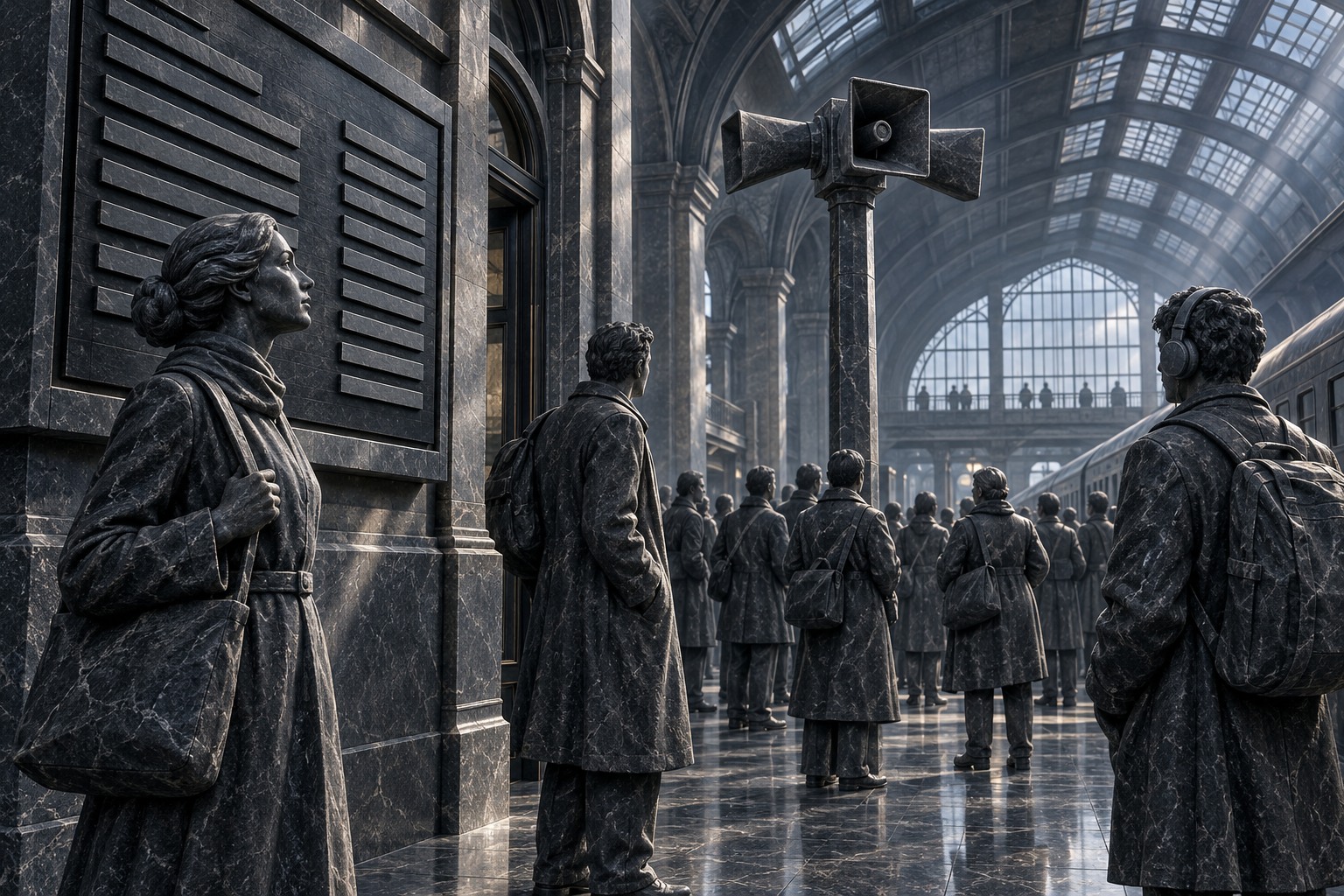
Imagine a small station announcing a changed departure time. One passenger stands beside the display, another talks near a doorway, and a third listens to an audiobook through headphones. This scene is entirely invented. We stipulate one announcement and an updated board, identifying a shared object rather than obtaining real testimony. Different reports can then be imagined: ‘the board showed another time’, ‘I heard the announcement’s ending’, or ‘people started gathering’. Their difference does not cancel the common situation assumed in the example. It invites a question about the reported part. ‘We were there’ alone specifies neither what each person could access nor the assertion they are now prepared to make from it.
Shared event can mean something broad: a meeting, journey, or concert. People’s assertions concern narrower objects. ‘The concert was short’ might describe felt duration, comparison with a promised program, or recorded beginning and ending times. These have different criteria. Restoring a clear form can precede agreement. Someone discussing elapsed time and someone describing richness have not necessarily refuted one another. Different asserted ending minutes raise a question about that fact’s record or recollection. We offer this distinction as an editorial approach to reading a report rather than an established psychological technique. It identifies which dispute needs a common factual answer and which allows several personal descriptions while retaining a definite subject.
A common subject need not entail one experiential outcome. In the station scene, people can agree that departure changed while describing its significance differently. It might be a minor pause for one person and disruption of an invented onward plan for another. We supplied those circumstances; no population regularity is reported. Compatibility follows the reports’ content: an occurrence and its significance for someone are different assertions. This first step can make another account more intelligible. ‘We discuss the same announcement’ can coexist with ‘we have not described its meaning for us identically’. A shared reality need not flatten every evaluation in advance, while varied evaluations do not authorize arbitrarily altering the specified fact.
II. Being nearby and having equal access
Our imagined participants occupy different locations. We cannot immediately attribute equal access to one display line. Asking about that line requires recovering the observer’s location and report subject. This is a logical question within a stipulated scene, not a new experiment on distance and vision. We might explicitly stipulate that a pillar hides the board from the doorway. ‘I did not see the new time’ then fails to refute ‘it was written there’. One concerns an individual’s access, the other board content. A contradiction requires the stronger assertion that absent observation establishes the line’s absence. That transition gains no grounds merely from the initial personal report.
Access also has a time interval. Someone could arrive after an announcement begins or leave before the board changes. An honest report limited to the period before leaving remains partial without thereby becoming false. Asking which interval it covers need not demand immediate admission of error. Failure to observe an update differs from a firm assertion that none occurred. Another record might narrow the question, or remain unavailable and leave a bounded inference appropriate. This article supplies no universal witness-reliability scale. It examines how access shapes the assertion a person can actually support through the grounds described in their account, rather than through presence alone.
One person’s question may concern a particular detail beforehand. Suppose one passenger checks platform number while another checks the new time. Both can supply different useful information. Their assigned tasks are our stipulation, not a scientific attention law. If another account omits the detail we want, first establish whether that detail was asked about. ‘You noticed nothing’ erases the difference between absence from a current report, unavailable information, and something the observer never attempted to determine. Careful reading allows a simple question about the subject. It need not make every pause proof of absent experience or every description proof that someone accessed all event details at once.
III. Experience’s personal form in James
James’s opening Chapter IX discusses thought’s belonging to personal consciousness. We take a historical question rather than an established contemporary mechanism. In our station example, a common object does not literally transfer one person’s past experience into another person’s ownership. Telling, showing a record, and clarifying words create a report and shared consideration. They should not be described as establishing identical experience in everyone. This is our conceptual application. It neither proves people inaccessible to understanding nor renders conversation useless. Dated clinical propositions on adjacent pages are not transferred into a present judgment about a particular person through this selected historical passage.
If a passenger says ‘I felt confused’, a listener can identify the moment and ask what confused means there. The experience does not thereby become the identical event within the listener’s experience. Conversation need not make that stronger claim to be substantive. Narrower aims remain: establish a circumstance, hear a description, or agree on the next question. Understanding words or recalling a similar moment supplies no complete access to another person’s entire past state. We do not measure mutual understanding’s depth here. ‘I understood your account of that moment’ asserts less than ‘I know every experienced feature of it’. The first can be valuable while preserving an honest limit on the second.
Personal ownership should not privilege every factual assertion. Reporting an unpleasant impression concerns one object; adding that an announcement lasted exactly three minutes introduces another, admitting comparison with a record. Respecting the first need not accept the second unchecked, and checking the second need not deny the first. An experiential report can be acknowledged while a numerical assertion receives more cautious evaluation. In the station example this is a two-assertion structure, not a promise that participants find separation easy. No difficulty or ability should be attributed to everyone beforehand. Leave room for both questions rather than deciding either through an answer directed at a different object within the account.
IV. Significance differs from factual description
Suppose the invented delay prevents one passenger attending a small meeting while giving another time to finish reading calmly. These are supplied plans rather than reported typical reactions. ‘It was unpleasant for me’ and ‘the pause suited me’ can coexist with one displayed time. Significance here follows the stipulated relation to plans, while the factual line remains another subject. Calling an account wrong merely because another person evaluated the delay differently silently changes the question. Discussing fairness or an appropriate next action would require a new task and matching grounds. Personal significance does not decide it automatically, but neither disappears when the exact departure time is established through a record.
A more complex personal account might find the delay convenient and worrying together. That need not contradict itself if the evaluations concern different circumstances. Our passenger gained time for a task while remaining unsure about the onward connection. This establishes no general emotion law. It shows how an account may need several objects instead of one word for an entire event. ‘Did you like it or not?’ may close that distinction prematurely. Our editorial alternative asks which part helped, which caused inconvenience, and what remained unknown. The proposal concerns conversational clarity. Loftus and Palmer’s experiment did not test its efficacy, and it is not offered as a universal resolution of every interpersonal disagreement.
Suppose participants decide whether to wait together on the platform. They need not first acquire identical impressions of the delay. A practical task can be agreed: where to meet, which time is current, and what to do after another announcement. This is a hypothetical decision rather than tested transport-system advice. It illustrates two distinct aims: coordinated action and complete experiential agreement. One may be possible while the other remains unfinished. No conversation is promised always to produce agreement. The article instead identifies the agreement actually reached: participants accepted a definite next step without proving they experienced the delay identically or resolved every remaining question through a shared choice of waiting place.
V. A later account and the experienced moment
In Loftus and Palmer’s 1974 Experiment II, 150 students viewed an accident film. Three groups of 50 received a smashed speed question, a hit question, or none. A week later, without re-viewing, 16, 7, and 6 respectively reported broken glass absent from the film. These are responses under a specified procedure. The authors’ reconstructive-memory interpretation does not directly observe every internal change or characterize every real-accident witness. The study constrains certainty that a later question never relates to a later answer; it does not authorize treating every account as false or deliberately altered by the speaker.
Several moments in our station scene can be distinguished without a scientific claim about their relationship: announcement, presence, first personal note, and later conversation. If a new detail enters the conversation, ask where it comes from: observation then, today’s board, or another passenger’s report? This proposes identifying grounds rather than diagnosing memory change. An added detail may be useful and true; its basis is the question. Entry into a personal narrative does not automatically make it personal observation. An unknown source can remain unknown. We need not fill the gap with a plausible story about the speaker’s consciousness to record a report’s boundary honestly and identify what remains examinable within it.
New grounds and a new experience of the earlier event also differ. A passenger could obtain an accurate time record and then evaluate the delay differently. Within our hypothetical scene this is an allowed narrative development rather than a demonstrated psychological regularity. The record concerns time; the evaluation concerns a present attitude. Today’s explanation cannot retrospectively be declared present word for word at the first moment. Nor must reinterpretation be prohibited to preserve a supposedly pure first version. Retain both dates and identify the altered part. Shared consideration then becomes clearer: several reports have different times and grounds, each deserving the role its actual content specifies rather than treatment as one motionless document of consciousness.
VI. A question also needs a specified subject
Someone could assume the delay was chaotic and ask, ‘How long did this disorder continue?’ Our invented question already includes an evaluation. Answering about minutes might leave that evaluation undisputed even though it was not established in the shared description. This is a logical feature of our phrase, not a measured conversation outcome. If duration matters, our editorial alternative separates it: which beginning and ending are meant, and what grounds identify them? Organizational evaluation can be considered separately. This order promises neither flawless memory nor a uniquely correct answer. It clarifies the requested subject and the extra meaning introduced before someone supplies their own moment description and numerical grounds.
Another question could name a cause in advance: ‘Did you also notice that the employee’s carelessness made the announcement late?’ Time, an alleged cause, and another person’s agreement are joined. No cause was stipulated in our example, so the question does not establish one. Separate what was heard, which time was expected, and whether any grounds concern an employee. This is work on one’s wording in voluntary neutral discussion rather than an official questioning instruction. Perhaps only timing mattered. An unsupported causal accusation then need not remain inside the question, distracting from the shared object actually available for checking through the accounts already supplied.
More cautious wording still does not guarantee accuracy; these proposed questions were not efficacy-tested. Someone may not remember, decline to answer, or understand a word differently. ‘I do not know’ and requests for clarification remain legitimate outcomes. Requiring every table cell to be completed can create pressure for certainty absent from the original grounds. Our practice uses a table to distinguish questions rather than obtain an answer at any cost. It can remain incomplete. A bounded outcome is identifying the requested description part and the place still lacking suitable grounds. That does not replace an event, an earlier experience, or further inquiry into their relationship, nor require expanding an account beyond the participant’s chosen task.
VII. Different reports, supplementation, and contradiction
Suppose one passenger reports the new time while another reports the platform number. These differ yet may supplement each other in our scene. Combining them still requires knowing whether they concern the same departure and update. Joining useful details does not itself establish that connection. A platform number might come from an older line while the time comes from a newer one. That would form a composite report nobody observed in full. We stipulate this possibility without asserting its real-world frequency. Retaining each detail’s origin allows its relationship to be checked. A shared account can then be built openly, showing each person’s contribution and the transition between reports still needing separate confirmation.
Now imagine claims about the same line at one specified minute: ‘17:20’ and ‘17:40’. If subject and time match, this is a factual contradiction rather than two emotional meanings. Respect for witnesses need not declare both numbers simultaneously correct in that description. It asks for evaluating grounds without premature personal judgments. Another record might help, while its absence leaves the question unresolved. Uncertainty belongs to our conclusion rather than requiring the physical display to contain both lines at once. This is the invented example’s logic, not a legal evidential standard or a method of judging honesty through how quickly someone accepts a proposed correction to their reported time.
Clarifying the object might remove a contradiction: people named different trains. That is a possible resolution of our example rather than a promise that every disagreement is verbal. A contradiction can remain, and inventing a convenient explanation solely to obtain a peaceful account would obscure it. State which part is agreed and which remains disputed. That is more precise than compulsory ‘everyone is right in their own way’ when one factual line is at issue, and more precise than ‘someone cannot be trusted’ over a single detail. Participants gain an editorial record of assertions with different statuses rather than a validated scale. Supplementation, contradiction, and unresolvedness retain their objects instead of merging into one label for a relationship.
VIII. Testimony and a separate evidential ground
In X.5–7, Hume relates testimony assessment to experience and reporting circumstances. This is a historical philosophical argument rather than a contemporary reliability formula. Our narrower station question asks what a second report adds. Another passenger might independently see a line or repeat someone else’s words. Both can be useful, but repeating does not automatically constitute another independent observation. We offer a conceptual application rather than attributing a modern research protocol to Hume. His later miracle polemic and cultural generalizations are not adopted as present facts about people or final judgments concerning faith through this selected historical passage.
Imagine three acquaintances naming one number because all read one phone message together. Repetition alone cannot repair a mistaken initial message. This is hypothetical reasoning, not a measurement of actual source dependence. Find where the number originated. Several speakers and several grounds are different things. All three reports can be retained while their common source is identified; their role becomes appropriate without losing them. If someone separately saved a display record, ask what it shows, when it was obtained, and whether it matches our question. That record still does not answer for the entire event, but a transition from repetition to another ground can now be named and examined openly.
Separate a record’s content from attributed significance. A display photograph could help identify written time if relevant conditions were established. It would not automatically reveal how upsetting the delay was or why an employee announced it that way. These limits do not empty its value; they assign an appropriate subject while preserving personal accounts for other questions. Our fictional conversation might agree on a number yet retain experiential differences, or clarify significance while the number remains disputed. Name each advance separately. Testimony is neither wholly replaced by an impersonal record nor exempted from factual clarification through experience’s uniqueness. Different grounds remain available for different assertions, without requiring one source to explain everything.
IX. Understanding a person and evaluating an assertion
‘I believe you’ can express support, acceptance of a feeling report, or confidence in an exact number. Those meanings need naming in our example if the subsequent conversation depends on them. An unpleasant delay can be heard while the announcement minute remains unknown. Support need not become unlimited factual certification, nor checking a number necessarily a refusal to hear someone. This article neither establishes each person’s reaction to such a question nor promises that suitable wording removes tension. It analyzes assertion meanings, allowing greater precision about what was heard and acknowledged, what still needs grounds, and which next action participants can actually offer one another at this stage.
Agreeing on a purpose can help voluntary discussion. If a passenger wants simply to describe waiting, checking the exact minute is another task they may not presently choose. If both want a time for onward planning, a concrete record question fits that chosen task. This is an editorial participation frame rather than a prescription for every official or legal circumstance. Its bounded meaning is that one person’s checking interest does not oblige everyone else to disclose more experience. An accessible public record can be examined or the personal conversation left there. Agreed purpose does not guarantee truth, but identifies which question participants consider jointly and which they have not agreed to answer to one another.
One discovered inaccuracy does not supply a completed account of someone’s personality. Our passenger might misstate time while correctly reporting platform number or an attitude toward waiting. Each assertion has its grounds. We establish no cause of the mistake: a later question, display access, a verbal slip, or something else. A film experiment does not select the cause for this particular passenger. A bounded statement can be corrected without inventing a diagnosis or demanding that every account be declared unreliable. Grounds might even be insufficient for a final correction, leaving a specified gap or disputed detail. That boundary does not settle a relationship, but preserves participation without imposing an unsupported personal verdict.
X. A shared world allows different experience
Our invented station has one selected object: a departure change. Factual, practical, and personal descriptions can concern it. They need not share one criterion, but their relationships are not irrelevant. A personal report asserting written time enters a shared checking question. A report of waiting’s significance helps identify what matters to someone. Narrative differences entail neither arbitrarily created physical displays nor identical inner states. Those stronger conclusions lack grounds here. A narrower task remains: identify each report’s subject and determine where another evidential connection is needed, or where hearing a specified personal meaning suffices without requiring it to be measured through one number shared by all participants.
Historical reading and experiment have different roles here. James raises experience’s ownership question, Hume testimony’s grounds question; Loftus and Palmer supply a definite comparison of later answers. Their comparison proves no common philosophy and completes no contemporary memory dispute. Different roles make the map useful: one sees which source supports which assertion and where our own station application begins. Hypothetical examples do not repeat the experiment. They examine assertion compatibility and inferential limits. A scientific claim about people’s lives would need separate suitable work. A historical quotation and plausible scene cannot generate that work’s data, however often the familiar example is retold through another version of the same narrative.
A conversation can end without a complete common narrative. Our participants agree to meet at one platform, retain different experiences, and leave the announcement minute unchecked. This is the invented example’s bounded outcome rather than a universal agreement strategy. Its reasoning value is an accurately named result: uncertainty lacks fabricated precision, partial coordination is not complete understanding, and different evaluations do not cancel a shared subject. Someone can leave with a clearer question and choose whether to continue. Definite assertions and suitable grounds preserve a common world; distinct personal reports preserve experiential differences. Their encounter asks for careful distinctions without making everyone alike beforehand or declaring joint checking impossible because experience is unique.
What this means in practice
Choose your own neutral scene or use the invented station announcement. Another person’s private history without consent is unnecessary. Make four separate lines: specified event, your accessible part, your experience, and your present account. Any currently uninteresting line can be omitted. No difficult episode needs recalling, nor a complete explanation of what happened within another person.
To examine one factual detail, specify the assertion’s object and time, then its grounds: personal observation, record, another report, or a presently unknown source. Distinguish an absent narrative detail from an assertion that it was absent in the event. For two versions, ask whether subject and moment match. Keep uncertainty, supplementation, and actual contradiction as different outcomes. This record is no validated interview, witness assessment, or legal standard.
State what can be agreed now and which question remains open. Personal significance can be acknowledged separately from an exact number; new information can retain its time and source. Do not turn a mismatch into diagnosis, a personal label, or an obligation to disclose more. No therapeutic efficacy or universal reconciliation method is established here. A possible sufficient outcome is clearer questions and appropriate grounds for another voluntary step. Conversation can also end without one final shared account.
Key quotation
We frequently hesitate concerning the reports of others.
David Hume, An Enquiry concerning Human Understanding, X.6, SBN 112; English text. This complete short sentence belongs to discussion of testimony; it does not establish every other person’s report as false.
Connections between traditions
-
James: personal form / shared conversational object. Experience’s personal ownership does not cancel reporting and joint questions. This is conceptual application, not established impossibility of understanding.
-
Hume: reporting circumstances / experiment: specified procedure. Both invite questions about grounds. Historical argument does not become a modern experiment; a film experiment does not become a scale for every actual witness.
-
Loftus and Palmer: later response / editorial record: time and source. Question–report relationships are comparable interests. The proposed record is not an efficacy-tested interview.
-
James: experience / Hume: testimony. A personal report has ownership and factual content. These sources ask different questions rather than confirm one shared consciousness theory.
-
Supplementing descriptions / contradictory assertions. Both ask whether reports can be joined. The hypothetical station scene supplies a logical distinction rather than an empirical frequency of agreement or disagreement.
Primary sources
- William James. The Principles of Psychology, I, IX, 1890. Opening Thought tends to Personal Form, printed pp. 225–226; historical question.
- David Hume. An Enquiry concerning Human Understanding, X. Selected §§ 3–8; exact quotation X.6, SBN 112.
- Elizabeth F. Loftus, John C. Palmer. Reconstruction of Automobile Destruction, 1974. Journal of Verbal Learning and Verbal Behavior 13(5):585–589, DOI 10.1016/S0022-5371(74)80011-3. Primary methods and discussion read; Experiment II used briefly in public prose.
Tags
event, experience, testimony, account, James, Hume, Loftus, Palmer, memory, question, wording, access, observation, record, source, significance, fact, checking, contradiction, supplementation, uncertainty, time, consent, personal experience, shared world, understanding, independence, respect, voluntary participation, inferential limit
About the authors
Andrey Zarinsh is the author and founder of United Wisdom. He explores inner transformation, the unity of traditions, intercultural dialogue, and contemporary spiritual discipline. Instagram: @andrey.zarinsh.
Maria Evilkut is a co-author of United Wisdom. Alongside her research, she seeks to test these ideas in practice and observe how principles of unity and mutual understanding work in real life between people and cultures. Instagram: @ilkutki.
Keep what resonates with you.