
World & consciousness
Gesture and movement in understanding thought
How gesture participates in explanation: meaning, object, bounded experimental findings, and checking a proposal.
Epigraph
we have so many ideas which do not result in action.
William James, The Principles of Psychology, II, XXVI, printed p. 525, paragraph beginning ‘This case seems to me…’: closing clause of its final sentence, terminal period added.
What this article is about
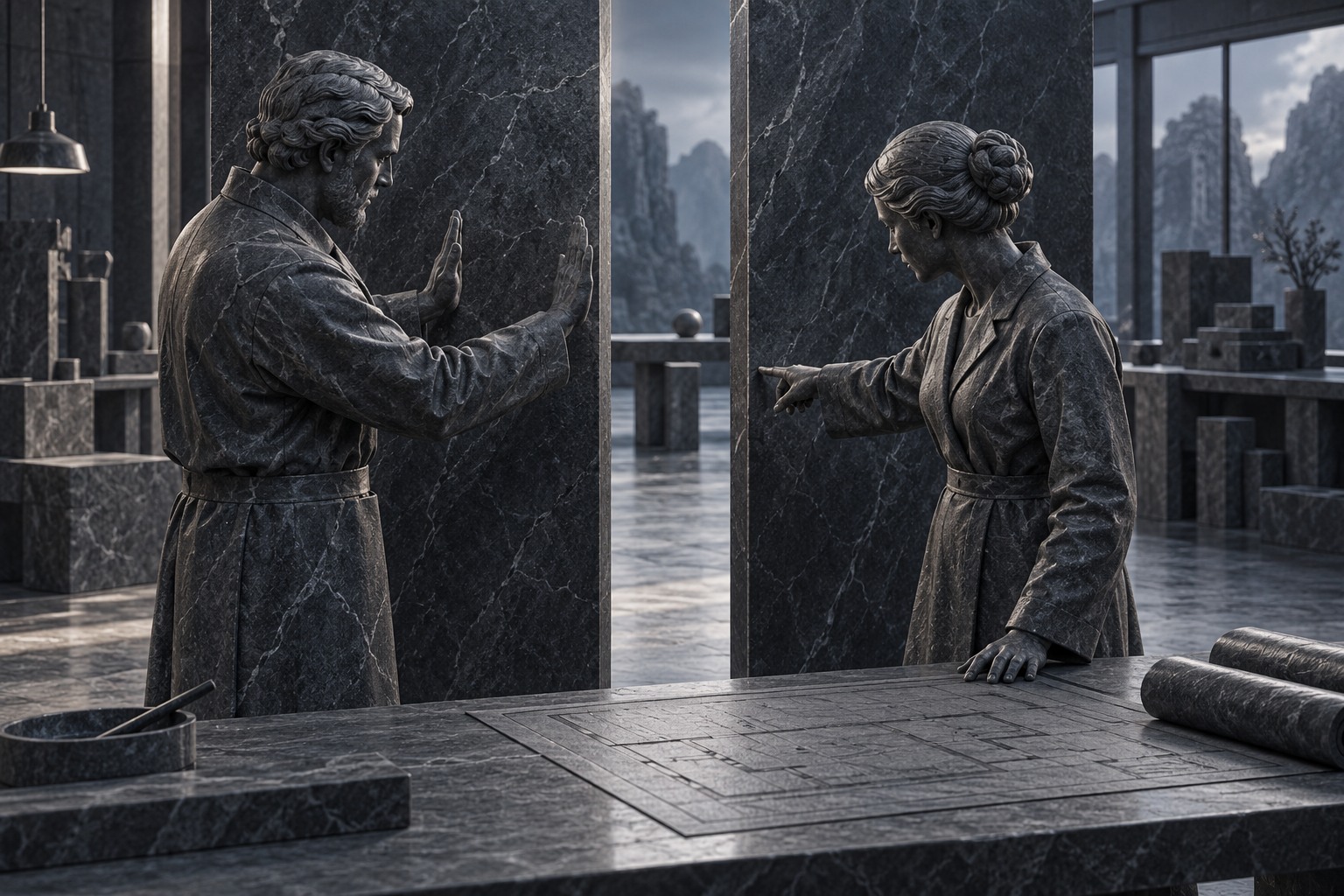
When someone explains a layout of partitions, two palms may indicate a passage before the words specify it. A listener sees movement but does not yet know whether it shows an available route, required width, or installation sequence. Meaning depends on the explanation and the subject being discussed. We will examine how gesture can participate in constructing that meaning, why movement alone does not certify a thought, and what two particular studies of mathematical explanation establish. Their outcome concerns recalling an unrelated list during explanation, rather than general intelligence or every form of conversation. A historical passage by James raises a different question about representation and action in the description of experience. We then return to the partitions to distinguish the convenience of showing, the proposal’s content, and checking whether it is correct. These are separate tasks, each requiring its own identifiable result.
I. Two palms and several possible meanings
Consider an original scene: two people discuss a temporary partition in a workshop. One holds both palms upright and says, ‘We need to leave space here.’ The movement can suggest a gap between boundaries, but ‘here’ and ‘space’ identify neither a plan location nor an acceptable dimension. The other person might take the palms to represent walls, cabinet edges, or successive positions of one panel. That ambiguity does not make the gesture useless: it proposes a relationship that can now be clarified. To assess the proposal, they must connect the showing to one object, a question, and an available diagram. This scene is invented for analysis, rather than an observation registered in a study.
The speaker now specifies that the left palm stands for the existing wall and the right for the proposed partition. Speech selects among earlier possibilities, while the hands temporarily maintain two roles. Moving the right palm away can show a wider passage. Yet centimetres do not appear automatically: conversational hand separation may be schematic, whereas the plan has another scale. A decision needs a separately recorded dimension. Preserve the gesture’s usefulness without assigning it the work of a measuring instrument. Even an intelligible movement conveys only the distinctions the participants have established. Other properties of the construction remain available for other questions, measurements, and choices about the proposal.
The example separates movement, its proposed meaning, and a claim about the object. Upright palms are observable action. ‘This palm represents the wall’ explains the action’s use here. ‘The passage suits the selected equipment’ is a claim requiring dimensions of both equipment and passage. A compelling demonstration does not prove a connection among all three levels. We can understand a proposal accurately and find it unworkable, or view a correct plan without understanding which portion is indicated. The distinction directs discussion toward the thought’s object and grounds, rather than guessing a speaker’s character or concealed confidence from the speed or breadth of hand movements.
II. Showing a relation and identifying an object
Pointing to a plan location answers ‘where’, but may not answer ‘what should be done’. A finger tracing a boundary can select a region, show a route, or recall an existing obstruction. Those uses differ through the words and purpose accompanying the movement. In our scene, a useful next step is to name the object: ‘This rectangle is already installed; the new one goes here.’ Gesture acquires an anchor in the diagram, and the diagram becomes the conversation’s temporary focus. If participants see different plan versions, the same ‘here’ can refer to different locations. A dispute about the hand’s meaning can then conceal a simpler difference in the documents available.
Showing a relation need not resemble the object precisely. A palm does not look like an actual wall, and movement between two points does not reproduce a worker’s route to scale. Explanation may need only the relevant distinction: existing and proposed, nearer and farther, first and next. Yet schematic representation requires caution in inference. An extended hand does not carry one fixed meaning for every person and situation. In this example, speech and a plan support its interpretation; elsewhere, the same posture may serve another purpose. Understanding the thought means establishing which relationship is shown now, rather than consulting a universal gesture dictionary as though the meaning had already been read before the conversation.
Hands can indicate several objects at once, but their number is also schematic. Two fingers may select two quantities, the space between them, or one transition’s direction. To avoid imposing an interpretation, return the understood relationship in words: ‘You propose moving this panel while retaining the other?’ The reply provides grounds to refine the proposal; silence need not confirm it. The question concerns a shared object and permits correction, rather than turning movement into a sincerity test. We need not interrupt every gesture in every conversation. It is enough to distinguish provisional understanding that works for now from a decision for which a possible misunderstanding has material consequences.
III. What a mathematical explanation experiment measured
Goldin-Meadow, Nusbaum, Kelly, and Wagner’s 2001 study initially tested forty children and thirty-six adults. Analysis included only those who gestured when permitted: twenty-six children and thirty-two college-age adults. Participants solved a mathematics problem, received an unrelated list, explained the solution, and recalled the list. Children received words and adults letters; hands were either unconstrained or required to remain still on the table. The authors reported better list recall with gesture. This is an outcome of a particular combination of explanation and retaining words or letters in selected participants. It is not a measurement of a general ability to think with the body, nor a comparison of every available way of explaining.
Separate comparisons found a difference for longer lists but not shorter ones; the list-length interaction itself was not significant. That does not establish a benefit for every movement or difficulty level. Discussion proposes competing mechanisms, while the experiment directly measured no brain processes. Explanations did not become shorter with gesture, so the authors examined and rejected a simple account based on shorter retention time. Nevertheless, recalling an unrelated list and having a correct mathematical idea are different outcomes. This study cannot supply our scene with a proportion of correct designs, a universal rule for hand behaviour, or evidence that demonstration eliminates calculation errors in a construction proposal.
Why does the outcome distinction matter? In the workshop, someone could retain an order number easily while indicating panel locations, yet propose a passage of the wrong width. That is a logically possible situation in our invented example. The list and the construction impose different requirements: recall the first, reconcile the second with dimensions and intended use. Calling every convenience ‘better thinking’ removes the question of what improved and how it was established. Substantive reading preserves the experiment’s measured object. It permits discussion of gesture’s possible role in explanation while retaining the need to assess the explained thought. It also supplies no grounds to classify people as capable or incapable according to whether their hands move.
IV. Movement’s meaning was compared separately
Cook, Yip, and Goldin-Meadow’s subsequent paper analysed 115 college students. While explaining polynomial factoring, they retained six consonants presented for two and a half seconds. Meaningful gesture, circular hand movement, and stillness were compared; each participant completed two of the three conditions, rather than all three. Main analysis favoured meaningful gesture for letter recall. Eighteen percent of trials were excluded, with the authors reporting the same overall pattern when retained. Some supplementary analyses yielded weaker contrasts with circular movement. These two papers belong to one research line, so they should not be presented as independent confirmation by different laboratories. Neither directly tests the workshop conversation invented here.
The authors expressly leave the mechanism open. Linking movement with meaning does not identify one explanation of the advantage. Their gestures primarily pointed to visible elements of the written task. Recall performance neither proves that any movement improves memory nor that hands literally contain a completed thought. Speech measures also differed from recall: circular movements involved fewer particular filled pauses without the same list advantage. Smooth explanation and retaining unrelated information therefore cannot be treated as one scale. Name the outcome before deciding what the action helped with and whether the claim transfers to another subject. These distinctions preserve the finding’s significance without expanding it into an all-purpose prescription for bodily activity.
For the partition discussion, the comparison suggests a question rather than a ready instruction: does the showing relate to the content being explained? A speaker might slowly indicate a wider passage or quickly move their hands in circles while talking. In our scene, the first proposes a relation to the plan; the second does not specify that relation by itself. We promise no measured advantage of the first for every interlocutor. If movement distracts or is unavailable, words and a diagram can identify the content. Research on one comparison obliges nobody to explain in a single manner. Establish what relationship can be discussed and checked, rather than requiring hand activity as evidence of understanding.
V. A historical view of representation and action
In his chapter on will, James discusses action following representation without a separately experienced decision, and other representations delaying it. The epigraph comes from that argument: he acknowledges many ideas that do not lead to action. We read the selected passage as a historical question about experiencing action, rather than a contemporary test of explanatory gesture. It includes physiological conjectures of its period. Mentioning movement does not turn those conjectures into data from the later experiments. Comparison is useful when its different tasks survive: describing an experienced transition to action and experimentally comparing list recall under specified conditions of explanation. Neither task automatically completes the other or validates its entire theoretical account.
Before describing decision types, James warns that this is an introspective account of symptoms and phenomena, postponing causal agency. That qualification supplies our key quotation. It helps distinguish a person’s accessible description from an established mechanism. In our scene, the speaker may notice that movement makes the wall–panel distinction easier to retain. The report matters when choosing a convenient explanatory method, but measures no nervous-system activity and guarantees no benefit to another person. Preserve its form: someone reports their experience in this conversation. A causal mechanism requires grounds beyond the mere existence of that report. The historical warning is used for this distinction, rather than as proof of one contemporary explanation of gesture.
An idea may also exist without visible demonstration. Someone can specify dimensions in a note, while moving palms can accompany an indeterminate proposal. Absence of gesture therefore certifies no absence of thought, and presence certifies no completed understanding. The epigraph does not excuse declining to act; it preserves the distinction between representation and observable outcome. An agreement to move the panel must be checked against the plan and actual execution, rather than the expressiveness of its demonstration. This reading leaves the historical author his own question and returns our conversation to a concrete check. It extracts no complete answer about free will, character, or an action’s inevitability from one paragraph.
VI. Space, sequence, and change
While two palms remain still, they may represent two panels’ locations. When one follows the other, the demonstration can shift to installation order. The plan contains the same objects, but the question has changed. ‘This first, that next’ describes sequence rather than final passage width. If the transition goes unnoticed, one participant may discuss allowable distances while the other discusses access to fastenings. Their answers can differ although each understood part of the showing correctly. Naming the change helps: ‘I am showing order now, not size.’ The explanation then identifies which feature needs to be retained and which distinction has temporarily been left outside its current purpose.
Sequence also need not prove that one order is necessary. Suppose our proposed first panel leaves access to a corner. Assessing the proposal requires knowing which fastenings occupy that corner and whether another route reaches them. Gesture can represent the chosen sequence precisely without explaining its grounds. Comparing two sequences on a diagram can reveal a useful question, but cannot answer it instead of examining the construction. In this scene, the proposal’s form can become clear before its justification. Clarity makes checking possible; it does not make checking unnecessary or turn the listener’s agreement into a property of the actual object being discussed.
Showing change can easily be taken as reporting an existing state. The speaker moves a palm away to propose a wider passage; the listener thinks they are being told its present width. Resolving that particular mismatch requires status words: ‘I propose’, ‘already installed’, ‘not measured yet’. They do not merely repeat movement; they add a distinction it may not express. The current and proposed states can then be recorded separately. Our analysis uses that record to preserve content, without claiming a proven memory-improvement technique. It supports returning to the question after the hands cease to maintain their temporary diagram and discussion turns to execution.
VII. Explanatory convenience and a solution’s correctness
If conversation becomes easier, acknowledge that change without attaching other achievements to it. The participants finally identify the panel under discussion, removing an earlier ambiguity. Yet a useful pointing gesture completes no load calculation, passage specification, or installation check. Convenience here concerns access to the conversational object; correctness concerns whether the proposed action meets construction requirements. If the panel later needs another position, the earlier explanation’s clarity does not become deception. A proposal can be clear and mistaken. Correcting it means changing the content while retaining clarity about what is discussed, rather than abandoning every demonstration or judging the speaker by the proposal’s expressiveness.
The reverse is also possible: a correct solution is explained awkwardly. Someone states the required dimensions but mixes existing and proposed partitions in the diagram. The listener can clarify symbols before assessing dimensions, instead of rejecting the entire thought because its demonstration was confusing. This requires no faith in unsupported claims. Separating doubts selects an appropriate check for each. Ask what a palm denotes; obtain an actual width from measurement or a reliable document. Neither answer replaces the other. Conversation becomes more specific: which claim needs confirmation before the decision can be used? The question provides a more useful basis for action than deciding who appears more competent or composed.
The list-recall finding preserves another distinction. Retaining unrelated letters during explanation, communicating a proposal intelligibly to a listener, and later independently solving a new problem are three different outcomes. The last needs its own evidence; it is not the finding summarised here from these papers. Gesture should not be declared a ready educational method merely because one comparison yielded more recalled letters. Our example can examine whether participants understood the current plan, but that also proves no transfer to another object. Keeping the distinctions makes a possible success more precise. A boundary does not devalue the particular result actually obtained; it prevents replacing that result with another that has yet to be established.
VIII. When showing needs clarification
Speech and hands can propose different relationships. Someone says, ‘Leave it as it was’, while moving a palm. That warrants clarification of the current version, rather than establishing a lie or inner conflict. They may be showing an earlier installation movement, or may have changed the proposal before changing the words. These remain possibilities in our scene until the speaker explains the showing. ‘Are you indicating the current passage or proposing another one?’ preserves correction and concerns the decision. The observer acquires no power to read thought directly from movement, and coordinating two representations requires no psychological assessment of the person producing them or speculation about a concealed motive.
A listener seeing only a movement’s end may understand a different part of the sequence. Repeating with a named starting point can address that mismatch: ‘First this panel is here, then here.’ Repetition need not copy the original form exactly; a diagram arrow or two sketches can replace it. Our conversation’s criterion is access to the required relationship, rather than fidelity to one outward explanatory form. Marking the initial and proposed states can preserve meaning after discussion. This is an original way to clarify an invented case, not a universal instruction or a report of a tested gesture intervention for long-term learning or the quality of every shared decision.
Sometimes the clarification concerns a boundary of confidence rather than the object. A participant says, ‘This will be convenient’, having shown only that panels can fit. Another takes ‘convenient’ to mean safe access; a third thinks of easy cleaning. Gesture selects no evaluation criterion on their behalf. Name the criterion separately when the decision depends on it. The diagram can then answer one question while another remains open. Cleaning convenience requires a different examination from fastening access. One explanation need not prove every conceivable property. Identify requirements that actually matter and seek grounds for them, instead of accepting a generally positive word as the answer to each specific question.
IX. The form of expression remains a choice
Neither study creates an obligation to move one’s hands. Researchers specified conditions for a particular task. In conversation, explanatory form can be selected according to accessibility, subject, and participants’ preferences. If showing with palms is uncomfortable, dimensions on a diagram remain substantive. If someone prefers indicating direction, there is no automatic need for a lengthy verbal account of every visible transition. Assess whether the content is sufficiently represented for the current purpose. This promises no equal measured outcome for every method. It preserves choice and distinguishes a conversation’s task from experimental conditions, rather than converting a published comparison into a mandatory rule about how people must behave.
Hand movement accompanying speech should not be called a complete language merely because it conveys meaning. In our scene, understanding depends on temporary symbols and a jointly selected plan. An account of an independent sign language would require another subject and sources. We do not transfer findings from speaking college students to its users or replace a language with expressive poses. This is a consequential boundary for the analogy. Hands can participate in different forms of expression, but sharing a body part does not give those forms one structure. A meaningful comparison names the specific action, content, and conditions rather than merging them under one impressive label or presuming identical results.
Stillness can also be a convenient way to listen or explain. In our scene, one participant prefers examining the diagram to following hands. Asking for a dimension does not mean refusing to understand; it changes the available way of checking. If another needs a directional demonstration, it can be included. Neither possibility requires assessing temperament or the interlocutor’s condition. A preference remains information about this conversation until grounds support another conclusion. Respect for expression thus connects with attention to the object: choose a form permitting discussion of the required relationship, without making one person’s convenience a demand on everyone or an outward sign of the ability to think.
X. Thought returns to its object
Our conversation can end with a clear proposal: move the new partition, preserve a specified width, and install panels in an agreed order. Hands helped indicate relationships in the invented scene; words and a record clarified which ones participants accepted. Feasibility still depends on the construction and its requirements. An unknown dimension can remain identified as unknown instead of ending discussion with one persuasive demonstration. The thought is substantive because the proposal admits questions and revision. Outward expressiveness may accompany that process, yet its result resides in a specified object, its grounds, and a named boundary of the checking already completed. This boundary remains relevant when the proposal is put to use.
The experiments add bounded empirical content to this analysis. Under their list-retention and explanation conditions, meaningful gesture accompanied better recall, while simple movement was no equivalent replacement in the second main comparison. Sampling and supplementary-analysis limitations remain part of the claim. The historical text adds another way of asking about representation and action while distinguishing introspection from causal explanation. None supplies a ready solution for the partition. They preserve questions otherwise easily merged: movement, meaning, measured outcome, personal description, and the proposal’s correctness. Sources with different roles make the comparison substantive without turning it into one comprehensive doctrine, a universal explanation, or an obligatory technique for every reader.
The reader can examine their understanding without assessing personality. Which object is identified? Which relationship is shown? What is proposed, and what reports something already done? What grounds can support the decision? These questions require neither prohibiting nor increasing gesture. They permit a convenient form, preservation of substantive results, and clarification of doubts where those doubts affect the work. A personal impression can remain identified as such; a needed dimension requires a dimension. Precision does not diminish the thought. It gives another person an object they can work with, agree about, challenge, or revise, while retaining the difference between an expressive explanation and evidence that its proposed action is suitable.
What this means in practice
If you wish to examine such a case, choose a simple task without important consequences: placing two boxes on a shelf or describing a sequence using a paper diagram. You may move your hands, draw, or use words alone. First identify one object and one question. Are you discussing the current arrangement or proposing a new one? If movement occurs, note what it represented: an object, gap, direction, or sequence. Its force, speed, or elegance need not be assessed. The observation aims to preserve content you meant to express, rather than infer a characteristic of your thinking. Choose another form immediately if this one is uncomfortable, and keep the observation brief.
Next, express the same proposal in one or two sentences or two small drawings. Compare whether the relevant relationship survives, and name any difference. Perhaps movement showed sequence while the sentence described only the final arrangement; perhaps ‘here’ had no definite anchor. With a willing interlocutor, you can ask what proposal they understood and clarify a mismatch. Their response measures no intelligence, and easier conversation proves no general exercise benefit. Without a listener, your own record is sufficient. Separately identify what is known, proposed, and unverified, so the result does not depend on reproducing the original gesture later. The aim is a usable description whose boundaries are visible, rather than a performance judged against someone else’s preferred style.
Finally, select one check concerning the object itself. For a box position, this might be available space; for an action sequence, whether the next step can follow the preceding one. Record an unperformed check as unperformed. There is no need to turn the observation into a letter-memory test: that belonged to another procedure in particular studies. This original practice asks a question about an ordinary explanation, promising no improvement in memory, learning, or all problem solving. End after one clarification or skip it. Its substantive result distinguishes what was shown, what was understood, and what was established about the proposal, preserving each uncertain part rather than declaring complete understanding from one fluent demonstration.
Key quotation
this is only an introspective account of symptoms and phenomena.
William James, The Principles of Psychology, II, XXVI, printed p. 529, paragraph beginning ‘The decision may come…’: warning clause beginning ‘this is only…’, terminal period added.
Connections between traditions
| Grounding | Comparison here | Boundary |
|---|---|---|
| James, II, XXVI, p. 525 | Representation and transition to observable action | Historical description verifies no contemporary gesture mechanism |
| James, II, XXVI, p. 529 | Personal description and causal explanation | The introspective warning does not replace measurement |
| Goldin-Meadow et al., 2001, methods and results | Task explanation and recall of an unrelated list | Selected sample, different child/adult tasks; not general intelligence |
| Cook, Yip, Goldin-Meadow, 2011/2012, methods and results | Meaningful gesture, circular movement, and stillness | Each participant completed two conditions; supplementary contrasts weaker than main analysis |
| Their mechanism discussion and our example | An accessible relationship, possible mechanism, and correctness | Mechanism open; scene and practice original, not a tested intervention |
Primary sources
- William James. The Principles of Psychology, II, XXVI, Will, 1890: selected pp. 522–530; quotations pp. 525 and 529. Historical English text, own Russian translations.
- Susan Goldin-Meadow, Howard Nusbaum, Spencer D. Kelly, Susan Wagner. Explaining Math: Gesturing Lightens the Load, Psychological Science 12(6), 516–522, 2001. DOI: 10.1111/1467-9280.00395. Main text read; bounded list-recall comparison used, no illustrations reproduced.
- Susan Wagner Cook, Terina Kuangyi Yip, Susan Goldin-Meadow. Gestures, but not meaningless movements, lighten working memory load when explaining math, author-hosted 2011 online version; Language and Cognitive Processes 27(4), 594–610, 2012. DOI: 10.1080/01690965.2011.567074. Methods, results, discussion; meaningful indications of the task, rather than every movement.
Tags
gesture, movement, thought, understanding, explanation, speech, meaning, representation, action, James, GoldinMeadow, Cook, Yip, workingMemory, list, recall, mathematics, pointing, space, sequence, diagram, proposal, measurement, grounds, checking, boundaries, introspection, accessibility, choice, UnitedWisdom
About the authors
Andrey Zarinsh is the author and founder of United Wisdom. He explores inner transformation, the unity of traditions, intercultural dialogue, and contemporary spiritual discipline. Instagram: @andrey.zarinsh.
Maria Evilkut is a co-author of United Wisdom. Alongside her research, she seeks to test these ideas in practice and observe how principles of unity and mutual understanding work in real life between people and cultures. Instagram: @ilkutki.
Keep what resonates with you.