
World & consciousness
Sleep, Wakefulness, and the Boundaries of Awareness
Distinguishing sleep stages, available accounts, and interpretation through a blinded test and a historical religious text.
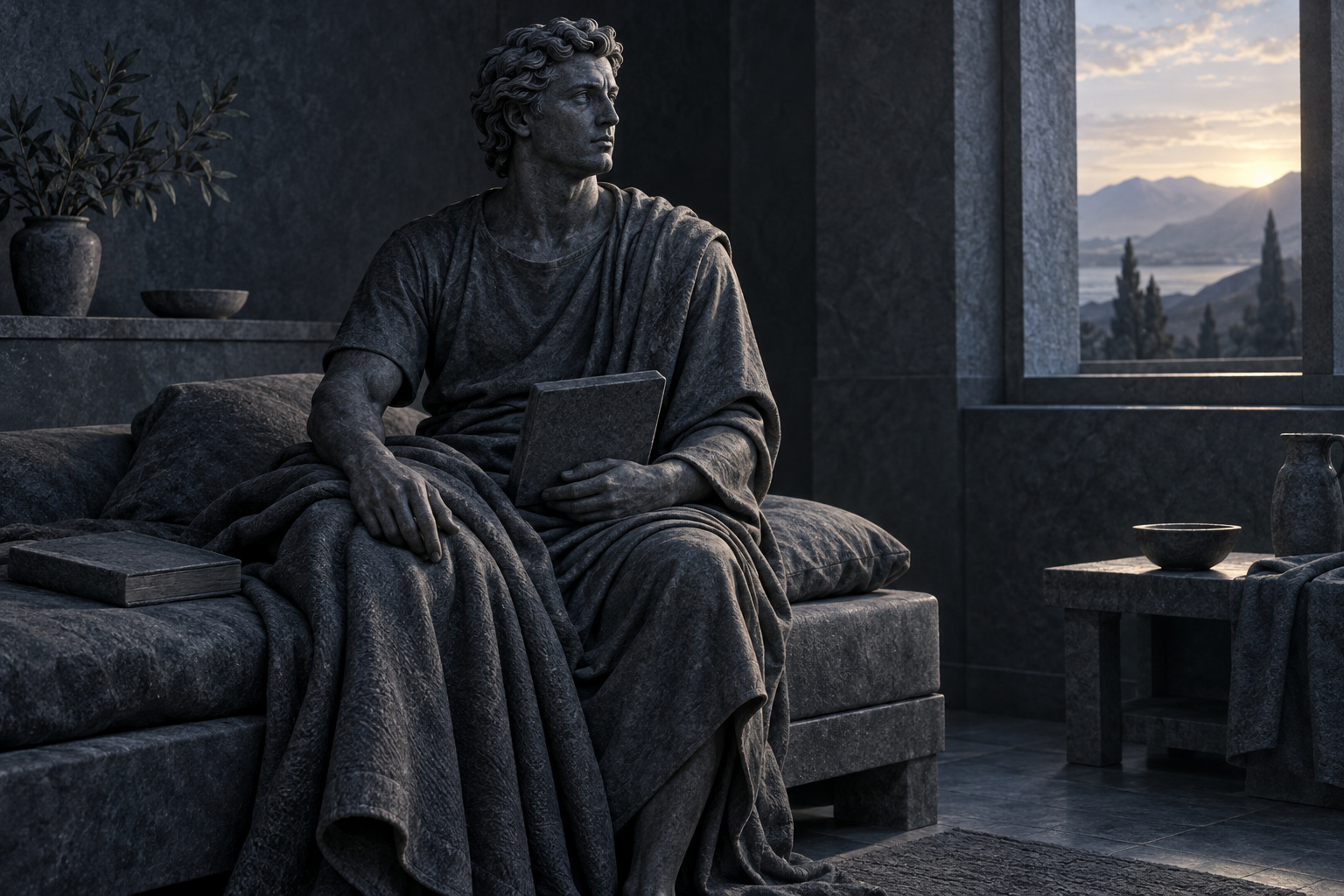
Epigraph
Learn from me the true nature of sleep (svapna).
— Chāndogya Upanishad, VI.8.1, a complete sentence in F. Max Müller's English translation, 1879. An invitation within a religious dialogue, it neither names a modern physiological classification nor instructs readers to change their sleep. United Wisdom translated it into Russian.
What this article is about
In the morning, someone may say “I dreamed nothing,” “Something happened, but I cannot remember,” or “I remember a dream.” These statements distinguish the available account without providing a continuous record of nighttime experience. Sleep research adds other grounds: signal recording, stage scoring, interviews, and tests of prediction. A religious text may ask about sleep as a person's relationship with the Self. Here we preserve the differences among these questions. We read a particular blinded Dream Catcher test, a bounded discussion of meditation reports, and a Chāndogya Upanishad dialogue. We ask what an absent memory permits us to say, why a sleep stage cannot replace an experiential account, and how an unsuccessful scientific prediction should be understood. The practice concerns an existing record. It requires no nighttime awakenings, shortened sleep, unusual state, or acceptance of a memory as proof of an external event.
I. “I do not remember” and “nothing happened” ask different questions
Begin with what someone can say now. “I do not remember” concerns a memory's availability. “Nothing happened” asserts an absence of an event or experience. Ordinary conversation sometimes interchanges these phrases without much inconvenience. Consciousness research changes its subject when making that substitution. We distinguish them as reading questions rather than a reason to doubt every morning statement. People can speak habitually; researchers and readers need to identify what inference they build upon the report and how broad it is. That additional responsibility belongs to the inference, not automatically to the speaker.
In a fictional example, someone records in the morning: “I remember only feeling that something was happening.” A day later they describe a conversation with a friend. A new element has appeared between the records. The example does not establish whether it was recalled, inferred, or prompted by later discussion. An accurate record preserves both formulations and when they appeared. It does not automatically declare the later detail false. Its narrower purpose is to show what was available at different moments so that a present conclusion does not masquerade as an original continuous recording.
Dream Catcher distinguished reports of no experience, a sense of experience without recalled content, uncertainty, and dreaming. For the selected test, its authors retained the first and last categories. This matters: intermediate cases remained part of human sleep while being excluded from this particular analysis. A model's binary answer must be read alongside the admitted reports. Requiring records to be sorted into two groups cannot provide a map of every possible nighttime state. The categories arise through a procedure whose selection needs to remain visible when the result is interpreted.
The authors also consider whether an absence of dream reporting might reflect difficulty recalling experience rather than its absence. They do not establish continuous consciousness. While research relies on recollection, distinguishing these possibilities remains problematic. We retain that open question. It permits neither adding hidden nighttime content to someone's account nor declaring every gap full of experience. An available report's limit matters because it prevents silence from becoming a final answer and prevents an unwarranted story from filling the silence. Both conclusions would go beyond what has actually been reported.
II. A sleep stage and an account of sleep
Dream Catcher used recordings scored as NREM Stages 2 and 3 alongside participants' subsequent reports. The procedure connects these grounds without making them simple synonyms. A stage characterizes a recording through an accepted system of features. An account tells what someone could describe after awakening. When a person says “deep,” they may mean a subjective impression; research scoring has its own meaning. Before comparison, identify the ground behind the word in each statement and who established it. The same label cannot silently transfer one kind of evidence into another.
The authors selected minute-long recordings before awakenings, balancing stage proportions between report categories. They aimed to avoid confusing differences between reports with differences in selected sleep depth. This control is neither perfect nor direct mind-reading. It does show how a question becomes testable: specify the material, the comparison, and a possible confound. Readers benefit from seeing these decisions before the result. Successful or unsuccessful prediction then concerns a defined task rather than the entirety of nighttime experience. A procedure's choices help explain both its usefulness and the limits of its conclusions.
Consider our analogy with a music recording. An archivist notes duration and loudness; a listener describes a mood. Both records may concern one sound, but a loudness measurement does not automatically translate into a specific emotion. This analogy explains no sleep physiology and does not equate brain signals with sound. It clarifies different subjects: measured features and available descriptions require a rule connecting them. The rule needs testing rather than being treated as ready-made because both kinds of data appear together in a single study. Shared timing alone does not complete the inference.
The distinction matters when a popular account calls something an “unconscious stage.” A stage's name alone is insufficient to establish absence of experience. These authors tested classification through specified reports and discussed that reliance's limits. We offer no opposite formula declaring every stage conscious. Instead, retain concrete work: what was scored, what was reported, how they were compared, and what uncertainty the procedure leaves. A sleep map becomes an object of inquiry without a promise to settle every question about awareness beforehand. Its terms remain connected to their actual grounds.
III. What was tested blind?
Dream Catcher divided work between two teams. One collected recordings and accounts; the other analysed signals with restricted report information. Initially, the Analysis Team lacked the corresponding labels. Later steps provided information about pairs, participants, and condition groups. These were five levels of disclosure rather than five independent large studies. Separation allowed the proposed analysis to predict a report category without knowing the answer in advance. It did not remove every limitation of sampling or recording. A test's blindness concerns specified information, rather than a general guarantee that no uncertainty remains.
The final set contained nine participants and 54 minute-long segments: three dreaming and three non-dreaming reports per person. Participants came from volunteers. Some did not continue after adaptation because of laboratory sleeping difficulties, unclear reports, or artefacts. Another participant who reported no NREM dreams was omitted from this test. These decisions belong beside the numbers. Fifty-four recordings do not mean fifty-four independent people or permit a calculation of dream prevalence among all sleepers. Their value lies in providing selected material for a defined comparison, with its recruitment and exclusions stated.
The analysis also included only particular static early-night dreams, assigned to a category by two agreeing raters. This reduced some material differences while narrowing coverage. Researchers must choose which task they address. Readers can ask which other cases remain untested. Conclusions cannot move without qualifications to all sleep, complex changing accounts, or every age group. A limited set can help test a method while remaining insufficient for a general description of a person across an entire night. Its deliberate selection is both part of the method and part of its boundary.
In our example, an examiner tests whether a sorter can distinguish two document types with their names hidden. Hiding names makes the task more informative without guaranteeing that the documents represent a whole archive. Similarly, blinded analysis answers a particular prediction question. Its value includes the opportunity to encounter unsupported expectations. The outcome cannot become an assessment of participants' sincerity or a declaration that every account is finally explained. The procedure needs to specify what information was hidden and what counted as success before wider significance can be discussed responsibly.
IV. An unsuccessful prediction has its own scope
At no level did classification significantly exceed chance. The best proportion correct was 59 percent, with the paper reporting p = 0.44. These figures concern this set and procedure; they are not the probability that brains participate in dreaming. The question must remain the same after the result. This study could not reliably sort selected recordings into report categories through its proposed approach. That statement already matters: it exposes a limit of the method's applicability without a final philosophical conclusion. A meaningful unsuccessful test needs neither concealment nor exaggeration to become useful.
The discussion identifies a small sample, possible noise, and measurement differences from comparator studies. The researchers had fewer channels than one cited high-density approach, and selecting static dreams altered the comparison's subject. These are possible explanations rather than demonstrated causes of every error. We did not examine those other studies' primary data or reproduce their computations. Here it is sufficient to read Dream Catcher's own result accurately and retain the limitations accompanying the authors' possible explanations. Their discussion remains a set of qualified possibilities rather than a substitute for further testing.
The distinction between “this method did not obtain the desired result” and “the relationship exists nowhere” is particularly important. The second claim is much broader and needs grounds a small analysis cannot supply. An unsuccessful test should remain visible, but its scope cannot expand for dramatic effect. Similarly, a future predictive success would not automatically explain all consciousness. Accuracy works in both directions: support and lack of support belong to a particular subject, procedures, and the differences actually illuminated. Neither outcome receives unlimited reach merely because the question interests us deeply.
Our everyday reading question is therefore: “What exactly could not be determined?” In an invented retelling, a headline declares “Sleep explained” or “Science cannot explain sleep.” Readers can return to the classification task and replace the headline with a narrower statement. This restores the result's reach rather than changing it according to taste. Research retains room for a significant failure, and testimony remains available for further investigation. No final metaphysics is required to acknowledge which prediction was insufficiently reliable here. Precision can preserve the outcome without demanding that it resolve every surrounding dispute.
V. What sleep means in a religious dialogue
VI.8 of the Chāndogya Upanishad asks about sleep while teaching Śvetaketu. Müller's translation connects it with returning to one's own and union with Sat; the dialogue develops a teaching about existence's basis. This question differs from analysing pre-awakening signals. We read the entire selected passage and notes while preserving its genre. A religious proposition becomes no experimental result through proximity to contemporary research. Equally, lack of laboratory verification does not turn the text into a meaningless statement about a wrongly classified sleep stage. It asks and answers within a particular teaching.
Müller's note to VI.8.1 discusses deep sushupta sleep and its relation to the Self. This is translation and commentary, distinct from the literal dialogue. Another note offers readings of prāṇa as Sat or breath. Here, those alternatives become no instruction to breathe in a particular way. They show why a historical word has an interpretive context. Modern NREM scoring is not a dictionary that automatically chooses the only correct translation of every such concept and confirms all associated propositions. Reading requires identifying which layer of the edition supplies each interpretation.
The tethered-bird comparison in VI.8.2 explains the mind's return within this teaching. We do not present the image as a contemporary nervous-system model. Analogy proposes a relationship and belongs with the text's question. Readers can ask why sleep prompts discussion of what someone regards as their own and foundational. This philosophical and religious question remains separate. Connecting it to today's account requires naming an interpretive step rather than retrospectively assigning a modern record to the ancient source. The connection may be meaningful while still requiring an explanation of how it is made.
A substantive comparison emerges. The laboratory procedure asks whether signals can predict a specified account. The religious dialogue offers an understanding of sleep through the Self and Sat. They touch through sleep without sharing one verification process. Readers can investigate both without manufacturing agreement. Preserving difference makes a more precise connection possible: what proposition is offered, what meaning is given to it, and what additional grounds are needed when it extends beyond the teaching itself? These questions permit comparison without making either source responsible for an inquiry it did not undertake.
VI. Reporting awareness in sleep and checking it
MPE-92M includes discussion of reports of awareness in sleep. The authors identify a direction for further investigation if the finding is replicated. These retrospective answers cannot become a completed polysomnographic verification of every reported state. The survey measured no sleep stage directly during the described episode. This marks a substantial boundary between contemporary grounds: a response map and a laboratory recording address different tasks. Their proximity can pose a question without producing a missing result or automatically establishing the physiological timing of someone's remembered experience. The proposed connection remains available for future work.
MPE-92M's qualifications about memory and reporting illuminate this boundary. The authors consider cases in which a later description differs from what could be reported during the state itself. No ready-made method recovers everything experienced. Instead, the question concerns what researchers can extract from an answer. Sleep makes this especially clear: a morning statement belongs to a moment when someone can tell an account. Respect it as available material without turning it into a continuous recording of every change in awareness throughout the night. That distinction limits inference without dismissing the speaker.
In an imagined example, someone says “I knew I was asleep” without specifying when they formulated that knowledge. They may mean the experience, a later inference, or its present name. Clarification must not pressure them to find a more convincing story. Ask about available wording and retain uncertainty. This is our reading task rather than a diagnostic interview. It reveals possible relationships between a statement and its timing without choosing one through an attractive label or creating details through questions on the speaker's behalf. They remain free to leave the account incomplete.
Comparison with VI.8 preserves another difference. A teaching about returning to the Self is not a particular person's claim to have been aware of sleeping. The first carries religious content within its text; the second requires understanding a report's subject. Readers may use the teaching for personal interpretation while naming that choice. Researchers may clarify descriptions without promising that a questionnaire confirms the Self. Each ground retains its value: the text its meaning, the report its available content, and the procedure the question for which it was actually prepared and conducted.
VII. Confidence after awakening
A clear account can remain a limited account. Someone confidently remembers a scene, but confidence does not replace evidence of its external existence. Dreaming a conversation does not establish that another person actually said those words through vivid memory alone. We apply this logical limit to reading rather than evaluating any particular study participant. Preserve it especially when a dream becomes grounds for accusation, promises, or decisions on another's behalf. An external-event claim needs other appropriate grounds. Personal significance and the factual status of a conversation must remain separately discussable.
Dream Catcher's intermediate categories remind us why confidence and content cannot collapse onto one scale. Someone may feel they experienced something without an available scene. They may hesitate over naming a surviving fragment. Those reports were not analysed as one of the test's two final groups. We therefore propose no classification of every reader into those groups. The narrower procedural lesson is to identify how uncertainty was represented or excluded before discussing a conclusion as though it had already been explained. A selection's clarity should not erase the cases outside it.
In our example, a morning record contains “I remember a room” and “I am unsure whose voice it was.” Later, someone encounters a similar story and identifies the voice as familiar. Keeping the new entry alongside the old one makes the new confidence's source visible. This is neither exposure of deception nor memory recovery. It makes current reasoning more transparent. A question concerning someone else cannot be settled through the resemblance alone. The account may have personal meaning while its external assertion remains insufficiently supported and requires a different kind of check.
Uncertainty gives readers no authority to tell a speaker what they “really” dreamed. Questions and distinctions can be offered; wording remains the person's choice. They may seek no final explanation and disclose no private record. Careful retelling cannot be promised to eliminate every confusion. Its limited value here is the opportunity to see what is known, supposed, or left open. An absent answer should become no evaluation of someone's maturity, sincerity, or worth. These reading limits preserve both the account's ownership and the possibility of considering its content accurately.
VIII. Discussing sleep without interfering with it
The study's awakening procedure becomes no homework here. We propose neither reproducing it, interrupting ordinary sleep, nor obtaining a desired experience category. Scientific description and reader advice are different actions. One reports what researchers did under specified conditions; the other needs separate grounds and responsibility. Our purpose requires only a published text or existing record. Questions about knowledge can then be discussed while preserving ordinary rhythms rather than turning interest in consciousness into an obligation to produce new states. Learning how research was conducted does not require participating in its procedures at home.
When someone chooses to share an account, a conversation can begin with their purpose. Do they want to describe a scene, discuss a word, or compare a source? These tasks need different detail. In a fictional conversation, one person appreciates an image while the listener immediately searches for a prediction. Clarifying the purpose restores an available subject. Respect requires no acceptance of the offered interpretation, and speakers need not continue for someone else's curiosity. Consent concerns the present conversation separately from its unusual topic. Both participants can choose how far the discussion goes.
Identify decisions' boundaries too. In a fictional situation, a person wants to change a shared agreement because of a remembered nighttime scene. They can express their feeling and propose discussing the arrangement. The scene itself cannot establish that someone already agreed, broke a promise, or must act differently. A shared change needs ordinary available grounds and renewed agreement. This is our contemporary reasoning rather than a rule proved in the laboratory or literally prescribed in the Upanishad. Preserving its source boundary keeps responsibility with decisions concerning real people and their present relationships.
Reading this topic requires neither diagnosis nor spiritual assessment of every episode. An unusual account alone cannot establish what support a particular person needs. This article makes no such assessment and proposes no change to existing support. It distinguishes questions and sources when someone voluntarily considers a record's significance. Conversation may end at a clear limit: “I hear that this matters; we do not yet know what external inference it supports.” This is no finding about the brain, but a possible formulation for respectful communication that participants can accept or revise by choice.
IX. Different grounds make a boundary clearer
Keep several times visible: nighttime experience, available reporting, research, and present interpretation. They need not coincide. A signal recording concerns a specified interval; an answer follows it; philosophical understanding may arrive much later. Naming the times loses fewer details. Later meaning need not pretend to be an original observation. Nor need it be rejected because it appeared later. Identify what connection is being proposed and what supports it. The sequence can retain a place for significance without erasing the distinction between when something was experienced and when it became describable.
Dream Catcher shows a way to test a specified prediction while honestly retaining its lack of support. MPE-92M reveals problems of question comprehension and retrospective reporting. VI.8 offers a religious relationship between sleep and the Self, with translator's notes distinguished. A common subject does not make these one genre of answer. Comparison works through the differences: how a text supports a proposition, what a study actually did, and what remains to examine. This makes mutual reading meaningful without converting contemporary findings into proof of an ancient teaching or that teaching into a replacement for present testing.
An open question is not an absence of results. Sometimes the result clarifies what a method does not yet predict, which reports an analysis omits, and where memory remains the only available material. A next question can become more specific. Another sample, recording procedure, or definition may be needed. A reader may prefer philosophical discussion of sleep's significance. Either way, avoid expanding a completed answer beyond its grounds or assigning unknown details to someone for the sake of a finished explanation. Partial knowledge can guide inquiry while preserving what has not yet been established.
For United Wisdom, this approach connects attention to inward life with respect for research. Sleep becomes neither an empty interval nor a demonstrated continuous Self here. We leave room for accounts and distinguish the conditions under which they can be considered. Shared work begins with a sufficiently precise question: what was recorded, what is remembered, and what is asserted? The answer may remain partial. Its value lies in honest continuation: personal accounts need not become universal proof, while a scientific limit need not declare that personal significance has disappeared. Each can retain its proper scope.
What this means in practice
Use an existing voluntary record or published sleep account. The exercise requires no new dream, nighttime interview alarms, shortened rest, or altered breathing. Without your own record, a published text is sufficient. Choose one sentence reporting content and one explaining its significance. If the second is absent, do not invent it for the author. Read available material rather than recover unknown scenes or confirm an external event, conversation, or intention through a memory's vividness. The task concerns what the text permits you to say now, not what you can make it disclose.
Separately identify what is known about recording time and what remains unknown. “Written in the morning” is not “measured during sleep.” Mark words of confidence and gaps: “I remember,” “it seems,” or “I cannot describe anything.” Do not improve them into a more definite story for an attractive outcome. Never use another person's private record without consent. Even voluntary sharing creates no obligation to answer every further question. Reading can end with a note that the report's subject remains partly unclear and subsequent inference limited. That is a valid description of available information.
Compare two grounds: Dream Catcher's report categories and VI.8.1 with its translator's sushupta note. Write what each establishes in its context. Then identify a transition the text does not make, such as equating a religious term with a specific EEG stage. When uncertain, return to the particular edition rather than seeking a required state in yourself. Leaving a question open is allowed. It characterizes your reading and available grounds rather than measuring someone's experiential depth or spiritual development. A comparison can be useful without ending in either complete agreement or dismissal.
Finish with one choice: check a term, read a specified research limitation, retain the distinction between account and conclusion, or keep a record private. The choice need not concern all consciousness. If a shared agreement is involved, discuss it directly with participants; a dream cannot replace their present words and consent. The exercise yields a more precise record of what you can say now. Revision remains possible without making later interpretation an original detail or turning uncertainty into an established answer. A modest next step can preserve both interest and the limits of the evidence.
Key quotation
We recommend that future investigations rely on larger samples in order to properly confirm or disconfirm the findings in our study.
— William Wong and colleagues, Dream Catcher, “Discussion / Possible explanations of the results,” small-sample paragraph. A complete sentence concerning the study's own findings; a larger sample alone does not resolve every question about consciousness. United Wisdom translated it into Russian.
Connections between traditions
| Shared question | Two grounds | Connection and boundary |
|---|---|---|
| What is called sleep? | Chāndogya Upanishad, VI.8.1 and note 98:2; Dream Catcher, General Methods / Data selection | A religious relationship with the Self is compared with NREM scoring and reporting. Sushupta is not automatically a name for Stage 2 or 3. |
| What does an absent account establish? | Dream Catcher, four categories and recollection qualification; MPE-92M, reporting and memory limitations | A gap can concern descriptive availability; neither complete absence nor obligatory continuity of experience is demonstrated. |
| How do researchers obtain knowledge? | Dream Catcher, separate teams and five levels; MPE-92M, instructional comprehension limits | Hiding answers and clarifying questions address different difficulties. Blinded analysis does not remove memory error. |
| Whom do numbers represent? | Dream Catcher, nine selected participants and 54 recordings; MPE-92M, self-selection and incomplete responses | Sampling defines generalization's limits. Recordings and questionnaires do not automatically provide a proportion of experiences among everyone. |
| How does sleep enter interpretation? | VI.8.1–2 and notes 98:2 / 99:2; MPE-92M, Factor 5 | Teaching about the Self and a hypothesis concerning reported awareness remain distinct. The questionnaire tested neither Sat nor each episode's stage. |
| What does an unsuccessful prediction mean? | Dream Catcher, results and Discussion; VI.8.1 / 7 | Unsupported classification has its own scope. It neither proves nor refutes the religious proposition about the Self. |
Primary sources
- William Wong and colleagues. “The Dream Catcher experiment: blinded analyses failed to detect markers of dreaming consciousness in EEG spectral power.” Neuroscience of Consciousness, 2020(1), niaa006; published 15 July 2020. OUP article; university PDF. PDF pages 1–13 were actually read, covering methods, selection, analysis, and results. Remaining selected full discussion paragraphs on methodological boundaries and future work were read as returned by the primary OUP page's indexed full text. Final PDF pages are not claimed as directly read after access failures. Supplements and data were not analysed. This bounded analysis of nine selected participants establishes no general metaphysics. United Wisdom supplied its own Russian quotation translation.
- Chāndogya Upanishad, VI.8. The Upanishads, Part I, translated by F. Max Müller, Oxford: Clarendon Press, 1879. VI.8. All §§1–7 and five notes were read, printed pages 98–101; title details were checked while reading this edition in the present task. The already-read passage is honestly reused. United Wisdom translated the epigraph into Russian from this English version. Teaching and translation apparatus remain distinct from contemporary physiology and practical advice.
- Alex Gamma and Thomas Metzinger. “The Minimal Phenomenal Experience questionnaire (MPE-92M).” PLOS ONE 16(7), e0253694, 2021. Main article; 2024 data-link correction. Selected methods and results, factor discussion, complete limitations, and selected conclusion actually read in this task are honestly reused; one inaccessible methodological passage is excluded from the reading claim. Factor 5 and reporting/memory limitations are particularly relevant. This retrospective questionnaire directly recorded no stage of the described sleep; data and supplements were not analysed.
Tags
sleep, wakefulness, awareness, consciousness, dreaming, memory, accounts, testimony, Dream Catcher, NREM, EEG, MPE-92M, Chandogya, Upanishads, Self, Sat, translation, religious experience, scientific method, blinded analysis, sampling, self-selection, uncertainty, inference limits, philosophy, comparative reading, consent, personal significance, United Wisdom, open questions
About the authors
Andrey Zarinsh is the author and founder of United Wisdom. He explores inner transformation, the unity of traditions, intercultural dialogue, and contemporary spiritual discipline. Instagram: @andrey.zarinsh.
Maria Evilkut is a co-author of United Wisdom. Alongside her research, she seeks to test these ideas in practice and observe how principles of unity and mutual understanding work in real life between people and cultures. Instagram: @ilkutki.
Keep what resonates with you.