
World & consciousness
Models and Reality in Contemporary Cosmology
Cosmological models connect observations with conditional conclusions. Einstein, Kant, and selected Planck passages distinguish measurement, assumptions, and explanatory limits.
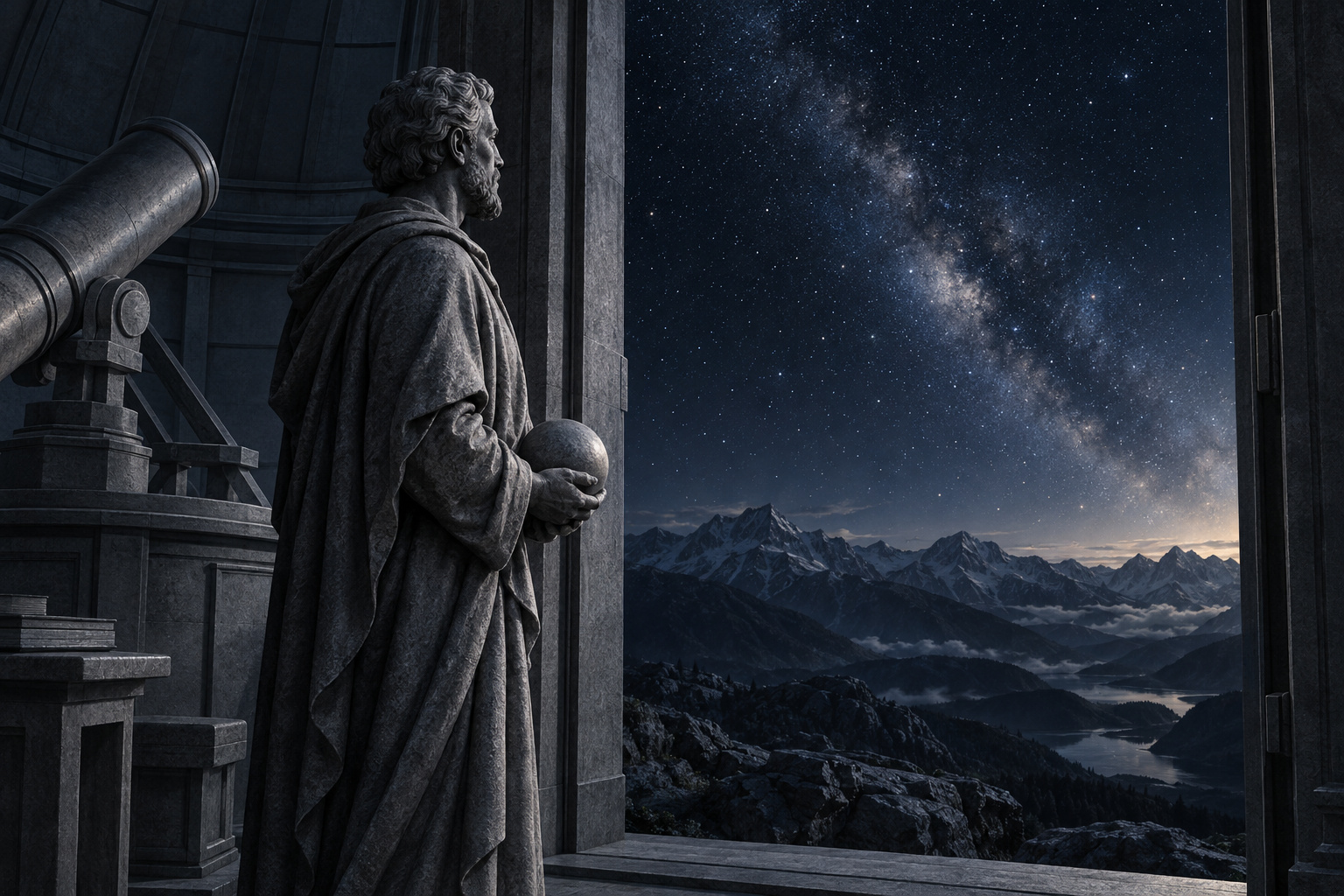
Epigraph
its answer can only be furnished by experience
Albert Einstein, Geometry and Experience, closing eight-word clause of the English sentence about the geometry of the universe, line 141. G. B. Jeffery and W. Perrett English translation, 1922 edition; the Russian version is our translation from this English edition, not from German.
What this article is about
When a cosmologist shows a sky map and names the parameters of the universe, considerable work connects the picture to the numbers: measurement, processing, assumptions, and tests of consequences. The map does not thereby become an arbitrary picture, nor does the model become the universe itself. Their relationship deserves attention. We compare Einstein’s distinction between geometry and physical experience, Kant’s idea of systematic unity, and the conditions of a particular Planck analysis. These are different arguments that help us ask more precise questions. What was recorded? What was assumed? What followed under those assumptions? What question remains after a successful explanation? Hypothetical examples let us follow the sequence without specialist software. Our aim is to understand how explanations acquire support, remain open to correction, and provide knowledge without answering every question about existence.
I. From the sky to a claim about the sky
Consider our own hypothetical example: an observer sees points of light through a window with several covered areas. The observer draws their positions, proposes that they form a grid, and uses the visible intervals to reconstruct hidden positions. Four results can be distinguished. Particular light signals were recorded. Processing produced a map. A rule for the arrangement was proposed. Positions of unseen points were inferred. Even if a prediction is subsequently confirmed, the first and last results were obtained differently. “Saw” suits an uncovered area; for a covered area, “predicted and then checked” is more accurate. We invented this example; it describes neither a satellite’s design nor an actual astronomical dataset.
Now allow the glass to vary in transparency. A faint point might be a faint source or might be viewed through a darker part of the window. Choosing between these explanations requires information about the glass or another observation. An attractive grid drawing does not supply that information. Yet processing does not make the drawing useless: transparency can be checked, an observation repeated through another window, or a point’s expected position specified in advance. A model connects assumptions with distinguishable consequences. It allows us to learn more than was directly recorded while requiring us to explain why the move towards additional knowledge is warranted in this particular situation.
A cosmological report invites us to trace a comparable sequence without substituting our toy apparatus for actual research. What is an observed signal, what is a processed product, and what is an explanatory parameter? Which alternatives were compared, and which conditions remained fixed? Answering does not require accepting every philosophical position held by a researcher. It requires reading a result within its intended domain. A mistake occurs when the final number is treated as a direct imprint of all reality or, conversely, when the entire chain is dismissed because it includes assumptions. Both moves obscure the opportunity to follow a specific inference and identify where a check is needed.
II. Mathematical clarity and physical meaning
In Geometry and Experience, Einstein distinguishes formal geometrical relations from their application to actual measuring bodies. An additional coordination of concepts with experience gives logical consequences physical content. This is an argument from a historical address, not a Planck finding. It helps us avoid treating correct calculation as sufficient evidence of applicability. Distances can be calculated flawlessly in a chosen system while its elements are incorrectly connected with what was measured. Such an error need not be in the algebra. Checking what actual operation the word “distance” denotes might expose it. The mathematical result and the physical use therefore raise connected but distinguishable questions.
Take another example of our own. A paper grid specifies one unit between neighboring marks. Under that rule, ten intervals amount to ten units. But if the paper has stretched unevenly, ten drawn intervals do not guarantee a specified physical length. We could retain the mathematical grid and account for stretching in its translation into measurements. We could choose another representation. Either choice requires attending to correspondence. The example does not establish that cosmic space resembles stretched paper. It makes a logical distinction visible: consequences within a model are connected with claims about their target through additional conditions, which can also be discussed and checked.
This distinction changes the order of questions when reading cosmology. First understand what a parameter denotes within a model, then which observations constrain it, and finally which physical interpretation is warranted. Moving too quickly from notation to an image produces misleading clarity. For example, “flat” can suggest a sheet lying on a table, although that picture already adds an outside space, edges, and an observer’s location. These additions do not follow from the term alone. A substantive explanation asks about the precise relation expressed by the term, rather than deciding the issue through a familiar everyday picture. The image may help, provided its extra features are recognized.
III. What a cosmological model estimates
Planck 2018 results VI, published in 2020, analyzes cosmic microwave background temperature, polarization, and lensing data. Its base description is spatially flat ΛCDM with primordial adiabatic perturbations, a power-law spectrum, six cosmological parameters, and specified further assumptions. Six is not the total number of instrumental and nuisance parameters in the analysis. The illustrative Hubble constant value, 67.4 ± 0.5 kilometers per second per megaparsec, is a historical estimate within the stated model, using the paper’s 68-percent parameter interval convention. It was not read directly from an instrument as a separate quantity. We use selected methodological and concluding passages, rather than claim a complete independent repetition of the analysis or an examination of its underlying data.
A parameter is better compared with an unknown in a problem than with a finished label extracted from nature. Relations between an assumed description and observed consequences constrain its value. Several matters are important together: which unknowns were chosen, what was held fixed, and which procedure assessed compatibility. Keeping only the final figure prevents a reader from understanding what changed in a subsequent estimate. A change could reflect different data, a different set of assumptions, or different processing of earlier material. These possibilities are not equivalent, even if a headline describes all of them as a “recalculation.” Identifying the change helps identify the question the new result actually answers.
“The model depends on assumptions” is therefore not a complete objection. A useful objection names an assumption and explains its role. If a condition is stated openly, yields testable consequences, and can be examined through different observations, conditionality does not destroy knowledge. It specifies how that knowledge can be discussed and corrected. An objection becomes stronger when it identifies an inconsistency or an overlooked alternative. It becomes weaker when it merely repeats that reasoning intervenes between measurement and conclusion. Without reasoning, even two measurements made in different ways could not be meaningfully compared. The existence of an inferential step is a reason to examine it rather than reject it automatically.
IV. One result and several unknowns
Consider an elementary construction of our own, rather than a cosmological calculation. Suppose all we know is a + b = 10. The pairs 2 and 8, 4 and 6, and others satisfy it. Knowing the sum exactly does not mean knowing either term exactly. If a − b = 2 is obtained independently, the two relations give a = 6 and b = 4. The new condition helps for more than the extra row it adds to a table. It constrains the earlier uncertainty differently. Ten copied versions of the first equation would not provide the same result. The arithmetic is exact; applying the example to science merely illustrates a problem’s structure.
This example distinguishes the number of reports from the amount of independent information. Five publications retelling one source do not supply five observations. When two calculations share initial material, their agreement can usefully check a procedure without being equivalent to agreement between entirely different datasets. We should ask what was repeated and what changed independently. Without clarification, “confirmed” can refer to checking arithmetic, comparing processing methods, making a new measurement, or testing a consequence in a different domain. Each activity has its value and limits. Counting uses of the word cannot establish which activity occurred or how much additional support was obtained for the specific claim under discussion.
Combining datasets in cosmology involves real mathematical and physical problems far more complex than two equations. Our example does not establish that any two observational methods are independent, nor identify which actual parameters can be separated. It supplies a precise question: which previously compatible family of possibilities does the new observation exclude, and why? That question treats additional data as a change in the grounds for inference. Instead of competing over who has more measurements, we can examine the argument’s structure: shared material, separate conditions, additional constraints, and the remaining ways to reconcile alternative explanations with observation. This requires following the research rather than transferring the toy example’s answer to it.
V. Precision under stated conditions
A narrow interval is impressive because it represents a strong constraint within a particular problem. It does not replace the problem’s description. Imagine our hypothetical room plan: the distance between two marks has been determined very precisely, but every dimension uses a wrongly selected unit. Repeatedly refining a mark’s position might never expose the unit error if every check uses the same standard. This is not an allegation about Planck. It distinguishes a result’s variation under a given description from the correspondence of that description with its target. Checking the latter can require a different kind of investigation from further refinement of the same numerical quantity.
The Planck authors explicitly make estimates conditional on the cosmological model, knowledge of instruments, and astrophysical foregrounds. The selected methodological context describes map checks and differences between implementations of the analysis. These support an assessment of work performed, but a list of checks is not a promise that every conceivable error is absent. Such a promise would exceed the reported result. The limitation has a positive meaning: the number’s conditions are stated. A reader can therefore distinguish questions about observations, processing, and the cosmological description, instead of adopting an undirected distrust of any complex investigation. Each question can be directed to the part of the work relevant to answering it.
Reducing an interval should also be distinguished from extending a result’s domain. The first does not automatically imply the second. A model’s improved ability to separate possibilities within its domain does not mean that it now answers a question absent from its construction. Estimating expansion more precisely, for example, does not automatically explain why a world exists at all. Moving to a new problem requires another argument. This boundary need not diminish the refinement: learning a particular relation more precisely can be a substantial scientific achievement. Its significance is better preserved by describing the actual question and completed work than by making it answer every possible question about the cosmos.
VI. Images, geometry, and the whole world
In the selected text, Einstein uses a spherical-surface image to discuss finite space without a boundary. We adopt the analogy’s function, rather than his historical conclusion about the universe’s actual shape. It helps represent a relation obscured by the everyday assumption that anything finite must have an edge. Yet a familiar picture can import extra properties. A drawn sphere has a surface, an external viewpoint, and visible space surrounding it. One relation’s usefulness does not mean that all these features transfer to the cosmos being discussed. A reader needs to know which part of the image performs the explanatory work and which parts remain incidental features of the picture.
Here is our own hypothetical scheme: a track forms a loop, and movement along it never reaches a last point, although its length is limited. This shows two properties to be compatible within the specified construction. It does not prove that cosmic space is a track or has the same dimensionality. Used carefully, an analogy extends the possibilities we can consider. Treated as an observation, it replaces a missing test with a feeling of clarity. The difference becomes especially visible if several schemes preserve the relevant relation. The first picture then loses its claim to being the target’s only possible arrangement. Representability opens a question; it does not answer that question empirically.
Statements about curvature and about the entire global shape also require distinguishing the questions posed. In the selected Planck conclusions, curvature estimates are discussed with specified data combinations; they do not become an outside view of all space. In our analysis, a local geometrical characteristic is insufficient to describe every global connection and size. A term must retain its research meaning even when it sounds simple in popular reporting. A useful image clarifies a condition without removing the need to learn what has actually been determined. Otherwise, two readers could agree on one word while assigning mutually incompatible cosmic pictures to it. Agreement in vocabulary would conceal disagreement about the claim.
VII. Unity of knowledge and its object
In §56 of the Prolegomena, Kant discusses systematic unity as a function of ideas of reason. Directing inquiry towards a whole differs, on his account, from knowing a whole as a given object. “Regulative” and “constitutive” matter here: one concerns the direction of knowledge, the other a supposed determination of the object itself. This philosophical distinction is not equated with a modern statistical criterion. It lets us ask when connecting knowledge helps inquiry and when a desire for completeness becomes a claim that one description already embraces all reality. Kant does not study microwave background parameters or predict the design of the Planck model; the comparison is ours.
Our own archive analogy is useful for this comparison. Trying to organize all found documents under one rule might reveal a missing connection. But a folder arrangement does not guarantee that every document that ever existed has been found. A system assists inquiry while allowing new material to change a category. It closes inquiry when something not found is declared impossible simply because no category accommodates it. This example does not represent every detail of Kant’s philosophy. It keeps two questions distinct: how work with known material is organized, and what grounds support a claim that its object is complete. Organizing and establishing completeness are different acts with different demands.
Unity in a scientific model has an additionally testable aspect: one set of assumptions should answer different observational questions without arbitrary changes of rules after every result. A pleasing plan cannot substitute for successfully reconciling data. Yet reconciling specified observations does not establish philosophical completeness concerning everything. These moves require different grounds. We can value the coherence of an explanation, check its consequences, and leave open which new relations it does not yet include. This need not force a choice between final truth and meaningless opinions. It leaves room for substantive, definite, corrigible knowledge. Its claims remain meaningful because their scope can be named, even when inquiry is still unfinished.
VIII. Successful description and unfinished explanation
A model can successfully connect observations while leaving the fundamental nature of its ingredients unresolved. The selected Planck conclusion distinguishes these matters for the base description. It should not be retold as an admission that nothing is known. An observationally constrained, testable relation remains a constraint even when its deeper basis is unknown. Nor should an open question be replaced by a confident everyday picture of hidden material or energy. A name within an explanation poses a research problem; it does not always provide a complete account of what the named ingredient is at the most fundamental level. Naming, constraining, and fundamentally explaining therefore represent different achievements.
The selected passages of Kant’s §57 also distinguish natural explanation from demands for an ultimate ground, but their domain and meaning are different. His boundary of possible experience is not today’s boundary of telescope sensitivity. A present lack of measurement does not establish permanent impossibility of measurement. Our comparison neither closes a physical question forever nor turns a philosopher into the author of a contemporary cosmological hypothesis. It shows why the explanation we seek must be specified. Connecting observed quantities, proposing a physical mechanism, and answering an ultimate question about existence are different achievements, even when conversation gives them the same label. Recognizing the difference makes each question clearer.
Imagine a limited rule of our own for a drawing: each successive row contains one more mark. From the first row, it lets us predict the size of the tenth without identifying who draws the marks or why. If someone actually made the drawing, the question about its maker has another meaning and needs other information. The cosmos is not equated with an intentionally made drawing; the example only separates requests for explanation. A further question is not answered merely because the earlier rule works. Equally, the rule’s success cannot be denied simply because it does not answer the further question. This distinction preserves the point of both scientific refinement and philosophical inquiry.
IX. Discrepancies and corrections have an address
When two methods yield different values, first establish what is being compared. Are definitions and domains the same, and are conditions compatible? Could processing, assumptions, or a new relation produce the discrepancy? These questions do not supply an answer. They order the consideration of alternatives so that “contradiction” does not perform all the investigative work. A real discrepancy deserves attention because it can clarify an explanation’s limits. It is not automatically evidence of deception or a finished discovery of new physics. A stronger conclusion needs additional grounds connecting the difference to the proposed cause. Taking the difference seriously therefore requires more than choosing a dramatic interpretation of it.
The 2021 corrigendum to the selected Planck paper is instructive. It corrects a numerical error in deriving a 95th percentile from Monte Carlo samples for particular bounds on early-time optical depth: for lowE data with FlexKnot, the bounds are 0.018 with a flat prior on τ(15,30) and 0.023 with a flat prior on the knots. The authors describe an approximately threefold increase over the earlier bounds. This corrects a particular computational result; it does not report a revision of the Hubble constant. We read it at that scale. We have not repeated the computation from the original samples, nor inferred a claim about every other parameter from this short correction. Its scope is part of its meaning rather than an optional qualification.
In our hypothetical example, a table could contain correct initial numbers but an incorrectly calculated percentile. Finding the error requires changing that operation’s result and checking the conclusions that depend on it. It does not require discarding every row because one procedure was wrong. Conversely, merely replacing a number is insufficient if it supported a stronger claim. The dependencies must be traced: which conclusion used the wrong result, how its support changed, and what wording is now warranted. We propose this approach as an authorial way of reading the example. Its usefulness for a reader is not presented as the result of an independent experiment or a tested intervention.
X. Trust in specified work
“Should we believe cosmology?” is too broad if it combines a particular measurement, a model, a popular illustration, and an answer about existence’s meaning. It is better to select a result and reconstruct its grounds. Sometimes a headline will have expanded the conclusion’s domain. Sometimes a correction will have honestly narrowed an earlier claim. Sometimes a limitation is part of what makes a result intelligible rather than an objection to it. A reader need not pretend to be a specialist who checked every software module. The work of reading can be distinguished from scientific checks not performed, allowing an unanswered question to be named without overstating competence.
This also changes conversation. One person might care about how well a description matches observations; another might ask why anything exists. The first need not present a parameter estimate as an answer to the second question. The second need not reject the estimate because it has a limited purpose. Conversation becomes possible when each names the question and the kind of grounds expected. Philosophical argument then does not replace instrumental measurement, and measurement does not silently prove an entire metaphysical picture. Comparing traditions helps by preserving distinctions: it shows where questions meet and where a move between them still requires justification. Their meeting is not automatically their resolution.
A model is valuable as an organized way of making its conclusions answerable to their target. Its strength lies in more than descriptive simplicity: conditions can be specified, distinguishable consequences obtained, a particular correction acknowledged, and inquiry continued. Reality does not reduce to the latest table, nor become inaccessible because tables are used. Specific work connects the two. Reading it carefully leaves room for confidence in a definite result and for another question. A cosmological model then ceases to be a slogan about total knowledge or total ignorance. It becomes an opportunity to understand how an explanation was obtained and what further work could meaningfully improve it.
What this means in practice
Choose a short report about a cosmological result and write three lines: “what was observed,” “what was assumed,” and “what was inferred.” Leave a line open if the report does not let you fill it. That is more accurate than completing it with a familiar worldview from memory. Note the study’s date and the kind of claim: recorded signal, parameter estimate, illustration, or philosophical question. A historical number does not become the latest estimate because a recent retelling repeats it. This is our exercise; it is not offered as a substitute for specialist education or an empirically tested method for changing beliefs.
Next select one move between the lines. What condition makes it possible, and what change might affect the conclusion? Known transparency served that role in our glass example; in a scientific study, read the actual conditions rather than transferring our window to it. If a correction appears, identify the corrected operation and its associated claim. Record separately what changed and what you have not checked. “This quantity was recalculated” means something different from “every ground of the description was rejected.” The broader statement requires independent support for its broader content. A correction’s stated reach is a useful starting point for following dependencies.
Finally, formulate one remaining question so that an appropriate answer can be sought. It might concern data, an assumption, a definition, or the philosophical meaning of completeness. Immediate resolution is optional. It is enough to stop demanding every explanation from a single number without devaluing the number for answering a specified question. If the analysis becomes excessively technical, stop at an honest account of your reading’s limits and return to the primary text later.
Key quotation
that which is merely regulative to be constitutive
Immanuel Kant, Prolegomena §56, line 724: eight-word internal clause after “if we regard.” Paul Carus English edition, Third Edition 1912; our Russian version is translated from this English, not German. Kant warns against treating an idea’s guiding function as a determination of the object itself.
Connections between traditions
1. Einstein and Planck: an interpreted system is tested. For Einstein, geometry together with physical laws answers to experience (Geometry and Experience, 148–151); Planck makes estimates conditional on model, instruments, and foregrounds (1157–1176). The comparison identifies a transition: formal consequences become physical inferences through conditions of interpretation. A historical argument is not a modern likelihood function, and no influence of one text on the other’s authors is asserted.
2. Einstein and Planck: geometrical meaning needs observational grounds. Einstein distinguishes practical from purely axiomatic geometry (139–142); the selected Planck conclusion discusses curvature with specified data combinations (6462–6472). A claim about space requires more than a drawn figure. This connection does not turn a curvature constraint into knowledge of all global topology or confirm Einstein’s historical cosmic picture.
3. Kant and Planck: seeking unity and testing agreement. Kant considers systematic unity (§56, 721–723); Planck discusses different spectra’s consistency with a base description (6426–6435, 6513–6516). Our comparison distinguishes a guiding aim from scientific work in which one set of assumptions answers different observational questions. A regulative idea is not a parameter or a substitute for checking data. An organizing task does not establish a shared doctrine.
4. Kant and Planck: an explanation’s limit preserves its content. Kant’s selected §57 distinguishes natural explanation from reason’s ultimate demands (738–741); Planck retains questions about fundamental ingredients alongside successful observational description (6529–6534). The comparison separates an established relation from a deeper task. It neither makes Kant a predictor of dark matter nor declares an open physical question permanently beyond investigation.
5. Einstein and Kant: representation and grounds of knowledge. Einstein’s spatial analogy helps us think of finitude without a boundary (179–196); Kant’s distinction prevents guiding unity from becoming a given whole (§56, 719–724). An image or idea can organize a question without thereby proving its target’s arrangement. A geometrical scheme and a transcendental idea differ in method and object. This is our comparison, rather than their reduction to one doctrine.
6. Einstein and the Planck corrigendum: corrections concern particular links. Einstein considers the physical conditions of measuring bodies (147–159); Planck’s correction addresses a particular percentile calculation (39–50). The comparison asks which inferential link changed and which consequences depend on it. A rod’s thermal behavior is not a Monte Carlo numerical error. Neither circumstance warrants arbitrarily rejecting every result of an investigative system.
Primary sources
Albert Einstein, Geometry and Experience, Sidelights on Relativity. Jeffery and Perrett English translation, 1922. Adopted passages 126–162 and 179–196; historical claims about the universe’s actual shape are not contemporary findings. Images were not separately examined.
Immanuel Kant, Prolegomena, Paul Carus, Third Edition 1912. §56 and selected §57. The philosophical boundary of possible experience is not equated with present access to measurement.
Planck Collaboration, Planck 2018 results VI, A&A 641 A6 (2020). Selected primary methodological and concluding passages were read; not the entire paper, code, or raw maps. Values are historical and conditional on the stated analysis.
Planck Collaboration, Corrigendum, A&A 652 C4 (2021). Complete substantive correction paragraph for particular optical-depth bounds; not a revision of every parameter.
Tags
#cosmology, #model, #reality, #observation, #measurement, #geometry, #Einstein, #Kant, #Planck, #parameter, #assumptions, #explanation, #experience, #knowledge, #system, #unity, #regulative, #curvature, #precision, #uncertainty, #interval, #correction, #data, #analogy, #map, #verification, #inference, #limits, #philosophyofscience, #cosmicmicrowavebackground, #cosmos, #UnitedWisdom
About the authors
Andrey Zarinsh is the author and founder of United Wisdom. He explores inner transformation, the unity of traditions, intercultural dialogue, and contemporary spiritual discipline. Instagram: @andrey.zarinsh.
Maria Evilkut is a co-author of United Wisdom. Alongside her research, she seeks to test these ideas in practice and observe how principles of unity and mutual understanding work in real life between people and cultures. Instagram: @ilkutki.
Keep what resonates with you.