
World & consciousness
Evolution and Purpose: When Explanation Becomes Intention
Evolution, function, and purpose: distinguishing a trait’s history, useful outcome, and conscious project.
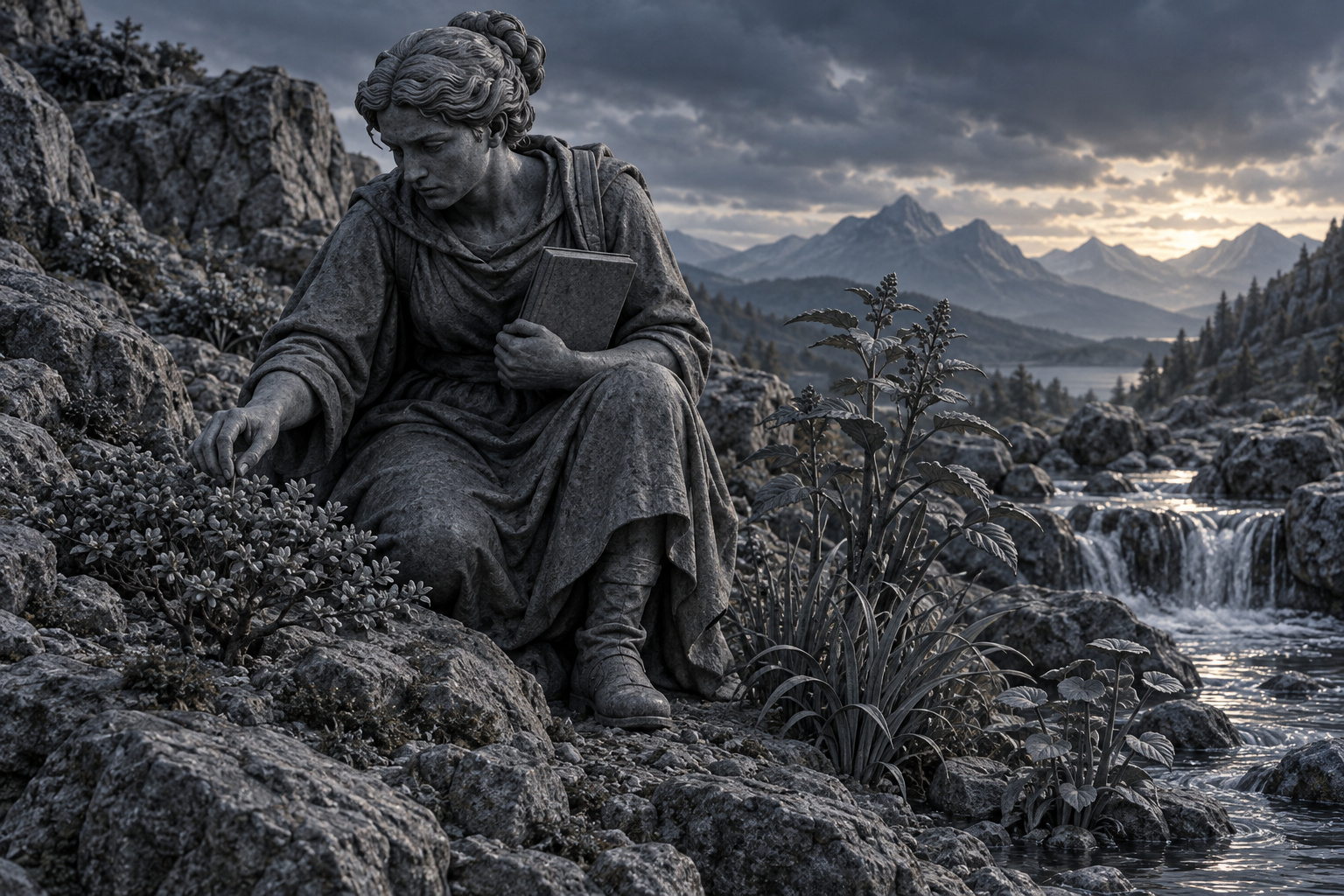
Epigraph
“they necessarily judge other natures by their own”
Spinoza, Ethics I, Appendix, a fragment about projecting human purposes onto nature, in R. H. M. Elwes's historical English translation. The Russian rendering is the author's translation through Elwes. This is a claim within Spinoza's philosophical argument, not a measured description of everyone.
What this article is about
“In order to” offers a short way to describe living structures: roots absorb water, a particular shape contributes to movement, behavior changes opportunities for reproduction. Yet the same phrase can quietly turn explanation into a story of nature's intention. A useful outcome becomes an advance assignment, while a trait's history becomes progress toward a conclusion already known to us. Function, the preservation of differences, and a conscious project need distinguishing. Through an invented museum caption, we compare selected passages by Darwin, Aristotle, and Spinoza with experimental research on the historical contingency of one bacterial innovation. These sources form no single doctrine. Aristotle's natural purpose requires no deliberating agent; Spinoza's critique belongs to his metaphysics; the experiment addresses a bounded biological question. Keeping their grounds distinct preserves both natural explanation and human meaning without making either evidence for the other or evolution the judge of our decisions.
I. One Caption Conceals Three Questions
Imagine a small museum with a schematic seed and the caption, “Evolution gave it wings so the species could conquer new places.” The seed and caption are invented; no researched species or established organ history is described. The sentence sounds intelligible but contains several transitions. There is a proposed action of the shape: contributing to transport. There is a proposed history of its emergence and spread. Finally, evolution seems to know a desirable outcome and supply the necessary means. The first claim establishes neither the second nor the intention added by the third. A visitor may remember a convenient image without noticing that one sentence has supplied answers to different questions.
Asking what a structure does now differs from asking how it arose. Even an established ability to contribute to transport reveals no complete sequence of earlier changes. A historical explanation would need relevant evidence about variants, inheritance, conditions, and reproduction. A project explanation would need an agent and grounds for attributing knowledge of the outcome. An attractive image cannot replace these requirements. A museum arrow from shape to new location might illustrate a proposed action; it is no document of intention. The caption becomes clearer when it identifies the question it answers and the part of the history still unknown. Different evidence is needed because the claims concern different relationships.
An editor can revise the sentence without sacrificing accessibility: “In this diagram the shape helps transport; its emergence requires a separate explanation.” If research establishes a variant's advantage under particular conditions, that conclusion and its grounds can be added. Until then, a victorious history should not be invented. This is an author exercise with a teaching caption, not a universal ban on purpose language. Human purpose may be entirely real: an exhibition's author wants visitors to understand. The error occurs when that author's intention quietly becomes a property of the natural process being explained. The sentence then saves words by changing the subject of knowledge rather than making the knowledge clearer.
II. Usefulness Depends on Conditions
In Chapter IV's opening in the first edition of On the Origin of Species, Darwin connects differences with chances of surviving and leaving offspring. He discusses advantage relative to other organisms and conditions of life. This is a historical natural-history argument from 1859, not a complete present genetics textbook. Usefulness has a relation: useful to whom, under which circumstances, for which outcome? A trait receives no certificate of superiority in every possible world. Climate or neighboring organisms can change the comparison's conditions. Biological “better” therefore needs specification; otherwise, an explanation easily becomes admiration of general perfection, with no clear account of the outcome actually being compared.
In our museum example, wider distribution should not automatically be the sole measure. We have not established which conditions suit the proposed organism, what other consequences accompany the shape, or what happens after transport. Distance alone tells no story of reproduction. A teaching diagram can make longer transport useful in one setting and unhelpful in another. It illustrates the question's structure without adding facts about a real seed. A substantive explanation connects action with a particular biological outcome and relevant restrictions. The attractive word “conquest” does none of that work. It supplies a human image of success before the biological subject and conditions of success have been established.
Darwin also writes in the selected passage that variations neither useful nor injurious would not be affected by natural selection. That prevents automatically presenting every noticeable feature as a separately perfected solution. A contemporary analysis of a particular trait may require other mechanisms and data; we do not decide its account in advance. Distinguishing observation, a usefulness hypothesis, and a supported history is enough here. Conditional usefulness makes no trait meaningless. It makes the explanation more precise: function concerns a relationship, not a creature's world ranking. Adaptation can be discussed without a summit or final destination of development. The relevant comparison need not settle any broader judgment about the organism's value.
III. A Future Result Does Not Act Backward
Knowing a story's conclusion makes earlier events look like preparation for it. The caption suggests that the seed's shape arose because future descendants had to reach farther away. But a sequence requires causes available at the corresponding stage, not knowledge belonging to a later narrator. Darwin begins with arising differences and conditions in which some provide an advantage. A useful outcome does not create its own preceding variation. His selected text explicitly states that without profitable variations occurring, selection can do nothing. This requirement distinguishes an explanation from a ready answer to every future need. It also leaves open whether the required material existed in the particular case being discussed.
Imagine teaching cards showing initial variants, different reproductive circumstances, and the next generation's composition. The model proves nothing about an actual species but clarifies the questions' order. An arrow backward from the result represents our reconstruction, not the future acting in reverse. Removing variants and keeping only success loses an essential link. “It appeared to help” can then conceal a missing investigation. The issue is whether abbreviated speech can be expanded into a sequence whose transitions have grounds and require no anticipation of the final state. Familiarity with the outcome gives the narrator an informational advantage; it should not be silently attributed to the earlier process or to the organisms involved.
A human project differs in a relevant respect: someone can imagine a desired outcome and act with that representation in mind. The museum's visitor route may have been designed for clarity because makers, discussions, and a selected task are known. The project guarantees no success, but attributing an intention has grounds. That explanation cannot be transferred to every natural result without further argument. Nor does the distinction require denying all goal-directed behavior in living creatures. Our subject is narrower: a heritable trait's historical spread cannot be explained solely by an imagined future task that evolution supposedly assigned to a population beforehand. Establishing one difference should not turn it into an unsupported claim about every kind of behavior.
IV. Variation and Selection Are Different Parts
Darwin's selected opening distinguishes the existence of variations from preservation of those that prove favorable. His historical language supplies no complete contemporary account of heritable change. Yet the distinction matters: material arising and differences in its subsequent fate are not one event. Calling both “nature choosing what it needs” loses questions about which variants were available and why. A particular case requires investigation rather than completion with a familiar formula. Selection identifies a mechanism concerning differences in preservation; the word itself promises neither the required form nor its arrival on schedule. The distinction makes explanatory work visible that an intentional image would otherwise perform without evidence.
In the selected opening of Blount, Borland, and Lenski's modern paper, heritable variation, mutation, selection, and random loss even of beneficial changes are different elements of history. We use the abstract and selected introductory paragraphs, without claiming complete methods reading or independent calculation of results. Two questions matter: where differences arise, and what happens to them under given conditions. Randomness here means neither that everything lacks causes nor that selection writes a complete advance script. Compressing the components into one word simplifies the account only superficially. Explaining their different contributions requires retaining the conditions and sequence that make a proposed relationship meaningful rather than merely plausible after the event.
For the caption, this permits a specific acknowledgment of missing knowledge. If available material does not investigate the shape's history, the editor should not promise that nature always supplies needed variants. An action description can remain while origin stays open. Where earlier changes, conditions, and reproduction are known, they can be explained accessibly. The account needs no craftsman making every trait to order. Its strength rests on relations between evidence and conclusion, not on how appropriate the result seems or how easily a useful side can be imagined. A clearly stated limit allows visitors to understand the supported part without taking a gap as proof of a hidden project.
V. Available Possibilities Have a History
Blount, Borland, and Lenski's 2008 study considered aerobic citrate use emerging in one experimental Escherichia coli population. Its complete abstract describes initially identical populations, the innovation's long absence, and its later appearance in one lineage. Researchers compared restarted experiments using material from different historical stages. Later samples more often produced the change, supporting an earlier potentiating alteration. We reproduce no numerical estimates or claim independent verification of all data. The conclusion concerns a particular phenotype in a laboratory history, not proof that all life is unpredictable. Its evidential scope remains important even when the case is useful for a larger conceptual discussion about retrospective explanation.
The example shows that an environmental opportunity does not equal immediate access to a path. A medium component was present earlier, yet the later-known result did not simply arise because it might help. The population's prior state mattered. Comparing historical samples distinguishes this from a free parable about destiny: the authors report an experimental way to examine alternatives. Complete methods, supplementary material, and later work are outside our reading. We therefore retain the authors' abstract-level conclusion rather than assert that every innovation needs the same sequence or that another outcome is impossible elsewhere. A bounded result remains informative without becoming a formula for all biological history or every possible environmental change.
Comparison with Darwin refines the available-variation condition while preserving different periods and concepts. Darwin offers a historical selection argument; the selected experiment investigates one path's dependence on earlier changes. Neither makes an outcome a message from the future. “Which preceding conditions made this path available?” helps the caption more than nature's supposedly lengthy preparation for our known conclusion. That question returns branching and sequence to a history flattened into one inevitable goal. It also separates understanding an accomplished path from predicting every later possibility. A historically conditioned explanation can describe why an outcome became possible without promising either complete foreknowledge or a reproduction of the outcome under all circumstances.
VI. Aristotle's End Is Not a Conscious Plan
In Physics II.8, Aristotle considers nature a cause operating for the sake of something. He presents an objection: why could useful structures not arise coincidentally, with fitting formations surviving? He then disputes this account through natural processes' usual regularity and the relation of preceding stages to completion. Attribution matters. An objection he states does not become his own conclusion because a sentence resembles a later debate. Conceptual history requires reading the reply and its grounds rather than extracting a convenient sentence. Otherwise, an apparently respectful comparison can misrepresent the author and replace a real disagreement with a story of agreement the sources do not support.
Aristotle explicitly says that lack of observed deliberation does not abolish purpose. Natural completion concerns form and a developmental sequence, not necessarily a being drawing up a plan. “Who consciously decided?” is therefore insufficient as a faithful summary of his position. It differs from a contemporary evolutionary model but is not merely our caption's personification. We need to identify the author's explanation and grounds. This is historical philosophical natural inquiry in Hardie and Gaye's translation, without Greek collation, not a present experiment establishing every organ's purpose. Keeping that genre visible makes it possible to consider his argument without lending it the evidential status of a different kind of study.
The comparison helps through difference. One question considers completed form and parts' relation to a whole; another considers historical population changes through available differences and reproductive conditions. Similar structures may be discussed on different explanatory grounds. Purpose language cannot make the accounts agree, and an ancient thinker should not simply be given a human engineer's image. A public explanation should show the disagreement's subject. A functional-looking result selects no theory of origin by appearance alone. Faithfully presenting a historical position does not adopt it as present biology. It allows readers to understand what that position asks and why another explanation might require different kinds of evidence rather than merely a different preference for words.
VII. Spinoza Questions Projection of Our Ends
In the selected opening of Ethics I's Appendix, Spinoza criticizes nature arranged for human advantage. He relates that account to awareness of our desires and ignorance of their causes. Lacking a cause, people look inward and judge another nature through their own. This is a metaphysical argument, not contemporary research on everyone. Spinoza discusses God's necessary nature and things' dependence upon it. His position cannot quietly become Darwin's separate scientific hypothesis. A shared criticism of attributed intention makes neither author's grounds identical. Their concepts must retain their histories and explanatory roles if the comparison is to reveal a distinction rather than manufacture a single shared doctrine.
For the caption, the passage suggests a question: are we explaining a structure through a benefit we could obtain? A visitor may enjoy the seed's imagined conquest; that supplies no historical grounds. Likewise, human use of a plant does not establish its emergence for human use. Our purpose may be real and important while belonging to the user. Usefulness to us and an object's origin are different relations. Identifying the purpose's owner requires abandoning neither gratitude nor wonder or personal meaning. It requires keeping those experiences from supplying a missing causal link. The distinction concerns the grounds of explanation rather than a requirement that readers feel differently about nature.
Spinoza also discusses obstacles to human advantage that resist a convenient story of a world provided for us. We apply this neither to judging suffering nor someone's faith. It raises the risk of an explanation accepting every event as one purpose's confirmation. If success proves a plan and failure becomes secret usefulness, what could change the conclusion? Established, proposed, and unknown claims need separating. A bounded scientific explanation does not settle every question of meaning by rejecting an unverified natural intention. An unestablished purpose also differs from established absence of every possible purpose; the latter needs its own grounds. Showing that a caption adds unsupported intention does not make that error proof of a complete opposite worldview. The criticism should remain as precise as the conclusion it asks others to support.
VIII. Functional Shorthand Must Be Expandable
“For” need not always mean will. We can explain a component's system function, describe an organ's usual action, or name a human project's task. The meaning must be expandable. If the caption says the shape serves transport, specify how it contributes and what supports the claim. A history of a variant's preservation needs the corresponding generations and conditions. A conscious project needs an agent and grounds for intention. One expression can serve different relations; confusion occurs when the text switches silently between them. Its convenience is valuable only if visitors can learn which relationship is actually being described rather than receiving a combined claim stronger than the available evidence.
Try two versions: one explains the diagram's proposed action, another the trait's proposed origin. If the second simply repeats useful function in different words, it adds no historical grounds. “Convenient, therefore created for convenience” is circular. Imagining a benefit confirms no origin. A functional hypothesis can still guide investigation, but a question's direction differs from its answer. A useful conjecture becomes stronger when missing evidence is clear rather than concealed by phrasing. The editor can preserve the conjecture as a question and present the established action separately. This gives the visitor both an intelligible account and a reason to ask what further research would be needed.
The inference's scale also matters. Explaining one action of a trait reveals no complete organism history. One laboratory phenotype establishes no rule of all innovations. A philosophical argument measures no frequency of human error. These are different limits because the sources ask different questions. Repetitive warnings beside every sentence are unnecessary. Organize the account to distinguish description, hypothesis, bounded result, and historical position. Shorthand then remains lively without gaining accessibility through an artificial unity of evidence answering different questions. The distinction can be built into the explanation itself: name the subject, present the relevant relation, and leave larger conclusions at the level supported by their own grounds.
IX. Reconstruction Should Respect Its Evidence
A trait's existence today cannot alone reveal its history. Otherwise everything surviving looks advance-required, and unrealized possibilities vanish. The bacterial abstract compares historical stages to examine access to an innovation; additional evidence supports the conclusion. A real museum object might require other methods. Our invented diagram supplies none. An editor can explain a possible mechanism while distinguishing it from established history. A careful reconstruction gives both a plausible direction and the material supporting it, including where it remains conjectural. Its usefulness need not depend on providing an uninterrupted story from beginning to end. Missing portions can be named without turning the supported ones into mere speculation.
Missing knowledge matters differently for different questions. Explaining schematic transport may not require every ancestor. Establishing a particular shape's origin cannot bypass the history with words. Examining one contribution may leave other functions open; calling it the sole perfect purpose requires broader grounds. Specifying the question preserves useful knowledge. Rejecting an inflated story need not end with “Nothing is known.” Action may be known, a path proposed, and its exclusivity unestablished. Writing those states separately is better than filling the interval with intention. The visitor gains a usable account of what can be explained rather than a forced choice between complete certainty and abandoning the subject altogether.
Darwin's neutral-variation remark and prerequisite of available variation, alongside the experiment's history-dependent path, resist a comprehensive legend. They offer no ready biography of every trait. They show why an outcome cannot replace missing causes. Readers can examine what an explanation does: does it connect evidence, distinguish alternatives, and mark scale? A simple story can remain provisional. Its strength comes from an intelligible relation between material and conclusion, not a confident voice promising that nature always knew today's answer. This asks more of the explanation without demanding exhaustive knowledge for every limited statement. A clearly supported part can remain valuable while its relation to a wider history continues to be investigated.
X. Human Purposes Retain Their Own Grounds
Refusing to give evolution our known conclusion as its goal erases no human purposes. Museum staff can choose clarity, accuracy, accessibility, or artistic expression and discuss their combination. These intentions belong to acting people; a trait's history does not prove them. A separate transition with its own grounds connects explaining nature and choosing how to live. Relative biological advantage gives no moral right to rank human worth. Lack of an established natural project makes neither care nor knowledge or promises meaningless. A biological description does not perform all value judgments for us. Treating the distinction seriously keeps both explanation and choice accountable to the questions they actually address.
Precision helps the choice. Exhibition makers can say they want to show an action without pretending its entire history is established. They may use a clearly marked metaphor beside an account of the accessible mechanism. They can leave an open question instead of inventing a final destination. This needs no resolution of every dispute about natural ends, God, or historical necessity. It requires responsibility for their own text and distinction between others' grounds. Aristotle, Spinoza, Darwin, and experimental researchers remain more than four voices for one slogan. Their contributions can be compared without assigning them the same meaning or making one source supply evidence absent from another.
Our invented caption ends with a more precise relation between image and words. Function does not replace origin, a late outcome creates no early cause, and human usefulness does not make nature the executor of our project. Questions about what a structure does, how it changed, and why a particular path gained support remain open to inquiry. Scientific curiosity and personal meaning retain their different grounds. Purpose ceases to patch an unknown history silently. It becomes a defined concept of the author being discussed, a supported intention of an acting person, or functional shorthand expandable without substituting intention for explanation. None needs to take another's place for the discussion to remain substantive.
What this means in practice
-
Choose an explanation you have written about nature using “for,” “in order to,” or “needed.” Copy it in full. Identify whether it describes current action, proposed history, a conscious project, or a metaphor. Separate mixed claims. Add no facts about a real species that you have not checked.
-
Specify grounds and limits for each claim. Observed usefulness can suggest a question without proving origin. If an intention is attributed, identify its agent and how their representation of the outcome is known. Leave a missing link open rather than replacing it with the general word “evolution.”
-
Write a more precise version preserving useful information. Function, hypothesis, and an unknown portion can be stated separately. This is a voluntary author exercise for examining formulations, with no measured efficacy, diagnosis, or compulsory change of worldview. Discuss personal purposes and values on their own grounds rather than presenting them as deductions from biological advantage.
Key quotation
“unless profitable variations do occur, natural selection can do nothing”
Charles Darwin, On the Origin of Species, first edition, 1859, Chapter IV's opening, the last clause of the paragraph on profitable variations. The Russian rendering is the author's translation from original English. This historical requirement is not a complete account of contemporary genetics.
Connections between traditions
-
Relative advantage — natural completion. Darwin IV, favorable differences preserved; Aristotle, Physics II.8, form and end. One structure receives different explanations: population history or parts' relation to completion. Aristotle's purpose needs no conscious plan; the grounds are not equated.
-
Available variation — historical potentiation. Darwin IV, profitable variation prerequisite; Blount and colleagues' complete abstract, earlier-sample comparisons. Possibility depends on available material and prior state. The historical argument is no complete modern genetics, and one experiment establishes no path for all innovations.
-
Projected personal use — conditional advantage. Spinoza, Appendix I, projection of our ends; Darwin IV, changed physical and biotic conditions. Specify whose usefulness, relative to what. Metaphysical criticism is neither a measured psychological law nor independent biological proof.
-
Visible function — disputed cause. Aristotle II.8, the teeth objection and reply; Darwin IV, variation and preservation. Similar outcomes can be examined through different causal grounds. The objection is not Aristotle's conclusion; coincidence is not the complete selection mechanism.
-
History dependence — attributed destination. Blount and colleagues' replay-experiment abstract; Spinoza, Appendix I, explanation through our desired result. Separate a later narrator's knowledge from a stage's causes. Laboratory history settles no entire dispute about God, destiny, or human meaning.
-
Neutral difference — human purpose. Darwin IV, differences neither useful nor harmful; Spinoza, Appendix I, human utility. Not every feature becomes a separate plan; a human project needs an identified maker. Nature's description prescribes neither human dignity nor compulsory moral choices.
Primary sources
-
Charles Darwin. On the Origin of Species, Chapter IV. Original English, first edition, 1859, Project Gutenberg. The selected opening on variation, relative advantage, and changed conditions was read with edition framing. Neither the entire chapter nor work is claimed. This historical argument supplies no complete present genetics textbook; the Russian key fragment is translated from the original.
-
Aristotle. Physics II.8. R. P. Hardie and R. K. Gaye's historical English translation. The entire selected chapter and nearby framing were read, without Greek collation or a whole-work claim. Its natural end is not simply conscious planning; the coincidental-structure objection and Aristotle's answer remain distinct.
-
Baruch Spinoza. Ethics I, Appendix. R. H. M. Elwes's 1883 historical translation of the 1677 text. The selected opening on projecting human ends and usefulness was read; neither the whole Appendix nor work is claimed. The Russian epigraph is an original rendering through Elwes, without Latin collation. Metaphysical argument is not presented as measured psychology of everyone.
-
Zachary D. Blount, Christina Z. Borland, Richard E. Lenski. Historical contingency and the evolution of a key innovation in an experimental population of Escherichia coli. PNAS 105(23), 2008, 7899–7906, original English. The complete publisher abstract and selected introduction on random and systematic components were read. Full methods, results, supplement, and data were not read; estimates were not recalculated. The conclusion is bounded by the studied phenotype and laboratory history.
Tags
#Evolution, #Purpose, #Function, #Intention, #Explanation, #NaturalSelection, #Variation, #Inheritance, #History, #Conditions, #Advantage, #Population, #Adaptation, #Cause, #Mechanism, #Chance, #Contingency, #Reconstruction, #Metaphor, #Teleology, #Form, #Usefulness, #Agent, #HumanChoice, #ScientificPrecision, #Museum, #Darwin, #Aristotle, #Spinoza, #Lenski
About the authors
Andrey Zarinsh is the author and founder of United Wisdom. He explores inner transformation, the unity of traditions, intercultural dialogue, and contemporary spiritual discipline. Instagram: @andrey.zarinsh.
Maria Evilkut is a co-author of United Wisdom. Alongside her research, she seeks to test these ideas in practice and observe how principles of unity and mutual understanding work in real life between people and cultures. Instagram: @ilkutki.
Keep what resonates with you.