
World & consciousness
Landscape as a Participant in Human History
Landscape in history: conditions, decisions, traces, continuing work, and cultural meaning.
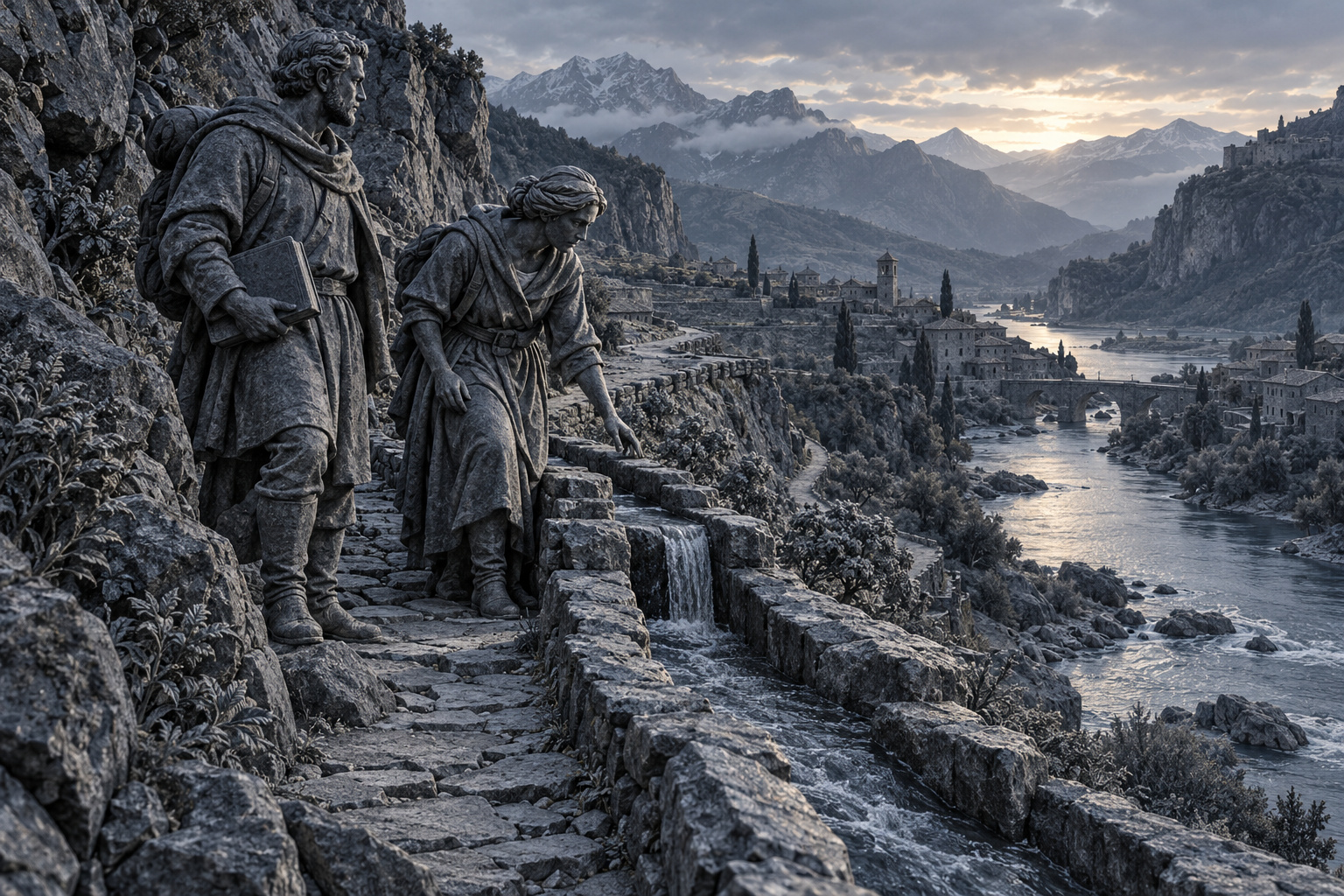
Epigraph
“a gift of the river”.
Herodotus, The History of Herodotus, II.5, a fragment describing the part of Egypt reached by Greek shipping. G. C. Macaulay’s named historical English translation; the Russian version is our own rendering through Macaulay, without Greek collation. The image expresses the river’s role in forming land, rather than a conscious intention to give it to people.
What this article is about
A place can seem like a stationary stage on which people make decisions. Yet a river, bank, soil, or route can change available actions, the effort they require, and a project’s consequences. People, in turn, alter channels, allocate water, and sustain places’ meanings. Landscape can therefore be considered a participant in history, provided the image is made precise: participation in relationships does not establish conscious will. We will compare selected accounts by Herodotus and Thucydides with NASA’s explanatory feature on the Aral Sea and UNESCO’s cultural-landscape framework. These are different genres with different grounds for knowledge. An invented local-history notebook will help distinguish a natural condition, human decision, material trace, and cultural meaning. The distinction enriches a place’s history without making geography a people’s destiny, old testimony a present measurement, or an attractive view evidence of origin or everyone’s shared memory.
I. Participation Does Not Require a Conscious Agent
Imagine Mira preparing a teaching notebook about an invented settlement beside a river. Its first page shows a bank, an old slope down to the water, and a terrace. The caption says: “The river decided where people should live.” A useful question has been joined to an unnecessary attribution. Water, the bank’s height, and a possible crossing may have mattered. The drawing establishes neither a river’s decision nor why actual people would have chosen this particular place. Mira can retain the question while revising the caption: “Which conditions of this bank might have mattered to the choice of a settlement?” The illustration then begins an inquiry instead of supplying its answer.
Calling landscape a participant concerns relationships in which physical properties have consequences. It does not make a bank a person. A route’s accessibility or a change in water can be discussed without attributing desire or explaining the whole of history through it. Human actions involve goals, agreements, knowledge, and unequal opportunities. A condition connects with those through a particular step: how did it enable, obstruct, or change an action? Without that step, “influence” remains a general frame. It can conceal missing evidence as readily as excessive personification does. Participation needs a concrete meaning: a process, time, and identification of those for whom the consequences mattered.
Mira separates three notebook sentences. The first describes an assumed property of the place. The second proposes a hypothesis about its human use. The third concerns how participants might have evaluated the result. This is an author-created teaching construction, rather than the recovered history of a real settlement. Separating the sentences reveals where a map, document, account, or chronological evidence would be needed. It also retains room for choice. Even an important condition does not determine a single human response. The river can enter an explanation in its physical role, while people enter with decisions and limited knowledge. Participation then reveals connections instead of replacing them with one voice of nature.
II. The Land Can Have a History of Formation
In II.5 Herodotus calls the land a gift of the river and connects his conclusion with visible indications. A priestly report precedes it; what the author judges is distinguishable from what he has been told. We read the selected historical argument through Macaulay, rather than a complete modern account of delta formation. The shift in the question matters: land becomes more than a surface for actions and acquires a history of formation. If a place changed before a particular human project, one description of its current form cannot reveal every earlier possibility. An assertion needs a time and a basis for the proposed change.
Mira can draw two hypothetical bank lines and put different dates beside them. The dates and lines in our notebook are invented, however. They do not become historical evidence simply by appearing on a map. The origin of each line needs clarification: is it a present contour, reconstruction, or illustration? We then need to ask what changed and what people could access during that period. An old route to the water cannot be explained solely by its present distance from the bank. Several histories of change may be possible; selecting among them would require evidence about the place. The distinction establishes none of them, but prevents one period from silently substituting for another.
Land formation should also be distinguished from human access. Even if a natural process created a surface, that does not determine who could work there, how it was used, or what people considered theirs. In the drawing, the terrace can enter different assumed actions; they cannot be deduced from its height alone. Natural conditions and human use belong to different parts of the explanation. The image of a gift makes dependence visible, but allocates no rights, credit, or duties. If that metaphor is retained, a concrete account should accompany it: which change in the land is being discussed, and which human question remains unanswered?
III. A Resource Works Through Human Relationships
In the selected opening of Book I, Thucydides connects population movements, fertility, individuals’ growing power, internal conflict, and invasion. This is his retrospective explanation of early Hellas, with an explicit qualification about knowing the distant past. We do not turn it into a rule that good soil always brings war and poor soil peace. For our question, the natural advantage passes through human relationships in the account. Fertility does not simply give everyone equal prosperity. The author introduces ways power, conflict, and movement develop. The land’s participation is mediated. Those steps belong to the explanation and should not be reduced to a single geographical property.
Mira draws one convenient terrace and two imagined uses. In the first, access is shared among participants; in the second, one group retains use for itself. These invented alternatives establish nothing about a real settlement. They demonstrate a logical distinction: the same condition can enter different decisions. Recovering an actual history would need evidence about who could act, the restrictions they faced, and changing relationships. Calling land fertile is insufficient to establish a society’s organisation. Calling conflict fertility’s sufficient consequence is also unjustified when the proposed steps remain assumptions hidden inside a confident general term. The drawing can disclose those missing steps instead of pretending to supply them.
This reasoning does not remove natural conditions from history. It identifies human mediation. An available resource can change possibilities and the subject of a dispute; the way it is used determines other consequences. An overall result needs both levels connected through particular evidence. A more precise question becomes available: who benefited from the selected use, and how did it relate to others? The answer cannot be read in advance from the terrain. Terrain should not be treated as irrelevant merely because it fails to explain everything. A limited condition can matter while remaining part of a cause, rather than the sole author of human history.
IV. People Change the Conditions of Later Decisions
NASA’s Aral Sea feature describes river-water diversion for irrigation and changes documented through a named satellite series. The direction of the connection reverses: a human project changes subsequent environmental conditions. The entire explanatory body was read. This is an official institution’s observation feature, rather than our own analysis of raw satellite data. Its series concerns 2000–2018 and the preceding diversion history; it does not establish today’s water level. The selected example retains a feedback relationship. A place’s state affects people’s possibilities, while people’s actions become part of the conditions encountered by later participants. Both directions belong in the question.
Mira adds an upstream channel above the old slope. Its construction and consequences remain hypothetical. Calling it useful does not establish that the whole system improved. We need to specify the action supposedly helped, where flow changed, and the other areas connected with it. The same project may have different questions at its entrance and exit. An explanation that stops at its initiator’s convenience risks losing later links. An actual project would require specialist investigations and decisions. Our subject remains the quality of a historical explanation, without recommendations to build anything or alter a river. The imagined channel reveals a question about consequences, rather than answering it for an actual place.
A changed environment can retain the trace of a decision after its original task is no longer discussed. A place’s history consequently belongs to a new inquiry. A current condition should not automatically be called an original natural given. We must ask which actions may have contributed to it. A trace, however, identifies neither everyone involved nor their intentions. Beside the channel, Mira keeps separate notes for its presumed purpose and presumed consequence. They need not match. Distinguishing them makes feedback visible without justifying every alteration or concluding that human action always causes harm. The explanation becomes more particular, rather than adopting a verdict in advance.
V. Scale Changes the Evaluation of an Outcome
NASA’s feature separately considers northern and southern water bodies. The described dam retains water in the north while limiting onward flow towards the south. This is a particular distinction within the reported period, rather than a present policy assessment or water-management instruction. It shows why an overall slogan of improvement or disappearance can conceal scale. A change in one part need not report an identical outcome throughout a system. A consequence needs its subject, location, time, and relevant area named. Otherwise, even a genuine change can acquire a caption wider than its evidence supports. The boundary concerns what the material establishes, rather than the emotional force of its description.
Mira returns to the invented channel. Easier access to water at one slope does not establish equal opportunity for every hypothetical participant. Assumed results upstream and downstream can be described separately. No damage has been measured and no conflict established here; we are separating questions. A real place would need evidence about flow, use, and the people to whom the conclusion applies. Historical writing benefits from retaining such boundaries even after finding a convincing document about one side of a project. Strong testimony about one part should not automatically answer for areas it does not address. The notebook makes those distinct areas visible rather than making their outcomes identical.
This permits a substantive evaluation without a premature final verdict. One result can be acknowledged while another question remains open. A condition under which an action made sense can be identified without declaring it useful for every period. Different consequences can be discussed without reducing people to one shared interest. Landscape enters history through particular connections; human evaluation retains its speaker and criterion. Instead of one arrow labelled “better”, the notebook gains several bounded assertions. Together they do not supply a ready-made decision. They show which information is needed before a local result can become an overall story about the place.
VI. Material Form and Continuing Work Are Different
In II.99 Herodotus explicitly changes the account’s frame: he will relate a history heard from others, adding some things he has seen. The priests then recount Min’s alteration of the river and the founding of Memphis; the text also mentions supervision and repair of the bank arrangement. We retain that attribution instead of presenting the account as independently verified modern archaeology. The distinction between construction and conditions of preservation matters. An arrangement made once can remain dependent on later work. Material form can therefore be a historical trace without proving that every initial action continues unchanged or that the reason for its survival is fully known.
UNESCO’s official framework distinguishes, among other things, relict and continuing cultural landscapes. A surviving form is distinguishable from an active social role and continuing process. This is an institutional classification, rather than confirmation of Herodotus’s narrative or a designation for our invented place. The comparison offers different questions for Mira’s terrace. Does only the outline of former use remain? Does a practice continue? Has its meaning changed? A single attractive photograph cannot settle these alternatives. Each needs material relevant to form, action, and time. A category name should not become evidence of every historical step that an author can attach to it.
Something old need not be stationary, and something continuing need not be unchanged. In the notebook, the slope can persist with a different use; a maintained path can acquire a new form. These are invented analytical possibilities, rather than reports of a discovered monument. They avoid two simplifications: treating every trace as an exact copy of the past or every alteration as a complete break. We should specify what remained and what changed. History then gains several temporal layers connected by particular processes. Continuation becomes a question about action and meaning, rather than a necessary promise that the place stayed identical in every respect.
VII. A Place’s Meaning Does Not Replace Causal Explanation
UNESCO also identifies associative cultural landscapes, where religious, artistic, or cultural connections with a natural element matter. Material cultural evidence in this category can be slight or absent. The institution describes a basis of significance within its framework; it proves neither a mountain’s physical will nor everyone’s identical belief. This differs from Thucydides’s explanation involving fertility and population movements. A place can matter through how it is understood, while a causal account of an event needs grounds of its own. Neither question becomes unnecessary. They should simply not answer on each other’s behalf without an explicit basis. Their distinction keeps material effects and human meaning available for examination.
Mira invents a story about returning travellers being welcomed at the old slope. This is not testimony she has received. It distinguishes two possible inquiries: did that practice exist, and what meaning did participants give it? A convenient bank does not establish the story; the story alone does not measure convenience. Actual records could be compared with an account of the place if they became available. For now, both parts are labelled as teaching material. Mira retains the value of asking about memory without presenting imagination as a shared tradition or emotional persuasiveness as evidence of the past. The invented scene supplies a question, not missing witnesses.
Different people can associate different histories with the same place. A particular assertion needs the preserved voice and its period identified. “People always believed” may be too strong when the material concerns one speaker or one document. Limited testimony is nevertheless meaningful. It can report someone’s significance without representing every resident or establishing a causal chain. Readers can retain human memory together with its bearer. Landscape then participates through people’s relations to a place, alongside water and surface. Neither the place nor its population needs to possess one collective consciousness. A limited voice remains audible without being inflated into everybody’s story.
VIII. An Observed Pattern Does Not Reveal Every Cause
In II.19 Herodotus asks about the Nile’s flood and acknowledges that he did not obtain the explanation he sought. In the next selected passage, he tests one proposed explanation by comparing conditions. We do not adopt ancient answers as present hydrology. The boundary between a noticed pattern and an established cause matters. Repetition or change can be visible while relevant processes remain unknown. NASA’s sequence is bounded by named times and an instrument; its explanatory text provides additional conditions. These grounds differ. They cannot be combined as equivalent observations, but they permit a comparison of the steps from a described change to a stronger assertion about it.
Mira places two hypothetical pages of the bank side by side. The difference between pictures does not explain itself. The place may have changed; so may the depiction, season, or maker’s purpose. The notebook contains no actual images or measurements. A real comparison would require dates, origins, accessible scale, and conditions of comparability checked. This asks something of the material without demanding suspicion of everything. A known change can be retained. An open cause should not be completed solely for a convenient story. Making the distinction prevents an observation from being lost when an excessively complete explanation must be abandoned. The uncertainty attaches to a particular step.
A former period must especially be distinguished from the present. An old image can provide good testimony about its time while remaining insufficient for a current conclusion. Dating it makes it more precise. Each hypothetical line in the notebook therefore receives a temporal question of its own. A place’s human history consists of changes, rather than one form transferred to every year. To discuss continuation, we need a connection between periods. To discuss a break, we need to say what stopped. Neither permanence nor complete disappearance should follow automatically from one convincing image whose date and scale have been removed. The period is part of the evidence.
IX. An Account of a Place Can Become Checkable
Mira rewrites the first caption. The river’s decision is replaced by separate bounded sentences about assumed conditions, possible choice, later change, and the slope’s meaning. Each element has an origin marked beside it: explanatory invention, a selected source’s reported conclusion, or an open question. The notebook still is not research into a real settlement, but its language allows examination. Readers can see the material each step would require and where different questions were previously joined by one word. They can assess the story’s attractiveness alongside the relationship between an assertion, its basis, and the boundary its author is prepared to retain. A question can be specific before its answer is available.
This does not require collecting every fact about a place before saying anything useful. A small question and accessible material can be chosen: distinguishing a described form from an assigned purpose, for example, or checking dates on two records. A limited result remains useful if its scope is not silently widened. Conversely, a large collection of pictures can produce a weak explanation when the parts’ origins and connecting steps are unknown. Page count does not replace relationships between pages. One clear question helps determine what needs reading, what can be compared, and which gap remains essential. The unknown becomes particular, rather than hidden behind a confident conclusion about the landscape’s entire history.
In conversation, this preserves respect for others’ knowledge and independent evaluation. Someone may remember a path differently from the selected diagram; a document may describe only part of the actions. They need not be declared opponents or equivalent evidence in advance. Their subjects can be clarified to locate an actual disagreement. Landscape then does not become the conversation’s final judge, as if one visible surface cancelled every human account. It remains an important material participant in the question. People retain responsibility for choosing explanations, handling memory, and limiting conclusions offered to others as knowledge. An unresolved difference can remain visible without being turned into an invented final answer.
X. Geography Offers Conditions, Not a People’s Destiny
Land’s importance establishes neither an unchanging human character nor one necessary social path. Such a step would require evidence our comparisons do not supply. Thucydides’s explanation remains his particular reconstruction; Herodotus’s image retains the selected river role; NASA describes a particular intervention history; UNESCO offers a framework of cultural significance. None licenses ranking people’s dignity by where they live. Mechanisms, decisions, and meanings can be discussed without geographical destiny. Environmental constraints can then remain visible without justifying coercion or necessarily explaining every action already taken, or still to be taken, in the place. A condition’s importance does not make it a complete account of a person.
Human responsibility does not disappear behind “landscape” either. If people chose an action, its physical consequences do not automatically make it nature’s decision. Goals, available information, conditions, and other participants need examination. This promises no easy evaluation of every past project. It clarifies the subject being evaluated. In the notebook, Mira can separately value the bank, acknowledge an unknown history, and ask about intervention’s consequences. These require no single judgement of nature. Attachment to a place can be retained while its description changes with new material. Recognising dependence does not abolish freedom of reflection; freedom does not mean having no conditions.
The result is a history of relationships, instead of a stationary stage or a conscious master. Land can have a formation history; a resource, socially mediated effects; a structure, continuing work; a place, different meanings; a picture, its own period and means of production. Each retains its grounds. The invented slope remains invented, an ancient account remains historical testimony, and a named observation series remains temporally bounded. Landscape participates by entering causal and cultural relationships, rather than speaking for people. Such precision enriches a place’s history and leaves human decision with its own grounds, memory, responsibility, and possibility of revision. The additional detail comes from distinctions the evidence can sustain.
What this means in practice
-
Choose an accessible account of a familiar place: a caption, your note, or a published story. Separate form, its presumed formation history, human action, and meaning for named people. Identify the material’s date and origin. Avoid supplying missing testimony on the narrator’s behalf.
-
For one transition, write a question: how does a condition connect with an action or consequence? Mark what is established, attributed to a source, and your hypothesis. If comparing periods, check whether a present state has been transferred to the past or an earlier one to today.
-
Rewrite one excessive sentence, retaining its useful part and limiting its conclusion. Work on the account, without intervening in a river, monument, or anyone’s memories. This voluntary author-created exercise has no tested efficacy. It is no archaeological finding, engineering, legal, or medical recommendation, and promises no change in your relationship with a place.
Key quotation
“combined works of nature and of man”.
UNESCO World Heritage Centre, Cultural Landscapes, History and Terminology. The selected official English formulation is linked on the page to Article 1 of the Convention. The Russian version is our own rendering, rather than a claimed match with the official Russian Convention translation. It confers no designation on any illustrated place.
Connections between traditions
-
Land formation — human alteration of flow. Herodotus, II.5, the river’s gift; NASA, diversion and the satellite-sequence passages. Distinguish causal directions: conditions enable actions, and actions change later conditions. The historical image supplies no complete hydrology; the selected Aral period describes no universal history of intervention.
-
A resource — human allocation. Thucydides, the early Book I argument about fertility and migration; NASA, diversion and the difference between northern and southern water bodies. Consequences pass through decisions and scales of use. A particular reconstruction does not become every society’s destiny; one part’s outcome does not represent every participant.
-
A maintained arrangement — a documented change. Herodotus, II.99, the testimony frame and channel/repair account; NASA, the named observation series. A place has a history of actions and conditions being retained. A priestly account and instrument-based explanation have different grounds; neither automatically confirms the other.
-
A material trace — continuing practice. UNESCO, relict and continuing landscape categories; Herodotus, II.99, later work. Distinguish surviving form from active action and meaning. An institutional category does not verify an ancient account or formally designate an invented terrace.
-
A cultural connection — causal reconstruction. UNESCO, the associative category; Thucydides, the selected land and migration account. A place’s significance and its consequences ask different questions. Someone’s story establishes neither a place’s physical will nor everyone’s shared belief; an ancient argument is not complete present archaeology.
-
A noticed pattern — a dated sequence. Herodotus, II.19–20, the flood question and explanatory boundary; NASA, the series’ period and changing water bodies. Retain observation, cause, and time separately. Ancient answers supply no current hydrology; a former sequence supplies no present water-level report.
Primary sources
-
Herodotus. The History of Herodotus, Book II. G. C. Macaulay’s named historical English translation, volume I. The complete selected II.5, II.19–20, and II.99 passages were read with nearby framing. The Russian epigraph is our own rendering through Macaulay, without Greek collation. Priestly report, authorial judgement, and an open causal question are distinguished. Neither the entire book nor modern independent archaeological verification is claimed.
-
Thucydides. The History of the Peloponnesian War, Book I. Richard Crawley’s named historical English translation. The complete selected early argument on migration, land use, fertility, invasion, and Attica was read with the author’s remote-past qualification. Neither whole-work reading nor Greek collation is claimed. This is the author’s historical reconstruction, rather than a universal law of societies’ geographical origins.
-
NASA Earth Observatory. World of Change: Shrinking Aral Sea. Official English explanatory feature with a named Terra/MODIS series for 2000–2018. Its complete main text on diversion, changes, and different water bodies was read. Raw data, complete linked studies, and present levels were not checked; independent image measurement is not claimed. The material supplies no medical or engineering advice.
-
UNESCO World Heritage Centre. Cultural Landscapes. Official English page; the complete selected History and Terminology and Categories and Subcategories passages were read. This is an institutional framework of meaning and classification. The entire Convention, current complete guidelines, and individual site assessments were not read. The Russian key quote is our own rendering of the English fragment. No official designation is assigned to the invented place.
Tags
#landscape, #history, #place, #river, #bank, #land, #soil, #water, #conditions, #humanChoice, #feedback, #memory, #meaning, #culturalLandscape, #heritage, #materialTrace, #practice, #migration, #resource, #scale, #period, #observation, #testimony, #explanation, #Herodotus, #Thucydides, #NASA, #UNESCO, #AralSea, #responsibility
About the authors
Andrey Zarinsh is the author and founder of United Wisdom. He explores inner transformation, the unity of traditions, intercultural dialogue, and contemporary spiritual discipline. Instagram: @andrey.zarinsh.
Maria Evilkut is a co-author of United Wisdom. Alongside her research, she seeks to test these ideas in practice and observe how principles of unity and mutual understanding work in real life between people and cultures. Instagram: @ilkutki.
Keep what resonates with you.