
World & consciousness
Plato’s Cave: Education as a Change in How We Look
Plato’s cave, the turning of a capacity and return to the city: distinguishing understanding, confidence, choice and the grounds of education.
Epigraph
“Not all in a moment”.
Plato, Republic, Book VII, Glaucon’s reply after the question about a prisoner brought into sunlight. Exact opening clause of Benjamin Jowett’s English translation; the following comma and reporting clause are omitted. Primary text, the paragraph immediately after the forced ascent from the cave. The Russian companion uses United Wisdom’s own translation from this English version.
What this article is about
We can learn a new explanation while continuing to look at events in the old way. Someone confidently repeats the language of checking information but judges by a familiar voice; another knows a rule yet misses the assumptions behind its application. The cave in Book VII of Plato’s Republic gives us a way to question this gap. What changes when education concerns the way we distinguish objects, signs and reasons for judgement, alongside the answers we possess? We will examine the cave, the difficult ascent, gradual adjustment to light and the return to former companions. Aristotle’s distinctions between capacity, action and choice will then sharpen several questions. Plato’s metaphysical and political commitments remain visible: the Good, a hierarchy of knowledge and educated people’s duty to their city. This reading offers more precise questions about learning, without promising final enlightenment or one path suitable for everyone.
I. The cave is more than one person’s mistake
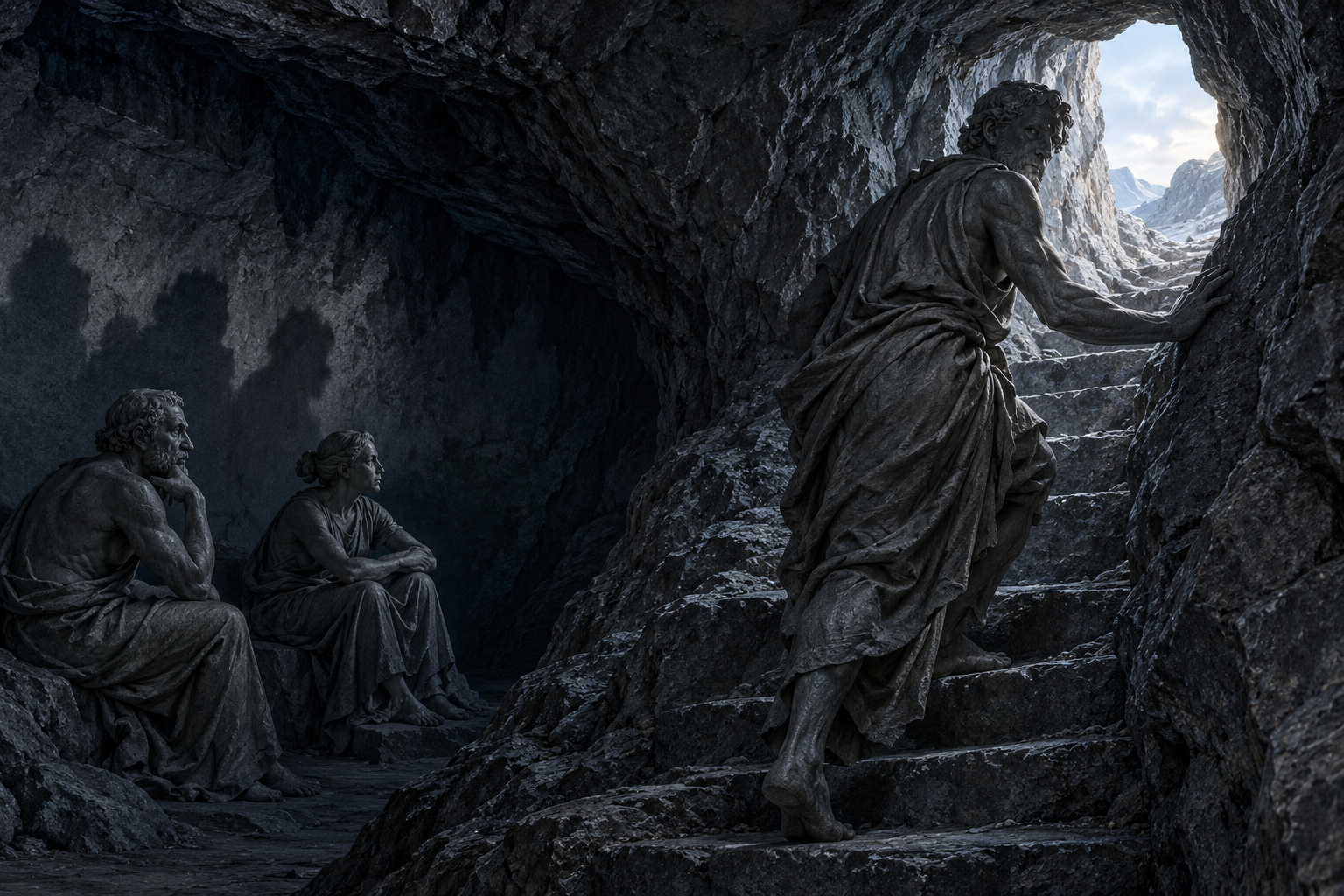
The cave begins with an arranged space in which people can see only part of what happens. In Socrates’ story, prisoners have been bound since childhood so that they cannot turn their heads. A fire burns behind them; people carrying various objects pass between the fire and the prisoners. Shadows fall on the wall within their view. The important elements include the shadows and the relations between light, carried objects, a barrier and the observer’s position. What appears has conditions of appearance that the prisoner cannot yet see.
This gives us a starting point for our own reasoning about learning. Suppose an employee receives a table rating a department’s performance. They can see a number but do not know which cases were excluded, what was measured or why the calculation changed. The number may contain no arithmetic error. Understanding its significance nevertheless requires examining how it was produced. This is an invented example distinguishing a measure from what it is meant to represent, rather than modern evidence for Plato’s account of reality.
Words also enter the cave. Socrates asks whether the prisoners would give names to the shadows and treat those as the things they discuss. An agreed vocabulary therefore need not imply an understanding of how the named appearance arises. We may understand a colleague perfectly when they speak of the department’s success while both overlooking the construction of its rating. Communication functions within an established frame; the frame itself remains outside the conversation.
There is also an echo. A passing person’s voice can seem to belong to a shadow. The mistake now concerns the attribution of an action as well as the appearance of an object. The first educational question is consequently broader than whether a statement is correct: what connections am I adding to what I observe, and how could I check them? Asking this does not require declaring our world a deception. We can begin by separating an observation from an explanation of its appearance.
II. Predicting successfully leaves another question open
A skill can work well within a limited setting while leaving that setting poorly understood. Socrates describes the honours the prisoners might award to someone who remembers the order of shadows and predicts what will appear next. Such a person need not be incompetent. They attend carefully to the available sequence and have mastered local rules of recognition. The image questions whether that success is sufficient, while allowing us to recognise the genuine skill involved in noticing patterns.
Imagine two students. One quickly selects a formula from a familiar-looking problem; the other asks why this particular quantity matters. The first may achieve a better result in a standard exercise. This alone does not establish who understands the subject better. We need to know what the task required and how each reasons when its conditions change. Speed, understanding the grounds of a solution and transferring a method are different properties. One score should not silently stand for all three.
Plato’s scene adds a social tension. Recognition reinforces what counts as worthy of attention within the cave. A person who asks about the origin of the shadows may lose the time needed to compete at predicting them. The image makes the cost of changing a question visible: a familiar criterion of success loses its exclusive authority. It does not establish that every reward damages education or that a confident expert must be mistaken.
It is more useful to distinguish two levels of checking. First, does a person act correctly under known conditions? Second, do they understand the conditions that make the action correct? Sometimes the first level is sufficient, as when carrying out a clear, limited procedure. Elsewhere the procedure itself needs reconsideration. Education can extend our ability to ask the second question while preserving the value of the first. Without that distinction, a critical outlook can easily become contempt for practical competence, although the argument gives us no reason for such contempt.
III. The ascent is not presented as a gentle conversation
Release in Socrates’ story is painful and involves compulsion. The prisoner is made to stand, turn their head, walk and look towards the light; later they are dragged up a difficult ascent. They suffer, resist and find the old shadows more intelligible than the objects now shown to them. Removing these details would produce a comfortable story about personal growth but alter the text. Plato connects a change of vision with conflict between habit, an understanding of truth and an external demand.
Socrates asks what would happen if the released prisoner were required to answer questions about unfamiliar objects. Confusion is likely. The earlier clarity has disappeared before a new clarity has emerged. The important distinction concerns familiarity and the grounds of confidence. Something easy to recognise may seem more trustworthy precisely because a person has long known how to deal with it. Ease of recognition does not settle how well its object is understood.
A contemporary application requires its own choice of means. The prisoner’s pain does not show that teachers should humiliate students, that resistance proves a guide right or that every difficulty marks progress towards truth. Those conclusions need support that the allegory does not supply. We can voluntarily reconsider a rule, receive an explanation and acknowledge an error without violence. That would be our approach to the question, rather than a faithful enactment of Plato’s release.
The difference matters especially when a teacher feels certain about the direction of the turn. Who checks the teacher’s own view? How can the student object? How are useful difficulty and pointless pressure distinguished? The scene does not answer every such question about education today. It makes those questions necessary if we want to use the image responsibly. Acknowledging the historical severity of the argument keeps it open to discussion, instead of letting an attractive metaphor of light justify any method of teaching in advance.
IV. A new view does not make everything visible at once
The upper world becomes accessible gradually. The released prisoner can first distinguish shadows, then reflections of people and things in water, and later the things themselves. The night sky and its lights become available; only afterwards can they look at the sun. Glaucon’s reply in the epigraph concerns immediate sight after leaving the cave. Its meaning belongs to adjustment to changed conditions. It makes no promise that every period of waiting must end in knowledge.
The sequence changes the supports available to the observer. A reflection differs from an object, night light from daylight, and seeing from subsequent reasoning about what makes visible things possible. Socrates does not describe one sudden jump from total error to total clarity. The image moves through intermediate relations to an object. It allows us to consider how someone can notice more while still being unable to connect what they see into an explanation.
Suppose a beginning editor has judged writing mainly by its confident tone. They then learn to check quotations, sources, the reach of a conclusion and the relation between an example and a claim separately. At first those questions slow their reading. They notice more distinctions but cannot yet use them fluently. We can discuss the development of new criteria here without identifying the example with Plato’s ascent towards the Good. This is a limited task whose results others can check.
Gradual adjustment also leaves the direction open to assessment. A person can spend a long time becoming familiar with a mistaken explanation. Questions about time therefore need questions about reasons: what has become easier to distinguish, what new checks are possible, and which previous confusion has been removed? Patience can then mean continuing intelligible work. If every doubt is explained by the student’s lack of readiness, however, the adjustment stage becomes a way to postpone scrutiny of the teaching indefinitely.
V. Plato’s sun is more than a symbol of feeling better
Socrates interprets the cave within a particular philosophical account. The visible world corresponds to the underground dwelling, and the ascent to the soul’s movement towards the intelligible. The Good occupies the highest position in the explanation. Within this framework it is connected with truth, reason and just action. Readers can examine, accept or challenge the argument. They should not quietly replace its commitments with the broad term clarity.
The difference matters. In an ordinary situation we might call checking a timetable, correcting a calculation or discovering an omitted condition a clarification. Plato discusses a stronger change in the grounds of knowledge and life. Turning his Good into a pleasant sense of confidence removes the question of why it should guide right action. Subjective conviction takes the place of a philosophical ground, although the text does not propose that identification.
We can preserve a useful distinction without accepting the whole metaphysics. For example, we can ask whether our confidence differs from the quality of our reasons for a decision. If I am convinced a plan is good, what makes it good for those involved? Which aims are compatible, which costs are distributed unequally, and which objections remain unanswered? This is our application of a question about the grounds of evaluation. It remains open to debate and claims no access to a higher order of being.
Such a reading leaves two levels available. Historically, we understand the role the Good plays in Socrates’ account. In our own setting, we choose which questions can develop our reasoning. There is interpretive work between these levels, rather than a ready-made bridge. The cave then ceases to be a universal seal by which a favourite idea can be declared light and disagreement darkness. Its philosophical force survives when its underlying commitments remain visible.
VI. The capacity to learn differs from its direction
Education in Socrates’ account turns a capacity already present in the soul, rather than placing sight in blind eyes. This is one of the passage’s best-known thoughts, but it can easily be expanded into a claim that is absent here. Having the capacity to learn does not mean someone already knows every answer, has no need for information or can only be hindered by a teacher. The issue is the capacity’s direction and what becomes its object.
Socrates continues with an example of a clever but bad person. Their vision may be sharp; the problem concerns what it serves. Taking that distinction seriously means that being well educated no longer automatically means being morally trustworthy. Someone may understand a process thoroughly and use that understanding for an unjust purpose. Skill makes an action more effective, but does not itself choose a worthy end. Evaluating a capacity and evaluating its use require separate conversations.
Aristotle also distinguishes outward results from the grounds of action in Book II of the Nicomachean Ethics. Chapter 4 considers conditions for the action of a virtuous person: knowledge, choosing the action for itself and a stable disposition. This is a different argument focused on ethical character. It nevertheless sharpens our question: is presenting a correct answer enough, or do we need to know why someone chooses it? Matching results do not give us a complete account of action.
Suppose a participant corrects a misquotation during a discussion. They may seek accuracy, want to humiliate an opponent or hope to appear attentive. The correction can be useful under different motives, while the quality of the relationship and the choice of a next step may differ. There is no need to guess someone’s inner life from one act. We can discuss the checkable result, their treatment of another person and the stated purpose separately. Capacity and direction then become more precise distinctions than a division between people who know and people who do not.
VII. Practice shapes action, but repetition does not ensure quality
A changed orientation needs expression in action if it is to become more than a statement of intention. Aristotle begins Book II by distinguishing what is given by nature from what is acquired through habit. His argument connects character with particular actions. He compares good and bad performance in a craft: sharing the name of an activity does not imply equal quality. This is why a teacher and the way a person acts from the beginning matter in his account.
The comparison does not make Plato and Aristotle the authors of one educational programme. The former directs the soul’s turning towards a particular order of being; the latter discusses the formation of ethical dispositions. Both texts nevertheless allow us to separate capacity from its exercise. We can be able to learn and still reproduce a familiar mistake. We can practise extensively and reinforce an action that poorly fits its task. The number of repetitions cannot replace a question about what is being repeated.
Consider our invented editor again. If they only check whether a link is present every day, the habit may remain superficial. A further question concerns the source’s role: does it contain the relevant claim, does the conclusion stay within the passage read, and is an illustration being distinguished from evidence? The object of the action changes here, alongside any change in its frequency. Even a small check becomes more substantial when it removes a particular confusion. The new distinction can then be tested in another text.
Still, every stable skill should not be called a moral virtue. Aristotle considers choice and character, while our example concerns limited work with information. Its value lies in clarifying the relation between activity and the quality of activity. A teacher can point out a distinction, examine an unsuccessful attempt and propose an accessible next step. Dependence on the teacher can decrease when the student understands the grounds of checking, rather than merely learning to guess which answer earns approval.
VIII. Confusion can have different directions
The same visible uncertainty does not tell a person’s whole story. Socrates distinguishes disturbed vision when moving from darkness into light from disturbed vision on returning to darkness. Someone observing a confused speaker should consequently ask where they have come from. Within the allegory, that distinction depends on Plato’s hierarchy. It still raises a question for hasty evaluation: what transition lies behind the difficulty we can see?
One person cannot answer because they do not know a word’s meaning. Another has noticed ambiguity in the question and cannot yet select an answer. A third understands the subject but is unfamiliar with the task’s format. These invented cases may look similar while requiring different kinds of help. Explaining a term, clarifying a premise and introducing a format address different difficulties. Treating every pause as a lack of capacity removes those distinctions before learning begins.
Aristotle supplies a different limitation in Chapter 2 of the same book. An account of actions cannot have the precision of an unchanging formula under every circumstance. The acting person must attend to the particular case. Comparing the passages keeps the conditions of judgement in view. It does not turn the philosophical texts into a method for diagnosing students. We still need to establish what has been asked, what information is available and what the person is trying to do, rather than attribute an explanation that happens to suit us.
This applies to judging ourselves too. After discovering a new criterion we may temporarily answer more slowly because there are further distinctions to consider. Slowness itself does not demonstrate depth. A more precise question is whether we can name an obstacle, explain its role and suggest how to check it. That leaves room both for genuine ignorance and for useful complication of a task. We can look for a next step without treating confidence or confusion as a final verdict on our capacity to learn.
IX. Returning makes education a political question
The cave’s story does not end with the released person’s private wellbeing. On returning, they distinguish shadows poorly, appear ridiculous to those who have retained their familiar skill and may encounter hostility. The story even raises the prisoners’ willingness to kill someone trying to release others. That indicates the depth of the conflict between an established world and interference with it. Reducing the return to advice about patiently explaining a new idea would weaken the reading substantially.
A further conflict then appears. Those who have ascended to contemplation may prefer to remain there. Yet the founders of the city under discussion must require them to return and take part in ruling. Glaucon asks whether this would be unjust to them. Socrates answers in terms of the whole city’s good and the education it has provided. Personal preference, received assistance and political obligation become connected, while the connection remains part of an argument.
Aristotle’s opening discussion of habit in Book II also refers to legislators and the education of citizens. The comparison shows the public scale of these ancient accounts of education. Their tasks differ, however: Plato’s passage concerns rulers’ particular preparation and duty to serve, while Aristotle’s concerns character formed through citizens’ practice. Neither of these particular texts establishes a contemporary teacher’s right to direct a student’s life.
For a reader today, a substantial question about the responsibility of knowledge remains. If I understand a process better than others, what duties follow, and who can justify them? Sharing an explanation, making conditions accessible and accepting scrutiny of one’s own position are possible answers in a particular situation. They require attention to people’s roles and agreement. The cave helps us pose the question but gives no general permission to compel others towards what we consider the correct view.
X. We can discuss changed vision without ranking people as light and darkness
A powerful metaphor obstructs reasoning when it assigns everyone’s role beforehand. If I declare myself outside the cave and another person its prisoner, their objection can easily lose significance. Disagreement begins to confirm my account regardless of its content. An image intended to question the grounds of knowledge becomes a defence against that question. My position is exempted from scrutiny by the very word liberation.
We can use the image differently by applying it first to our own position in a particular matter. What do I observe directly? What do I know through another person’s report? Which signs can I recognise, while not understanding how they appear? What would moving to the next level of checking require? These questions do not arrange people according to an overall spiritual height. They distinguish ways of approaching one subject in which every participant may find both knowledge and a gap.
Suppose two people disagree about the quality of learning. Instead of accusing each other of blindness, they can clarify their criteria: retaining material, solving independently, understanding an explanation and selecting an appropriate task. They can then ask which observations are available for each criterion. Agreement need not follow. The subject of disagreement changes, however: an overall assessment of someone’s person becomes several questions that can be discussed separately. That is already a substantial change in how they look at the disagreement itself.
We return, then, to the opening gap between a learned explanation and a familiar way of seeing. Learning the words of the cave does not necessarily change the question guiding us. A first step may be noticing a condition previously hidden behind a confident answer. The next is giving that condition a place in the explanation and allowing someone else to check it. Plato’s path leads towards the Good and service to the city. Our limited conclusion concerns clearer attention to the grounds of judgement and willingness to discuss the direction of our own skill.
What this means in practice
If you want to apply this reading, choose one small question to which you already have a confident answer: why a workplace decision counts as successful, what an assessment means or why you trust a message. Start where checking is accessible and no important decision has to be made immediately. Neither danger nor humiliation is a condition of this work.
Write down the answer first, then its grounds separately. Distinguish three things: what you observed, what another person told you and what you added through your explanation. For example, a result in a table is observed; the compiler supplies information about its calculation; a conclusion about why it increased may be your hypothesis. If two of those descriptions merge, you have a particular place to clarify. There is no need to doubt everything in order to notice one unsupported transition.
The next step is to find a check for that transition. You could ask about an assessment criterion, compare original entries, read a passage from a source or construct a simple changed case. If a rule works only under certain conditions, name them. Following the check, alter the answer as far as the new information warrants. Saying that you cannot yet determine the cause can be more accurate than replacing one confident story with another.
If you are helping someone else learn, establish where the difficulty arose. Avoid rushing to explain it as unwillingness to see the truth. A word may be unclear, the original material unavailable, or several questions may have been asked at once. Offer one accessible step and room to object. Explaining the direction and criteria makes the quality of the help discussable; pressure without such grounds merely changes the distribution of power.
Finally, return to the chosen answer and see what actually changed. Did you learn a fact, distinguish two concepts, limit a conclusion or notice another person’s interest? Those are different results. You can stop with one. This practice is a way to examine your judgement attentively, rather than a tested learning programme or a promise of attaining Plato’s Good. Its possible consequence is more modest: a subsequent conversation may rest on clearer reasons alongside the confidence you already recognise.
Key quotation
“the power and capacity of learning exists in the soul already”.
Plato, Republic, Book VII, Socrates’ account of education as turning a capacity. Exact internal clause from Benjamin Jowett’s English translation. The carrier’s singular exists is retained; the quotation is a sentence fragment, not a complete aphorism. Primary text, paragraph beginning “Whereas, our argument shows that”, followed by the comparison between turning the eye and turning the whole body. The Russian companion uses United Wisdom’s own translation from English.
Capacity in this passage does not mean already possessing completed knowledge. The quotation preserves the question of its direction that continues the discussion of education.
Connections between traditions
1. Turning a capacity and exercising a capacity. Plato’s Book VII passage comparing the turning of eye and soul concerns the direction of an existing capacity. Aristotle’s Nicomachean Ethics II.1 distinguishes natural capacities from ethical dispositions acquired through action. Both let us ask separately about a possibility and its exercise. Plato’s movement towards being and Aristotle’s formation of character nevertheless have different aims; the comparison establishes neither a shared psychology nor historical influence.
2. Difficulty of ascent and the relation to pleasure. In Plato’s release sequence, the prisoner suffers, resists and gradually adjusts to new light. Aristotle connects character with pleasure and pain in Nicomachean Ethics II.3. The similarity concerns an orientation affecting what seems attractive or burdensome alongside verbal answers. Allegorical pain and the ethical education of feeling neither prove suffering necessary for all learning nor describe a neural mechanism.
3. A sharp mind and the grounds of choice. Plato’s clever but bad person in Book VII separates acuity from the purpose it serves. Aristotle’s II.4 distinguishes the outward appearance of an act from the agent’s knowledge, choice and stable disposition. The pairing develops questions about competence and the direction of action. These are different normative arguments, and they do not let us diagnose another person’s intentions from one result.
4. Two transitions and a particular case. Socrates distinguishes confusion on entering light from confusion on returning to darkness in Book VII. Aristotle’s II.2 limits the precision of a general account of action and requires attention to the case. Both make context relevant to assessment. The image of transition belongs to Plato’s hierarchy of knowledge, however, while the restriction on precision belongs to Aristotle’s ethics; together they do not form a tested method of assessing students.
5. Returning to the city and educating citizens. Plato’s discussion of prepared rulers’ return connects education to the whole city’s good and compulsory service. Aristotle’s II.1 discusses legislators forming citizens’ habits. Both take education beyond individual satisfaction. The preparation of a particular ruling group differs from education through civic practice; compulsion in Plato’s construction remains visible and grants no contemporary permission for a teacher to govern a student’s life.
6. The art of turning and the quality of exercise. Plato’s Book VII account concerns the art of directing a capacity. Aristotle’s examples of good and bad performance in II.1 make the quality of repeated action and the teacher’s role significant. The connection distinguishes help with a subject from simply increasing the amount of exercise. Metaphysical turning and ethical formation remain different; these passages establish no modern programme’s effectiveness.
Primary sources
- Plato, Republic, Book VII, English translation by Benjamin Jowett. Primary philosophical dialogue. The complete opening sequence concerning the cave, the soul’s turning and return to civic duties was used; part of the subsequent discussion of mathematical education was also read. Neither the entire dialogue nor the remainder of Book VII is claimed as read. The exact printed edition underlying this web transcription is unestablished; quotations in the Russian companion were translated from this English carrier.
- Aristotle, Nicomachean Ethics, Book II, English translation by W. D. Ross. Primary ethical philosophy. Comparisons use fully read Chapters 1–4 on habit, circumstances, pleasure and the conditions of virtuous action. This is a normative argument rather than a modern experimental study of learning.
Tags
Plato, Republic, cave, Socrates, Glaucon, Benjamin Jowett, education, learning, changed perspective, shadows, echo, representation, object, intermediary, grounds of knowledge, Good, intelligible, capacity, direction of capacity, practice, Aristotle, Nicomachean Ethics, habit, choice, character, pleasure, confusion, context, political responsibility, return, teacher’s role, checking judgement
About the authors
Andrey Zarinsh is the author and founder of United Wisdom. He explores inner transformation, the unity of traditions, intercultural dialogue, and contemporary spiritual discipline. Instagram: @andrey.zarinsh.
Maria Evilkut is a co-author of United Wisdom. Alongside her research, she seeks to test these ideas in practice and observe how principles of unity and mutual understanding work in real life between people and cultures. Instagram: @ilkutki.
Keep what resonates with you.